R E S E A R C H A R T I C L E
Open Access
Registration of published randomized trials:
a systematic review and meta-analysis
Ludovic Trinquart
1*, Adam G. Dunn
2and Florence T. Bourgeois
3,4Abstract
Background:Prospective trial registration is a powerful tool to prevent reporting bias. We aimed to determine the extent to which published randomized controlled trials (RCTs) were registered and registered prospectively.
Methods:We searched MEDLINE and EMBASE from January 2005 to October 2017; we also screened all articles
cited by or citing included and excluded studies, and the reference lists of related reviews. We included studies that examined published RCTs and evaluated their registration status, regardless of medical specialty or language. We excluded studies that assessed RCT registration status only through mention of registration in the published RCT, without searching registries or contacting the trial investigators. Two independent reviewers blinded to the other’s work performed the selection. Following PRISMA guidelines, two investigators independently extracted data, with discrepancies resolved by consensus. We calculated pooled proportions and 95% confidence intervals using random-effects models.
Results:We analyzed 40 studies examining 8773 RCTs across a wide range of clinical specialties. The pooled proportion of registered RCTs was 53% (95% confidence interval 44% to 58%), with considerable between-study heterogeneity. A subset of 24 studies reported data on prospective registration across 5529 RCTs. The pooled proportion of prospectively registered RCTs was 20% (95% confidence interval 15% to 25%). Subgroup analyses showed that registration was higher for industry-supported and larger RCTs. A meta-regression analysis across 19 studies (5144 RCTs) showed that the proportion of registered trials significantly increased over time, with a mean proportion increase of 27%, from 25 to 52%, between 2005 and 2015.
Conclusions:The prevalence of trial registration has increased over time, but only one in five published RCTs is prospectively registered, undermining the validity and integrity of biomedical research.
Keywords:Randomized controlled trials, Registration, Reporting bias
Abbreviations:ANZCTR, Australian New Zealand Clinical Trials Registry; CT.gov, ClinicalTrials.gov; FDA, Food and Drug Administration; FDAAA, Food and Drug Administration Amendments Act; ICMJE, International Committee of Medical Journal Editors; ISCRCTN, International Standard Randomised Controlled Trials Number; IF, impact factor; PEDro, Physiotherapy Evidence Database; RCT, randomized controlled trial; SR, systematic review; WHO ICTRP, World Health Organization International Clinical Trials Registry Platform
* Correspondence:[email protected]
1Department of Biostatistics, Boston University School of Public Health,
Boston, Massachusetts, USA
Full list of author information is available at the end of the article
Background
Prospective clinical trial registration is at the foundation
of research transparency [1, 2]. By documenting the
ex-istence of clinical trials and providing a summary of protocol details before patients are enrolled and trial re-sults become known, registries can prevent unnecessary duplication of trials, facilitate the identification of re-search gaps, and support coordination of study efforts
for a disease [3]. As registration allows public scrutiny of
the availability of trial results, it also provides means to identify and monitor biased reporting of trials. Several cases have highlighted how selective reporting can lead to considerable harm to patients. Rofecoxib, a nonsteroi-dal anti-inflammatory drug, was found to be associated with increased risk of myocardial infarction as early as 2000, but the primary trial publication selectively omit-ted findings on cardiovascular safety, and rofecoxib was not withdrawn from the market until several years later,
in 2004 [4,5]. Incomplete trial reporting can also lead to
considerable waste of resources, as has been seen in the
case of oseltamivir [6] or gabapentin [7,8] with billions of
dollars spent despite poor evidence of efficacy. Prospective
trial registration—if universally implemented—can serve
as a powerful tool to detect and prevent this type of
publi-cation bias and selective outcome reporting [3,9–11].
The International Committee of Medical Journal Editors (ICMJE) announced in 2004 a requirement for prospective registration of clinical trials as a pre-requisite for consider-ation for publicconsider-ation in its member journals, beginning
the following year [2]. In the USA, the Food and Drug
Ad-ministration Amendments Act (FDAAA) has mandated prospective trial registration with ClinicalTrials.gov since 2007 for drugs, biologics, and devices subject to Food and Drug Administration (FDA) regulation. The requirements for registration and result posting have recently been expanded with the FDAAA Final Rule and a similar
policy by the National Institutes of Health [12, 13].
Other countries and funders have implemented
simi-lar policies [14, 15].
The clinical trial research community has widely adopted trial registration, and trial registries have been
leveraged to monitor research activity and integrity [16–
18]. For example, trial registration data have been used
to show that the results of registered trials are frequently not disseminated, either through reporting in biomedical
journals or posting on ClinicalTrials.gov [19, 20].
How-ever, several studies in specific medical specialties have suggested that many published trials are not registered or not registered prospectively, raising concerns that long-standing efforts have not succeeded in achieving
universal trial registration [21–23]. Our objective in this
systematic review was to determine the extent to which published randomized controlled trials (RCTs) were reg-istered and regreg-istered prospectively.
Methods
Search and study selection
Studies were eligible if they were based on a sample of RCTs identified in published reports in medical journals and evaluated their registration status. All eligible stud-ies across medical specialtstud-ies were included. Studstud-ies not limited to RCTs were not eligible, unless they provided relevant data on registration of the subgroup of RCTs. Studies that determined trial registration only through mention of trial registration in the published article (i.e., the article included the trial registration number in the abstract or main text), but did not further search for in-formation on registration status with either a search for trial records in registries or by contacting the trial inves-tigators to inquire about registration status, were ex-cluded. Lastly, studies that covered a majority of trials published prior to 2005 (i.e., the middle of the range of years covered was prior to 2005) were excluded.
We did not register a protocol for the review. We searched MEDLINE via PubMed and EMBASE without language restriction for studies published between January 1, 2005, and October 31, 2017. The search strategy was (trial[tiab] OR trials[tiab]) AND (registration[ti] OR regis-tered[ti] OR unregisregis-tered[ti]) in MEDLINE and (trial:ti OR trial:ab OR trials:ti OR trials:ab) AND (registration:ti OR registered:ti OR unregistered:ti) in EMBASE. Additionally, we screened all articles that were cited by or that cited any of the included studies and studies excluded after full-text screening, and we screened the reference lists of related
re-views [24–26] for additional eligible studies.
Two investigators screened the titles and abstracts of all records, independently and in duplicate, to identify potentially eligible studies for further assessment. Discrep-ancies were discussed to reach consensus. All authors then independently assessed each remaining full-text article for inclusion. We again reviewed all discrepancies, and the final list of included studies was determined by consensus among all authors.
which we could not completely ensure that there was no overlap from the primary analysis but included the totality of the available data in a secondary analysis.
Data extraction
Two investigators independently extracted data from each included study using a standardized data collection form. Discrepancies were resolved by consensus. For each included study, we extracted the medical specialty, the publication years of included RCTs, the number of journals searched for RCTs, the list of journals (when provided), the number of identified RCTs, and the num-ber of registered RCTs. We also assessed how trial regis-tration was assessed (i.e., through the reporting of a trial registration number in the article, by searching for trial
records in trial registries [27], and/or by contacting
cor-responding authors). We noted which registries were searched and assessed whether studies had included tri-als that started enrolment before 2005, as the ICMJE policy was implemented in September 2005. Moreover, we noted if each study assessed if the trial registration was prospective. In that case, we also extracted the num-ber of trials registered prospectively. According to the ICMJE, trials must register at or before the onset of pa-tient enrollment as a condition of consideration for pub-lication. According to FDAAA, Applicable Clinical Trials must be registered no later than 21 days after en-rollment of the first participant. We considered trials to be registered prospectively, as defined by the authors of the review.
Lastly, we also extracted the number of registered trials in certain subgroups, when this information was available: in trials that started enrolment after 2005, according to publication year and trial size, and in industry-supported trials. We defined industry support as direct or indirect fi-nancial support by a company that produces drugs or medical devices.
Data synthesis
For each included study, we calculated the proportion of registered RCTs with the 95% Clopper-Pearson exact confidence interval. We assessed the heterogeneity across studies through a visual examination of a forest plot and
heterogeneity statistics (Cochran’s chi-square test and
between-study variance τ2). We estimated pooled
propor-tions by using arcsine transformapropor-tions and a beta-binomial random-effects model with Anscombe continuity
correc-tion [28,29]. We examined potential small-study effects by
using a funnel plot showing the relationship between the log odds of being registered and the associated standard error. Similar methods were used for the synthesis of pro-spective registration data. For the latter analysis, we first calculated the proportion of RCTs registered prospectively out of the total number of identified RCTs. We also
calculated the proportion of RCTs registered prospectively among registered RCTs.
To examine the effect of time on registration preva-lence, we conducted three analyses. We synthesized data for RCTs that started enrolment exclusively after 2005. Because the RCT start dates were frequently unclear, we also performed an analysis limited to RCTs published in 2010 or later in order to capture RCTs that were likely to have all been initiated after the implementation of the ICMJE registration policy. The year 2010 was chosen based on data indicating that the time from start of study enrollment to publication is approximately 5 years
[30, 31]. Finally, in order to detect changes in
registra-tion over the study period, we examined the proporregistra-tion of registered trials by publication year, within studies and across studies, by using meta-regression models. We fitted the models on the log odds scale and back trans-formed the fitted lines to produce a plot showing the pro-portion of registered trials against publication year. We also analyzed the proportion of prospectively registered trials by publication year through a meta-regression.
To further explore sources of heterogeneity in registra-tion prevalence, we performed a subgroup analysis in trials (fully or partially) supported with funding from industry. We also examined the prevalence of registration according to the sample size of RCTs. Because different thresholds were used across studies, we reported the extracted data without meta-analysis. Finally, we examined the subset of studies that identified published RCTs from a sample of high-impact factor journals. Analyses were performed using R v3.4.1 (R Development Core Team, Vienna, Austria) with the metafor package for meta-analysis. The
data and R code are provided in Additional files1and2.
Results
Characteristics of included studies
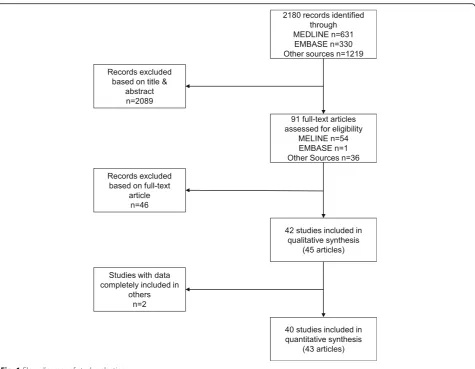
We identified 40 eligible studies reported in 43 articles
[21, 22, 32–72]. Figure 1 shows the selection process.
We screened 2180 records and 91 full-text articles. The most common reason for excluding articles was that the assessment of trial registration was based solely on mention of a trial registration number in the article
(Additional file 3: Table S1). In addition, we excluded
two articles [73, 74] because the data were completely
included in two other, larger studies [34, 35]. Finally,
for one study [37], we excluded data for a subset of
RCTs which were also covered in another study [35].
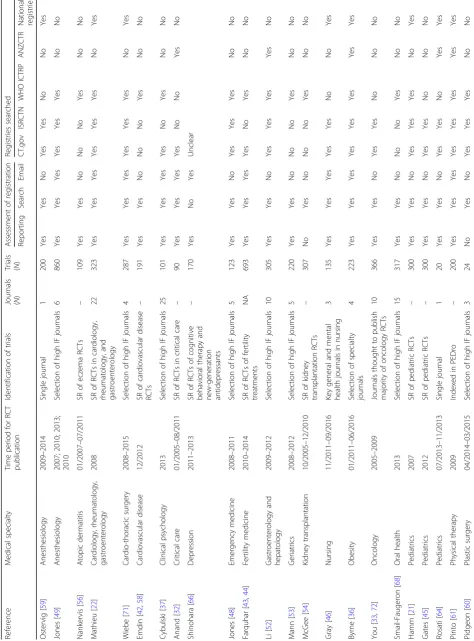
Table 1 shows the characteristics of included studies.
journals, the median number of included journals was 5
(Q1–Q3 4–10). Each study examined a median of 187
RCTs (Q1–Q3 103–301). Studies examined RCTs
pub-lished over a median of 3 years (Q1–Q3 1–5 years), with
a median starting year of 2009. To assess the registration status of published RCTs, all studies examined if a trial registration number was reported in the published art-icle, except four studies. All studies except one searched trial registries, 28 (70%) searched ClinicalTrials.gov, and 29 (73%) searched the World Health Organization Inter-national Clinical Trials Registry Platform (WHO ICTRP). Finally, 19 (48%) studies contacted trial investigators to inquire about registration status. In all, 18 (45%) studies used all three methods (reporting of registration number, search in registries, and contact of authors).
Prevalence of registration
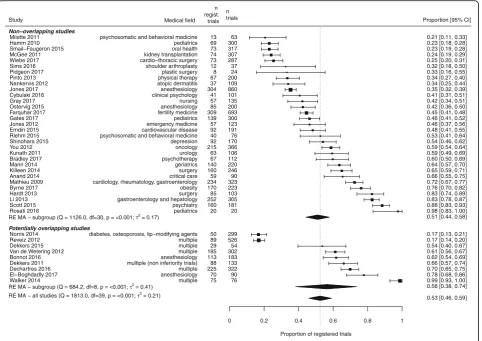
We included 31 non-overlapping studies in the main analysis. The studies examined a total of 6788 RCTs, among which 3267 (48%) RCTs had been registered. The proportion of registered trials varied considerably
across studies, ranging from 21 to 100% (Q statistic
1126, df = 30, p< 0.001, between-study variance 0.17).
In a random-effects meta-analysis, the pooled propor-tion of registered RCTs was 51% (95% confidence
interval 44 to 58%) (Fig.2). In a secondary analysis, we
in-cluded an additional nine studies examining 1985 RCTs, which potentially overlapped in part with the primary sample. Among these, 924 (47%) RCTs were registered. When combining all 40 studies, totaling 8773 RCTs, the pooled proportion of registered RCTs was 53% (95% confi-dence 46 to 59%) with considerable between-study hetero-geneity. A funnel plot did not show evidence of small-study
effects (Additional file3: Figure S1).
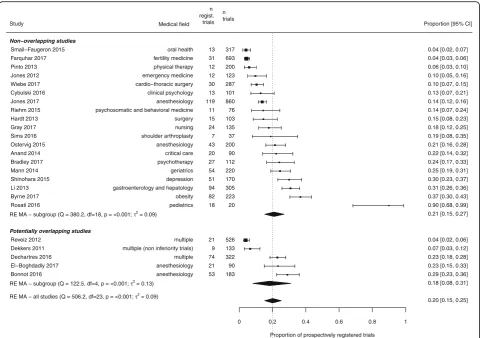
Among the 31 non-overlapping studies, 19 also reported the number of trials that were registered prospectively. The studies included a total of 4272 RCTs, among which 676 (16%) RCTs were registered prospectively. There was a considerable heterogeneity across studies, with the pro-portion of prospectively registered RCTs ranging from 4
to 90% (Q statistic 380, df = 18,p< 0.001, between-study
Table 1 Characteristics of included studies Refere nce Medical spec ialty Time pe riod for RCT pub lication Ident ification of trials Jour nals ( N )
Trials (N)
Table 1 Characteristics of included studies (Continued) Refere nce Medical spec ialty Time pe riod for RCT pub lication Ident ification of trials Jour nals ( N )
Trials (N)
registered RCTs was 21% (95% confidence interval 15 to
27%) (Fig. 3). Of the additional nine potentially
overlap-ping studies included in the secondary analysis, five exam-ined prospective registration across 1257 RCTs. When combining all 24 studies totaling 5529 RCTs, the pooled proportion of prospectively registered RCTs was 20% (95% confidence interval 15 to 25%). In addition, across these 24 studies, 1734 (67%) RCTs among 2588 regis-tered RCTs were regisregis-tered retrospectively, for a pooled proportion of 65% (95% confidence interval 59 to 71%).
Prevalence of registration over time in study subgroups
Four studies [32, 35, 65, 66] included only studies that
started to enroll participants exclusively after 2005, and
another four studies [38,47,51,59] included sub-analyses
based on studies enrolling only after 2005. Across these eight studies totaling 938 RCTs, 622 (66%) were regis-tered, and the pooled proportion was 65% (95%
confi-dence interval 50 to 78%) (Additional file3: Figure S2).
Seven studies reported data on registration according to
RCT publication year (Fig. 4). Separate meta-regression
models showed that the proportion of registered trials in-creased over time in five of these studies. Moreover, 12
studies examined RCTs published in a single year (n= 1
for 2007 [21],n= 3 for 2009 [39,51,61],n= 2 for 2010
[62, 70],n= 2 for 2012 [42, 45];n= 4 for 2013 [34, 37,
64, 68]) (Additional file3: Table S2). When combining all
19 studies, totaling 5144 RCTs, a meta-regression model showed that the proportion of registered trials increased
significantly over time (p= 0.03), with a mean absolute
pro-portion increase of 27% between 2005 and 2015, from 25 to 52%. In addition, 7 of the 12 studies that examined RCTs published in a single year reported data on prospective
registration (Additional file3: Table S2). A meta-regression
model suggested that the proportion of prospectively regis-tered trials increased as well, from 3% in 2009 to 21% in
2013 (18% increase,p= 0.04) (Additional file3: Figure S3).
Finally, in an analysis limited to studies published in 2010 or after, 26 studies reported data on 5401 RCTs. Of these, 2550 (47%) were registered, for a pooled proportion of 54% (95% confidence interval 47 to 60%).
Prevalence of registration based on certain trial features
by industry sources. Of the 778 RCTs, 475 (61%) were reg-istered. The pooled proportion was 59% (95% confidence interval 47 to 71%), as compared to 43% (95% confidence interval 30 to 58%) among trials not supported by industry. Five studies examined the prevalence of registration
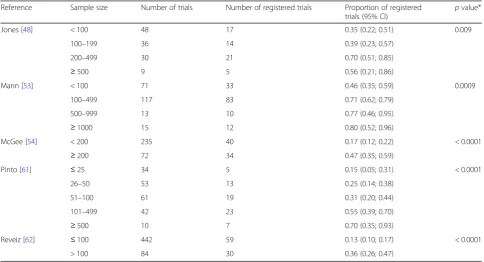
ac-cording to the trial sample size (Table 2). In all studies,
there was evidence of higher registration prevalence among larger RCTs. Finally, 17 studies identified published RCTs from high-impact factor journals only. Out of 3383 RCTs, 1724 (51%) were registered. The pooled proportion was 55% (95% confidence interval 44 to 66%) as compared to 50% (95% confidence interval 42 to 59%) in the other 23 studies (5390 RCTs).
Discussion
In this systematic review, we found that, among pub-lished RCTs, the proportion of registered and prospect-ively registered RCTs has increased over time but lack of registration and retrospective registration are still com-mon. In analyses of more than 8000 RCTs published in medical journals, half of the RCTs published in recent years had not been registered, and 4 in 5 published RCTs had not been registered prospectively. Registration
prevalence was higher in trials supported by industry funding, in larger trials, and in trials published in high-impact factor journals. While sharing of individual participant data has recently garnered much attention, our findings highlight the need for renewed efforts to address the first step on the continuum of research transparency and make prospective trial registration a top priority. Without prospective registration, our ability to monitor and resolve issues in trial reporting is substantially diminished.
Our synthesis shows that publication of unregistered trials and of trials registered retrospectively in medical journals persists. Many journals do not endorse the ICMJE registration policy and continue to support the publication
of unregistered trials [75,76]. In a mixed-methods analysis,
editors and publishers reported several reasons for why journals do not reject unregistered or retrospectively regis-tered articles, including concerns about losing submissions or preventing publication of studies from developing coun-tries. Conducting trials without making all the results
pub-licly available is unethical [77,78]. Publishing the results of
Fig. 4Meta-regression analysis of the prevalence of trial registration in relation to publication year. Each circle represents one study, and the size of each circle represents the weight given to the study in meta-regression. Separate meta-regression models were fitted in 7 studies that reported trial registration data by publication year. The black dashed line corresponds to an overall meta-regression model across these 7 studies with 11 studies that examined RCTs published in a single year. It showed that the proportion of registered trials increased over time, from 23% in 2005 to 52% in 2015 (29% increase,p= 0.03)
Table 2Prevalence of registration among published randomized trials according to trial size
Reference Sample size Number of trials Number of registered trials Proportion of registered
trials (95% CI)
pvalue*
Jones [48] < 100 48 17 0.35 (0.22; 0.51) 0.009
100–199 36 14 0.39 (0.23; 0.57)
200–499 30 21 0.70 (0.51; 0.85)
≥500 9 5 0.56 (0.21; 0.86)
Mann [53] < 100 71 33 0.46 (0.35; 0.59) 0.0009
100–499 117 83 0.71 (0.62; 0.79)
500–999 13 10 0.77 (0.46; 0.95)
≥1000 15 12 0.80 (0.52; 0.96)
McGee [54] < 200 235 40 0.17 (0.12; 0.22) < 0.0001
≥200 72 34 0.47 (0.35; 0.59)
Pinto [61] ≤25 34 5 0.15 (0.05; 0.31) < 0.0001
26–50 53 13 0.25 (0.14; 0.38)
51–100 61 19 0.31 (0.20; 0.44)
101–499 42 23 0.55 (0.39; 0.70)
≥500 10 7 0.70 (0.35; 0.93)
Reveiz [62] ≤100 442 59 0.13 (0.10; 0.17) < 0.0001
> 100 84 30 0.36 (0.26; 0.47)
to the results of these trials. But the large prevalence of un-registered trials published in medical journals raises con-cerns about persistent lack of transparency, underreporting or misreporting of trials, and biases in the resulting scien-tific literature. It directly undermines the first key objective
of registries, which is to form a public“denominator”of all
initiated trials, so that trials left unpublished can be identi-fied and the available evidence interpreted in the context
of unreported trials [79,80].
Moreover, permitting publication of retrospectively registered trials defeats the second key objective of trial registration, which is to provide timestamped amend-ments to trial protocols. If a trial is registered after the enrollment of the first participants, it is no longer possible to compare reported results to the original trial record in order to identify selective reporting of outcomes and
ana-lyses [81,82]. Among published RCTs that were registered,
we found that 65% had been registered retrospectively.
Zarin et al. [18] found a lower proportion; among 49 751
RCTs registered in ClinicalTrials.gov between 2012 and 2014, 33% had been registered more than 3 months after the trial start. Possible reasons for the difference is that our results concern only published RCTs; in contrast, most registered trials on ClinicalTrials.gov do not report results
in a timely fashion [19]. In addition, we examined studies
that assessed prospective registration according to the ICMJE or FDAAA definitions, which stipulates registration prior to the onset of patient enrollment or no later than 21 days after enrollment of the first participant. A higher proportion of trials may have been classified as prospect-ively registered had the cutoff been 3 months. Another reason for the difference is that we included trials regis-tered in other registries and that practices with regard to prospective registration might be different among trials registered in these. Lastly, among 123 trials rejected by the BMJ between June 2013 and June 2017 because they did not comply with ICMJE trial registration require-ments, 89% were retrospectively registered and 7% were
unregistered [83].
Our findings have implications for systematic viewers. Roberts et al. have suggested that systematic re-views include only prospectively registered trials, under the premise that such trials are the only ones not affected by reporting bias. Registered and unregistered trials have been found to differ in their risk of bias in studies examin-ing 326 RCTs from Latin America and the Caribbean and
693 RCTs of fertility treatments [44,62]. Other
investiga-tions have examined the impact of registration status on positive study findings and have not found differences
be-tween registered and non-registered trials [38,42,58]. We
do not endorse restricting a systematic review to only reg-istered trials but, given the large number of unregreg-istered trials in the current medical literature and the potential difference from registered trials, systematic review
authors should conduct subgroup analyses in cases where both registered and unregistered trials contribute to a meta-analysis. Such analyses should ideally distin-guish between unregistered trials, retrospectively regis-tered trials, prospectively regisregis-tered trials with potential outcome reporting bias, and prospectively registered trials with no outcome reporting bias.
Our findings also have implications for a range of stakeholder groups focused on improving trial registra-tion. Many actions have already been implemented by journal editors, regulatory agencies, and funding
organi-zations to tackle the lack of prospective registration [18].
Because of the inherent lag between registration and publication, we could see substantial changes in upcom-ing years in response to the Final Rule and the new Na-tional Institutes of Health policy. However, existing laws and policies may not be sufficient and novel interven-tions may be required to increase trial registration. Many organizations in the USA do not have policies, staff, or other resources needed to ensure their trials are
regis-tered and reported in a timely fashion [84]. Twenty
stakeholders have recently affirmed that prospective registration is of critical importance and that they will implement policies with monitoring systems to improve registration and reporting of results. In a recent commen-tary, Loder suggested treating unregistered or
retrospect-ively registered trials as medical “never events.” Such
events should trigger drastic responses, similar to specified events in clinical medicine. For example, Dr. Loder argues that journal editors and peer reviewers should verify that trial registration occurred before the trial enrolment began and, according to the ICMJE policy, reject trials registered retrospectively. If not published in medical journals, trial results could still be posted online. Most importantly, we believe that multiple entities, including funding agencies, ethics committees, and academic institutions should con-tinue to enforce standards of universal trial registration
[85–88]. For example, these stakeholders could take
pro-spective registration into account when considering full grant payments or academic promotions.
though we found that trial registration varied substantially across clinical fields and journals. Moreover, registration prevalence was higher among trials supported by the industry, larger trials, and trials in high-impact factor journals. Data were not available on trial location, and compliance with trial registration is likely to vary across
countries. Viergever and Li [14] have shown that trends
in registration on WHO ICTRP did not take place equally in all parts of the world. Fourth, our results apply to RCTs, while registration requirements apply broadly to all types of clinical trials. We therefore can-not ascertain whether the prevalence of registration we report here would be the same across all clinical study designs. Fifth, the included studies used different methods to ascertain whether published RCTs were registered. Some included studies might have missed registered RCTs and thus possibly underestimate the proportion of regis-tered RCTs. Conversely, we excluded studies that assessed trial registration based solely on the mention of a trial registration number in the article, because such studies would underestimate the proportion of registered RCTs. However, trial registration is useful if end users can identify trial records. In this regard, the proportion of registered RCTs we found might be larger than the proportion of
“useful”registrations. Sixth, data on the proportion of
pro-spectively registered RCTs according to publication year were limited. Finally, in our systematic review, we have not assessed the quality of the registration of outcomes. The lack of a detailed specification of outcomes may also
intro-duce reporting biases [89].
Conclusions
Non-registration and retrospective registration of clinical trials remain common, undermining the validity and in-tegrity of biomedical research. Given long-standing policies mandating registration, enforcing prospective registration will likely require novel interventions and greater endorse-ment by a range of stakeholders in the research community, including investigators, funding entities, ethical oversight bodies, and journal editors. Universal, prospective trial registration should be a top priority in the endeavors to improve research transparency and ensure rigorous, high-quality evidence is available to inform patient care.
Additional files
Additional file 1:abstracted data. (CSV 2 kb)
Additional file 2:R code. (HTML 1110 kb)
Additional file 3:PRISMA checklist. (DOCX 149 kb)
Funding
FTB and AGD have received grant support from the Agency for Healthcare Research and Quality (R03HS024798 developing methods to improve
systematic reviews using clinical trial registries). FTB has received grant support from the National Institutes of Health and holds an Innovation in Regulatory Science Award from the Burroughs Wellcome Fund. AGD has received grant support from the National Health and Medical Research Council (Australia) for unrelated research.
Availability of data and materials
All data generated or analyzed during this study are included in this published article [and its supplementary information files].
Authors’contributions
LT and FTB conceived and designed the study. LT, AGD, and FTB selected the studies and collected the data. LT analyzed data, and all authors interpreted the results. LT drafted and revised the paper. AGD and FTB revised the draft paper. All authors read and approved the final manuscript.
Competing interests
The authors declare that they have no competing interests.
Publisher’s Note
Springer Nature remains neutral with regard to jurisdictional claims in published maps and institutional affiliations.
Author details
1Department of Biostatistics, Boston University School of Public Health,
Boston, Massachusetts, USA.2Centre for Health Informatics, Australian
Institute of Health Innovation, Macquarie University, Sydney, Australia.
3Department of Pediatrics, Harvard Medical School, Boston, Massachusetts,
USA.4Center for Pediatric Therapeutics and Regulatory Science, and
Computational Health Informatics Program, Boston Children’s Hospital,
Boston, MA, USA.
Received: 21 April 2018 Accepted: 7 September 2018
References
1. Zarin DA, Tse T. Medicine. Moving toward transparency of clinical trials. Science. 2008;319(5868):1340–2.
2. De Angelis C, Drazen JM, Frizelle FA, Haug C, Hoey J, Horton R, Kotzin S, Laine C, Marusic A, Overbeke AJ, et al. Clinical trial registration: a statement from the International Committee of Medical Journal Editors. N Engl J Med. 2004;351(12):1250–1.
3. Chan AW, Song F, Vickers A, Jefferson T, Dickersin K, Gotzsche PC, Krumholz HM, Ghersi D, van der Worp HB. Increasing value and reducing waste: addressing inaccessible research. Lancet. 2014;383(9913):257–66. 4. Topol EJ. Failing the public health--rofecoxib, Merck, and the FDA. N Engl J
Med. 2004;351(17):1707–9.
5. Juni P, Nartey L, Reichenbach S, Sterchi R, Dieppe PA, Egger M. Risk of cardiovascular events and rofecoxib: cumulative meta-analysis. Lancet. 2004; 364(9450):2021–9.
6. Jefferson T, Jones MA, Doshi P, Del Mar CB, Hama R, Thompson MJ, Spencer EA, Onakpoya I, Mahtani KR, Nunan D, et al. Neuraminidase inhibitors for preventing and treating influenza in healthy adults and children. Cochrane Database Syst Rev. 2014;(4):CD008965.
7. Vedula SS, Bero L, Scherer RW, Dickersin K. Outcome reporting in industry-sponsored trials of gabapentin for off-label use. N Engl J Med. 2009;361(20): 1963–71.
8. Vedula SS, Goldman PS, Rona IJ, Greene TM, Dickersin K. Implementation of a publication strategy in the context of reporting biases. A case study based on new documents from Neurontin litigation. Trials. 2012;13:136.
9. Krleza-Jeric K, Chan AW, Dickersin K, Sim I, Grimshaw J, Gluud C. Principles for international registration of protocol information and results from human trials of health related interventions: Ottawa statement (part 1). BMJ. 2005;330(7497):956–8.
10. Bourgeois FT, Murthy S, Mandl KD. Outcome reporting among drug trials registered in ClinicalTrials.gov. Ann Intern Med. 2010;153(3):158–66. 11. Chan AW, Pello A, Kitchen J, Axentiev A, Virtanen JI, Liu A, Hemminki E.
12. Zarin DA, Tse T, Williams RJ, Carr S. Trial reporting in ClinicalTrials.gov - the Final Rule. N Engl J Med. 2016;375(20):1998–2004.
13. Hudson KL, Lauer MS, Collins FS. Toward a new era of trust and transparency in clinical trials. JAMA. 2016;316(13):1353–4.
14. Viergever RF, Li K. Trends in global clinical trial registration: an analysis of numbers of registered clinical trials in different parts of the world from 2004 to 2013. BMJ Open. 2015;5(9):e008932.
15. Trial Registration, Organizations with Policies.http://www.who.int/ictrp/trial_ reg/en/index2.html. Accessed 9 Sept 2018.
16. Laine C, Horton R, DeAngelis CD, Drazen JM, Frizelle FA, Godlee F, Haug C, Hebert PC, Kotzin S, Marusic A, et al. Clinical trial registration: looking back and moving ahead. Lancet. 2007;369(9577):1909–11.
17. Weber WE, Merino JG, Loder E. Trial registration 10 years on. BMJ. 2015;351:h3572. 18. Zarin DA, Tse T, Williams RJ, Rajakannan T. Update on trial registration 11 years
after the ICMJE policy was established. N Engl J Med. 2017;376(4):383–91. 19. Chen R, Desai NR, Ross JS, Zhang W, Chau KH, Wayda B, Murugiah K, Lu DY,
Mittal A, Krumholz HM. Publication and reporting of clinical trial results: cross sectional analysis across academic medical centers. BMJ. 2016;352:i637. 20. Ross JS, Tse T, Zarin DA, Xu H, Zhou L, Krumholz HM. Publication of NIH
funded trials registered in ClinicalTrials.gov: cross sectional analysis. BMJ. 2012;344:d7292.
21. Hamm MP, Hartling L, Milne A, Tjosvold L, Vandermeer B, Thomson D, Curtis S, Klassen TP. A descriptive analysis of a representative sample of pediatric randomized controlled trials published in 2007. BMC Pediatr. 2010;10:96. 22. Mathieu S, Boutron I, Moher D, Altman DG, Ravaud P. Comparison of
registered and published primary outcomes in randomized controlled trials. JAMA. 2009;302(9):977–84.
23. Missing trial data–briefing notes.http://www.alltrials.net/wp-content/ uploads/2013/01/Missing-trials-briefing-note.pdf. Accessed 9 Sept 2018. 24. Dal-Re R, Marusic A. Prevention of selective outcome reporting: let us start
from the beginning. Eur J Clin Pharmacol. 2016;72(10):1283–8.
25. Jones CW, Keil LG, Holland WC, Caughey MC, Platts-Mills TF. Comparison of registered and published outcomes in randomized controlled trials: a systematic review. BMC Med. 2015;13:282.
26. Bashir R, Bourgeois FT, Dunn AG. A systematic review of the processes used to link clinical trial registrations to their published results. Syst Rev. 2017;6(1):123. 27. Glanville JM, Duffy S, McCool R, Varley D. Searching ClinicalTrials.gov and
the International Clinical Trials Registry Platform to inform systematic reviews: what are the optimal search approaches? J Med Libr Assoc. 2014; 102(3):177–83.
28. Trikalinos TA, Trow P, Schmid CH. Simulation-based comparison of methods for meta-analysis of proportions and rates. Rockville: Agency for Healthcare Research and Quality (US); 2013.
29. Bakbergenuly I, Kulinskaya E, Morgenthaler S. Inference for binomial probability based on dependent Bernoulli random variables with applications to meta-analysis and group level studies. Biom J. 2016;58(4):896–914.
30. Haidich AB, Ioannidis JP. Effect of early patient enrollment on the time to completion and publication of randomized controlled trials. Am J Epidemiol. 2001;154(9):873–80.
31. Ioannidis JP. Effect of the statistical significance of results on the time to completion and publication of randomized efficacy trials. JAMA. 1998;279(4): 281–6.
32. Anand V, Scales DC, Parshuram CS, Kavanagh BP. Registration and design alterations of clinical trials in critical care: a cross-sectional observational study. Intensive Care Med. 2014;40(5):700–22.
33. Boespflug A, Gan H, Chen EX, Pond G, You B. Consistency in the analysis and reporting of PEPs in oncology randomized controlled trials from registration to publication: a systematic review. Bull Cancer. 2012;99(10):943–52.
34. Bonnot B, Yavchitz A, Mantz J, Paugam-Burtz C, Boutron I. Selective primary outcome reporting in high-impact journals of anaesthesia and pain. Br J Anaesth. 2016;117(4):542–3.
35. Bradley HA, Rucklidge JJ, Mulder RT. A systematic review of trial registration and selective outcome reporting in psychotherapy randomized controlled trials. Acta Psychiatr Scand. 2017;135(1):65–77.
36. Byrne JL, Yee T, O’Connor K, Dyson MP, Ball GD. Registration status and methodological reporting of randomized controlled trials in obesity research: a review. Obesity (Silver Spring). 2017;25(4):665–70. 37. Cybulski L, Mayo-Wilson E, Grant S. Improving transparency and
reproducibility through registration: the status of intervention trials published in clinical psychology journals. J Consult Clin Psychol. 2016;84(9): 753–67.
38. Dechartres A, Ravaud P, Atal I, Riveros C, Boutron I. Association between trial registration and treatment effect estimates: a meta-epidemiological study. BMC Med. 2016;14(1):100.
39. Dekkers OM, Soonawala D, Vandenbroucke JP, Egger M. Reporting of noninferiority trials was incomplete in trial registries. J Clin Epidemiol. 2011; 64(9):1034–8.
40. Dekkers OM, Cevallos M, Buhrer J, Poncet A, Ackermann Rau S, Perneger TV, Egger M. Comparison of noninferiority margins reported in protocols and publications showed incomplete and inconsistent reporting. J Clin Epidemiol. 2015;68(5):510–7.
41. El-Boghdadly K, Wiles M, Atton S, Bailey C. Analysis of registration rigour of randomised controlled trials published in anaesthesia. Anaesthesia. 2017;72:17. 42. Emdin C, Odutayo A, Hsiao A, Shakir M, Hopewell S, Rahimi K, Altman DG.
Association of cardiovascular trial registration with positive study findings: epidemiological Study of Randomized Trials (ESORT). JAMA Intern Med. 2015;175(2):304–7.
43. Farquhar CM, Showell MG, Showell EAE, Beetham P, Baak N, Mourad S, Jordan VMB. Clinical trial registration in fertility trials - a case for improvement? Hum Reprod. 2017;32(9):1827–34.
44. Farquhar CM, Showell MG, Showell EAE, Beetham P, Baak N, Mourad S, Jordan VMB. Clinical trial registration was not an indicator for low risk of bias. J Clin Epidemiol. 2017;84:47–53.
45. Gates A, Hartling L, Vandermeer B, Caldwell P, Contopoulos-Ioannidis DG, Curtis S, Fernandes RM, Klassen TP, Williams K, Dyson MP. The conduct and reporting of child health research: an analysis of randomized controlled trials published in 2012 and evaluation of change over 5 years. J Pediatr. 2018;193:237–244.e37.
46. Gray R, Badnapurkar A, Hassanein E, Thomas D, Barguir L, Baker C, Jones M, Bressington D, Brown E, Topping A. Registration of randomized controlled trials in nursing journals. Res Integr Peer Rev. 2017;2:8.https://doi.org/10. 1186/s41073-017-0036-9.
47. Hardt JL, Metzendorf MI, Meerpohl JJ. Surgical trials and trial registers: a cross-sectional study of randomized controlled trials published in journals requiring trial registration in the author instructions. Trials. 2013;14:407. 48. Jones CW, Platts-Mills TF. Quality of registration for clinical trials published in
emergency medicine journals. Ann Emerg Med. 2012;60(4):458–464.e1. 49. Jones PM, Chow JTY, Arango MF, Fridfinnson JA, Gai N, Lam K, Turkstra TP.
Comparison of registered and reported outcomes in randomized clinical trials published in anesthesiology journals. Anesth Analg. 2017;125(4):1292–300. 50. Killeen S, Sourallous P, Hunter IA, Hartley JE, Grady HL. Registration rates,
adequacy of registration, and a comparison of registered and published primary outcomes in randomized controlled trials published in surgery journals. Ann Surg. 2014;259(1):193–6.
51. Kunath F, Grobe HR, Keck B, Rucker G, Wullich B, Antes G, Meerpohl JJ. Do urology journals enforce trial registration? A cross-sectional study of published trials. BMJ Open. 2011;1(2):e000430.
52. Li XQ, Yang GL, Tao KM, Zhang HQ, Zhou QH, Ling CQ. Comparison of registered and published primary outcomes in randomized controlled trials of gastroenterology and hepatology. Scand J Gastroenterol. 2013;48(12): 1474–83.
53. Mann E, Nguyen N, Fleischer S, Meyer G. Compliance with trial registration in five core journals of clinical geriatrics: a survey of original publications on randomised controlled trials from 2008 to 2012. Age Ageing. 2014;43(6):872–6. 54. McGee RG, Su M, Kelly PJ, Higgins GY, Craig JC, Webster AC. Trial
registration and declaration of registration by authors of randomized controlled trials. Transplantation. 2011;92(10):1094–100.
55. Milette K, Roseman M, Thombs BD. Transparency of outcome reporting and trial registration of randomized controlled trials in top psychosomatic and behavioral health journals: a systematic review. J Psychosom Res. 2011;70(3):205–17.
56. Nankervis H, Baibergenova A, Williams HC, Thomas KS. Prospective registration and outcome-reporting bias in randomized controlled trials of eczema treatments: a systematic review. J Invest Dermatol. 2012;132(12): 2727–34.
57. Norris SL, Holmer HK, Fu R, Ogden LA, Viswanathan MS, Abou-Setta AM. Clinical trial registries are of minimal use for identifying selective outcome and analysis reporting. Res Synth Methods. 2014;5(3):273–84.
59. Ostervig RM, Sonne A, Rasmussen LS. Registration of randomized clinical trials--a challenge. Acta Anaesthesiol Scand. 2015;59(8):986–9.
60. Pidgeon TE, Limb C, Agha RA, Whitehurst K, Chandrakumar C, Wellstead G, Fowler AJ, Orgill DP. The use of study registration and protocols in plastic surgery research: a systematic review. Int J Surg. 2017;44:215–22. 61. Pinto RZ, Elkins MR, Moseley AM, Sherrington C, Herbert RD, Maher CG,
Ferreira PH, Ferreira ML. Many randomized trials of physical therapy interventions are not adequately registered: a survey of 200 published trials. Phys Ther. 2013;93(3):299–309.
62. Reveiz L, Bonfill X, Glujovsky D, Pinzon CE, Asenjo-Lobos C, Cortes M, Canon M, Bardach A, Comande D, Cardona AF. Trial registration in Latin America and the Caribbean’s: study of randomized trials published in 2010. J Clin Epidemiol. 2012;65(5):482–7.
63. Riehm KE, Azar M, Thombs BD. Transparency of outcome reporting and trial registration of randomized controlled trials in top psychosomatic and behavioral health journals: a 5-year follow-up. J Psychosom Res. 2015;79(1):1–12. 64. Rosati P, Porzsolt F, Ricciotti G, Testa G, Inglese R, Giustini F, Fiscarelli E,
Zazza M, Carlino C, Balassone V, et al. Major discrepancies between what clinical trial registries record and paediatric randomised controlled trials publish. Trials. 2016;17(1):430.
65. Scott A, Rucklidge JJ, Mulder RT. Is mandatory prospective trial registration working to prevent publication of unregistered trials and selective outcome reporting? An observational study of five psychiatry journals that mandate prospective clinical trial registration. PLoS One. 2015;10(8):e0133718. 66. Shinohara K, Tajika A, Imai H, Takeshima N, Hayasaka Y, Furukawa TA.
Protocol registration and selective outcome reporting in recent psychiatry trials: new antidepressants and cognitive behavioural therapies. Acta Psychiatr Scand. 2015;132(6):489–98.
67. Sims MT, Sanchez ZC, Herrington JM, Hensel JB, Henning NM, Scheckel CJ, Vassar M. Shoulder arthroplasty trials are infrequently registered: a systematic review of trials. PLoS One. 2016;11(10):e0164984.
68. Smail-Faugeron V, Fron-Chabouis H, Durieux P. Clinical trial registration in oral health journals. J Dent Res. 2015;94(3 Suppl):8S–13S.
69. Walker KF, Stevenson G, Thornton JG. Discrepancies between registration and publication of randomised controlled trials: an observational study. JRSM Open. 2014;5(5):2042533313517688.
70. van de Wetering FT, Scholten RJ, Haring T, Clarke M, Hooft L. Trial registration numbers are underreported in biomedical publications. PLoS One. 2012;7(11):e49599.
71. Wiebe J, Detten G, Scheckel C, Gearhart D, Wheeler D, Sanders D, Vassar M. The heart of the matter: outcome reporting bias and registration status in cardio-thoracic surgery. Int J Cardiol. 2017;227:299–304.
72. You B, Gan HK, Pond G, Chen EX. Consistency in the analysis and reporting of primary end points in oncology randomized controlled trials from registration to publication: a systematic review. J Clin Oncol. 2012;30(2):210–6.
73. Azar M, Riehm KE, McKay D, Thombs BD. Transparency of outcome reporting and trial registration of randomized controlled trials published in the journal of consulting and clinical psychology. PLoS One. 2015;10(11):e0142894. 74. De Oliveira GS Jr, Jung MJ, McCarthy RJ. Discrepancies between randomized
controlled trial registry entries and content of corresponding manuscripts reported in anesthesiology journals. Anesth Analg. 2015;121(4):1030–3. 75. Wager E, Williams P, Project Overcome failure to Publish nEgative fiNdings
C.“Hardly worth the effort”? Medical journals’policies and their editors’and publishers’views on trial registration and publication bias: quantitative and qualitative study. BMJ. 2013;347:f5248.
76. Hooft L, Korevaar DA, Molenaar N, Bossuyt PM, Scholten RJ. Endorsement of ICMJE’s Clinical Trial Registration Policy: a survey among journal editors. Neth J Med. 2014;72(7):349–55.
77. Moorthy VS, Karam G, Vannice KS, Kieny MP. Rationale for WHO’s new position calling for prompt reporting and public disclosure of interventional clinical trial results. PLoS Med. 2015;12(4):e1001819.
78. Pica N, Bourgeois F. Discontinuation and Nonpublication of Randomized Clinical Trials Conducted in Children. Pediatrics. 2016;138(3). pii: e20160223.
https://doi.org/10.1542/peds.2016-0223.
79. Zarin DA, Tse T, Williams RJ, Califf RM, Ide NC. The ClinicalTrials.gov results database--update and key issues. N Engl J Med. 2011;364(9):852–60. 80. Dickersin K, Rennie D. The evolution of trial registries and their use to assess
the clinical trial enterprise. JAMA. 2012;307(17):1861–4.
81. Dwan K, Gamble C, Williamson PR, Kirkham JJ, Reporting Bias G. Systematic review of the empirical evidence of study publication bias and outcome reporting bias - an updated review. PLoS One. 2013;8(7):e66844.
82. Dwan K, Altman DG, Clarke M, Gamble C, Higgins JP, Sterne JA, Williamson PR, Kirkham JJ. Evidence for the selective reporting of analyses and discrepancies in clinical trials: a systematic review of cohort studies of clinical trials. PLoS Med. 2014;11(6):e1001666.
83. Loder E, Loder S, Cook S. Characteristics and publication fate of unregistered and retrospectively registered clinical trials submitted to The BMJ over 4 years. BMJ Open. 2018;8(2):e020037.
84. Mayo-Wilson E, Heyward J, Keyes A, Reynolds J, White S, Atri N, Alexander GC, Omar A, Ford DE, National Clinical Trials R, et al. Clinical trial registration and reporting: a survey of academic organizations in the United States. BMC Med. 2018;16(1):60.
85. O’Reilly EK, Hassell NJ, Snyder DC, Natoli S, Liu I, Rimmler J, Amspacher V, Burnett BK, Parrish AB, Berglund JP, et al. ClinicalTrials.gov reporting: strategies for success at an academic health center. Clin Transl Sci. 2015;8(1):48–51. 86. Goldacre B. How to get all trials reported: audit, better data, and individual
accountability. PLoS Med. 2015;12(4):e1001821.
87. Meerpohl JJ, Schell LK, Bassler D, Gallus S, Kleijnen J, Kulig M, La Vecchia C, Marusic A, Ravaud P, Reis A, et al. Evidence-informed recommendations to reduce dissemination bias in clinical research: conclusions from the OPEN (Overcome failure to Publish nEgative fiNdings) project based on an international consensus meeting. BMJ Open. 2015;5(5):e006666. 88. Doernberg SN, Wendler D. Ensuring respect for human research
participants: institutional review boards and sharing results from research. JAMA. 2016;316(11):1149–50.