Turkish Journal of Fisheries and Aquatic Sciences 13: 581-592 (2013)
www.trjfas.org ISSN 1303-2712 DOI: 10.4194/1303-2712-v13_4_03
© Published by Central Fisheries Research Institute (CFRI) Trabzon, Turkey in cooperation with Japan International Cooperation Agency (JICA), Japan
Quantification of the Synergistic Effects of Eutrophication, Apex Predator
Pressure, and Internal Processes on the Black Sea Ecosystem
Baris Salihoglu
1,*, Nusret Sevinc
11
Middle East Technical University, Institute of Marine Sciences, Erdemli, Mersin, Turkey.
* Corresponding Author: Tel.: +903245212150; Fax: +903245212327; E-mail: [email protected]
Received 28 June 2013 Accepted 24 October 2013
Abstract
In the present study, a model of the lower-trophic pelagic food web of the Black Sea is considered in order to provide a quantitative understanding of the marked changes in the food web structure in response to changing top-down and bottom-up control mechanisms due to eutrophication, overfishing, and climatic changes. The simulations consider three particular parameters controlling the changes in the ecosystem structure due to these stressors; (i) the magnitude of the nitrate flux into the euphotic layer from the chemocline layer (enrichment due to eutrophication), (ii) the magnitude of predation control introduced by the planktivorous fish on mesozooplankton (fishery), (iii) the magnitude of the Q10 parameter controlling temperature dependence of the Mnemiopsis growth (changing climatic conditions). A simulation assessing the level of enrichment on the ecosystem indicates a shift of the major trophic energy flow towards Noctiluca and Aurelia and thus showing how the ecosystem would degrade when a critical level of enrichment is passed. Increasing predation pressure of the planktivorous fish during the enrichment phase is shown to reduce the mesozooplankton biomass that in turn declines its predation pressure on Noctiluca population and thus allows Noctiluca biomass to increase, considering that mesozooplanton is assumed to feed on Noctiluca (at a level of 15% food preference) in the current model.. Noctiluca then acts as a major consumer and a critical element of the degraded food web structure. The overfishing of planktivorous fish stocks allows Mnemiopsis biomass to increase considerably under changing (warmer) climatic conditions at the end of 1980s, following a decade-long intense cooling phase. Thus, our results suggest that overfishing would not alone be able to promote a Mnemiopsis population outburst in the absence of warming.
Keywords: Black Sea, population dynamics, trophic levels, nutrient enrichment, predation control, mnemiopsis.
Karadeniz Ekosisteminin Ötrofikasyon, Predatör Baskısı ve Besin Ağı İç Dinamikleri Etkileşimlerinin Modelleme Yöntemi ile Analizi"
Özet
Karadeniz besin ağında gözlemlenen değişimlerin ötrofikasyon, balıkçılık ve iklim değişikliklerinden kaynaklı üstten alta (top down) ve altan üste (bottom up) kontrol mekanizmalarına verdiği tepkiyi anlayabilmek üzere bir Karadeniz besin ağı modeli kullanılmıştır. Gerçekleştirilen simülasyonlarda bu baskıları kontrol eden üç parametre seçilmiştir; (i) kemoklin tabakadan ışıklı tabakaya (öfotik bölge) olan azot girdisi (ötrofikasyon kaynaklı), (ii) planktivor balıklar tarafından mesozooplankton üzerinde uygulanan predasyon baskısı (balıkçılık etkisi), (iii) Q10 parametresinin Mnemiopsis büyümesini sıcaklığa göre kontrolü (iklim etkisi). Besin tuzu artışının ekosistem üzerindeki etkisinin analizine yönelik yapılan simulasyon sonuçlarına göre bu koşullar altında trofik enerji akışı Noctiluca ve Aurelia yönünde olmuştur. Yine bu dönemde artan planktivor balık kaynaklı predasyon baskısı mesozooplankton biyokütlesinin azalmasına yol açmış ve bu da Noctiluca üzerindeki trofik baskıyı azaltarak Noctiluca populasyonunun artmasında rol oynamıştır. Burada mevcut modelde mesozooplanktonun Noctiluca üzerinde azda olsa (%15) beslenebildiği unutulmamalıdır. Bunu takiben Noctiluca besin ağı ve trofik seviyeler arası enerji akışı içerisinde etkili bir konuma gelmiştir. Planktivor balıkların aşırı avlanması sonucunda 1980’lerin sonunda on yıllık soğuk dönemden sonra değişen iklim koşullarıyla beraber (artan sıcaklık) Mnemiopsis biyokütlesi önemli ölçüde artmıştır. Dolayısıyla sonuçlar, aşırı balıkçılığın Mnemiopsis biyokütlesinde görülen aşırı artışı artan deniz suyu sıcaklığının etkisi olmaksızın tetikleyemeyeceğine işaret etmektedir.
Introduction
The Black Sea is one of the best known examples of large marine ecosystems simultaneously impacted by anthropogenic eutrophication, changes in predator fish stocks, and climatic changes. Starting from the early 1970s, the entire basin was heavily enriched by nutrients as evident by an increase of nitrate concentration in the chemocline layer from its background values of 2-3 mmol m-3 to 6-9 mmol m-3 (see Figure. 1 in Oguz et al. 2008a). The impact of eutrophication was also clearly evident in an order of magnitude increase in summer phytoplankton biomass within the northwestern shelf and a five-fold increase in the inner basin (BSC, 2008). The system was disturbed simultaneously by the decline in fish stocks due to their overfishing, leaving small pelagics as the top predator community after the mid-1970s (Oguz et al., 2012). The deterioration of the food web by eutrophication and overfishing promoted the appearance of opportunistic and gelatinous species as dominant factors within the food web which were able to share rich food resources with planktivorous fish. Among these species, the jellyfish medusae Aurelia aurita was the most dominant one during the 1980s and the ctenophore Mnemiopsis leidyi was dominant after the end of 1980 following its accidental introduction into the Black Sea. Both Aurelia aurita and Mnemiopsis leidyi acted as dead-ends in the food web structure due to their lack of predators. Similarly, the red tide species heterotropic
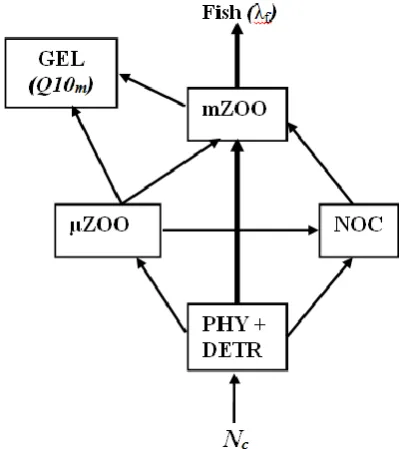
dinoflagellate Noctiluca scintillans also acted as the dead-end element of the degraded food web. As a result, the classical phytoplankton-mesozooplankton-fish dominated food chain was transformed into a more complex form (Figure 1) in which a major fraction of the energy that enters the system through photosynthesis is diverted to the dead-end groups.
Numerous ecosystem modeling studies have been performed with different biogeochemical complexities. Among the one-dimensional coupled physical-biogeochemical models, the one in Oguz et al. (2000, 2001a) was used to study the impact of top– down control imposed by gelatinous carnivores on the annual variability of phytoplankton and mesozooplankton distributions as well as redox dynamics in the Black Sea. Lancelot et al. (2002) presented a complex ecological model involving carbon, nitrogen, phosphorus and silicon cycling for the north-western shelf. Gregoire et al. (2008) examined the functioning of the central Black Sea ecosystem at the end of the 1980s when eutrophication and invasion by the gelatinous organisms seriously affected the stability and dynamics of the system. Some of these models were also extended to perform three-dimensional studies to investigate the regional variability of ecosystem properties (Grégoire and Lacroix (2003), Grégoire and Friedrich (2004), Grégoire et al. (2004), Korotaev et al. (2011), Korotaev et al. (2011), Dorofeyev et al. (2012)).
The present modeling study complements the
existing modeling studies by exploring relative contributions of the external stressors on the structural changes in the food web since the 1970s. In particular, it examines the critical role of some particular processes leading to the transitions between four quasi-stable phases of the Black Sea ecosystem; the pre-eutrophication phase (before 1970), the intense eutrophication phase with high planktivorous fish stock (the late 1970s and 1980s), low planktivorous fish stock and high Mnemiopsis biomass phase (1989-1991), and finally, moderate eutrophication, moderate or low planktivorous fish stock, and moderate Mnemiopsis phase (after the early 1990s). The subsequent sections first describe the model structure, the initial and boundary conditions, and the parameters setting. A suite of model simulations is then presented to seek quantitative support for the impacts of multiple exogenous forcing on the marked changes in the food web structure. Finally, we discuss our findings within the context of the observed Black Sea ecosystem changes.
Model Description
A one-dimensional, three-layer, coupled physical-biochemical model (Oguz et al., 2001b) approximates the area-averaged conditions of the interior Black Sea (>1500 m depth) away from the shelf and the topographic slope zone around the basin. The euphotic layer is represented by the combination of mixed and intermediate layers that are located above and below the seasonal thermocline, respectively. The temporal variation of the mixed layer follows the Kraus-Turner bulk mixed layer dynamics (Niiler and Kraus, 1977), whereas the thickness of the euphotic layer is assumed to correspond to the depth at which the photosynthetically active ration is 1% of its value at the surface, depending on the temporally varying light extinction coefficient. If the mixed layer exceeds the lower boundary of the euphotic zone, which is likely during winter months, its thickness is set to the euphotic zone thickness. In this case, the intermediate layer temporally vanishes and the model vertical resolution reduces to two layers. The third layer, the chemocline, represents the biologically inactive, aphotic zone extending down to the anoxic interface (taken at 100 m depth). It mainly acts as a nitrogen pool where the sinking particulate material is remineralized, converted to inorganic form and stored to be made available again into the euphotic zone by means of vertical diffusion and entrainment processes. Its thickness is the difference between the total upper layer water column of 100 m and the euphotic zone. The model does not incorporate redox layer located below the chemocline layer because of its lack of direct relevance to the present work. The details of the model formulation are provided in Appendix A.
Nitrogen constitutes the main limiting nutrient for phytoplankton growth for the interior Black Sea
ecosystem when compared to silicate and phosphate. Using nitrogen as the main currency, the lower trophic pelagic food web structure is assumed to comprise of 11 aggregated compartments. They include three phytoplankton species/groups (small phytoplankton (Ps) less than 10 μm in diameter,
diatoms (Pda), dinoflagellates (Pdi)), two zooplankton
groups (microzooplankton (Zmi), mesozooplankton
(Zme)), two gelatinous carnivore species (Aurelia
aurita (Za) and Mnemiopsis leidyi (Zm)), opportunistic
red tide heterotrophic dinoflagellate Noctiluca scintillans (Ns), labile pelagic detritus (D), nitrate (N)
and ammonium (A). This model therefore does not explicitly resolve the dissolved organic nitrogen pool and bacterioplankton as well as the coccolithophores group because of its minor role in the functioning of the pelagic food web structure. For zooplankton groups, the distinction is made according to their size being smaller or larger than 200 μm, each
zooplankton group consuming different
phytoplankton groups with differing preference coefficients. The microzooplankton group represents heterotrophic flagellates and ciliates. It is more efficient at consuming flagellates and bacteria and links the microbial loop to the upper trophic levels. The mesozooplankton community includes both omnivores and carnivores. The omnivorous group is formed by young and adult individuals of copepods (e.g., Pamcalanus, Psedocalanus, Galanus, Acartia, and Oithona), cladocerans, and appendicularians.
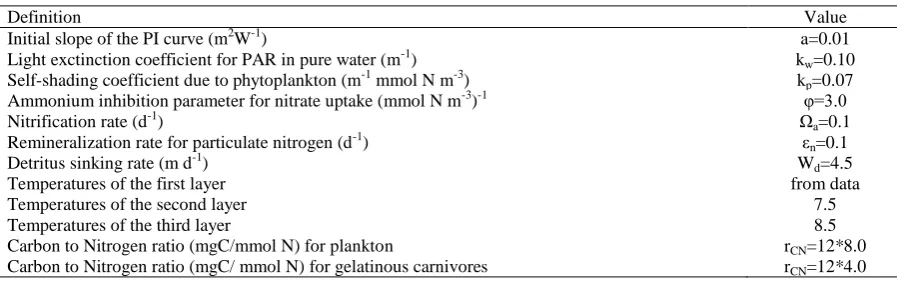
The model food web structure identifies the heterotrophic dinoflagellate Noctiluca as an independent functional group, because of its predominancy in the eutrophic Black Sea ecosystem during the 1980s (Zaitsev and Mamaev, 1997). Noctiluca is a nonspecific consumer feeding on phytoplankton, and microzooplankton, as well as particulate organic matter, and is consumed by mesozooplankton. This food web structure is consistent with the optimum configuration suggested by Oguz et al. (2008a) simulating temporal variations of the Black Sea ecosystem. The biological source-sink terms and the vertical transport terms are given in Appendix B. Definitions and values of the parameters used in the dynamical equations are given in Tables B1-B4.
each time step and the light limitation function of the phytoplankton growth. Similarly, daily temperature variations introduce temperature limitation for phytoplankton growth; for the mixed layer the temperature is taken to be the climatological sea surface temperature. For the second and third layers we set temperature to temporally uniform values of
7.5 oC and 8.5 oC, respectively. The parameter values are chosen from the published Black Sea literature, and mostly follow those given by Salihoglu, 1998, Oguz et al., 1996, Oguz and Salihoglu (2000), Oguz et al. (2001a,b) and Oguz and Merico (2006).
Initially, nitrate concentrations of 0.1, 1.0, and 3 mmol N m-3 are set for the mixed, intermediate and
Table B1. Definition of functions used for phytoplankton growth formulation
Definition Function
Net phytoplankton growth rate Φ=g·α(I) ·β(Nn,Na) ·f(T) Total nitrogen limitation function β(Nn,Na)= β(Nn)+ β(Na) Nitrate limitation function β(Nn)=[Nn/(Kn+Nn)]exp(-ψNa) Ammonium limitation function β(Na)=[Na/(Ka+Na)]
Light limitation function αk(I)=(1/Hk)∫tanh[aI(z)]
Temperature Limitation function ( 15)/10
, 10
)
(
Tjj
T
Q
f
Table B2. Definition of parameters and their values used for phytoplankton and zooplankton groups
Definition Diatom Dinofla gellate
Small Phyto
Microzoo Mesozoo Noctiluca Aurelia Mnemiop sis Maximum growth/
grazing rate (d-1)
σl=2.8 σd=2.0 σs=3.0 gs=1.0 gl=0.7 gn=0.45 ga=0.35 gm=0.40
Mortality rate (d-1) λn=0.04 λn=0.04 λn=0.05 λf=0.10 λd=0.05 λn=0.03 λa=0.005 λm=0.005
Excretion rate (d-1) µ
s=0.05 µl=0.05 µn=0.02 µa=0.01 µm=0.01 Assimilation
efficiency
γs=0.75 γl=0.75 γn=0.7 γa=0.7 γm=0.7
Half saturation constant (mmol N m-3)
Knl=0.5 Kal=0.2
Knd=0.4 Kad=0.2
Kns=0.4 Kas=0.2
Ks=0.45 Kl=0.50 Kn=0.23 Ka=0.35 Km=0.25
Q10 parameter for temperature limitation
Qpl=1.8 Qpd=1.9 Qps=1.9 Qzs=2.1 Qzl=1.9 Qn=2.0 Qa=2.0 Qm=1.5
Table B3. Food preference coefficients
Microzoo Mesozoo Noctiluca Aurelia Mnemiopsis
Diatom 0.20 0.35 0.35
Dinoflagellate 0.05 0.15 0.20
Small phytoplankton 0.65 0.10 0.25
Microzooplankton 0.15 0.15 0.70 0.25
Mesozooplankton 0.30 0.75
Noctiluca scintillans 0.15
Detritus 0.10 0.10 0.05
Table B4. Definition of some parameters and their values
Definition Value
Initial slope of the PI curve (m2W-1) a=0.01
Light exctinction coefficient for PAR in pure water (m-1) kw=0.10
Self-shading coefficient due to phytoplankton (m-1 mmol N m-3) kp=0.07
Ammonium inhibition parameter for nitrate uptake (mmol N m-3)-1 φ=3.0
Nitrification rate (d-1) Ωa=0.1
Remineralization rate for particulate nitrogen (d-1) εn=0.1
Detritus sinking rate (m d-1) Wd=4.5
Temperatures of the first layer from data
Temperatures of the second layer 7.5
Temperatures of the third layer 8.5
Carbon to Nitrogen ratio (mgC/mmol N) for plankton rCN=12*8.0
chemocline layers, respectively. All the other state variables are set to small values. The initial thicknesses of the mixed and the intermediate layers are all set to 20 m. As a result, the initial thickness of chemocline layer equates to 60 m.
The equations in each layer are stepped forward in time with a 5 minute time step and using the second order accurate leap-frog time stepping scheme together with the Asselin time filter. The system usually approaches a stable period orbit by the fifth year, but the model is nevertheless integrated for 10 years in all of the simulations.
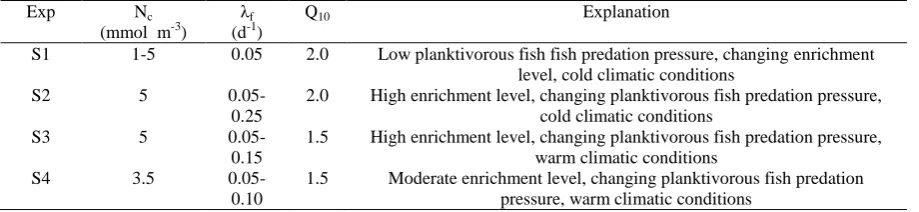
The model assigns three particular free parameters, each of which controls a major process of the ecosystem functioning since the 1960s. One of them is the nitrate flux into the euphotic layer from the chemocline layer, which controls the level of resource availability in the food web. This flux is expressed by the product of the nitrate concentration in the chemocline layer and the sum of entrainment and vertical diffusion rates. In the present study, the entrainment and diffusion rates are kept unchanged whereas nitrate concentration, Nc, is chosen to vary in a way that mimicks different eutrophication phases of the ecosystem. The second parameter signifies the predation rate of planktivorous on mesozooplankton (λf). The third parameter is the Q10 parameter which
appears in the temperature control term of Mnemiopsis growth and reproduction (Oguz et al., 2008b). The list of simulations using different combinations of these parameters is shown in Table 1.
Results
Impact of Nutrient Enrichment
Experiment S1 considers the impact of four-to-five fold increase in nutrient concentrations and their eventual accumulation in the chemocline layer of the deep basin during the 1970s. In order to simulate the response of the food web to the nutrient enrichment in the water column, the parameter Nc is varied from 1
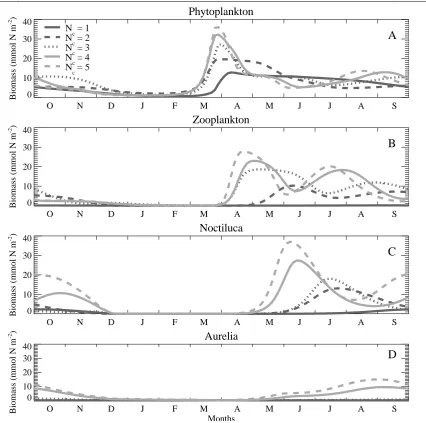
mmol m-3 (oligotrophic system) to 5 mmol N m-3 (eutrophic system). As shown in Figure 2A, the case for Nc = 1 mmol N m-3 represents a food web that can
only accommodate phytoplankton as the basal group with the rest of the food web being absent. The total
phytoplankton biomass increases in March in response to the shallowing mixed layer. It then declines gradually during the rest of the year in response to natural mortality in the absence of any predation pressure. When Nc = 2 mol N m-3, the food
web can support both zooplankton and Noctiluca, in addition to a slightly higher phytoplankton biomass. It triggers the spring bloom roughly two weeks earlier, preserves the peak total biomass of 20 mmol N m-2 within the euphotic zone until mid-May and then starts declining in response to predation impacts of first zooplankton and then Noctiluca (Figure 2A-C). They attain a peak biomass of 10 mmol N m-2 and 15 mmol N m-2 at the begining of June and around mid-July, respectively. The food web is still unable to support jellyfish Aurelia aurita (Figure 2D) and the model does not include the Mnemiopsis compartment for this phase of the ecosystem. Further enrichment as parametrized by Nc=3.0 mmol N m-3 provides
structurally similar food web as in the previous case with the slightly higher spring phytoplankton peak and its much faster decline in response to zooplankton development that last longer due to the lack of predator except apparently low level planktivorous stocks (expressed by λf = 0.05 d-1).
The food web structure changes significantly when Nc ≥ 4 mmol N m-3. A major modification is the
development of Aurelia, and the initiation of a Noctiluca bloom one month earlier and spreading of its influence to entire summer (Figure 2C, D). Noctiluca biomass peak is as high as phytoplankton but prevails longer; thus indicating that it is the main consumer of trophic energy provided by primary producers. Aurelia biomass also gradually increases in summer months up to its maximum level during August-September but is depleted by the end of the year. We note that the annual phytoplankton and zooplankton structures show a small change for Nc= 4
and 5 mmol N m-3, but the difference is more apparent for Noctiluca and Aurelia biomasses, which implies a more efficient resource supply to higher trophic levels beyond a critical level of enrichment.
Impact of Changing Predation Pressure
We next examine the impact of changing
Table 1. The list of simulation experiments
Exp Nc
(mmol m-3) λf (d-1)
Q10 Explanation
S1 1-5 0.05 2.0 Low planktivorous fish fish predation pressure, changing enrichment level, cold climatic conditions
S2 5
0.05-0.25
2.0 High enrichment level, changing planktivorous fish predation pressure, cold climatic conditions
S3 5
0.05-0.15
1.5 High enrichment level, changing planktivorous fish predation pressure, warm climatic conditions
S4 3.5
0.05-0.10
1.5 Moderate enrichment level, changing planktivorous fish predation pressure, warm climatic conditions
predation pressure of planktivorous fish on the food web during the 1980s (corresponding to the enrichment phase) following the removal of the apex predators from the ecosystem (experiment S2). The enrichment level is defined by Nc= 5 mmol N m-3 for
this simulation together with three different choices of the predation rate; λf = 0.05 d
-1
, 0.15 d-1, and 0.25 d
-1. The major impact of increasing predation rate is a
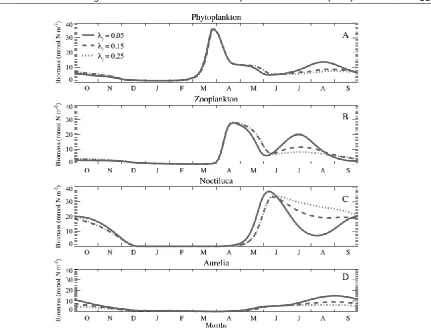
reduction in summer mesozooplankton biomass following its spring bloom (Figure 3B) that does not alter the annual phytoplankton biomass appreciably (Figure 3A) but introduces an increase in Noctiluca biomass (Figure 3C) due to the reduced effect of mesozooplankton grazing pressure on the Noctiluca population. Indirectly, the reduced predation pressure of mesozooplankton on microzooplankton and phytoplankton groups also result in a more favourable resource supply to Noctiluca. Moreover, the microzooplankton biomass is consumed preferentially
by Noctiluca. Because Noctiluca has a competitive advantage of food consumption with respect to Aurelia, the latter acquires less resource availability and thus a lower biomass (Figure 3D).
Impact of Mnemiopsis Population Outburst
We consider that the Mnemiopsis population outburst is partly related to its favourable growth conditions under relatively warm climatic conditions that developed temporally at the end of 1980s with respect to the previous cold years. The warm climatic condition introduces better temperature dependence of the growth Mnemiopsis. In particular, relatively low values of the Q10 parameter promotes higher growth
rate at low temperatures (less than 15oC) which are present in the spring transition period. The experiment S3 therefore repeats the earlier simulation S2 with a reduced Q10 value of 1.5 for the Mnemiopsis
Phytoplankton
O N D J F M A M J J A S 0
10 20 30 40
B
io
m
as
s
(m
m
o
l
N
m
-2 )
N
c = 1
N
c = 2
N
c = 3
A
N
c = 4
N
c = 5
Zooplankton
O N D J F M A M J J A S 0
10 20 30 40
B
io
m
as
s
(m
m
o
l
N
m
-2 )
B
Noctiluca
O N D J F M A M J J A S 0
10 20 30 40
B
io
m
as
s
(m
m
o
l
N
m
-2 )
C
Aurelia
O N D J F M A M J J A S Months
0 10 20 30 40
B
io
m
as
s
(m
m
o
l
N
m
-2 )
D
Figure 2. Temporal variations of total biomass within the euphotic zone for (A) phytoplankton, (B) zooplankton, (C) Noctiluca, (D) Aurelia (all expressed in mmol N m-2) under changing nutrient concentrations (Nc inmmol m-3) for the experiment S1 where λf=0.05 (d
-1
compartment whereas the Aurelia compartment maintains its former value of 2.0 (Figures. 4A-D). In addition, its higher growth and food consumption rate gives Mnemiopsis a competitive advantage to acquire higher biomass with respect to Aurelia. Thus, Mnemiopsis is able to grow during July-August and depletes gradually towards autumn due to food limitation, whereas Aurelia biomass remains at very low levels throughout the year. The biomass is almost twice as high in the case of reduced planktivorous fish predation pressure value indicating that reduced fishing pressure promotes Mnemiopsis growth in addition to changing climatic conditions. In the case of reduced planktivorous fish pressure (e.g. due to weakening of stocks under high fishery applications), higher mesozooplankton availability allows relatively high Mnemiopsis biomass (Figure 4D). When the available mesozooplankton is heavily consumed by Mnemiopsis, its subsequent low predation pressure on microzooplankton and phytoplankton supports even higher Noctiluca biomass in late-summer (Figure 4 C).
The last simulation S4 examines the conditions of Mnemiopsis biomass development under moderate eutrophication (Nc=3.5) together with the predation
pressure of either moderate planktivorous fish stock (λf = 0.1 d-1) or of low stock (λf = 0.05 d-1). Figures.
5A-D show that under moderate eutrophication and moderate planktivorous fish stock the phytoplankton biomass reduces slightly whereas the zooplankton biomass decreases up to one third (Figures. 5A, B). A relatively high reduction occurs on Noctiluca biomass due to inefficient bottom up control of this species as phytoplankton and zooplankton biomass levels decrease. Mnemiopsis biomass level is lower as compared to the previous simulation. More importantly, Aurelia co-exists with Minemiopsis as observed during 1990’s in the Black Sea. These results apply equally-well to both the low and the moderate planktivorous fish stock regimes, suggesting that Mnemiopsis biomass changes under moderate nutrient enrichment levels are independent of the fish stock changes.
Discussion and Conclusions
The Black Sea, at an increasing rate, has been under the threat of acute human-induced pressures since the middle of the previous century. As a result, weakening of its resilience against external stresses caused a severe degradation of its food web and made it more vulnerable to overexploitation, nutrient enrichment and recycling, non-native species invasion, and climatic variations. The current study is
Figure 3. Temporal variations of total biomass within the euphotic zone for (A) phytoplankton, (B) zooplankton, (C) Noctiluca, (D) Aurelia (all expressed in mmol N m-2) under changing predation pressure (λ
f in d-1) for the experiment S2 where Nc=5 (mmol m
-3
devoted to a better understanding and quantifying these effects and their impacts on the ecosystem functioning. Below we provide an interpretation of the model simulations in conjunction with the relevant observations on the ecosystem functioning of the Black Sea.
Degradation and changes in the ecosystem started with the decline of large and medium size fish stocks leaving only small-size fishes (mostly anchovy and sprat) by the 1960s (Zaitsev., 1992, Daskalov et al., 2007). This period also corresponded to an increasing rate of fertilizer use in agriculture within the former Soviet Union countries, the result of which was a 4-5 fold increase in the Danube nutrient loads and a similar increase in the nutrient pool of the entire Black Sea during the 1970s (Mee et al., 2005). In assessing the likely impacts of nutrient enrichment of the sea, the present study confirms that such an increase in nutrient content can indeed promote a major increase in small-size fish groups in the absence of their predators. The simulations also confirm that a further increase in nutrient enrichment does not support a promotion of fish stocks any further, but supports the development of a jelly food
web dominated by the heterotrophic dinoflagellate species Noctilucascintillans and the jellyfish species Aurelia aurita. The model therefore supports the ecosystem degradation beyond a critical level of enrichment as observed during the early 1980s. The model further suggests that the level of food web degradation positively correlates with the level of predation pressure of the planktivorous fish on mesozooplankton and microzooplankton groups. In the case of high fish stocks of the 1980s, higher fish predation pressure on zooplankton reduces the mesozooplankton bimass. It then causes to decline their predation pressure exerted on Noctiluca population, resulting in a particular increase of Noctiluca biomass as encountered in the 1980s, specifically along the highly degraded western coastal and shelf waters (Oguz and Velikova, 2010). The contributions of qualitative and quantitative prey items to Noctiluca bloom remains only partly understood and are not yet clearly established (e.g., Elbrachter & Qi 1998, Miyaguchi et al., 2006) this should be further investigated by model sensitivity analyses.
According to the observations, Noctiluca and
Aurelia dominated food web degradation prevailed during the 1980s that correspond climatically to severely cold winters (Nesterova et al. 2008). These type of climatic conditions did not affect Noctiluca and Aurelia populations because they can grow well in the cold climatic conditions. However, the same is not true for Mnemiopsis that has been settled into the Black Sea during the early 1980s but was not able to experience a favourable population growth until the end of 1980s. In the present study, we related this feature to the concurrent effects of anchovy overfishing and relatively warm climatic conditions during the spring transition period. Our simulations with weakening predation pressure of planktivorous fish due to the weakening of their stocks in response to a higher rate of fishing and assigning a better growth condition of Mnemiopsis due to climatic warming give rise to an abrupt increase of Mnemiopsis biomass with some corresponding changes in the rest of the food web.
Soon after the population increase of Mnemiopsis, a major reduction took place in the nutrient loads entering from the River Danube in response to the reduction in fertilizer use due to the collapse of the Soviet Union. This feature introduced a new era in the Black Sea ecosystem that is represented in our model simulations by the moderate level of enrichment accompanied with low and/or moderate level of planktivorous fish stocks; hence the low and/or moderate level of predation pressure on the lower trophic levels of the food web structure. The simulations suggest that the moderate enrichment, in spite of the warm climatic conditions, reduced Mnemiopsis biomass by roughly 30% and allowed for the simultaneous increase in the biomass of its competitor Aurelia. Thus, both Aurelia and Mnemiopsis may exist together under moderate enrichment conditions and this condition is further supported by the relatively weak control of planktivorous fish on the food web. The model
Figure 5. Simulated time distributions of (A) phytoplankton, (B) zooplankton, (C) Noctiluca , (D) Aurelia and Mnemiopsis in mmol N m-2 under moderate N
findings further suggest that reduced planktivorous fish stock indirectly results in a decrease in Noclituca through top down control on Noctiluca, whereas bottom up control by mesozooplankton causes an increase in Mnemiopsis biomass.
To conclude, the present study provides a quantitative understanding for the most critical, first order processes governing the ecosystem functioning during its four quasi-stable phases; the pre-eutrophication phase with low planktivorous fish stock (before 1970), the intense eutrophication phase with high planktivorous fish stock (the late 1970s and 1980s), low planktivorous fish stock and high Mnemiopsis biomass phase (1989-1991), and moderate eutrophication, low-to-moderate planktivorous fish stocks, moderate Mnemiopsis biomass phase (after the early 1990s).
Appendix A. Mixed Layer Dynamics and Entrainment Formulation
The deepening of the mixed layer is controlled by the entrainment rate, We , as
.
0
1
ee
with
W
W
t
H
where We is computed using the balance
between the rate of potential energy increase in the mixed layer due to buoyancy inputs and the net rate of turbulent kinetic energy production due to wind stirring and cooling in the form
1 0
1 ( )
.3
1 e
m e
e W b H m u H B W
W
In eq. (A1), Θ denotes the Heaviside step function defined by Θ(We)=1 and Θ(-We)=0 if We>0
(entrainment). u2=|τ|/ρ0denotes square of the friction
velocity with |τ| representing magnitude of the wind stress, bm=g(∆ρ/ρ0) and ∆ρ denote the buoyancy and
the density difference at the base of the mixed layer, respectively, B0=g[αQtot/ρ0Cp] the total buoyancy
flux through the surface associated with the total surface heat flux (Qtot>0 for cooling). The
contribution of the penetrative solar radiation on the turbulent kinetic energy production/destruction is neglected in eq. (A1) since it is much smaller than the other factors. The mixed layer density is not predicted for simplicity. It is therefore not possible to prescribe precisely the temporal variations of ∆ρ. On the basis of available data, we take its value as 1.0 kg m-3. The definition and values of all other parameters are given in Table A1.
In the absence of sufficient surface-generated turbulent kinetic energy to overcome stabilizing effect of the surface buoyancy flux, the mixed layer retreats to shallower depths. In this case, taking We=0, eq. (A1) reduces to H1= - [mu3/B0].
Appendix B. Mathematical Formulation of the
Model Food Web Structure
The biological source-sink and vertical transport terms are expressed by
s l s l l l n l n
l ll l
l P G P Z G P Z G P C mP P
R( ) ( ) ( ) ( )
s s s l s l n s n
s s ss
s P G P Z G P Z G P C mP P
R( ) ( ) ( ) ( )
s d s l d l n d n d d
d d
d P G P Z G P Z G P C m P
P
R( ) ( ) ( ) ( )
2 ) ( ) ( ) ( ) ( ) ( ) ( ) ( ) ( s s s s g s g f s f n s n l s l s d s s s l s s s Z Z C Z G C Z G C Z G Z Z G Z N G P G P G Z R
( ) ( )
2 2) ( ) ( ) ( ) ( ) ( ) ( ) ( l f l l l l g l g a l a l n l s l d l s l d l l l l l Z Z Z C Z G C Z G Z C G Z G N G P G P G P G Z R
n l n d n s n d n sn l n l n n l n n
n G P G P G P G N G Z C GC Z C C
C
R( ) ( ) ( ) ( ) ( ) ( ) ( )
a l a s
a a a a aa
a
G
Z
G
Z
C
C
C
C
R
(
)
(
)
(
)
m l m s
m m m m mm
m
G
Z
G
Z
C
C
C
C
R
(
)
(
)
(
)
( ) ( ) ( ) . ) ( ) ( ) 1 ( ) ( ) ( ) 1 ( ) ( ) ( ) ( ) ( ) ( ) 1 ( ) ( ) ( ) ( ) ( ) 1 ( ) ( ) ( ) ( ) ( ) ( ) ( ) 1 ( ) ( 2 2 d n n d n n s d s s l d l l m m a a n n l l s s l l s s m s m l m m a s a l a a n s n d n s n d n l n n s d s s s d d l s s l n l s l d l s l d l l l l d N C N G Z N G Z N G C C C Z Z P m P m C Z G Z G C Z G Z G C Z G N G P G P G P G Z N G P G P G P G Z C G Z G N G P G P G P G N R ) ( ) ( , , m m a a n n l l s s d d a a k k k totkk a
a P N N Z Z C C C
N
R
c
t a a k k k totk
k n
n
P
N
N
N
N
R
3, ,
)
(
1
)
(
)
(
i ji i i ji j i ji j j ij
with
b
F
b
K
F
b
T
f
g
F
G
2 1 21 2 1 1
1
1
(
)
1
F
w
F
F
F
F
W
W
H
e e
s
32 3 2 21 2 1 2 1
2 2
1
F
F
w
F
F
F
F
H
s
32 3 2 2
3 3
1
F
w
F
F
H
s
production and losses due to zooplankton grazing and physiological mortality controls temporal variations in the phytoplankton biomass. The net phytoplankton growth rate is expressed by the maximum growth rate multiplied with its limitation functions for temperature, light and nitrogen. Uptake of both nitrate and ammonium is modeled by Monod formulation. The nitrate uptake is further inhibited by an exponential function in the presence of ammonium. The attenuation of photosynthetically available radiation (PAR) within the water column is represented by an exponentially decaying function. The temperature limitation obeys the Q10 type
formulation. The distinction between phytoplankton groups is made by assigning different values for their growth rates and half saturation nitrate uptake values, and Q10 parameter values. Changes in all zooplankton
groups are controlled by ingestion, predation,
mortality, and excretion. Meso- and
microzooplankton groups feed on all phytoplankton groups and detritus at different proportions. Mesozooplankton also prey on Noctiluca and microzooplankton. Noctiluca preferentially consumes small phytoplankton and detritus as well as some microzooplankton. Mnemiopsis primarily graze up on mesozooplankton but microzooplankton forms the main diet of Aurelia. Mnemiopsis, once existed on the system, has a competitive advantage of feeding and growth with respect to Aurelia.
The ways in which the mortality and grazing functions are formulated are critical in terms of intrinsic stability properties of the food web models with multiple prey and predator groups. Numerous studies carried out during recent years (e.g., Gibson et al., 2005; Morozov et al., 2005; Gentleman et al., 2003; Fulton et al, 2003; Lima et al., 2002; Edwards, 2001; Kemp et al., 2001, and the references cited therein) have reported stable solutions for a wider range of parameters when the mortality/predation function is represented in quadratic and/or sigmoidal forms (i.e., density-dependent self-limitation) and the grazing function represented in Michaelis-Menten form. We also note here that expressing the mortality/predation rates in quadratic form for micro- and mesozooplankton groups reveals stable solutions. The grazing terms are expressed in the Michaelis-Menten functional form in terms of the maximum grazing rate, temperature limitation function, and food preference coefficients of a predator preying on different species/groups.
Fecal pellets, which constitute the unassimilated part of ingested food, dead phytoplankton and zooplankton, are the sources of labile sinking particulate organic matter. They are recycled by ingestion by zooplankton and decomposition. Dissolved organic material excreted by zooplankton groups and the particulate material decomposed form the ammonium sources. The losses are uptake during the phytoplankton production and oxidation to nitrate. The nitrate equation consists of a source term due to
nitrification and a loss term associated with its uptake by phytoplankton, and interfacial exchanges between the layers. The form of the interfacial flux terms is consistent with the absence of turbulent and sinking fluxes across the surface and the base of the chemocline layer.
The parameter values listed in Tables B1 - B4 are chosen from the published Black Sea literature, and mostly follows those given in our previous studies (Salihoglu, 1998; Oguz et al., 1996; Oguz et al., 2000, 2001a,b; Oguz and Merico, 2006).
References
BSC 2008. State of the Environment of the Black Sea (2001-2006/7), Oguz T
391 (ed) The Commission on the Protection of the Black Sea Against Pollution publication, 392 448 pp. Daskalov G.M., Grishin A.N., Rodianov S., Mihneva V.
2007. Trophic cascades triggered by overfishing reveal possible mechanisms of ecosystem regime shifts. Proc Natl Acad Sci USA 104:10518–10523 Dorofeyev, V. L., Oguz, T., Sukhikh, L. I., Knysh, V. V.,
Kubryakov, A. I., and Korotaev, G. K. 2012. Modeling long-term changes of the Black Sea ecosystem characteristics, Ocean Sci. Discuss., 9, 2039-2080, doi:10.5194/osd-9-2039-2012, 2012. Edwards, A.M. 2001. Adding detritus to a
nutrient-phytoplankton-zooplankton model: a dynamical-systems approach. Journal of Plankton Research, 23(4): 389-413. doi: 10.1093/plankt/23.4.389 Elbrachter M., Qi Z. (1998) Aspects of Noctiluca
(Dinophyceae) population dynamics. In: M. Anderson, D. Cembella & M. Hallegraeff (Eds). Physiological ecology of harmful algal blooms: 315-335.
Fulton, E.A., Smith, A.D.M. and Johnson, C.R. 2003. Mortality and predation in ecosystem models: is it important how these are expressed? Ecological Model-ling, 169: 157–178. doi: 10.1016/S0304-3800(03)00268-0
Gentleman, W., Leising, A., Frost, B., Strom, S. and Murray, J. 2003. Functional responses for zooplankton feeding on multiple resources: a review of assumptions and biological dynamics. Deep-Sea Research II, 50: 2847–2875. doi: 10.1016/j.dsr2.2003.07.001
Gibson, G.A., Musgrave, D.L. and Hinckley, S., 2005. Non-linear dynamics of a pelagic ecosystem model with multiple predator and prey types. Journal of Plankton Research, 27(5): 427–447. doi: 10.1093/plankt/fbi016 Gregoire M., Lacroix G. 2003. Exchange processes and
nitrogen cycling on the shelf and continental slope of the Black Sea basin. Global Biogeochememical Cycles, 17:1072.
Grégoire M., Friedrich J. 2004. Nitrogen budget of the north-western black sea shelf as inferred from modeling studies and in-situ benthic measurements. Mar. Ecol. Prog. Ser., 270:15–39.
modeling of the deep black sea ecosystem functioning during the late 1980s (eutrophication phase). Progress in Oceanography, 76:286–333.
Kemp, W.M., Brooks, M.T. and Hood, R.R., 2001. Nutrient enrichment, habitat variability and trophic transfer efficiency in simple models of pelagic ecosystems. Marine Ecology Progress Series, 223: 73–87. doi: 10.3354/meps223073
Korotaev, G.K., Oguz, T., Dorofeyev, V.L., Demyshev, S.G., Kubryakov, A.I. and Ratner, Y.B. 2001. Development of Black Sea nowcasting and forecasting system. Ocean Sci., 7, 629-649.
Lancelot C., Staneva J., Van Eeckhout D., Beckers J.M., Stanev E. 2002. Modeling the impact of the human forcing on the ecological functioning of the northwestern Black Sea, Estuarine. Coastal and Shelf Science, 54:473-500.
Lima, I.D., Olson, D.B. and Doney, S.C. 2002. Intrinsic dynamics and stability properties of size-structured pelagic ecosystem models. Journal of Plankton Research, 24: 533–556. doi: 10.1093/plankt/24.6.533 Mee L.D., Friedrich J., Gomoiu M.T. 2005. Restoring the
Black Sea in times of uncertainty. Oceanography (Wash DC) 18:32 – 43
Miyaguci, H.; Fujiki, T.; Kikuci, T. Et al. Relationship between the bloom of Noctiluca scintillans and environmental factors in the coastal waters of Sagami Bay, Japan. J. Plankton Res., v. 28, n. 3, p. 313-324, 2006.
Morozov, A.Y., Nezlin, N.P. and Petrovskii, S.V. 2005. Invasion of a top predator into an epipelagic ecosystem can bring a paradoxical top-down trophic control. Biological Invasions 7: 845–861. doi: 10.1007/s10530-005-5213-y
Oguz T., Ducklow J., Malanotte-Rizzoli P. 2000. Modeling distinct vertical biogeochemical structure of the Black Sea: dynamical coupling of the oxic, suboxic, and anoxic layers. Global Biogeochemical Cycles, 14 (4):1331–1352.
Oguz, T., Salihoglu, B. 2000. Simulation of eddy-driven phy- toplankton production in the Black Sea. Geophys. Res. Lett. 27 (14), 2125–2128.
Oguz T, Ducklow J, Purcell J, Malanotte-Rizzoli P. 2001a. Modeling the response of top-down control exerted by gelatinous carnivores on the black sea pelagic food
web. J. Geophys. Res., 106(C3):4543–4564.
Oguz T., Malanotte-Rizzoli P., Ducklow H.W. 2001b. Simulations of phytoplankton seasonal cycle with multi-level and multi-layer physical-ecosystem models: The Black Sea example. Ecological Modelling, 144:295-314.
Oguz T., Merico A. 2006. Factors controlling the summer Emiliania huxleyi bloom in the Black Sea: a modeling study. J. Marine Systems, 59:173-188.
Oguz T., Salihoglu, B., Fach, B. 2008a. A coupled plankton–anchovy population dynamics model assessing nonlinear controls of anchovy and gelatinous biomass in the Black Sea. Mar. Ecol. Prog. Ser. 369: 229–256
Oguz T., Fach B., Salihoglu B. 2008b. Invasion dynamics of the alien ctenophore Mnemiopsis leidyi and its impact on anchovy collapse in the Black Sea. J Plankton Res 30(12): 13851397
Oguz T., Velikova V. 2010. Abrupt transition of the northwestern Black Sea shelf ecosystem from a eutrophic to an alternative pristine state. Mar. Ecol. Prog. Ser., 405:231–242.
Oguz T., Akoglu E., Salihoglu B. 2012a. Current state of overfishing and its regional differences in the Black Sea. Ocean and Coastal Management, 58:47-56. Nesterova D.A., Moncheva S., Mikaelyan A., Vershinin A.
and others 2008. The state of phytoplankton. In: Oguz T (ed) State of the environment of the Black Sea (2001–2006/7). The Commission on the Protection of the Black Sea Against Pollution publication, Istanbul, p 173–200
Niiler, P.P., Kraus, E.B., 1977. One dimensional models of the upper ocean. In: Kraus, E.B. (Ed.), Modelling and Predic- tion of the Upper Layers of the Ocean. Pergamon Press, New York, pp. 143–172.
Salihoglu, B. (1998) Three-layer model of plankton productivity in the Black Sea basin. M.Sc. Thesis. Institute of Marine Sciences, Middle East Technical University, Turkey, 92 pp.
Zaitsev Y.P. 1992. Recent changes in the trophic structure of the Black Sea. Fish Oceanogr., 1:180–198. Zaitsev, Y. P. and Mamaev, V., 1997. Biological Diversity