www.threatenedtaxa.org
ISSN 0974-7907 (Online) | ISSN 0974-7893 (Print)
Building evidence for conservation globally
Journal of Threatened Taxa
For Focus, Scope, Aims, Policies, and Guidelines visit https://threatenedtaxa.org/index.php/JoTT/about/editorialPolicies#custom-0
For Article Submission Guidelines, visit https://threatenedtaxa.org/index.php/JoTT/about/submissions#onlineSubmissions
For Policies against Scientific Misconduct, visit https://threatenedtaxa.org/index.php/JoTT/about/editorialPolicies#custom-2
For reprints, contact <[email protected]>
Communication
Colour aberration in Indian mammals:
a review from 1886 to 2017
Anil Mahabal, Radheshyam Murlidhar Sharma, Rajgopal Narsinha Patil &
Shrikant Jadhav
26 April 2019 | Vol. 11 | No. 6 | Pages: 13690–13719
DOI: 10.11609/jott.3843.11.6.13690-13719
Partner
Member
Publisher & Host
The opinions expressed by the authors do not reflect the views of the Journal of Threatened Taxa, Wildlife Information Liaison
Communica
tion
DOI: https://doi.org/10.11609/jott.3843.11.6.13690-13719
Editor: L.A.K. Singh, Bhubaneswar, Odisha, India. Date of publication: 26 April 2019 (online & print)
Manuscript details: #3843 | Received 03 October 2017 | Final received 06 April 2019 | Finally accepted 08 April 2019
Citation: Mahabal, A., R.M. Sharma, R.N. Patil & S. Jadhav (2019). Colour aberration in Indian mammals: a review from 1886 to 2017. Journal of Threatened Taxa 11(6): 13690–13719. https://doi.org/10.11609/jott.3843.11.6.13690-13719
Copyright: © Mahabal et al. 2019. Creative Commons Attribution 4.0 International License. JoTT allows unrestricted use, reproduction, and distribution of this article in any medium by adequate credit to the author(s) and the source of publication.
Funding: None.
Competing interests: The authors declare no competing interests.
For Author details and Marathi abstract, see end of this article.
Author contribution: AM conceptualised the review. AM, RS, SJ and RP collected the literature, data, compiled and wrote the paper. RP created the figures and maps.
Acknowledgements: The authors are thankful to Dr. Kailash Chandra, Director, and Dr. S. S. Talmale, Scientist, Zoological Survey of India, for their support of this study. We would also like to express our gratitude to Dr. Hein van Grouw, Dr. Amit Sayyed, Sanjay Thakur, Ajit Joshi, Sudhir Kulkarni and Dr. S. Sathyakumar for their help in procuring some references and for photos for this study. We duly acknowledge the sources used for generating maps - Google, Gisrael, ORION-ME and ZENRIN.
Colour aberration in Indian mammals:
a review from 1886 to 2017
Anil Mahabal
1, Radheshyam Murlidhar Sharma
2, Rajgopal Narsinha Patil
3&
Shrikant Jadhav
41
1935, Sadashiv Peth, Pune, Maharashtra 411030, India.
2E-7 Srushti, New DP Road, Kothrud, Pune, Maharashtra 411038, India.
3B-55, Woodland Apt, Gandhi Bhavan Road, Kothrud, Pune, Maharashtra 411038, India.
4Zoological Survey of India, Western Regional Centre, 29 Vidya Nagar, Sector No. 29, PCNT Post, Rawet Road, Akurdi,
Pune, Maharashtra 411044, India.
1
[email protected] (corresponding author),
2[email protected]
,
3[email protected]
,
4[email protected]
Abstract: The phenomena of colour aberration (albinism, leucism, piebaldism, melanism, hypomelanism, and blue-eyed colour morph)
is reported in various mammalian species throughout the world including India. A total of 239 such instances in Indian mammals was
tabulated in this study along with maps showing locations of the records. The records from 1886 to 2017 (till July) were gathered from
published scientific literature, magazines, and images uploaded on various websites. The records were reviewed along with their
order-wise and family-order-wise representation and were analyzed. Appropriate identification of colour aberration was attempted on the basis of any
presented evidence. Altogether, 56 (out of 421) mammalian species belonging to eight orders and 19 families were reported to exhibit
various types of colour aberrations, amounting to 13.3% of the total mammalian species found in India. Of these, albinos constituted
21.8%, leucistic 14.2%, piebald 5.4%, melanistic 25.5%, hypomelanistic 18.4%, and blue-eyed white morph 1.3%; the remaining 13.4%
was undetermined. The study highlights 1) the absence of records of colour aberrations in the largest mammal family Vespertilionidae,
which contrasts with studies elsewhere, 2) the persistent occurrence of albinos in Spotted Deer and Blackbucks in Gujarat, 3) the high
number of melanistic leopards in India over the years and recent instances of melanistic Asian Golden Cats in Sikkim, 4) regular records of
hypomelanism in Gaurs of the southern Western Ghats except in the last few years. Overall, a need for further studies in colour aberration
in mammals is urged.
Keywords: Albinism, blue-eyed colour morph, chromatic disorders, hypomelanism, leucism, mammals, melanism, piebaldism.
ISSN 0974-7907 (Online) ISSN 0974-7893 (Print)
The characteristic skin in mammals is clothed with
fur or hair and its concealment may be effected by
the colour and pattern of the coat. The colouration
in animals is a function of selective pressures that
can be divided into three categories: concealment,
communication, and regulation of physiologic processes
(Caro 2005). Generally, the coat colour change depends
on the surrounding seasonal climate conditions and also
the geographic regions where they are found (Menon
2003). Besides this, the age, sex, health, and nutrition
play important roles in the looks of an animal. Mammals
also show individual coat or pelage differences even
within the same race and this is particularly so in the
case of genetic mutations such as albinism, melanism
(Menon 2003), and other types of colour aberrations
such as leucism, piebaldism, hypomelanism, and
blue-eyed white morph.
The colour aberrations are variously termed as
colour variation (Hofreiter & Schöneberg 2010),
anomalous colouration (Abreu et al. 2013), atypical
colouration (Zalapa et al. 2016), and chromatic disorder
(Lucati & Lopez-Baucells 2016). The phenomenon of
colour aberration is not uncommon in vertebrate groups
including birds and mammals. The most common
pigment in both birds and mammals is melanin (Fox &
Vevers 1960) and the pigmentation process in mammal
hair is identical to that in bird feathers (Lubnow 1963; van
Grouw 2013). There are two forms of melanin: eumelanin
and phaeomelanin (Lubnow 1963). Depending upon
the concentration and distribution within skin and fur,
eumelanin is responsible for black, grey, and/or dark
brown colours whereas phaeomelanin is responsible
for warm, reddish-brown to pale buff colours. Both
melanins together can give a wide range of
greyish-brown colours (Lubnow 1963; van Grouw 2013). The
development of melanin is the result of a biochemical
process called melanin synthesis in melanin-producing
cells (melanocytes); the amino acid tyrosine and enzyme
tyrosinase are necessary to start this synthesis. Further,
every disturbance or the heritable cause, i.e., genetic
mutation, at every stage of melanin synthesis affects the
concentration and distribution of melanin resulting in an
aberrant colour (van Grouw 2013).
The colour aberrations in mammals were described
using various terms such as albinism (pure/complete),
partial albinism, melanism, and erythrism. There is no
consensus on standard terminology to describe the
aberrations accurately. Recently, van Grouw (2006,
2013) and Mahabal et al. (2016) produced an excellent
can be extremely difficult, this key makes it possible to
name many mutations correctly. The mammals await
such imminently usable identification key.
Abreu et al. (2013) and Lucati & Lopez-Baucells (2016)
attempted to classify the aberrations for their study of
bats. We mostly continued the use of terminology based
on these literature. The terms used in this study are
summarised in Table 1 and further details are provided
below.
Albinism is a hypo-pigmentary disorder with a total
lack of both melanins in hairs, eyes, and skin due to
the heritable absence of functional tyrosinase enzyme
in pigment cells affecting all skin and hairs, resulting in
a total white plumage/fur with red eyes. Albinism is
controlled via inheritance by an autosomal recessive
gene in all animal species (Hale et al. 2005; van Grouw
2006, 2013).
Leucism is a total lack of pigmentation in the whole
body due to an inherited defect in the pigment transfer
process effecting white or whitish hair, pale skin, but
normal coloured eyes (van Grouw 2006; Abreu et al.
2013; Lucati & Lopez-Baucells 2016).
Piebaldism is a type of hypopigmentation in which
the absence of pigment is localized and is due to an
absence of melanocytes in the affected skin and hair
follicles as a result of genetic mutation. This is similar to
leucism but differs in that the melanocyte development
is only locally disrupted. Piebald animals have a variable
distribution of white spots on the body but have normal
coloured eyes (Lucati & Lopez-Baucells 2016). Although
not used widely, it seems to be the least confusing term
to denote those cases where the colour aberration
affects only part of the body.
Hypomelanism is another type of hypo-pigmentation
wherein an inherited colour aberration results in a fawn,
cream, grey, grey-brown, ashy, whitish-yellowish, light
golden-brown, or orange to light red individual with
insufficiently pigmented skin. This is mainly due to
mutations affecting melanin biosynthesis resulting in
pigment reduction in one or both of the two melanin
forms leading to various colour morphs (van Grouw
2006, 2013; Lucati & Lopez-Baucells 2016; Mahabal et
al. 2016).
Melanism is the opposite condition of albinism
Blue-eyed white morph: Blue-eyed white morph in
some instances of tigers and leopards is a morph with
dominant genes seen effecting a light ivory-coloured
to white or creamy white fur with typical black-brown
stripes, pink nose and pads, and pale blue eyes (Pant &
Dhariyal 1979). In tigers, this mutation primarily affects
the red/yellow pheomelanin pathway (Xu et al. 2013).
A number of instances of colour aberrations
occurred and were recorded in various vertebrate
species throughout the world including India. In this
context, instances of colour aberrations were reviewed
in herpetofauna (Mahabal & Thakur 2014) and birds
(Mahabal et al. 2016) in India from 1886 to 2013 and
2015, respectively. Indian mammals needed detailed
attention in this regard. In other parts of the world,
some researchers tackled this topic sporadically in
various species (Macnaghten 1918; Allen 1939; Setzer
1950; Pirlot 1958; Jones 1973; McBride 1977; Howell
1980; Smith 1982; Morris & Tutt 1996; Uieda 2000; Hsu
2003; Acevedo & Aguayo 2008; McCardle 2012; Abreu
et al. 2013).
The current communication intended to review the
instances of all types of colour aberrations recorded in
Indian mammals since 1886, including the 54 records
(marked * in Table 2) assessed by Singh (2014). The
study by Singh (2014) made a scientometric analysis
of the availability and dissemination of information
on ‘true albino’ and ‘white’ mammals accessed for the
period 1886–2014 in Indian sources usually consulted by
wildlife and natural history workers. Our focus of study,
however, was a comprehensive compilation of all types
of colour aberrations recorded in various mammalian
species, its order-wise and family-wise representation,
and its analysis. The geographic distribution pattern of
these aberrations was also provided.
METHODS
In this study, the scattered records on colour
aberrations (albinism, leucism, piebaldism, melanism,
and others) in Indian mammals were gathered from
published scientific literature available in print as well as
in digital databases such as JStor, EBSCOHost, and open
access journals. We also searched for photographic
records available in various print resources such as
newspapers and magazines and in electronic media
including platforms and websites (such as India Nature
Watch, Flickr, and Facebook). The reviewed records
range from 1886 to 2017 (till July) including some historic
records dating back to the years 1561, 1608, and 1820.
For tabular presentation of the data on records
of instances of colour aberrations of the species,
we followed taxonomic sequence and scientific and
common names as per Pradhan & Talmale (2012); we also
provided the type and description of aberration as per
the original author, our interpretation of the aberration,
locality with geographic coordinates (if available), date,
sex, remarks (if any), and the source of information. In
some instances, we noticed possible misidentification of
the type of colour aberration and tried to deduce the
more appropriate type based on any evidence present
in the text or any accompanying images. Wherever the
evidence was insufficient to accurately determine the
aberration, for example, missing details of the colour
of eyes which is essential to separate albinism from
Table 1. Terminology used to describe colour aberrations adopted from van Grouw (2006, 2013), Abreu et al. (2013), Lucati & Lopez-Baucells
(2016), and Mahabal et al. (2016) except for the blue-eyed white morph.
Aberration Effect on melanin Resulting phenotype Other names
Albinism Total lack of both melanins in skin, hair follicles, and eyes due to the heritable absence of the enzyme
tyrosinase in pigment cells. All-white hair, pale skin, and red eyes.
Total/pure/complete/perfect albinism; total amelanism
Leucism
Total lack of both melanins in all of the hair follicles and skin due to the heritable absence of pigment cells caused by the failure of melanocytes to migrate to the skin and hair follicles.
All-white or whitish hair, pale skin; eyes and/or body extremities normally coloured.
Piebaldism Total lack of melanin in part of the skin and/or hair follicles due to the heritable absence of melanocytes in the affected part.
All-white fur/skin patches; eyes
always normally coloured. Part albino
Melanism Abnormal deposition of melanin (not necessarily an increase of pigment) in the skin and/or hair follicles. Increase of black and/or reddish-brown or altered pattern. Nigrism
Hypomelanism Mutations affecting melanin biosynthesis, pigment granule trafficking, or membrane sorting. Beige, brown, golden, yellowish or reddish fur; skin and eyes always normally coloured.
Erythrism; flavism; rufism; silvering; tawny; dilution
Blue-eyed white morph Pheomelanin is largely absent, eumelanin is present in the eyes and in the hairs of stripes. Mostly seen in tigers and leopards.
Geographic information and mapping
For each occurrence, we tried to ascertain the precise
geographic location based on the information provided.
Some of the records, especially the recent ones, give
the exact geographic coordinates. In many records,
however, the coordinates associated with the locality
have the limitation of not being the exact location of the
observation due to lack of precise information. In such
cases, a central point within the locality/area was taken.
The data was plotted and georeferenced onto the map
of India using QGIS v. 2.12.2 (Open Source Geospatial
Foundation, Lyon).
RESULTS AND DISCUSSION
Altogether, 239 instances of various colour
aberrations recorded in Indian mammals over a period
of 130 years were compiled in Table 2. The Indian
mammalian fauna is represented by 420 species
belonging to 48 families and 14 orders (Pradhan &
Talmale 2012). This communication has one additional
species (Indian Cheetah
Acinonyx jubatus
), which
has since become extinct and hence is excluded from
Pradhan & Talmale (2012). The family-wise distribution
of the known species, number of aberrant colour
species, and occurrence of the number of instances in
various types of colour aberrations were summarized in
Table 3.
The analysis of Tables 2 and 3 reveals that only
56 species (out of 421 known mammalian species,
including 420 extant and one extinct species from the
region) belonging to eight orders and 19 families were
reported to exhibit various types of colour aberrations
amounting to 13.3%. Of these, albinos constituted
21.8%, leucistic 14.2%, piebald 5.4%, melanistic 25.5%,
hypomelanistic 18.45%, and blue-eyed white morph
1.3%; the remaining 13.4% was undetermined. Most of
the records under ‘undetermined’ were either albinos
or leucistic animals; however, the eye colour, which is
red/pink in albinos and normal in leucistic animals, was
not noted by the original authors.
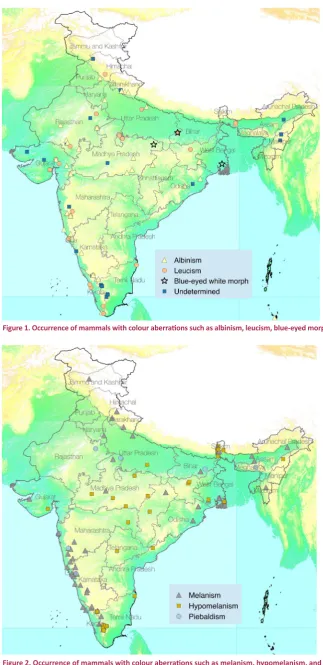
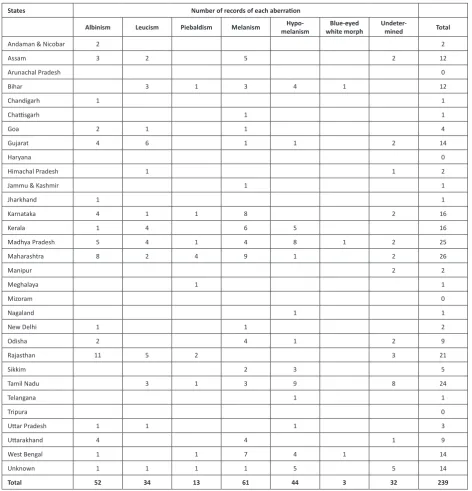
Figures 1 and 2 illustrate the spread of the
occurrences of colour aberrations on the map of India.
The reports of colour aberrations were recorded from
various regions of India with a noticeable gap in the
Deccan plateau region of Maharashtra, Telangana,
Andhra Pradesh, and Karnataka states, possibly due to
lack of published records. Very few instances of colour
the country. Blue-eyed white morph, however, seems to
be mostly from the eastern and central parts. Records of
melanistic animals were mostly from the forested areas
of the Western Ghats, the foothills of the Himalaya,
and central India. The instances of hypomelanism are
peculiarly concentrated in the southern Western Ghats
straddling the states of Kerala and Tamil Nadu. The bulk
of these records is those of the Gaur. Both melanistic
and hypomelanistic instances were almost negligible in
the northwestern states of Punjab, Haryana, Rajasthan,
and Gujarat. In fact, there is no record of any colour
aberration in mammals from the states of Haryana,
Arunachal Pradesh, Tripura, and Mizoram (Table 4).
While states like Maharashtra, Madhya Pradesh, and
Tamil Nadu have many records of colour aberration
compared to other states, states like Chhatisgarh,
Jammu & Kashmir, Jharkhand, Meghalaya, Nagaland,
and Telagana have only one record each of any colour
aberration. The gaps mentioned above indicate a need
for more observations.
The instances of colour aberrations were more
pronounced in the families Felidae (76), followed by
Bovidae (42) and Cervidae (36). Felidae also exhibited
the maximum number of instances of melanistic
animals (46), particularly in leopards (32), tigers (8),
and jungle cats (3). The highest number of instances
of hypomelanism (11) was noticed in Gaur (Bovidae),
followed by Sloth Bear (8; Ursidae) and macaques (7;
Cercopithecidae). Cervids showed the highest number
of albinistic animals (16), followed by squirrels (10;
Sciuridae). Blackbucks (Bovidae) showed the highest
number of instances of leucism (6). Piebaldism was
quite uncommon with most instances in Muridae (5).
Similarly uncommon, almost all instances of blue-eyed
white morph animals were recorded in leopards and
tigers (Tables 2 & 3).
The earliest record of colour aberration in India is of
a tigress with her cubs in 1561 in the Mughal period from
Gwalior-Malwa area of central India (Divyabhanusinh
1987a; Xu et al. 2013). Thereafter, from 1820 to 1978,
a number of wild ‘white’ tigers were reported from the
central and eastern states of India. It is unclear whether
these were albinos, leucistic, or blue-eyed white morphs
as the colour of eyes of the species were not recorded.
Figure 2. Occurrence of mammals with colour aberrations such as melanism, hypomelanism, and piebaldism in India.
most captive white tigers to Mohan of Rewa. Mohan
was a blue-eyed white morph. A programme of captive
breeding of this tiger was undertaken and its descendant
stock is now in various zoos all over the world including
India. Its genealogy was described by various authors
(namely, Oswald 1960; Gee 1964; Sankhala 1969; Pant &
Dahariyal 1979; Mishra et al. 1982; Singh 1996).
These captive instances of blue-eyed white morph
tigers were not considered in this communication.
Further, it is remarkable to note that after 1958 till date
there are no published records of the occurrence of wild
white tigers from any forested tracts of India. Singh
(2010), during his stay from 2009 to 2010 in the white
tiger country of Rewa forest in Madhya Pradesh, did not
see any wild white tigers (Table 2). Therefore, it can be
safely said that the wild strain of blue-eyed white morph
tiger has diminished from India; however, it needs a
scrupulous search from time to time.
The order Chiroptera with 117 species stands rich
among the class Mammalia; however, looking at the
instances of colour aberration occurrences, it is negligible
(Table 3). Only one type, i.e., albinism, was reported in
seven species of bats belonging to four different families
covering nine instances. This shows that albinism is rare
in bats as also opined by Khajuria (1973) and Hsu (2003).
Hsu (2003), however, stated that the highest number
of known albino cases was recorded in evening bats of
the family Vespertilionidae at the global level (42.2%),
as reviewed by Uieda (2000). In India, this family
contains 58 known species of evening bats; however, it
is intriguing to note that there is not a single instance of
any type of colour aberration recorded from this largest
family of Indian mammals. One of the reasons for this
could be that “bats have not received adequate attention
in biodiversity research in India” (Debata & Palita 2018)
and the other could be that the occurrence of albinism
is indeed rare in the group. Calderon-Alvarez &
Marin-Vasquez (2018) studied colour aberration in the
Short-tailed Fruit Bat
Carollia perspicillata
and support the
view that the cause of variation in instances of albinism
in families is unknown, but it appears to occur in species
that are both social in their breeding habits and also
fairly sedentary.
Albino individuals are more conspicuous as
compared to normal individuals. In prey species,
they are at a definite disadvantage in the struggle for
existence and very few albinos manage to escape their
natural enemies and survive to attain sexual maturity.
For this reason, albino individuals are only sporadically
Also, we see persistent records of albino Blackbucks
in the region around Ahmedabad in Gujarat, including
the Velavadar Blackbuck National Park (Table 2). The
albinos in these populations, therefore, can make good
candidates for studies about the effect of albinism on
prey-predator relationship as well as on social behaviour
within the herd. Additionally, the phenomenon of
persisting albinism in Blackbucks of Velavadar Blackbuck
NP is worth investigating.
Instances of black or melanistic leopards were
recorded in various states from 1889 onwards almost
regularly, indicating that the population of melanistic
morph is well established in the country (Table 2). This
was substantiated by the camera trapping studies since
2008 by Karanth (2014) in several wildlife sanctuaries,
namely, Anshi, Dandeli, Bhadra, and Bandipur in
Karnataka and Waynad in Kerala. About 10% of captured
images of leopards belong to black leopards, appearing
less rare than originally thought. Bashir et al. (2011)
hypothesized that a number of melanistic forms of
Asiatic Golden Cat captured in camera traps in different
parts of Prek Chu catchment area of Khongchendzohga
Biosphere Reserve, Sikkim, were either all melanistic
or of a different subspecies. It is apparent from the
above information that molecular study needs to be
undertaken on priority to establish the genetic identity
in different populations of melanistic leopards spread
over the country and the Asiatic Golden Cats from
Sikkim.
Singh (1999) is of the opinion that except for black
panthers (leopard), all other leopards and tigers with
colour aberration were discarded by natural processes;
in the case of leopards, the black forms, although
regularly seen, have not succeeded yet in replacing the
normally spotted forms as the former are comparatively
less fecund and viable.
Table 2. Records of colour aberration in Indian mammals between 1886 and 2016
(taxonomy and sequence follow Pradhan & Talmale 2012).
Taxa and common name Description of aberration as given by the original author (with remarks, if any)
Most likely aberration (sex, if any)
Aberration as named by the original
author
Locality (with decimal coordinates) and date (if any)
Source
Order: Proboscidea Family: Elephantidae
1* Elephas maximus1758 Linnaeus, Asian or Indian Elephant
Light pink skin with white hairs prominent on head, except at tip of tail giving pinkish-grey colour. Pearl eyes; mouth and palate light pink, toe and nails white. Usual black colour not visible. No change in colour even after a year.
Leucism (one female)
Albino either partial or complete
Karippanthode, 13 miles from Koni Central Forest Division, Travancore (9.0960N
& 77.0850E)
April 1945
Simon (1946)
Order: Primates
Family: Cercopithecidae
2 Macaca assamensis(McClelland, 1840) Assamese Macaque
Dorsal fur colouration exceptionally bright burnt orange (as per author, no albino cases reported in this species).
Hypomelanism
(one female) Erythrism
Rongli (27.1750N & 88.7470E),
Sikkim
(in collection of BNHS, Mumbai, Specimen No. 5119) Between 1916 and 1938
Fooden (1982)
3 Macaca assamensis Dorsal fur colouration exceptionally bright burnt orange.
Hypomelanism
(one male) Erythrism
Manshitang (27.5960N &
88.2400E), Sikkim
(in collection of Z.M.B. Berlin, Specimen No. 91098) Between 1916 and 1938
Fooden (1982)
4 Macaca assamensis Dorsal fur colouration exceptionally bright burnt orange.
Hypomelanism
(one male) Erythrism
Mokokchung (26.3190N &
94.5120E), Nagaland
(in collection of BNHS, Mumbai, Specimen No. 5115) Between 1916 and 1938
Fooden (1982)
5 Macaca assamensis Dorsal fur colouration exceptionally bright burnt orange.
Hypomelanism
(one male) Erythrism
Sookia Pokhari (26.9980N &
88.1670E), W.B.
(in collection of BNHS, Mumbai, Specimen No. 5121) Between 1916 and 1938
Fooden (1982)
6 Macaca assamensis
Dorsal fur colouration tends to bright burnt orange; bright patch of deep chestnut on ventral surface of tail.
Hypomelanism (one adult
female) Erythrism
Gopaldharan (26.6070N &
88.2200E), W.B.
(in British Museum, London. Specimen No. 25.1.11) Between 1923 and 1932
Hill (1974) as cited by Fooden (1982)
7 Macaca mulatta1780) (Zimmermann, Rhesus Macaque
Completely white-bodied pair having red face, pink eyes and nails.
Albinism (one male and one female) Albino
Zoo of H.H. Maharawat of Pratapgarh (24.0330N &
74.7810E), Rajasthan
In 1942
Bahadur (1942b)
8* Macaca mulatta An individual with very pale, golden fur with normal coloured eyes. Image by Kedar Tambe.
Hypomelanism (young) Albino
Pench N.P. (21.7620N &
79.3380E), M.P.
May 2014
Anonymous (2014)
9* Macaca mulatta - Albinism Albino Desert town of Bikaner, Rajasthan Singh & Mohnot (2009)
10 Macaca radiata 1812) (E. Geoffroy, Bonnet Macaque or Monkey
A captive male with white fur
and skin but brown irises Leucism (one male)
White/ pigment absence
India, but exact locality not given (kept in London Zoo) In 1836
Ogilby (1838) as cited by Fooden (1981)
11 Macaca radiata Pale golden brown in colour with abnormally reduced pigmentation.
Hypomelanism (one female sub-adult)
Pigment reduction
India, but exact locality not given
(kept in US National Museum of Natural History (Species No. 1221717), Washington, D.C., U.S.A.
Fooden (1981)
12 Macaca radiata A captive albino male with pink irises. Albinism (one male) Albino Trivandrum Zoo ( 8.510
0N
& 76.9550E), southern India
In 1936
Hill (1937) as cited by Fooden (1981)
13* Macaca radiata
A medium-sized macaque with absolute white fur all over body including crown. Limbs and snout pinkish. Eyes reddish (image).
Albinism (one
female) Total albino
Valpoi Village (15.5270N &
74.1360E), Sattari, North Goa
District, Goa November 2002
author
Order: Rodentia Family: Sciuridae
14 Ratufa indicaIndian Giant Squirrel or Malabar (Erxleben, 1777) Squirrel
A more reddish-brown body with varying shades of colour on face, between the ears and both the feet. Tail not completely black but dark reddish-brown patchily distributed between base and the tip, forehead and ear-tips darker.
Hypomelanism
(one male) Colour variation
Five miles north of Gungavadori Evergreen Forest (3,000ft; 10.2000N
& 77.4990E) in Palani Hills,
T.N. (in collection of BNHS, Mumbai)
Before 1952
Abdulali & Daniel (1953)
15* Ratufa indica A pure white albino squirrel with pink eyes in the company of other normal-coloured squirrels.
Albinism (one adult) Albino
Mahabaleshwar (4,000ft; 17.9220N & 73.6560E),
Western Ghats, Satara District, Maharashtra (in collection of BNHS, Mumbai) 29 December 1952
Abdulali & Daniel (1953)
16 Ratufa indica
Totally white squirrel including tail, pink mouth and ears, pinkish limbs and blood red eyes. Moving in company of normal squirrels (image).
Albinism Albino
Evergreen forest, Mahabaleshwar (4,000ft; 17.9220N & 73.6560E),
Western Ghats, Satara District, Maharashtra 22 February and 23 April 2013
Sayyed et al. (2014)
17 Ratufa indica
Total white body with pinkish snout and reddish eyes visible in image (image by Vishwatej Pawar).
Albinism Leucism Satara (17.666
0N & 73.9830E),
Maharashtra, 01 April 2015
Anonymous (2016a)
18 Eupetaurus cinereus1888 Thomas, Woolly Flying Squirrel
A jet black above and brownish-grey on forelimbs and membrane. Cheeks, chin, throat, chest, belly brownish with grey line along the middle of belly.
Melanism (one
adult) Melanism partial
Kashmir (34.07400N &
75.8100E) (kept in Leyden
Museum as reported by J. Anderson)
Before 1879
Chakraborty & Agrawal (1977)
19*
Callosciurus pygerythrus (I. Jeoffroy Saint Hilaire, 1833) Hoary-bellied or Irrawaddy Squirrel
Complete white, tail faded white, eyes red and ear untufted (image).
Albinism (12 individuals with a baby) Albino
From five different villages in Sibsagar District, Assam
Between 1992 and 2005 Kalita (2009)
20*
Callosciurus pygerythrus lokroides (Hodgson, 1836) Hoary-bellied Himalayan Squirrel
In a pair male normal-coloured, female total white with no line of demarcation between dorsal and ventral. Eyes red (image).
Albinism
(female) Albino
Samsing (27.1640N &
88.2910E), Darjeeling District,
W.B.
Bhattacharyya & Murmu (2004)
21 Funambulus palmarum(Linnaeus, 1766) Three-striped Palm Squirrel
Totally white with pinkish snout, ears and limbs, but normal-coloured eyes.
Leucism (one
adult) Leucism
Fragmented forested habitat of Gudalur Forest Division, Tamil Nadu (11.4930N &
76.3360E)
22 September 2016
Samson et al. (2017)
22 Funambulus tristriatus(Waterhouse, 1837) Jungle Palm Squirrel
Total white, bushy-tailed with snout, ears, and forelimbs pinkish. Eyes blood red. This individual was mingling with four normal-coloured squirrels (image).
Albinism (two adults) Albino
Miramar Residency (15.4960N
& 73.8080E), Panjim, Goa
24 April, 06 & 07 July 2015
Sayyed et al. (2015a)
23 Funambulus tristriatus
Squirrel with white patches on hindlimb on lateral side. Identical on other side. White hairs mixed with normal-coloured hair in tail region. Eyes, ears, snout, and limbs normal (image). Leucism (one adult) Leucistic- partial with bilateral symmetry
Miramar Residency (15.4960N
& 73.8080E), Panjim, Goa
24 April, 6 & 7 July 2015
Sayyed et al. (2015a)
24
Funambulus pennantii
Wroughton, 1905
Five-striped or Northern Palm Squirrel
Entire dorsum cream-buff without any visible stripe. Dorsum and ventrum do not show any difference. Naked skin area, anal opening with pinkish tinge, nails pale.
Leucism (one
adult male) Albinistic partially
Oudh (27.7570N & 80.7290E),
U.P. (in collection of Z.S.I. Kolkata, Regd. No. 3798)
Agrawal & Chakraborty (1979)
25 Funambulus pennantii
The whole body covered with spotless white fur, dorsum does not show any sign of striped pattern. Eyes pink.
Albinism (one
female) Albinism
Chandigarh (30.7320N &
76.7790E)
April 1981
Taxa and common name Description of aberration as given by the original author (with remarks, if any)
Most likely aberration (sex, if any)
Aberration as named by the original
author
Locality (with decimal coordinates) and date (if any)
Source
26* Funambulus pennantii
A milky white albino sub-adult without dark-coloured stripes on back. Eyes bright red, ear pinnae also reddish.
Albinism (one sub-adult) Albino
Udaipur City (24.6030N
& 73.7010E), southern
Rajasthan 06 September 2001
Sharma (2004)
27* Funambulus pennantii
Total white adult with faint red spots and narrow stripes on the flanks. Forehead yellowish. Eyes pink. A young one total white with pink eyes near nesting site (image with editors).
Albinism (one adult and one
young) Total albinism
Deogad Fort (16.3740N
& 73.3780E), Sindhudurg
District, Maharashtra 22 November 2001, November 2002, and December 2008 at the same place by first author
Mahabal et al. (2005)
28 Funambulus pennantii
A white squirrel with a small brownish patch in the middle of dorsal side of the body. Eyes red (image with editors). Its father too was albino.
Albinism (two adults) Albino
In residential area, northern Udaipur (24.6190N &
73.6860E), Rajasthan
Mid-July 2005
Mehra et al. (2007, 2010)
29 Funambulus pennantii
Total white with pinkish snout, ears, and limbs. Two white median dorsal with whitish supplementary stripes. Eyes normal-coloured (image).
Leucism Leucism
Andori (18.0860N &
74.1500E), near Lonand,
Khandala Taluk, Satara District, Maharashtra 04 September 2015
Sayyed & Mahabal (2016)
30 Funambulus Striped Palm Squirrelsp. Total white squirrel. No other details provided. Undetermined (one adult) Albinism
Near bungalow in Cutch (23.7390N & 69.8530E),
Gujarat In 1886
Newnham (1886)
Family: Muridae
31 Tatera indica (Hardwicke, 1807) (indica) Indian Gerbil or Antelope
Pure white hairs all over the body including tail and eyelashes but iris black (unlike in albinos). Exposed skin devoid of pigmentation and translucent white, other three young ones normal-coloured.
Leucism (one young female) White
Jodhpur (26.2390N &
73.0250E), Rajasthan
In 1972
Prakash et al. (1973)
32 Bandicota bengalensis 1835) (Gray, Lesser Bandicoot Rat
A totally white with pinkish tinge, pink mouth and ears, red eyes (image).
Leucism (roadkill of
adult) Total albinism
Ajinkyadurg (17.6660N
& 73.9830E), Satara,
Maharashtra 17 January 2013
Sayyed et al. (2014)
33 Bandicota bengalensis
A totally white with pinkish tinge, pink mouth and ears, red eyes (adult captured live, photographed, and released).
Albinism Total albinism
Ajinkyadurg (17.6660N
& 73.9830E), Satara,
Maharashtra 22 August 2013
Sayyed et al. (2014)
34 Madromy1881) blanfordi (Thomas, Blanford’s Rat
Out of 1213 rats trapped, one albino female captured, fur uniformly dull white along with tail, pink eyes. Mating experiment with normal male resulted all young ones normal-coloured in two litters.
Albinism (one
female) Albinism
Four miles from Sagar in forested area (14.1670N &
75.02700E), Shimoga District,
Karnataka 17 November 1966
Rajagopalan (1967)
35 Niviventer1836) niviventer (Hodgson, Himalayan White-bellied Rat
A partial albino, white on posterior side while blackish-brown on anterior side of dorsal view, on both lateral side mixed with black and white. No mixing with Domestic Rat hence a pure wild partial albino collected out of eight specimens (image).
Piebaldism (one male) Partial albinism
Dense, evergreen forest of Khasi Hills, Shillong Peak (25.5470N & 91.8750E),
Meghalaya In 1965
Rajagopalan & Mandal (1965)
36 Rattus norvegicus1769) (Berkenhont, Brown Rat or Norway Rat
A piebald (partial albino) rat having two-third body white on posterior side whereas rest of body black on dorsal side, ventral side white. Tail brown on upper side, terminal portion white (image).
Piebaldism (one
female) Piebald albino
Library Road, Dadar, Bombay (19.0280N & 72.8390E),
Maharashtra
(skin preserved in Haffkine Institute Bombay) 06 February 1960
Joshee & Kamat (1963)
37 Rattus rattusCommon House Rat (Linnaeus, 1758) Part albinos, individuals with white belly, rest of the body normal, several in population.
Piebaldism
(several) Part albino
Calcutta (22.5800N &
88.3630E), W.B.
In 1907 Hossack (1907)
38 Rattus rattus
Part albinos with white belly (recorded by The Plague Investigation Commission in India).
Piebaldism
(many) Part albino
Bombay (19.0790N &
72.8790E), Maharashtra
In 1912
author
39 Rattus rattus 16 part albinos (white belly) out of 682 (examined in rat-flea
survey). Piebaldism (16) Part albino
Bhandup, Bombay (19.1500N
& 72.9310E), Maharashtra
August to November 1959
Joshee & Kamat (1963)
40 Rattus rattus
The colour of body and tail completely black with no line of demarcation between dorsal and ventral aspects. Pinna lighter in colour.
Melanism (two males and three females) Melanism
Calcutta (22.5800N &
88.3630E), W.B. (in collection
of ZSI, Kolkata) In 1906
Bhattacharyya (1973)
41 Rattus rattus One black rat Melanism (one) Melanism
Suburban areas of Bombay (19.1560N & 72.8740E),
Maharashtra Before 1961
Joshee (1961)
Family: Hystricidae
42
Hystrix brachyura Linnaeus, 1758
Himalayan Crestless or Malayan Porcupine
An albino without any pigmentation. Absence of crest bristles on crown. Tail not brush-like.
Undetermined (one sub-adult female) Albino
28km north of Imphal on Dimapur Road (25.3670N
& 93.9830E), Imphal Dist,
Manipur (in collection of ZSI, Kolkata. Reg. No. 11349) 29 November 1945
Mandal & Ghosh (2000)
43* HystrixPorcupine sp. White Undetermined Albino Nandankanan Biological Park, Odisha Anonymous (2013 a)
Order: Erinaceomorpha Family: Erinaceidae
44 Paraechinus micropus1846) (Blyth, Indian Hedgehog
Total white together with spines, eyes reddish. Seen with a
normal individual (image). Albinism (adult) Albino
Amali Village (21.6280N
& 74.0030E), Akkalkuwa
Taluk, Nandurbar District, Maharashtra
08 August 2015
Mahabal et al. (2015)
Order: Soricomorpha Family: Soricidae
45 Suncus murinus 1766) (Linnaeus, House Shrew
An albino having general colour from pure white to dirty white, naked parts and colour of iris pinkish.
Albinism (one
female) Albinism
Jabalpur City (23.1660N &
79.9510E), M.P.
(in collection of ZSI, Jabalpur) 16 October 1975
Khajuria (1983)
Order: Chiroptera
Family: Pteropodidae
46
Rousettus leschenaultii
(Desmarest, 1820) Fulvous Fruit Bat or Leschenault’s Rousette
Albino but colour details not
given. Undetermined (one) Albino
-Karim (1983) cited by Bhati (1988)
Family: Hipposideridae
47
Hipposideros diadema (nicobarensis) (E. Geoffroy, 1813)
Diadem Leaf-nosed Bat
In a colony of 500 normal-coloured bats, one single albino with pelage of entire body white, eyes red (image).
Albinism (one
male) Albino
Forest cave at Katchal Island (7.9700N & 93.3540E),
Nicobar Archipelago, A.N. In November 2002–2003
Aul & Marimuthu (2006)
48* Hipposideros diadema(nicobarensis) The albino bat was disgorged by a Pit Viper. Albinism (one dead) Albino
Forest cave at Katchal Island (7.970 0N & 93.3540E),
Nicobar Archipelago, A.N. In November 2002–2003
Aul & Marimuthu (2006)
49 Hipposideros lankadiva1850 Kelaart, Indian Leaf-nosed Bat
Albino specimen collected along with normal individuals but no
other details provided. Undetermined Albino
Hoshangabad Dist. (22.6660N
& 77.5000E), M.P. Khajuria (1984)
50 HipposiderosLeaf-nosed Bat sp. Albino from a large colony of bat in a cave, no colour details provided.
Undetermined
(one) Albino A district in M.P. In 1972 Khajuria (1973)
Family: Rhinopomatidae
51
Rhinopoma hardwickei (hardwickei) Gray, 1831 Lesser Rat-tailed or Lesser Mouse-tailed Bat
General pelage, wing membranes, metacarpels, phalanges, and ears white to dirty white. Legs, arms, tail, face, chin, throat pinkish. Colour of eyes not mentioned. In a bat colony of 100 individuals.
Leucistism (one female) Albinism
Cave near Jabalpur City (23.1520N & 79.9370E),
M.P. (in collection of ZSI, Jabalpur)
26 April 1972
Taxa and common name Description of aberration as given by the original author (with remarks, if any)
Most likely aberration (sex, if any)
Aberration as named by the original
author
Locality (with decimal coordinates) and date (if any)
Source
52 Rhinopoma hardwickei(hardwickei) - Piebaldism (three individuals)
Partial
albinism Building Senacha & Purohit (2005)
53*
Rhinopoma microphyllum (=kinneari Wroughton) (Brunnich, 1782) Rat-tailed or Greater Mouse-tailed Bat
Albino in a bat colony in the university campus. No other details provided (image).
Albinism (one
male) Albino
University of Jodhpur (26.2910N & 73.0310E),
Jodhpur, Rajasthan During 1987–1988
Bhati (1988)
54 Rhinopoma microphyllum
A large colony of about 50,000 individuals in a cave mine, a single white-coloured pink-eyed albino sighted (image).
Albinism (one) Albino
Sipa Mines (22.4060N
& 73.6180E), border of
Jambughoda WS, Gujarat 10 June 2009
Devkar et al. (2011)
Family: Emballonuridae
55 TaphozousTomb Bat or Sheath-tailed Bat sp.
A roosting bat colony in fort groove /crevices of wall, a single white-bodied individual having reddish eyes with tinge of orange; mouth, ears and fore-arms orange-red (image).
Albinism (one) Albino Red Fort (28.656
0N &
77.2410E), Delhi
20 October 2010
Dhanya et al. (2015)
Order: Carnivora
Family: Felidae
56
Catopuma
(=Pardofelis) temminckii (Vigors & Horsfield, 1827)
Asiatic Golden Cat
Black-coloured morph (image).
Melanism (number of
individuals) Melanism
Prek Chu catchment of Khangchendzonga B,R. (27.4910N & 88.1840E),
Sikkim
January 2009 to August 2010
Bashir et al. (2011)
57 Felis chausJungle Cat Schreber, 1777 Dorsum and underside, limbs including tail dark brown.
Melanism (one) Melanism
Belgaum (15.8680N &
74.5000E), Karnataka (in
collection of BNHS, Mumbai, Reg. No. 6035).
05 December 1912
Chakraborty et al. (1988)
58 Felis chaus
Entire dorsum, tail, limbs with dark brown hairs, sides of body and cheeks with pale cream hairs.
Melanism (one) Partial melanism
Tikoli (26.3080N & 78.1090E),
22km from Gwalior, M.P. (in collection of BNHS, Mumbai, Reg. No. 6018)
February 1914
Chakraborty et al. (1988)
59 Felis chaus
Entire dorsum, under surface, and tail dark brown with some fine pale cream grizzling except in mid-dorsal region
Melanism (one) Melanism
Arcadia Tea Estate (10.0780N
& 77.2210E), T.N. (in
collection of BNHS, Mumbai, Reg. No. 6044)
22 February 1940
Chakraborty et al. (1988)
60* Felis chaus Pink colour of eyes was not obvious. Observed in camera
trap. Leucism (one)
Partial albinism
Amaravila area (8.3900N
& 77.0980E), Neyattinkara
Taluk, Thiruvananthapuram District, Kerala
Sanil et al. (2014)
61* Prionailurus bengalensis1792 Kerr, Leopard Cat
Two black-coloured individuals in
camera trap by WWF. Melanism (two) Melanistic
Bonnie Camp, Sunderbans BR, (21.8660N & 88.8910E),
South 24-Paragana Forest Division, W.B.
February 2013
Anonymous (2013c)
62 Acinonyx jubatus Indian Cheetah (Schreber)
Due to lack of pigmentation of hairs, whitish body inclined to bluishness and light coloured spots also look bluish (instead of black spots) due to body colour. Colour of eyes not mentioned (in the memoirs of Mughal Emperor Jahangir). Only known historic record.
Leucism? (one
adult) White
Orcha (25.2790N &
78.6160E), M.P.
In 1608
Divyabhanusinh (1987b, 1993)
63 Panthera pardus 1758) (Linnaeus,
Leopard or Panther Total black-coloured Leopard Melanism (one) Black
Calcutta Zoo (22.5360N &
88.3320E), W.B.
In 1889 Buckland (1889)
64 Panthera pardus Black-coloured, known to author. Melanism (one) Black Madras Residency, T.N. In 1889 Buckland (1889)
65 Panthera pardus
Uniformly black-coloured pair, deep brown belly with black blotches, normal eyes, palate and pink tongue.
Melanism (one male and one
female) Melanism
Brought from northern China (?)
1902–1903
author
66 Panthera pardus Progeny of above pair. All black-coloured cubs in two litters. Melanism (Two and five cubs)
Melanism Captive breeding at Kolhapur Zoo, Maharashtra (16.7190N
& 74.2320E)
1905–1906
Ferris (1905, 1906a)
67 Panthera pardus Shot black-coloured animal with black tongue. Melanism (one) Melanism Kanara (14.157
0N &
74.9670E), Karnataka
In 1905 Ferris (1906a)
68 Panthera pardus Shot black-coloured animal with black tongue. Melanism (one) Melanism Supa (18.336
0N & 74.3720E),
Maharashtra
In 1905 Ferris (1906a)
69 Panthera pardus
Shot animal with very dark brown to black on upperparts, little lighter on ventral parts and limbs. Tongue and mouth pink, eyes and claws normal-coloured.
Melanism
(one male) Black
Dajipur Jungle, (16.4250N &
73.9960E), Kolhapur District,
Maharashtra 12 May 1906
Ferris (1906b)
70 Panthera pardus
A black-coloured paired gave birth to six cubs in two litters in captive breeding. All cubs black-coloured.
Melanism (one male and one female adult; three males and three female cubs)
Melanism Zoological Garden, Calcutta (22.5360N & 88.3320E), W.B.
July 1925 to 1926 Ali (1927)
71 Panthera pardus Black colour with pale blue eyes, caught and transported to Calcutta Zoo.
Melanism (two males and one female)
Black (two males and one female)
Forest of Dannig (26.6290N &
91.5070E), Assam
05 November 1931 Pizey (1932)
72 Panthera pardus
A black-coloured pair gave birth to six cubs in three litters. All cubs black in colour during captive breeding.
Melanism (one male and one female adult; three males and three female cubs)
Black Jamnagar (22.47270.0570E), Gujarat 0N &
January 1939 to June 1940
Bahadur (1942a)
73 Panthera pardus Shining black-coloured coat with very faint brown spots. Melanism (one) Black
Bhaluharcar Cave, Meur Hot Spring, Eastern Kharagpur Forest Range (25.1260N &
86.5460E), Bihar
Between 1990 and 1996
Sinha (1996)
74 Panthera pardus Black in colour Melanism (one) Black
Morwe River near Sinhoul Village, West Kharagpur Forest Range (22.3330N &
87.2940E), Bihar
Between 1990 and 1996
Sinha (1996)
75 Panthera pardus Black leopard basking in sun during winter months. Melanism (one) Black
Gridhakoot Hill, Kharagpur Forest Range (25.1260N &
86.5460E), Bihar
Between 1990 and 1996
Sinha (1996)
76 Panthera pardus A captive black leopard. Melanism (one) Black Nandankanan Park (20.397
0N
& 85.8200E), Orissa
Between 1990 and 1996 Sinha (1996)
77 Panthera pardus Black-coloured animal seen in wild state. Melanism (one male) Black
Corbett N.P. near Ramnagar (29.4360N & 79.1290E),
Uttarakhand March 1958
Bedi (1998)
78 Panthera pardus Black colour, transported from Assam to Nandankanan Park, Orissa.
Melanism (one male) Black
Guwahati Aviary (26.1460N &
91.7350E), Assam
18 October 1972 Bedi (1998)
79 Panthera pardus Black-coloured cubs in captive breeding born to a normal-coloured female and black male.
Melanism (one male and two cubs)
Black Nandankanan Biological Park (20.3970N & 85.8200E), Orissa
02 August 1973 Bedi (1998)
80 Panthera pardus Black-coloured. Melanism (one) Black Delhi Zoo (28.601
0N &
77.2440E), Delhi
In 1998 Bedi (1998)
81 Panthera pardus
Black-coloured with black rosette hidden beneath the black pigmentation in wild state (probably the same individual sighted in different months at same locality; image with editors).
Melanism (one) Melanism
Kas plateau, part of Western Ghats (17.7210N & 73.8230E),
Satara District, Maharashtra 08 December 2010, 21 March 2012, 13 April 2012
Taxa and common name Description of aberration as given by the original author (with remarks, if any)
Most likely aberration (sex, if any)
Aberration as named by the original
author
Locality (with decimal coordinates) and date (if any)
Source
82 Panthera pardus Black in colour in hilly areas in wild state. Melanism (one) Melanism
Near Manohar Mansantosh Twin Forts (15.8970N
& 73.6840E), Western
Ghats, Sindhudurg District, Maharashtra.
03 June 2009
Sayyed et al. (2013); Anonymous (2009)
83 Panthera pardus Black-coloured wild leopard sighted by local people and
forest department personnel. Melanism (one) Melanism
Chandoli NP (17.1680N &
73.7710E), Sangli District,
Maharashtra Between 2008 and 2012
Sayyed et al. (2013)
84 Panthera pardus Black-coloured with black rosette (sighted thrice in the same area
in wild; image with editors). Melanism (one) Melanism
Banks of Bhadra Reservoir in Bhadra TR (13.6850N
& 75.6410E), Chickmaglur
District, Karnataka 22 February 2012, April 2012, May 2012
Sayyed et al. (2013)
85* Panthera pardus One or more black leopards caught in camera traps (image by Ulhas Karanth).
Melanism (one
or more) Melanistic
Dandeli WS, (15.2470N &
74.6340E), Karnataka
In 2008–2016 Karanth (2014)
86* Panthera pardus --do-- Melanism Melanistic Anshi NP (14.998
0N &
74.3580E), Karnataka
In 2008–2016 Karanth (2014)
87* Panthera pardus --do-- Melanism Melanistic Bhadra WS (13.446
0N &
75.5740E), Karanataka
In 2008–2016 Karanth (2014)
88* Panthera pardus --do-- Melanism Melanistic Bandipur NP (11.665
0N &
76.6280E), Karnataka
In 2008–2016 Karanth (2014)
89* Panthera pardus --do-- Melanism Melanistic Wynaad, Nilgiri BR (11.934
0N
& 76.0040E), Kerala
In 2008–2016 Karanth (2014)
90* Panthera pardus Personal observations of black leopards by Tariq Badar during his treks and camping in the wild.
Melanism
(several) Melanistic
Shivalik Hills and Terai areas of Uttar Kashi Dist. (30.9280N
& 78.4750E), Uttarakhand
In 1994–2014
Badar (2014)
91* Panthera pardus --do-- Melanism (several) Melanistic
Shivalik Hills and Terai areas of Dehradun Dist. (30.3160N
& 78.0310E), Uttarakhand
In 1994–2014
Badar (2014)
92* Panthera pardus --do-- Melanism (several) Melanistic
Shivalik Hills and Terai areas of Pilibhit Dist. (28.5830N &
80.0080E),
Uttarakhand In 1994–2014
Badar (2014)
93 Panthera pardus
Fur with dense deposit of melanin, closet black rosettes present but hidden beneath the black pigmentation. A roadkill (image).
Melanism (sub
adult male) Melanism
Mumbai-Bengaluru Highway near Satara City (17.6580N &
74.0140E), Maharashtra
27 March 2015
Sayyed & Mahabal (2015)
94* Panthera pardus A single black panther. Melanism (one) Melanistic Sanguem (15.230
0N &
74.1500E), Goa
December 2015
Anonymous (2015)
95 Panthera pardus
Skin pale rich buff, spots dull orange, eyes bright sky blue but not pink-coloured. Black hairs at the tip of tail.
Blue-eyed white morph (one female)
Pale-coloured
form Calcutta (22.580
0N &
88.3630E), W.B.
In 1940–1941 Fooks (1941)
96 Panthera pardus Animal shot had ground pale colour than usual with tan spots. Hypomelanism (one) Pale-coloured form
Dumraon State (23.9650N
& 85.3650E), Hazaribagh
District, Bihar (in British Museum, London) Before 1940
Fooks (1941); Pocock (1939)
97 Panthera pardus
A semi-albino was shot, had white body with pale background, rosette in darker shed of tan (image).
Hypomelanism (one)
White/semi- albino
Dumraon State (23.9650N
& 85.3650E), Hazaribagh
District, Bihar Before 1940
Ingen & Ingen (1941)
98 Panthera pardus Killed animal had light sandalwood colour. Skin exists. Hypomelanism (one) Mutant
Jhinna, near Ajaigarh (24.7260N & 80.1880E), Panna
District, M.P. In 1905
author
99 Panthera pardus Shot a white animal with sandalwood-coloured light spots all over the body.
Hypomelanism
(one) Mutant
Aramgang Village, Ajaigarh (24.7260N & 80.1880E), Panna
District, M.P. (mounted trophy in Ajaigarh Palace) In 1965
Divyabhanusinh (1993)
100 Panthera pardus White leopard shot but no other details. Leucism? (one) White or mutant Dumraon (25.549
0N &
84.1500E), Bihar
In 1910
Divyabhanusinh (1993)
101 Panthera pardus White leopard shot but no other details. Leucism? (one) White or mutant Dumraon, (25.549
0N &
84.1500E), Bihar
In 1927
Divyabhanusinh (1993)
102 Panthera pardus
White animal was shot, at sides creamy towards centre with pale brown spots, tail normal. Eyes sky blue (no trace of pink in the eye when shot).
Blue-eyed white morph (one female)
White or mutant
15 miles from Sarasaran near Dumraon (25.5490N &
84.1500E), Bihar
In 1930
Divyabhanusinh (1993)
103 Panthera pardus The ground colour of the skin much paler than usual, almost cream and the pattern tanned.
Hypomelanism
(one) Mutant
Hazaribagh (23.9650N &
85.3650E), Bihar (in British
Museum, London) In 1939
Divyabhanusinh (1993)
104 Panthera pardus White (albino) leopard, but no other details provided. Albinism? (one) White or mutant Not given Before 1907 Divyabhanusinh (1993)
105 Panthera pardus White leopard skin but no other details provided. Leucism? (one) White or mutant Tikamgarh near Orcha (24.9740N & 78.9280E), M.P.
in 1967
Divyabhanusinh (1993)
106 Panthera pardus The skin normal except for having light brown spots instead of black.
Hypomelanism?
(one) Mutant No information Before 1929 Divyabhanusinh (1993)
107 Panthera pardus Pure white (rare in nature). No other details provided. Leucism? White
Hazaribagh (23.9650N &
85.3650E), Bihar (in British
Museum, London) Bedi (1998)
108 PantheraTiger or Royal Bengal Tigertigris (Linnaeus, 1758) Black-coloured animal was killed. Melanism (one) Black-coloured West Bengal In 1889 Buckland (1889)
109 Panthera tigris Total black animal basking on rocks in the evening. Melanism (one) Black-coloured
Harrow (9.8660N &
77.1490E), Cardamom Hills of
Travancore, Kerala In autumn of 1895
Capper Stewart (1914)
110 Panthera tigris Very dark coloured animal was shot. Melanism (one) Dark coloured In forest of Central Province In 1912 Pitman (1912)
111 Panthera tigris Animal with very pale yellow skin was shot. Hypomelanism (one) Pale yellow colouration 20 miles away from above forest of Central Province
In 1912 Pitman (1912)
112 Panthera tigris Black in colour. Melanism (one) Black Lushai Hills, (23.585
0N &
92.8480E), Assam
In 1929 Pocock (1929)
113 Panthera tigris A young tiger having dark brown body with black stripes on dark
background shot. Melanism (one) Melanism
Central Province
A few years before 1936 Prater (1937)
114 Panthera tigris Black-coloured animal. Melanism (one young) Melanism Dibrugarh (27.473
0N &
94.9120E), Assam
In 1915 Prater (1937)
115 Panthera tigris A black tiger of Royal Bengal type. Melanism (one) Black-coloured
Forest in Dibrugarh, (27.4730N & 94.9120E),
Assam 10 October 1936
Prater (1937)
116 Panthera tigris Colour uniformly brown, stripes not visible (to camouflage in the open sandy tracks of Sunderban)
Hypomelanism
(one) Brown variety
Khulana or Backerganj (22.2220N & 88.8390E),
Sunderban, W.B. (from dist. Gazetteer of Bengal)
Prater (1937)
117 Panthera tigris
Black skin with tawny stripes on back and white stripes on ventral side. Seen several times by forest officials (animal was shot).
Melanism
(one female) Melanism
Podagad Village, Bhandan River Valley, Similipal TR (21.7500N & 86.3330E), Orissa
July 1993
Prusty & Singh (1996a)
118* Panthera tigris Black tiger caught in camera trap. Melanism (one) Melanistic Similipal TR, (21.750
0N &
86.3330E), Orissa
July 2012