The Journal of Threatened Taxa (JoTT) is dedicated to building evidence for conservation globally by publishing peer-reviewed articles online every month at a reasonably rapid rate at www.threatenedtaxa.org. All articles published in JoTT are registered under Creative Commons Attribution 4.0 International License unless otherwise mentioned. JoTT allows allows unrestricted use, reproduction, and distribution of articles in any medium by providing adequate credit to the author(s) and the source of publication.
www.threatenedtaxa.org
ISSN 0974-7907 (Online) | ISSN 0974-7893 (Print) Building evidence for conservation globally
Journal of Threatened Taxa
For Focus, Scope, Aims, Policies, and Guidelines visit https://threatenedtaxa.org/index.php/JoTT/about/editorialPolicies#custom-0 For Article Submission Guidelines, visit https://threatenedtaxa.org/index.php/JoTT/about/submissions#onlineSubmissions For Policies against Scientific Misconduct, visit https://threatenedtaxa.org/index.php/JoTT/about/editorialPolicies#custom-2 For reprints, contact <[email protected]>
Communication
A case study on the public knowledge and awareness of
the Philippine Pangolin Manis culionensis (Mammalia:
Pholidota: Manidae)
Frances Mae Tenorio & Joselito Baril
26 September 2019 | Vol. 11 | No. 12 | Pages: 14484–14489 DOI: 10.11609/jott.4983.11.12.14484-14489
Partner
Member
Threatened Taxa
Publisher & Host
PLATINUM OPEN ACCESS
Communica
tion
DOI:https://doi.org/10.11609/jott.4983.11.12.14484-14489
Editor: Priya Davidar, Sigur Nature Trust, Nilgiris, India. Date of publication: 26 September 2019 (online & print)
Manuscript details: #4983 | Received 02 April 2019 | Final received 03 September 2019 | Finally accepted 10 September 2019
Citation:Tenorio, F.M. & J. Baril (2019). A case study on the public knowledge and awareness of the Philippine Pangolin Manis culionensis (Mammalia: Pholidota: Manidae). Journal of Threatened Taxa 11(12): 14484–14489. https://doi.org/10.11609/jott.4983.11.12.14484-14489
Copyright: © Tenorio & Baril 2019. Creative Commons Attribution 4.0 International License. JoTT allows unrestricted use, reproduction, and distribution of this article in any medium by adequate credit to the author(s) and the source of publication.
Funding: Department of Science and Technology ASTHRDP-NSC scholarship.
Competing interests: The authors declare no competing interests.
Author details: Frances Mae Tenorio is currently an MS in wildlife studies student. Her researchinterests are animal behavior, behavioral ecology, anthrozoology, and environmental psychology. Joselito Baril is currently an Assistant Professor in the Animal Biology Division. He specializes in conservation biology, genetics, vertebrate biology and environmental science. His research interests include conservation genetics and behavioral ecology.
Author contribution: FMT conceptualized and designed the study, gathered data, performed statistical analysis and interpretation, wrote the draft and revisions of the manuscript. JB provided revisions to the scientific content and is the adviser of the study.
Acknowledgements: The authors would like to thank the Biodiversity Conservation Society of the Philippines and all the individuals for sharing the online survey in their social media accounts and Dr. Eleanor Aurellado for her assistance during the statistical analysis of the data.
A case study on the public knowledge and awareness
of the Philippine Pangolin Manis culionensis (Mammalia:
Pholidota: Manidae)
Frances Mae Tenorio 1 & Joselito Baril 2
1,2 Institute of Biological Sciences, College of Science, University of the Philippines Los Banos, Batong Malake, Los Baños Laguna 4031, Philippines. 1 [email protected] (corresponding author), 2 [email protected]
Abstract: Pangolins are poorly known species despite their high demand in the illegal international trade. This study has been conducted
to analyze the awareness of Filipinos towards the endemic Philippine Pangolin Manis culionensis and how much they would be willing to contribute to its conservation. The respondents were selected from the social media reach of the researchers. The results showed that most of the respondents know about the pangolin from mass media such as news from television. Social media is also a factor in their awareness of the animal. They unanimously agreed that pangolins are important ecologically rather than its medicinal value in the illegal market trade. Overall, the respondents showed a high degree of knowledge of pangolins and have favorable attitudes towards its conservation.
Keywords: Conservation, Manis, social media, trade.
ISSN 0974-7907 (Online) ISSN 0974-7893 (Print)
Public knowledge on the Philippine Pangolin Tenorio & Baril
Journal of Threatened Taxa | www.threatenedtaxa.org | 26 September 2019 | 11(12): 14484–14489 14485
INTRODUCTION
There are only eight extant species of pangolins in the world (Lim & Ng 2007). Unfortunately, all pangolin species are in high demand for international illegal trade, most especially in China, making them the most visible and most voluminous mammals in trade. They are traded for skin (leather goods like boots and shoes), scales (traditional medicine), and meat (food and traditional medicine) (Schoppe & Cruz 2009).
Among the eight species, only one species is found in the Philippines. The Philippine Pangolin Manis culionensis, locally known as Balintong, is endemic to the Palawan faunal region (Lagrada et al. 2015). It occurs in lowland primary and secondary forests, grassland/ secondary growth mosaics and mixed mosaics of agricultural lands and scrubland adjacent to secondary forests (Esselstyn et al. 2004; Heaney et al.1998). It is currently classified as Endangered by the IUCN Red List (2015) and under Appendix I of the Convention on the International Trade of Endangered Species of Flora and Fauna (2016) (CITES). Currently, there is an increase in the demand in the local trade for live pangolins. In November 2017, two individuals were found in Manila and taken into custody by the Biodiversity Management Bureau (BMB). This year, five individuals were found again in Manila and were surrendered to BMB. All individuals were allegedly caught to be sold as delicacy for private individuals (Sy pers. comm. 05 March 2018).
Conservation in the Philippines is inextricably linked to social and political issues. The country was long under colonial rule, and its natural resources were traditionally controlled by the elite and powerful, whose unsustainable and inequitable exploitation devastated the environment and marginalized the poor (Broad & Cavanagh 1993; Pineda-Ofreneo 1993). But considerable progress in environmental protection legislation has been made, driven in part by public advocacy. Of significance to biodiversity conservation are the National Integrated Protected Areas System (NIPAS) Act of 1992, the establishment of protected areas, and the 2002 Wildlife Resources Conservation and Protection Act. At the international level, Philippines is one among the signatories to the Convention on Biological Diversity and other agreements such as CITES, and the Ramsar Convention on Wetlands (Posa et al.2008). With the on-going efforts of the government and conservation groups, public interest in biodiversity conservation has
increased.
In 2017, Gamalo et al. conducted a case study on the Philippine Wildlife and wildlife laws’ awareness in
tertiary education. In the study, it was found that the Philippine Pangolin is among the endemic wildlife which were poorly known to the students. Since the decline of pangolin populations is due to anthropogenic pressures such as illegal trade, poaching, and deforestation, it is important to determine the public knowledge and perception towards the animal. Thus, this study is aimed at determining the public knowledge on the Philippine Pangolin and their awareness of the plight of this poorly studied species. It is also aimed to identify the willingness of the public to participate in the conservation of pangolins. The data collected will help in creating a suitable campaign and awareness programs for the Philippine Pangolin.
METHODS
An online survey, created through Google forms, was used for the collection of data. Google forms was selected since it is easy to operate, and the survey generated can be easily answered by the respondents. The survey was disseminated via Facebook and Twitter. The survey was opened online and shared for one month to allow a large number of respondents to access the survey. A total of 169 respondents from various regions all over the Philippines answered the survey. These respondents were from regions where no pangolin is found. It should be noted, however, that the respondents from this survey were selected from the researchers’ social media reach and does not reflect the general populations’ knowledge and awareness about the Philippine Pangolin.
The survey questionnaire is composed of 14 questions which is divided into three sections: knowledge on pangolins, awareness on laws protecting the pangolin, and willingness to participate in conservation activities related to the Philippine Pangolin.
All statistical analyses were done using R Studio version 3.4.3 (R Core Team, 2018). Percentage was taken using package ‘prettyR’(Lemon & Grosjean 2018).
RESULTS
from Region IV-A (CALABARZON) and 10.1% are from Region III (central Luzon).
Knowledge of pangolins
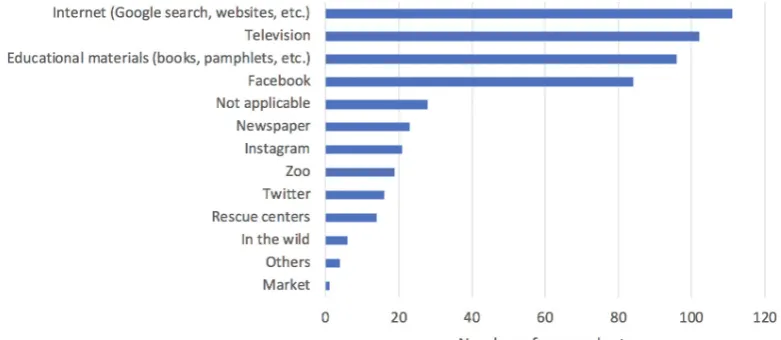
Majority of the respondents (74.56%) claimed to know the animal shown in the survey; the popular answers included the pangolin and armadillo (Table 2). The respondents were also asked whether they knew what the animal in the photo ate. Many of the answers included insects, ants, and termites. In terms of encounter, the respondents were more likely to encounter a pangolin on the internet, television,
Table 1. Demographic characteristics of respondents (n=169).
Category Overall %
Gender Male 49.11
Female 50.89
Age 12–20 28.67
21–30 51.48
31–40 14.2
41–50 2.96
51 and above 2.37 Educational
Attainment Secondary 12.13
Tertiary 66.27
Post graduate (MS) 18.24
Post graduate (PhD) 2.37
Region NCR 49.11
Region IV-A 23.08
Region III 10.06
Region IV-B 4.14
Region V 2.37
Region VI 2.37
Region XIII 2.37
Region VII 1.78
Region XI 1.78
Region XII 1.18
CAR 0.59
Region IX 0.59
Region X 0.59
Monthly income Not applicable 40.24 10,000 PHP and below 10.65
11,000 – 20,000 PHP 17.75 21,000 – 30,000 PHP 15.98 31,000 – 40,000 PHP 6.51
41,000 – 50,000 PHP 2.96 51,000 and above 5.92
Table 2. Respondents’ answers to whether they know the animal in the photo or not (N=169).
Overall %
Yes 74.56
No 25.44
Pangolin 63.90
Armadillo 11.24
Philippine pangolin 7.69 Palawan pangolin 3.55
Anteater 2.96
Porcupine 1.18
Balintong 0.59
I don’t know 2.37
Table 3. Respondents’ answers to whether they think a pangolin is beneficial or harmful (N=169).
Overall % Yes, it is beneficial 99.41
No, it is harmful 0.59
Ecological 87.57
Cultural 4.14
Medicinal 1.18
Don’t know 7.1
educational materials, and through Facebook.
Many stories and myths generated from the relationships between animals and man had been passed on from generation to generation (Setlalekgomo 2014). Based on the responses, it was found that medicinal use is the most widely known belief associated with pangolins. Setlalekgomo (2014) noted that pangolins were used as bush meat and different body parts of pangolins were used in traditional medicine by indigenous people. Pangolins were used in traditional medicine to cure several human ailments as well as being used in charm making. The respondents, however, unanimously agreed (99.41%) that the pangolin is beneficial due to its ecological role in the environment (87.57%) (Table 3).
Awareness on laws protecting pangolins
Public knowledge on the Philippine Pangolin Tenorio & Baril
Journal of Threatened Taxa | www.threatenedtaxa.org | 26 September 2019 | 11(12): 14484–14489 14487
Willingness to participate in conservation of pangolins
The respondents were willing to donate in kind to the conservation of pangolins. Majority of the respondents were willing to volunteer to conserve pangolins (94.1%) through awareness on social media platforms, educational campaigns, and research (Fig. 1).
DISCUSSION
Communication has been used throughout human history to impart information, teach skills, influence attitudes and perceptions, moderate debate and disagreement, cre ate connections between individuals and groups, inspire new ideas, and facilitate cultural and behavioral changes (Anderson-Wilk 2009). It is often cited for its role in creating change (King 2003; Rogers 2003). At the core of a conservation movement is a
communication movement. This is primarily because con servation requires change, and change requires communication (Anderson-Wilk 2009). Communication can be channeled through mass media such as television and radio, literature such as articles and books, and social media. Media particularly television has the largest impact on the familiarity of respondents with wildlife. Television shows on channels such as National Geographic, Discovery Channel, Animal Planet, BBC Earth, Born to be Wild and local and international news feature wildlife. Mass media often targets a wide range of audience and is effective at creating initial awareness and interest (FAO 2006).
The high degree of knowledge of the respondents shows that the use and influence of electronic media such as television and internet have a positive impact on the knowledge on pangolins. According to Brossard & Scheufele (2013), the news media portrayal of wildlife is related to public conservation awareness and shows good or positive content of intervention information. This may strengthen environmentally-favorable behavior, thereby increasing the public’s knowledge on biological conservation (Shiffman 2012; Fauville et al. 2014; Bombaci et al. 2015; Minin et al. 2015). The news media have different types of coverage and portrayal of wildlife issues (Muter et al. 2013), which could direct the public’s attitudes towards conservation (Wu et al. 2018). This is shown by the high number of respondents knowing that the pangolin is an animal that should be protected and conserved.
Creating a conservation education movement to connect between people with nature is not easy (Abd Mutalib et al. 2013). Finding a balance between monetary values with conservation value might be
Table 4. Respondents’ answers to participate in conservation activities (N=169).
Overall %
Willingness to donate Yes 91.7
No 8.3
In kind 68.6
Monetary 31.4
Willingness to
volunteer Yes 94.08
No 5.92
Awareness through
social media 78.1 Educational
campaigns 60.9
Research 59.2
difficult, and requires an in-depth understanding of the aspects such as carrying capacity, demographic structures, and conservation interests (Humavindu &
Stage 2014). Social demographics such as age, gender,
level of education, monthly income and years at residence play an important role in the determination of the level of awareness towards wildlife, and often act as behavioral predictors (Thornton & Quinn 2009; Loyd & Miller 2010; Mahmood-ul-Hassan et al.
2011; Shumway et al. 2014). In this study, however, social demographics do not have any implications on the knowledge and awareness on pangolins based on the age, educational attainment and monthly income of the respondents.
Social media such as Facebook shows that social media is a great tool in spreading knowledge and awareness on pangolins. Currently, there are 47 million active users of Facebook in the Philippines. Convenient social platforms such as Facebook are believed to have a great power in impacting on public awareness on wildlife conservation. In fact, studies have shown that even conservation science information extracted from professional conferences can be delivered to more audience via social media forums such as Twitter (Shiffman 2012; Bombaci et al. 2015; Wu et al. 2018). The data on social media can potentially play an important role in conservation since it can be used to learn more about the spatio-temporal patterns, values, and activities related to biodiversity conservation of different groups of people. Moreover, social media can directly target specific citizen science campaigns (Minin et al. 2015).
Citizen science is defined as the practice of engaging the public in a scientific project – a project that produces reliable data and information usable by scientists, decisionmakers, or the public that is open to the same system of peer review that applies to conventional science (McKinley et al. 2017). Citizen scientists can spread knowledge among their friends, family, and colleagues by sharing their citizen science activities and discussing the issues (Nerbonne & Nelson 2004; Overdevest et al. 2004; Johnson et al. 2014; Forrester et al. 2016) on pangolins. The respondents were willing to volunteer out of moral obligation, gaining knowledge, passion and compassion towards animals, satisfaction, advocacy, and research background. They chose volunteering to raise awareness through social media because of its wider audience capacity, low-cost effectiveness, viability, and easy use.
Respondents were likely to conserve and protect pangolins due to its ecological importance, endemism,
rarity, intrinsic value, inherent value, aesthetic value, economic benefits through ecotourism, cultural value, and conservation status. The respondents also believe that pangolins are needed to maintain biodiversity and are equally important species that needs conservation to prevent extinction.
According to the respondents, awareness through dissemination of information via social and mass media, and seminars and orientations, baseline research, protection of natural habitat, and strict enforcement of law are the programs needed to protect and conserve pangolins.
CONCLUSION
Public awareness on wildlife is essential to the effectiveness of wildlife conservation and protection. The respondents were well aware of the Philippine Pangolin and had favorable attitudes towards wildlife protection and conservation. The awareness on wildlife were most likely due to mass media and social media. This implies that these media should be used by conservationists and conservation groups to promote and disseminate information regarding wildlife.
REFERENCES
Anderson-Wilk, M. (2009). Changing the engines of change: Natural
resource conservation in the era of social media. Journal of Soil and
Water Conservation 64(4): 129A–131A. https://doi.org/10.2489/
jswc.64.4.129A
Bombaci, S.P., C.M. Farr, H.T. Gallo, A.M. Mangan, L.T. Stinson, M. Kaushik & L. Pejchar (2015). Using Twitter to communicate conservation science from a professional conference. Conservation
Biology 30: 216. https://doi.org/10.1111/cobi.12570
Broad, R. & J. Cavanagh(1993).Plundering Paradise: The Struggle for
the Environment in the Philippines. University of California Press, Berkeley, 244pp.
Brossard, D. & D.A. Scheufele(2013). Science, new media, and the
public. Science 339(6115): 40–41.
CITES (2016). Consideration of proposals for amendment of appendices I and II, CoP17 Prop. 10. Seventeenth meeting of the Conference of the Parties, 24 September–5 October 2016. CITES, Johannesburg, South Africa, 1–13.
Esseltlyn, J.A., P. Widmann & L.R. Heaney(2004). The mammals of
Palawan Island, Philippines. Proceedings of the Biological Society of Washington 117(3):271–302.
FAO (2006). Information and Communication for Natural Resource
Management in Agriculture: A Training Sourcebook. Food and Agriculture Organization, United Nations, Rome, 131pp.
Fauville, G., A. Lantz-Andersson & R. Säljö (2014). ICT tools in
environmental education: reviewing two newcomers to schools.
Environmental Education Research 20(2): 248–283. https://doi.org
/10.1080/13504622.2013.775220
Public knowledge on the Philippine Pangolin Tenorio & Baril
Journal of Threatened Taxa | www.threatenedtaxa.org | 26 September 2019 | 11(12): 14484–14489 14489
https://doi.org/10.1016/j.biocon.2016.06.025
Gamalo, L.E. A.J. Cabañas, K.J. Suetos, J.I Tauli, N.J Vegafria, F.M. Tenorio, M. Galapon, J. Balatibat. (2018). Awareness and perception on wildlife and conservation of teachers and college students in Los Baños, Laguna Philippines. Journal of Biodiversity and Environmental Sciences 12(2): 160–167.
Heaney, L.R., D.S. Balete, M.L. Dolar, A.C. Alcala, A.T.L. Dans, P.C. Gonzales, N.R. Ingle, M.V. Lepiten, W.L.R. Oliver, P.S. Ong, E.A.
Rickart, B.R. Tabaranza, Jr. & R.C.B. Utzurrum (1998).A synopsis of
the mammalian fauna of the Philippine Islands. Fieldiana: Zoology, n.s., 88: 61pp.
Humavindu, M.N. & J. Stage (2014). Community-based wildlife management failing to link conservation and financial viability.
Animal Conservation 18, 4–13. https://doi.org/10.1111/acv.12134 Johnson, M.F., C.Hannah, L. Acton, R. Popovici, K.K. Karanth & E.
Weinthal (2014). Network environmentalism: Citizen scientists as agents for environmental advocacy. Global Environmental Change
29: 235–245. https://doi.org/10.1016/j.gloenvcha.2014.10.006
King, D. (2003). Communicators as architects of change. Journal of
Applied Communications 87(1) : 1–3. h
ttps://doi.org/10.4148/1051-0834.2179
Lagrada, L., S. Schoppe & D. Challender (2014). Manis
culionensis. The IUCN Red List of Threatened Species 2014: e.T136497A45223365. Downloaded on 08 April 2018. https://doi. org/10.2305/IUCN.UK.2014-2.RLTS.T136497A45223365.en
Lemon, J. & P. Grosjean(2018). prettyR: Pretty Descriptive Stats. R
package version 2.2-2. https://CRAN.R-project.org/package=prettyR Lim, N.T.L. & P.K.L. Ng (2007). Home range, activity cycle and natal
den usage of a female Sunda pangolin Manis javanica (Mammalia: Pholidota) in Singapore. Endangered Species Research 4: 233–240.
https://doi.org/10.3354/esr00032
Loyd, K.T. & C.A, Miller (2010). Factors related to preferences for Trap-Neuter-Return management of feral cats among Illinois homeowners. Journal of Wildlife Management 74: 160–165.
https://doi.org/10.2193/2008-488
Mahmood-ul-Hassan M, Faiz-ur-Rehman & M. Salim (2011). Public perceptions about the fruit bats in two horticulturally important districts of Pakistan. Journal of Animal and Plant Sciences 21(2):
135–141.
McKinley, D.C., A.J. Miller-Rushing, H.L. Ballard, R. Bonney, H. Brown, S.C. Cook-Patton, D.M. Evans, R.A. French, J.K. Parrish, T.B. Phillips, S.F. Ryan, L.A. Shanley, J.L. Shirk, K.F. Stepenuck, J.F. Weltzin, A. Wiggins, O.D. Boyle, R.D. Briggs, S.F. Chapin, D.A. Hewitt, P.W. Preuss & M.A. Soukup (2017). Citizen science can improve conservation science, natural resource management, and environmental protection. Biological Conservation 208: 15–28;
https://doi.org/10.1016/j.biocon.2016.05.015
Minin, E.D., H. Tenkanen & T. Toivonen (2015). Prospects and
challenges for social media data in conservation science. Frontiers
in Environmental Science 3: 63.
Muter, B.A., M.L. Gore, K.S. Gledhill, C. Lamont & C. Huveneers (2013). Australian and U.S. News media portrayal of sharks and their conservation. Conservation Biology 27: 187–196.
Nerbonne, J.F. & K.C. Nelson (2004). Volunteer macroinvertebrate monitoring in the United States: Resource mobilization and comparative state structures. Society and Natural Resources 17(9):
817–839. https://doi.org/10.80/08941920490493837
Pineda-Ofreneo R. (1993). Debt and environment: The Philippine
experience, pp. 221–233. In: Howard, M.C. (ed.). Asia’s Environmental Crisis. Westview Press, Boulder, CO, 268pp.
Posa, M.R.C., A.C. Diesmos, N.S. Sodhi & T.M. Brooks(2008). Hope
for threatened tropical biodiversity: Lessons from the Philippines.
BioScience 58(3): 231–240.
R Core Team(2018). R: A language and environment for statistical
computing. R Foundation for Statistical Computing, Vienna, Austria. http://www.R-project.org/
Rogers, E.M.(2003).Diffusion of Innovations, 5th Edition. Free Press,
New York, 576pp.
Setlalekgomo, M.R.(2014). Ethnozoological survey of the indigenous
knowledge on the use of pangolins (Manis sps.) in traditional medicine in Lentsweletau Extended Area in Botswana. Journal of Animal Science Advances 4(6): 883–890.
Shiffman, D.S.(2012). Twitter as a tool for conservation education
and outreach: what scientific conferences can do to promote live-tweeting. Journal of Environmental Studies and Sciences 2: 257–262.
Schoppe, S. & R. Cruz (Katala Foundation Inc.) (2009). The Palawan Pangolin Manis culionensis pp. 176–188. Proceedings of the Workshop on Trade and Conservation of Pangolins Native to South and Southeast Asia, 30 June–2 July. TRAFFIC Southeast Asia, Petaling Jaya, Selangor, Malaysia, 237pp.
Shumway N, L. Seabrook, C. McAlpine & P. Ward (2014). A mismatch of community attitudes and actions: A study of koalas. Landscape
and Urban Planning 126: 42–52. https://doi.org/10.1016/j. landurbplan.2014.03.004
Teel, T.L., M.J. Manfredo & H.M. Stinchfield(2007). The need and
theoretical basis for exploring wildlife value orientations
cross-culturally. Human Dimensions of Wildlife 12(5): 297–305. https://
doi.org/10.1080/10871200701555857
Thornton, C. & M.H., Quinn (2009). Coexisting with cougars: public perceptions, attitudes, and awareness of cougars on the urban-rural fringe of Calgary, Alberta, Canada. Human–Wildlife Interactions
3(2): 282–295. https://doi.org/10.26077/xvx2-ba39
Wu, Y., L. Xie, S. Huang, P. Li, Z. Yuan & W. Liu. (2018). Using social media to strengthen public awareness of wildlife conservation.
Ocean and Coastal Management 153: 76–83. https://doi. org/10.1016/j.ocecoaman.2017.12.010
ISSN 0974-7907 (Online) | ISSN 0974-7893 (Print)
September 2019 | Vol. 11 | No. 12 | Pages: 14471–14630 Date of Publication: 26 September 2019 (Online & Print)
DOI: 10.11609/jott.2019.11.12.14471-14630
www.threatenedtaxa.org
publishing peer-reviewed articles online every month at a reasonably rapid rate at www.threatenedtaxa.org. All articles published in JoTT are registered under Creative Commons Attribution 4.0 International License
unless otherwise mentioned. JoTT allows allows unrestricted use, reproduction, and distribution of articles in any medium by providing adequate credit to the author(s) and the source of publication.
Article
Ornithophony in the soundscape of Anaikatty Hills, Coimbatore, Tamil Nadu, India
– Chandrasekaran Divyapriya & Padmanabhan Pramod, Pp. 14471–14483
Communications
A case study on the public knowledge and awareness of the
Philippine Pangolin Manis culionensis (Mammalia: Pholidota: Manidae) – Frances Mae Tenorio & Joselito Baril, Pp. 14484–14489
Winter food habits of the Common Palm Civet Paradoxurus hermaphroditus (Mammalia: Carnivora: Viverridae) in Patna Bird Sanctuary, India
– Khursid Alam Khan, Jamal Ahmad Khan, Khursheed Ahmad & Narendra Mohan, Pp. 14490–14495
Report of five interesting avian species from Durgapur ecoregion, West Bengal, India by citizen science effort
– Sagar Adhurya & Shantanu Bhandary, Pp. 14496–14502
Brief insight into the behavior, activity, and interspecific interactions of urban
Trimeresurus (Cryptelytrops) albolabris (Reptilia: Squamata: Viperidae) vipers
in Bangkok, Thailand
– Curt Hrad Barnes & Tyler Keith Knierim, Pp. 14503–14510
The distributional pattern of benthic macroinvertebrates in a spring-fed foothill tributary of the Ganga River, western Himalaya, India
– Vijay Prakash Semwal & Asheesh Shivam Mishra, Pp. 14511–14517
Seasonal vegetation shift and wetland dynamics in vulnerable granitic rocky outcrops of Palghat Gap of southern Western Ghats, Kerala, India
– Pathiyil Arabhi & Maya Chandrasekharan Nair, Pp. 14518–14526
A comprehensive checklist of endemic flora of Meghalaya, India – Aabid Hussain Mir, Krishna Upadhaya, Dilip Kumar Roy, Chaya Deori & Bikarma Singh, Pp. 14527–14561
Shola tree regeneration is lower under Lantanacamara L. thickets in the upper
Nilgiris plateau, India
– Muneer Ul Islam Najar, Jean-Philippe Puyravaud & Priya Davidar, Pp. 14562– 14568
Overcoming the pollination barrier through artificial pollination in the Wild Nutmeg Knema attenuata (Myristicaceae), an endemic tree of the Western Ghats, India
– Murugan Govindakurup Govind, Koranapallil Bahuleyan Rameshkumar & Mathew Dan, Pp. 14569–14575
Short Communications
The first photographic record of the Red Panda Ailurus fulgens (Cuvier, 1825) from Lamjung District outside Annapurna Conservation Area, Nepal – Ganesh Ghimire, Malcolm Pearch, Badri Baral, Bishnu Thapa & Rishi Baral, Pp. 14576–14581
Dhole Cuon alpinus (Mammalia: Carnivora: Canidae) rediscovered in
Bardia National Park, Nepal
– Shailendra Kumar Yadav, Babu Ram Lamichhane, Naresh Subedi, Ramesh Kumar Thapa, Laxman Prasad Poudyal & Bhagawan Raj Dahal, Pp. 14582–14586
Observations of Brown Mongoose Herpestes fuscus (Mammalia: Carnivora: Herpestidae) in the wet evergreen forests of the Western Ghats, India – Vignesh Kamath & Kadaba Shamanna Seshadri, Pp. 14587–14592
Further studies on two species of the moth genus Paralebeda Aurivillius (Lepidoptera: Bombycoidea: Lasiocampidae) from northwestern India – Amritpal Singh Kaleka, Devinder Singh & Sujata Saini, Pp. 14593–14598
The genus Grewia (Malvaceae: Grewioideae) in Andaman & Nicobar Islands, India with a conservation note on the endemic G. indandamanica
– K.C. Kishor & Mayur D. Nandikar, Pp. 14599–14605
Three grasses (Poaceae), additions to the flora of Andhra Pradesh, India – Anil Kumar Midigesi & Boyina Ravi Prasad Rao, Pp. 14606–14611
Ethnobotanical survey of indigenous leafy vegetables consumed in rural areas of Terai-Dooars region of West Bengal, India
– Mallika Mazumder & Anup Kumar Sarkar, Pp. 14612–14618
Australasian sequestrate Fungi 20: Russula scarlatina (Agaricomycetes: Russulales: Russulaceae), a new species from dry grassy woodlands of southeastern Australia
– Todd F. Elliott & James M. Trappe, Pp. 14619–14623
Notes
The Himalayan Crestless Porcupine Hystrix brachyura Linnaeus, 1758 (Mammalia: Rodentia: Hystricidae): first authentic record from Bangladesh – Mohammad Ashraf Ul Hasan & Sufia Akter Neha, Pp. 14624–14626
A new distribution record of Asplenium scalare Rosenst. (Aspleniaceae) in India
– Periyasamy Vijayakanth, Jaideep Mazumdar, S. Sahaya Sathish, Veluchamy Ravi & Ramachandran Kavitha, Pp. 14627–14628
Response & Reply
Response to spiders of Odisha: a preliminary checklist additions to the spider checklist of Odisha
– John T.D. Caleb, Pp. 14629–14630
Reply to response: spiders of Odisha
– Sudhir Ranjan Choudhury, Manju Siliwal & Sanjay Keshari Das, P. 14630