Tomasz Płonek
1, A, D–F,
Artur Pupka
1, A, C, E, Jakub Marczak
1, B, C, F, Jan Skóra
2, A, E,
Dariusz Blocher
3, B, CThe Influence of Regular Exercise Training on Kidney
Transplant Recipients’ Health and Fitness Condition
Wpływ regularnej aktywności fizycznej na stan zdrowia i kondycję
fizyczną pacjentów po przeszczepie nerki
1 Department of Cardiac Surgery, Wroclaw Medical University, Poland
2 Department of Vascular, General and Transplantation Surgery, Wroclaw Medical University, Poland 3 General Medical Practice, Grzybowo, Poland
A – research concept and design; B – collection and/or assembly of data; C – data analysis and interpretation;
D – writing the article; E – critical revision of the article; F – final approval of article; G – other
Abstract
Background. There is no data available explaining the correlation between the intensity of exercise training and kidney transplant recipients’ health and fitness condition.
Objectives. The aim of the study was to evaluate the influence of the intensity of physical activity on the renal transplant recipients’ self reported health and fitness condition.
Material and Methods. A retrospective study was performed using a questionnaire form. The questionnaire was filled out by members of the Polish department of the World Transplant Games Federation and the Polish Association of People on Dialysis and After Kidney Transplantation. 167 patients (Age: 36 ± 11 yrs, Males: 52%) were enrolled in the study.
Results. Even two hours of exercise per week after the transplantation statistically significantly ameliorated the recipients’ self-reported health (p = 0.007) and fitness condition (p < 0.0001). The amount of time devoted weekly to sports positively correlated with the patient’s health and fitness condition (p = 0.00325 and p = 0.00123 respecti-vely). People who did not exercise had higher BMI levels than those who practiced sports (25.8 ± 5.2 and 24 ± 3.99 respectively, p = 0.0003) but the weekly training time did not correlate with the BMI of kidney transplant recipients (r = –0.08, p = 0.275).
Conclusions. Regular physical activity did not deteriorate the graft’s function in the examined patients. The results of this study bring authors to the conclusion that physical activity can be recommended for all kidney transplant recipients that do not have other serious comorbidities which would restrain them from practicing sports (Adv Clin Exp Med 2013, 22, 2, 203–208).
Key words: sports, exercise, renal transplantation.
Streszczenie
Wprowadzenie. Pacjenci po przeszczepie nerki chcący rozpocząć aktywność fizyczną często nie mogą uzyskać odpowiedzi na pytanie, czy wysiłek fizyczny może pogorszyć ich stan zdrowia.
Cel pracy. Analiza wpływu intensywności aktywności fizycznej u pacjentów po przeszczepie nerki na własną ocenę swojej wydolności fizycznej i stanu zdrowia.
Materiał i metody. Przeprowadzono retrospektywne badanie ankietowe wśród członków Polskiego Stowarzyszenia Osób Dializowanych i Osób Po Przeszczepie Nerki, a także wśród członków polskiego oddziału World Transplant Games Federation. Ostatecznie analizowano dane od 167 pacjentów (wiek: 36 ± 11 lat, mężczyźni: 52%).
Wyniki. Nawet dwie godziny aktywności fizycznej tygodniowo istotnie statystycznie poprawiały własną ocenę stanu zdrowia (p = 0,007) i kondycji fizycznej (p < 0.0001). Tygodniowy czas przeznaczany na aktywność ruchową korelował dodatnio z własną oceną zdrowia i kondycji fizycznej pacjenta (odpowiednio: p = 0,00325 i p = 0,00123). Osoby, które nie ćwiczyły miały większe BMI niż ci, którzy uprawiali sport (odpowiednio: 25,8 ± 5,2 i 24 ± 3,99; p = 0,0003), ale wśród osób, które ćwiczyły tygodniowy czas poświęcany na treningi nie korelował z wartością BMI (r = –0,08; p = 0,275).
Adv Clin Exp Med 2013, 22, 2, 203–208 ISSN 1899–5276
ORIGINAl PAPERS
Renal transplantation (KTx) has become a common way of treating end-stage renal disease so there are more and more patients who have un-dergone this operation. The main cause of death among renal transplant recipients is cardiovascu-lar disease [1]. Obesity is observed among two-thirds of KTx patients [2]. Corticosteroids, which are a part of the immunosuppressive therapy, also result in many adverse effects like osteoporosis, weight gain and muscle damage [3, 4]. An effec-tive way of coping with obesity would be physical activity, which also decreases the risk of athero-sclerosis, diabetes mellitus and osteoporosis [5].
Many patients who have been highly active be-fore the development of renal disease are eager to return to their training routine. lack of up-to-date knowledge about the positive impact of intensive sports on renal transplant recipients may inhibit doctors from encouraging transplant patients to commence sport training. There are studies which confirm that physical activity is beneficial for the transplant population [6–13]. Better quality of life, greater physical endurance and a lower BMI are key achievements of people who implement sports in their daily routines [14, 15]. Studies conducted among participants of the 2006 Canadian Trans-plant Games revealed that the general population has a slightly higher respiratory function than pa-tients after KTx [16]. Nevertheless, papa-tients who have undergone renal transplantation are thought to have a good tolerance for physical effort and can achieve results comparable to a healthy popu-lation [17]. However, there are no studies that show how the intensity of training correlates with the patients’ health and fitness after kidney trans-plantation.
The aim of the study was to examine how regular physical activity affects the health condi-tion and the physical fitness level of patients after renal transplantation and to show the difference between patients who do not implement sports in their lives, and those who do so in a moder-ate or intensive manner. The main hypotheses tested were as follows: Does physical activity help to maintain body weight among the kidney re-cipients? Does exercising improve the health and fitness of patients after KTx? Is longer and more frequent physical training correlated with better health and fitness condition? Finally, how long after the transplantation should physical activity be initiated?
Wnioski. Regularna aktywność fizyczna nie pogorszyła czynności przeszczepionego narządu u analizowanych pacjentów. Wyniki badania własnego sugerują, że u pacjentów po przeszczepie nerki, którzy nie mają innych poważ-nych schorzeń dodatkowych, można zalecać czynne uprawianie sportu (Adv Clin Exp Med 2013, 22, 2, 203–208).
Słowa kluczowe: sport, wysiłek fizyczny, przeszczep nerek.
Table 1. Characteristics of the patients Tabela 1. Charakterystyka pacjentów
Characteristics of the patients (Charakterystyka pacjentów)
Patients who did not exer-cise (Pacjenci niećwiczący) N = 39
Patients who exercised (Pacjenci ćwiczący) N = 128
Male (Mężczyźni) 18 (46%) 69 (54%)
Age (Wiek) 37 ± 9 35 ± 11
Hypertension
(Nadciśnienie) 13 (33%) 56 (44%)
Impaired renal graft function (Nieprawidłowa czynność prze-szczepu)
12 (31%) 29 (23%)
Posttransplant di-abetes (Cukrzyca poprzeszczepowa)
5 (13%) 20 (16%)
Material and Methods
Study Design
The authors prepared a questionnaire for members of the “Polish Association of People on Dialysis and After Kidney Transplantation”. 271 patients responded by filling-out the question-naire. All respondents were kidney transplant re-cipients, thus eligible for further analysis. The data of 104 patients was not taken into consideration as they did not meet the inclusion criteria. The crite-ria were as follows: no symptomatic cardiovascular disease, no orthopedic disorders that could limit physical activity, and strictly following the immu-nosuppressive therapy. Finally, the data of 167 pa-tients were analyzed in the study. The population characteristics are shown in Table 1.
Questionnaire
the advancement of one’s physical fitness, the au-thors surveyed the frequency and mean length of training sessions, overall weekly time of sport exer-cise and the most frequently exerexer-cised sports disci-plines. The mean time from the transplantation to commencing physical exercise was also surveyed. In the last section of the questionnaire, the authors asked for a subjective assessment of the patient’s health and fitness before the renal disease, after the transplant, and at present. To simplify and stan-dardize the subjective assessment of the health and fitness condition, a scale of 0 to 10 points was used. The patients were asked to answer 0 if their health condition was extremely bad and symptoms were perceived as unbearable, and 10 if they felt very well. The same applied to fitness condition.
Statistical Analysis
Statistica 9.0 software, Statsoft Inc. was used to perform all statistical calculations. The normality of distribution was assessed by a Shapiro-Wilk test. Normally distributed data was tested by a Pear-son’s test in the search for a correlation between variables, whereas data where normal distribution did not exist was analyzed using Spearman r-rank. Statistical significance was at a standard level of 0.05. Mean values of Body Mass Indices were com-pared using a Student t-test.
Results
Physical Activity
Among 167 patients, 39 (23%) did not exer-cise. 128 (77%) study participants stated that they exercised regularly. The most popular sports disci-plines were cycling (34% of patients), skiing (28%),
fitness training (21%), swimming (18%), Nordic walking (16%), jogging (12%), football (7%) and body building (7%). The mean time from the surgery to sport commencement was 10.3 ± 13.8 months (median = 6 months). The average train-ing session lasted 1.33 ± 0.89 hours (median = 1 hour), with 2.1 ± 1.1 training sessions per week (median = 2 sessions). The mean weekly training time was 2.79 ± 2.8 hours, (median = 2 hours).
Health Condition
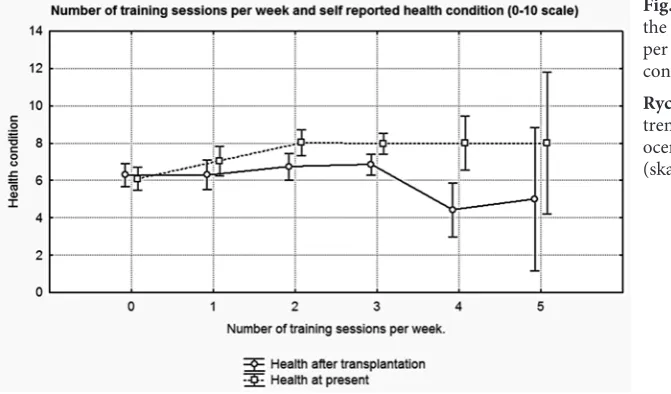
As is shown in Fig. 1, the number of training sessions per week was positively correlated with the self-reported health condition (r2 = 0.325,
p < 0.0001). Even one training session per week ac-counted for a significant improvement in the pa-tient’s health condition (p = 0.029). It is also worth mentioning that patients who did not exercise did not notice an improvement of health condition over time (p = 0.42).
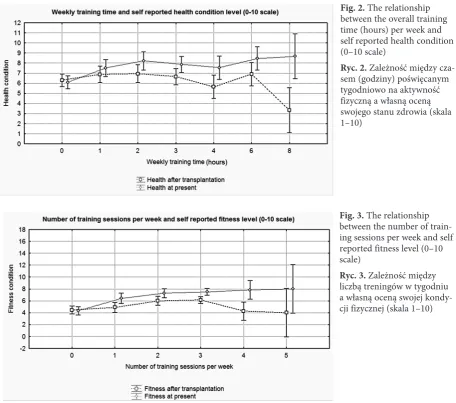
Overall training time per week was positively correlated with the self-reported health condition (F(12, 238) = 2.5663, p = 0.0033) (Fig. 2). In the presented population, the most effective amount of time devoted to physical activity per week was 8 hours (F = 32.7; p < 0.0001). Those who did not train at all or trained only one hour per week did not assess their present health condition as better than postoperatively (0 hours, p = 0.423; 1 hour, p = 0.067; 2 hours, p = 0.007).
Fitness Condition
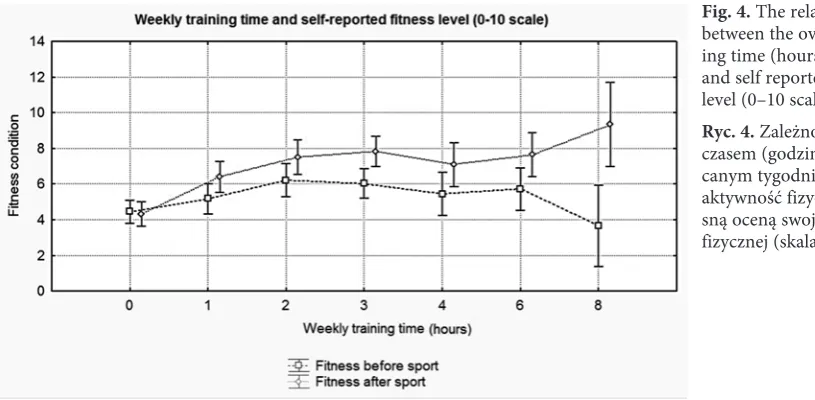
With the rising number of training sessions, the study participants were more likely to assess their fitness condition better than those who im-plemented less sports in their daily routine (rs =
0.507, p < 0.0001) (Fig. 3). As little as one session
Fig. 1. The relationship between the number of training sessions per week and self reported health condition (0–10 scale)
per week improved the patients’ self-reported fit-ness condition (p = 0.0002).
Overall training time per week was positively correlated with the self-reported fitness condition (F(12, 236) = 2.8246, p = 0.0012) (Fig. 4). After the transplant, people who did not exercise did not improve in their own assessment of their fitness condition. Those who trained as little as one hour per week described their fitness as statistically bet-ter than those who did not (p = 0.0009).
Body Mass Index
People who did not exercise at all had statisti-cally significant higher BMI levels than those who exercised regularly (25.8 ± 5.2 and 24 ± 3.99 re-spectively, p = 0.0003). The authors did not find a statistically significant correlation between the weekly training time and BMI of the patients (r2 = –0.08, p = 0.275). The number of trainings
per weeks was not correlated with BMI either (r2 =
–0.13, p = 0.31).
Post-transplant Sport
Commencement
The post-transplant time when the study par-ticipants commenced physical training was neither correlated with the present self-reported health condition nor with the present fitness level (rs =
–0.07, p = 0.45 and rs = 0.03, p = 0.38).
Discussion
Regular physical activity is associated with the improvement in kidney functioning after trans-plantation [18]. It has been proved that physical activity positively correlated with GFR (glomerulal filtration rate) levels [18]. What is more, regular exercise has a positive effect on the quality of life of patients after kidney transplantation [1, 19]. Mac-donald et al. (2009) also found that patients who regularly exercise have lower body fat levels.
In the present study, 77% of patients claimed that they exercised regularly. This is in contrast
Fig. 3. The relationship between the number of train-ing sessions per week and self reported fitness level (0–10 scale)
Ryc. 3. Zależność między liczbą treningów w tygodniu a własną oceną swojej kondy-cji fizycznej (skala 1–10)
Fig. 2. The relationship between the overall training time (hours) per week and self reported health condition (0–10 scale)
with the study carried out by Gordon et al. (2009), where 78% of patients were sedentary. The authors think that this difference occurred in their study due to a selection of patients who were capable of exercising. They did not analyze the data of patients who were not able to practice sports (be-cause of other serious comorbidities), be(be-cause they wanted to find correlations between the frequency and the duration of exercise trainings and the par-ticipants’ well being.
Most of the patients practiced aerobic sports disciplines. Only 12 patients (7%) reported in-volvement in anaerobic training (body building). The authors believe that further trials are needed to evaluate whether sports associated with an in-tensive effort of the muscles in the abdominal area are safe for kidney transplant recipients.
There are no studies that analyze the relation-ship between the post transplant intensity of exercise trainings and the patients’ health and fitness. The authors intended to find correlations between the amount of time devoted to sports and the patients’ self reported health condition and fitness level. Nor-mal regular exercise, even 8 hours a week, was well tolerated by the patients and they reported a better fitness level and a better health condition than those who did not exercise. Those who trained reported an improvement in health condition and physical fitness from the early post transplant period to the day of the present study. Study participants who were sedentary did not notice an improvement in the above-mentioned parameters.
The data of the present study shows that peo-ple who trained more than 6 hours a week reported the best health condition and fitness level after the transplantation. However it is not clear whether
they underestimated their health and fitness level in the postoperative period in order to emphasize the positive effect of sports on their lives.
People who exercised had statistically signifi-cantly lower BMI levels than those who were sed-entary. However there was no statistically signifi-cant correlation between the weekly training time and BMI. This means that regular exercising is associated with lower BMI levels but the amount of time devoted to sports does not correlate with the BMI. In authors’ opinion, this finding may be explained by the fact that people who exercise in-tensively have a bigger muscle mass and therefore higher BMI levels.
The post-transplant time when study partici-pants commenced physical activity was not corre-lated with the self-reported health and fitness con-dition. This means that starting exercise training even late after the transplantation may be associ-ated with better well-being of the patients.
In the present study, the authors observed that even short periods of time per week devoted to exercise training after kidney transplantation improves with the recipients’ self reported health and fitness condition. The time dedicated weekly to sports positively correlates with the patient’s well-being. People who do not exercise have high-er BMI levels than those who practice sports, but the intensity of trainings does not correlate with the BMI of the kidney transplant recipients. The results of this study bring authors to the conclu-sion that regular physical activity may have a fa-vorable effect on the health condition of transplant patients and can be recommended to all kidney transplant recipients that do not have other seri-ous comorbidities.
Fig. 4. The relationship between the overall train-ing time (hours) per week and self reported fitness level (0–10 scale)
References
[1] Kahwaji J, Bunnapradist S, Hsu JW, Idroos ML, Dudek R: Cause of Death With Graft Function Among Renal Transplant Recipients in an Integrated Healthcare System. Transplantation 2010.
[2] Jezior D, Krajewska M, Madziarska K, Kurc-Darak B, Janczak D, Patrzalek D, Boryslawski K, Klinger M:
Posttransplant overweight and obesity: myth or reality? Transplant Proc 2007, 39(9), 2772–2775.
[3] Cordier P, Decruynaere C, Devogelaer JP: Bone mineral density in posttransplantation patients: effects of physi-cal activity. Transplant Proc 2000, 32(2), 411–414.
[4] Grotz WH, Mundinger FA, Rasenack J, Speidel L, Olschewski M, Exner VM, Schollmeyer PJ: Bone loss after kidney transplantation: a longitudinal study in 115 graft recipients. Nephrol Dial Transplant 1995, 10(11), 2096– 2100.
[5] Pate RR, Pratt M, Blair SN, Haskell WL, Macera CA, Bouchard C, Buchner D, Ettinger W, Heath GW, King AC et al.: Physical activity and public health. A recommendation from the Centers for Disease Control and Prevention and the American College of Sports Medicine. JAMA 1995, 273(5), 402–407.
[6] Daudet G, Dupuis JM, Jocteur-Monrozier D, Reix P, Cochat P, Bellon G: [Kidney transplanted child and sport practices]. Arch Pediatr 2005, 12(3), 273–277.
[7] Calzolari A, Giordano U, Matteucci MC, Pastore E, Santilli A, Turchetta A, Rizzoni G: Exercise tolerance and behavior of blood pressure in children and adolescents after renal transplant. J Sports Med Phys Fitness 1997, 37(4), 267–272.
[8] Painter P: Exercise after renal transplantation. Adv Ren Replace Ther 1999, 6(2), 159–164.
[9] Yango AF, Gohh RY, Monaco AP, Reinert SE, Gautam A, Dworkin LD, Morrissey PE: Excess risk of renal allograft loss and early mortality among elderly recipients is associated with poor exercise capacity. Clin Nephrol 2006, 65(6), 401–407.
[10] Kjaer M, Beyer N, Secher NH: Exercise and organ transplantation. Scand J Med Sci Sports 1999, 9(1), 1–14. [11] Slapak M: Sport for the transplant athlete – just harmless fun or a valuable tool? Ann Transplant 2005, 10(4), 24–27. [12] Painter PL, Topp KS, Krasnoff JB, Adey D, Strasner A, Tomlanovich S, Stock P: Health-related fitness and
quality of life following steroid withdrawal in renal transplant recipients. Kidney Int 2003, 63(6), 2309–2316. [13] Painter P, Ward K, Nelson RD: Self-reported physical activity in patients with end stage renal disease. Nephrol
Nurs J 2011, 38(2), 139–147; quiz 148.
[14] Painter PL, Hector L, Ray K, Lynes L, Dibble S, Paul SM, Tomlanovich SL, Ascher NL: A randomized trial of exercise training after renal transplantation. Transplantation 2002, 74(1), 42–48.
[15] Painter PL, Luetkemeier MJ, Moore GE, Dibble SL, Green GA, Myll JO, Carlson LL: Health-related fitness and quality of life in organ transplant recipients. Transplantation 1997, 64(12), 1795–1800.
[16] Tomczak CR, Warburton DE, Riess KJ, Jendzjowsky NG, Esch BT, Liang Y, Haennel RG, Haykowsky MJ:
Pulmonary oxygen uptake and heart rate kinetics during the six-minute walk test in transplant recipients. Transplantation 2008, 85(1), 29–35.
[17] Painter P: Exercise following organ transplantation: A critical part of the routine post transplant care. Ann Transplant 2005, 10(4), 28–30.
[18] Gordon EJ, Prohaska TR, Gallant MP, Sehgal AR, Strogatz D, Yucel R, Conti D, Siminoff LA: longitudinal analysis of physical activity, fluid intake, and graft function among kidney transplant recipients. Transpl Int 2009, 22(10), 990–998.
[19] Macdonald JH, Kirkman D, Jibani M: Kidney transplantation: a systematic review of interventional and obser-vational studies of physical activity on intermediate outcomes. Adv Chronic Kidney Dis 2009, 16(6), 482–500.
Address for correspondence:
Tomasz Płonek
Department of Cardiac Surgery Wroclaw Medical University Borowska 213
50-556 Wrocław Poland
Tel.: +48 602 127 941
E-mail: [email protected] Conflict of interest: None declared Received: 21.11.2011