An Improved Authentication Scheme for Electronic Payment Systems
in Global Mobility Networks
Mohammad Heydari, S. Mohammad-Sajad Sadough
Department of Electrical Engineering, Shahid Beheshti University, Tehran, Iran e-mail: [email protected], [email protected]
Shehzad Ashraf Chaudhry
Department of Computer Science & Software Engineering, International Islamic University Islamabad, Pakistan
e-mail: [email protected]
Mohammad Sabzinejad Farash
Department of Mathematics and Computer Sciences, Kharazmi University Tehran, Iran
e-mail: [email protected]
Mohammad Reza Aref
Department of Electrical Engineering, Sharif University Tehran, Iran
e-mail: [email protected]
http://dx.doi.org/10.5755/j01.itc.44.4.9197
Abstract. Recently Yang et al. proposed an authenticated encryption scheme based on elliptic curve cryptography. The scheme reduced computation cost by excluding the construction of sender’s digital signatures. Furthermore, Yang et al. presented an e-payment system based on their authenticated encryption scheme. They claimed their scheme to resist replay, man-in-middle, impersonation and identity theft attack, while providing confidentiality, authenticity, integrity and privacy protection. However, in this paper we show that Yang et al.’s both authenticated encryption scheme and e-payment system are vulnerable to impersonation attack. An attacker after acquiring the public key and identities of the participants can easily masquerade as legitimate user. Then, we presented improvements over both Yang et al.’s authenticated encryption and e-payment schemes. We analyze the security of proposed schemes using widespread automated tool ProVerif. The proposed schemes are more secure and lightweight as compared with Yang et al.’s schemes.
Keywords: authenticated encryption; e-payment system; elliptic curve cryptography; digital signature; signcryption.
1. Introduction
Authentication and message confidentiality are the main requirements in-order to secure resource constrained environment. Till now many authentication [1-14] and encryption [15-17] schemes were proposed. Traditionally, authentication and
indispensable need. Zhang [18] was the premier to introduce notion of authenticated encryption (some times termed as signcryption). Till then a lot of authenticated encryption schemes were proposed [19-26].
An authenticated encryption consists of three phases: (1) key generation phase; (2) authenticated encryption phase; and (3) verification phase. Zhang [18] proposed an authenticated encryption scheme based on the notion of ElGamal cryptosystem. The scheme was proved to be very efficient when compared with sign-then-encryption strategy on the same ElGamal cryptosystem. However, Zhang’s scheme was inefficient and lacking many security features but it provided a basis for future research. Bao and Deng [27] then proposed another direct verifiable authenticated encryption scheme. Their scheme provided the facility to verify the validity of plain text, which is a serious threat to confidentiality. Gamage et al.[28] then proposed another authenticated encryption scheme to improve Bao and Deng’ scheme. Gamage et al.’s scheme provided the facility to verify a cipher message. Their scheme was lacking forward secrecy. Zheng and Imai [29] were the first to define authenticated encryption scheme based on elliptic curve cryptography. Elliptic curve got attention during recent past because of its low resource requirements for the same level of security as compared with traditional public key cryptosystems. However, their scheme was lacking forward secrecy and public verifiability. Hwang et al. [30] then proposed another authenticated encryption scheme. Hwang et al.’s scheme was more efficient as compared with previous schemes but their scheme lacks confidentiality during verification of message. Toorani and Shirazi [31] proposed another scheme which was more efficient than Hwang et al.’s scheme and was more secure than previous schemes. Similarly Yoon et al.[32] also proposed efficient authenticated encryption scheme.
Motivation and Contributions: Recently Yang et al. [33] pointed out that in existing authenticated encryption schemes [19-25, 27-32] sender’s signature is generated further the signature is verified on receiver side, this generation and verification of sender’s signature burdened the system. They also emphasized that the signature transmitted over insecure public network may result into its illegal use. Yang et al. [33] then proposed a novel authenticated encryption scheme without sender’s signature. In their proposed scheme [33], the sender generates a symmetric key based on his own private key and the public key of the receiver. The receiver generates the same symmetric key based on his private key and public key of the sender. Yang et al. [33] further asserted that their proposed scheme achieved authenticity and confidentiality. The security of their scheme is relied on generation and reconstruction of shared symmetric key, which they claimed can only be accomplished by legitimate sender and receiver respectively. As an application, Yang et al. presented
an e-payment system using their authenticated encryption scheme. However, in this paper, we show that Yang et al.’s authenticated encryption scheme is insecure against sender impersonation attack. We prove that an attacker after acquiring the public keys and identities of sender and receiver can easily masquerade as a legal sender. We also show that the Yang et al.’s e-payment system [33] is also suffering from the same weakness, where an adversary can masquerade as a legitimate customer and can redeem electronic products on behalf of legal customer while cheating the bank and merchant. Then we propose an improved authenticated encryption scheme and e-payment system.
Contributions of this paper are threefold. Initially we prove that Yang et al.’s authenticated encryption and e-payment schemes are vulnerable to impersonation attacks. Secondly, we propose improved authenticated encryption and e-payment schemes. Both of our schemes are robust against all known attacks. Furthermore, our proposed schemes are more lightweight than Yang et al.’s schemes. Finally, we prove the security of our proposed schemes using the widely accepted automated tool ProVerif.
2. Preliminaries
In this section, we briefly describe background for elliptic curve cryptography and the basic definitions of authenticated encryption and e-payment systems.
2.1. Elliptic Curve Cryptography
Elliptic curve cryptography (ECC) is based on some non-singular elliptic curve 𝐸𝑝(𝑎, 𝑏): 𝑦
2
= 𝑥3+ 𝑎𝑥 + 𝑏mod𝑝 over finite field 𝐹𝑝 which is deliberated as the set of points (𝑥, 𝑦) over 𝐸𝑝(𝑎, 𝑏) , where
𝑎, 𝑏€ ∈ 𝑍𝑝 & 4𝑎3+ 27𝑏2mod𝑝 ≠ 0 and 𝑝 is a large prime number, along with a point at infinity to serve as identity element for the group. There are two primitive operations, point addition and scalar multiplication. The latter is defined as repeated addition 𝑥𝑃 = 𝑃 + 𝑃 + 𝑃. . . +𝑃(𝑥 𝑡𝑖𝑚𝑒𝑠), given a point 𝑃 and an integer 𝑥 ∈ 𝐹𝑝. ECC provides identical security as compared with existing other cryptographic methods like DH, RSA, DSA with shorter parameters and lowered resources [8, 10, 34, 35].
2.2. Authenticated Encryption
devices. Such twofold operations perform paired computation and consume related resources like memory and communication power. Fortunately, the authenticated encryption notion put forward by Zhang [18] can avoid such resource hungry tasks. In an authenticated encryption scheme, the sender first generates a symmetric key, then performs encryption and computes signatures based on message and receiver’s public key and sends both to receiver. On receiving side, the receiver generates the same symmetric key, then decrypts the message and checks signature validity [21-24].
2.3. E-payment system
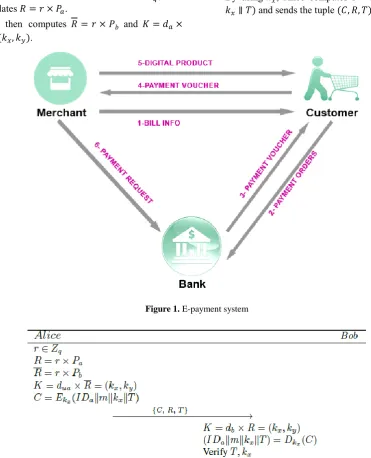
An e-payment system facilitates the digital transactions. A general e-payment system consists of a customer, bank, merchant and a trusted third party to resolve a dispute. The basic aim of an e-payment scheme is to provide framework for on line purchase of digital products while ensuring user’s anonymity, fair exchange and dispute resolution. Fair exchange employees that none of the participants should have unfair advantage. In case of any dispute between the participants, the trusted third party is responsible for its resolution.A typical e-payment system as shown in Fig. 2.2 consists of the following five phases:
1. Buying phase: A customer initiates this phase by downloading the bill information from merchant’s website, and then asks the bank for payment voucher.
2. Paying phase: During this phase bank deducts the bill amount from customer’s account and stores the bill amount in some temporary account, finally bank generates and sends payment voucher with some arbitrary expiry date to customer.
3. Exchanging phase: During this phase the customer and merchant exchange the payment voucher and digital product to each other.
4. Transferring phase: The merchant sends the payment voucher to bank before expiry date, the bank transfers the voucher amount to merchant’s account.
5. Dispute resolution phase: This is an optional phase, and can be initiated either by customer or merchant if their arise some dispute among both.
2.4. Adversary Model
In this paper, we have considered the common adversarial model, where according to the adversary capabilities the following assumptions are made: The adversary 𝒜 is having full control over the
insecure public communication channel. 𝒜 can intercept, modify, insert or delete any message. 𝒜 knows the public keys and identities of all the
participants.
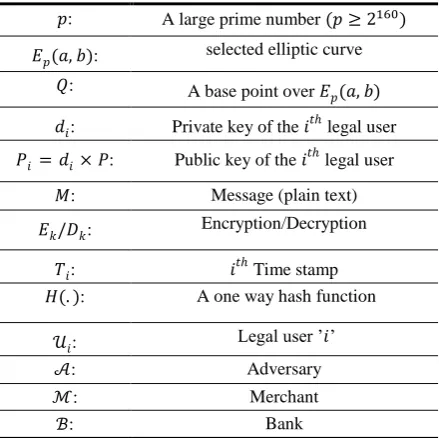
Table 1. Notation Guide
𝑝: A large prime number (𝑝 ≥ 2160)
𝐸𝑝(𝑎, 𝑏): selected elliptic curve
𝑄: A base point over 𝐸 𝑝(𝑎, 𝑏)
𝑑𝑖: Private key of the 𝑖𝑡ℎ legal user 𝑃𝑖 = 𝑑𝑖× 𝑃: Public key of the 𝑖𝑡ℎ legal user
𝑀: Message (plain text) 𝐸𝑘/𝐷𝑘: Encryption/Decryption
𝑇𝑖: 𝑖𝑡ℎ Time stamp
𝐻(. ): A one way hash function
𝒰𝑖: Legal user ’𝑖’
𝒜: Adversary
ℳ: Merchant
ℬ: Bank
3. Review of Yang et al.’s authenticated
encryption scheme and e-payment system
This section reviews Yang et al.’s authenticated encryption scheme and its application in e-payment. The scheme is based on elliptic curve cryptography [36-38]. Further, it does not require digital signatures for verification. The scheme and its e-payment version are described in below subsections.
3.1. Yang et al.’s authenticated encryption scheme Yang et al.’s authenticated encryption scheme consists of three phases: initialization, authenticated encryption and verification. The notation guide is illustrated in Table 1.
3.1.1. System initialization phase
This phase is committed to set system parameters. Initially a finite field 𝐹𝑝 is selected over a large prime
𝑝 ≥ 2160, then a non singular elliptic curve 𝐸
𝑝(𝑎, 𝑏) is selected. Further system selects a base point 𝑄 over
𝐸𝑝(𝑎, 𝑏) along with a symmetric key
encryption/decryption algorithm 𝐸𝑘(. )/𝐷𝑘(. ). Each of the participants then picks his private 𝑑𝑖, and figures out his public key as 𝑃𝑖 = 𝑑𝑖× 𝑄. Finally, system parameters and public keys are published, while private keys are kept secret by their corresponding users.
3.1.2. Authenticated encryption phase
Alice selects some random number 𝑟 ∈ 𝑍𝑞, then calculates 𝑅 = 𝑟 × 𝑃𝑎.
Alice then computes 𝑅 = 𝑟 × 𝑃𝑏 and 𝐾 = 𝑑𝑎×
𝑅 = (𝑘𝑥, 𝑘𝑦).
By using 𝑘𝑥, Alice computes 𝐶 = 𝐸𝑘𝑥(𝐼𝐷𝑎∥ 𝑚 ∥
𝑘𝑥∥ 𝑇) and sends the tuple (𝐶, 𝑅, 𝑇) to Bob.
Figure 1. E-payment system
Figure 2. Yang et al.’s authenticated encryption scheme
3.1.3. Verification phase
Upon receiving (𝐶, 𝑅, 𝑇), Bob using his private key 𝑑𝑏 verifies the received tuple as follows:
Step 1. Bob computes 𝐾 = 𝑑𝑏× 𝑅 = (𝑘𝑥, 𝑘𝑦) to acquire the shared symmetric key 𝑘𝑥.
Step 2. Bob then decrypts 𝐶 using 𝑘𝑥 and obtains
(𝐼𝐷𝑎∥ 𝑚 ∥ 𝑘𝑥∥ 𝑇) and verifies whether 𝑇 is valid or not. If 𝑇 is valid, then Bob verifies validity of 𝑘𝑥. If both 𝑇 and 𝑘𝑥 are valid, Bob considers the message is from legitimate user Alice.
The authenticated encryption and verification phases are also illustrated in Fig. 2.
3.2. Yang et al.’s e-payment system
In this subsection, we review Yang et al.’s proposed e-payment system. The e-payment system involves three participants: a legal customer Charlie, the merchant and the bank. Yang et al.’s scheme consists of the following five phases:
3.2.1. The initialization phase
3.2.2. Buying phase
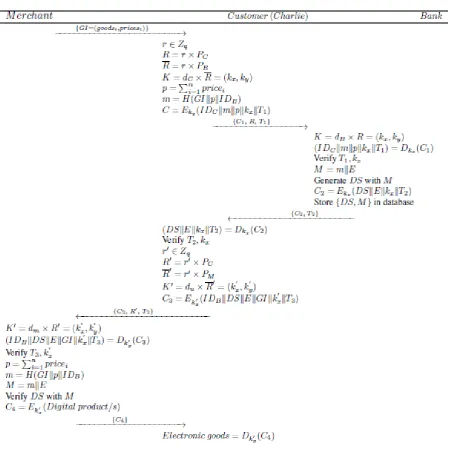
The customer Charlie initiates this phase when he wants to buy some digitized product/s. Charlie visits merchant website and selects some product/s then he downloads goods/bill information 𝐺𝐼 = 𝑔𝑜𝑜𝑑𝑠1, 𝑝𝑟𝑖𝑐𝑒1, 𝑔𝑜𝑜𝑑𝑠1, 𝑝𝑟𝑖𝑐𝑒2, . . . 𝑔𝑜𝑜𝑑𝑘, 𝑝𝑟𝑖𝑐𝑒𝑘 . For buying digital product/s, Charlie performs the following steps:
Step 1. Charlie generates a random number 𝑟 ∈ 𝑍𝑞 and computes 𝑅 = 𝑟 × 𝑃𝑐.
Step 2. Charlie then computes 𝑅 = 𝑟 × 𝑃𝐵 and 𝐾 =
𝑑𝐵× 𝑅 = (𝑘𝑥, 𝑘𝑦) , where 𝑘𝑥, 𝑘𝑦 are the respective 𝑥 and 𝑦 coordinates of 𝐾.
Step 3. Charlie then accumulates payment 𝑝 = ∑𝑙
𝑖=1𝑝𝑟𝑖𝑐𝑒𝑖 and bill information 𝑚 = 𝐻(𝐺𝐼 ∥
𝑝 ∥ 𝐼𝐷𝐵)
Step 4. Charlie computes 𝐶1= 𝐸𝑘𝑥(𝐼𝐷𝐶 ∥ 𝑚 ∥ 𝑝 ∥
𝑘𝑥∥ 𝑇1), where 𝑇1 is the current time stamp. Finally Charlie sends payment order tuple
(𝐶1, 𝑅, 𝑇1) to bank.
3.2.3. Paying phase
For the received payment order tuple (𝐶1, 𝑅, 𝑇1), the bank performs the following steps to generate payment voucher and to check legality of the customer.
Step 1. The bank computes 𝐾 = 𝑑𝐵× 𝑅 = (𝑘𝑥, 𝑘𝑦) to acquire the 𝑘𝑥.
Step 2. The bank then decrypts 𝐶1 by using 𝑘𝑥 and acquires (𝐼𝐷𝐶∥ 𝑚 ∥ 𝑝 ∥ 𝑘𝑥∥ 𝑇1) = 𝐷𝑘𝑥(𝐶1).
Step 3. The bank verifies whether 𝑇1 and 𝑘𝑥 are valid. If any of these is invalid, the bank aborts the session. Otherwise, the bank accepts the payment order.
Step 4. For valid received payment order, the bank withdraws amount 𝑝 from Charlie’s account and deposits 𝑝 into a temporary account. Further, the bank generates an expiry date 𝐸
and computes 𝑀 = 𝑚 ∥ 𝐸 along with digital signatures 𝐷𝑆 based on his private key 𝑑𝐵 and message 𝑀. The bank archives the pair
{𝐷𝑆, 𝑀} in its database.
Step 5. Finally bank computes 𝐶2= 𝐸𝑘𝑥(𝐷𝑆 ∥ 𝐸 ∥
𝑘𝑥 ∥ 𝑇2) and sends payment voucher tuple
(𝐶2, 𝑇2) to Charlie.
Step 6. For the received payment voucher tuple
(𝐶2, 𝑇2), Charlie using 𝑘𝑥 decrypts 𝐶2 to acquire (𝐷𝑆 ∥ 𝐸 ∥ 𝑘𝑥∥ 𝑇2) = 𝐷𝑘𝑥(𝐶2) . Charlie further checks validity of 𝑇2 and 𝑘𝑥. If any of them in invalid, Charlie rejects the payment voucher. Otherwise he accepts the payment voucher.
3.2.4. Exchanging phase
For this phase, Charlie uses the valid payment voucher to exchange digital product/s with the merchant. To complete this phase, the following steps are performed between Charlie and merchant: Step 1. Charlie generates a new random number 𝑟′ ∈
𝑍𝑞 and computes 𝑅′ = 𝑟′ × 𝑃𝐶, 𝑅′ = 𝑟′ × 𝑃𝑀 and 𝐾′ = 𝑑𝐶× 𝑅
′
= (𝑘𝑥′, 𝑘𝑦′).
Step 2. Charlie then computes 𝐶3 = 𝐸𝑘
𝑥
′(𝐼𝐷𝐵 ∥ 𝐷𝑆 ∥
𝐸 ∥ 𝐺𝐼 ∥ 𝑘𝑥 ′
∥ 𝑇3) and sends payment voucher (𝐶3, 𝑅′, 𝑇3) to merchant.
Step 3. For the received payment voucher tuple
(𝐶3, 𝑅′, 𝑇3), the merchant computes 𝐾′ =
𝑑𝑀× 𝑅′ = (𝑘𝑥′, 𝑘𝑦′) and (𝐼𝐷𝐵∥ 𝐷𝑆 ∥ 𝐸 ∥
𝐺𝐼 ∥ 𝑘𝑥′−∥ 𝑇3) = 𝐷𝑘𝑥′(𝐶3). Further merchant checks the validity of time stamp 𝑇3 and 𝑘𝑥′ and aborts the session if any of these is invalid. Otherwise, the merchant computes the bill information 𝑝 = ∑𝑛𝑖=1𝑝𝑟𝑖𝑐𝑒𝑖 and
𝑚 = 𝐻(𝐺𝐼 ∥ 𝑝 ∥ 𝐼𝐷𝐵) , 𝑀 = 𝑚 ∥ 𝐸 . The merchant checks legality of signatures 𝐷𝑆
with 𝑀. If it is valid, merchant sends encrypted digital product/s 𝐶4= 𝐸𝑘
𝑥
′(𝑑𝑖𝑔𝑖𝑡𝑎𝑙 𝑝𝑟𝑜𝑑𝑢𝑐𝑡/𝑠) to Charlie. Upon receiving 𝐶4, Charlie decrypts and gets the anticipated digital product/s.
3.2.5. Transferring phase
The merchant can send the payment voucher to bank before the expiry date. After expiry date the bank transfers amount 𝑝 from temporary account to merchant’s account and deletes the tuple {𝐷𝑆, 𝑀} from his database.
4. Cryptanalysis of Yang et al.’s scheme
In this section, we show that Yang et al.’s authenticated encryption scheme can not withstand impersonation attacks, the same is the case with their e-payment system. In the following subsections, we prove that in both of Yang et al.’s schemes, an attacker can impersonate as a legal user having knowledge of only public keys and identities of the participants.
4.1. Impersonation attack on authenticated encryption
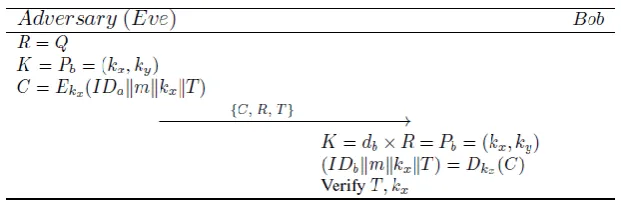
Here, we show that an adversary Eve can deceive the receiver Bob by performing the following steps: Step 1. Eve computes the following:
𝑅 = 𝑄 (1)
𝐾 = 𝑃𝑏= (𝑘𝑥, 𝑘𝑦) (2)
Step 2. By using 𝑘𝑥 Eve computes:
𝐶 = 𝐸𝑘𝑥(𝐼𝐷𝑎∥ 𝑚 ∥ 𝑘𝑥∥ 𝑇) (3)
Step 3. Eve finally, sends the authenticated encryption message tuple (𝐶, 𝑅, 𝑇) to Bob. Step 4. For the received tuple (𝐶, 𝑅, 𝑇) , Bob
computes the decryption key as follows:
𝐾 = 𝑑𝑏× 𝑅 = 𝑑𝑏× 𝑄 = 𝑃𝑏= (𝑘𝑥, 𝑘𝑦) (4)
Step 5. Using 𝑘𝑥 Bob computes:
(𝐼𝐷𝑎∥ 𝑚 ∥ 𝑘𝑥 ∥ 𝑇) = 𝐷𝑘𝑥(𝐶) (5)
Step 6. Bob then verifies freshness of the time stamp
𝑇 and validity of 𝑘𝑥. If both are valid, Bob recognizes the sender as Alice.
Proposition 1. At the end of the impersonation attack, Bob accepts Eve as the legal sender Alice.
Proof. During verification phase, the receiver Bob authenticates the sender Alice if time stamp 𝑇 is fresh and 𝑇 and 𝑘𝑥 computed by Eq. (4) are same as of both received in encrypted message 𝐶 = 𝐸𝑘𝑥(𝐼𝐷𝑎∥ 𝑚 ∥
𝑘𝑥 ∥ 𝑇). Time stamp 𝑇 can easily be generated by any adversary, so if the adversary Eve becomes able to generate valid 𝑘𝑥, then he can encrypt same key 𝑘𝑥 and current time stamp along with arbitrary message and sender’s 𝐼𝐷𝑎. Therefore, the security merely relies on the validity of generation of 𝑘𝑥. As Eve computed
Figure 4. Impersonation attack on Yang et al.‘s authenticated encryption scheme
upon receiving message, Bob computes same 𝐾 in Eq. (4) as was computed by Eve in Eq. (2). So both Eq. (2) and (4) are same. Therefore, Eve successfully impersonated Bob on behalf of Alice.
4.2. Impersonation attack on e-payment system Let Charlie be a legal customer and Eve be the adversary. Eve will perform the following steps in-order to masquerade as Charlie to deceive the bank and merchant for fraudulent purchase of electronic goods.
Step 1. Eve selects and downloads the goods information 𝐺𝐼 from merchant’s website and computes following:
𝑅 = 𝑄 (6)
𝐾 = 𝑃𝐵= (𝑘𝑥, 𝑘𝑦) (7)
𝐶 = 𝐸𝑘𝑥(𝐼𝐷𝐶 ∥ 𝑚 ∥ 𝑘𝑥∥ 𝑇1) (8)
Step 2. Eve sends {𝐶1, 𝑅, 𝑇1} to bank, where 𝑇1 is the current time stamp.
Step 3. Upon receiving {𝐶1, 𝑅, 𝑇1} , the bank computes the following:
𝐾 = 𝑑𝐵× 𝑅 = 𝑑𝐵× 𝑄 = 𝑃𝐵= (𝑘𝑥, 𝑘𝑦) (9)
(𝐼𝐷𝐶 ∥ 𝑚 ∥ 𝑘𝑥∥ 𝑇) = 𝐷𝑘𝑥(𝐶1) (10)
Step 4. The bank verifies the correctness of 𝑇1 and 𝑘𝑥 after performing decryption. If both 𝑇1 and 𝑘𝑥 are correct, the bank generates the expiry date
𝐸 and 𝑀 = 𝑚 ∥ 𝐸. Then it computes digital signature 𝐷𝑆 with 𝑀 and computes:
𝐶2= 𝐸𝑘𝑥(𝐷𝑆 ∥ 𝐸 ∥ 𝑘𝑥∥ 𝑇2) (11)
Step 5. The bank deducts money from Charlie’s account and stores {𝐷𝑆, 𝑀} in his database. Finally, it sends {𝐶2, 𝑇2} to Charlie, where 𝑇2 is fresh time stamp.
Step 6. Eve intercepts the message and uses the same key 𝑘𝑥 to compute:
(𝐷𝑆 ∥ 𝐸 ∥ 𝑘𝑥 ∥ 𝑇2) = 𝐷𝑘𝑥(𝐶2) (12)
Step 7. Eve verifies 𝑇2 and 𝑘𝑥, then computes the following:
𝑅′ = 𝑄 (13)
𝐾′ = 𝑃𝑀 = (𝑘𝑥′, 𝑘𝑦′) (14)
𝐶3= 𝐸𝑘𝑥′(𝐼𝐷𝑏∥ 𝐷𝑆 ∥ 𝐸 ∥ 𝐺𝐼 ∥ 𝑘𝑥 ′ ∥ 𝑇
3) (15)
Step 8. Eve sends {𝐶3, 𝑅′, 𝑇3} to the merchant, where
𝑇3 is fresh time stamp.
Step 9. Upon receiving {𝐶3, 𝑅′, 𝑇3}, the merchant computes the following:
𝐾′ = 𝑑𝑀× 𝑅′ = (𝑘𝑥′, 𝑘𝑦′) (16)
(𝐼𝐷𝐵 ∥ 𝐷𝑆 ∥ 𝐸 ∥ 𝐺𝐼 ∥ 𝑘𝑥′ ∥ 𝑇3) = 𝐷𝑘𝑥′(𝐶3) (17)
Step 10. The merchant verifies the validity of 𝑘𝑥′ and
𝑇3 , computes the following if both are correct:
𝑝 = ∑𝑛𝑖=1𝑝𝑟𝑖𝑐𝑒𝑖 (18)
𝑚 = 𝐻(𝐺𝐼 ∥ 𝑝 ∥ 𝐼𝐷𝐵) (19)
𝑀 = 𝑚 ∥ 𝐸 (20)
Step 11. Further merchant computes digital signature
𝐷𝑆 based on 𝑀 and checks its validity by comparing it to the 𝐷𝑆 obtained in Eq. (17). If it is valid, the merchant computes:
𝐶4= 𝐸𝑘𝑥′(𝐷𝑖𝑔𝑖𝑡𝑎𝑙 𝑝𝑟𝑜𝑑𝑢𝑐𝑡/𝑠) (21)
Step 12. Finally, the merchant sends encrypted electronic goods 𝐶4 to Charlie.
Step 13. Eve intercepts the message and retrieves
𝐷𝑖𝑔𝑖𝑡𝑎𝑙 𝑝𝑟𝑜𝑑𝑢𝑐𝑡/𝑠 = 𝐷𝑘𝑥′(𝐶4).
Proposition 2. At the end of the impersonation attack, The Bank and the merchant accept adversary Eve as the legal customer Charlie and Eve becomes able to purchase digital product/s on behalf of Charlie.
Proof. During paying phase, the bank authenticates the customer Charlie on the basis of time stamp 𝑇1 and 𝑘𝑥. Following are the three conditions to be met for successful impersonation attack:
1. 𝑇1 is fresh.
2. 𝑇1 should be the same as received in plain
text and obtained after decryption of 𝐶1. 3. 𝑘𝑥 should be the same as computed in Eq. (9)
The fresh time stamp 𝑇1 can be easily generated by any adversary, so the security of Yang et al.’s scheme relies on the validity of 𝑘𝑥. The adversary Eve computed 𝑅 = 𝑄 in Eq. (6) and 𝐾 = 𝑃𝐵 = (𝑘𝑥, 𝑘𝑦) in Eq. (7), then Eve generated fresh time stamp 𝑇1. Eve further sent (𝐶1, 𝑅, 𝑇1) to the bank, which initially verified freshness of 𝑇1. 𝑇1 was freshly generated time stamp so the bank computed 𝐾 = 𝑑𝐵× 𝑅 =
𝑑𝐵× 𝑄 = 𝑃𝐵= (𝑘𝑥, 𝑘𝑦) in Eq. (9). Then by using 𝑘𝑥, bank further computed (𝐼𝐷𝐶 ∥ 𝑚 ∥ 𝑘𝑥∥ 𝑇) = 𝐷𝑘𝑥(𝐶1) in Eq. (10) which is same as computed by Eve in Eq. (7), and found same in 𝐶1 in Eq. (10). Similarly 𝑇1 is also same as it is sent in plain text. Therefore, Eve has deceived the bank on behalf of Charlie. Similarly, during exchanging phase Eve computed 𝑅′ = 𝑄 in Eq. (13) and 𝐾′ = 𝑃𝑀 in Eq. (14). Eve further generated new time stamp 𝑇3 and sent (𝐶3, 𝑅′, 𝑇3) to the merchant. The same three conditions must be met for successful impersonation attack, which are as follows:
1. 𝑇3 is fresh.
2. 𝑇3 should be the same as received in plain text and obtained after decryption of 𝐶3. 3. 𝑘𝑥′ should be the same as computed in Eq.
(16) and obtained after decryption of 𝐶3. As described earlier generation of fresh time stamp is very easy, the security relies on the validity of 𝑘𝑥′. The merchant upon receiving first checks whether 𝑇3 is fresh or not, as 𝑇3 was freshly generated, so merchant computes 𝐾′ = 𝑑𝑀× 𝑅′ = (𝑘𝑥′, 𝑘𝑦′) in Eq. (16) and then decrypts 𝐶3, which is same as the merchant computed 𝐾′ because it was computed by Eve in Eq. (14). Hence the merchant finds same 𝑘𝑥′
after decryption of 𝐶3 . Therefore, Eve has impersonated the bank and the merchant on behalf of Charlie and fraudulently purchased digital product/s.
5. Proposed authenticated encryption scheme
It can be easily verified that the security weakness of Yang et al.’s scheme was due to the design of 𝑅 and
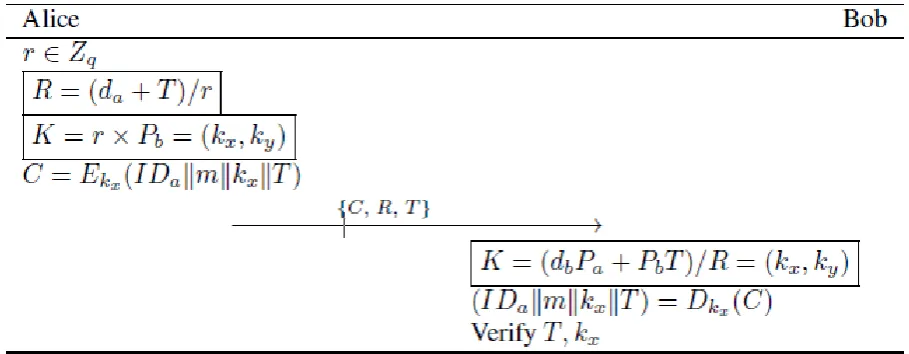
𝐾, so we just improve the calculations of both of these parameters during authenticated encryption and verification phases, while there is no change in the initialization phase. Proposed authenticated encryption scheme is shown in Fig. 6.
5.1. Authenticated encryption phase
Authenticated encryption is performed by a legal user Alice, when she wants to send another user Bob a message 𝑚. Alice performs the following steps: Step 1. Alice generates a random number 𝑟 ∈ 𝑍𝑝 and
uses her private key 𝑑𝑎 along with fresh time stamp 𝑇 to compute 𝑅 = (𝑑𝑎+ 𝑇)/𝑟.
Step 2. Alice then figures out 𝐾 = 𝑟 × 𝑃𝑏 and extracts 𝑘𝑥 (the 𝑥 coordinate of 𝐾).
Step 3. Using 𝑘𝑥 Alice computes 𝐶 = 𝐸𝑘𝑥(𝐼𝐷𝑎∥ 𝑚 ∥
𝑘𝑥∥ 𝑇), and sends (𝐶, 𝑅, 𝑇) to Bob.
5.2. Verification phase
For the received tuple (𝐶, 𝑅, 𝑇), Bob performs following steps to acquire message and verify the legality of sender Alice. For verification Bob performs the following steps:
Step 1. Bob computes 𝐾 = 𝑅(𝑃𝑎+ 𝑇𝑄)𝑑𝑏 =
(𝑘𝑥, 𝑘𝑦) to obtain key 𝑘𝑥.
Step 2. Bob using 𝑘𝑥, decrypts 𝐶 and gets (𝐼𝐷𝑎∥ 𝑀 ∥
𝑘𝑥∥ 𝑇),
Step 3. Bob verifies whether the received 𝑇 and computed 𝑘𝑥 are the same as they are present in decrypted message. if both are same then he considers the sender as legal user Alice.
6. The improved e-payment using proposed
scheme
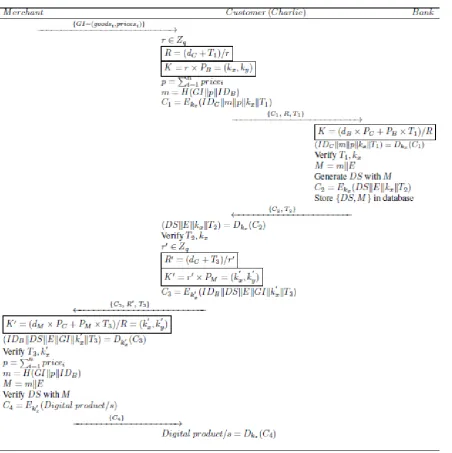
In this section, we elaborate the enhanced e-payment system, which is based on our proposed authenticated encryption scheme. The enhanced e-payment system is illustrated in Fig. 7 and is described by following subsections:
6.1. Initialization phase
This phase is analogous to that presented in Subsection 3.2.1. In this phase the system parameters are initialized. The system sets 𝐸𝑝(𝑎, 𝑏), 𝐸𝑘(. ),
𝐷𝑘(. ) and base point 𝑄. Then each participant, the customer, bank and the merchant, elects their respective key pairs 𝑃𝐶/𝑑𝐶, 𝑃𝐵/𝑑𝐵, 𝑃𝑀/𝑑𝑀. Finally all public keys and system parameters are published.
6.2. Buying Phase
The customer Charlie initiates this phase when he wants to buy some digitized product/s. Charlie visits merchant website and selects some product/s. Then he downloads goods/bill information 𝐺𝐼. For buying digital product/s, Charlie performs the following steps:
Step 1. Charlie generates a random number 𝑟 ∈ 𝑍𝑞 and computes 𝑅 = (𝑑𝐶+ 𝑇1)/𝑟.
Step 2. Charlie then computes 𝐾 = 𝑟 × 𝑃𝐵 =
(𝑘𝑥, 𝑘𝑦), where 𝑘𝑥, 𝑘𝑦 are the respective 𝑥 and 𝑦 coordinates of 𝐾.
Step 3. Charlie then accumulates payment 𝑝 = ∑𝑛
𝑖=1𝑝𝑟𝑖𝑐𝑒𝑖 and bill information 𝑚 = 𝐻(𝐺𝐼 ∥
𝑝 ∥ 𝐼𝐷𝐵).
Step 4. Charlie computes 𝐶1= 𝐸𝑘𝑥(𝐼𝐷𝐶 ∥ 𝑚 ∥ 𝑝 ∥
𝑘𝑥∥ 𝑇1), where 𝑇1 is the current time stamp. Finally Charlie sends payment order tuple
(𝐶1, 𝑅, 𝑇1) to the bank.
Figure 7. Proposed e-payment system
6.3. Paying phase
For the received payment order tuple {𝐶1, 𝑅, 𝑇1}, the bank performs the following steps:
Step 1. The bank computes 𝐾 = (𝑑𝐵× 𝑃𝐶+ 𝑃𝐵×
𝑇1)/𝑅 = (𝑘𝑥, 𝑘𝑦) to acquire the 𝑘𝑥.
Step 2. The bank then decrypts 𝐶1 by using 𝑘𝑥 and acquires (𝐼𝐷𝐶 ∥ 𝑚 ∥ 𝑝 ∥ 𝑘𝑥 ∥ 𝑇1) = 𝐷𝑘𝑥(𝐶1).
Step 3. The Bank verifies whether 𝑇1 and 𝑘𝑥 are valid. If any of these is invalid , the bank aborts the session. Otherwise, the bank accepts the payment order.
Step 4. For valid received payment order, the bank withdraws amount 𝑝 from Charlie’s account and deposits 𝑝 into a temporary account.
Further, the bank generates an expiry date 𝐸
and computes 𝑀 = 𝑚 ∥ 𝐸 along with digital signatures 𝐷𝑆 based on it’s private key 𝑑𝐵 and message 𝑀. The bank archives the pair
{𝐷𝑆, 𝑀} in its database.
Step 5. Finally, the bank computes 𝐶2 = 𝐸𝑘𝑥(𝐷𝑆 ∥
𝐸 ∥ 𝑘𝑥∥ 𝑇2) and sends payment voucher pair
(𝐶2, 𝑇2) to Charlie.
Step 6. For the received payment voucher pair
(𝐶2, 𝑇2), Charlie using 𝑘𝑥 decrypts 𝐶2 to acquire (𝐷𝑆 ∥ 𝐸 ∥ 𝑘𝑥∥ 𝑇2) = 𝐷𝑘𝑥(𝐶2) . Charlie further checks the validity of 𝑇2 and
6.4. Exchange phase
The exchange phase consists of the following three steps:
Step 1. For the valid payment voucher, Charlie generates 𝑟′ ∈ 𝑍𝑝 to compute 𝑅′ = (𝑑𝐶+
𝑇3)/𝑟′ and 𝐾′ = 𝑟′ × 𝑃𝑀= (𝑘𝑥′, 𝑘𝑦′). Then, using 𝐾𝑥
′, Charlie computes
𝐶3= 𝐸𝑘𝑥′(𝐼𝐷𝐵 ∥
𝐷𝑆 ∥ 𝐸 ∥ 𝐺𝐼 ∥ 𝑘𝑥 ′
∥ 𝑇3). Finally, he sends
(𝐶3, 𝑅′, 𝑇3) to merchant.
Step 2. Upon Receiving (𝐶3, 𝑅′, 𝑇3), the merchant computes 𝐾′ = (𝑑𝑀× 𝑃𝐶+ 𝑃𝑀× 𝑇3)/𝑅 =
(𝑘𝑥′, 𝑘𝑦′) , then decrypts 𝐶3 , using 𝑘𝑥′ as decryption key. Further merchant checks the validity of time stamp 𝑇3 and 𝑘𝑥′ and aborts the session if any of these are invalid. Otherwise, merchant computes the bill information 𝑝 = ∑𝑛𝑖=1𝑝𝑟𝑖𝑐𝑒𝑖 and 𝑚 =
𝐻(𝐺𝐼 ∥ 𝑝 ∥ 𝐼𝐷𝐵), 𝑀 = 𝑚 ∥ 𝐸. The merchant checks legality of signatures 𝐷𝑆 with 𝑀. If it is valid, the merchant sends encrypted digital product/s 𝐶4 = 𝐸𝑘𝑥′(𝑑𝑖𝑔𝑖𝑡𝑎𝑙 𝑝𝑟𝑜𝑑𝑢𝑐𝑡/𝑠) to Charlie.
Step 3. Upon receiving 𝐶4, Charlie decrypts and gets the anticipated digital product/s.
6.5. Transferring phase
In the proposed e-payment system the merchant can send the payment voucher to the bank before its expiry date, the customer can abandon the transaction before the expiry date, if some dispute arise between the merchant and himself. In such case the dispute is referred to the trusted third party. Otherwise, after expiry date the bank transfers the transaction amount to merchant’s account and obliterate the record
{𝐷𝑆, 𝑀} from his database.
6.6. Dispute resolution phase
A trusted third party (TTP) can resolve a dispute if it arises between the merchant and Charlie (the customer). For dispute resolution, private key of the merchant is exposed to trusted third party, which can check the validity of payment voucher and encryption key 𝑘𝑥′ after acquiring the message {𝐶3, 𝑅′, 𝑇3}. TTP performs the following for fixing responsibility:
𝐾′ = (𝑑𝑀× 𝑃𝐶+ 𝑃𝑀× 𝑇3)/𝑅3= (𝑘𝑥′, 𝑘𝑦′) (22)
(𝐼𝐷𝐵 ∥ 𝐷𝑆 ∥ 𝐸 ∥ 𝐺𝐼 ∥ 𝑘𝑥′ ∥ 𝑇3) = 𝐷𝑘𝑥′(𝐶3) (23)
After decrypting 𝐶3, TTP checks the equality of 𝑇3 with in 𝐶3 and received in plain text message. Further, TTP checks whether 𝑘𝑥′ , received in encrypted message (as computed in Eq.(23)) is same as used during decryption of 𝐶3 (as computed in Eq. (22)).
7. Security analysis
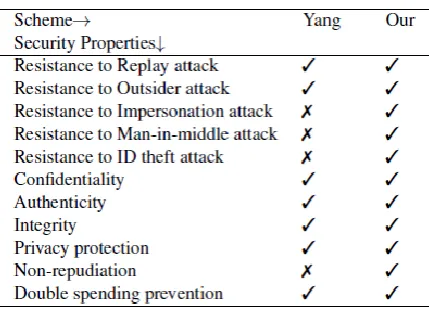
The proposed authenticated encryption scheme and e-payment system fulfill all the known security requirements as stated by Yang et al. and others. In this section, we analyze the security of the proposed schemes. The proposed schemes provide resistance to replay, outsider, impersonation, man-in-middle and ID theft attacks. Further, it provides confidentiality, authentication, privacy protection and non-repudiation. Additionally our proposed e-payment system also provides double spending prevention of the same payment voucher. Table 8 illustrates the security comparison of the proposed scheme with Yang et al.’s scheme.
7.1. Mutual Authentication
In the proposed authenticated encryption scheme, Alice (the sender) generates a symmetric key 𝑘𝑥. The computation of 𝑘𝑥 involves: (1) engendering a random number 𝑟 ∈ 𝑍𝑝; (2) computing 𝑅 = (𝑑𝑎+ 𝑇)/𝑟; and (3) 𝐾 = 𝑟 × 𝑃𝑏= (𝑘𝑥, 𝑘𝑦). As it can be easily seen, that valid pair (𝐾, 𝑅) can only be generated by making use of Alice’s private key 𝑑𝑎 and Bob’s (the receiver) pubic key 𝑃𝑏. Similarly, on receiving side, Bob can generate the same symmetric key 𝑘𝑥 using his own private key 𝑑𝑏 and Alice’s public key 𝑃𝑎. Hence the shared symmetric key 𝑘𝑥 can only be computed and verified by legal entities in authenticated encryption scheme. E-payment system is very analogous to authenticated encryption scheme. Hence both the proposed schemes ensure mutual authentication.
7.2. Integrity
If some adversary modifies the authenticated encryption message (𝐶, 𝑅, 𝑇), then Bob will reject the message, as the message will not pass the validity check for 𝑘𝑥 and 𝑇.
7.3. Privacy protection
In the proposed schemes, the identity of sender is sent in encrypted message 𝐶. Further, in e-payment system, the goods information sent to bank is protected by one-way hash function. It must also be noted that the digital signature does not expose the customer’s information. Hence sender as well as buying information privacy is protected.
7.4. Non-repudiation
7.5. Impersonation attack
An adversary (Eve) can impersonate as a legal user/customer (Alice) to deceive the receiver (Bob), if he is having the ability to generate valid (𝑅, 𝐾) pair. It is already described in Subsection 7.1, that the adversary needs Alice’s private key 𝑑𝑎 and Bob’s public key 𝑃𝑏 to generate valid (𝑅, 𝐾) pair. Similarly, the adversary needs to know Bob’s private key 𝑑𝑏 and Alice’s public key 𝑃𝑎, if he wants to impersonates as the receiver (Bob). However, the adversary cannot access private keys, so our scheme is resistant to impersonation attacks.
7.6. Replay attack
The proposed scheme resists replay attacks, as if some adversary intercepts a previous message
(𝐶, 𝑅, 𝑇) sent by Alice and replays it later to Bob. Then upon reception of the message tuple, Bob first checks the validity of time stamp 𝑇, because the time stamp is outdated, Bob recognizes the replay and simply rejects the message.
7.7. Outsider attack
An outsider can easily intercept a message
(𝐶, 𝑅, 𝑇). Further, he can also access public keys and identities of the participants, but to attain the useful information contained in 𝐶, he needs to know private key of Alice (the sender).
7.8. Man-in-middle attack
If the adversary (Eve) intercepts a message
(𝐶, 𝑅, 𝑇) and replaces it by some other message tuple
(𝐶̅, 𝑅̅, 𝑇𝑓𝑟𝑒) , then the receiver (Bob) can easily understand the message is from adversary, as the valid
(𝐶̅, 𝑅̅) can be generated by the use of private key of Alice. Suppose if adversary sends the same intercepted tuple (𝐶, 𝑅) along with fresh time stamp
𝑇𝑓𝑟𝑒, then Bob after decryption of message will compare the time stamp embedded in the encrypted message 𝐶 and plain text time stamp 𝑇𝑓𝑟𝑒, because both are not the same, Bob will reject the message.
7.9. ID theft attack
The valid pair (𝐶, 𝑅) is generated using public and private keys of receiver and sender, respectively. Furthermore, (𝐶, 𝑅) pair is having no relationship with the identities of the participants. Therefore, even if identities of all the participants are exposed to adversary, it will have no effect on security of the proposed schemes.
7.10. Confidentiality
The encrypted message 𝐶 can only be decrypted by first computing the shared symmetric key 𝑘𝑥. It is already proved in Subsection 7.1, that only legal
intended user Bob can compute the symmetric key 𝑘𝑥. Hence, proposed scheme provides message confidentiality.
7.11. Double spending prevention
In the proposed e-payment system the payment voucher {𝐷𝑆, 𝑀} is used once as the voucher remains in bank’s database until the merchant asks for payment. After expiry date bank transfers the voucher amount in merchant’s account and deletes the voucher from his database. Hence, our e-payment system ensures double spending prevention of same voucher. Table 2. E-payment system security analysis
8. Protocol verification using ProVerif
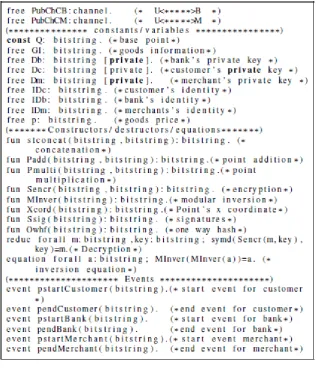
Figure 8. Declaration part
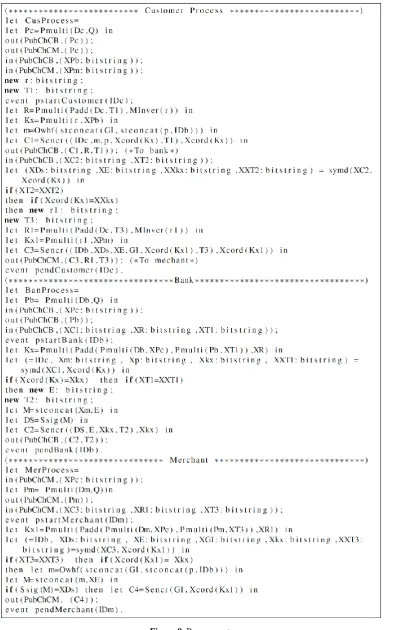
are modeled as the real steps in proposed protocol. The customer process initiates the transaction by computing and sending (C1,R,T1) to the bank via public channel PubChCB. The bank process checks legality of the sender and message and then responds with (C2,T2) via same channel. The customer process then sends (C3,R’,T3) to merchant process, which after verification of authenticity responds with (C4)
the digital product/s. We simulate parallel execution of all the three processes in the main part along with the attacker queries to check secrecy of two session keys shared between the customer and the bank and the customer and the merchant. Further, we also model the reachability queries to check correctness of the proposed schemes. The queries are shown in Fig. 10.
Finally, we got the results as follows:
The results (1 − 3) state the successful initiation and termination for three process. While (4 − 5)
verify that attacker is not able to reveal two session key 𝐾𝑥 and 𝐾𝑥1, which eventually proves that the proposed scheme achieved mutual authentication between the customer and the bank as well as between the customer and the merchant.
9. Performance Analysis
This section evaluates the performance comparison of the proposed e-payment scheme with related existing schemes [33, 43, 44]. For comparison purposes, we have introduced the following notations: 𝑇𝑚𝑒: Time for Exponentiation
𝑇𝑒𝑐𝑚: Time for Elliptic curve point multiplication 𝑇𝑒𝑐𝑎: Time for Elliptic curve point addition 𝑇𝑠𝑦𝑒𝑑: Time for Symmetric encryption/ decryption
operation
𝑇ℎ𝑠: Time for One way hash function
Table 8 illustrates the performance comparison of the proposed scheme with related existing schemes [33, 43, 44]. According to Kilinc et al. [45], execution time for 𝑇𝑚𝑒 ≈ 3.85 𝑚𝑠, 𝑇𝑒𝑐𝑚≈ 2.226 𝑚𝑠, 𝑇𝑒𝑐𝑎 ≈
0.0023 𝑚𝑠 on Ubuntu system with dual core E2200 2.20 GHz processor, 2048 MB of RAM and PBC library. It can be easily verified that the execution time of the proposed scheme is just 9% of Wang et al.’s
scheme [44], 37% of Oros-Popescu’s scheme [43] and 50% of Yang et al.’s scheme [33]. Therefore, the proposed scheme is having more security and is more lightweight as compared with existing schemes.
Figure 10. Main part
10. Conclusion
In this paper, we cryptanalyzed Yang et al.’s authenticated encryption and e-payment schemes. We proved that both of Yang et al.’s schemes are vulnerable to impersonation attack. As a remedy, we proposed improved authenticated encryption scheme to overcome security weaknesses of Yang et al.’s scheme. Furthermore, we also improved e-payment system of Yang et al. We have performed informal and
formal verification of our improved protocol using widespread automated tool ProVerif. The proposed schemes ensured robustness against all known attacks, while reducing about 66% computation cost on user side as compared to Yang et al.’s scheme. Hence the proposed scheme improved the security as well as computation overhead and is more suitable for resource constrained environments.
Table 3. Computation cost analysis
Acknowledgements
Authors would like to thank the anonymous reviewers and the editor in chief for their valuable suggestions to improve the quality, correctness, presentation and readability of the manuscript.
References
[1] S. A. Chaudhry, K. Mahmood, H. Naqvi, M. K. Khan. An improved and secure biometric authentication scheme for telecare medicine informa-tion systems based on elliptic curve cryptography.
Journal of Medical Systems, 2015, Vol. 39, No. 11,
1-12.
[2] S. A. Chaudhry, M. S. Farash, H. Naqvi, S. Kumari, M. K. Khan. An enhanced privacy preserving remote user authentication scheme with provable security.
Security and Communication Networks, DOI:
10.1002/sec.1299, 2015.
[3] M. S. Farash, M. A. Attari. An enhanced authenti-cated key agreement for session initiation protocol.
Information Technology and Control, 2013, Vol. 42,
No. 4, 333-342.
[4] M. S. Farash, M. A. Attari. An enhanced and secure three-party password-based authenticated key exchan-ge protocol without using server’s public-keys and symmetric cryptosystems. Information Technology and
Control, 2014, Vol. 43, No. 2, 143-150.
[5] M. S. Farash, M. A. Attari. An anonymous and untra-ceable password-based authentication scheme for session initiation protocol using smart cards.
Interna-tional Journal of Communication Systems, DOI:
10.1002/dac.2848, 2014.
[6] M. S. Farash, M. A. Attari. Cryptanalysis and impro-vement of a chaotic map-based key agreement protocol using chebyshev sequence membership testing.
Nonli-near Dynamics, 2014, Vol. 76, No. 2, 1203-1213.
[7] M. S. Farash, M. A. Attari. An efficient client pass-word-based authentication scheme with provable security. The Journal of Supercomputing, 2014, Vol. 70, No. 2, 1002-1022.
[8] A. Irshad, M. Sher, E. Rehman, S. Ashraf Ch, M. Ul Hassan, A. Ghani. A single round-trip SIP authentication scheme for voice over internet protocol using smart card. Multimedia Tools and Applications, 2015, Vol. 74, No. 2, 3967-3984.
International Conference on Digital Information
Processing and Communications (ICDIPC),
pp. 164-167.
[10] A. Irshad, M. Sher, M. S. Faisal, A. Ghani, M. Ul Hassan, S. Ashraf Ch. A secure authentication scheme for session initiation protocol by using ECC on the basis of the Tang and Liu scheme. Security and
Communication Networks, 2014, Vol. 7, No. 8,
1210-1218.
[11] S. Kumari, S. A. Chaudhry, F. Wu, X. Li, M. S. Farash, M. Khurram Khan. An improved smart card based authentication scheme for session ini-tiation protocol. Peer-to-Peer Networking and
Appli-cations, DOI: 10.1007/s12083-015-0409-0, 2015.
[12] S. A. Chaudhry, K. Mahmood, H. Naqvi, M. Sher. A secure authentication scheme for session initiation protocol based on elliptic curve cryptography. In: The 13th IEEE International Conference on Dependable,
Autonomic and Secure Computing (DASC 2015),
pp 1-5.
[13] S. A. Chaudhry, H. Naqvi, M. Sher, M. S. Farash, M. Ul Hassan. An improved and provably secure privacy preserving authentication protocol for SIP.
Peer-to-Peer Networking and Applications, DOI:
10.1007/s12083-015-0400-9, 2015.
[14] S. A. Chaudhry, H. Naqvi, T. Shon, M. Sher, M. S. Farash. Cryptanalysis and improvement of an improved two factor authentication protocol for telecare medical information systems. Journal of Medical Systems, 2015, Vol. 39, Issue 6.
[15] Z. Brakerski, V. Vaikuntanathan. Efficient fully homomorphic encryption from (standard) LWE. SIAM
Journal on Computing, 2014, Vol. 43, No. 2, 831-871.
[16] A. Bogdanov, F. Mendel, F. Regazzoni, V. Rijmen, E. Tischhauser. ALE: AES-based lightweight authen-ticated encryption. In: 20th International Workshop on
Fast Software Encryption (FSE, 2013).
[17] P. Zhang, C. Lin, Y. Jiang, Y. Fan, X. Shen. A Lightweight Encryption Scheme for Network-Coded Mobile Ad Hoc Networks. IEEE Transactions on
Parallel and Distributed Systems, 2014, Vol. 25,
No. 9, 2211-2221.
[18] Y. Zheng. Digital signcryption or how to achieve cost (signature & encryption) << cost (signature)+ cost (encryption). In: Advances in Cryptology (CRYPTO’97),pp. 165-179. Springer, 1997.
[19] M. Toorani , A. A Beheshti. An elliptic curve-based signcryption scheme with forward secrecy. arXiv preprint arXiv:1005.1856, 2010.
[20] Y. Han, X. Yang, Y. Hu. Signcryption based on elliptic curve and its multi-party schemes. In:
Proceedings of the 3rd international conference on
Information security, ACM 2004, pp. 216-217.
[21] S. A. Ch, M. Sher, A. Ghani, H. Naqvi, A. Irshad. An efficient signcryption scheme with forward secrecy and public verifiability based on hyper elliptic curve cryptography. Multimedia Tools and Applications, 2014, Vol. 74, No. 5, 1711-1723.
[22] S. A. Ch, N. Nizamuddin, M. Sher. Public verifiable signcryption schemes with forward secrecy based on hyperelliptic curve cryptosystem. In: Information
Systems, Technology and Management, pp. 135-142.
Springer, 2012.
[23] N. Nizamuddin, S. A. Ch, N. Amin. Signcryption schemes with forward secrecy based on hyperelliptic curve cryptosystem. In: High Capacity Optical
Networks and Enabling Technologies (HONET), 2011,
pp. 244-247.
[24] N. Nizamuddin, S. A. Ch, W. Nasar, Q. Javaid. Efficient signcryption schemes based on hyperelliptic curve cryptosystem. In: 7th International Conference
on Emerging Technologies (ICET), 2011, pp. 1-4
[25] S. Bala, G. Sharma, A. K. Verma. An improved forward secure elliptic curve signcryption key management scheme for wireless sensor networks. In:
IT Convergence and Security 2012, pp. 141-149.
Springer, 2013.
[26] S. A. Chaudhry, M. S. Farash, H. Naqvi, M. Sher. A secure and efficient authenticated encryption for electronic payment systems using elliptic curve cryptography. Electronic Commerce Research, DOI: 10.1007/s10660-015-9192-5, 2015.
[27] F. Bao, R. H. Deng. A signcryption scheme with signature directly verifiable by public key. In: Public
Key Cryptography, pp. 55-59. Springer, 1998.
[28] C. Gamage, J. Leiwo, Y. Zheng. Encrypted message authentication by firewalls. In: Public Key
Cryptography, pp. 69-81. Springer, 1999.
[29] Y. Zheng, H. Imai. How to construct efficient signcryption schemes on elliptic curves. Information
Processing Letters, 1998, Vol. 68, No. 5, 227-233.
[30] R.-J. Hwang, C.-H. Lai, F.-Fu Su. An efficient signcryption scheme with forward secrecy based on elliptic curve. Applied Mathematics and Computation, 2005, Vol. 167, No. 2, 870-881.
[31] M. Toorani, A. A. Beheshti. An elliptic curve-based signcryption scheme with forward secrecy. arXiv preprint arXiv:1005.1856, 2010.
[32] E.-J. Yoon, K.-Y. Yoo. A secure and efficient convertible authenticated encryption scheme with message linkages using elliptic curve cryptosystem.
Applied Mathematical Sciences, 2013, Vol. 7, No. 127,
6309-6317.
[33] J.-H. Yang, Y.-F. Chang, Y.-H. Chen. An efficient authenticated encryption scheme based on ecc and its application for electronic payment. Information
Tech-nology and Control, 2013, Vol. 42, No. 4, 315-324.
[34] M. S. Farash. Security analysis and enhancements of an improved authentication for session initiation protocol with provable security. Peer-to-Peer
Networking and Applications, DOI:
10.1007/s12083-014-0315-x, 2014.
[35] M. S. Farash, M. A. Attari. A secure and efficient identity-based authenticated key exchange protocol for mobile client-server networks. The Journal of
Supercomputing, 2014, Vol. 69, No. 1, 395-411.
[36] C.-T. Li. Secure smart card based password authenti-cation scheme with user anonymity. Information
Technology and Control, 2011, Vol. 40, No. 2,
157-162.
[37] J.-W. Hong, S.-Y. Yoon, D.-I. Park, M.-J. Choi, E.-J. Yoon, K.-Y. Yoo. A new efficient key agreement scheme for VSAT satellite communications based on elliptic curve cryptosystem. Information Technology
and Control, 2011, Vol. 40, No. 3, 252-259.
[38] M. S. Farash, M. A. Attari. A provably secure and efficient authentication scheme for access control in mobile pay-tv systems. Multimedia Tools and
Applications, DOI: 10.1007/s11042-014-2296-4, 2014.
Informa-tion Technology and Control, 2013, Vol. 42, No. 3, 231-237.
[40] Q. Xie, N. Dong, D. S Wong, B. Hu. Cryptanalysis and security enhancement of a robust two-factor authentication and key agreement protocol.
Interna-tional Journal of Communication Systems, DOI:
10.1002/dac.2858, 2014.
[41] B. Hu, Q. Xie, Y. Li. Automatic verification of pass-word-based authentication protocols using smart card.
In: International Conference on Information
Technolo-gy, Computer Engineering and Management Sciences
(ICM),2011, pp. 34-39.
[42] V. Cheval, B. Blanchet. Proving more observational
equivalences with ProVerif. In: Principles of Security and Trust, pp. 226-246. Springer, 2013.
[43] H. Oros, C. Popescu. A secure and efficient offline electronic payment system for wireless networks.
International Journal of Computers, Communications
& Control, 2010, Vol. 5, No. 4, 551-557.
[44] H. Wang, J. Cao, Y. Zhang. A flexible payment scheme and its role-based access control. IEEE
Transactions on Knowledge and Data Engineering,
2005, Vol. 17, No. 3, 425-436.
[45] H. H. Kilinc, T. Yanik. A survey of SIP authentica-tion and key agreement schemes. IEEE
Communica-tions Surveys & Tutorials, 2014, Vol. 16, No. 2,
1005-1023.