Aher Nitin Sanjay
KCT’S RGS College of Pharmacy, Anjaneri, Nashik Email: [email protected]
Address for correspondence
Access this article online www.japer.in
Pharmaceutical Cocrystallization: A Review
INTRODUCTION
For many the interest in molecular crystal engineering is no doubt fuelled by aesthetic aspects; if not by the beauty of crystal morphologies, then certainly by the symmetry and complexity of the crystal structures. In addition, crystal engineering paves the road for many potential applications of organic and inorganic as well as hybrid organic–inorganic crystals. These applications range from lenses, nonlinear optics, sensors, and semiconductors, to catalysts and storage materials for small molecules. Many examples of new crystalline materials and compounds with interesting structures and properties were presented at the recent Euro conference on Molecular Crystal Engineering, which focused on the “Design and Preparation of Molecular Materials”.2
The following definition of co-crystals was proposed by the FDA in the draft guidance: Solids that are crystalline materials composed of two or more molecules in the same crystal lattice. The December 2011 release of a draft United States Food and Drug
Administration (FDA) guidance concerning regulatory classification of pharmaceutical co-crystals of active pharmaceutical ingredients (APIs) addressed two matters of topical interest to the crystal engineering and pharmaceutical science communities:
(1) A proposed definition of co-crystals;
(2) A proposed classification of pharmaceutical co-crystals as dissociable “API- excipient” molecular complexes.1
CLASSIFICATION OF COCRYSTAL
The following classification has been proposed by the FDA: Co-crystals should be classified within the Agency’s current regulatory framework as dissociable “API-excipient” molecular complexes. They may then be treated as a “drug product intermediate” rather than as a drug. Should this classification be adopted, then there are several implications:1
1. Cocrystal containing drug products will not be considered to contain new APIs.1
2. New drug application, NDAs, and abbreviated NDAs, ANDAs, claiming to contain a cocrystal form will have to prove the extent of proton transfer.1
3. The cocrystal must be shown to dissociate in vivo prior to reaching its active site. The nature and
Cocrystals as defined by the FDA are, “Solids that are crystalline materials composed of two or more molecules in the same crystal lattice”. Pharmaceutical cocrystals represent a subset of cocrystals. Pharmaceutical cocrystals have quickly evolved from relative obscurity to a widely studied class of crystal forms in the context of pharmaceutical science and engineering. Cocrystals, like salts, represent solid forms that if novel can be patented and they are known to modulate important physicochemical properties such as solubility, stability, or bioavailability. They can therefore be applicable for use as an API in either immediate release or extended release formulations. The diversity of API crystal forms makes it difficult to classify solid forms into three categories that are mutually exclusive:
Polymorphs, Salts, and Co-crystals. However, a classification of cocrystals has been attempted in this review. There is an extensive amount of literature available on cocrystals. However, there is a lack of an exhaustive review on methods of preparation of cocrystals. This review has made an attempt of bridge this gap. This review covers all methods of literature such as grinding method (Neat and Solvent drop grinding methods), Co-crystallization from Solution, SonoCo-crystallization Method, Hot melt extrusion, etc. A brief on characterisation techniques routinely used for cocrystals has also been incorporated here. Advantages of adopting the cocrystal approach have also been mentioned. Reported work on cocrystals was reviewed and has been briefly outlined herewith.
Keywords: Cocrystals, Crystal engineering, hydrogen bonding, supramolecular synthons, Polymorphs, Salts.
ABSTRACT ABSTRACT ABSTRACT ABSTRACT Aher Nitin Sanjay*, Shinkar
Dattaraya Manohar, Saudagar Ravindra Bhanudas1
Department of Pharmaceutics, KCT’S RGS College of Pharmacy, Anjaneri, Nashik-422213. Maharashtra, India.
1Department of Pharmaceutical
Chemistry, KCT’S RGS College of Pharmacy, Anjaneri, Nashik-422213, Maharashtra, India.
location of the putative active site varies greatly between different drug classes, such that there is significant ambiguity about how to address the dissociation requirement, especially in the case of topically active drugs (applied on skin or orally active within the GI tract, for instance).1
4. The API cocrystal which by definition is a crystalline multicomponent chemical compound would be considered analogous to the “API-excipient” blend that overwhelmingly represents a physical mixture of an API and excipient(s).1
With this in mind, the strong consensus of the authors is that cocrystals should naturally be grouped with salts for this and a number of other reasons: 1
• Given that the difference between a salt and a cocrystal might just be the movement of a proton by around 1Å, is there any reason why the type of interaction in a solid form should in effect be used to classify it? For example, a formic acid solvate of an API could be classified as a solvate, a cocrystal, or a salt. However, only the nature of the interaction between the two components will tell one how to classify such a molecular complex. Does the nature of this interaction have any relevance at all to pharmaceutical science and clinical performance? 1
• The issue of the “salt cocrystal continuum”, which was raised by the FDA, has not been studied in sufficient breadth or depth to conclude the frequency or importance of this phenomenon. Furthermore, it becomes moot if salts and pharmaceutical cocrystals are grouped together. 1
• Like salts, cocrystals have defined stoichiometry, and similar solution speciation characteristics, such as common-component effects (similar to common ion effects of salts), multiple ionization (API and coformer), and association (self-association and complexation). 1
• Similar to salts, cocrystals will exhibit a solubility product (Ksp) and a pHmax (that specifies the thermodynamic stability region of the cocrystal). These properties are of paramount importance in the
performance aspects and analytical procedures that cocrystals will require (such as level of coformer, common components) to provide reasonable assurance of their safety and effectiveness. 1
• There are already marketed drugs that could be classified as cocrystals. Caffeine citrate, Depakote (the valproic acid cocrystal of sodium valproate), and Escitalopram oxalate are marketed as salts but they could be classified as cocrystals according to our proposed definition. 1
• Polymorphism in cocrystals (different packing arrangements with the same composition, e.g.carabazepine,saccharin,piroxicam:4hydroxybenzoi cacid and hydrates of cocrystals) defy the idea that cocrystal formers play the same role as that of an excipient. Rather, cocrystals are novel solid forms that can be patented and are known to modulate physicochemical properties such as solubility in either direction. This means that they could be applicable in either immediate release or extended release formulations unlike the “API-excipient complexes”.
• The position of the proton in autoionizable APIs such as Cefdinir (which could exist in zwitterionic or molecular form) and Triclabendazole (polymorph II exists with tautomeric forms in the asymmetric unit) is not considered relevant for classification so why does it matter to the debate about salts v/s cocrystals?
• The analogy between cocrystals and “API-excipient complexes” is tenuous for a number of reasons: An excipient is supposed to be chemically inert with regard to the API, unlike a cocrystal former whose function is to participate in intermolecular interactions with an API and become an integral part of the resulting crystal structure. 1
of API particles. However, they do not become part of the crystal structure as in cocrystals. 1
- The formation of a cocrystal of an API fully resembles API salt formation since the intent is to alter the properties of the drug substance via a premeditated chemical interaction between the API and the cocrystal former; therefore, it should not be considered as a formulation process of blending an API with excipient(s) to afford a “drug product intermediate.” Ultimately, any cocrystal form of an API, just like any salt of an API, would still require appropriate formulation to afford the final dosage form. 1
• Cocrystals, like salts, represent solid forms that if novel can be patented and they are known to modulate important physicochemical properties such as solubility, stability, or bioavailability. They can therefore be applicable for use as an API in either immediate release or extended release formulations. 1
Co-crystals, or multicomponent molecular crystals, attract wide interest in the crystal engineering community because of fundamental and practical reasons. Of course, it has been known for more than 150 years that molecular solids may be obtained that contain, within them, two or more distinct chemical compounds, and accordingly, co-crystal formation per se is not of intrinsic novelty. However, during the last 25 or so years, there has been a more sharpened focus on the situations when and the reasons why these multicomponent crystals are formed. This is the fundamental reason for co-crystals being studied so extensively. The practical reasons have to do with the fact that co-crystals of active pharmaceutical ingredients (API) may be attractive candidates for protection of intellectual property in terms of their particular novelty, utility, and non obviousness. An obvious question, in the crystal engineering context, is whether it is easier or more straightforward to design the crystal structure of a multicomponent organic crystal when compared to the crystal structure of a pure compound. The answer to this question is by no means straightforward. Many years ago, one of us
wrote that “the very manifestation of co-crystallisation in a particular system implies that it is possible to dissect and analyse a few significant molecular interactions from amongst the larger number that actually determine the stable crystal structure. In other words, it is usually easier to understand why two molecules may co-crystallise rather than why a single molecule adopts a particular crystal structure in preference to another.” With the hindsight of the 23 intervening years that have elapsed since that paper was published, it could now be said that the first statement in the quote might equally well apply to crystallization of a single compound as it does to co- crystallization of two compounds: the idea of identifying specific interactions in a crystal structure leads directly to the concept of the supramolecular synthons.3
As for the second statement, it would probably be accepted even today, but understanding a crystal structure is not the same as designing or predicting a structure. Considerable progress has been made in the definition of protocols for the design of co-crystals, notably by Zaworotko but also by others, using the retrosynthetic approach that is afforded by the concept of the supramolecular synthon. However, there is a difference between designing a crystal structure of a co-crystal by invoking chemically reasonable synthons based on hydrogen bonding and also other significant intermolecular interactions, and actually obtaining such a co-crystal in the laboratory. This difference between expectation and realization is largely a matter of kinetics, solvent choice, and solubility. These are unavoidable issues. More avoidable are issues pertaining to an incomplete understanding of the supramolecular chemistry of the API and the selected co-crystal former. 3
Supramolecular Synthons
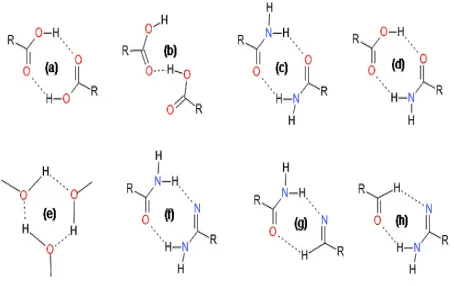
in a predictable fashion by non-covalent interactions.18
• Self-complementary functional groups, such as alcohols, amides, and carboxylic acids contain both a hydrogen bond donor and acceptor and are therefore capable of forming supramolecular
homosynthons.
Functionalities of other functional groups, which contain only hydrogen bond donors or acceptors, do not have this ability. Though, all functionalities are capable of forming supramolecular heterosynthons with other complementary functional groups.
Fig 1: Showing representative supramolecular synthon
a. Homosynthons exhibited by carboxylic acid, b. Head-to-tail chains formed from carboxylic acids, c. Homosynthons exhibited by amide dimmers, d. Heterosynthon exhibited by acid-amide dimers, e. Six membered intramolecular hydrogen bond
ring formed in preference Hydrogen Bonding Rules,
f. Strong synthon with N–H…O and O–H…N interactions,
g. Less favoured synthon with one weak C–H…O and one strong hydrogen bond,
h. Weak synthon observed in co-crystals with diols. Some functionalities that are capable of forming supramolecular synthons; alcohol, acids (carboxylic, sulfonic, phosphonic, and boronic), amino-pyridine, ketone, aldehyde, ether, ester, primary and secondary amine, aromatic nitrogen, primary and secondary amide, sulfoxide, sulfonamide, cyano, imine, nitro,
sulfonyl, water, and ions such as Cl- and Br .19
Complexation is the association between two or more molecules to form a nonbonded entity with a well- defined stoichiometry. Complexation relies on relatively weak forces such as London forces, hydrogen bonding and hydrophobic interactions.18
Etter and co-workers projected the rules to facilitate the deliberate design of hydrogen-bonded solids13
a. All good proton donors and acceptors are used in hydrogen bonding.
b. Six-membered ring intramolecular hydrogen bonds form in preference to intermolecular hydrogen bonds.
c. The best proton donor and acceptor remaining after intramolecular hydrogen- bond formation will form intermolecular hydrogen bonds to one another (but not all acceptors will necessarily interact with donors)
METHODS OF PREPARATION OF COCRYSTALS:
The most conventional method used for crystal formation the use of suitable solution with proper degree of super saturation. There are several methods through which solution is supersaturated such as evaporation, cooling and incorporation of solubility lowering solvent or substance. The most common technique used for preparation of cocrystals is the evaporation. Cocrystallization through solution evaporation based crystal growth technique did not offer optimal result.15
coformer used during development of cocrystal is GRAS chemical i.e. generally recognised as safe (GRAS).11
There are two ways of producing co-crystals mainly they are, solution based and grinding methods. The solution based method is important one because of its nature of producing most of the co-crystals which can qualify for the single X-ray diffraction (SXRD) testing. It includes evaporation of a heterometric solution method, reaction crystallization and cooling crystallization methods. The grinding methods include neat grinding and solvent drop grinding. Apart from theses convictional methods of co-crystallization methods, today there are many other new emerging methods, such as co-crystallization using supercritical fluid, hot-stage microscopy, and ultrasound assisted.12
Co-crystals can be prepared by solid and solvent based techniques. The solvent-based techniques involve solvent evaporation, slurry conversion, cooling crystallization and precipitation. The solid based techniques involve net grinding, solvent-assisted grinding and sonication (applied to both to dry or wet solid mixtures) 80o to 85o.12
1) Grinding method:
The product acquired when preparing co-crystals from grinding is usually consistent with that obtained from solution. This may specify that patterns of hydrogen-bond connectivity are not idiosyncratic or determined by non-specific and uncontrollable effects of solvent or crystallization conditions. Disappointment in co-crystals formation by grinding co- crystallization possibly due to an incapability to generate suitable co-crystal arrangements rather than due to the stability of the initial phases. Formation of co-crystal has been successful from solution but not from grinding, this may be due to solvent inclusion in stabilizing the supramolecular structure. The current technique of liquid assistant grinding (solvent drop grinding) has been shown to improve the kinetics and facilitate co- crystal formation and as lead to increased attention of solid-state grinding as a method for co-crystallization.13
Two methods of co-crystals has been developed which are – Neat grinding (dry grinding, solid state grinding) and Solvent drop grinding (SDG).15
Neat grinding can be done in different methods such as, mechanical grinding using ball mill mixture, vibratory mail or by manual grinding using motor and pestle, thus developing the co-crystals by grinding method.15
Solvent drop grinding was performed by the regular addition of solvent the choice of solvent is important and should be able to dissolve the
compound. Example: Caffeine-glutaric acid co-crystal polymorph and comparing with evaporation method is eco-friendly, cost effective and more effective in the development of new co-crystals.13
a) Solid state grinding:
Solid state grinding is alternative synthetic method for solution based cocrystallization process. Particle size reduction is carried out in mixture which increases the covalent reactivity. This method offers increase in selectivity and simplicity over solution crystallization technique.11
The application of solid state grinding was studied using six cocrystals of sulfadimidine with anthranillic acid and salicylic acid, the cocrystal of sulfadimidine –salicylic acid while grinding with anthranillic acid. The replacement of Salicylic acid with anthranillic acid occurs as a result of common pattern of hydrogen bonding of both of cocrystals.15
The solid grinding approach is having drawback of polymorphic transition during the process which results in dangerous side effect that may include permanent withdrawal from market.15
b) Solvent drop grinding:
Solvent drop grinding is emerging step in advancement of polymorphic selectivity in various models of cocrystals. Solvent drop grinding includes grinding of two materials together like solid state grinding with incorporation of small quantity of solvent.15 The solvent added act as catalyst. It is
characterization of co-crystals, regardless of the inabilities to characterize materials synthesized using this method by single-crystal X-ray diffraction.16
Initially their synthesis is carried out by solution crystal growth method. Some crystals were readily prepared with solid grinding method but some did not successfully preceded further. For them solvent drop grinding technique found to be efficient.15
The inability of Solid grinding process for selective polymorphic synthesis of caffeine and Glutaric acid co crystal was successfully fulfilled by solvent drop grinding. The applications of solvent drop technique in inter converting polymorphic organic substances in case of carboxylic acids like succinic acid and anthranillic acid. Solvent drop grinding is useful in synthesis of crystalline salt with pharmaceutical substances. Indomethacin cocrystals with saccharine were prepared by solvent drop grinding, the optimal result obtained with increased dissolution rate and physical stability.13
2) Co-crystallization from Solution:
The two components must have similar solubility for solution cocrystallization; otherwise the component which has least soluble will precipitate out entirely. On the other hand similar solubility of two components alone will not promise success. It has been recommended that it possibly useful to believe polymorphic compounds, which exist in more than one crystalline form as co-crystallizing components. If a molecular compound exists in numerous polymorphic forms it has showed a structural flexibility and is not locked into a single type of crystalline lattice or packing mode.13
Co-crystal from small-scale preparation has been described. Scale-up crystallization was carried out in a water-jacketed glass crystallization vessel and temperature was controlled by a circulating water bath. Teflon blade and overhead stirrer with a glass shaft were attached to vessel ports and also a reflux column, digital thermometer were attached. The API and co-crystal former were added to this vessel and
were dissolved in ethanol/methanol mixture and heated to 70o C under reflux for 1 hour. To induce
precipitation of co-crystal, temperature was decreased at a rate of 10o C in a stirred, unseeded
system. Literate to improve solids recovery decrease the additional temperature.13
a) Solvent Evaporation:
This is most conventional technique of cocrystallization which includes super saturation of solution by evaporation, cooling and addition of solubility changing solvent or substance. The series of events that are follows in solvent evaporation are preparation of two or more suspensions by dissolution of stoichiometric amounts of materials in a solvent, mixing of suspensions and storage under suitable temperatures for co-crystallization. In evaporation process the solution of multiple molecules in suitable amounts are assumed to undergo hydrogen bonding. To have optimal result during evaporation the thermodynamic stability of molecules should always be considered. The major drawback of evaporation process is its failure to comply in large scale preparations.15
These Method used for increase intrinsic solublity of Fluoxetine hydrochloride by using multiple coformers like succinic acid, fumaric acid and benzoic acid.15 Norfloxacincocrystals were
synthesized with Isonicotinamide, Malonic acid and maleic acid as coformers.13
b) Slurry Crystallization:
Slurry crystallization is simple process which includes the addition of crystallization solvent in the components i.e. API along with its acceptable former. The selection of this process is mainly depends upon the physical stability of the crystallization solution to co crystals and its solid former. The study on synthesis of cocrystals through slurry crystallization was commenced in sixteen co crystal system with optimum result.15
was stirred at room temperature for few days. After few days, the solvent was decanted and the solid product was dried under a flow of nitrogen for few minutes. The remaining solids were then characterized using PXRD analysis.13
While preparation of cocrystals for Trimethoprim and sulfamethoxazole through slurry technique simple distilled water is used as solvent. Cocrystals of aspirin designed with 4, 4-Dipyridil as a coformer by using slurry crystallization method. However the yield obtained was not sufficient as compared with solvent drop grinding method.15
The major disadvantage of this method is that it requires large amount of solvent.15
3) Hot melt extrusion:
Extrusion is useful method for synthesis of cocrystals, it involves highly efficient mixing and improved surface contacts, Co crystals are prepared without use of solvent. The selection of this method is primarily depends on thermodynamic stability of compound. This method was studied with the use of four models for cocrystal formation. Solvent drop extrusion technique used to optimize and make the process more flexible. Solvent drop extrusion technique gives an advantage to carry out process at lower temperature. Hot melt extrusion method was used in synthesis of Carbamazepinenicotinamide cocrystals with polymer as former. Continuous cocrystallization, API and coformer poured in the twin extruder. As a result of continuous addition of mixture the barrel temperature also increases. 15
4) Sonocrystallization Method:
The development of sonochemical method for preparation of organic cocrystals of very finite size has been done. This method was primarily developed for preparation of nanocrystals. Caffeine-maleic acid cocrystal preparation commenced with use of ultrasound method. The comparative study of method of preparation of caffeine and theophylline as API and
L-tartaric acid as coformer by Solvent drop grinding method and sonochemical method has been commenced. The results of methods were consistent hence Sonocrystallization proves to be a significant approach. 15
Characterization of co-crystals
Melting point is the temperature at which the solid phase is at equilibrium with the liquid phase.20 Melting point of pure API, formers and
co-crystals are obtained by capillary method using liquid paraffin17 or DSC is the preferred for obtaining
melting point data and thermal data such as enthalpy of melting. DSC has recently been used as a tool for rapid cocrystal screening.21
SEM is a type of electron microscope that images a sample by scanning it with a high-energy beam of electrons. The electrons interact with the atoms that make up the sample producing signals which provide information about the sample’s surface topography. It is used to determine the cocrystal micrograph and particle size.[21-23]
Single X-ray diffraction (SXRD) is a technique for determination of the solid-state structure of cocrystals at an atomic level. The problem is that a single pharmaceutical cocrystal which is qualified for SXRD testing cannot always be produced. Therefore, powder X-ray diffraction (PXRD) are utilised more frequently to verify the formation of cocrystals.[21-23]
Raman spectroscopy is used to study vibrational, rotational, and other low frequency modes in a system. There are many applications using Raman spectroscopy to identify characteristic peaks of cocrystal products.[21-23]
Advantages of cocrystal approach
excipients, additives, and other APIs, the only solid form that is designable via crystal engineering patentable expanding IP portfolios and can be produced using solid-state synthesis green technologies high yield, no solvent or by-products.13
• Compared to other solid-state modification techniques employed by pharmaceutical industry, co-crystal formation appears to be an advantageous alternative for drug discovery (e.g. new molecule synthesis, nutraceutical co-crystals), drug delivery (solubility, bioavailability) and chiral resolution. Experts are of the opinion that pharmaceutical intellectual property landscape may benefit through co-crystallization.23
REPORTED WORK:
• Co-Crystals of the Anti-HIV Drugs Lamivudine
and Zidovudine3
• Fast Dissolving Curcumin Cocrystals4
• Co-crystals of carbamazepine with
isonicotinamide, benzamide and nitrobenzamide, and of cinnamic acid with 3-nitrobenzamide have been discovered.5
• Cocrystals and Salts of Gabapentin6 • Pharmaceutical Cocrystals of Niclosamide7
• Cocrystals of Piroxicam with Carboxylic Acids8
CONCLUSION
The myriad of advantages of the cocrystal approach show that they have a great potential such as ease of fabrication attributed to no requirement of making or breaking covalent bonds. They exhibit better stability than amorphous drugs ,can be modified to give immediate or prolonged release formulations & hence co crystal formation appears to be an advantageous alternative for drug discovery (e.g. new molecule synthesis, nutraceutical cocrystals), drug delivery (solubility, bioavailability) and chiral resolution when compared with other solid state modification techniques of the pharmaceutical industries. Cocrystals must be studied more and in depth analysis of their properties and further exploration of simpler and cost effective methods of preparation for
cocrystals should be undertaken. The process of new molecule synthesis has been proved to be accelerated by adopting the cocrystal approach. Further refining of already established processes of new drug development may become possible using this approach. Cocrystal engineering may solve many conventional and non-conventional problems that pharmaceutical scientists face in today’s age.
Thus, encouragement for further development and polishing of this filed is the need of the hour and must be undertaken to gather all information of this novel concept.
REFERENCES
1. Aitipamula S, Banerjee R, Bansal AK, Biradha K, Cheney ML et al. Polymorphs, Salts, and Cocrystals:
What’s in a Name? Crystal Growth Design, 2012; 12:2147-52.
2. Sommerdijk N. Crystal Design and Crystal
Engineering. Angew. Chem. Int. Ed. 2003, 42, 3572– 74.
3. Prashant M. Bhatt, Yasser Azim, Tejender S. Thakur, and Gautam R. Desiraju. Co-Crystals of the Anti-HIV Drugs Lamivudine and Zidovudine. CRYSTAL GROWTH & DESIGN 2009; 9:(2):951–957.
4. Palash Sanphui, N. Rajesh Goud, U. B. Rao Khandavilli, and Ashwini Nangia. Fast Dissolving Curcumin Cocrystals. Cryst. Growth Des. 2011, 11, 4135–4145.
5. J. H. ter Horst, M. A. Deij, and P. W. Cains. Discovering New Co-Crystals. Crystal Growth & Design, Vol. 9, No. 3, 2009.
6. L. Sreenivas Reddy, Sarah J. Bethune, Jeff W. Kampf, and Nair Rodriguez-Hornedo. Cocrystals and Salts of Gabapentin: pH Dependent Cocrystal Stability and Solubility. Crystal Growth & Design, Vol. 9, No. 1, 2009: 378–385.
7. Palash Sanphui, S. Sudalai Kumar, and Ashwini Nangia. Pharmaceutical Cocrystals of Niclosamide Cryst. Growth Des. 2012, 12, 4588−4599.
9. Schultheiss N, Newman. A Pharmaceutical Cocrystals and their Physiochemical Properties. Cryst growth & design. 2009:9 (6).
10. Bupendra. S. S. Pharmaceutical Co-Crystals – A Review. Ars Pharm. 2009: 50 (3): 99-117.
11. Vitthalrao M, Kumar F, Radheshyam Bk. Reviw Article Cocrystalization : An Alternative Approach
For Solid Modification. 2013;3(4):166–72.
12. Raghuram Reddy Kothur As, Swetha Npb. An Outline Of Crystal Engineering Of Pharmaceutical Co-Crystals And Applications : A Review. Int J Pharm Res
Dev. 2012;4(0974):84–92.
13. Sevukarajan M, Thamizhvanan K, Sodanapalli Riyaz, Sateesh Babu Jm, Naveen Kumar B, Sreekanth Reddy B, Sethu Krishna J, Vivekananda U. Sarada K, Hyndavi N. Crystal Engineering Technique – An Emerging Approach To Modify Physicochemical Properties Of Active Pharmaceutical Ingredient. Int J Chem Pharm Sci. 2012;3(1):15–29.
14. Amin M, Alhalaweh A, Velaga SP. Hansen solubility parameter as a tool to predict cocrystal formation. Int J Pharm [Internet]. Elsevier B.V.;
2011;407(1-2):63–71. Available from:
http://dx.doi.org/10.1016/j.ijpharm.2011.01.030 15. Vitthalrao ma, kumar fn, radheshyam bk. Reviw
article cocrystalization : an alternative approach for
solid modification. J drug deliv ther. 2013;3(4):166– 72.
16. Trask A V, Motherwell WDS, Jones W. Solvent-drop
grinding: green polymorph control of
cocrystallisation. Chem Commun (Camb) [Internet].
2004 Apr 7;(7):890–1. Available from:
http://www.ncbi.nlm.nih.gov/pubmed/15045115 17. Shah k, borhade s, londhe* v. Utilization of
co-crystallization for solubility enhancement of a poorly
soluble antiretroviral drug – ritonavir. Int j pharm pharm sci. 2014;6(2):2–4.
18. *S.Vijayaraj, Kumar AS. PHARMACEUTICAL
APPROACH TO SUPRAMOLECULAR CHEMISTRY – A COMPREHENSIVE REVIEW. Int J Pharm Dev Technol. 2013;3(1):35–40.
19. Reddy LS, Bethune SJ, Kampf JW, Rodrı́guez-Hornedo N. Cocrystals and Salts of Gabapentin: pH Dependent Cocrystal Stability and Solubility. Cryst Growth Des [Internet]. 2009 Jan 7;9(1):378–85. Available from: http://pubs.acs.org/doi/abs/10.1021/cg800587y 20. Prasad RV, Rakesh MG, Jyotsna RM, Mangesh ST,
Sapkale P, Mayur PK. Pharmaceutical
Cocrystallization : A Review. Int J Pharm Chem Sci.
2012;1(3):725–36.
21. Asija* R, Mangukia D, Asija S. Pharmaceutical cocrystals: an overview. Int J Pharm [Internet]. 2011
Oct 31;419(1-2):1–11. Available from:
http://www.ncbi.nlm.nih.gov/pubmed/24487190 22. Sekhon BS. Pharmaceutical co-crystals - a review.
ARS Pharm. 2009;50(1):99–117.
23. Prasad RV, Rakesh MG, Jyotsna RM, Mangesh ST,
Sapkale P, Mayur PK. Pharmaceutical
Cocrystallization : A Review. Int J Pharm Chem Sci.
2012;1(3):725–36.
How to cite this article: Aher Nitin Sanjay*, Shinkar
Dattaraya Manohar, Saudagar Ravindra Bhanudas; Pharmaceutical Cocrystallization: A Review; J. Adv. Pharm. Edu. & Res. 2014: 4(4): 388-396.