Turkish Journal of Fisheries and Aquatic Sciences 10: 463-470 (2010)
www.trjfas.org ISSN 1303-2712 DOI: 10.4194/trjfas.2010.0404
© Published by Central Fisheries Research Institute (CFRI) Trabzon, Turkey in cooperation with Japan International Cooperation Agency (JICA), Japan
Stocking Density and Photoperiod Manipulation in Relation to Estradiol
Profile to Enhance Spawning Activity in Female Nile Tilapia
Introduction
Commercial production of tilapia is increasingly gaining expansion in many countries due to its
suitability to variety of pond farming conditions, resistance to diseases, high survival and growth rate (Pullin et al., 1991). The economic and nutritional importance of tilapia species is well outlined in Altun
Edward Ebo Onumah1,*, Stephan Wessels1, Nina Wildenhayn1, Bernhard Brümmer1, Gabriele Hörstgen Schwark1
1 Georg-August University, Department für Agrarökonomie und Rurale Entwicklung, Göttingen, Germany.
* Corresponding Author: Tel.: +49.179 1483513; Fax: +49.179 1483513;
E-mail:[email protected]
Received 11 September 2009 Accepted 15 August 2010
Abstract
This study investigated the effects of stocking density and photoperiod manipulation in relation to plasma estradiol-17β
(E2) profile to enhance spawning activity in female Nile tilapia using F1 clonal crosses. The fish were divided into
experimental and control groups and subjected to a combination of stocking density and photoperiod treatments (40 kg/m3;
6L:18 D, 40 kg/m3; 12 L:12 D and transferred into single compartments at 12 L:12 D; 14 kg/m3; 12L:12D, respectively).
Blood samples were taken by caudal puncture from both experimental and control fish for estradiol profile analysis. Results showed that experimental fish exhibited significantly higher number of spawns per day, total and relative fecundity, hatching and swim-up rates (P<0.05). Regression analyses revealed a significant positive relationship between fish size (body weight),
and total and relative fecundity (P<0.001). It was also revealed that E2 levels demonstrated a pattern based on completed
reproductive cycle in the experimental fish. The study therefore established that a combination of stocking density and photoperiod treatments can be adopted to manipulate the timing of spawning activity in female Nile tilapia without having adverse effect on other reproductive parameters such as egg qualities and fecundity. Findings further suggested that the effects of exogenous factors on manipulation of spawning activities of female Nile tilapia may be achieved as a result of hormonal changes including E2 levels.
Keywords: Stocking density, Photoperiod, Spawning, Estradiol levels, Nile tilapia.
Dişi Nil Tilapyasında Yumurtlama Aktivitesini Güçlendirmek Amacıyla Estradiol Yapısına İlişkin Olarak Stoklama Yoğunluğu ve Fotoperiot Uygulaması Değişimleri
Özet
Bu çalışma, F1 klon çaprazlama yöntemi kullanılarak Nil tilapiyasında yumurtlama aktivitesini güçlendirmek amacıyla
plazma estradiol -17β (E2) seviyesine ilişkin olarak stoklama yoğunluğunun ve fotoperiyot değişimlerinin etkilerini
incelemiştir. Balıklar, deney ve kontrol grubuna ayrılmış, yumurtlama yoğunluğu ve fotoperiod işlemi kombinasyonuna
maruz bırakılmıştır (40 kg/m3;6L:18D, 40 kg/m3;12L:12D ve sırasıyla 12L:12D; 14 kg/m3;12L:12D’de ayrı bölümlere
transfer edilmiştir). Estradiyol profil analizi için hem deney hem de kontrol grubu balıklardan kaudal yüzgeç bölgesinden kan
örnekleri alınmıştır. Sonuçlara göre deney grubu balıklarının günlük olarak daha fazla sayıda yumurtladıkları, toplam ve relatif fekonditenin, kuluçka çıkışının ve yüzme oranının (P<0,05) daha yüksek olduğu görülmüştür. Regresyon analizleri; balık boyu (vücut ağırlığı), toplam ve relatif fekondite arasında anlamlı pozitif bir ilişki olduğunu göstermiştir (P<0,001).
Aynı şekilde E2 seviyelerinin, deney balıklarında tamamlanmış üreme döngüsüne dayanan bir şablon gösterdiği ortaya
çıkarılmıştır. dişi Nil tilapiyasında yumurtlama aktivitesinin zamanlamasını manipüle etmek amacıyla stoklama yoğunluğu ve
fotoperiyot işlemlerinden oluşan bir kombinasyonun, yumurta kalitesi ve fekondite gibi üremeyle ilgili diğer parametreler
üzerinde herhangi bir yan etkiye sebep olmadan kullanılabileceği de bu çalışmada ortaya konmuştur. Ayrıca bulgulara göre E2
seviyeleri de dâhil olmak üzere hormonal değişiklikler sonucunda dişi Nil tilapiyasının yumurtlama aktivitelerinin
manipülasyonu üzerinde dış faktörlerin bulunabileceği önerilmiştir.
et al. (2006). According to Josupeit (2007), worldwide tilapia production reached 2.5 million tones in 2005. Ongoing research studies such as selective breeding, gynogenesis, androgenesis, hybridization or ploidy manipulation with tilapia are considered as a major breakthrough for the development of unique broodstock or progeny with desirable qualities to boost its production optimization. However, these research activities are constrained by inadequate supply of eggs at required time due to the asynchronous spawning behaviour of tilapia (Jalabert and Zohar, 1982; Rana, 1988; Bhujel, 2000). Thus, the importance of conditioning spawning of tilapia species for a predetermined time is worth adopting. This innovation therefore calls for the necessity to induce tilapia seed production outside the regular spawning period.
Findings of several studies have demonstrated that a variety of environmental factors such as photoperiod, temperature, rainfall, salinity; biological parameters such as nutritional status and size of fish species; and farm management techniques such as feeding rate and stocking density are significant in the timing of reproductive activities of some seasonal fish (Allison, 1951; Hazard and Eddy, 1951; De Vlaming, 1972; Jalabert and Zohar, 1982; Lam, 1983; Haddy and Pankhurst, 2000). In the tilapia species, Ridha et al. (1998) found a positive effect of photoperiod manipulation on seed production in Oreochromis spilurus. Results of Biswas et al. (2005) suggested that photoperiod manipulation can be used to arrest the spawning problems in Nile tilapia (Oreochromis niloticus). Allison et al. (1979) demonstrated an inverse relationship between stocking density and the number of young produced by Oreochromis aureus. Balarin and Haller (1982) noted unsatisfactory spawning of tilapia in tanks stocked above 10 kg/m3.
In addition to the individual factors, Bromage et al. (2001) emphasised the importance of research to consider interactive effects of these exogenous factors on spawning. Although some studies have been undertaken on combination of photoperiod and temperature (Paessun and Allison, 1984; Ridha et al., 1998) as well as photoperiod and light intensity (Ridha and Cruz, 2000), no comprehensive study has been conducted to assess the effect of interaction between photoperiod and stocking density on the reproductive activities of tilapia species. It is also reported that the effects of exogenous factors on manipulation of spawning are achieved by corresponding adjustments in hormonal levels (Jalabert, 2005; Biswas et al., 2005). However, very few studies have extended the effects of exogenous factors in relation to endocrine mechanisms (such as estradiol levels) which are responsible for the control of reproductive cycle.
Based on this background, this study was aimed at investigating a combination of stocking density and photoperiod manipulation on spawning activity and the corresponding estradiol levels in female Nile
tilapia using F1 clonal crosses. Bromage et al. (2001) stated that environmental effects on spawning are coordinated by genetic make-up of the species. Therefore, use of F1 clones dismisses variation effect due to genetic heterogeneity.
Materials and Methods
Recirculation System Conditions
The study was carried out in the warm water recirculation system of the Department of Animal Science, University of Göttingen. Water temperature was maintained constant at 28±0.5°C. Levels of pH, nitrite, ammonium, and dissolved oxygen were evaluated twice per week to keep the water quality within the following range: pH 6.5–7.5; NO-2 <0.2
mg/L; NH+
4 <0.4 mg/L; Oxygen >7 mg/L. Fish were
fed with commercial pelleted diet (Skretting C-2 Pro Aqua K18, Norway; crude protein 36%) at a daily ration of 2% body weight.
Experimental Fish
Nile tilapia F1 clonal crosses of two homozygous lines with Lake Manzala origin were used for the present experiment. Vivid description of the origin of this population, kept at the Department of Animal Science, University of Göttingen, was outlined by Jenneckens et al. (1999) and Mueller-Belecke and Hörstgen-Schwark (1995, 2000). Fish were divided into control and experimental groups each consisting of 36 twelve months old female F1 clonal crosses with initial average body weight of 328±51 g and 336±70 g, respectively. Both fish in the experimental and control groups were subjected to similar management and husbandry care. All fish were tagged with Passive Integrated Transponder (PIT) tags to assess performance of individual fish over the period of the experiments.
Stocking Density and Photoperiod Treatments
The control fish (all females) were kept in an 800 L fiberglass tank for 7 days at an initial stocking density of 40 kg/m3. They were then transferred into
300 L glass aquaria and kept in groups of 12 at a stocking density of 14 kg/m3. Photoperiod of 12 hours
of light and 12 hours of darkness (12L:12D) was maintained throughout the control experiment. This is the standard method of treating females to induce spawning at the recirculation system.
Experimental fish (all females) were kept in an equal 800 L fiberglass tank at an initial stocking density of 40 kg/m3 under a photoperiod of 6 hours of
sheet to exclude all external source of light. All lights were controlled with electronic timer to achieve the desired photoperiod. After a 21-day period, 36 spawners were stocked individually into a single 50 l glass compartments (about 7 kg/m3 stocking density)
and a photoperiod of 12 hours of light and 12 hours of darkness (12L:12D) was provided.
Spawning Activity
At the end of the stocking density and photoperiod treatments, fish were carefully monitored twice daily (from 9 to 10 am and from noon to 1pm) over a 5-day period for signs of first spawning after stocking to determine total number of spawns per each observation day. Evidence of spawning activity of fish included reddish genital papilla, swollen abdomen, aggressive behaviour, change in body colouration of the lower half of each flank and the entire ventral side to red. Fish were checked for ovulation by means of abdominal stripping. Fish found ready to spawn were anaesthetized by immersion in a 1/10,000 (v/v) dilution of ethylene glycol monophenyl ether, manually stripped for eggs, weighed and all data recorded. Stripped eggs were washed with 0.9% saline solution and spread over a considerable extent in six 90 mm diameter Petri dishes for scanning and counting with a tally counter. This method allowed ample time for egg counting. 100 Randomly sampled eggs from each batch of eggs were artificially fertilized with mixed sperm from 3 males and incubated at 28°C water temperature until swim-up stage of larvae on day 9 post fertilization. Reproductive parameters estimated included fecundity (number of eggs in a freshly spawned egg batch), relative fecundity (number of eggs per gram body weight of the spawner), hatching rate (number of hatched normal larvae x 100/number of fertilized eggs) and swim-up rate (number of swim-up fry 9 days after fertilization x 100/number of fertilized eggs). Fish that spawned within the five day observation period were monitored for additional 21 days for signs of second spawning to determine the
time elapsed between two spawns, inter-spawning interval (ISI).
Blood Sampling
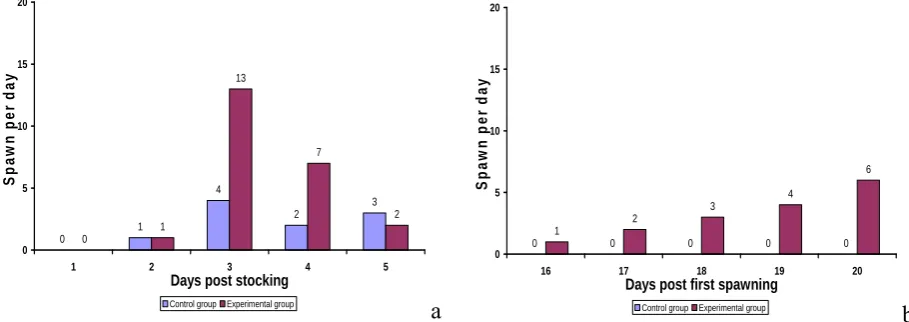
Over a period of 21 days, blood samples were taken daily from two fish in both the experimental and control groups between 11 am and 12 noon by caudal puncture starting on the next day of the first spawning. Females that spawned on the third and fourth day post stocking in the experimental group (n = 20, Figure 1a) and females that spawned on the third, fourth and fifth day post stocking in the control group (n=8, Figure 1a) were considered for the blood sampling analysis. Blood samples were taken at least twice from each fish because it was not possible to take blood everyday from the same fish over the 21-day cycle. Sampled blood was mixed with sodium cyanide to a final concentration of 10% to prevent coagulation and centrifuged at 3000 rpm for 10 minutes. Supernatant plasma collected was stored at -20°C until analysis.
Plasma Analysis
Enzyme-linked immunosorbent assay (ELISA) sensitive laboratory technique was used to evaluate plasma levels of estradiol-17β (Meyer and Gueven, 1986). Details of this competitive assay and antiserum characteristics have been outlined by Meyer et al. (1990) and Dhesprasith (1995). Plasma samples were diluted to 1:25 fold in assay buffer during extraction with diethylether. The sensitivities of the assays were validated according to (Freund et al., 1995).
Statistical Analysis
Data for the parameters were expressed as mean±standard deviation (SD). Statistical comparisons of estradiol levels, fecundity, relative fecundity, hatching and swim-up rates of experimental and control groups were made using the t-test to determine significant differences. Mean difference between number of spawns per day of
0
1
4
2
3
0
1
13
7
2
0 5 10 15 20
1 2 3 4 5
Days post stocking
S
p
a
w
n pe
r d
a
y
Control group Experimental group
a
0 0 0 0 0
1
2
3
4
6
0 5 10 15 20
16 17 18 19 20
Days post first spawning
S
p
a
w
n
pe
r da
y
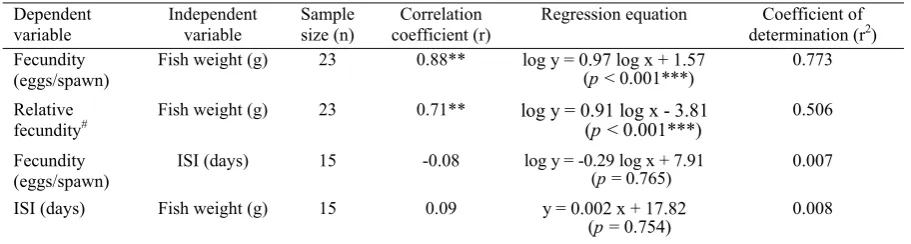
treatment and control groups were tested for significance using a 2 x 2 contingency chi-square test. Regression analysis was employed to investigate relationships between the following parameters: fecundity and fish weight, relative fecundity and fish weight, fecundity and ISI and between ISI and fish weight. Data were tested for heteroscedasticity (Breusch-Pagan/Cook-Weisber test) prior to analysis and were log10 transformed if necessary.
Results
Reproductive Performance
Results indicated that no significant differences were found between the experimental and control groups in terms of fish weight at the beginning and the end of the experiment (P<0.05). Table 1 highlighted the advantages of the experimental group over the control group in terms of mean spawns per day, fecundity, relative fecundity, hatching rate and swim-up rate based on five day observation period post stocking. Mean number of spawns per day (n=6±5.6) in the experimental group was significantly higher that in the control group (n=2.5±1.3). The mean value of fecundity (eggs per spawn) obtained in the experimental group (1,170±316 eggs per spawn) was significantly higher than in the control group (896.5±320.2 eggs per spawn). Consequently, mean relative fecundity (number of eggs produced per gram body weight) was estimated to be 4.0±1.6 eggs per grams body weight in the experimental group which was significantly higher that in the control group (2.6±1.0 eggs per grams body weight). Hatching and swim-up rates were also observed to be significantly
higher in the experimental group (67.2±10.6, 65.6±10.9%, respectively) those in the control group (62.2±14.8, 60.4±14.2, respectively).
Figure 1a showed that no spawning occurred both in the control and experimental groups on the next day of stocking. Spawning in both groups started on day 2 and continued through day 5. The highest number of spawns in both groups was observed on the third day. In the experimental group, 23 females (64%) spawned within the entire five-day observation period compared to 10 females (27%) in the control group.
No second spawning activity was observed in the control group within the 21-day observation period. However, in the experimental group, 15 out of 23 females (65%) spawned for the second time within five days during the 21-day period (Figure 1b). Mean inter-spawning interval (ISI) based on completed reproductive cycle was 18.4±1.6 days varying from 16 days to 20 days (Figure 1b). Positive correlation was found between ISI and fish size (weight). However, P-values indicate no significant correlation between fecundity and ISI. The present study also revealed that fecundity and relative fecundity increased significantly with fish weight in the experimental group (Table 2).
Plasma Estradiol-17β levels
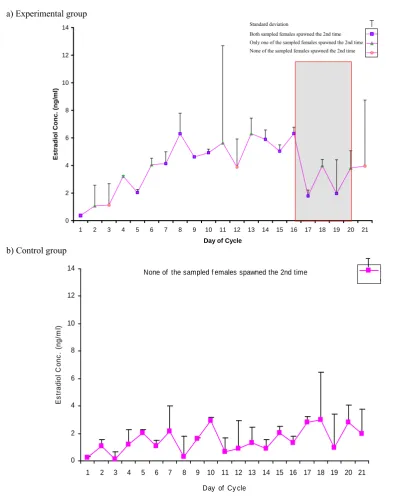
Plasma estradiol-17β (E2) concentration in the
control group did not show any significant distributional pattern (Figure 2b). However, in the experimental group, E2 concentration demonstrated a
pattern based on completed reproductive cycle (Figure 2a). Estradiol-17β levels were low on day 1
Table 1. Mean spawns per day, fecundity, relative fecundity, hatching rate and swim-up rate of experimental and control groups
Reproductive Parameters
Total spawns*
Spawns per day
Fecundity (eggs/spawn)
Relative fecundity**
Hatching rate (%)
Swim-up rate (%)
Control group 10 2.5 (1.3) 896.5 (320.2) 2.6 (1.0) 62.2 (14.8) 60.4 (14.2)
Experimental group 23 6 a (5.6) 1169.7 b (316.2) 4.0 b (1.6) 67.2 b (10.6) 65.6 b (10.9)
Standard deviations (in bracket) are placed below respective mean values, * indicates the total value for the entire 5 day observation period,
**eggs per gram body weight, a value significantly different from control value: χ2 test (P<0.05), b mean values significantly different from
control means: t-test (P<0.05).
Table 2. Regression and correlation analyses of fecundity, relative fecundity, fish weight and inter spawning interval (ISI)
Dependent variable
Independent variable
Sample size (n)
Correlation coefficient (r)
Regression equation Coefficient of
determination (r2)
Fecundity (eggs/spawn)
Fish weight (g) 23 0.88** log y = 0.97 log x + 1.57
( < 0.001***)p 0.773
Relative
fecundity# Fish weight (g) 23 0.71** log y = 0.91 log x - 3.81 ( < 0.001***)p 0.506
Fecundity (eggs/spawn)
ISI (days) 15 -0.08 log y = -0.29 log x + 7.91
( = 0.765)p 0.007
ISI (days) Fish weight (g) 15 0.09 y = 0.002 x + 17.82
( = 0.754)p 0.008
a) Experimental group
0 2 4 6 8 10 12 14
1 2 3 4 5 6 7 8 9 10 11 12 13 14 15 16 17 18 19 20 21
Day of Cycle
E
s
tradiol
C
o
n
c
.
(ng/ml)
Both sampled females spawned the 2nd time Only one of the sampled females spawned the 2nd time None of the sampled females spawned the 2nd time Standard deviation
b) Control group
0 2 4 6 8 10 12 14
1 2 3 4 5 6 7 8 9 10 11 12 13 14 15 16 17 18 19 20 21
Day of Cy cle
E
s
tr
a
d
io
l C
o
n
c
. (
n
g
/m
l)
S e None of the sampled f emales spawned the 2nd time
Figure 2. Changes in estradiol-17β concentration over 21 day observation period. Data are presented as mean±standard deviation for the two fish sampled at each day of the cycle. Shaded portion in (a) corresponds to days of second spawning activities.
after the first spawning (0.37±0.05 ng/ml). Thereafter, there was a steady increase in E2 levels until a peak
value was reached on day 16 (6.32±0.5 ng/ml). E2
concentration decreased afterwards to a basal level on day 17 and remained low until day 20 when it
appeared to increase again on day 21. E2
concentrations were significantly higher between day 8 and 16 than between day 1 and 3 and day 17 and 19 (P<0.01). Reduction of estradiol levels after the peak on day 16 simultaneously coincided with second spawning activities as confirmed by Figure 1b. Both females sampled for blood analysis on day 21 including one female on day 11 in the experimental
group did not spawn for the second time over the observation period. This could explain the large variation in the E2 concentration on day 11 and 21 as
shown by the standard deviation.
Discussion and Conclusion
days. However, the present study demonstrated that the timing of spawning activity in Nile tilapia can be modified by a combination of stocking density and photoperiod manipulation. Tropical tilapia are territorial species, exhibit a strong social hierarchy and need daily light cycle and space for their reproductive activities.
In this study, it appeared that the initial high stocking density (40 kg/m3) and change of day length
provided by the photoperiod (6L:18D) manipulation in the experimental group also offered a schooling conduct (Balarin et al., 1986) which haltered the reproductive activities of the female fish. Transferring the fish into the single compartments with enough holding space and ambient photoperiod might have broken up the social hierarchies to induce the large number of spawns in the experimental group.
Nevertheless, in order to consider stocking density and photoperiod technique as an effective tool in controlling spawning of farmed stocks of Nile tilapia, there must be little or no associated loss in egg quality (survival of eggs and fry) and the fecundity of the brood stock. Puckhaber (1992), however, did not assess these parameters in the course of her experiments on the Lake Manzala population. Ridha and Cruz (2000) reported poorer quality of eggs (yolk sac and swim-up fry) from groups treated with combination of light intensity and photoperiod of 500 lux/18 h, 500 lux/15 h and 500 lux/12 h. A reduced seed kg/female/day was observed by Ridha et al. (1998) in the 29°C/13 h temperature/light duration treatment compared to the ambient condition. Biswas et al. (2005) obtained poorer egg quality and low fecundity in fish exposed to the 6L:6D photoperiod manipulation. However, no loss in egg quality such as survival of eggs and fry was experienced with the stocking density and photoperiod manipulation in the present work. Consistent with Campos-Mendosa et al. (2004), the method in this study helped improve some important reproductive traits in Nile tilapia. Fish from the experimental group exhibited significantly higher mean total and relative fecundity, hatching and swim-up rates over the control groswim-up.
Fecundity was between 656 and 1,778 eggs per fish with a mean of 1,170±316 eggs per fish in the experimental group. These figures are slightly higher than 306-1,158 eggs per fish estimated by Rana (1988) in Oreochromis niloticus but significantly lower than the values (2,020±80-2,408±70 eggs per fish) obtained by Campos-Mendosa et al. (2004) also in Oreochromis niloticus. However, the mean weight of fish used by Campos-Mendosa et al. (2004) was larger than the fish used in the present study. It is well documented that total fecundity is related to factors such as age and size (weight) of fish (Rana, 1988; Coward and Bromage, 1999). Fish used in the present study were of the same age. However, findings from the study confirmed that fecundity was significantly positively related to fish weight at a rate of 0.97. Coward and Bromage (1999) also estimated a rate of
0.65. Coward and Bromage (1999) demonstrated a significantly negative relationship between inter-spawning interval (ISI) and fecundity in certain weight classes of Tilapia zilli and suggested that ISI may in part control fecundity. However, the present study revealed no significant correlation between fecundity and ISI. Relative fecundity in this study was estimated to increase significantly with fish weight contrary to the finding of Coward and Bromage (1999) who observed a significantly inverse relationship between relative fecundity and fish weight in Tilapia zilli.
Mean inter-spawning interval in the experimental group was observed to be 18.4±1.6 days (n = 23). This compares with 18.6±2.3 days found by Ridha and Cruz (2000) in the light intensity (2,500 lux) and light duration of 18 hours per day treatments of Oreochromis niloticus. The shortest spawning interval (16 days) found in this study is almost identical to the 15 days in Campos-Mendosa et al. (2004), but considerably longer than the shortest cycle of 7 days found by Coward and Bromage (1999). However, mean weight of fish (336±70 g) used in this experiment is considerably larger than the mean weight of females (136.35±9.8 g) used by Coward and Bromage (1999). Siraj et al. (1983) noted that inter-spawning interval is usually shorter in smaller tilapia. This assertion was revealed by findings in the present study although the relationship was weak. Tacon et al. (1996) also suggested that ISI variability in aquaria-held Nile tilapia was probably due to genetic differences between females confirming an observation made by Duponchelle et al. (1997) that genetic make-up plays an important role in determining the reproductive performance of fish. However, this study considered F1 clonal crosses to discard variation effect due to genetic heterogeneity and argued that the longer spawning cycles could be due to the body size (weight) of fish used.
Further investigation in this study demonstrated that plasma estradiol-17β (E2) concentration may have
played an important role in relation to the effect of stocking density and photoperiod treatments on the spawning activity of female Nile tilapia. In Oreochromis mossambicus, Foo and Lam (1993) observed a delayed reproductive activity due to low level of E2 after cortisol treatment. Consistent with
surge in the gonadotropin levels was related to the final stages of oocyte maturation and ovulation by Jalabert (2005). Observation of individual fish based on completed reproductive cycle of second spawning in the experimental group confirmed the coincidence of low estradiol levels at spawning.
In conclusion, the study demonstrated that a combination of stocking density and photoperiod treatments can be adopted to manipulate the timing of spawning activity in Nile tilapia without having adverse effect on other reproductive parameters such as survival of eggs or fry and fecundity. The proposed method would enable supply of eggs or fry to be made available to tilapia breeders and farmers at required time in a short day planning period. Findings further demonstrated that hormonal changes such as estradiol levels play an important role in the effect of exogenous factors on manipulation of spawning activity in female Nile tilapia. However, the relative importance of either factor (photoperiod/stocking density) on the reproductive activity remains to be resolved in future experiments.
References
Allison, L.N. 1951. Delay of spawning of eastern brook trout by means of artificially prolonged light intervals. The Progressive Fish-Culturist, 13: 111-116.
Allison, R., Smitherman R.O. and Cabrero, J. 1979. Effect of high density culture and form of feed on
reproduction and yield of Tilapia aureus. In: T.V.R.
Pillay and W.A. Dill (Eds.), Advances in Aquaculture. Fishing News Books Ltd., Farnham, Surrey: 168-170.
Altun, T., Tekelioğlu, N. and Danabaş, D. 2006. Tilapia
culture and its problems in Turkey. European Journal of Fisheries and Aquatic Science, 23: 473-478. Balarin, J.D. and Haller, R.D. 1982. The intensive culture of
tilapia in tanks, raceway and cages. In: J.F. Muir and R.J. Roberts (Eds.), Recent Advances in Aquaculture. Westview, Boulder: 266-355.
Balarin, J.D., Haller, R.D. and Armitage, A.T. 1986. Research on intensive culture of tilpia in tanks. In: E.A Huisman (Ed.), Aquaculture Research in the Africa Region: Proceedings of the African Seminar on Aquaculture, Organised by the International Foundation for Science (IFS), Stockholm. Pudoc, Wageningen: 206-216.
Bhujel, R.C. 2000. A review of strategies for the
management of Nile tilapia (Oreochromis niloticus)
broodfish in seed production systems, especially Hapa based systems. Aquaculture, 181: 37-59.
Biswas, A.K., Morita, T. Yoshizaki, G., Maita, M. and Takeuchi, T. 2005. Control of reproduction in Nile
tilapia Oreochromis niloticus (L.) by photoperiod
manipulation. Aquaculture, 243: 229-239.
Bromage, N.R., Porter, M. and Randall, C.F. 2001. The environmental regulation of maturation in farmed finfish with special reference to the role of photoperiod and melatonin. Aquaculture, 197: 63-98. Campos-Mendoza, A., McAndrew, B.J., Coward, K. and
Bromage, N.R. 2004. Reproductive response of Nile
tilapia (Oreochromis niloticus) to photoperiodic
manipulation; effects on spawning periodicity, fecundity and egg size. Aquaculture, 231: 299-314.
Coward, K. and Bromage, N.R. 1999. Spawning periodicity, fecundity and egg size in laboratory-held stocks of
substrate-spawning tilapiine, Tilapia zillii (Gervais).
Aquaculture, 171: 251-267.
Coward, K., Bromage, N.R. and Little, D.C. 1998. Inhibition of spawning and sociated suppression of sex steroid levels during confinement in the
substrate-spawning Tilapia zilli. Journal of Fish Biololgy, 52:
152-165.
Dhesprasith, D. 1995. Plasma oestradiol-17β and
testosterone patterns of female rainbow trout (Oncorhnchus mykiss) exposed to different photoperiods. PhD thesis, Göttingen: University of Göttingen, Germany (in English)
De Vlaming, V.L. 1972. Environmental control of teleost reproductive cycles: A brief review. Journal of Fish Biololgy, 4: 131-140.
Duponchelle, F., Pouyaud, L. and Legendre, M. 1997. Variation in reproductive characteristics of
Oreochromis niloticus populations: genetic or environmental effects? In: K. Fitzsimmons (Ed.), Tilapia Aquaculture: Proceedings from the 4th International Symposium on Tilapia in Aquaculture, NRAES-106, Northeast Regional Agricultural Engineering Service, Ithaca, New York, 808 pp. Foo, J.T.W. and Lam, T.J. 1993. Retardation of ovarian
growth and depression of serum steroid levels in the
tilapia Oreochromis mossambicus by cortisol
implantation. Aquaculture, 115: 33-143.
Freund, F., Hörstgen-Schwark, G. and Holtz, W. 1995. Seasonality of the reproductive cycle of female
Heterobranchus longifilis in tropical pond culture. Aquat. Living. Res., 8: 297-302.
Haddy, J.A. and Pankhurst, N.W. 2000. The effects of salinity on reproductive development, plasma steroid levels, fertilisation and egg survival in black bream
Acanthopagrus butcheri. Aquaculture, 188: 115-131. Hazard, T.P. and Eddy, R.E. 1951. Modification of the
sexual cycle in brook trout (Salvelinus fontinalis) by
control of light. Transactions of the American Fisheries Society, 80: 158-162.
Jalabert, B. 2005. Particularities of reproduction and oogenesis in teleost fish compared to mammals. Reproduction Nutrition Development, 45: 261-279. Jalabert, B. and Zohar, Y. 1982. Reproductive physiology in
cichlid fishes, with particular references to Tilapia and Sarotherodon. In: R.S.V. Pullin and R.H. Lowe-McConnell (Eds.), The Biology and Culture of Tilapia, International Center for Living Aquatic Resources Management (ICLARM) conference proceedings 7, Manila: 129-140.
Jenneckens, I., Mueller-Belecke, A., Meyer, J.H. and Hörstgen-Schwark, G. 1999. Prove of the successful
development of Nile tilapia Oreochromis niloticus
clones by DNA fingerprinting. Aquaculture, 184: 67-76.
Josupeit, H. 2007. Tilapia production booming. FAO, Globefish, INFOFISH Tilapia Conference, Kuala Lumpur, August 2007.
Lam, T.J. 1983. Environmental influences on gonadal
activity. In: Hoar et al. (Eds), Fish Physiology, Vol.
IX, Reproduction, Part B, Behavior and Fertility Control. Academic Press, New York: 65-160. Meyer, H.H.D. and Güven, B. 1986. Improvement of
Steroid Biochemistry, 25: 139-141.
Meyer, H.H.D., Sauerwein, H. and Mutayoba, B.M. 1990. Immunoaffinity chromatography and a biotin-streptavidin amplified enzyme immonoassay for
sensitive and specific estimation of estradiol-17β.
Journal Steroid Biochemistry, 35: 263-269.
Mueller-Belecke, A. and Hörstgen-Schwark, G. 1995. Sex
determination in tilapia (Oreochromis niloticus) sex
ratios in homozygous gynogenetic progeny and their offspring. Aquaculture, 137: 57-65.
Mueller-Belecke, A. and Hoerstgen-Schwark G. 2000. Performance testing of homozygous lines in
Oreochromis nilticus. Aquaculture, 173: 377-388. Nagahama, Y. 1994. Endocrine regulation of gametogenesis
in fish. Int. J. Dev. Biol., 38: 217-229
Paessun, M.A. and Allison, R. 1984. Maximizing tilapia production in recirculating system by sequential rearing. Aquaculture, 42: 185-189.
Puckhaber, B. 1992. Untersuchungen zur Produktivitäts steigerung bei Afrikanischen Buntbarschen. PhD thesis, Göttingen: University of Göttingen, Germany, 144 pp.
Pullin, R.S.V., Eknath, A.E., Gjedrem, T., Tayamen, M.M., Macaranas, J.M. and Abella, T.A. 1991. The genetic improvement of farmed tilapias (GIFT) Project: The story so far. The ICLARM Quarterly, Naga, 31 pp. Rana, K.J. 1988. Reproductive biology and the hatchery
rearing of tilapia eggs and fry. In: J.F. Muir and R.J. Roberts (Eds.), Recent Advances in Aquaculture.
Croom Helm, London: 343-406.
Ridha, M.T., and Cruz, E.M. 2000. Effect of light intensity
and photoperiod on Nile tilapia Oreochromis niloticus
L. seed production. Aquaculture Research, 31: 609-617.
Ridha, M.T., Cruz, E.M., Al-Ameeri, A.A. and Al-Ahmed, A.A. 1998. Effects of controlling temperature and light duration on seed production in tilapia,
Oreochromis spilurus (Guether). Aquaculture Research, 29: 403-410.
Siddiqui, A.Q., Al-Harbi, A.H. and Al-Hafedh, Y.S. 1997. Effect of stocking density on patterns of reproduction and growth of hybrid tilapia in concrete tanks in Suadi Arabia. Asian Fisheries Science, 10: 41-49.
Siraj, S.S., Smitherman, R.O., Castillo-Gallusser, S. and Dunham, R.A. 1983. Reproductive traits for three year
classes of Tilapia nilotica and maternal effects on
their progeny. In: L. Fishelson and Z. Yaron (Eds.), Proceedings of the Symposium on Tilapia in Aquaculture, Tel Aviv University, Nazereth, Isreal: 210-218.
Tacon, P., Indiaye, P., Cauty, C., Le Menn, F. and Jalabert, B. 1996. Relationships between the expression of maternal behaviour and ovarian development in the
mouthbrooding cichlid fish Oreochromis niloticus.
Aquaculture, 146: 261-275.