The Journal of Threatened Taxa is dedicated to building evidence for conservation globally by publishing peer-reviewed articles online every month at a reasonably rapid rate at www.threatenedtaxa.org. All articles published in JoTT are registered under Creative Commons Attribution 4.0 International License unless otherwise mentioned. JoTT allows unrestricted use of articles in any medium, reproduction, and distribution by providing adequate credit to the authors and the source of publication.
OPEN ACCESS
www.threatenedtaxa.org
ISSN 0974-7907 (Online) | ISSN 0974-7893 (Print) Building evidence for conservation globally
Journal of Threatened Taxa
For Focus, Scope, Aims, Policies and Guidelines visit http://threatenedtaxa.org/index.php/JoTT/about/editorialPolicies#custom-0 For Article Submission Guidelines visit http://threatenedtaxa.org/index.php/JoTT/about/submissions#onlineSubmissions For Policies against Scientific Misconduct visit http://threatenedtaxa.org/index.php/JoTT/about/editorialPolicies#custom-2 For reprints contact <[email protected]>
Short Communication
Report of the early winter migrants and resident birds in
an inland wetland near Tundi Camp, Bajana, Gujarat
Abhishek Chatterjee, Sudeshna Ghoshal, Soumyajit Chowdhury & Pinakiranjan Chakrabarti
26 April 2018 | Vol. 10 | No. 5 | Pages: 11652–11658 10.11609/jott.2459.10.5.11652-11658
Threatened Taxa
Member
Partners
Shor
t
Communic
ation
DOI:http://doi.org/10.11609/jott.2459.10.5.11652-11658 | ZooBank: urn:lsid:zoobank.org:pub:0CD4B27F-C987-4CD1-BD0A-090FB9822F45
Editor: Rajiv S. Kalsi, M.L.N. College, Yamunanagar, India. Date of publication: 26 April 2018 (online & print)
Manuscript details: Ms # 2459 | Received 23 April 2017 | Final received 18 April 2018 | Finally accepted 22 April 2018
Citation:Chatterjee, A., S. Ghoshal, S. Chowdhury & P. Chakrabarti (2018). Report of the early winter migrants and resident birds in an inland wetland near Tundi Camp, Bajana, Gujarat.Journal of Threatened Taxa 10(5): 11652–11658; http://doi.org/10.11609/jott.2459.10.5.11652-11658
Copyright: © Chatterjee et al. 2018. Creative Commons Attribution 4.0 International License. JoTT allows unrestricted use of this article in any medium, reproduction and distribution by providing adequate credit to the authors and the source of publication.
Funding: None.
Competing interests:The authors declare no competing interests.
Acknowledgements: We are deeply indebted to Forest Department, Government of Gujarat for permitting us to carry out our work. We also express our heartiest
gratitude to the accompanying students of the Zoology Department, Vijaygarh Jyotish Ray College for their help during the study.
Report of the early winter migrants and resident birds in
an inland wetland near Tundi Camp, Bajana, Gujarat
Abhishek Chatterjee 1, Sudeshna Ghoshal 2, Soumyajit Chowdhury 3&
Pinakiranjan Chakrabarti 4
1,2,4 Department of Zoology, Vijaygarh Jyotish Ray College, Bejoygarh, Jadavpur, Kolkata, West Bengal 700032, India 3 Department of Zoology, M.U.C. Women’s College, B.C. Road, Bardhaman, West Bengal 713104, India 3,4 Department of Environmental Science, University of Calcutta, 35, Ballygunge Circular Road, Kolkata,
West Bengal 700019, India 1 [email protected], 2 [email protected], 3 [email protected]
4 [email protected] (corresponding author) ISSN 0974-7907 (Online)
ISSN 0974-7893 (Print)
OPEN ACCESS
Abstract: The study is based on the avian community observed in the region. In total, 1,079 individuals, 62 genera and 79 species of birds belonging to 35 families have been recorded. Among them, the family Anatidae with 20.42% incidence is the most frequent; immediately followed by the family Phoenicopteridae (10.59% of occurrence). Little Cormorant Phalacrocorax niger is the most abundant avian species observed. The community consists of 44% resident; 36% resident-migrant and 20% migrant bird species. It was observed that the concerned community shows a considerable diversity and a correspondingly low value of dominance. In the feeding guild analysis, the insectivore guild has the most number of recorded avian species. The feeding guild affiliations also point out that the overall community is fairly rich in its composition as it houses bird species belonging to various feeding guilds.
Keywords: Avifaunal diversity, Gujarat, Tundi camp, water-birds, wetland.
Abbreviations: NT - Near Threatened; LC - Least Concern; RM - Resident-Migrant; R - Resident; M - Migrant; FU - Frugivore; N - Nectarivore; P - Piscivore; G - Granivore; I - Insect and other terrestrial invertebrate feeder; PL - Plankton feeder; IN - Aquatic Invertebrate feeder; A - Amphibian feeder; OP - Ophidiovore; RP - Reptile feeder; W - Weedivore; H - Herbivore; C - Carrion feeder; PD - Predatory.
Journal of Threatened Taxa | www.threatenedtaxa.org | 26 April 2018 | 10(5): 11652–11658
Water birds around Tundi Camp Chatterjee et al.
11653 certain parts of their life (Weller 1981).
Birds are ideal bio-indicators and useful models for studying a variety of environmental problems (Newton 1995). Birds occupy a wide range of ecological positions (Sekercioglu & Hakki 2006). In many respects biodiversity, both present and past are better understood for birds than for any other major group of organisms. One basic approach in generating an indicator of the state of wildlife is to measure diversity through time. Species loss or gain could then be used to gauge the trends in biodiversity (Van 1997). Thus the avifaunal diversity of a region is a very prompt indicator of the environmental conditions of the concerned place.
The Little Rann of Kutch (LRK) is one of the more popular tourist destinations in the state. It is also internationally famous for its salt pans and wetlands which harbor a vast variety of migratory birds. In spite of its economic importance; little scientific work has been done. Our work was aimed at filling that gap. Hence, this study is of unique importance, focusing mainly on the wide spectrum of birds that are available there and on their feeding habits; which in turn reveal the composition of a greater part of the ecological community present in the region.
materials and methods Study area
Gujarat is located on the Tropic of Cancer (20.0166660N–24.1166660N & 68.0666660E –74.0666660E); falls in the sub-tropical climatic zone and has a varied climate and climatic regions (SACON ENVIS Newsletter 2012). Kutch (22.6863880N–24.6963880N & 68.1627770E–71.91305550E), extending over 45,652sq. km. area lies in the western part of Gujarat state and falls under the Desert bio-geographic zone and 3B Desert-Kutch Province (Gajera et al. 2012). There are many natural seasonal wetlands in Kutch. In total about 258 wetlands were delineated through satellite imageries. These wetlands cover approximately 21,772sq.km. area, which is more than 80% of the entire Kutch region (Stanley 2004).
The study was carried out in the vicinity of a forest camp located in the Wild Ass Sanctuary, Little Rann of Kutch, Gujarat which is locally known as the Tundi Camp (at the intersection of 23.1472220N & 71.7413880E). The camp is located at a distance of 12.2km (by road) due west from the nearest landmark township of Bajana. We carried out our survey on an adjacent wetland and its adjoining areas, which acted as a watering-hole for the animal community of the region. The wetland extends from 23.1497220N–23.1508330N &
71.7430550E–71.7488880E. It is fed by a non-perennial river called the Okaro-Kharaghoda. The sites for study on the bank of the wetland are marked in the satellite image given in Fig. 1. The place is entirely devoid of any anthropogenic interventions. This fact, on its own, makes the study far more interesting.
Bird species survey
The survey was conducted in early and mid-December of 2013. During the surveys, birds were identified early in the morning from 06:00–10:00 hr and late afternoon from 16:00–18:30 hr when the temperature was relatively warm (in the morning, the temperature usually remains within 28–32 0C and in the evening it is usually within 35–36 0C). Additional surveys had also taken place between 20:00–22:30 hr for the identification of nocturnal birds. Birds were identified with the aid of standard field guide (Grimmett et al. 2011). On every occasion, the counting distance was restricted to around 50m for identification purposes. Birds that flew overhead but did not land in the sites were also recorded. The checklist was prepared following the standardized common and scientific names of the birds of the Indian subcontinent by Manakkadan & Pittie (2001).
Statistical analyses
The various richness (species, genus and family) indices, Shannon evenness (J’), Shannon-Wiener diversity (H’), Simpson’s Diversity Index (l) and Simpson’s index of dominance (D’) have been calculated (Bower et al. 1997). The various indices were computed using the software, PAST [version 3.08] (Hammer et al. 2001). From the value of the Shannon-Wiener diversity index, the effective number of species (ENS), a way of converting diversity measures to an easily interpretable linear scale, has been derived (Jost 2006). Shannon’s diversity index is converted by taking its exponential; ENS=exp (H’), where, H’ is the value of the Shannon-Wiener diversity index (Jost 2006). Evenness ranges from 0 to 1 and as it approaches 1, individuals are partitioned equally among species. High values of H’ and low values of D’ indicate high species diversity (Bower et al. 1997).
Results
Threatened Species categories, viz., Least Concerned (LC) and Near Threatened (NT) [IUCN 2001]. Among the observed 79 avian species, 76 of them (96.2 percent), belong to the Least Concerned category; whereas, only three bird species (3.8 percent)—the Painted Stork
Mycteria leucocephala, Oriental White Ibis Threskiornis
melanocephalus and Lesser Flamingo Phoenicopterus
minor, belong to the Near Threatened category.
In the study, 35 families of birds were observed; among which family Anatidae has recorded the highest number of species (as shown in Table 2). All the different kinds of migration categories, viz., the resident (R) birds, the resident-migrant (RM) birds and the migrant or migratory (M) birds have been observed during the survey. 35 resident (44%), 28 resident-migrant (36%) and 16 migratory (20%) species were observed. Therefore, in total, 44 migratory bird species have been recorded (Fig. 2); which account for 56 percent of the total species observed.
Fourteen (14) kinds of feeding guilds, viz., aquatic
invertebrate-feeder, piscivore, insectivore, granivore, frugivore, reptile-feeder, ophidiovore, amphibian-feeder, nectarivore, weedivore, plankton-amphibian-feeder, herbivore, carrion-feeder and predatory were identified; among the bird species observed (Ali & Ripley 1987) (Fig.
Figure 1. Satellite image of Tundi Camp and its adjacent wetland with the study-sites marked as red dots
Journal of Threatened Taxa | www.threatenedtaxa.org | 26 April 2018 | 10(5): 11652–11658
Water birds around Tundi Camp Chatterjee et al.
11655 3). Here, the insectivore guild is the most frequent one
with thirty percent incidence and 45 species occurring under this shared category. Whereas, nectarivore and plankton-feeder guilds are the least frequent with only two species observed in each.
In order to visually represent the diversity of the avian community a dominance-diversity curve (Bower et al. 1997) has been plotted in Fig. 4. The values of the various diversity indices have been provided in Table 3. We have observed that the high values of the Simpson diversity index (0.9676) indicates the high diversity observed.
Discussion
Wetlands and natural grasslands are important habitats for avian populations throughout the world and the studied one is no exception. The overall condition of the wetland is pretty good and it shows signs of a self-sustaining environment which is mostly because of the very sparse human interventions. This enabled us to
study the wetland at its ecological prime.
The dominance-diversity curve (in Fig. 4) has been plotted in order to get an idea of the amount of diversity observed in the studied avian community. In this case, the trend-line on the curve shows that the studied community exhibits a high amount of diversity; because of the petite angle of intersection and the right-hand side alignment of the curve.
The calculated values of the various diversity indices, especially that of the Simpson Dominance (l) = 0.0324 proves that the community of avifaunal species show very low dominance. On the other hand, this depicts considerably high diversity of the avian community. The maximum value of the Simpson Diversity Index (DS) can be 1 (Magurran 2004). Here, its value is 0.9676. The value of the Shannon-Wiener Diversity Index (H’) of the studied community depicts that the chances of getting an individual of the same species in a random sample is about 3.75; which points out to the considerably vast population size of almost every species sampled during our study. When converted to ENS, its value becomes approximately 42.39; which means that a community with Shannon index of 3.75 has an equivalent diversity as a community with almost 42 equally-abundant species. This is further proved by the fact that the value of Shannon Evenness Index (J’); which being quite close to 0.5 shows that there is an intermediate amount of variance in the population size of different avian species. Species diversity is more positively correlated with evenness (Bock et al. 2007). This testifies to the sizeable diversity observed in the studied avian community. The overall scenario, as is evident in the calculated values of these diversity indices (Table 3), is that the sampled community is greatly diverse in its composition.
The pie-chart depicting the Feeding Guilds of the various avifauna (Fig. 3) observed, clearly shows that the community of this ecosystem is also sufficiently rich and greatly diversified. Hence it is able to support birds with such a varied spectrum of feeding habits.
Conclusion
On the basis of our study, we can now conclude that the avian community observed at the wetland shows little dominance, but a fair amount of diversity. In addition, the presence of the various feeding guilds bear proof of the fact that the entire ecological community is fairly diverse and show signs of a healthy environment.
References
Ali, S. & S. D. Ripley (1983).Handbook of the Birds of India and Pakistan
(Compact Edition). University Press, Bombay, India, 32–547pp.
Figure 3. Percent composition of bird species observed according to their feeding guilds
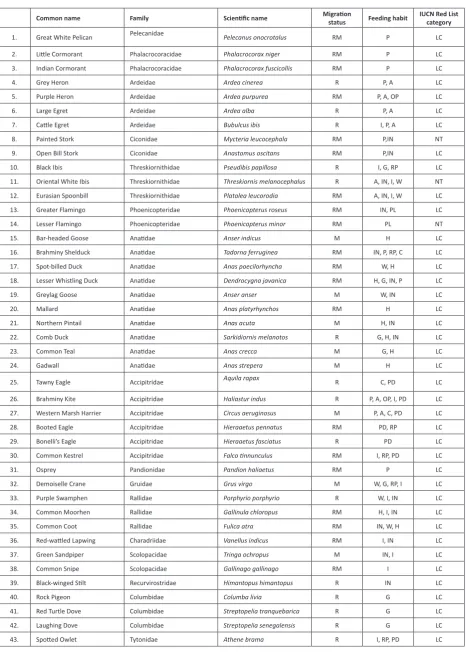
Table 1. Checklist of the bird species observed at Tundi Camp
Common name Family Scientific name Migration status Feeding habit IUCN Red Listcategory
1. Great White Pelican Pelecanidae Pelecanus onocrotalus RM P LC
2. Little Cormorant Phalacrocoracidae Phalacrocorax niger RM P LC 3. Indian Cormorant Phalacrocoracidae Phalacrocorax fuscicollis RM P LC
4. Grey Heron Ardeidae Ardea cinerea R P, A LC
5. Purple Heron Ardeidae Ardea purpurea RM P, A, OP LC
6. Large Egret Ardeidae Ardea alba R P, A LC
7. Cattle Egret Ardeidae Bubulcus ibis R I, P, A LC
8. Painted Stork Ciconidae Mycteria leucocephala RM P,IN NT
9. Open Bill Stork Ciconidae Anastomus oscitans RM P,IN LC
10. Black Ibis Threskiornithidae Pseudibis papillosa R I, G, RP LC 11. Oriental White Ibis Threskiornithidae Threskiornis melanocephalus R A, IN, I, W NT 12. Eurasian Spoonbill Threskiornithidae Platalea leucorodia RM A, IN, I, W LC 13. Greater Flamingo Phoenicopteridae Phoenicopterus roseus RM IN, PL LC 14. Lesser Flamingo Phoenicopteridae Phoenicopterus minor RM PL NT
15. Bar-headed Goose Anatidae Anser indicus M H LC
16. Brahminy Shelduck Anatidae Tadorna ferruginea RM IN, P, RP, C LC
17. Spot-billed Duck Anatidae Anas poecilorhyncha RM W, H LC
18. Lesser Whistling Duck Anatidae Dendrocygna javanica RM H, G, IN, P LC
19. Greylag Goose Anatidae Anser anser M W, IN LC
20. Mallard Anatidae Anas platyrhynchos RM H LC
21. Northern Pintail Anatidae Anas acuta M H, IN LC
22. Comb Duck Anatidae Sarkidiornis melanotos R G, H, IN LC
23. Common Teal Anatidae Anas crecca M G, H LC
24. Gadwall Anatidae Anas strepera M H LC
25. Tawny Eagle Accipitridae Aquila rapax R C, PD LC
26. Brahminy Kite Accipitridae Haliastur indus R P, A, OP, I, PD LC 27. Western Marsh Harrier Accipitridae Circus aeruginosus M P, A, C, PD LC 28. Booted Eagle Accipitridae Hieraaetus pennatus RM PD, RP LC
29. Bonelli’s Eagle Accipitridae Hieraaetus fasciatus R PD LC
30. Common Kestrel Accipitridae Falco tinnunculus RM I, RP, PD LC
31. Osprey Pandionidae Pandion haliaetus RM P LC
32. Demoiselle Crane Gruidae Grus virgo M W, G, RP, I LC
33. Purple Swamphen Rallidae Porphyrio porphyrio R W, I, IN LC 34. Common Moorhen Rallidae Gallinula chloropus RM H, I, IN LC
35. Common Coot Rallidae Fulica atra RM IN, W, H LC
36. Red-wattled Lapwing Charadriidae Vanellus indicus RM I, IN LC
37. Green Sandpiper Scolopacidae Tringa ochropus M IN, I LC
38. Common Snipe Scolopacidae Gallinago gallinago RM I LC
39. Black-winged Stilt Recurvirostridae Himantopus himantopus R IN LC
40. Rock Pigeon Columbidae Columba livia R G LC
41. Red Turtle Dove Columbidae Streptopelia tranquebarica R G LC
42. Laughing Dove Columbidae Streptopelia senegalensis R G LC
Journal of Threatened Taxa | www.threatenedtaxa.org | 26 April 2018 | 10(5): 11652–11658
Water birds around Tundi Camp Chatterjee et al.
11657 Common name Family Scientific name Migration status Feeding habit IUCN Red Listcategory
44. Indian Little Nightjar Caprimulgidae Caprimulgus asiaticus R I LC
45. Little Swift Apodidae Apus affinis RM I LC
46. Lesser Pied Kingfisher Alcedinidae Ceryle rudis R P, A, IN LC 47. Small Blue Kingfisher Alcedinidae Alcedo atthis RM P, A, IN LC 48. Little Green Bee- Eater Meropidae Merops orientalis R I LC
49. Indian Roller Coraciidae Coracias benghalensis R I, RP LC
50. Common Hoopoe Upupidae Upupa epops RM I LC
51. Eurasian Wryneck Picidae Jynx torquilla M I LC
52. Indian Bush Lark Alaudidae Mirafra erythroptera R I, W LC
53. Tawny Pipit Motacillidae Anthus campestris M I LC
54. Paddyfield Pipit Motacillidae Anthus rufulus R I LC
55. Yellow Wagtail Motacillidae Motacilla flava RM I LC
56. Grey Wagtail Motacillidae Motacilla cinerea M I LC
57. White Wagtail Motacillidae Motacilla alba M I LC
58. White-eared Bulbul Pycnonotidae Pycnonotus leucotis R FU, I LC 59. Red-vented Bulbul Pycnonotidae Pycnonotus cafer R FU, I, H LC
60. Bay-backed Shrike Laniidae Lanius vittatus R I, RP LC
61. Long-tailed Shrike Laniidae Lanius schach R I, RP, PD LC
62. Isabelline Shrike Laniidae Lanius isabellinus M I LC
63. Blue Rock Thrush Turdidae Monticola solitarius RM I, FU LC
64. Blue Throat Muscicapidae Luscinia svecica RM I LC
65. Isabelline Wheatear Muscicapidae Oenanthe isabellina RM I LC
66. Pied Bushchat Muscicapidae Saxicola caprata M I LC
67. Red-breasted Flycatcher Muscicapidae Ficedula parva M I LC
68. Indian Robin Muscicapidae Saxicoloides fulicatus R I LC
69. Common Babbler Timalidae Turdoides caudata R I, FU, G LC
70. Jungle Prinia Cisticolidae Prinia sylvatica R I LC
71. Rufous-fronted Prinia Cisticolidae Prinia buchanani R I LC
72. Zitting Cisticola Cisticolidae Cisticola juncidis R I LC
73. Common Tailor Bird Cisticolidae Orthotomus sutorius R I, N LC
74. Booted Warbler Sylviidae Hippolais caligata RM I LC
75. Clamorous-reed Warbler Sylviidae Acrocephalus stentoreus R I LC
76. Siberian Chiffchaff Sylviidae Phylloscopus tristis M I LC
77. Yellow-throated Sparrow Passeridae Petronia xanthocollis R G LC
78. Brahminy Starling Sturnidae Temenuchus pagodarum R FU LC
79. Black Drongo Dicruridae Dicrurus macrocercus R I, N LC
Ali, S. & S.D. Ripley (1987).Compact handbook of the birds of India and Pakistan together with those of Bangladesh, Nepal, Bhutan and
Sri Lanka. Oxford University Press, Delhi, 81–749pp.
Bock, C.E., Z.F. Jones & J.H. Bock (2007). Relationships between species
richness, evenness, and abundance in a southwestern savanna.
Ecology 88(5): 1322–1327; http://doi.org/10.1890/06-0654
Bower, J.E., J.H. Zar & C.N. von Ende (1997).Field and Laboratory
Manual of General Ecology. WCB Mc. Graw -Hill, Boston, 171–
193pp.
Buckton, S. (2007). Managing wetlands for sustainable livelihoods at
KoshiTappu. Danphe 16(1): 12–13.
Gajera, N.B., A.K.R. Mahato & V.V. Kumar (2012). Wetland birds of
arid region-a study on their diversity and distribution pattern in kachchh. Columban Jornal of Life Science 13(1&2): 47–51.
Gibbs, J.P. (1993). The importance of small wetlands for the persistence
of local populations of wetland-associated animals. Wetlands 13: 25–31; http://doi.org/10.1007/BF03160862
Table 2. Family-wise distribution of the recorded bird genera and species along with their respective percentage of occurrence.
Name of the family genera No. of observed No. of species observed Percent occurrence in sample
1. Pelecanidae 1 1 4.34
2. Phalacrocoracidae 1 2 10.59
3. Ardeidae 2 4 4.09
4. Ciconidae 2 2 9.38
5. Threskiornithidae 3 3 1.82
6. Phoenicopteridae 1 2 5.14
7. Anatidae 5 10 20.42
8. Accipitridae 5 6 1.06
9. Pandionidae 1 1 0.15
10. Gruidae 1 1 1.36
11. Rallidae 3 3 3.78
12. Charadriidae 1 1 1.06
13. Scolopacidae 2 2 0.60
14. Recurvirostridae 1 1 1.82
15. Columbidae 2 3 3.93
16. Tytonidae 1 1 0.61
17. Caprimulgidae 1 1 2.87
18. Apodidae 1 1 5.30
19. Alcedinidae 2 2 0.91
20. Meropidae 1 1 3.93
21. Coraciidae 1 1 0.45
22. Upupidae 1 1 0.30
23. Picidae 1 1 0.15
24. Alaudidae 1 1 0.15
25. Motacillidae 2 5 1.66
26. Pycnonotidae 1 2 4.09
27. Laniidae 1 3 0.45
28. Turdidae 1 1 0.15
29. Muscicapidae 5 5 1.66
30. Timalidae 1 1 4.69
31. Cisticolidae 3 4 0.91
32. Sylviidae 3 3 0.45
33. Passeridae 1 1 0.61
34. Sturnidae 1 1 0.30
35. Dicruridae 1 1 1.97
Table 3. Values of the various indices
Name of the indices Value Richness Indices
1. Family Richness 35
2. Genus Richness 62
3. Species Richness 79
Diversity Indices
1. Simpson Diversity Index 0.9676 2. Shannon -Wiener Index 3.747
Dominance Index
1. Simpson’s index of dominance 0.03236
Evenness Index
1. Shannon evenness Index 0.5366
Subcontinent. Oxford University Press, New Delhi, 21–418pp.
Hammer, Ø., D.A.T. Harper & P.D. Ryan (2001). PAST: Paleontological
Statistics Software Package for Education and Data Analysis.
Palaeontologia Electronica 4(1): 9.
IUCN (2001). IUCN Red List Categories and Criteria: Version 3.1. IUCN Species Survival Commission. IUCN, Gland, Switzerland and Cambridge, UK.
Jost, L. (2006). Entropy and diversity. Oikos 113: 363–375; http://doi. org/10.1111/j.2006.0030-1299.14714.x
Magurran, A.E. (2004). Measuring Biological Diversity. Blackwell Publishing, Oxford, 11–101pp.
Manakadan, R. & A. Pittie (2001). Standardized common and scientific
names of the birds of the Indian subcontinent. Buceros 6(1): 1–37.
Mitsch, W.I. & I.G. Gosselink (1986).Wetlands. Van Nostrand Reinhold, New York, 26–142pp.
Newton, I. (1995). The contribution of some recent research on birds
to ecological understanding. Journal of Animal Ecology 64: 675–696;
http://doi.org/10.2307/5848
Paracuellos, M. (2006). How can habitat selection affect the use of a
wetland complex by waterbirds? Biodiversity and Conservation 15: 4569–4582; http://doi.org/10.1007/s10531-005-5820-z
SACON ENVIS Newsletter (2012). SACON ENVIS Newsletter on wetland
ecosystems and inland wetland. Sarovar Saurabh, Govt. of India
8(4): 1–5.
Sekercioglu, C.H. & C. Hakki (2006). Ecological significance of bird
populations, pp. 15–34. In: Hoyo, J.D., A. Elliott & D. Christie (eds.).
Handbook of the Birds of the World, Volume 11. Lynx Edicions,
Spain, 800pp.
Stanley, O.D. (2004). Wetland ecosystems and coastal habitat diversity
in Gujarat, India. Journal of Coastal Development 7(2): 49–64.
Van, S.A.J. (1997). Biodiversity declining in the Netherlands: an
indicator to describe the changes in the number of wild species. Netherlands Official Statistics, Winter, 45–49pp.
Weller, M.M. (1981).Freshwater Marshes and Wildlife Management. University of Minnesota Press, Minneapolis, 184pp.
Whittaker, R.H. & G.E. Likens (1973). Primary production: the
biosphere and man. Human Ecology 1: 357–369; http://doi. org/10.1007/BF01536732
ISSN 0974-7907 (Online); ISSN 0974-7893 (Print)
April 2018 | Vol. 10 | No. 5 | Pages: 11551–11702 Date of Publication: 26 April 2018 (Online & Print)
DOI: 10.11609/jott.2018.10.5.11551-11702
www.threatenedtaxa.org
peer-reviewed articles online every month at a reasonably rapid rate at www.threatenedtaxa.org. All articles published in JoTT are registered under Creative Commons Attribution 4.0 International License
unless otherwise mentioned. JoTT allows unrestricted use of articles in any medium, reproduction, and distribution by providing adequate credit to the authors and the source of publication.
Article
Butterfly diversity in human-modified ecosystems of southern Sikkim, the eastern Himalaya, India
-- Prem Kumar Chettri, Kishor Sharma, Sailendra Dewan & Bhoj Kumar Acharya, 11551–11565
Communications
Contrasting human perceptions of and attitudes towards two threatened small carnivores, Lycalopex fulvipes and Leopardus guigna, in rural
communities adjacent to protected areas in Chile
-- I. Sacristán, A. Cevidanes, F. Acuña, E. Aguilar, S. García, M.J. López, J. Millán & C. Napolitano, Pp. 11566–11573
Sighting trend of the Indian Skimmer (Charidiformes: Laridae: Rynchops
albicollis Swainson, 1838) in National Chambal Gharial Sanctuary (1984–
2016) reflecting on the feasibility of long-term ecological monitoring
-- L.A.K. Singh & R.K. Sharma, Pp. 11574–11582
Comparative cross-sectional survey on gastrointestinal parasites of captive, semi-captive, and wild Elephants of
Sri Lanka
-- Nirupama Abeysekara, R.P.V. Jayanthe Rajapkse & R.S. Rajakaruna, Pp. 11583–11594
Short Communications
The extinction of Faure’s Broom Adenocarpus faurei Maire (Leguminosae) in Algeria
-- Mohamed Djamel Miara, Mohammed Ait Hammou & Jah Skipper, Pp. 11595–11598
Conservation assessment of two rare gingers (Zingiberaceae) from Dampa Tiger Reserve, Mizoram, India
-- Pankaj Kumar & Priya Singh, Pp. 11599–11605
New records of bats (Mammalia: Chiroptera) from Assam, northeastern India with a distribution list of bat fauna of the state
-- Ananda Ram Boro, Prasanta Kumar Saikia & Uttam Saikia, Pp. 11606–11612
On the birds of Marivan County, western Iran: an update
-- Fatah Zarei, Seyed Naseh Hosseini, Jalal Pezeshk, Loghman Maleki & Hamid Reza Esmaeili, Pp. 11613–11617
Nesting pattern of birds in Jahangirnagar University Campus, Bangladesh
-- Israt Jahan, Sajeda Begum, Mohammad Mostafa Feeroz, Delip Kumar Das & Ashis Kumar Datta, Pp. 11618–11635
An annotated checklist of the birds of the upper Siang region, Arunachal Pradesh, India
-- Anirban Datta-Roy, Vivek Ramachandran & Karthik Teegalapalli, Pp. 11636– 11651
Report of the early winter migrants and resident birds in an inland wetland near Tundi Camp, Bajana, Gujarat
-- Abhishek Chatterjee, Sudeshna Ghoshal, Soumyajit Chowdhury & Pinakiranjan Chakrabarti, Pp. 11652–11658
The first report of two thread-legged assassin bugs (Hemiptera: Reduviidae: Emesinae) from India
-- Balasaheb V. Sarode, Swapnil S. Boyane & Hemant V. Ghate, Pp. 11659– 11664
Water striders, the genus Cylindrostethus Mayr (Insecta: Heteroptera: Gerridae) from India with a new record
-- E. Eyarin Jehamalar, Kailash Chandra & G. Srinivasan, Pp. 11665–11671
The invasive aphid Pterochloroides persicae (Cholodkovsky, 1899) (Hemiptera: Aphidoidea: Lachninae) recorded on important fruit trees in Kashmir Valley, India
-- Govindasamy Mahendiran, Shahid Ali Akbar & Mudasir Ahmad Dar, Pp. 11672–11678
Notes
Anemone trullifolia and Berberis angulosa as new records to the flora of
the western Himalaya, India
-- Ishwari Datt Rai, Gajendra Singh & Gopal Singh Rawat, Pp. 11679–11682
Notes on fairy orchids (Magnoliopsida: Asparagales: Orchidaceae:
Oberonia) of Sri Lanka: revision in regional distribution and documentation
on vegetative propagation
-- Menaka Ariyarathne & Deepthi Yakandawala, Pp. 11683–11685
Additional reports of solitary potter wasps (Hymenoptera: Vespidae: Eumeninae) in Bhutan
-- Tshering Nidup, Wim Klein, P. Girish Kumar & Phurpa Dorji, Pp. 11686– 11696
On the occurrence of the rare Long-nosed Stargazer Ichthyscopus lebeck (Bloch & Schneider, 1801) (Uranoscopidae) in the coastal waters off Visakhapatnam, India
-- Govinda Rao Velamala & Muddula Krishna Naranji, Pp. 11697–11700
Correction
Corrigendum - Butterfly host plant Monograph, P. 11701
Miscellaneous
National Biodiversity Authority