Robert Ślusarz, Renata Jabłońska, Agnieszka Królikowska
The Quality of Health Care on Neurosurgical Wards
– Work of a Therapeutic Team*
Jakość opieki na oddziałach neurochirurgii
– praca zespołu terapeutycznego
Neurological and Neurosurgical Nursing Department, Collegium Medicum in Bydgoszcz, Nicolaus Copernicus University, Toruń, Poland
Abstract
Objectives. The aim of the work was to get to learn opinions of patients from Kuyavian Pomeranian Voivodeship about the quality of the medical services they had been provided in regard to the work of the therapeutic team. Material and Methods. The research was carried out in five neurosurgical wards in Kuyavian Pomeranian Voivodeship. 455 patients underwent the research. The anonymous questionnaire – Patient’s Satisfaction Questionnaire– based on available standard tools was used as a survey instrument. Permission to carry out the research was given by the Bioethics Committee of Collegium Medicum in Bydgoszcz at Nicolaus Copernicus University in Toruń.The obtained results were statistically analysed using a programme called Statistica version 6,0. Statistical hypotheses were verified according to a level of relevance p ≤ 0.05.
Results. Ward III received the highest grade – an average of 4.67, ward V – the lowest – 3.91 average (p < 0.0001). One of the criteria by which the nurses were evaluated was how well the patients were informed about the performed procedures – ward I – an average of 4.85; ward V – an average of 4.19; (p < 0.05). As far as devoting time to the patients is concerned, the highest average for the doctors was 4.80 (ward IV), the lowest – 3.92 (ward V) (p < 0.05).
Conclusions. 1. The patients of the neurosurgical wards evaluated positively the quality of the care they were pro-vided with. 2. The high level of satisfaction was visible most of all among the patients treated in the neurosurgical wards of teaching hospitals. 3. The doctors and nurses received the lowest grades for giving poor information about further treatment (Adv Clin Exp Med 2012, 21, 4, 505–512).
Key words: quality, satisfaction, patients, neurosurgery.
Streszczenie
Cel pracy. Poznanie opinii pacjentów oddziałów neurochirurgii województwa kujawsko-pomorskiego na temat jakości świadczonych im usług pod względem pracy zespołu terapeutycznego.
Materiał i metody. Badania przeprowadzono na pięciu oddziałach neurochirurgii województwa kujawsko-pomor-skiego. Objęto nimi 455 chorych. Wykorzystano anonimowy kwestionariusz ankiety – Satysfakcji Pacjenta, opra-cowany na podstawie dostępnych narzędzi standardowych. Na przeprowadzenie badań uzyskano zgodę Komisji Bioetycznej działającej przy CM w Bydgoszczy, UMK w Toruniu. Otrzymane wyniki poddano analizie statystycz-nej za pomocą programu Statistica 6.0. Hipotezy statystyczne weryfikowano na poziomie istotności p ≤ 0,05. Wyniki. Najwyższą ocenę uzyskał oddział III – średnia 4,67; najniższą – oddział V – średnia 3,91 (p < 0,0001). Jednym z kryteriów oceny pielęgniarskiej było udzielanie informacji o wykonywanych czynnościach i zabiegach – oddział I – średnia 4,85, oddział V – średnia 4,19 (p < 0,05). Pod względem przeznaczenia czasu dla pacjenta przez lekarzy najwyższa średnia to 4,80 (oddział IV), najniższa – 3,92 (oddział V) (p < 0,05).
Wnioski. 1. Pacjenci oddziałów neurochirurgii pozytywnie ocenili jakość sprawowanej opieki. 2. Wysoka satys-fakcja badanych była widoczna przede wszystkim wśród pacjentów neurochirurgii szpitali klinicznych. 3. W pracy lekarzy i pielęgniarek pacjenci najniżej ocenili informowanie chorych (Adv Clin Exp Med 2012, 21, 4, 505–512). Słowa kluczowe: jakość, satysfakcja, pacjent, neurochirurgia.
Adv Clin Exp Med 2012, 21, 4, 505–512 ISSN 1899–5276
ORIgINAl PAPERS
© Copyright by Wroclaw Medical University
Along with health care reform in Poland, there is now a situation in which efforts to attract pa-tients and to provide the highest level of services are part of the marketing strategy. Although pre-pared standards and guidelines concerning man-aging quality exist, a specific character of health services requires creating separate programmes of monitoring patients’ needs and expectations. One of them is an evaluation of an institution where the medical care is carried out [1]. This evaluation can be carried out from the staff and patient’s (client’s) point of view.
The patient’s opinion about the medical in-stitution certainly differs from the one of the staff working there. It is a totally subjective evaluation and on the ground of information asymmetry, which takes place between a doctor and a patient, it is mainly connected with aspects of the service that are not medical in nature. In order to improve the quality of services, the needs of their receivers should be known [2].
In the research of care quality, patient’s sat-isfaction is defined as a reaction to experiences related to the medical services. These experiences concern interpersonal aspects, but mainly to what degree the patient’s subjectivity and autonomy are taken into account [3]. From the literature it can be concluded that collecting the patients’ opinions about the services they are provided with plays a therapeutic role, makes them stronger, and is an important element of the health care, determin-ing a direction of improvement in the functiondetermin-ing of a medical institution [4–8]. Although different methods of evaluating the patients’ satisfaction exist, it has been proven that a self-completed questionnaire appears very useful [3]. Works con-nected with the quality of care can be found in the available literature; however, it is difficult to come across an article concerning the quality of care in neurosurgery. This means that this speciality re-quires more research and interest, which can result
in an introduction of measurement systematics in all medical services.
The aim of the work was to get to know the neurosurgical patients’ opinions about the quality of the medical services they had been provided with in regard to the work of the therapeutic team.
Material and Methods
The research was carried out in five neuro-surgical wards of Kuyavian Pomeranian Voivode-ship: Neurosurgery and Neurotraumatology Ward of University Hospital no. 2 in Bydgoszcz, Neurosurgery Teaching Department of Univer-sity Hospital no. 1 in Bydgoszcz, Neurosurgery and Head Surgery Teaching Department of 10th
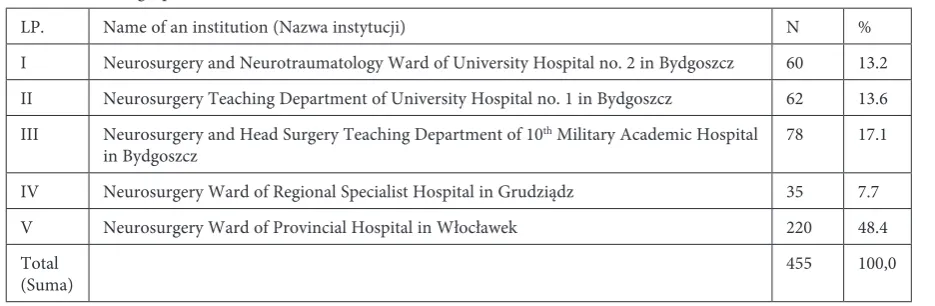
Military Academic Hospital in Bydgoszcz, Neu-rosurgery Ward of Regional Specialist Hospital in grudziądz, Neurosurgery Ward of Provincial Hospital in Włocławek. To help the research the were marked as I, II, III, IV, V, the wards I–III are units of the academic hospitals (Bydgoszcz) while the wards IV–V are located in the whole voivode-ship (outside Bydgoszcz). 455 patients aged 18–72 underwent the research, 51% of patients were men treated in the above mentioned wards. The num-ber of patients in the individual wards is presented in Table 1.
An anonymous questionnaire – Patient’s Sat-isfaction Questionnaire was used in the research. It consisted of demographics and questions which took into account such evaluation criteria as: stay-ing in an admission room, admittance to the ward, the work of the therapeutic team, the work of diag-nostic laboratories, rehabilitation, nutrition, visits and running the ward. Results of patients’ opinions about the work of the therapeutic team – nurses and doctors, were included in the analysis. likert scale was used to prepare this evaluation: points 1 and 2 reflected negative statements, point 3 was
Table 1. Research group Tabela 1. Badana grupa
lP. Name of an institution (Nazwa instytucji) N %
I Neurosurgery and Neurotraumatology Ward of University Hospital no. 2 in Bydgoszcz 60 13.2 II Neurosurgery Teaching Department of University Hospital no. 1 in Bydgoszcz 62 13.6 III Neurosurgery and Head Surgery Teaching Department of 10th Military Academic Hospital
in Bydgoszcz 78 17.1
IV Neurosurgery Ward of Regional Specialist Hospital in grudziądz 35 7.7 V Neurosurgery Ward of Provincial Hospital in Włocławek 220 48.4 Total
a middle option and 4 and 5 presented a positive opinion.
Ethics Committee
Permission to carry out the research was given by the Bioethics Committee of Collegium Medi-cum in Bydgoszcz at Nicolaus Copernicus Univer-sity in Toruń (No. 42/2010).
Statistical Analysis
The calculations were carried out using
Statis-tica version 6.0. An arithmetic average and a
stan-dard deviation were used in the analysis. The Kruskal-Wallis test was applied to compare the wards. It is a statistical rank test comparing the distribution of variables in k > 2 groups that do not assume normality in the data. While compar-ing the wards located in and outside Bydgoszcz,
U Mann-Whitney test was used. It is a test which evaluates differences of one characteristic between two populations (groups). Null hypothesis was ac-cepted (H0) – there are no differences between the
research groups. A level of significance p ≤ 0.05 was accepted as a statistical significance limit.
Results
Table 2 presents the averages of the general opinion about the individual wards. The patients gave the highest grade to ward III – an average of 4.67; the lowest to ward V – an average of 3.91. The obtained differences of opinions are statistically significant. Analysing the hospitals in Bydgoszcz together (I–III), they received better marks than the wards of the hospitals located outside Bydgo-szcz (IV–V) – these are the statistically significant differences (p < 0.0001).
Evaluating the work of the therapeutic team, first the work of the nurses was taken into
ac-count. One of the evaluation criteria was inform-ing patients about performed actions and proce-dures (Table 3). The nurses from ward I received the highest grades – an average of 4.85; the lowest grades were given to the nurses from ward V – an average of 4.19; this means that in this field the analysed wards differ significantly from each other from the patients’ point of view (p < 0.0001). Re-specting patients’ personal dignity and ensuring discretion presented by the nurses was the next evaluated variable. In this case the highest grades were given by the patients from ward III – an aver-age of 4.79; the lowest by the patients from ward IV – an average of 4.20 (p < 0.0001). Nursing staff’s reaction to patients’ requests was a subject of the next analysis. Here the results show that the nurses from ward I received the highest grades – an aver-age of 4.68; and the lowest the nurses from ward V – an average of 4.11; it was also confirmed sta-tistically (p < 0.0001). Data connected with the av-erage grades concerning nurses’ availability were presented in the third table. The nurses from ward I received the highest average – 4.65; the nurses from ward V got the lowest grades – an average of 4.10 (p < 0.05).
As far as the nurses’ work is concerned, the patients were also asked how well they were taught about self-care, especially in relation to the self-care the patients have to perform after being discharged from hospital. The neurosurgical ward IV got the highest grade – an average of 4.20; the lowest aver-age – 3.42 was given to the neurosurgical ward II (Table 4). It was also confirmed in the evaluation of the difference among the grades; p < 0.05, and it is statistically significant. The next evaluated crite-rion was the kindness and politeness of the nursing staff. The patients gave the highest grades to the workers from ward I – an average of 4.77; and the lowest to the workers from ward V – an average of 4.34 (p < 0.05). The patients also gave the aver-age grades concerning the nurses’ work during day and night shifts. Regardless of the shift, the nurses
Table 2. The general opinion about the researched ward Tabela 2. Ogólna ocena badanego oddziału
Ward
(Oddział) N c SD min max median H; p
I 60 4.40 1.1230 0.0 5.0 5.0
H = 62.6015 p < 0.0001
II 62 4.19 0.6736 2.0 5.0 4.0
III 78 4.67 0.7147 0.0 5.0 5.0
IV 35 4.34 1.6259 0.0 5.0 5.0
V 220 3.91 1.0840 0.0 5.0 4.0
from ward I got the highest grades – the average during the day shift – 4.68; the average during the night shift – 4.72 (p < 0.0001).
The doctors were the next evaluated profes-sional group. One of the criteria of this evalua-tion was how well the doctor informed the patient about a disease and the planned treatment. The doctors from the neurosurgery IV received the highest grades – an average of 4.89; while the low-est grades were given to the doctors from ward V – an average of 4.12 (Table 5). Taking the level of significance into consideration (p < 0.05), there is a basis to reject the null hypothesis – the analysed wards from the patients’ point of view differ sig-nificantly as far as how well they were informed
about the disease and the planned treatment are concerned. The next determinant of the evaluation connected with the doctors’ work was the time de-voted to the patient. The doctors from ward IV got the highest marks – an average of 4.80; and the doctors from ward V got the lowest grades – an av-erage of 3.92 (p < 0.05). Being kind and polite was the next criterion taken into account while evalu-ating neurosurgeons’ work. It follows from the research that the doctors from ward IV deserved the highest grades (the average 4.86) (p < 0.05). Are your doctors trustworthy? This was the next question answered by the surveyed patients of the neurosurgical wards. The highest average was 4.86 and was given to wards III and IV, while the low-Table 3. The evaluation of the nurses (part 1)
Tabela 3. Ocena pielęgniarek (część 1)
Informing patients about performed actions and procedures
Ward
(Oddział) N c SD min max median H p
I 60 4.85 0.3601 4.0 5.0 5.0 35.64568 < 0.0001
II 62 4.40 0.9136 1.0 5.0 5.0
III 78 4.50 0.9363 0.0 5.0 5.0
IV 35 4.49 1.3144 0.0 5.0 5.0
V 220 4.19 1.0292 0.0 5.0 4.0
Respecting patients’ personal dignity and ensuring discretion
I 60 4.72 0.8654 0.0 5.0 5.0 25.13569 < 0.0001
II 62 4.63 0.7067 1.0 5.0 5.0
III 78 4.79 0.6519 0.0 5.0 5.0
IV 35 4.20 1.6592 0.0 5.0 5.0
V 220 4.37 0.9584 0.0 5.0 5.0
Reaction to patients’ requests
I 60 4.68 0.5365 3.0 5.0 5.0 27.89094 < 0.0001
II 62 4.32 1.0366 0.0 5.0 5.0
III 78 4.67 0.7327 0.0 5.0 5.0
IV 35 4.46 1.2448 0.0 5.0 5.0
V 220 4.11 1.1173 0.0 5.0 5.0
Availability
I 60 4.65 0.5150 3.0 5.0 5.0 32.03296 < 0.0001
II 62 4.37 0.9449 0.0 5.0 5.0
III 78 4.64 0.7381 0.0 5.0 5.0
IV 35 4.40 1.2649 0.0 5.0 5.0
est average – 4.16 went to ward V (p < 0.05). The last determinant of the evaluation of the neurosur-geons’ work was connected with the information given about further procedures after the patient’s being discharged from hospital. The doctors from ward IV fulfilled this task better than the others – their average was 4.57; the doctors from ward I and II got the lowest grades – the average of 3.50. Taking the level of the significance into account (p < 0.05), there is a basis to reject the null hypoth-esis – the patients’ opinions differ significantly from each other.
Discussion
The work of the therapeutic team from the neurosurgery wards is not only the totality of the medical, nursing, manual or technical procedures but the whole of interpersonal relations, the staff’s knowledge and their ability to make decisions. It is really difficult to evaluate the quality of this work and even more difficult to measure it. However, mainly patients’ opinions should be taken into ac-count to assess to what degree the health service meets their needs and requirements.
From the results of the majority of the re-search, it can be concluded that the patients pres-ent a high level of satisfaction connected with their Table 4. The evaluation of the nurses (part 2)
Tabela 4. Ocena pielęgniarek (część 2) Teaching about self-care
Ward
(Oddział) N c SD min max median H p
I 60 3.90 1.7044 0.0 5.0 5.0 10.52342 0.0325
II 62 3.42 1.8247 0.0 5.0 4.0
III 78 3.58 1.8483 0.0 5.0 4.5
IV 35 4.20 1.6592 0.0 5.0 5.0
V 220 3.96 1.2398 0.0 5.0 4.0
Being kind and polite
I 60 4.77 0.6475 1.0 5.0 5.0 23.34849 < 0.0001
II 62 4.68 0.5944 2.0 5.0 5.0
III 78 4.67 0.8004 0.0 5.0 5.0
IV 35 4.51 1.2689 0.0 5.0 5.0
V 220 4.34 1.0139 0.0 5.0 5.0
Work during a day shift
I 60 4.68 0.5365 3.0 5.0 5.0 27.89094 < 0.0001
II 62 4.32 1.0366 0.0 5.0 5.0
III 78 4.67 0.7327 0.0 5.0 5.0
IV 35 4.46 1.2448 0.0 5.0 5.0
V 220 4.11 1.1173 0.0 5.0 5.0
Work during a night shift
I 60 4.72 0.5237 3.0 5.0 5.0 40.14128 < 0.0001
II 62 4.27 1.1187 0.0 5.0 5.0
III 78 4.62 0.9566 0.0 5.0 5.0
IV 35 4.49 1.2689 0.0 5.0 5.0
care. Own research confirms this fact – the analy-sed wards received positive grades and the grades are higher for the university or teaching hospitals. Thorne et al. [9] report 70–80% positive opinions connected with the satisfaction concerning the neurosurgical care; however, they pay attention to managing defects. Terada et al. [10] mentioning
the subject of the intensive postoperative care in neurosurgery notice that it does not influence the increase of the patients’ satisfaction as far as the general medical care in the hospital is concerned. Coulter and Cleary [11] present patients’ opinions about the quality of the medical care in the hospi-tals in germany, Sweden, Switzerland, the UK and Table 5. The assessment of doctors
Tabela 5. Ocena lekarzy
Informing about further procedures after the patient’s being discharged from hospital Ward
(Oddział) N c SD min max median H p
I 60 4.70 0.5304 3.0 5.0 5.0 45.43255 < 0.0001
II 62 4.45 0.9175 1.0 5.0 5.0
III 78 4.77 0.7011 0.0 5.0 5.0
IV 35 4.89 0.3228 4.0 5.0 5.0
V 220 4.12 1.1406 0.0 5.0 5.0
Devoting time to the patient
I 60 4.25 0.9851 0.0 5.0 5.0 29.05910 < 0.0001
II 62 4.08 1.0758 1.0 5.0 4.0
III 78 4.45 0.9756 0.0 5.0 5.0
IV 35 4.80 0.6325 2.0 5.0 5.0
V 110 3.92 1.2126 1.0 5.0 4.0
Being kind and polite
I 60 4.67 0.7955 0.0 5.0 5.0 27.36926 < 0.0001
II 62 4.61 0.6365 3.0 5.0 5.0
III 78 4.81 0.4282 3.0 5.0 5.0
IV 35 4.86 0.4300 3.0 5.0 5.0
V 110 4.20 1.1154 1.0 5.0 5.0
Being worth trusting
I 60 4.67 0.9858 0.0 5.0 5.0 55.24537 < 0.0001
II 62 4.58 0.8598 0.0 5.0 5.0
III 78 4.86 0.3856 3.0 5.0 5.0
IV 35 4.86 0.4300 3.0 5.0 5.0
V 110 4.16 0.9817 1.0 5.0 4.0
Informing about further procedures after the patient’s being discharged from hospital
I 60 3.50 2.0127 0.0 5.0 4.0 25.81151 < 0.0001
II 62 3.50 1.8354 0.0 5.0 4.0
III 78 4.09 1.6529 0.0 5.0 5.0
IV 35 4.57 1.2669 0.0 5.0 5.0
the US. The evaluation concerns the following: the health information and education, the coordina-tion of the treatment, its continuacoordina-tion and the per-formed changes, respecting the preferences of the hospitalised people, the mental support the patients were provided with, the commitment of the family members and friends to this care. In the research of these authors the percentage of patients complain-ing about the medical care is relatively low – under 9%, the lowest is in Switzerland – 3.7%. Because of the methodological differences, it is difficult to compare directly the above mentioned results with the ones presented in this work.
The quality of the care is also a result of the work of the whole therapeutic team – professionals. The research demonstrated the positive evaluation of the medical staff’s care – the doctors and nurses. The literature indicates that the therapeutic team’s functioning in the hospital wards is an important element of the improvement concerning the care of the hospitalised patient [12]. This improvement is determined by interpersonal relations. The most important person the patient meets is the attending doctor. It has been noticed that an adequate length of consultations, the possibility of quick help, the confidentiality of information, complete informa-tion about the disease and making the patient feel comfortable while talking about their disease are the most appreciated factors by the patients in all the countries [13].
The obtained results demonstrated that the nurses for their work received good and very good grades from the patients. From the research car-ried out by the Centre of Quality Monitoring in Healthcare Sector [14] it can be concluded that all the aspects concerning the evaluation of the nurses oscillated around 90% of the positive grades.
Kind-ness and a proper approach to the patient as well as professional skills (proficiency in performing nursing procedures) are the most important fac-tors for the patients.
The patients’ high satisfaction can also result from lowering of the level of their expectations towards the nursing care. Some of the research patients’ opinions indicate that their expectations towards the nurses were based on the observation of their work. According to Kropornicka et al. [15] the nurses were so loaded with work that they were not able to help the patients organise their free time. Wasilewski’s research [16] indicates that the patients’ satisfaction concerning the analysed as-pects of the nursing care was on an average level.
Own analysis showed, in contrast to the evalu-ations obtained abroad [9], that the lowest grades were given to the nurses for teaching about self-care, while the doctors – for not giving information about the further treatment and the procedures af-ter the patient’s being discharged from hospital.
The patients’ opinions about hospitalisation create the basis of the health care system concen-trated on the client [17]. In practice this helps to collect information about the patients’ needs and expectations. It is important to carry out the re-search, as it can possibly be used to improve the results of the treatment.
The authors concluded that the patients of the neurosurgical wards evaluated positively the quality of the care they were provided with. The high level of the satisfaction was visible most of all among the patients treated in the neurosurgi-cal wards of teaching hospitals. The doctors and nurses received the lowest grades for giving poor information about the further treatment and the lack of explanation how to perform self-care.
References
[1] Donabedian A: Evaluating the quality of medical care. Milbank Quart 2005, 83, 4, 691–729.
[2] Kurpas D, Steciwko A: Jakość usług medycznych w podstawowej opiece zdrowotnej. Adv Clin Exp Med 2005, 14, 3, 603–608.
[3] Anczewska M, Raduj J, Indulska A, Pałyska M, Prot K: Porównanie opinii pacjentów o jakości opieki na oddzia-łach psychiatrycznych i neurologicznych. Psychiatr Pol 2010, 44, 2, 255–265.
[4] Heinemann AW, Fisher WP Jr, Gershon R: Improving health care quality with outcomes management. J Prosth Orthot 2006, 18, 1, 46–50.
[5] Maffei C, Shea J: Stewart M: Measuring patient satisfaction. Psychiatr Serv 2003, 54, 10, 1411.
[6] Linhorst DM: Empowering people with severe mental illness A practical guide. Oxford University Press 2006. [7] Meehan T, Bergen H, Stedman T: Monitoring consumer satisfaction with inpatient service delivery: the Inpatient
Evaluation of Service Questionnaire. Austr New Zealand J Psychiatry 2002, 36, 807–811.
[8] Crawford MJ, Rutter D: Are the views of members of mental health user groups representative of those of “ordi-nary” patients? A cross-sectional survey of service users and providers. J Mental Health 2004, 13, 6, 561–568. [9] Thorne L, Ellamushi H, Mtandari S, McEvoy AW, Powel Ml, Kitchen ND: Auditing patient experience and
satisfaction with neurosurgical care: results of a questionnaire survey Br J Neurosurgery 2002, 16, 3, 243–255. [10] Terada Y, Inoue S, Tanaka Y, Kawaguchi M, Hirai K, Furuya H: The impact of postoperative intensive care on
outcomes in elective neurosurgical patients in good physical condition: a single centre propensity case-matched study. Can J Anaesth 2010, 57, 12, 1089–94.
[12] Wołowski T, Piątek W, Nowalińska M: Ocena jakości opieki pielęgniarek uzdrowiskowych przez kuracjuszy. Ann Acad Med gedan 2010, 40, 109–116.
[13] Grol R, Wensing M, Mainz J, Jung H.P, Ferreira P, Hearnshaw H, Hjortdahl P, Olesen F, Reis S, Ribacke M, Szecsenyi J: Patients in Europe evaluate general practice care: an international comparison. Br J gen Pract. 2000, 50 (460), 882–887.
[14] Cieślik P: Personel medyczny w oczach pacjentów. Słuzba Zdr 2001, 15, 5–8.
[15] Kropornicka B, Baczewska B, Turowski K: Satysfakcja z opieki pielęgniarskiej w grupie pacjentów hospitalizo-wanych z powodu dyskopatii lędźwiowej. Annales UMSC 2003, 58, supl.13, 129: 132–137.
[16] Wasilewski T: Analiza wybranych aspektów satysfakcji pacjenta z pobytu w szpitalu w ocenie chorych z półkulo-wymi uszkodzeniami mózgu. Zdr Publ 2009, 119 (2), 152–155.
[17] Committee on Quality of Health Care in America. Crossing the quality chasm: a new health system for 21st cen-tury. Washington DC: Institute of Medicine 2001.
Address for correspondence:
Robert Ślusarz
Zakład Pielęgniarstwa Neurologicznego i Neurochirurgicznego CM UMK Techników 3
85-801 Bydgoszcz Poland
Tel.: +48 52 585 21 93 E-mail: [email protected]
Conflict of interest: None declared