University of New Orleans University of New Orleans
ScholarWorks@UNO
ScholarWorks@UNO
University of New Orleans Theses and
Dissertations Dissertations and Theses
5-20-2011
The Effects of Graphing Calculator use on High-School Students'
The Effects of Graphing Calculator use on High-School Students'
Reasoning in Integral Calculus
Reasoning in Integral Calculus
Hunter Julie Spinato University of New Orleans
Follow this and additional works at: https://scholarworks.uno.edu/td
Recommended Citation Recommended Citation
Spinato, Hunter Julie, "The Effects of Graphing Calculator use on High-School Students' Reasoning in Integral Calculus" (2011). University of New Orleans Theses and Dissertations. 1346.
https://scholarworks.uno.edu/td/1346
The Effects of Graphing Calculator use on High-School Students‟ Reasoning in Integral Calculus
A Dissertation
Submitted to the Graduate Faculty of the University of New Orleans in partial fulfillment of the requirements for the degree of
Doctor of Philosophy in
Curriculum and Instruction Mathematics Education
by
Julie Spinato Hunter
B.S., Loyola University, 2005 M.Ed., University of New Orleans, 2006
Acknowledgements
Deus Providebit. I would like to begin by thanking God for everything that He has provided for me and for the many blessings in my life. Thank you to all of my family, who has helped me through the process of completing the doctoral program and throughout all of my life.
Particularly, to my mom and dad, thank you for your constant love and support, for helping me through this process, for providing me with a good education, and for teaching me and instilling
in me the importance of dedication, hard work, and faith in God. Thank you to my husband Andrew, for your love, support, and understanding, for helping me in countless ways, and for your encouragement. Thank you to my sister Kaylyn for your help and encouragement always,
for always listening, caring, and being there for me. Thank you to my grandparents, mama, papa, and poppa, for your love and guidance, your example, and your encouragement to always strive
to do my best. Thank you to my grandparents, Mama Cat and Mama Hertz, who I know will be looking down from Heaven and will be with me as I graduate. To all of my family and friends, thank you for being wonderful and supportive.
Thank you to my advisor and major professor, Dr. Germain-McCarthy, for preparing me and helping me through this process step by step. I truly could not have done this without your
guidance and your wonderful ideas. Thank you for all of the time that you spent working with me and for your dedication.
Thank you to the methodologist for this study, Dr. Thoreson, for answering my many
questions, and for your help in writing the methodology and results for the study. Your time, your helpful ideas, and encouragement throughout the process are greatly appreciated.
Thank you to my research seminar professor and dissertation committee member, Dr.
conducting the literature review and in designing the study to make this study better. Thank you for your time and for your encouragement.
Thank you to the mathematicians for this study, Dr. Jensen and Dr. Santanilla, for helping in the development and critique of the instruments and for your time spent grading all of the
assessments. Your help is truly appreciated.
Thank you to everyone who helped in this study, including the schools that participated, my fellow graduate student and calculus teacher, and the students that participated in the
Table of Contents
List of Figures ... viii
List of Tables ... ix
GLOSSARY ... x
Abstract ... xi
CHAPTER 1: INTRODUCTION ... 1
Problem and Purpose ... 1
Reasoning in Calculus ... 4
Conceptual Understanding in Calculus ... 5
Graphing Calculators ... 6
Teachers’ Concern on Usage of the Graphing Calculator ... 6
Appropriate Use of the Graphing Calculator ... 7
Conceptual Framework ... 8
Constructivism ... 8
Types of Constructivism ... 9
Constructivism in Mathematics Education Research ... 10
Constructivism and Conceptual Understanding ... 11
Constructivism and Reasoning ... 12
Constructivism and Technology ... 12
Methodology ... 14
Research Questions ... 15
Research Hypothesis ... 16
Overview of the manuscript ... 16
CHAPTER 2: REVIEW OF THE LITERATURE ... 18
Reasoning in Mathematics ... 18
Types of Reasoning ... 20
Components of Reasoning ... 21
Reasoning in the Content Areas ... 22
Research on Reasoning ... 24
Conceptual Understanding in Calculus ... 26
Conceptual Understanding versus Algorithmic Techniques ... 27
Problems with Algorithmic Techniques ... 29
Conclusion ... 30
Handheld Graphing Technology in the Calculus Curriculum ... 31
Technology in the Mathematics Classroom ... 31
Types of Graphing Calculators ... 32
Uses of Graphing Calculators ... 33
Recommendations for Use ... 34
Research on Graphing Calculators ... 35
Appropriate and Effective Use of the Graphing Calculator ... 42
Conclusion ... 44
CHAPTER 3: METHODOLOGY ... 46
Research Questions ... 46
Research Hypothesis ... 46
Sampling Procedures and Participants ... 47
Variables ... 50
Instrument Development ... 51
Pretest and Posttest ... 51
Validity and Reliability ... 54
Procedures ... 55
Data Collection ... 59
Data Analysis ... 60
Ethical Considerations ... 62
Limitations ... 63
CHAPTER 4: RESULTS ... 64
Schools and Participants ... 64
Quantitative Analysis ... 65
Posttest Components ... 65
t – test ... 65
The First Research Question... 67
Second Research Question ... 70
The Third Research Question ... 72
Qualitative Analysis ... 74
Interview Setting ... 74
Interview Description ... 74
Individual Interview Participants ... 75
Interview Scores ... 76
Analysis of Interviews ... 76
Summary ... 96
CHAPTER 5 DISCUSSION AND CONCLUSIONS ... 98
Purpose ... 98
First Research Question ... 98
Second Research Question ... 100
Third Research Question ... 103
Appropriate Instruction in and Use of Graphing Calculators ... 104
Other Considerations ... 107
Conclusion ... 109
Implications for Research and Practice ... 111
Recommendations for Future Research ... 112
REFERENCES ... 115
APPENDICES ... 119
Appendix A IRB Application ... 120
Appendix B Participant Solicitation Materials ... 130
Appendix C Pretest ... 135
Appendix D Posttest ... 147
Appendix E Pretest Sample Solutions ... 159
Appendix F Posttest Sample Solutions ... 171
Appendix G Pretest and Posttest Grading Rubric ... 183
Appendix H Lesson Plans ... 194
Appendix I Interview Script ... 244
Appendix J School Administrator Observation Assessment ... 251
Appendix K Interview Transcriptions ... 253
Appendix L Math Anxiety ... 273
List of Figures
Figure 1: Problem ... 2
Figure 2: Conceptual Framework ... 14
Figure 3: Observed Individual Differences ... 79
Figure 4: Problem Solving Approaches and Representations... 87
Figure 5: Reasoning Questions ... 89
List of Tables
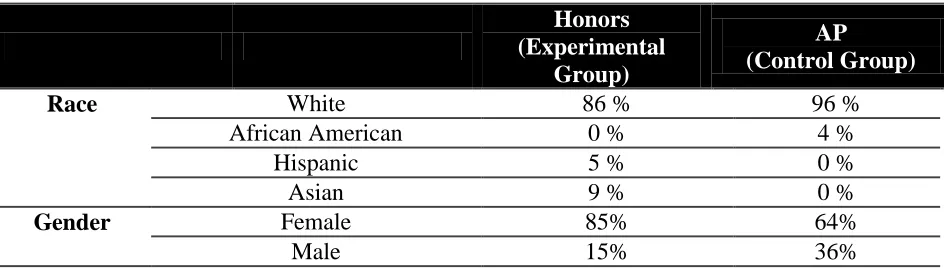
Table 1: Student Demographics ... 47
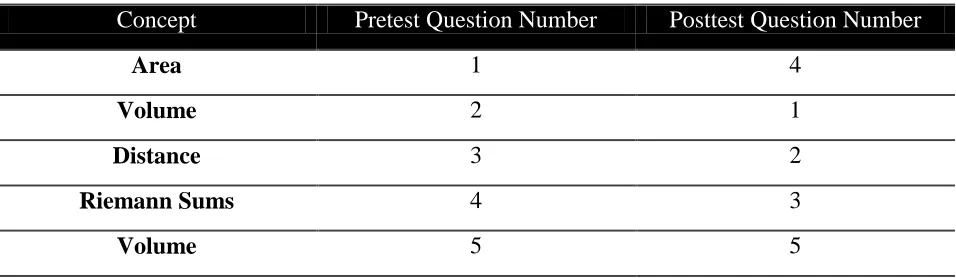
Table 2: Concepts Included on Assessments ... 53
Table 3: Elements of Reasoning Included on Assessments ... 54
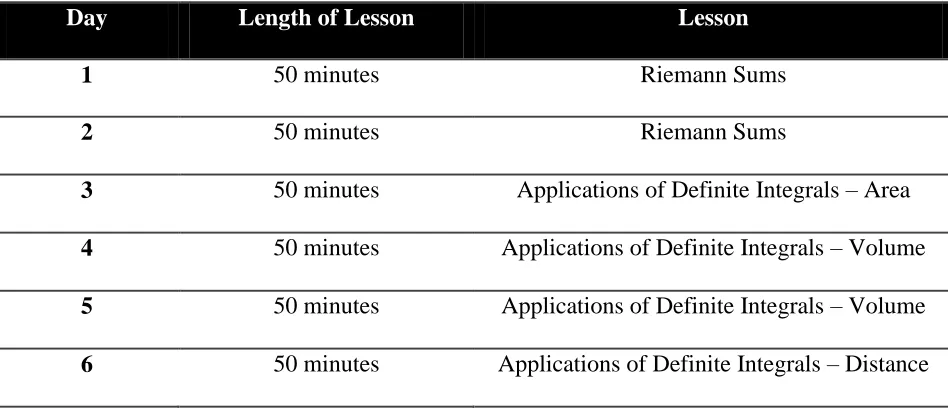
Table 4: Lesson Content and Time Frame ... 58
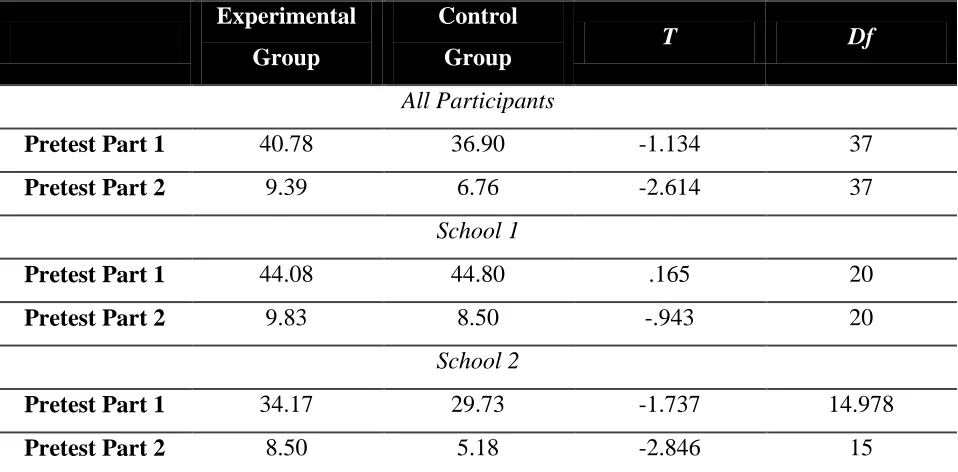
Table 5: Independent Samples t-test ... 67
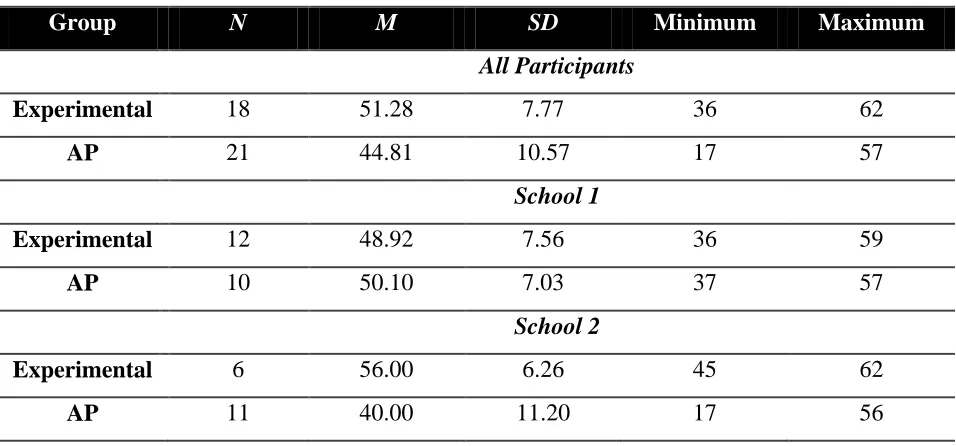
Table 6: Descriptive Statistics ... 68
Table 7: Summary of MANCOVA Results ... 69
Table 8: Summary of Univariate Results ... 71
Table 9: Summary of ANCOVA Results... 73
GLOSSARY
Algebraic Manipulation – Problem solving involving algebraic methods, use of formulas, and algorithms
Algorithmic Techniques – See algebraic manipulation
Conceptual Understanding – One of the strands of mathematical proficiency defined by the National Research Council (2001, p. 5) as “comprehension of mathematical concepts, operations, and relations.”
Constructivism – an epistemology which suggests that all knowledge is constructed and that
students are active participants in the learning process
Definite Integral – Calculus concept representing the area between two curves on the Cartesian plane
Disk Method – Calculus procedure for finding the volume of solids of revolution Handheld Graphing Technology – Graphing calculators
Integral Calculus – Part of calculus involving integration techniques Manipulative Techniques – See Algebraic Manipulation
Non-routine problem solving – The process of solving problems with which students are not
typically familiar
Reasoning – “The process of drawing conclusions on the basis of evidence or stated
assumptions” (NCTM, 2009, p. 2)
Riemann Sums – Calculus procedure for approximating a definite integral
Routine problem solving – The process of solving problems with which students are familiar Solids of Revolution – Calculus concept referring to a three-dimensional solid formed when
Abstract
This mixed-method study investigated the impact of graphing calculator use on high school calculus students‟ reasoning skills through calculus problems when applying to concepts of the
definite integral and its applications. The study provides an investigation of the effects on reasoning when graphing calculators are used, since it is proposed that, through reasoning,
conceptual understanding can be achieved. Three research questions were used to guide the study: (1) Does the use of the graphing calculator improve high school calculus students‟
reasoning ability in calculus problems applying the definite integral? (2) In what specific areas of reasoning does use of the graphing calculator seem to be most and least effective? and (3) To what extent can students who have used the graphing calculator demonstrate ability to solve
problems using pencil and paper methods? The study included a quantitative, quasi-experimental component and a qualitative component. Results of the quantitative and qualitative analysis indicate that (1) graphing calculators had a positive impact upon students‟ reasoning skills (2)
graphing calculators were most effective in the areas of initiating a strategy and monitoring progress (3) students‟ reasoning skills were most improved when graphing calculators were used
together with the analytic approach during both instruction and testing and (4) students who used the graphing calculator performed equally as well in all elements of reasoning as those who used
pencil and paper to solve problems.
CHAPTER 1:
INTRODUCTION
The development of conceptual understanding is critical to students‟ success and ability
to solve problems in calculus courses. Understanding concepts, such as the limit, derivative, and integral, requires a method of thinking different from other areas of mathematics. Many other
areas of mathematics involve finite processes, whereas most calculus concepts, such as those listed above, involve infinite processes (NCTM, 1989). It has been recommended that curriculum and instruction in calculus focus on conceptual understanding rather than algebraic manipulation
(NCTM, 1989, 2009). Despite this recommendation, it has been common for calculus courses to focus on algorithmic techniques. Several studies have documented the difficulties that students have faced in calculus as a result of the focus on algebraic manipulation and a lack of focus on
conceptual understanding (Baker, Cooley, & Trigueros, 2000; Judson & Nishimore, 2005; White & Mitchelmore, 1996). For example, this lack of understanding has caused students to have
difficulty in linking calculus concepts in order to solve problems, thus creating an obstacle for student success in this course (Baker et al.; Judson & Nishimore; White & Mitchelmore).
Problem and Purpose
Reasoning is one important component of students‟ mathematical learning and
conceptual understanding in mathematics (NCTM, 2009). Development of conceptual
understanding is important in mathematics and should be the goal of mathematics teaching rather
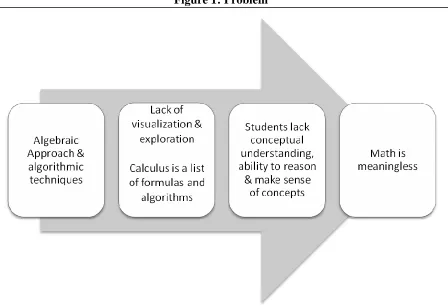
calculus, and this lack of understanding appears to be a common problem (Baker et al., 2000, Judson & Nishimore, 2005, White & Mitchelmore, 1996). I have constructed Figure 1 below to
illustrate the problem that students encounter in their calculus courses when the focus is placed on an algebraic approach and manipulative techniques.
Figure 1: Problem
There are several skills important to an understanding of math, of which reasoning is one (Garden et al., 2006). It has been suggested that student use of the graphing calculator can
improve student success in areas such as concept development and problem solving while providing opportunities for visualization, access to multiple representations, and computation
calculus problems. NCTM postulates that use of technology may have an impact upon students‟ reasoning skills, but this has not been proven in previous research.
The purpose of this study was to investigate the impact of graphing calculator use on high-school calculus students‟ reasoning in solving problems on the definite integral and its
applications. Garden et al. (2006) identified calculus as one of the traditional advanced
mathematics content domains that deserves considerable emphasis, stating “calculus is a central
tool in understanding the principles governing the physical world” (p.12) and “is the principal
point of entry to most mathematically-based scientific careers” (p. 12). Since students‟ reasoning skills are part of their conceptual understanding in calculus, it is important to
determine how these skills can be improved. The NCTM (2009) has identified several areas of mathematics, such as algebra, geometry, and statistics, that should include reasoning. As these areas form the foundation for calculus concepts, reasoning skills are an essential part of learning
in calculus as well. Garden et al. (2006) also identifies calculus as one of the three main
advanced mathematics content domains in which reasoning skills are useful. The NCTM has also
suggested that technology be included to improve reasoning skills. Several types of technology, including graphing technologies such as graphing calculators, have been used in mathematics classrooms and in calculus classrooms, in particular. They have been used in order to improve
student success in areas such as the development of problem-solving skills, and research has shown how the graphing calculator can be helpful in mathematics courses when it is used for
visualization, computation, and access to multiple representations (Anderson et al., 1999;
Brosnan & Ralley, 1995; Kimmins & Bouldin, 1996; NCTM, 1989, 2009; Porzio, 1997; Powell, 1998; Reznichenko, 2007; Waits & Demana, 1998). Although it has been suggested that the
reasoning, this has not been studied in previous research. Recommendations for the inclusion of reasoning opportunities and the recent emphasis on reasoning skills reiterated the need for a
study to investigate ways to improve these skills. This study addressed this need by investigating whether the use of graphing calculators could improve reasoning in calculus. This study provides
information for the research community and for calculus teachers on whether the graphing calculator can be used to increase students‟ reasoning in calculus, so that conceptual
understanding and success in calculus can be achieved.
Reasoning in Calculus
Currently, although reasoning is considered an important part of learning mathematics, these skills have not been given consistent attention in the mathematics curriculum (Fuson, Kalchman, & Bransford, 2005; NCTM, 2009). Furthermore, many students lack reasoning skills
when they enter college (CUPM, 2004). As a result of the lack of reasoning abilities that exist, students often have not been able to see the meaning in mathematics, and ability to retain
knowledge has been difficult (NCTM). Calculus students, in particular, have often struggled with a lack of understanding of concepts (Baker et al., 2000; Carson et al., 2003; White et al., 1996). Several studies have documented the areas where calculus students have struggled, such as the
second derivative and the definite integral, and the apparent causes of these struggles, which include lack of understanding of functions and variables (Baker et al.; Judson et al.; White et al.).
Little research, however, has focused on improving students‟ reasoning skills, particularly in calculus. While it has been suggested that appropriate use of the graphing calculator can help students in problem solving and reasoning through the solutions to problems, previous empirical
Because of the potential benefits that reasoning may provide for students‟ understanding
and success in mathematics, and calculus in particular, it is necessary to develop ways to
improve reasoning skills in mathematics, but the strategies to do so are largely unexplored (CUPM, 2004). The NCTM suggests that technology be included throughout the mathematics
curriculum in order to achieve this goal. It is suggested that technology can be used to provide multiple representations of calculus problems for students to see and that technology can provide more of these representations than students can often do by hand (NCTM, 2000, 2009). Because
of the capabilities and opportunities afforded by technology, it can provide “a lens that leads to a deeper understanding of mathematical concepts” (NCTM, 2009, p. 14).
Conceptual Understanding in Calculus
The importance of conceptual understanding is emphasized widely (Council, 2001;
CUPM, 2004; Fuson, Kalchman, & Bransford, 2005), and the importance of improving
conceptual understanding in calculus courses has been well documented (CollegeBoard, 2009;
Kissane & Kemp, 2008; Schwalbach & Dosemagen, 2000; Slavit, Lofaro, & Cooper, 2002), as this understanding can have a profound impact on students‟ ability to solve problems. The National Mathematics Advisory Panel (2008) has recommended that future research be focused
on ways to improve conceptual understanding. One suggestion comes from the National Council of Teachers of Mathematics (NCTM, 2009). The NCTM recommends that refocusing the
mathematics curriculum on reasoning and sense making will improve conceptual understanding (NCTM). Reasoning is defined by the NCTM (2009) as “the process of drawing conclusions on
the basis of evidence or stated assumptions” (p. 2). Sense making is defined as “developing
(NCTM, 2009, p. 3) as students can make sense of mathematical concepts as they engage in reasoning. The NCTM suggests that including opportunities for reasoning and sense making in
the mathematics curriculum will help students to have a better understanding of mathematical procedures, when they are used, what they mean, and why they work. Likewise, mathematics
should make sense and have meaning to students (NCTM). In addition, students are only able to make sense of mathematics if they have an understanding of the concepts involved. Concepts are said to be “the substance of mathematical knowledge” (NCTM, 1989, p. 223).
Graphing Calculators
Although many types of technology have been useful in mathematics classrooms, graphing calculators, in particular, have been beneficial in mathematics classes including calculus (Brosnan & Ralley, 1995; Porzio, 1997; Reznichenko, 2007). Graphing calculators can
be used in a variety of ways in teaching and learning calculus (CUPM, 2004; NCTM, 1989, 2000). They can be used to increase the efficiency of calculations as well as to explore abstract
concepts. Computing technology, such as the graphing calculator, “makes the fundamental concepts and applications of calculus accessible to all students” (NCTM, 1989, p. 182).
Teachers’ Concern on Usage of the Graphing Calculator
My perspective toward the graphing calculator is based upon my experience as a high-school calculus teacher and my discussions with other teachers. I have used graphing calculators
in calculus instruction for the past few years, and it has been a useful tool for my classes, yet many teachers question its use because they believe that it replaces students‟ thinking. Another concern among teachers that I have spoken with is how to help students in their ability to read
that students struggle with portions of the test due to lack of ability to read and interpret graphs. Furthermore, these teachers have commented that students often resort to recalling formulas and
following procedures rather than relying on their reasoning skills to solve problems. These teachers have made a connection between reasoning skills and working with graphical
representations.
Appropriate Use of the Graphing Calculator
Although overreliance on the calculator is a concern for some, the uses of the graphing
calculator extend beyond mere ease of computation. They can be used to explore abstract concepts that are otherwise difficult to visualize, such as continuity, differentiability, end
behavior, and concavity (NCTM, 1989). Features of the calculator such as the “zoom” feature and the ability to compute the definite integral make these explorations possible (NCTM, 2009). Numerous studies have documented the benefits associated with appropriate use of the graphing
calculator on student learning in calculus and other mathematics (Anderson, Mueller, & Pedler, 1999; Beckmann, Thompson, & Senk, 1999; Brosnan & Ralley, 1995; Mesa, 2007; NCTM,
1989, 2000, 2009; Porzio, 1997; Waits & Demana, 1998). As with any technology, however, it is important to use this tool in a way that enhances opportunities for student learning and not to cause students to develop an overreliance on the calculator. With the proper curriculum design to
employ this technology and appropriate use of the graphing calculator by the teacher and the students, this tool offers some advantages for student learning of mathematics, and calculus in
particular, that is difficult or not possible without it (Doerr & Zangor, 2000).
My students and I have used the calculators not for mere computation or to replace their problem-solving skills but for exploration and visualization of functions and concepts. I have
understand the concept of local linearity when learning about the derivative and linear
approximations. This is better understood by graph than it is algebraically, from my experience.
Moreover, the graph can be manipulated through the graphing calculator. Drawing the graph for students on the board provides them with visualization, but zooming into the graph helps them to
see more clearly and understand the meaning of the term local linearity. It is my perspective, though, that its effectiveness depends upon how it is used. Therefore, I was interested in determining whether, when graphing calculators are used strategically, for visualization and
exploration, they have any effect on reasoning skills in integral calculus.
This study focuses on integral calculus, the part of calculus that deals with the definite
integral and its applications. Graphing calculators can be used in integral calculus to demonstrate the area under a curve or between curves, to demonstrate the process used in computing a
Riemann sum, a procedure used for approximating a definite integral, to approximate a definite
integral, to compute area and volume of solids, and to teach the process used to find distance by demonstrating the motion of an object moving in a linear path. Although some of these concepts
can be computed by hand and visualized through hand-drawn graphs, the graphing calculator provides a way to perform computations efficiently and provides graphical representations that
can be manipulated.
Conceptual Framework
Constructivism
My conceptual framework for the study is the theory of constructivism, an epistemology which suggests that students are active participants in the learning process and construct their
foundation for the theory of constructivism was developed by Jean Piaget in 1937, and it was further expanded by von Glasersfeld (von Glasersfeld, 1996a).
There are several varieties of constructivism, but these varieties all share the belief that knowledge cannot simply be passed on from the teacher to the students or “internalized, stored,
and reproduced at some later time” (Iran-Nejad, 1995, para. 7). Rather, knowledge is constructed
by the student when he or she makes connections with previously existing knowledge.
Constructivists believe, in fact, that all knowledge is constructed (Noddings, 1990). Through the
processes of assimilation and accommodation, students construct their understanding by gaining new experiences and building upon what they already know (Ernst, 1996, Iran-Nejad). Their previous knowledge becomes the “building blocks” (Ernest, 1996, p. 336) for new constructions which they make. A critical part of this epistemology is that students are “active” in the learning
process, not passive recipients of knowledge, and that students must participate in the learning
process in order to achieve understanding (Harris & Graham, 1994). As stated by von
Glasersfeld, “knowledge is not passively received but built up by the cognizing subject” (1996b,
p. 18).
Types of Constructivism
There are several varieties of constructivism. Von Glasersfeld advocated a form called radical constructivism, which states as one of its principles, “the function of cognition is adaptive
and serves the organization of the experiential world, not the discovery of ontological reality”
(von Glasersfeld, 1996b, p. 18). Radical constructivism is “radical” in the sense that it denies the existence of an objective reality or truth and, because of this, radical constructivism cannot even claim that the theory of constructivism itself is true (Glasersfeld, 1990; Simon, 1995). There is
constructivism. According to this theory, although students construct their own knowledge, this process is not solely an individual act. Rather, social constructivists believe in the importance of
social interaction in learning and constructing knowledge (Green & Gredler, 2002). Students construct knowledge through interactions with their environment, and their environment includes
the people around them (Ernest, 1996).
Constructivism in Mathematics Education Research
Constructivism is one of the most common theoretical perspectives used in research on
mathematics education (Ernest, 1996). The constructivist perspective influences many areas of thought on mathematics teaching, including particular teaching strategies, the importance of
conceptual understanding, reasoning, and the use of technology. In addition, constructivist theories about how students acquire knowledge have influenced the mathematics reform
movement. The reform movement arose in response to the 1983 publication of Bell‟s A Nation at
Risk, which called for standards-based education reform. In response to this, the NCTM published the Curriculum and Evaluation Standards for School Mathematics in 1989. The
mathematics reform movement and these standards continue to be important and to have influence today (Byers, 2004). The reform movement generally supports student-centered learning rather than direct instruction. In student-centered learning, the student is involved in discovering information while the teacher serves more as a guide. “Discovery learning”
(White-Clark, DiCarlo, & Gilchriest, 2008, p. 42) is one of the strategies associated with constructivist
approach was favored, the direct instruction approach was more prominent in both high school and college classrooms.
Constructivism and Conceptual Understanding
Conceptual understanding is fundamental in the theory of constructivism. As suggested
by Iran-Nejad (1995), “constructivism requires teachers to focus on depth of understanding” (para. 11). Memorization does not consitute knowing, and “is often not successful because knowledge is not a ready-made, transferable product but, rather, a product of the learner's thinking” (Iran-Nejad, 1995, para. 39). In addition, constructivists do not believe that “rote responses represent knowledge” (Noddings, 1990, p. 13). Simply reciting pieces of information,
relying on memorization, and following procedures without understanding cannot be called knowledge. Rather, simple recitation of information is called a “knowledge claim” (Noddings,
1990, p. 13). As suggested by Noddings (1990), “students need building materials, tools, patterns, and sound work habits if they are to construct mathematical objects and relationships”
(p. 15). The constructivist perspective on the use of symbolic manipulation versus conceptual understanding is seen in von Glasersfeld‟s comment in response to the “formalist myth that all that matters in mathematics is the manipulation of symbols” (von Glasersfeld, 1996a, p. 312).
Von Glasersfeld has stated that symbols are often treated as though there were no concepts that
were behind them, and therefore students are unable to understand the meaning behind actions and procedures. However, von Glasersfeld, states “spoken words or marks on paper are symbols
only if one attributes to them something they symbolize, that is, a meaning – and meaning is always conceptual” (von Glasersfeld, 1996a, p. 312). In the constructivist view, then, conceptual
understanding in mathematics is of great importance. A focus on conceptual understanding will
Constructivism and Reasoning
Reasoning is one important aspect of understanding (Garden et al., 2006). The
constructivist view can be seen in the emphasis on reasoning skills, and the mathematics reform movement, which is influenced by constructivist theories, includes reasoning as one of its
important principles for school mathematics. Reasoning, the process of drawing conclusions, is said to begin with explorations, conjectures, false starts, and partial explanations (NCTM, 2009). Constructivism encourages teachers to allow students to actively participate in learning through experimentation and exploration. When students‟ constructions lead to incorrect results, a
constructivist would encourage the teacher to have the student explore whether the results could
be accurate. The teacher would not simply provide the student with immediate criticism of the response. Reasoning also requires that students analyze a problem in order to develop strategies to solve the problem and, if necessary, to modify those strategies. In addition, it requires students
to draw conclusions, question the reasonableness of a solution, make inferences, draw upon previous knowledge, and connect different concepts (NCTM). Teaching in a constructivist
manner would involve asking students to analyze a problem, interpret results, classify terms or concepts, and to make predictions (Lunenberg, 1998). These activities are strongly connected to the reasoning process.
Constructivism and Technology
Use of technology is one of the strategies that is consistent with constructivist methods
of teaching, and it is one way that students are able to explore concepts (White-Clark et al., 2008). Graphing calculators are tools that allow students to explore the behavior of functions, for example. The use of tools in mathematics classrooms, as explained by Hiebert et al. (1997), may
the use of tools in mathematics classrooms occurs when students work with tools for an extended period of time, explore ways to use the tools, and then see what happens as a result of using the
tools. Students become familiar with the tools after working with them and constructing meaning for them. Then, the tools can be used to help solve problems. The meanings that different
students may construct may be different for the same tools, though, and this is the idea behind constructivism. Students will develop different meanings for tools if they use them for simply calculating answers or if they use them for deciding why certain procedures work (Hiebert et al.).
The graphing calculator is one of those tools that can be used in different ways. It can be used, on the one hand, to simply calculate an answer; however, it can also be used for exploration, an
idea more consistent with constructivism. Although tools used in the mathematics classrooms extend beyond technologies such as the graphing calculator, the graphing calculator is one of the tools that may have the potential to allow students to construct meaning in mathematics. For example, students can use the calculator to “see the connections between a solution and what the word „solution‟ means in terms of the graph” (White-Clark et al., 2008, p.43). Therefore, through
the graphing calculator, students can connect abstract terms to what these terms actually mean (White-Clark et al.).
My study, which examines the effects of the graphing calculator on students‟ reasoning,
is based on constructivist theories about how students learn. I emphasize the importance of conceptual understanding and reasoning in students‟ mathematical learning, and these aspects are
supported by constructivist theories. In addition, I advocate a strategy based on constructivist theories – the use of a tool, the graphing calculator, in supporting students‟ mathematical
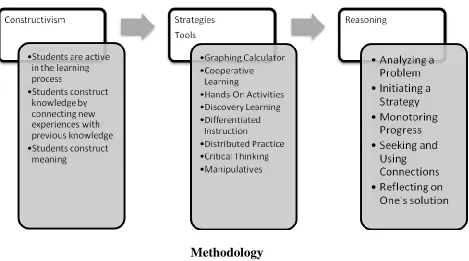
learning by improving reasoning. I have constructed Figure 2 below to illustrate my approach to
Figure 2: Conceptual Framework
Methodology
This dissertation describes a mixed-method study that investigated the effects of graphing calculators on calculus students‟ reasoning skills when learning the definite integral and its
applications. Four calculus classes, two honors and two Advanced Placement (AP), were used for the study. Two classes were from a private all-girls high school in a suburban area, and two
classes were from a private co-educational high school in a rural area of the Southeast United States. The design of the quantitative part of this study was quasi-experimental because there was no random assignment to groups. The AP classes (control group) used traditional methods of
graphing using pencil and paper. The honors classes (experimental group) used the graphing calculator, in addition to traditional methods of graphing, in learning applications of the definite
same level of difficulty. The difference between the two classes was only in the utilization of graphing calculators. All students completed a pretest to assess reasoning in order to identify
individual differences in skill at the beginning of the study. Lessons created by the researcher on the definite integral and its applications took place in both classes over the course of a three
week period. After three weeks, all students completed a reasoning assessment developed by the researcher and validated by a panel of two mathematicians. The assessment was completed by all students participating in the study. The data collected through this instrument were used to determine whether the graphing calculator has an effect on students‟ reasoning skills in calculus
and, if so, in which specific areas of reasoning it was most and least effective. In addition, data
were also analyzed to determine if students who used the graphing calculator could also solve problems using pencil and paper. After completion of this portion of the study, the AP students were instructed in the use of the graphing calculator as well and then interviews were conducted
with one student from each calculus class. Observations and responses to the interview questions were scored by the researcher using a researcher-developed rubric in order to assess the
reasoning processes used by students when solving problems on the definite integral and its applications when graphing calculators were used and when they were not used. The researcher also made observations during the interviews in order to identify the most effective uses of the
graphing calculator and the most effective way to incorporate the graphing calculator into the calculus curriculum.
Research Questions
The following research questions guided the study:
2. In what specific areas of reasoning does use of the graphing calculator seem to be most and least effective?
3. To what extent can students who have used the graphing calculator demonstrate ability to solve problems using pencil and paper methods?
Research Hypothesis
The mean reasoning score of those who use pencil and paper graphing methods (control group) is greater than the mean reasoning score of those who use graphing calculators
(experimental group) ( ).
The mean reasoning score of those who use graphing calculators (experimental group) is greater than the mean reasoning score of those who use pencil and paper graphing methods
(control group) ( ).
Overview of the manuscript
In Chapter One, I have provided an overview of the topic of this dissertation, the purpose of this study, and the importance of the study to the research community. In Chapter Two, I
provide a thorough review of the literature related to the main areas addressed in this dissertation, including conceptual development in calculus, reasoning in calculus and other
mathematics courses, and the use of graphing calculators in calculus and other mathematics courses. The review of the literature on conceptual development in calculus and the use of graphing technology in calculus and other mathematics courses begins with reports and research
conducted since 1986, the time that the calculus reform movement was established.
mathematics. However, much of the specific information currently known about specific elements of reasoning is based on a recent report published by the NCTM in 2009.
Chapter Three provides a detailed description of the methodology used in conducting this study, including sampling and the selection of participants, research questions, instrumentation,
procedures, data collection, data analysis procedures, ethical considerations, and limitations. Chapter Four provides a detailed analysis of the data, including that from posttest scores and from interviews, and report of the results and findings from the study. Chapter Five provides an
CHAPTER 2:
REVIEW OF THE LITERATURE
This chapter provides a review of the literature relating to the main topics of this paper,
which include reasoning, conceptual understanding in calculus, and graphing technology in calculus curriculum and instruction. The review begins with the literature on the inclusion of
reasoning in the mathematics curriculum, with a look at the types of reasoning opportunities that students are provided with and how these skills can be improved. A review of the literature on conceptual understanding in calculus follows this, with a description of the common difficulties
experienced by calculus students, the suggested causes of these difficulties, and the solutions that have been offered through commentaries and research studies. The review of the literature will conclude with an analysis of research that has focused on the inclusion of graphing technology,
mainly handheld graphing technology, or graphing calculators, in the calculus curriculum. The focus will be on how graphing calculators could be used to improve reasoning in calculus
courses, so that conceptual understanding can be achieved.
Reasoning in Mathematics
Reasoning is an important aspect of mathematical learning that has been recommended for inclusion in the mathematics curriculum. Reasoning is defined by several researchers. Reasoning is defined by the NCTM (2009) as “the process of drawing conclusions on the basis of evidence or stated assumptions” (p. 2). Kulpa (2009) defines reasoning as “knowledge
describes reasoning as the processes of making conjectures, forming logical deductions from a set of assumptions, and justifying results. Although several different definitions for reasoning are
provided by researchers, they all seem to involve the same general processes. In general, reasoning involves a higher level of thinking that leads one to form conclusions based on some initial set of assumptions. Adaptive reasoning, which is defined as the “capacity for logical thought, reflection, explanation, and justification,” (p. 116) is included by the National Research
Council (2001) as one of the five strands of mathematical proficiency. The Council suggests that students who cannot reason in mathematics are “cut off from whole realms of human endeavor”
(2001, p. 16). Learning in mathematics, therefore, is not just about finding answers but about the
ability to interpret them and reflect upon them. This is one area of reasoning.
In order to understand the process of reasoning, one must differentiate between routine and non-routine problems. Garden et al. (2006) explains the difference. Routine problems are
those that students are familiar with and encounter often in a mathematics course. Non-routine problems, on the other hand, are those that students do not often encounter and are not familiar
with solving. These types of problems require a level of thinking beyond that of routine
problems, and as explained by Schoenfeld (1992), non-routine problem solving can occur after routine problem solving. Although reasoning skills are used to solve both types of problems, it is
the non-routine problems for which reasoning skills are most useful. As explained by Garden et al., reasoning is used in solving both types of problems when students apply their existing
Types of Reasoning
Reasoning takes more than one form. It can range from formal reasoning, often referred
to as mathematical reasoning, or deducing and making conclusions on the basis of assumptions, to informal reasoning (NCTM, 2009). The process of reasoning, as explained by the NCTM,
incorporates both types – formal and informal. Evans and Thompson (2004) classify formal reasoning as falling into two categories – deductive reasoning and statistical inference. They argue that formal reasoning is researched to a much larger extent than informal reasoning and
that not enough emphasis is placed on the latter, since the majority of reasoning that occurs is informal. Kulpa (2009), who describes formal reasoning as “objective and rigorous,” (p. 76) also
suggests that most reasoning used in solving problems is not usually purely formal. Another type of reasoning described by researchers is plausible reasoning. Plausible reasoning, as explained by Lithner (2000), “is founded on mathematical properties of the components involved in the
reasoning” (p. 167) and “is meant to guide toward what probably is the truth, without necessarily having to be complete or correct” (p. 167). Lithner calls plausible reasoning a type of
“mathematically well-founded reasoning” (Lithner, 2004, p. 407) The NCTM describes plausible
reasoning as a type of reasoning used often in statistics and states that plausible reasoning is included in what is generally called mathematical reasoning. Two other types of reasoning
described by Lithner (2004) are repeated algorithmic reasoning and reasoning based on established experiences. These are both examples of what Lithner (2004) calls superficial
reasoning. In repeated algorithmic reasoning, the strategy that is followed is basically following algorithms or a set of procedures based purely on memory recall. Reasoning based on established experiences is based solely on an individual‟s previous experiences but shares a commonality
These two types of reasoning, however, are not the types that are useful in non-routine problem solving.
Components of Reasoning
Different sources describe various components and steps involved in the reasoning
process. Still, there seems to be close commonalities between the descriptions provided by all of these sources. Just as there are various definitions of reasoning that seem to share a common thread, so are there various components, which seem to all be related.
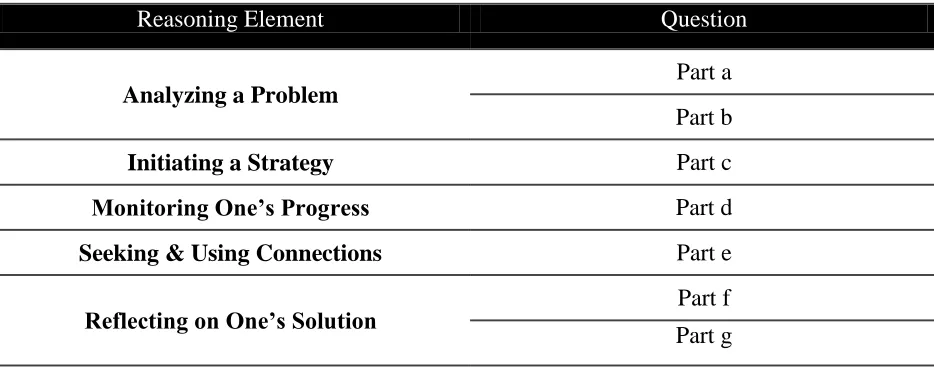
As explained by the NCTM (2009), there are five main areas which comprise reasoning, and these include analyzing a problem, initiating a strategy, monitoring one‟s progress, seeking
and using connections, and reflecting on one‟s solution. The first area, analyzing a problem,
consists of looking for hidden structures, identifying patterns and relationships, making
connections, making deductions, and determining whether a solution is appropriate. The second
area, initiating a strategy, consists of selecting the appropriate concepts, representations, and procedures, making purposeful use of procedures, organizing solutions, and making logical deductions. The third area, monitoring one‟s progress, includes reviewing the strategy that one
has chosen, making further analysis of a problem when necessary, and modifying selected strategies if necessary. The fourth area, seeking and using connections, includes connecting
different mathematical domains, connecting different contexts, and connecting different
representations. The last area, reflecting on one‟s solution, consists of interpreting the solution,
Other sources seem to provide some of the same components of reasoning, although they may describe them in more or less detail. In addition, the components described sometimes are
given a different name but generally involve the same skills. Lithner (2000), for example, suggests that reasoning in non-routine problems includes four components. These include
coming into contact with a problem, choosing a strategy, implementing the strategy, and reaching a conclusion. These steps share similarities with the steps involved in the reasoning process described by the NCTM.
Garden et al. (2006) also provide a list of components of the reasoning process. These are to analyze, generalize, synthesize and integrate, justify, and solve non-routine problems.
Analysis involves using the information that is given in a problem in order to determine which facts are necessary to solve the problem as well as identifying and using the relationships that exist between the objects in a problem. Generalizing involves applying the results of a problem
to more general situations. Synthesis and integration involves using different mathematical concepts and representations and connecting them in a way that will produce results. Justifying
involves determining whether a statement is true or false and providing a justification for the result using mathematical properties. Solving non-routine problems involves using mathematics in often unfamiliar ways to solve problems that are both mathematical and in real-life contexts.
Reasoning in the Content Areas
The discussion on the inclusion of reasoning, although existent for many years, has in the
this document, they suggest that reasoning be included in the mathematics curriculum in specific content areas that include numbers and measurements, algebraic symbols, functions, geometry,
and statistics. Reasoning with numbers and measurements include various aspects such as judging the appropriateness of solutions, choosing units, understanding the inherent error that
exists in measurements, understanding number systems, and applying techniques of counting. Reasoning with functions includes understanding multiple representations of functions,
developing mathematical models, and analyzing the effects of changing parameters in functions.
Reasoning in geometry consists of making conjectures, making deductive arguments, choosing geometric approaches, and using geometry in other disciplines and in real-world situations.
Reasoning with statistics and probability includes recognizing patterns and relationships through multiple representations of data, developing probability models, understanding the role of probability in statistical reasoning, and interpreting the results of statistical studies (NCTM,
2009). All of these areas form the basis for the concepts that are learned in calculus courses, and knowledge in all of these areas is necessary for problem solving in higher mathematics courses,
such as calculus.
The NCTM (2009) suggests that recommendations for inclusion of reasoning skills in the high school curriculum apply as well to the undergraduate curriculum in college. The CUPM
(2004) has provided a list of recommendations for the undergraduate mathematics curriculum. Among these recommendations it is stated that “every course should incorporate activities that
will help all students progress in developing analytical, critical reasoning, problem-solving, and communication skills and acquiring mathematical habits of mind” (CUPM, 2004, p. 7). In
particular, this includes the ability to perform tasks such as stating the problem, modifying the
the results, using multiple approaches to problems, evaluating whether solutions are correct, posing questions, creating and testing conjectures, and communicating ideas. Problem solving, as defined by the CUPM, “does not mean following recipes – it requires the application of careful,
organized, creative thought to the analysis of complex and often ill-defined questions in a diverse array of solutions” (p. 21). It requires activities and methods such as logic, proofs,
counterexamples, visualization, intuition, and memory retrieval. For this reason, problem solving is deeply connected with the act of reasoning. The CUPM has further stated that many students in college have “underdeveloped reasoning skills” (p. 21). They emphasize the importance of
improving these skills but suggest that much needs to be discovered about how this can be done
and through which strategies this can occur.
Research on Reasoning
Most of the available literature on reasoning is not empirical in nature, but rather
speculative. In order to find information on reasoning in calculus, I searched for relevant
literature beginning in 1989, since it is at this time that the NCTM established the curriculum and
evaluation standards. Consideration of reasoning is important in the discussion of calculus, and the calculus renewal movement has emphasized the importance of improving reasoning (CUPM, 2004). However, in general, previous empirical research has not addressed how reasoning in
calculus can be improved.
Although it seems overall that reasoning is widely recommended for inclusion in the
mathematics curriculum, reasoning is not usually given consistent attention in the mathematics curriculum (NCTM, 2009). As stated by Fuson et al. (2005), “mathematics instruction often
sometimes taught one correct method for solving a problem and that this does not encourage the development of students‟ reasoning skills (Fuson et al.).
Kulpa (2009) identifies one type of informal reasoning, which is the diagram, but states that this tool is often thought of as unreliable. Kulpa states that there are two main problems with
using diagrams for reasoning. These include a lack of generalizability and the diagram imprecision problem, which suggests that diagrams are not precise ways to solve problems. Kulpa argues, however, that diagrams can be used as reliable tools for solving problems and that
more research needs to be done to examine how this can occur.
In 2000, Lithner studied three university students in an attempt to understand their
reasoning through mathematical tasks. The tasks were related to calculus and included both routine and non-routine components. The researcher found that, in general, students seemed to choose reasoning based on established experiences to complete these tasks rather than plausible
reasoning. However, the students experienced difficulty, and Lithner attributed this difficulty to their inability to use other reasoning approaches like plausible reasoning. This study seems to
point to the idea that greater attention should be paid to helping students in solving mathematical tasks using the different types of reasoning. The students in this study seemed to only use
strategies that they were familiar with; however, reasoning involves solving problems that one is
familiar with as well as those that one is unfamiliar with. The students in this study did not appear to have the appropriate reasoning skills to do this. They seemed to only engage in what
Lithner (2004) would refer to as superficial reasoning. Since this study only looked at three students, however, the results are not generalizable to a larger population.
In 2004, Lithner conducted a related study in which he investigated the types of
calculus textbooks and found them to be similar. Lithner found that 90% of the textbook
exercises required types of reasoning that involved students merely looking for similar examples
or recalling information. The researcher concluded that the textbook did not have enough practice of global plausible reasoning skills, which he surmised could lead to a lack of
conceptual understanding and poor problem solving strategies.
Overall, the research seems to point to the idea that reasoning is not given consistent attention in many mathematics classrooms and curricula, and that students may lack reasoning
abilities when they enter college (CUPM, 2004). In addition, there is also a need for research on the strategies that may be used to improve reasoning skills.
Conceptual Understanding in Calculus
Conceptual understanding is a critical component to success in most mathematics
courses. In Adding It Up (2001), the National Research Council outlines five strands of mathematical proficiency, and one of these strands is conceptual understanding, which the
council defines as “comprehension of mathematical concepts, operations, and relations” (p. 5). Conceptual understanding in calculus, in particular, is important as well and can be defined as knowledge and understanding of the main concepts involved in calculus, including the limit, the
derivative, and the integral, and how these concepts tie in to one another. This is in contrast to learning that focuses on manipulative techniques and algebraic methods of problem solving. In
order to find information on this topic, I searched for literature that included commentaries from prominent mathematics teaching organizations, such as the NCTM, and research studies that have been conducted on understanding in calculus. I began my search with literature dated from
An analysis of the literature on conceptual understanding in calculus is necessary in order to understand its importance to success in calculus courses.
Conceptual Understanding versus Algorithmic Techniques
The reform movement in calculus was established in order to develop ways to improve
success rates in calculus courses. Conferences began taking place in 1986, which focused on conceptual understanding in calculus, use of technology in calculus, and viewing calculus as a “pump” rather than a “filter” (Cadena, Travis, & Norman, 2003, p. 1). Since this time, many
calculus curricula have changed to reflect these aspects, and organizations focused on reform mathematics, such as the NCTM, have been dedicated to improving calculus instruction. The
NCTM has emphasized that mathematics instruction can be improved through understanding, and it has defined four areas that contribute to students‟ understanding. These include reasoning,
communicating, drawing connections, and solving real problems (Hiebert, et al., 1997).
The NCTM (1989) has suggested that calculus instruction, in particular, focus on conceptual understanding and not algebraic manipulation. The Mathematical Association of America‟s Committee on the Undergraduate Program in Mathematics, or CUPM (2004), has recommended that undergraduate mathematics instruction focus on developing students‟
understanding of mathematical concepts rather than on procedures and computation. The CUPM
has further stated that there is too often an overemphasis on problem solving by way of following specific procedures without true understanding of the subject. The National Research Council
(2001) suggests as well that, although learning in mathematics is dependent upon understanding, memorization is often the focus, and Schoenfeld (1992) believes that treating mathematics as simply memorizing facts, formulas, and procedures “trivializes mathematics” (p. 3). Other
Kissane and Kemp (2008) suggest that “although there is an emphasis on procedures in calculus
in some classrooms, and an unavoidable emphasis on formal procedures in examinations, the
concepts of calculus are the most important elements” (p. 2). Although much emphasis is placed upon conceptual understanding, however, this does not mean that the importance of procedural
knowledge is diminished. In Mathematical Understanding: An Introduction, Fuson et al. (2005) outline three principles about “how people learn” (p. 37). The second principle states that
developing an understanding of mathematics and obtaining mathematical proficiency requires
both conceptual knowledge and procedural knowledge. Both are a necessary part of success in mathematics.
A variety of literature is available on the topic of conceptual understanding in mathematics, including calculus. This literature is both empirical and speculative, and the consensus among researchers and commentators alike seems to support the need for a focus on
conceptual understanding. Calculus courses supported by the College Board Advanced Placement program also reflect the emphasis on conceptual understanding over algebraic
manipulation. The course description for AP Calculus states learning goals, which include understanding connections among the different representations of functions, understanding the meaning of key concepts such as the derivative and integral, developing the ability to solve
problems through derivatives and integrals, understanding the relationship between key concepts, developing the ability to communicate mathematics, modeling with functions, differential
Problems with Algorithmic Techniques
Educators and researchers in the field of education consistently attempt to develop ways to improve students‟ understanding and success in calculus courses. Calculus is a subject that has
presented obstacles for many students, as the concepts involved are very different from most
other mathematics courses that students have participated in. Judson and Nishimore (2005) describe the barrier faced by many students who take part in calculus. In their study of high school calculus students from both Japan and the United States, Judson and Nishimore found that
the students thought calculus to be presented as more of a recipe book than a subject in which they could achieve a sound conceptual understanding. In both countries, students had a weak
understanding of concepts such as the function and the fundamental theorem of calculus, and students lacked the ability to link calculus concepts in order to solve problems.
Many researchers have cited the difficulties faced by students because of their lack of
conceptual understanding in calculus. Baker et al. (2000) found that calculus students at a large Midwestern university were able to retain certain concepts but not others. The main problem was in students‟ inability to see the first derivative as a function and thus had a misconception about
the second derivative. They did not understand the relationship between the first and second derivatives. After this study, the researchers concluded that students have less of an
understanding of calculus than originally believed. Since many other researchers had reached these same conclusions, Baker et al. surmised that this was a widespread problem and that a
solution must be reached.
Educators and researchers have suggested that the problem with students‟ lack of
understanding may be due to the emphasis that many calculus curriculums place upon
understanding despite the recommendations that this approach would be helpful. White and Mitchelmore (1996) studied calculus students at a university in order to assess their ability to
solve application problems and to observe the role of their conceptual understanding in solving these problems. They concluded that students lacked an understanding of concepts such as the
variable and mainly saw variables as symbols to manipulate rather than knowing their meaning. In order to solve the problem of this lack of conceptual understanding, organizations dedicated to improving mathematics instruction have offered some suggestions for improving the
way that students learn calculus (CUPM, 2004; National Reseach Council, 2001), and they have stated that students will only be able to make sense of the mathematics if they understand the
concepts that are involved (NCTM, 2009). As explained by Garden et al. (2006), understanding in mathematics involves operating in three cognitive domains – knowing, applying, and
reasoning. Knowing involves mathematical facts, procedures, and concepts. Applying involves
the use of knowledge to solve problems. The last cognitive domain, reasoning, involves solving non-routine problems and “the ability to use analytical skills, generalize, and apply mathematics to unfamiliar or complex contexts” (Garden et al., p. 17). Therefore, the process of reasoning is
an integral part of understanding in mathematics.
Conclusion
The importance of conceptual understanding in mathematics, and particularly calculus, has been well-established by educators and researchers. The NCTM (2009) suggests that, in
order to improve conceptual understanding, the mathematics curriculum be refocused on the development of reasoning and sense making skills. Without these skills, problem solving is difficult or even impossible. Problem solving, as described by Ellington (2003), involves two
select the appropriate strategy. The NCTM states that the process standards, which include problem solving, reasoning and proof, connections, communication, and representation, are all based on the acts of reasoning and making sense of mathematics. Students‟ difficulties in
mathematics, they claim, stem from their inability to see the meaning in mathematics and to
make sense of it.
Handheld Graphing Technology in the Calculus Curriculum
The final section of this review of the literature focuses on the graphing calculator and its uses in mathematics courses, with particular attention placed on its uses in calculus classrooms.
A review of the literature on the graphing calculator in calculus classrooms is necessary, as the purpose of this study will be to evaluate its use in specific ways, specifically its effect on
reasoning skills in calculus. The literature review will focus on ways that the graphing calculator
has been used in calculus classrooms and the benefits that it has provided to students learning calculus. The review of the literature on the uses of graphing calculators in calculus begins in
1986 since the calculus reform movement was established at this time. Technology in the Mathematics Classroom
It is widely believed, with the changes that are taking place in society due to increasing
use of technology, that the classroom reflect these changes and integrate technology as well into the way that students learn (Burrill et al., 2002). Different types of technology, such as computer
software, graphing calculators, and the internet, have changed the way that students learn and offer the potential to increase learning in the classroom. Specifically in mathematics, it is suggested that technology can improve mathematical learning specifically in the areas of
every level of the curriculum, some courses should incorporate activities that will help all students progress in learning to use technology” (p. 13) as a tool for both problem solving and
developing understanding of mathematical ideas. This review focuses mainly on handheld graphing technology, or graphing calculators.
Types of Graphing Calculators
Graphing calculators were first seen in 1985, when they were developed by Casio, and later were developed even further by Texas Instruments in 1995. With the invention of graphing
calculators came a new way to deal with mathematics that provided access to mathematical problem solving that, before this time, could only be done on the computer. Some graphing
calculators offer a CAS, or computer algebra system, that includes numerical solving, graphing, and symbol manipulating capabilities (Waits & Demana, 1998).
There are several varieties of graphing calculators, but all graphing calculators have
certain functions and capabilities in addition to computation such as graphing, viewing tables, and running programs and applications. In addition, these calculators have a calculate function
for computing roots, derivatives, extrema, and definite integrals. The TI-83 Plus and TI-84 Plus are two of the most basic graphing calculators that have all of these built-in functions. In
addition, all graphing calculators have the ability to run programs input by the user or transferred
to the calculator by connecting it with other calculators or by downloading from the Texas Instruments (TI) website. These programs add to the functionality of the calculator. Some more
advanced graphing calculators, such as the TI-89 Titanium, have all of the functions of the TI-83 Plus and TI-84 Plus with the additional capabilities of graphing in three dimensions and
symbolic manipulation. The most recent handheld graphing technology from Texas Instruments
calculators in addition to the ability to view multiple representations on the same screen, to construct and animate geometric figures, and to receive documents that allow visualizations of
solids of revolution.
Uses of Graphing Calculators
The CUPM (2004) suggests that technologies, and in particular handheld technologies, such as the graphing calculator, have impacted the way that mathematics is taught and can improve mathematics teaching. The National Research Council (2001) has also suggested that
graphing calculators can be used to enhance conceptual understanding. The CUPM further states that, in calculus courses in particular, graphing utilities can improve the time spent on graphing
functions and provide multiple approaches to functions, including graphical, numerical, and algebraic approaches, and they suggest that most calculus students do benefit from the availability of a graphing utility. One of these benefits is that of visualization. Visualization
through the graphing calculator can help students to understand calculus concepts such as Riemann sums and Taylor polynomials (CUPM).
Since the invention of the graphing calculator, they have been increasingly integrated into mathematics classrooms and have become a required part of some mathematics programs.
Programs such as the College Board Advanced Placement program, for example, require the use
of the graphing calculator on some portions of the Calculus AP test taken at the end of the course. The College Board recommends that the graphing calculator be included in everyday
teaching and learning of calculus and that instruction focus on specific ways to use the graphing calculator, including the ability to plot the graph of a function, find the roots of a function, calculate the derivative of a function, and calculate the integral of a function (NCTM, 2009). In
classrooms to increase understanding and help students make transitions from examples to proofs (Hurwitz, 1997, Touval, 1997).
Recommendations for Use
Those dedicated to calculus reform have emphasized that the use of technology to
enhance learning in calculus be included throughout the curriculum. The Harvard Consortium Calculus, which was an approach to calculus based on the elements of reform, suggests an approach to calculus using “the rule of three,” which includes the graphical, algebraic, and
numerical approaches. It encourages students to look at problems from multiple perspectives, and it also encourages the use of technology for visualization in calculus (Knill, 2004). The
NCTM, which is also dedicated to mathematics reform, offers some specific ways in which the graphing calculator can be used in mathematical learning and in calculus. The NCTM (2000) states that calculators and computers are “essential tools for teaching, learning, and doing mathematics” (p. 24). These tools offer benefits such as visualization of concepts, the ability to
perform accurate computations, and analysis of data. The council suggests that, when tools such
as these are available to students, they can spend time focusing on other activities, including problem solving and reasoning. In addition, graphing calculators can allow students to see multiple representations of functions in more ways than are either practical or possible by hand
(NCTM). There are also specific ways in which the graphing calculator can be used in calculus instruction. According to the NCTM, calculus instruction should provide exploration of concepts
from both a graphical perspective and a numerical perspective. This can be achieved through the use of both computer and calculator technology, allowing students to find maximum and
minimum values of a graph and interpret the results, explore the concept of the limit by looking