RESEARCH ARTICLE
Effect of steroid therapy on saccule and semicircular canals
function in patients with unilateral sudden sensorineural
hearing loss
Fahimeh Esmaeili1, Mansoureh Adel Ghahraman1, Reza Hoseinabadi1*, Shohreh Jalaie2, Ardavan Tajdini3
1
- Department of Audiology, School of Rehabilitation, Tehran University of Medical Sciences, Tehran, Iran
2- Biostatistics, School of Rehabilitation, Tehran University of Medical Sciences, Tehran, Iran
3- Department of Otolaryngology, Head and Neck Surgery, Amir Alam Hospital, Tehran University of Medical Sciences, Tehran, Iran
Received: 22 Jul 2019, Revised: 31 Aug 2019, Accepted: 1 Sep 2019, Published: 15 Jan 2020
Abstract
Background and Aim: In unilateral sudden sensorineural hearing loss (SSNHL), the ves-tibular system may be involved in addition to the auditory system. Several hearing assess-ments have shown that the disease course and the patient's improvement, at least two step of vestibular assessments can help in better control of the patient's balance function. The aim of this study was to evaluate the results of cervical ves-tibular evoked myogenic potentials (cVEMP) and video head impulse test (vHIT) used for assessment of saccule and semicircular canals before and after steroid therapy.
Methods: Twenty three patients with SSNHL were evaluated for auditory and vestibular func-tion before and after steroid therapy. The results of cVEMP and vHIT were compared between intact and impaired ears and between pretest/ posttest stages before and after treatment.
Results: For 26.08% of patients, the cVEMP response was absent in the affected ear, but after treatment it was reported for all patients. There was a significant difference in vestibulo-ocular
reflex (VOR) gain for both posterior and ante-rior semicircular canals of affected ear before and after treatment, but it was not significantly different after treatment as VOR gain increased. Conclusion: Dysfunction of nervous and vesti-bular systems in SSNHL is possible. Steroid therapy can improve the vestibular function and hearing of these patients. Therefore, vestibular evaluation can be used to determine the extent of lesions in SSNHL.
Keywords: Unilateral sudden sensorineural hearing loss; vestibular evoked myogenic potentials; saccule; semicircular canals; video head impulse test
Citation: Esmaeili F, Adel Ghahraman M, Hoseinabadi R, Jalaie S, Tajdini A. Effect of steroid therapy on saccule and semicircular canals function in patients with unilateral sudden sensorineural hearing loss. Aud Vestib Res. 2020;29(1):32-8.
Introduction
Sudden sensorineural hearing loss (SSNHL) was first described by De Kleyn in 1944 and was defined as hearing loss of at least 30 dB over three contiguous audiometric frequencies and occurs within three days or less [1]. Its * Corresponding author: Department of Audiology,
incidence is 5−20 cases per 100000 people and is equal in men and women. SSNHL is more common in patients aged 50−60 years [2-4]. There are vaious reasons for SSNHL occurrence including infections, traumas, tumors, autoi-mmune diseases, ototoxic drugs, and metabolic/ neurologic diseases [5]; however, theoritically, the main reasons are: viral infections, vascular blockage, cochlear membrane disruption and autoimmune diseases. In many cases, SSNHL is classified as “idiopathic” [6]. In SSNHL, hear-ing loss is accompanied by tinnitus as 70−90% and vertigo as 20−70% [7,8]. Vertigo is mostly found in patients with profound hearing loss; hearing improvement in patients with accom-panying vertigo is less that patients without any vertigo [9]. The close proximity of vestibule to cochlea cause simultaneous vertigo and hearing loss (specially in high frequency). In this way, cochlear damage is transmitted to vestibular organs through ductus reuniens [10]. There are different treatments for SSNHL including high-dose oral steroids, antiviral drugs, steroids com-bined with antiviral or vasodilators, anticoagu-lants, vitamin B complex, benzodiazepine, mag-nesium, plasma expanders, carbogen inhalation, hyperbaric oxygen and intratympanic steroids. Steroid therapy is the most acceptable method among others [11]. Corticosteroids can lead to the improvement of inner ear inflammation; they are mostly given by mouth rather than by injection [4].
Cervical vestibular evoked myogenic potential (cVEMP) is an inhibitory electromascular res-ponse recorded from ipsilateral sternocleido-mastoid (SCM) via sound, vibration and elec-trical stimulation. It is a saccular-originated res-ponse with a positive peak at a mean latency of 13 ms (p13) and a negative trough at 23 ms (n23). Video head impulse test (vHIT) is a rela-tively new objective and fast diagnostic method for the evaluation of semicircular canal evalu-ation through vestibulo-ocular reflex (VOR) [12,13].
By assuming the involvement of vestibular and nervous systems in SSNHL and considering the necessity of residual vestibular function evalu-ation (as a latent problem) in these patients
before and after steroid therapy as the conven-tional treatment, the aim of the present study was to evaluate the results of cVEMP and vHIT used for assessment of superior and inferior vestibular nerves in saccule and semicircular canals of patients with SSNHL before and after steroid therapy.
Methods
rarefaction polarity, 95 dB nHL stimulation level (5 per second), 5000 gain, 10−1000 Hz filtering, 50−100 ms time window, and 150 sweeps. To test the repeatability of the response, each intensity level of response was tested twice after a rest. To seek threshold, the test was star-ted at 95 dB nHL and intensity was decreased in 5 dB steps. The lowest level in which a repeat-able response was recorded, was defined as threshold. This process repeated for the second ear as well [14].
The vHIT was performed by ICS Head Impulse (GN Otometrics, Denmark). The goggle was put on the patients and the test process was expla-ined to them. Patients were asked to look at the point on the wall from a 1 m distance. After calibration, for testing lateral semicircular canal, the tester put her hands on the patients’ head and performed 10 fast impulse movements (at least 100 degrees per second) with 5−20 degrees to the sides. After each impulse, head remained in the last position to avoid masking any covert saccade. The timing and direction of impulses were different to avoid prediction [15]. After a rest, the stimulation of posterior and anterior semicircular canals were performed. For right posterior and left superior semicircular canals, patients’ head was turned 45 degrees to the right with one hand on top of the head and the other beneath the chin. After a rest, stimulation of left posterior and right superior semicircular canals were performed by turning head 45 degrees to the left. Each stage was performed twice.
Steroid therapy included taking 1 mg/kg predni-solone every morning with an oral omeprazole every 12 hours for 10 days. If hearing was not improved after 10 days, intratympanic injection of 4 mg/mL dexamethasone twice a week for two weeks was prescribed (a total of four injec-tions given in supine position with the head 45 degrees turned to the unaffected side). After one month, all procedures were performed again for all patients.
Kolmogorov-Smirnov test results showed that all collected data had normal distribution. Then, paired t-test was used for comparing quanti-tative parametrs of cVEMP and VOR gain in normal and abnormal ears before and after
treatment and comparing the mean of these parameters before and after treatment between two ears. McNemar's test was used for com-paring the cVEMP incidence ratio in each ear before and after treatment and between ears before and after treatment. All analyses were performed in SPSS 16 software.
Results
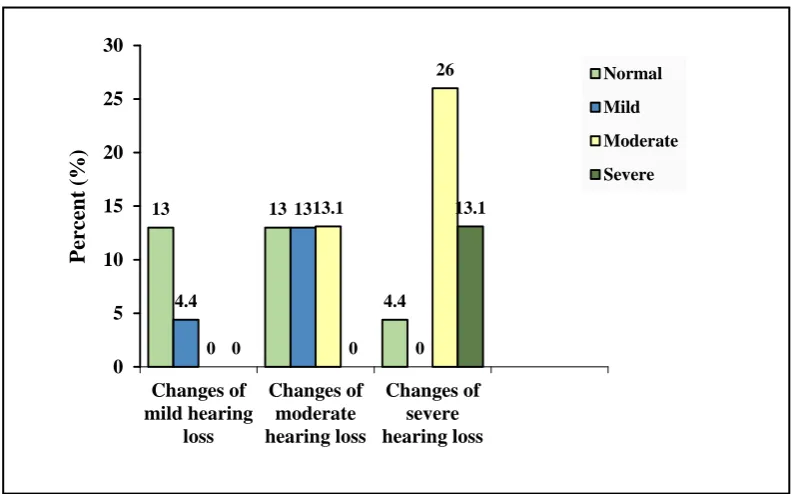
Table 1 summarizes the frequency of SSNHL configurations and rates in participants before and after steroid therapy. As can be seen, before treatment, flat audiogram was seen in 60.9% of cases and severe SSNHL was seen in 43.5% of cases. The highest rate of improvement follo-wing treatment (13%) was related to the ascen-ding audiogram and for mild SSNHL. Fig. 1 shows changes in SSNHL after treatment. The cVEMP was seen in 73.9% of involved ears and 100% of normal ears before treatment. There was a significant difference in incidence ratio between two ears before treatment (p = 0.031). After treatment, cVEMP was recorded success-fully in both ears.
Table 2 summarizes the quantitative results of cVEMP in each ear before and after treatment. There was a significant difference in the mean latency of p13 and the mean amplitude of p13-n23 between ears and between pretest/posttest stages before and after treatment (p > 0.05). The cVEMP threshold before and after treatment in the involved ear, the mean amplitude of p13-n23 before treatment between two ears, and the mean asymmetry ratio between pretest/posttest stages showed statistically significant differen-ces (p < 0.05).
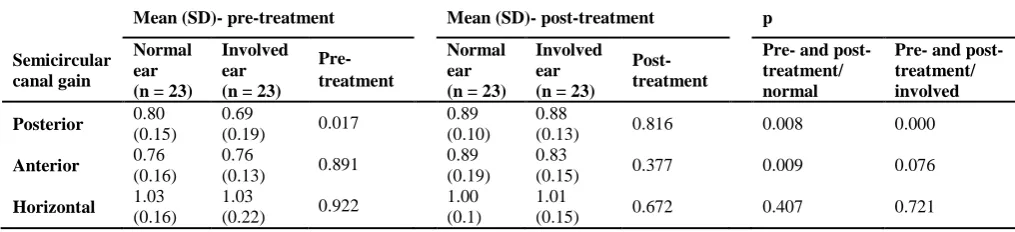
Table 3 summarizes the mean VOR gain for each semicircular canal. The mean VOR gain in posterior semicircular canal in normal ear before and after treatment and also between anterior and posterior canals in each ear after treatment was significantly different (p < 0.05). The mean VOR gain in each ear after treatment showed no significant difference (p > 0.05).
Discussion
due to the close proximity of vestibule to coch-lea or deficit in common blood supply of these two organs [10,19]. In the present study, 13% of patients had vertigo as well which decreased to 8.7% after treatment. Studies have reported diff-erent incidence rates for vertigo. Yu and Li
reported that 20−60% of patients with SSNHL had accompanying vertigo, and stated that ver-tigo is not a determining factor since there are some cases suffering from vestibular dysfunc-tion without any vertigo [8]. Biochemical changes in the inner ear fluid might be another Table 1. Pattern and degree of hearing loss and degree of hearing recovery
before and after treatment in patients with unilateral sudden sensorineaural hearing loss
Post-treatment (%)
Hearing loss Pre-treatment (%) Full recovery Partial recovery No recovery
Pattern
Sloping 21.7 8.7 0 13
Rising 17.4 13 4.4 0
Flat 60.9 8.7 39.1 13.1
Degree
Mild 17.4 13 0 4.4
Moderate 39.1 13 13 13.1
Severe 43.5 4.4 26 13.1
Full recovery: recovery of SRT and PTA thresholds in range of 10dB of those thresholds before hearing loss; Partial recovery: recovery of PTA and SRT thresholds in range of 50% of hearing thresholds before hearing loss; No recovery: recovery in range of less than 50% of hearing level before hearing loss.
13 13
4.4 4.4
13
0 0
13.1
26
0 0
13.1
0 5 10 15 20 25 30
Changes of mild hearing
loss
Changes of moderate hearing loss
Changes of severe hearing loss
P
ercent
(
%
)
Normal
Mild
Moderate
Severe
reason for transmission of dysfunction from cochlea to vestibule [19].
In the present study, vestibular function was evaluated in patients with SSNHL before and after treatment by using cVEMP and vHIT. The cVEMP response in affected ear changed signi-ficantly after treatment such that cVEMP was recorded in both ears. In 39.1% of patients, the amplitude asymmetry was present and decrea-sed significantly after treatment; however, amp-litude asymmetry was still present in 17.39% of patients.
The cVEMP results reported normal function of saccule, inferior vestibular nerve, lateral vesti-bular nucleus, vestibulo-spinal tract and SCM. The deficit in each of the mentioned compo-nents can remove cVEMP [20]. Based on the results of the present study, there is possibility
of dysfunction in saccule, inferior vestibular nerve and related pathways in patients with SSNHL. Previous studies reported 0−77% cha-nce of cVEMP abnormalities in patients with SSNHL and this was attributed to vestibular hair cell loss [17,20]. Our result is consistent with the results of Peng et al. who showed that results of cVEMP and ocular vestibular evoked myogenic potential (oVEMP) improved signifi-cantly after SSNHL treatment [21]. Chen and Young conducted a study to achieve a diffe-rential diagnosis of Meniere’s disease and SSNHL. They showed that 3 out of 14 patients with SSNHL had abnormal cVEMP. After treat-ment, one of them showed normal cVEMP [22]. In the present study, vHIT was performed and VOR gain was examined. It was shown that VOR gain in posterior and anterior semicircular Table 2. Comparison of mean and standard deviation of cervical evoked myogenic potential parameters in patients with unilateral sudden sensorineural hearing loss between ears and between pre- and
post-treatment stages
Mean (SD)- pre-treatment Mean (SD)- post-treatment p
Parameter
Normal ear (n = 23)
Involved ear (n = 17)
Pre- treatment
Normal ear (n = 23)
Involved ear (n = 23)
Post- treatment
Pre- and post-treatment/ normal
Pre- and post-treatment/ involved Latency (ms) 15.47 (1.97) 16.40
(2.61) 0.1
15.68 (2.03)
14.73
(3.26) 0.22 0.10 0.33
Threshold (dB nHL)
81.30 (4.32)
82.06
(5.6) 0.65
81.09 (4.25)
80.7
(5.57) 0.84 0.74 0.046
Amplitude (Mv)
150.64 (220.38)
146.09
(100.90) 0.006
210.22 (157.90)
177.49
(128.79) 0.30 0.67 0.26
Amplitude asemmetry ratio
0.46
(0.35) 0.032
0.26 (0.18) In 6 patients cVEMP response was absent before treatment.
Table 3. Comparison of mean (standard deviation) of semicircular canal vestibule-ocular gain in normal and involved ear in patients with unilateral sudden sensorineural hearing loss pre- and post-treatment
Mean (SD)- pre-treatment Mean (SD)- post-treatment p
Semicircular canal gain
Normal ear (n = 23)
Involved ear (n = 23)
Pre-treatment
Normal ear (n = 23)
Involved ear (n = 23)
Post-treatment
Pre- and post-treatment/ normal
Pre- and post-treatment/ involved
Posterior 0.80
(0.15)
0.69
(0.19) 0.017
0.89 (0.10)
0.88
(0.13) 0.816 0.008 0.000
Anterior 0.76
(0.16)
0.76
(0.13) 0.891
0.89 (0.19)
0.83
(0.15) 0.377 0.009 0.076
Horizontal 1.03
(0.16)
1.03
(0.22) 0.922
1.00 (0.1)
1.01
canals was significantly diferent before and after treatment in both ears. VOR gain significantly increased after treatment. Before treatment, VOR gain for posterior and anterior semicir-cular canals was less than 0.7 in 47.82 and 30.43% of patients, respectively. After treat-ment, it decreased to 8.7 and 13.04% respec-tively. There was also patients with abnormality in their non-affected ear which might be due to unclear problems. VOR is for fixating eyes on a target with making a head movement. This works by moving eyes at the same speed as head movement but in the opposite direction. Main components of VOR are semicircular can-als, vestibular nuclei, ocular movement nuclei and extraocular muscles. The vHIT provides information about VOR gain and helps in diag-nosis of vestibular dysfunction [23].
Pogson et al. in a retrospective study, used vHIT to evaluate semicircular canals in 27 subjects with SSNHL and found out that 74% of patients had posterior canal dysfunction, 41% superior canal dysfunction and 30% anterior canal dys-function (reduced VOR gain). Posterior canal had the highest rate of dysfunction due to laby-rinthine artery infarction [24]. Yao et al. studied 22 patients with vestibular neuritis and 30 pati-ents with SSNHL by using vHIT and showed that posterior canal dysfunction was more pre-valent in SSNHL patients, while dysfunction in all canals was more probable in patients with vestibular neuritis. They also stated that internal auditory artery dysfunction is the predominant cause of SSNHL but viral infection is main cause of vestibular neuritis [25].
In our study, patients received steroid therapy as the most common method for SSNHL treat-ment; however, its effect on vestibular labyrinth and efferents are not clear yet [26]. Steroids may improve prepheral system functions by their anti-inflammatory, anti-alergic, anti-edema and vaso-active properties [26]. They are effec-tive when the damage is mild and reversible [27] and also is in the acute phase [26]. There-fore, the improvement of cVEMP and VOR gain under vHIT after steroid therapy in our study may be because that there was a mild damage limited to peripheral vestibular system.
Conclusion
Evaluation of vestibular function in addition to hearing assessment can estimate the degree of damage to peripheral system related to sudden sensorineural hearing loss (SSNHL). Based on the results, it can be concluded that saccule, semicircular canals and related pathways are involved in SSNHL and steroid therapy not only can improve auditory function but also vesti-bular function. It is suggested that vestivesti-bular rehabilitation should be used for the balance improvement of SSNHL patients.
Acknowledgments
The authors would like to thank participants for their cooperation. This study is granted by TUMS with Registration Code 97-02-32-69488.
Conflict of interest
The authors declared no conflicts of interest.
References
1. Schreiber BE, Agrup C, Haskard DO, Luxon LM. Sudden sensorineural hearing loss. The Lancet. 2010;375(9721):1203-11. doi: 10.1016/S0140-6736(09)62071-7
2. Kuhn M, Heman-Ackah SE, Shaikh JA, Roehm PC. Sudden sensorineural hearing loss: a review of diag-nosis, treatment, and prognosis. Trends Amplif. 2011; 15(3):91-105. doi: 10.1177/1084713811408349
3. Plontke SK. Diagnostics and therapy of sudden hearing loss. GMS Curr Top Otorhinolaryngol Head Neck Surg. 2018;16:Doc05. doi: 10.3205/cto000144
4. Rauch SD, Halpin CF, Antonelli PJ, Babu S, Carey JP, Gantz BJ, et al. Oral vs intratympanic corticosteroid therapy for idiopathic sudden sensorineural hearing loss: a randomized trial. JAMA. 2011;305(20):2071-9. doi:
10.1001/jama.2011.679
5. Flint PW, Haughey BH, Robbins KT, Thomas JR, Niparko JK, Lund VJ, et al. Cummings otolaryngology - head and neck surgery e-book. 6th ed. Philadelphia: Sanders Elsevier; 2014.
6. Topuz E, Yigit O, Cinar U, Seven H. Should hyperbaric oxygen be added to treatment in idiopathic sudden sensorineural hearing loss? Eur Arch Otorhinolaryngol. 2004;261(7):393-6. doi: 10.1007/s00405-003-0688-6
7. Michiba T, Kitahara T, Hikita-Watanabe N, Fukushima M, Ozono Y, Imai R, et al. Residual tinnitus after the medical treatment of sudden deafness. Auris Nasus Larynx. 2013;40(2):162-6. doi:
10.1016/j.anl.2012.06.007
8. Yu H, Li H. Vestibular dysfunctions in sudden sen-sorineural hearing loss: a systematic review and meta-analysis. Front Neurol. 2018;9:45. doi:
10.3389/fneur.2018.00045
hearing loss with vertigo: study using click and galvanic vestibular evoked myogenic potentials. Arch Otolaryn-gol Head Neck Surg. 2005;131(10):857-62. doi:
10.1001/archotol.131.10.857
10. Ben-David J, Luntz M, Podoshin L, Sabo E, Fradis M. Vertigo as a prognostic sign in sudden sensorineural hearing loss. Int Tinnitus J. 2002;8(2):127-8.
11. Filipo R, Covelli E, Balsamo G, Attanasio G. Intratym-panic prednisolone therapy for sudden sensorineural hearing loss: A new protocol. Acta Otolaryngol. 2010; 130(11):1209-13. doi: 10.3109/00016481003793766
12. Maheu M, Houde MS, Landry SP, Champoux F. The effects of aging on clinical vestibular evaluations. Front Neurol. 2015;6:205. doi: 10.3389/fneur.2015.00205
13. Duchoud L, Maire R. [The video Head Impulse Test in the vertiginous patient]. Rev Med Suisse. 2017; 13(577):1694-7.French.
14. McCaslin DL, Jacobson JP. Vestibular-Evoked Myo-genic Potentials (VEMPs), in Jacobson JP, Shepard NT, editors. Balance function assessment and management. 2nd ed. San Diego: Plural Publishing; 2016. p. 533-80. 15. Hougaard DD, Abrahamsen AR. Functional testing of
all six semicircular canals with video head impulse test systems. J Vis Exp. 2019;(146). doi: 10.3791/59012
16. Xiao–tong Z, Bin S, Wen–Juan Z, Min X, Jun–rong W. Concurrent symptoms and disease conditions in sudden deafness. J Otol. 2010;5(1):20-3. doi: 10.1016/S1672-2930(10)50004-7
17. Fujimoto C, Egami N, Kinoshita M, Sugasawa K, Yamasoba T, Iwasaki S. Involvement of vestibular organs in idiopathic sudden hearing loss with vertigo: an analysis using oVEMP and cVEMP testing. Clin Neurophysiol. 2015;126(5):1033-8. doi:
10.1016/j.clinph.2014.07.028
18. Stamatiou G, Gkoritsa E, Xenellis J, Riga M, Korres S. Semicircular canal versus otolithic involvement in idiopathic sudden hearing loss. J Laryngol Otol. 2009; 123(12):1325-30. doi: 10.1017/S0022215109990715
19. Hong SM, Byun JY, Park CH, Lee JH, Park MS, Cha CI. Saccular damage in patients with idiopathic sudden sensorineural hearing loss without vertigo.
Otolaryngol Head Neck Surg. 2008;139(4):541-5. doi:
10.1016/j.otohns.2008.07.003
20. Korres S, Stamatiou GA, Gkoritsa E, Riga M, Xenelis J. Prognosis of patients with idiopathic sudden hearing loss: role of vestibular assessment. J Laryngol Otol. 2011;125(3):251-7. doi: 10.1017/S0022215110002082
21. Peng L, Chen R, Yuan H, Liang J. [The value of otolith function test in the prognosis of sudden sensorineural hearing]. Lin Chung Er Bi Yan Hou Tou Jing Wai Ke Za Zhi. 2016;30(4):272-6. Chinese.
22. Chen CN, Young YH. Differentiating the cause of acute sensorineural hearing loss between Ménière's disease and sudden deafness. Acta Otolaryngol. 2006;126(1):25-31. doi: 10.1080/00016480510012363
23. Bansal S, Sinha SK. Assessment of VOR gain function and its test-retest reliability in normal hearing individuals. Eur Arch Otorhinolaryngol. 2016;273(10): 3167-73. doi: 10.1007/s00405-016-3951-3
24. Pogson JM, Taylor RL, Young AS, McGarvie LA, Flanagan S, Halmagyi GM, et al. Vertigo with sudden hearing loss: audio-vestibular characteristics. J Neurol. 2016;263(10):2086-96. doi: 10.1007/s00415-016-8214-0
25. Yao Q, Xu C, Wang H, Shi H, Yu D. Video head impulse test results suggest that different pathomecha-nisms underlie sudden sensorineural hearing loss with vertigo and vestibular neuritis: Our experience in fifty-two patients. Clin Otolaryngol. 2018;43(6):1621-4. doi:
10.1111/coa.13196
26. Kitahara T, Kondoh K, Morihana T, Okumura S, Horii A, Takeda N, et al. Steroid effects on vestibular com-pensation in human. Neurol Res. 2003;25(3):287-9. doi:
10.1179/0161641031012013641
27. Moskowitz D, Lee K, Smith HW. Steroid use in idiopathic sudden sensorineural hearing loss. The Laryn-goscope. 1984;94(5):664-6. doi: 10.1288/00005537-198405000-00016
28. Stachler RJ, Chandrasekhar SS, Archer SM, Rosenfeld RM, Schwartz SR, Barrs DM, et al. Clinical practice guideline: sudden hearing loss. Otolaryngol Head Neck Surg. 2012;146(3_Suppl):S1-35. doi: