_____________
*Corresponding author
Received January 7, 2015
1
OFFSETTING THE DISPOSITION EFFECT WITH A STOP-LOSS RULE
ELDER MAURICIO SILVA, SERGIO DA SILVA*
Graduate Program in Economics, Federal University of Santa Catarina, Florianopolis SC, 88049-970, Brazil Copyright © 2015 E. Silva and S. Silva. This is an open access article distributed under the Creative Commons Attribution License, which permits unrestricted use, distribution, and reproduction in any medium, provided the original work is properly cited.
Abstract. We put forward an agent-based model of the stock market, where the behavior of agents showing the disposition effect can be offset by that of others using a stop-loss rule. In a stop-loss order, a stock is sold automatically if it drops below a threshold value. The disposition effect is the tendency to sell stocks that have gained in value (“winners”) and keep the ones that have fallen in value (“losers”). After showing the model can replicate actual return behavior considering data from the recent mini flash crashes, we explore the consequences of altering key behavioral parameters. Our primary result is that the presence of stop-loss agents in a non-Gaussian environment can offset the disposition effect. Furthermore, we find differing return targets to contribute to market efficiency, and a negative shock to a market sentiment index to cause the stock price to dip and trade volume to grow. Finally, increasing overconfidence generates higher trade volume.
Keywords: agent-based model; stock market; disposition effect; stop-loss rule. 2010 AMS Subject Classification:91B26.
1. Introduction
Agent-based models can replicate the extreme moves observed in actual stock markets.
Coupled with heterogeneous beliefs [1], such models also can take into account psychological
features, such as market sentiment and overconfidence [2, 3]. Here we suggest the “disposition
effect” (the tendency to sell winners and keep losers) can be offset by an automated stop-loss
rule, which is a predetermined policy that reduces the portfolio’s exposure after it reaches a
certain threshold of cumulative losses.
Math. Finance Lett. 2015, 2015:2
The most accepted explanation for the disposition effect is prospect theory. Because
investors dislike incurring losses much more than they enjoy making gains, and investors are
willing to gamble in the domain of losses, they will hold onto stocks that have lost value (relative
to the reference point of their purchase) and will be eager to sell stocks that have risen in value.
The disposition effect should lead to market failure in that it distorts the role of prices in
conveying information. Indeed, disposition-effect investors will hold onto a stock even if they
think it will fall further in value. The very existence of stop-loss investors can prevent such a
massive market failure in that they can offset disposition-effect investors. Although this may
seem obvious, our contribution is to show how the mechanics of the offsetting behavior operate
with the help of a model.
Indirect evidence supports the fact that in real-world markets, stop-loss rules can
compensate for the disposition effect. Although stop-loss rules are ineffective in efficient
markets [4], Kaminski and Lo [4] find stop-loss rules can reduce losses in a non-Gaussian
environment, although they do not consider the presence of the disposition effect. Their result
matches the one we find in this work – the presence of stop-loss agents can offset the disposition
effect given that the environment is non-Gaussian.
The next section presents the model; the results are shown in the subsequent section; and
the last section concludes the study.
2. Model
We consider a market populated by n10, 000 agents divided into two groups: disposition-effect investors (Eqs. (1)−(4) below) and stop-loss investors (Eq. (9)). We assign
exogenously the group to which each agent pertains, as well as group size. The disposition-effect
investors are modeled using the value function of cumulative prospect theory [5]. The investors
under the stop-loss rule are modeled building on Ref. [4]. Each agent collects information from
his neighborhood, and there are two exogenous parameters: 1) the ecology of distinct expected
returns ( xi), and 2) how one agent values the information he currently holds compared to
information received from neighbors (i). They also consider information from a measure of
sentiment at the market level. We also assume investors buy more stocks only after they have
Each time period t, agent i must decide between either buying or selling the stock, or doing nothing. He enters the market with probability it, where:
if he owns stocks
if he has no stocks
it it it
(1)
If investor i owns stocks, he is prone to the disposition effect, which is modeled by a
version of the value function of cumulative prospect theory:
, if 0 (gains)
, if 0 (losses)
i i it i i x x x x
(2)
Here, we interpret the values of xi as representing the fact that each agent i has a distinct
expected return. The investor places an order if a cumulative return Xi overshoots his expected
return xi. (If xi is large enough the investor may adopt a buy-and-hold strategy.) Parameter
(0,1]
governs the function concavity, and measures loss aversion. We set 2.25 (as in
Ref. [5]) and thus endorse the prospect theory explanation for the disposition effect as loss
aversion: The response to losses is more than twice as strong as the response to corresponding
gains. As argued by Barberis and Xiong [6], when investors gain utility from accumulated
operations during a year or other given time period, prospect theory does not lead to the
disposition effect. However, when utility accrues from simple buy and sell operations, as in our
model, prospect theory does predict a disposition effect.
We define a market sentiment index I at the market level as:
t t
t t t
b s
I
b s h
(3)
investor expects downward price movement due to the presence of many sellers. In the presence
of many buyers, the market sentiment is bullish (I1). A current value of the index I stays in place until the investor executes a future consultation of his neighborhood. Each agent uses index
I differently, and the random parameter i
0,1 captures this fact. In a full-fledgedequilibrium model, a market clearing condition would imply that index (3) should be zero. In our
disequilibrium model, however, we only expect (3) to asymptotically converge to zero when the
parameter configuration and model dynamics will lead to stability.
Assuming a bidimensional Moore grid [7], the neighbors of influence were defined by a
“nine-neighbor square.” The lattice size was defined to have 100 100 cells, totaling 10,000 traders. Eight neighbors can provide any of three types of information for the agent at hand: buy,
sell or hold on his position. Such information will be used in the subsequent period. If the agent
himself initially possesses some piece of information, then Oi 1; if not, Oi 0. His own
information comes from his last move. If the move was a purchase, his private information is a
purchase. If the move was a sell, his private information is a sell. If in the last move the investor
neither purchased nor sold, he doesn’t have his own information, in which case Oi 0. He puts a
weight to the value of his own information as compared to that possessed by his neighbors,
iOi
. If i 0, the agent pays no attention to the information he owns. If i 1, his own
information is given the same weight as that of his neighbors. As i grows, the weight given to
his own information increases, and as i , he considers only his own information, in which
case we can say he exhibits “overconfidence.”
If the investor has no stock, his probability it is then:
8 1 8
1( ) , 1
1
jt i i j
i it jt jt jt i i
j
b O
I
if
b s h O
(4)The probability it is greater the larger the market sentiment index is. In the first period it
refers solely to his probability to buy because he starts with no stocks. An equation reminiscent
wide-market index is more appropriate for evaluating market sentiment. Using a neighborhood
measure would be too narrow. We assume investors can get information about the index,
following Shiller [9]. Shiller uses questionnaires to get what we consider here as the
“neighborhood perspective,” and assumes agents know the market sentiment from a broader
market perspective. Since index I is not computed for every time period, the neighborhood
continues to be key for the current decisions of the agents in this model. Of note, in a given time
period, the weight ascribed to the neighborhood is much greater than that of the index. (The
probability to sell is analogous to Eq. (4).)
Individual choices are also constrained by what the group collectively does. When the
parameter configuration and the model dynamics lead to stability and market clearing, such a
constraint can be modeled by an excess demand function Dt:
t t t
b s
D n
(5)
The stock price p in the time period t is then computed using the previous price and the excess
demand. We consider a hyperbolic tangent functional form for the excess demand (as is Ref.
[10]):
1 1 tanh
t t t
p p D (6)
The initial price is arbitrary and does not interfere with the model dynamics. The agent’s initial
realized return ri is given by:
1
ln ln
it t t
r p p (7)
Each agent maintains the cumulative return Xi from the date of purchase of the stock, defined
t i i i p q X q
(8)
where qi is the purchasing price.
An agent relying on the automated stop-loss rule places the stop order t considering
some loss threshold [8]:
Buy if
Hold if 0 and Sell if 0 and Sell if i i
i i i
t
i i i
i i i
r
x X x
X X x
X X x
(9)
where i is the threshold for the automated order to be triggered, which assumes a different
value for each agent. The first line in Eq. (9) refers to current return when the investor owns no
stocks. If the investor owns any stocks, the current return no longer has any influence for him.
He will look at the cumulative return, that is, the purchase value minus the current value. He is
now contemplating one of the remaining three lines in Eq. (9). For this reason, there will be no
situation in which the investor looks at the current return and the cumulative return at the same
time. The first line is a rule of entry, then the investor picks one of the three remaining lines. The
second line refers to the period in which the investor is inactive; the third is the rule of exit if the
cumulative returns are negative; and the fourth is the exit rule for the cases where the cumulative
return is positive. Eq. (9) is borrowed from Ref. [4]. Unlike the environment of the disposition
effect (Eqs. (1)−(4)), in Eq. (9), an agent sells faster in a low and waits longer in a high. The
stop-loss investors are committed to a deterministic rule, but some find it difficult to adhere to
such a rule and may behave stochastically, in which case they follow the value function of
prospect theory.
3. Results
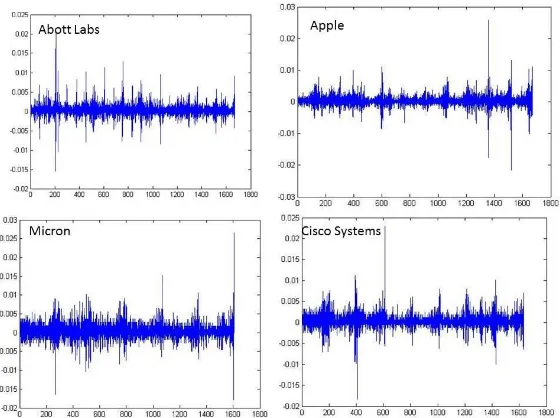
To check for the empirical relevance of our model, we considered data from the recent
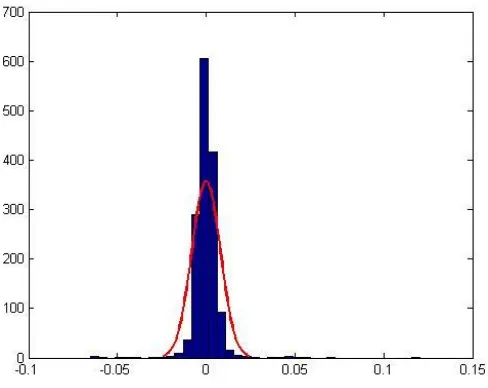
and Fig. 1). Returns are clearly non-Gaussian. Fig. 2 shows the histogram of the Apple stock and
its poor Gaussian fit.
Table 1. The stock returns for the period covering the mini flash crashes are not normally distributed.
Stock Time period Lilliefors test Excess kurtosis Reject normality?
Abott Labs April, 29 2011 – May, 31 2011 0.001 15.36 Yes
Apple March, 16 2012 − March, 30 2012 0.001 24.33 Yes
Cisco Systems July, 20 2011 − July, 29 2011 0.001 24.31 Yes
Core Molding August, 19 2011 − August, 31 2011 0.001 9.69 Yes
Note: The critical values were computed using Monte Carlo simulation for sample sizes less than 1,000 and significance levels between 0.001 and 0.5. The result 0.5 means the data are generated by a Gaussian, and 0.001 means rejection of Gaussianity
Fig. 2. Apple’s return histogram and Gaussian fit
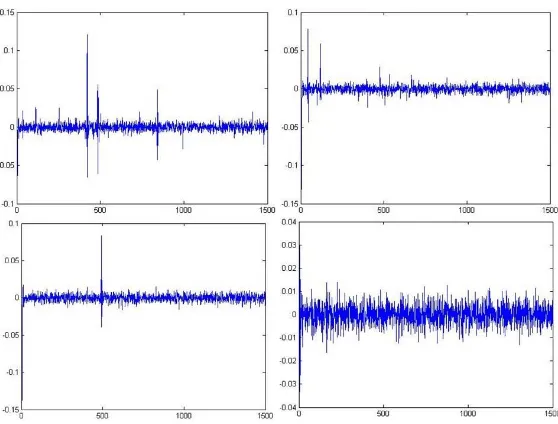
Fig. 3 shows the log-returns generated by our model for i 1; an upper bound of
0.16
x ; four groups of expectation targets (i4); and 25 percent of stop-loss agents. Fig. 4 shows the histogram. After comparing with the previous Figs. 1 and 2, one can see that the
model roughly replicates actual stock market behavior.
Fig. 4. The model return histogram and Gaussian fit; compare with Fig. 2
We are thus confident to proceed and explore some numerical implications of our model.
Table 2 shows selected simulation results using NetLogo
(http://modelingcommons.org/browse/one_model/3985#model_tabs_browse_procedures) for the
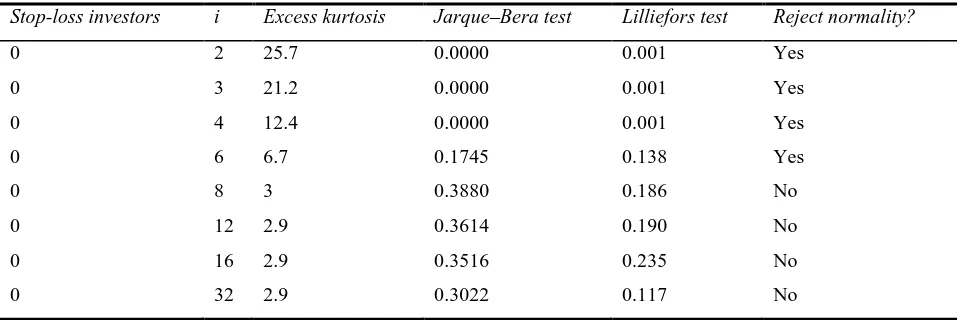
benchmark case where all 10,000 agents are disposition-effect investors. We first assume 1
and x 0.16. Excess kurtosis abates and the market becomes more Gaussian as we add more groups with distinct return targets (as we increase i). Thus, greater diversity of return targets
contributes to market efficiency, if Gaussianity can be translated into market efficiency [7].
Kaminski and Lo [4] proved stop-loss strategies cannot generate any excess profits if returns are
i.i.d., and the (weak) efficient market hypothesis assumes a white noise in the distribution of
returns. In our model, if we drop the disposition effect from the model, returns become Gaussian.
The very existence of disposition-effect investors makes it possible for stop-loss investors to
profit. In a non-Gaussian environment, which occurs when the disposition effect is considered,
Table 2. The model returns when all the agents are disposition-effect investors.
Stop-loss investors i Excess kurtosis Jarque–Bera test Lilliefors test Reject normality?
0 2 25.7 0.0000 0.001 Yes
0 3 21.2 0.0000 0.001 Yes
0 4 12.4 0.0000 0.001 Yes
0 6 6.7 0.1745 0.138 Yes
0 8 3 0.3880 0.186 No
0 12 2.9 0.3614 0.190 No
0 16 2.9 0.3516 0.235 No
0 32 2.9 0.3022 0.117 No
Table 3 shows the effect of the introduction of stop-loss agents who have the same x .
Now the agents cannot contribute to make the market more Gaussian. With i4, however, we cannot reject return normality. The presence of stop-loss agents reduces the importance of the
disposition effect in such a non-Gaussian environment. As observed, in Ref. [4] stop-loss rules
cannot stop losses for Gaussian returns, but are effective for non-Gaussian ones. Our model
confirms this. Starting from an endowment, agents using the stop-loss rule profit constantly,
while others are subject to both gains and losses.
Table 3. The model returns after the introduction of stop-loss investors.
Stop-loss investors i Excess kurtosis Jarque–Bera test Lilliefors test Reject normality?
5 4 16 0.0000 0.0010 Yes
10 4 16 0.0000 0.0200 Yes
20 4 22 0.0000 0.0010 Yes
30 4 23 0.0000 0.0010 Yes
40 4 14 0.0000 0.0010 Yes
50 4 10 0.0000 0.0010 Yes
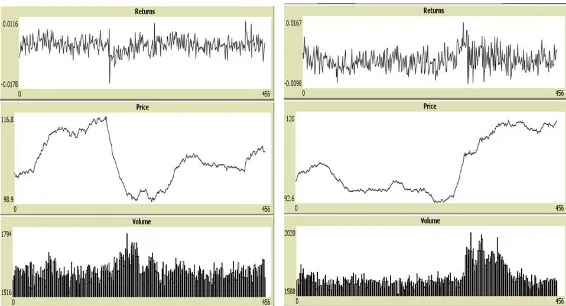
Our model recalculates the market sentiment index for each of the 50 periods. A
once-and-for-all negative shock of −20 to I can make the stock price dip, after 100 periods, from 116
Fig. 5. Effects of shocks coming from the market sentiment index I
Fig. 6 shows the effect of overconfident agents as i increases. Considering 25 percent
of stop-loss investors and i4, as i rises, both price and volume increase. As a result, overconfidence, which is accompanied by larger trade volume does not necessarily translate into
losses for the investors. This is because the volume increase is not due to the disposition-effect,
and the stop-loss agents are not affected by changes in i.
Fig. 6. The effect of overconfidence as i increases from 0.1 to 1 and then to 10
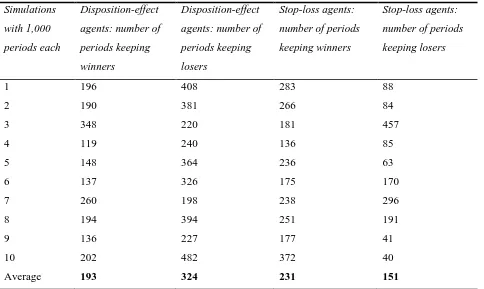
The 10 simulation results in Table 4 show that the two groups of agents behave in tandem.
The stop-loss agents keep winners 20 percent longer than the disposition-effect agents. And the
4. Conclusion
We set up a model of the stock market that considers agents subject to the disposition
effect and an offsetting stop-loss rule. The model can replicate actual return behavior considering
data from the recent mini flash crashes. We explore the consequences of altering key behavioral
parameters and show that differing return targets contribute to market efficiency; that a negative
shock to the market sentiment index causes the stock price to dip and trade volume to grow; and
that increasing overconfidence generates higher trade volume. More importantly, the presence of
stop-loss agents in a non-Gaussian environment offsets the disposition effect.
Table 4. Offsetting the disposition effect
Simulations
with 1,000
periods each
Disposition-effect
agents: number of
periods keeping
winners
Disposition-effect
agents: number of
periods keeping
losers
Stop-loss agents:
number of periods
keeping winners
Stop-loss agents:
number of periods
keeping losers
1 196 408 283 88
2 190 381 266 84
3 348 220 181 457
4 119 240 136 85
5 148 364 236 63
6 137 326 175 170
7 260 198 238 296
8 194 394 251 191
9 136 227 177 41
10 202 482 372 40
Average 193 324 231 151
Conflict of Interests
The author declares that there is no conflict of interests.
REFERENCES
[2] Kukacka, Jiri, and Jozef Barunik. "Behavioural breaks in the heterogeneous agent model: The impact of herding, overconfidence, and market sentiment." Physica A: Statistical Mechanics and its Applications 392.23 (2013): 5920-5938.
[3] Li, Yan, and Liyan Yang. "Prospect theory, the disposition effect, and asset prices." Journal of Financial Economics 107.3 (2013): 715-739.
[4] Kaminski, Kathryn M., and Andrew W. Lo. "When do stop-loss rules stop losses?." Journal of Financial Markets 18 (2014): 234-254.
[5] Tversky, Amos, and Daniel Kahneman. "Advances in prospect theory: Cumulative representation of uncertainty." Journal of Risk and uncertainty 5.4 (1992): 297-323.
[6] Barberis, Nicholas, and Wei Xiong. "What Drives the Disposition Effect? An Analysis of a Long‐Standing Preference‐Based Explanation." the Journal of Finance 64.2 (2009): 751-784.
[7] Suhadolnik, Nicolas, Jaqueson Galimberti, and Sergio Da Silva. "Robot traders can prevent extreme events in complex stock markets." Physica A: Statistical Mechanics and its Applications 389.22 (2010): 5182-5192. [8] Couzin, Iain D., et al. "Effective leadership and decision-making in animal groups on the move." Nature
433.7025 (2005): 513-516.
[9] Shiller, Robert J. "Measuring bubble expectations and investor confidence." The Journal of Psychology and Financial Markets 1.1 (2000): 49-60.