ISSN 2185-3762
‘Significant Others’ in Influencing Arab EFL Learners’ Learning Strategy Use and
Development: A Qualitative Inquiry
Anas Hajar, Coventry University, UK
Corresponding author: [email protected]
Publication date: September, 2015.
To cite this article
Hajar, A. (2015). ‘Significant others’ in influencing Arab EFL learners’ learning strategy use and development: A qualitative study. Studies in Self-Access Learning Journal, 6(3), 257-270.
To link to this article
http://sisaljournal.org/archives/sep15/hajar
This article may be used for research, teaching and private study purposes. Please contact the author for permission to re-print elsewhere.
‘Significant Others’ in Influencing Arab EFL Learners’ Learning Strategy
Use and Development: A Qualitative Inquiry
Anas Hajar, Coventry University, UK
Abstract
The paper reports on the involvement of ‘significant others’ (e.g. parents and friends) as experienced by a group of learners learning English at university in their Arab homelands. Underpinned by a sociocultural standpoint, the data collected from a written narrative and four subsequent semi-structured interviews suggest that ‘significant others’ directly and indirectly fostered or hindered the participants’ English language development and identity formation by prompting different strategies. Further research into the cooperation between actors inside and outside the classroom is believed to generate essential findings for the language learner development programmes.
Keywords: language learning strategies (LLSs); sociocultural approaches; significant others;
Arab learners; qualitative inquiry
Background
The ‘social turn’ in language learning research (Benson &Cooker, 2013), with new theoretical and analytical tools, has come under the sway of a sea of change in research and theory towards exploring ‘the socially, culturally, and historically situated nature of language learning’ (Morita, 2012, p. 26). Some researchers endorsing socially oriented theoretical perspectives (e.g. Gao, 2006; Mercer, 2011; Norton, 2013) have challenged the assumption that “foreign language learners’ development as language learners is largely language teachers’ responsibility” (Gao, 2006, p. 287). These researchers are also critical of the cognitive psychology perspective of language learning, which is largely based on the theory of human information processing to transform declarative knowledge into automatic
knowledge. From this perspective, language learning strategies (LLSs) are often defined as learners’ efforts to enhance their own language learning and/or use (Cohen, 2011). In another vein, the purpose of deploying LLSs by some language learners is often limited to linguistic objectives, for example having good examination results. Learners’ strategy use from a cognitive psychological standpoint also tends to be exclusively associated with the learners’ exercises of their cognitive and metacognitive activities in addition to some of their
communities. These processes might include artefacts, practices, and relationships among people. In this sense, the LLSs used by language learners are often influenced by the availability and accessibility of material and cultural artefacts, such as borrowing some valuable references from the school’s library or watching English TV programmes. Echoing this point, Palfreyman (2011) postulates that language learners’ learning motivations and strategy uses can “develop in multiple contexts; the classroom may be one of these, but a fuller picture of learning contains other contexts: the household, the peer group, the work place or neighbourhood shops” (p. 33).
Lai (in press) argues that there has recently been a burgeoning number of research studies that investigate “the less charted terrain of language learning beyond the classroom” (p. 2). According to her, most of these studies (e.g. Chik, 2014; Murray, 2008; Wang, 2012) found that ‘good language learners’ were more likely to make use of a broad array of
language learning resources available to them beyond the classroom (e.g., music, TV shows, the Internet and online chatting/forums), and that this was positively associated with their learning outcomes, confidence and enjoyment. Wang’s (2012) study, for example, explained how a group of Chinese students of English had overcome their difficulty of having poor listening and speaking skills by adopting the strategy of immersing themselves regularly and rigorously in English television drama at home in China. Based on the findings of her study, Wang (2012) suggested that the significance of watching movies rich in authentic and functional use of the target language was not limited to the advantage of pinpointing some specific linguistic facets that these students might still have needed to improve, such as pronunciation and intonation. This extended to being a mediating and enabling artefact for “an in-depth understanding of western social values, which will empower them [language learners] to become world citizens” (Wang, 2012, p. 339). By the same token, Murray (2008) recorded the language learning experiences of a few successful adult Japanese EFL learners, and found that they achieved intermediate to advanced levels of fluency through their engagement outside the classroom with technological tools related to American pop culture such as movies, TV programmes and music. Nonetheless, most of these studies paid a less central position to the potential of social agents in mediating the language learning resources to language learners. With the above in mind, this study is unique in that it is the first
neighbours who are often as crucial to a language learner as their teachers are (Palfreyman, 2011).
The Enquiry
Aims
This study is grounded in a sociocultural outlook and aims to interpret some
biographical episodes involving a group of Arab university students of English, taking into account the mediating effect of some social actors in either enabling or disabling the
participants’ language learning activities outside the classroom. In the Arab world, language learning resources and opportunities for language exposure are often viewed to be confined to formal settings (Domerow & Bailey, 2014). Due to growing global demands, however, many Arabs, especially those from the oil-rich Arab Gulf States, recognise that “a high standard of proficiency in English is a critical requirement for effective education and for access to, and utilization of, new knowledge and new technology” (El-Ezabi, 2014, p. x). In addressing this point, the following research question needs to be answered in this qualitative study:
To what extent do ‘significant others’ mediate the particular patterns of LLSs often utilised by a group of university learners from an Arabic background in their homelands?
Participants
In this study, there were three males and three females. They came from four different Arab backgrounds (The United Emirates, Iraq, Saudi Arabia and Syria), and were
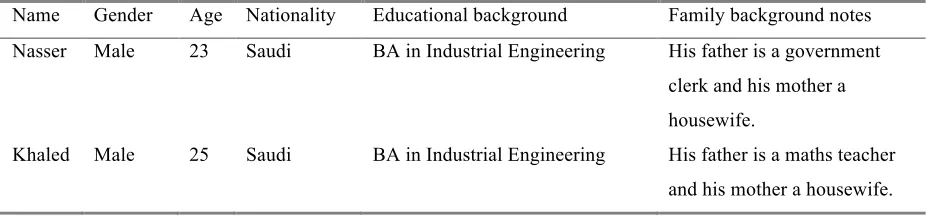
non-English major students. Their age range was between 23 and 27 years. Moreover, all of them were unknown to the researcher before the data collection stage, and were preparing to join their postgraduate programmes in an English-medium university in the UK. The participants were given pseudonyms and their profiles are provided in Table 1.
Table 1. Demographic Data of the Participants
Name Gender Age Nationality Educational background Family background notes
Nasser Male 23 Saudi BA in Industrial Engineering His father is a government clerk and his mother a housewife.
Fadi Male 24 Syrian BA in Dentistry His father is a surgeon and his mother an ophthalmologist. Rama Female 24 Syrian BA in Agricultural Engineering Both parents are farmers Zainab Female 25 Iraqi BA in Business and Management Her late father was an
architect and her mother a pharmacist.
Mouza Female 27 Emirati BA in Gynecology Her father was a retired policeman and her mother a housewife.
Data collection and analysis
The data were collected between 5 May and 10 September 2013. The participants, after being informed of their role in the research and their right to withdraw at any time, were asked first to write a short account in Arabic about themselves and some of their English learning experiences along with the LLSs that they often employed. They were given a set of questions to help them frame their essays, as shown in Appendix A. These accounts were used to construct the interview questions, given that this study espoused a second-order stance i.e. seeing the world from the participant’s standpoint. Four subsequent semi-structured interviews with open questions in Arabic were conducted with each participant. Each interview lasted for 35-45 minutes (see Appendix B for a sample interview schedule). Given that all the interviewees were Arabs, I decided that Arabic was the best language in which to conduct my interviews. Using this shared language helped the participants express themselves freely. Despite the usefulness of adopting a qualitative approach in this study, the combined use of semi-structured interviews and an open-ended questionnaire that fits local research contexts is essential to explore language learners’ metacognitive beliefs about LLSs, along with capturing the mediating artefacts in either enabling or disabling the learners’ LLS use and identity development.
A ‘selected reading approach’ (Van Manen, 1997) was used in this paper, meaning that as I was reading the transcripts, I highlighted the statements that captured the influences of ‘significant others’ on the participants’ language learning efforts and their strategy use and development. After that, the codes that shared some unifying features were collated to
intentionally to language resources, and/or practised English with them, and 3) ‘a neutral to negative kind of involvement’ indicating that a range of discouraging behaviours such as openly belittling the value of English learning or disregarding the participants’ language views were transmitted by some social agents to the participants. Following this, the
transcripts were re-read with special focus on the coded extracts to ensure that the produced themes actually accounted for the data.
Research Findings
A positive, indirect involvement of ‘significant others’
The data suggest that the parents of participants who were educated in the public sector often engaged indirectly in their children’s language learning in the form of emotional and/or financial support. For example, the parents of three participants (Khaled, Mouza and Nasser) financed private English tuition classes for their children at a late stage of their children’s education. For example, Mouza, the Emirati participant, mentioned that her father allowed her to arrange one-to-one tutorials at home to help her prepare for the IELTS exam. With the same objective, Mouza’s father also paid for her two-month subscription to online IELTS preparation on the British Council Website:
Although my parents weren’t highly educated, I received from them unlimited financial support…my father gave me the money needed to hire a private Australian tutor to train me on IELTS test. I also subscribed in some websites to try out online some IELTS sample tests (Transcript Mouza, No. 2, 33-146).
Regarding another participant, Khaled, the Saudi participant, declared that his parents supported his idea of taking some general English courses before commencing his
undergraduate degree. When asked about the usefulness of the private tutoring that he underwent, Khaled said:
Surprisingly, perhaps, the participants (apart from Fadi and Zainab) had little to say about their interactions with their counterparts inside and outside the classroom. For example, when Rama, the Syrian participant, was asked about the influence of her peers on her
language learning, she said that
My peers and I were quite poor in English. I didn’t ask them for help as I know we were all suffering…This was the situation of most Syrian students in the rural areas… In out-of-the-school settings, we just check the homework given by our teachers (Transcript Rama, No. 1, 77-79).
A positive, direct involvement of ‘significant others’
The data suggest that the parents of two participants (Fadi and Zainab) exhibited in some instances their direct involvement in their children’s language learning and the use of particular LLSs by purchasing English learning materials, choosing the right school or practising English with them. The parents of Fadi and Zainab, the Syrian and Iraqi
participants, attempted to instil positive attitudes and offer motivation for learning English in them from the beginning through sending them intentionally to a private international school at which English was emphasised throughout their school education:
When one was sent to a remarkable international school and some of one’s teachers were English native speakers, the English level of that person would be definitely developed. This picture described my situation perfectly...the tuition fees of this school were extremely high. So, my parents gave me a spark to learn English (Transcript Fadi, No. 1, 34-44).
My school was the first private school in Iraq that taught most of its classes in
English. At that time, my mother insisted that English was not very important but that none could predict what would happen after several years. She was right especially after the fall of the regime of Saddam Hussein (Transcript Zainab, No. 2, 55-60).
In this regard, the parents of Fadi and Zainab seemed to buy into ‘the idea of the earlier the better’, principally when it pertained to their children’s English language learning.
English. In Zainab’s case, she recalled that her parents used to reward her whenever she excelled at the primary and intermediate levels of her education, by bringing some animated DVD movies in English into the house:
I was addicted to English language movies and my father knew that. Therefore, his gifts to my sister and me whenever we passed the exam at school were choosing ten animated movies. Most of these movies were in English (Transcript Zainab, No. 3, 66-68).
One participant, Fadi, acknowledged that he was inspired by the Western culture brought back by his uncle’s family, who had lived in the UK for twelve years. When asked about the reasons behind his admiration for the Western culture, especially the British, Fadi explained that
My uncle’s children increased my love for English. They lived in the UK for many years. They told me a lot about the lifestyle of the British. I learnt from them many new words and idioms…I hung a large map of Britain on the wall of my room to get to know more about its geography (Transcript Fadi, No. 4, 81-94).
Accordingly, some of Fadi’s extended family members played a pivotal role in deepening his interest in learning English. They were also one of the main causes that encouraged him and his parents to choose the UK to complete his postgraduate studies.
As regards Zainab, the Iraqi participant, she revealed that her brother, a holder of a Diploma in English literature, fuelled her passion for the strategy of both reading and writing English poetry through purchasing some poetry books, especially those written by
Shakespeare:
During the summer period, I used to read some of my brother’s poetry books in his personal library. Poetry not only helped me to learn new words but also to know more about English culture...he also motivated me to read and write some poems. My family were very proud of me (Transcript Zainab, No. 4, 23-34).
I started listening to English songs with my sister after attending university. I loved Celine Dion’s songs. With her songs lyrics found in some websites, I sometimes put new words and phrases in my notebook to lodge them in my memory. I also revise them with my sisters (Transcript Nasser, No. 3, 94-97).
Negative or lack of involvement from ‘significant others’
Unlike the other participants, Rama, the Syrian participant, experienced a noticeable lack of almost any kind of support from her family members in relation to English language study. Rama recalled that her family members did not foster an appropriate language learning environment for her language learning such as by purchasing English learning materials or creating opportunities for practising English:
I was sent to under-resourced rural schools and none of my family could speak any English…my parents were farmers...we didn’t have a satellite TV or a computer in our house…I couldn’t even dare to ask any of my family to finance private English tuition classes for me at university because of our bad financial situation (Transcript Rama, No. 2, 105-128).
This extract suggests that Rama ascribed this limited family involvement in her English learning to the low income and education level of her parents.
Surprisingly, perhaps, the participants’ use of some Web 2.0 technologies (i.e., blogs, Facebook, Skype, YouTube, Twitter and wikis) to improve their English during their stay in their homelands was found to be fairly limited. For some participants (Fadi, Rama, and Zainab), the political factor might have had a prominent role to play in this finding, given that some popular social networking sites (e.g., Facebook, Skype and YouTube) were blocked in their countries. Nonetheless, Khaled, the Saudi participant, recalled the experience of
improving his skills in playing guitar through watching some YouTube guitar video lessons in English in his ‘spare time’:
I used to teach myself how to play guitar from free English video lessons on YouTube...I also used to upload some videos of my playing to get feedback from others. However, I gave up my guitar at university because this slowed down my achievement (Transcript Khaled, No.4, 66-69).
outside-the-classroom activities into the outside-the-classroom.
Discussion and Conclusion
The findings illustrate how ‘significant others’, mainly parents, influenced the
participants’ strategic language learning behaviour, including their own language beliefs and motivations, simply because these participants were not born with their existing set of values and beliefs attached to learning English. As shown in the previous section, the
socio-economic status of the participants’ parents related to their occupation, income and
educational attainment seemed to play a pervasive role in identifying the amount and kind of support they offered their children while learning English (Zaragoza, 2014). Although the participants, excluding Rama, belonged to better-off families, the influence of the parents of participants who were educated in the public sector on their English learning was, in
Kyriacou and Zhu’s (2008) words, “largely benign” (p. 101), and appeared at a late stage of their academic lives i.e., after entering university and realising the role that English could play in their children’s future.
and in conceptualising future visions that hold the flavour of actuality rather than fantasy (p. 592).
It should be noted that the reference made by some participants to the direct effects of their brothers or sisters on their language learning and strategy use could point to an
increasing mindfulness of the new generation in the Arabic-speaking world as regards the significance of English in one’s life. In this sense, Gitsaki (2011) in the preface to her volume on teaching and learning in the Arab world has emphasised the rapidly rising interest in English by Arabs in the twenty-first century: “Education is undergoing significant change globally and locally. In the Arab States, globalization and economic development have had a significant effect on [English language] education” (p. xiii).
In sum, social networks in language learning beyond the classroom are a fairly new area for research, which would benefit from further investigation. In this study, for instance, the impact of family members, mostly parents, on the participants’ strategy use and learning motivations was crucial, and varied according to the family’s socio-economic status. This influence of family members on Arab students in their homelands might not be mirrored in some other modern societies, where a learner’s peer group appears to be as or more powerful than the family. Therefore, research on individuals from other places or countries with different sociocultural, economic and political conditions, in relation to the impacts of informal agents (e.g. family members, neighbours, and friends) on their strategy use and identity development would enrich the data base available.
Notes on the contributor
Anas Hajar is a graduate of Warwick University holding PhD in English Language Education. He is currently working as an EAP tutor at Coventry University, UK. He is particularly interested in motivational issues in language learning and intercultural
engagement. He also works in the areas of language learning strategies and materials design.
References
Benson, P., & Cooker, L. (Eds.). (2013). The applied linguistic individual: Sociocultural
approaches to autonomy, agency and identity. London, UK: Equinox.
Block, D. (2007). The rise of identity in SLA research, post Firth and Wagner (1997). The
Chik, A. (2014). Digital gaming and language learning: Autonomy and community.
Language Learning and Technology, 18(2), 85-100. Retrieved from
http://llt.msu.edu/issues/june2014/chik.pdf
Cohen, A. (2011). Strategies in learning and using a second language (2nd ed.). London, UK: Longman.
Damerow, R., & Bailey, K. (2014). Research on the teaching and learning of English in the Arabic-speaking world. In K. Bailey & R. Damerow (Eds.), Teaching and learning
English in the Arabic-speaking world (pp. 1-13). Abingdon, UK: Routledge.
El-Ezabi, Y. (2014). Foreword. In K. Bailey & R. Damerow (Eds.), Teaching and learning
English in the Arabic-speaking world (pp. viii-xi). Abingdon, UK:Routledge.
Gao, X. (2006). Strategies used by Chinese parents to support English language learning: Voices of ‘elite’ university students. RELC Journal, 34(3), 285-298.
doi:10.1177/0033688206071302
Gao, X. (2012). Parental strategies in supporting Chinese children’s learning of English vocabulary. Research Papers in Education, 27(5), 581-595.
doi:10.1080/02671522.2011.602102
Gitsaki, C. (Ed.). (2011). Teaching and learning in the Arab world. Oxford, UK: Peter Lang. Kyriacou, C., & Zhu, D. (2008). Motivation towards learning English and the perceived
influence of important others. Educational Studies, 34(2), 97-104. doi:10.1080/03055690701811099
Lai, C. (2015). Perceiving and traversing in-class and out-of-class learning: accounts from foreign language learners in Hong Kong. Innovation in Language Learning and
Teaching, 9(3), 265-284.doi:10.1080/17501229.2014.918982
Mercer, S. (2011). Towards an understanding of language learner self-concept. Dordrecht, Netherlands: Springer.
Morita, N. (2012). The situated construction of identity and positionality in multilingual classrooms. In M. Sarah, S. Ryan, & M. Williams (Eds.), Psychology for language
learning: Insights from research, theory and practice (pp. 26-42). London, UK:
Palgrave Macmillan.
Murray, G. (2008). Pop culture and language learning: Learners’ stories informing EFL.
Innovation in Language Learning and Teaching, 2(1),1-17.
doi:10.1080/17501220802158792
Norton, B. (2013). Identity and language learning: Extending the conversation (2nd ed.). Bristol, UK: Multilingual Matters.
Norton, B., & Toohey, K. (2001). Changing perspectives on good language learners. TESOL
Quarterly, 35(2), 307-321. doi:10.2307/3587650
Palfreyman, D. (2003). Expanding the discourse on learner development: A reply to Anita Wenden. Applied Linguistics, 24(2), 243-248. doi:10.1093/applin/24.2.243
Palfreyman, D. (2011). Family, friends, and learning beyond the classroom: Social networks and social capital in language learning. In P. Benson & H. Reinders (Eds.), Beyond the language classroom. The theory and practice of informal language learning and
Ryan, S., & Dörnyei, Z. (2013). The long-term evolution of language motivation and the L2 self. In A. Berndt (Ed.), Fremdsprachen in der Perspektive lebenslangen Lernens (pp. 89-100). Frankfurt, Germany: Peter Lang.
Van Manen, M. (1997). Researching lived experience: Human science for an action sensitive
pedagogy (2nd ed.). London, UK: Althouse Press.
Wang, D. (2012). Self-directed English language learning through watching English television drama in China. Changing English, 19(3), 339-348.
doi:10.1080/1358684X.2012.704584
Appendices
Appendix A
Write an Essay that Covers the Following Points
ه�ي�ت�ا�ل�ا�ط�ا�ق�ن�ل�ا�ا�ه�ب�ج�ل�ا�ع�ت�ه�ي�ب�ر�ع�ل�ا�ه�غ�ل�ل�ا�ب�ه�ل�ا�ق�م�ب�ت�ك�ا�
1. Could you please write general information about your background (e.g. your parents’ job, the number of your brothers and sisters, your city/village...etc.)
1- ا�ن�ل�م�د�ق�ت�ن�ا�ن�ك�م�م� ل�م�ع�( ه�ي�ع�ا�م�ت�ج�ا�ل�ا�ك�ت�ي�ف�ل�خ�ب�ه�ق�ل�ع�ت�م�ل�ا�ه�م�ا�ع�ل�ا�ت�ا�م�و�ل�ع�م�ل�ا�ض�ع�ب�ن�ع�ه�ح�م�ل� ك�ي�د�ل�ا�و�-ك�ي�د�ل�ه�و�خ�ا�ل�ا�د�د�ع� -ف�ي�ر�ل�ا�و�ا�ه�ن�ي�د�م�ل�ا�ي�ف�ش�ي�ع�ت�ت�ن�ك�ل�ه� - ه�ي�ع�ا�م�ت�ج�ا�ه�ق�ب�ط�ي�ا�ى�ل�ا�
)خ�ل�ا� ...ي�م�ت�ن�ت�ت�ن�ا� 2. When did you start learning English?
؟ه�ي�ز�ي�ل�ك�ن�ا�ل�ا�ه�غ�ل�ل�ا�م�ل�ع�ت�ت�ا�د�ب�ا�م�د�ن�ع�ك�ر�م�ع�ن�ا�ك�و�ه�ا�م�- 2 3. What is your perspective about learning English at that time?
3- ت�ق�و�ل�ا�ك�ل�ذ�ي�ف�ه�ي�ز�ي�ل�ك�ن�ا�ل�ا�ه�غ�ل�ل�ا�م�ل�ع�ت�ه�ي�م�ه�ا�ن�ع�ك�ع�ا�ب�ط�ن�ا�و�ه�ا�م�
4. What sort of problems did your usually have in learning English?
5-ت�ب�ه�د�ا�ع�ك�ه�ج�ا�و�ت�ت�ن�ا�ك�ي�ت�ل�ا�ل�ك�ا�ش�م�ل�ا�ع�ا�و�ن�ا�ن�ع�ل�ي�ص�ف�ت�ل�ا�ب�م�ل�ك�ت�ت�ن�ا�ن�ك�م�م� ه�غ�ل�ل�ا�م�ل�ع� ه�د�ح�ت�م�ل�ا�ه�ك�ل�م�ل�ل�ك�م�و�د�ق�ل�ب�ق�ه�ي�ز�ي�ل�ك�ن�ا�ل�ا�
5. How did you sort them out?
Appendix B
A Sample Interview Schedule
1. Why do you think that you are learning English?
2. What kind of linguistic challenges did you face in your homeland? How did you deal with the difficulties?
3. Did you have enough opportunities to practise English outside the classroom? If no, why?
4. Is there any outstanding event/person that encouraged or discouraged you to learn English?
5. When did you actually recognise the importance of English in your life?
6. Have you found sufficient chances to communicate with native/competent speakers of English in your homeland? If yes, how? If no, why?
7. What about the role of your peers in facilitating your English learning?
8. Where did you used to encounter or learn new words in your native country? And what did you do in order to consolidate your memory of new words?