ISSN 1392-2785 ENGINEERING ECONOMICS. 2006. No 3 (48)
WORK HUMANISM
The Research of Work Search Method Choice Applying the Cluster Analysis
Daiva Beržinskien
ė
1, Stasys Stoškus
21Kauno technologijos universitetas Panevėžio institutas
Nemuno g. 33, LT-35209, Panevėžys
2Šiaulių universitetas
Architektų g.1, LT-76285, Šiauliai
The article deals with the causes of method choice looking for work, which are determined by the unem-ployed behaviour in the labour market. Though a big at-tention is paid to the unemployed behaviour in the scien-tific literature, conclusion validity is missed. Applying cluster analysis, we can show relative links among ana-lysing rates.
The unused employment opportunities are attributed to the phenomenon of long-term unemployment, the rea-sons being mainly of a social nature. Based on the results of the analysis carried out in the work, it was defined that the tendency of uneven development of regions is grow-ing, which makes presumptions to look for the reasons and to get rid of them, submitting suggestions to the state policies of regional development, in order to decrease the disproportions in all economic and social activities, and seeking a rational employment of the population. To reach the aim, an empiric analysis of the reasons of un-employment and the motivation of the unemployed are used.
The motivation of the analysis in the paper was de-fined by the research of the country’s employment and unemployment, as well as the analysis of the EU experi-ence. The analysis of the EU countries’ employment and unemployment demonstrated that the problem of the un-employment is also urgent in the Western countries. Hav-ing evaluated the fact that the EU countries have a long-term experience fighting unemployment, it is possible to state that long-term unemployment, as a reserve of un-used opportunities, is a constant satellite of the developed countries. According to the data of Lithuanian Labour Market, in the period between 2003 and 2004 the number of the long-term unemployed grew up from 48 to 51.2 %. The tendencies of long-term growth of the country’s un-employment, finding expression in the uneven index growth in the regions, preconditioned the aim of the re-search:
• to clarify the reasons of unsuccessful search of employment;
• to evaluate the work motivation of the unem-ployed.
• to base the presumptions of work search method choice applying the cluster analysis.
Keywords: labourmarket, long-term unemployment,
me-thods of work search, cluster analysis.
Introduction
The emergence of long-term unemployment has shaped the unemployment experience of many developed (OECD) countries over the last two decades. Some key issues concerning this type of unemployment are of par-ticular research interest. One of them, longer unemploy-ment spells can be related to lower transition probabilities out of unemployment and into employment.
The integration to the EU made presumptions for people movement, but it determined the lack of labour force as well. Though there are some free work places in different activity sectors, long time employment is still anactual problem. Work search motivation is determined by different reasons, such us social, economic, political, ideological and others. These reasons and decision in the work search process is related with the employment pos-sibilities. According to the latest researches, the method choice for the active work search, possibility to have the right qualification create the ability to integrate to the labour market much easily.
The aim of the article is to base the presumptions of work search method choice applying the cluster analysis.
The object of research is the causes of work search method choice.
Research methods are analysis of classified scien-tific literature, cluster analysis.
Review of the Research of the Unemployed Behaviour in the Labour Market
The transition from unemployment to long- term un-employment has spawned an abundant literature in labour economics seeking to provide microeconomic founda-tions to the problem.
One argument is: as the unemployment spell length-ens, workers lose some of their human capital. An imme-diate consequence is that they become less employable. Theoretical studies by Pissarides (1992) and Ljungqvist and Sargent (1998) use this loss of skills assumption to explain why some individuals become long-term unem-ployed after a temporary negative shock to unemploy-ment. Similarly, after some time unemployed individuals become discouraged and diminish their job search inten-sity, lowering their probability of finding employment.
countries shows remarkable contrasts with large disparities in its evolution across member countries. The long-term unemployment in EU comparison is shown in the Table.
A lot of researches are done about the unemployed be-haviour in the process of work search applying the theo-retical work supply model. Conventional work supply model is not proper in this situation because of the envi-ronment influence, so on the base of work search theory special dynamic models were produced, which let us esti-mate the employed behaviour in uncertain conditions. These models are based on the statistical interpretations of decision making. (Miller, 1984; Narendranathan, Nickell, 1985; Mortensen, 1986; Wright, 1987; Wolpin, 1987; Van den Berg, 1990; Mortensen, Pissarides, 1999). The point of these models is using the strategy of ‘in-between’ maxi-mizing the expectation. The decision to admit the job is made when salary is bigger or equal to its critical value (reserve payment). Practical realization of this model is limited by reserve payment based on different people ex-pectations. Because of the lack of statistical data, it is complicated to search the unemployed behaviour.
In the empirical researches based on work search theory a few number of parameter is used: work payment, period of work search, period of work in the same company, educa-tion etc. This lets us realise the research methodology, but
limits the interpretation possibilities of received results. However Nilsen, Bradberg (1998) estimated that the first period of work search (after graduating school or university) does not depend on education, but the period of work in the first company depends on education. The results of re-searches showed that reserve payment for women is much smaller than for men, so they stay in the same company longer. The period of work search depends on the period of work in the same company (Scheldon, 1999).
Studying the scientific works, which analyse work search problems, it is noticed that almost all of them are directed to different work search analysis, which is lim-ited by factors of work search period. Van der Klaav, van Ours (2000) made researches of influence of unemploy-ment benefits on the unemployed behaviour in the context of econometrics analysis. The researchers esti-mated that not only individual character features motivate to refuse to get social benefits and to start work., but un-employment rate predominated in the neighbourhood.
The unimproved opportunities in work search process are linked with the dynamics of labour resources; therefore most authors reflect the evaluation and models of labour qualitative and quantitative parameters. The labour demo-graphic changes were analyzed by Krugman (1991), Ol-gaard (2001), Valentinaitė (2001), Gruževskis (2002, 2003).
Table Long-term unemployment in EU comparison
Annual average 2004
Total Men Women Countries
2004 previous year* Change over 2004 previous year* Change over 2004 previous year* Change over
EU - 25 44.3 -0.5 43.4 -0.5 45.3 -0.5
EU - 15 41.2 -0.3 40.2 -0.4 42.1 -0.3
Belgium 49.0 +3.6 48.9 +5.1 49.2 +.,1
Czech Republic 51.0 +2.2 48.4 +2.0 53.3 +2.7
Denmark 21.5 +1.1 21.0 -3.1 21.9 +4.9
Germany 51.8 +2.2 50.5 +2.4 53.7 +2.1
Estonia 52.2 +6.3 54.2 +6.8 49.7 +5.4
Greece 53.1 -1.8 44.9 -3.1 57.9 -1.2
Spain 32.0 -1.6 27.8 -1.0 35.2 -2.2
France 40.4 +0.9 40.1 +0.5 40.8 +1.3
Ireland 34.9 +2.1 41.7 +2.9 23.6 +0.6
Italy 49.2 -8.9 46.1 -12.3 51.9 -6.0
Cyprus** 24.3 +3.2 20.8 +2.7 27.9 +4.4
Latvia 43.8 +2.4 45.0 +4.7 42.6 0.0
Lithuania 51.2 +3.2 50.2 +3.1 52.2 +3.2
Luxembourg 22.6 -2.3 24.1 -9.1 21.6 +4.2
Hungary 44.0 +2.9 45.7 +4.8 41.9 +0.5
Malta 47.1 +5.6 55.6 +5.7 33.3 +7.0
Netherlands 34.2 +6.4 35.6 +8.0 32.6 +4.5
Austria 26.7 -2.0 27.9 -3.0 25.6 -0.3
Poland 54.0 -1.9 52.7 -1.8 55.5 -2.0
Portugal 44.4 +9.4 43.7 +10.7 45.0 +8.2
Slovenia 51.5 -1.3 53.4 -0.9 49.5 -1.8
Slovak Republic 64.7 -0.5 64.9 +0.2 64.5 -1.2
Finland 24.0 -1.2 25.9 -2.1 22.0 -0.1
Sweden 19.3 +1.6 21.4 +1.6 16.6 +1.6
UK 20.6 -0.9 24.3 -0.8 15.3 -0.6
The opportunities of labour mobility, as a means of employment increase, and the reasons for migration were researched by Hick John (1962), who also identified the differences of economic advantages as essential motiva-tors for labour migration. In contemporary theories the personal migration is attributed to one of the investment types, based on the rule of cost return (Sjaastad, 1992). Analyzing the migration streams B. R. Chiswick notices the Kohort (assimilation) effect, based on the preferences of personal assimilation in order to achieve better work and pay conditions (Chiswick, 1978; Bartik, 2000; Timo-thy, 2000; Ellwood, 2000; Welty, 2000).
Classification of Work Search Methods
Bradshaw (1973) started the research of work search methods and a person’s, looking for a job, personal char-acteristics, which influenced the choice of methods. He claimed that informal relations between friends and rela-tives are more effective than other institutional practice in the work search period. Wielgozs, Carpenter (1987) made some comparative researches on alternative work search methods. In Holzer (1988) model work search method is related with the value of benefit, which is not related with payment for a job. Maximizing the value of benefit, the unemployed chooses reserve payment and makes a decision about intensity of work search. Reserve payment gives the possibility to decide about the particu-lar job, and intensity of work search, lets make decision about the quantity of offered work places.
In this way Holzer (1988) estimated 5 work search methods:
• Help of friends and relatives
• Direct contact with employer
• Different advertisements
• Work search institutions
• Others.
The results of Holzer (1988) research showed that the most effective work search method is based on the help of friends and relatives and on the direct contact with the em-ployer. High effectiveness of this method is based on low work search expenses. People, who do not have any infor-mal relationship with employers, appeal to work search in-stitutions. These results were confirmed by Blou's, Robins' (1990), Ports' (1993) scientific research. The same research was made not only in the USA but in Great Britain as well, where the most of the unemployed appeal to the work search institutions first. (Gregg, Wadsworth, 1996).
Applying Possibilities of Cluster Analysis
Applying cluster analysis, the object similarity is set out and they are divided into clusters. Cluster – is a group of similar objects. The aim of this analysis is to divide objects in the way that the differences in the clusters were minimal, and among the clusters – maximum. There are a lot of methods to form clusters. They are differentiated according to the similar measures, distance among the clusters and cluster making strategy (Johnson, 1998)
There are hierarchical and non-hierarchical types of cluster analysis methods. Hierarchical method types are divided into joint and separated methods.
Non-hierar-chical types are used when the number of clusters is known. Applying cluster analysis method in practice, objects are divided into clusters and we cannot know the number of clusters in advance in the searching popula-tion. In this way this analysis is based on the search of existing structures. The strategy of hierarchical joint method is applied in this paper, because:
1. there are N clusters with 1 object in each and N×N symmetrical matrix of distances (dij)ij;
2. with the help of matrix of distances we can form two clusters, which have the smallest distance be-tween them. Let say it is cluster U and V;
3. join two clusters U and V and call them UV. Then change the matrix of distances in this way:
a) delete columns and rows, equal to clusters U and V;
b) add a row and column with distances between UV and other clusters.
4. repeat step 2 and 3 N-1 times until the process is finished, when all objects are in the same cluster (Čekanavičius, 2002).
The distance d (Xi, Yj) between Xi∈Uand Yj∈Vof these clusters U and V is measured with fixed criterions. The most usual distances d(U, V) are:
1. unitary connect – ) ( min )
,
(U V X U,Y Vd Xi,Yj d
j i∈ ∈
= ; (1)
where: Xi – U object, Yj – V object,
2. full connect – ) ( max )
,
( ,
,Y V i j U
X d X Y
V U d
j
i∈ ∈
= ; (2)
3. average connect –
∑
∈∑
∈= ( , )/( )
) ,
(U V X U Y Vd Xi Yj nUnV
d
j
i ; (3)
where: nU, nV– number of cluster objects,
4. centers – ) , ( ) ,
(U V d U V
d = ; (4)
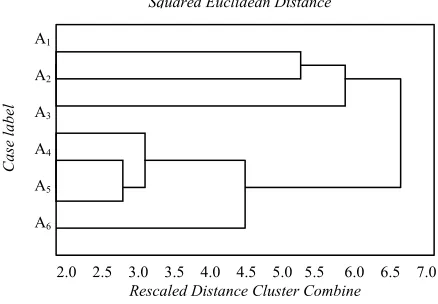
where:U,V – average of cluster vectors this process is shown in the diagram (dendrogram).
Figure. Dendrogram using Average Linkage (Between Groups)
Case label
2.0 2.5 3.0 3.5 4.0 4.5 5.0 5.5 6.0 6.5 7.0 Rescaled Distance Cluster Combine
A1
A2
A3
A4
A5
A6
To cluster objects you need to value feature types, scale of measurement, similarities measurement. Examin-ing the links between long time unemployed strategy and work motivation, cluster analysis uses metric distances and correlation rates (Everit, 1993). One of metric distance Euclidean distance for objects is expressed like this:
2 2
2 2 2 1
1 ) ( ) ... ( )
( )
,
(X Y X Y x y x y xm ym
d = − = − + − + + − ; (5)
where: X, Y – searching objects;
(x1, x2 ....xm), (y1, y2 ....ym) – objects X ir Y chosen m features vectors.
Correlation rates are used as measure of variable similarities, which estimate the similarity of objects. To estimate quantity similarities of the rates the rate of lin-ear correlation is used, which is expressed in this case:
∑
∑
∑
= =
=
− −
− − =
m
i
m
i i i
m
i
i i
XY
y y x x
y y x x r
1 1
2 2
1
) ( ) (
) )( (
; (6)
where: xi –X object i- feature value, yi– Y object j- feature value, m – number of features.
Research Results of Work Search Method Choice
The paper deals with the results of the repeated re-search (Beržinskienė, 2004) about the long term unem-ployed behaviour and motivation thein work search proc-ess. During the research, depressive regions of the coun-try (Šiauliai and Panevėžys districts) were chosen, where the highest unemployment rate was fixed. Today the situation has changed. Panevėžys district unemployment rate was 5.7 per cent at the beginning of 2006, Siauliai district – 4.5 per cent, but long term unemployment has still remained the actual problem. The long term unem-ployed comprised 19 per cent in Panevėžys district and 23 per cent in Šiauliai district according to the recorded unemployment in the labour exchange centres. The re-search is based on the data of the unemployed survey. The results were counted with the programm “Statistica“. The activity of self work search is higher among the town people (Kendal rate rKendal = 0,29) than the country people (Kendal rate rKendal = 0,21). Period of unemploy-ment is shorter among the people in the town than people in the country. Besides, their motivation is higher than that in the country. Higher motivation is one of the rea-sons for shorter period of unemployment.
According to the people from town and the country, the main reason of unemployment is lack of education. But according to the data analysis, people with lower education have higher motivation to work, because they tend to take any kind of job. This motive determined bet-ter integration to the labour market. `
It was also determined that the majority of the long-term unemployed having no job for 2 or more years, do not get job offers at all. They are not educated or have no profession; they have lost hope and do not try to find employment themselves. Such people make up the
larg-est part of the long-term unemployment. While the period of unemployment increases, the number of job offers in-creases very insignificantly. While the period of unem-ployment is increasing, the people’s motivation for work and its search are decreasing.
To count the correlation rate for registration period in labour exchange and work search period, rate was r = 0,32, which means that this correlation is not strong. The unemployed, registered in the labour exchange institu-tions, search for work very passively. Their motivation for work is weak. They search for work using the infor-mal relationship (64 per cent with the help of friends and relatives, 21 per cent – applied to the employers, 10 per cent – looked for the advertisements).
Cluster analysis method was used to base the links of work search method and the unemployed motivation. According to the answers two clusters were formed:
1. the unemployed, who registered in the labour ex-change (A5), who had their own business (A7), who gave advertisement in the newspaper (A3), who directly applied to the employers (A6); 2. the unemployed, who looked for a job according to
the advertisements (A1), who used informal rela-tionship (A6).
Estimating the results of cluster analysis we can no-tice that the employed from the second cluster searched for job passively and their motivation was very weak. The unemployed from the first cluster were more active and their motivation was much higher. The unemployed who are ready to change their qualification, they are ready to change their living place as well. Two thirds of unemployed do not search for work themselves.
Conclusions
1. Work search method is chosen according to the unemployed behaviour and motivation in the la-bour market. Different mathematic methods let us prove these assumptions.
2. Cluster analysis method helps to describe chosen objects, their links.
3. Analysing work search motives using cluster analysis method, it was established that ployed motivation is very weak. These unem-ployed are passive in the labour market, so they choose the passive methods of work search: look for information in the advertisements or ask their friends and relatives.
4. It was also determined that the majority of the
long-term unemployed having no job for 2 or more years, do not get job offers at all. They are not educated or have no profession, have lost hope and do not try to find employment themselves. Such people make up the largest part of the long-term unemployed. While the period of unemployment increases, the number of job offers increases very insignificantly. While the period of unemployment is increasing, the people’s motivation for work and its search are decreasing.
References
2. Beržinskienė, D. Darbo paieškos teoriniai modeliai ir jų taikymas / D. Beržinskienė, S. Stoškus // Ekonomika ir vadyba: aktualijos ir perspektyvos. E. Galvanausko tarptautinės konferencijos pranešimų
medžiaga, 2004, p. 40-44.
3. Blau, D.M. Job search outcomes for the employed and unemployed / D. M. Blau, P. K. Robins // Journal of Political Economy, 1990, No 98, p. 637-655.
4. Bradshaw, T.F. Job seeking methods used by unemployed workers // Monthly Labor Review p. 35-40.
5. Brandshaw, T. F. Job seeking methods used by unemployed workers // Monthly Labour Review, 1973, p. 35-40.
6. Čekanavičius, V. Statistika ir jos taikymas / V. Čekanauskas, G. Murauskas. 2002. Vilnius. 272p.
7. Chiswick, B. R. The Effect of Americanization on the earnings of foreign – born Men // Journal of Political Economy, 1978, p. 47-57.
8. Ellwood, D. Public Sector Employment and Mandatory Work: A
Policy Whose Time Has Come and Gone and Come Again? / D. Ellwood, E. Welty // New York: Russell Sage Foundation, 2000. 9. Everit, B. S. Cluster Anglysis / Wiley, 1993. 245p.
10. Gregg, P. How effective are state employment agencies? Jobcentre use and job matching in Britain / P. Gregg, J. Wadsworfh // Oxford Bulletin of Economics and Statistics, 1996, No 58, p. 43-67. 11. Guževskis, B. Ilgalaikis nedarbas: užimtumo gebėjimų didinimo
būdus siūlo mokslo darbuotojai // Darbo biržos naujienos, 2002, Nr. 4, p. 6-10.
12. Holzer, H.J. Search method by use by unemployed youth // Journal of Labor Economics, 1988, No 6, p. 1-20.
13. http://europa.eu.int/comm/employment_social/employment_analysis/ employ_2005_en.htm
14. Johnson, R. Applied Multivariate Statistical Analysis. 4th ed. Pren-tice Hall, 1998.
15. Krugman, P. R. International Economic: Theory and Policy / P. R. Krugman, M. Obstfeld. 1991.
16. Ljungqvist, L. The Insider–Outsider Theory of Employment and Unemployment / L. Ljungqvist, T. J. Sargent // Cambridge. MIT Press, 1998.
17. Miller, R. Job matching and occupational choice // Journal of Politi-cal Economy, 1984, No 92, p. 1086-1120.
18. Mortensen, D. Job search and labor market analysis / In: O. Ashenfelter, D. Card (ed.). The handbook of labour economics, 1986. v.II, p. 849-919.
19. Mortensen, D.T. New developments in models of search in the la-bour market / D. T. Mortensen, C. A. Pissarides. CEPR., 1999. 20. Narendranathan, W. Modeling the process of job search / W.
Narendrana-than, S. Nickell // Journal of Econometrics, 1995, No 28, p. 29-49. 21. Nilsen, O.A. Transitions from School to Work: Search Time and Job
Duration / O. A. Nilsen, E. Bratberg // IZA Discussion Paper, 1998, No 27.
22. Pissarides, C. A. Loss of Skill During Unemployment and the Persis-tence of Unemployment Shocks // Quarterly Journal of Economics, Vol. 107 (4). p. 1371-1391.
23. Ports, M.H. Trends in job search methods // Monthly Labor Review, 1993, No 116, p. 63-67.
24. Sheldon G. Arbeitsmarkt, Arbeitslosenversicherung. Bericht zu einem Auftrag des Bundesamtes für Wirtschaft und Arbeit. Basel, 1999, 32 S.
25. Sjaastad, L. A. The Cost and Returns of Human Integration // Journal of Political Economy, 1992, p. 80-93.
26. Valentinaitė, M. Darbo jėgos pokyčiai nuosmukio metu // Eko-nomika ir vadyba 2001. Konferencijos pranešimų medžiaga. Kaunas, 2001, p. 310-316.
27. Van den Berg, O. Non stationary in job search theory // Review of Economic Studies, 1990, Vol. 57, p. 255-277.
28. Van der Klaav, B. Labor supply and matching rates for welfare re-cipients: an analysis using neighborhood characteristics / B. van der Klaav, J. C. van Ours // IZA Discussion Paper, 2000, No. 102. 29. Wielgosz, J. B. The effectiveness of altemative methods of searching
for jobs and finding them / J. B. Wielgosz S // Carpenter American
Journal of Economics and Sociology, 1987, No 46, p. 151-164. 30. Wolpin, K.I. Estimating a structural search model: the transition from
school to work // Econometric, 1987, No 55(4).
31. Wright, R.D. Search, layoffs, and reservation wages // Journal of Labor Economics, 1987, No 5. p. 354-365.
Daiva Beržinskienė, Stasys Stoškus
Darbo paieškos metodo pasirinkimo tyrimas taikant klasterinę analizę
Santrauka
Straipsnyje analizuojami darbo paieškos metodo pasirinkimo motyvai, sąlygoti bedarbių elgsenos darbo rinkoje. Nors bedarbių
elgsenos tyrimams mokslinės literatūros studijose skiriama daug dėmesio, juose pasigendama išvadų pagrįstumo. Klasterinės analizės metodų taikymas leidžia tai padaryti, nes tiksliau atspindi analizuo-jamų rodiklių tarpusavio sąsajas.
Šalies integracija į ES sudarė prielaidas laisvam asmenų judė ji-mui, tačiau sąlygojo darbo jėgos stygių šalies vidaus darbo rinkoje. Nors laisvų darbo vietų šalyje užregistruojama įvairiuose veiklos sektoriuose, tačiau ilgalaikių bedarbių įsidarbinimo problema išliko aktuali. Asmenų darbo paieškos motyvacija sąlygojama įvairių
priežasčių. Dažniausios jos yra socialinės, ekonominės, politinės, ideologinės, kt. Šie motyvai ir apsisprendimas darbo paieškos procese yra glaudžiai susijęs su įsidarbinimo galimybėmis. Remiantis autorių
atliktais tyrimais nustatyta, kad aktyvaus darbo paieškos metodo pasirinkimas, noras kelti kvalifikaciją bei persikvalifikuoti suteikia galimybę greičiau ir sėkmingiau integruotis į darbo rinką.
Straipsnio tikslas – pagrįsti darbo paieškos metodo pasirinkimo prielaidas taikant klasterinę analizę.
Tyrimo objektas – darbo paieškos metodo pasirinkimo motyvai. Tyrimo metodai – sisteminė mokslinės literatūros analizė, klas-terinė analizė.
Gausūs literatūros šaltiniai, analizuojantys problemas
darbo rinkoje, leidžia paaiškinti nedarbo tapsmą ilgalaikiu nedarbu. Viena iš prielaidų yra ta, kad ilgėjant nedarbo laikui asmuo praranda dalį savo žmogiškojo kapitalo o dėl to netenka ir darbingumo. Pis-sarides (1992), Ljungqvist ir Sargent (1998) teorinėse studijose šis gebėjimų praradimas yra kaip prielaida paaiškinanti, kodėl asmenys, laikinai netekę darbo, tampa ilgalaikiais bedarbiais. Ilgėjant nedarbo laikui, bedarbiai tampa prislėgti, silpnėja jų darbo paieškos intensy-vumas ir tikimybėįsidarbinti.
Daug dėmesio mokslinės literatūros studijose skiriama bedarbių
elgsenos tyrimams darbo paieškos procese taikant darbo pasiūlos teorinį
modelį. Standartinis darbo pasiūlos modelis šioje situacijoje nėra tink-amas dėl aplinkos poveikio įtakos, todėl darbo paieškos teorijos (job search theory) pagrindu buvo išvesti specialūs dinaminiai modeliai, leidžiantys įvertinti bedarbių elgesį neapibrėžtumo bei neišsamios in-formacijos sąlygomis. Šie modeliai paremti sprendimų priėmimo pasekmių statistinėmis interpretacijomis (Miller, 1984; Narendranathan, Nickell, 1985; Mortensen, 1986; Wright, 1987; Wolpin, 1987; Van den Berg, 1990; Mortensen, Pissarides, 1999).
Vertinant darbo paieškos problemas analizuojančių kitų autorių
darbus, pastebėta, kad daugelis jų nukreipti į įvairiųdarbo paieškos situacijų analizę, kuri apsiriboja tik veiksnių, lemiančių darbo paieškos trukmę, analize. Van der Klaav, van Ours (2000) tyrinėjo išmokų nuo nedarbo įtaką jų gavėjų elgesiui ekonometrinės analizės kontekste. Tyrėjas nustatė, kad atsisakyti socialinių išmokų ir pradėti dirbti skatina ne tik individualios asmenų charakterio savybės, bet ir tarp aplinkinių (kaimynų) vyraujantis nedarbo lygis.
Nepanaudotos užimtumo galimybės darbo paieškos procese yra siejamos su darbo išteklių dinamika, todėl daugelio autorių darbuose atsispindi darbo jėgos kokybinių ir kiekybinių parametrų vertinimai bei modeliavimas. Darbo jėgos demografinius pokyčius, sąlygojusius ilgalaikio nedarbo dinamiką analizavo P. R. Krugman (1991), A. Olgaard (2001), M. Valentinaitė (2001), B. Gruževskis (2002, 2003).
nesusijusia su darbo užmokesčiu. Bedarbis, maksimizuodamas esamos ir laukiamos naudos sumos vertę, pasirenka rezervinį darbo užmokestį bei apsisprendžia dėl darbo paieškos intensyvumo lygio. Rezervinis darbo užmokestis apibrėžia tikimybę apsispręsti dėl konk-retaus darbo, o darbo paieškos intensyvumo lygis leidžia apsibrėžti siūlomų darbo vietų kiekį. Tokiu būdu Holzer (1988) įvertino 5 darbo paieškos metodus:
• artimųjų ir draugų pagalba;
• tiesioginis kontaktas su darbdaviu;
• įvairių skelbimų formų pagalba;
• kreipiantis įįsidarbinimui tarpininkaujančias institucijas;
• kitos.
(1988) atliktų tyrimų rezultatai parodė, kad efektyviausias darbo paieškos metodas paremtas artimųjų bei draugų parama bei tiesiog-iniu kontaktu su darbdaviu.
Tyrimų, kuriais būtų galima pagrįsti bedarbių darbo paieškos metodo pasirinkimą, šalyje iki šiol atlikta nebuvo. Nors teritorinės darbo biržos pateikia faktų apie bedarbių, kurie naudojasi atitink-amais darbo paieškos metodais, skaičių, tačiau pasigendama šių
duomenų analizės.
Šiame straipsnyje pateikiami tyrimų rezultatai, kuriuose klas-terinės analizės metodu analizuojami ilgalaikių bedarbių elgsenos motyvai darbo paieškos procese.
Taikant klasterinę analizę, nustatomas objektų panašumas juos skirstant į klasterius.
Yra nemažai klasterių sudarymo metodų. Jie diferencijuojami pa-gal tai, kaip parenkami panašumo matai, atstumo tarp klasterių
nustatymo kriterijai bei kokia skirstymo į klasterius strategija. Išskiri-amos hierarchinės ir nehierarchinės klasterinės analizės metodų klasės. Hierarchinės metodų klasės skaidomos į jungimo ir skaidymo metodus, nehierarchiniai taikomi tuomet, kai iš anksto žinimas klasterių skaičius. Praktiškai realizuojant klasterinės analizės metodiką, skirstant objektus
į klasterius, dažniausiai nežinoma, kiek klasterių tiriamoje populiaci-joje realiai esama. Todėl tam tikra prasme ši analizė remiasi esamų
struktūrų paieška. Šiame darbe taikyta hierarchinių jungimo metodų
strategija, kurią galima paaiškinti taip:
1. Turime N klasterių po 1 objektą ir N×N simetrinę atstumų
matricą(dij)ij;
2. Naudodamiesi atstumų matrica, nustatome du klasterius, tarp kurių atstumas yra mažiausias. Tarkime, kad tai U ir V klas-teriai;
3. Sujungiame U ir V klasterius, tai pavadiname (UV). Tuomet atstumų matricą pakeičiame taip:
a) išbraukiame stulpelius ir eilutes, atitinkančius U ir V klasterius,
b) pridedame eilutę ir stulpelį su atstumais tarp (UV) ir li-kusių klasterių.
4. kartojame 2 ir 3 žingsnius (N-1) kartų, kol baigiame procesą,
kai visi objektai yra viename klasteryje.
Straipsnyje pristatomi pakartotinai atlikto tyrimo (Beržinskienė, 2004) apie ilgalaikių bedarbių elgseną ir motyvaciją darbo paieškos procese rezultatai. Atliekant tyrimą, 2004 m. buvo pasirinkti de-presiniai šalies regionai (Šiaulių ir Panevėžio apskritys), kuriuose tiriamuoju laikotarpiu fiksuoti aukščiausi nedarbo rodikliai. Šiuo metu šiuose regionuose nedarbo situacija gerokai pakitusi. Panevėžio apskrities nedarbo lygis 2006 metų pradžioje siekė 5,7 proc., Šiaulių
– 4,5 proc., tačiau ilgalaikio nedarbo problema išliko aktuali. Šiuo laikotarpiu ilgalaikiai bedarbiai Panevėžio apskrityje sudarė 19 proc., Šiaulių – 23 proc. darbo biržose registruotų asmenų. Tyrimas atliktas remiantis šių apskričių darbo biržų bedarbių apklausų metu surinktais duomenimis. Tyrimo rezultatai apdoroti „Statistica“ programiniu paketu.
Pakartotinio tyrimo metu nustatyta, kad išliko aukštesnis sava-rankiškos darbo paieškos aktyvumas miesto gyventojų (Kendalo ko-reliacijos koeficientas – rKendalo = 0,29), palyginti su rajone
gyvenan-čiais (Kendalo koreliacijos koeficientas rKendalo = 0,21). Išliko
trumpesnė vidutinė nedarbo trukmė mieste gyvenančių bedarbių, nei rajono gyventojų. Be to, jų motyvacija darbui taip pat stipresnė nei rajone gyvenančių bedarbių. Stipresnę darbo motyvaciją galima lai-kyti viena iš priežasčių, sąlygojančių mieste gyvenančių bedarbių
trumpesnę nedarbo trukmę.
Įvertinus tai, kad tiek miesto, tiek rajonų bedarbiai kaip esminę
neįsidarbinimo priežastį nurodė nepakankamą išsilavinimą, išsami anketos duomenų analizė parodė, kad stipresnė mažiau išsilavinusių
bedarbių darbo motyvacija, nes jie labiau linkę dirbti bet kokį darbą. Šis motyvas lėmė sėkmingesnę integraciją į darbo rinką nei labiau išsilavinusių asmenų darbo siekis.
Nustačius ryšį tarp bedarbių registracijos darbo biržoje trukmės ir jų darbo paieškos trukmės, koreliacijos koeficientas r = 0,32 parodė, kad ryšys tarp šių požymio reikšmių nėra stiprus. Užsiregis-travę darbo biržoje bedarbiai savarankiškai darbo ieško pasyviai arba kurį laiką visai jo neieško. Darbo neturinčių asmenų darbo moty-vacija nėra stipri.
Apibendrinant galima teigti, kad:
1. Darbo paieškos metodo pasirinkimą lemia bedarbio elgsena ir motyvacija darbo rinkoje. Pagrįsti šias prielaidas leidžia
įvairių matematinių metodų taikymas.
2. Klasterinės analizės metodas leidžia tiksliau apibūdinti pasir-inktų objektų aibę, jų tarpusavio ryšius ir sąsajas.
3. Klasterinės analizės metodu tiriant darbo paieškos motyvus nustatyta, kad daugumos bedarbių motyvacija savarankiškai
įsidarbinti yra silpna. Šie bedarbiai pasyvūs darbo rinkoje, todėl renkasi pasyvius darbo paieškos metodus: ieško infor-macijos apie darbą skelbimuose ar kreipdamiesi į pažįstamus. Raktažodžiai: darbo rinka, ilgalaikis nedarbas, darbo paieškos metodai,
klasterinė analizė.
The article has been reviewed.