321
Agriculture and Biosciences
www.ijagbio.com P-ISSN: 2305-6622 E-ISSN: 2306-3599 [email protected]RESEARCH ARTICLE
Effect of Roxazyme G2G Supplementation on Performance and Carcass Characteristics of
Broilers Fed Wheat-Based Diets
*1Agboola AF, 1MAFagbemi, EI Oluwadamilare2 and OH Majolagbe3 1Department of Animal Science, University of Ibadan, Ibadan, Nigeria
2Department of Animal Health and Production Technology, Rufus Giwa Polytechnic, Owo, Nigeria 3Department of Agricultural Education, Adeniran Ogunsanya College of Education, Lagos, Nigeria
A R T I C L E I N F O A B S T R A C T
Received: Revised: Accepted:
August 12, 2013 September 15, 2013 October 10, 2013
Wheat contains both soluble and insoluble non-starch polysaccharides (NSP) which are poorly digested in broilers. Supplementation of such diets with NSP degrading enzyme helps to improve digestibility of the nutrients entrapped in the wheat cell wall thereby improving performance and carcass quality of broiler chickens. The effect of Roxazyme G2G (a cocktail of carbohydrase enzymes) supplementation on growth performance and carcass characteristics was investigated in a 42-day experiment using 120 one-day-old unsexed broiler chickens (Arbor acre strain) fed wheat-based diets without or with enzyme supplementation. The birds were randomly allotted to 3 dietary treatments. Each diet had 4 replicates of 10 birds each in a completely randomised design. Performance indices measured were the body weight gain, feed intake, feed conversion ratio and feed efficiency ratio. At day 42, birds were weighed and slaughtered by cervical dislocation. The weight of the carcass primal cuts and visceral organs were recorded. Roxazyme G2G supplementation significantly (P<0.05) influenced the dietary treatments, although growth performance of birds fed wheat based-diet with enzyme was identical to those without enzyme and the control diet. Similarly, enzyme supplementation did not positively increase the live weight, percentage dressed weight, eviscerated weight and other primal cuts with the visceral organs. Also, the carcass characteristics measured did not differ significantly from birds fed wheat diet without enzyme and control diet. There were no significant differences observed in feed cost/kg/bird and feed cost/kg weight gain of birds across the dietary treatments in both the starter and finisher phases. However, the feed cost/kg differ significantly (P< 0.05) among the dietary treatments in the two phases. It was highest (N107.81) in birds fed wheat diet with enzyme and least (N 102.90) in birds on the control diet for starter phase. Also, similar trend was observed for feed cost/kg in the finisher’s phase.
Key words:
Broilers Carbohydrase Carcass Performance Wheat
*Corresponding Address:
Agboola AF
[email protected] [email protected]
Cite This Article as: Agboola AF, MAFagbemi, EI Oluwadamilare and OH Majolagbe, 2013. Effect of roxazyme
G2G supplementation on performance and carcass characteristics of broilers fed wheat-based diets. Inter J Agri Biosci, 2(6): 321-326. www.ijagbio.com
INTRODUCTION
Improved efficiency of feedstuff utilisation and the use of a wide range of feed ingredients are being hindered by several factors. Among potential factors reducing nutrient bioavailability are the non-starch polysaccharides in ingredients such as soyabean meal, wheat, barley, oat, rye, sesame meal etc. Non starch polysaccharides (NSPs) are those polysaccharides (complex carbohydrates), other than starches, found in foods. The common NSPs include β-glucans, arabinoxylans and fructans (Classen and
enzymes have also been reported to improve energy utilisation in broilers (Douglas et al., 2000). Roxazyme 2G2 is one of the numerous exogenous enzymes used in poultry diets. It is a commercial multi-enzyme complex which contains β-xylanase activities. Its addition to relevant poultry diets usually result in numerous beneficial effects, such as increased utilisation of nutrients, reduced digesta viscosity and improved growth performance.
It was therefore the aim of this study to determine the effect of supplementing wheat-based diets with Roxazyme G2G (a cocktail of carbohydrase enzymes) on growth performance and carcass quality in 42-d-old broilers.
MATERIALS AND METHODS
Experimental site
This study was carried out at the poultry pen of the Teaching and Research Farm University of Ibadan, Oyo State in the South West geopolitical zone of Nigeria and within the Tropical rain forest region.
Management of experimental birds
One hundred and twenty (120) broiler chicks were used for this study. The birds were reared in a well-ventilated and illuminated standard poultry house. After 7 days of brooding, the birds were randomly allotted to 3 dietary treatments containing 4 replicates of 10 birds each. The experimental diets and water were supplied ad libitum during the period that lasted 6 weeks. During the experimental period daily feed intake was determined by deducting the left over from the total quantity of feed supplied to the birds. Weights of birds were monitored weekly and average cost of feed intake per bird and cost of feed/kg weight were also calculated as follows;
Feed Efficiency Ratio = Weight gain Feed intake
Feed Conversion Ratio = Weight gain Feed intake
Cost of feed/kg weight gain = Feed intake X Feed cost Weight gain
Experimental diets
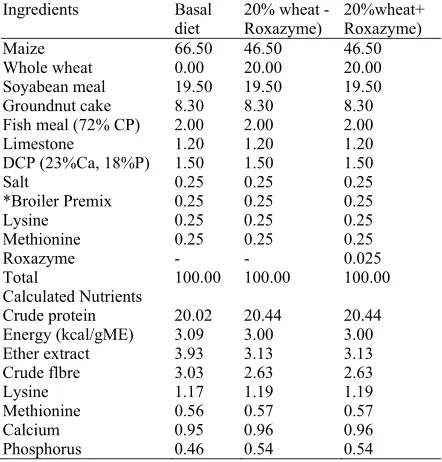
The experimental starter and finisher diets were offered to the birds at day 8 to 21 and 22 to 42 respectively. There were basal diets with 58.5% and 66.5% maize as sources of energy for starter and finisher phases respectively and 2 other diets in which maize in the basal (control) diets was replaced with 20% wheat, one of which was supplemented with Roxazyme G2G (contains endo-1,4-beta Glucanase and endo-1,3 (4)-beta Glucanase and endo-1,4-beta Xylanase) for both the starter (1-3weeks) and finisher (4-6weeks) phases (Tables 1 and 2). Diet 1 was the control which had a diet without wheat and enzyme supplementation while Diet 2 had wheat but without enzyme supplementation and Diet 3 had wheat with enzyme supplementation.
¾ Diet 1- Without wheat + without enzyme (control)
¾ Diet 2- 20% wheat + without enzyme
¾ Diet 3- 20% wheat + enzyme
Table 1: Gross composition of experimental broiler starter diets
(g/100gDM)
Ingredient Basal diet 20%wheat-
Roxazyme) 20%wheat+ Roxazyme)
Maize 58.50 38.50 38.50
Whole wheat 0.00 20.00 20.00 Soyabean meal 19.00 19.00 19.00 Groundnut cake 16.40 16.40 16.40 Fish meal (72% CP) 2.50 2.50 2.50
Limestone 1.10 1.10 1.10
DCP (23%Ca, 18%P) 1.50 1.50 1.50
Salt 0.25 0.25 0.25
*Broiler Premix 0.25 0.25 0.25
Lysine 0.25 0.25 0.25
Methionine 0.25 0.25 0.25
Roxazyme - - 0.025
Total 100.00 100.00 100.00
Calculated Nutrients
Crude protein 23.01 23.43 23.43 Energy (kcal/gME) 3.03 2.94 2.94 Ether extract 4.12 3.30 3.30 Crude flbre 3.25 2.85 2.85
Lysine 1.28 1.31 1.31
Methionine 0.59 0.60 0.60
Calcium 0.99 0.97 0.97
Phosphorus 0.49 0.57 0.57
DCP = Dicalcium phosphate *Composition of premix per kg of diet: vitamin A, 12,500 I.U; vitamin D3 2,500 I.U; vitamin E, 40mg; vitamin K3, 2mg; vitaminB1, 3mg; vitamin B2, 5.5mg; niacin 55mg; calcium pantothenate, 11.5mg; vitamin B6, 5mg; vitamin B12, 0.025mg; choline chloride, 500mg; folic acid, 1mg; biotin, 0.08mg; manganese, 120mg; iron, 100mg; zinc, 80mg; copper, 8.5mg; iodine, 1.5mg; cobalt, 0.3mg; selenium, 0.12mg; Anti-oxidant, 120mg. Roxazyme G2G (contains endo-1,4-beta Glucanase and endo-1,3 (4)-beta Glucanase and endo-1,4-beta Xylanase)
Table 2: Gross composition of experimental broiler finisher’s
diets (g/100gDM)
Ingredients Basal
diet 20% wheat - Roxazyme) 20%wheat+ Roxazyme)
Maize 66.50 46.50 46.50
Whole wheat 0.00 20.00 20.00 Soyabean meal 19.50 19.50 19.50 Groundnut cake 8.30 8.30 8.30 Fish meal (72% CP) 2.00 2.00 2.00
Limestone 1.20 1.20 1.20
DCP (23%Ca, 18%P) 1.50 1.50 1.50
Salt 0.25 0.25 0.25
*Broiler Premix 0.25 0.25 0.25
Lysine 0.25 0.25 0.25
Methionine 0.25 0.25 0.25
Roxazyme - - 0.025
Total 100.00 100.00 100.00
Calculated Nutrients
Crude protein 20.02 20.44 20.44 Energy (kcal/gME) 3.09 3.00 3.00 Ether extract 3.93 3.13 3.13 Crude flbre 3.03 2.63 2.63
Lysine 1.17 1.19 1.19
Methionine 0.56 0.57 0.57
Calcium 0.95 0.96 0.96
Phosphorus 0.46 0.54 0.54
Carcass characteristics
Four birds per replicate were selected at random for carcass evaluation. The birds were slaughtered and parameters evaluated were: dressed weight, eviscerated weight, weight of primal cuts (wings, shanks, drumstick, breast, back and thigh) and weights of visceral organs (heart, gizzard, lungs, kidney, pancreas and spleen).
Experimental design
The experimental design used was Completely Randomised Design.
Proximate composition
The proximate composition of each of the diets was determined according to the methods of AOAC (2000).
Statistical analysis
Data obtained were analysed using descriptive statistics and ANOVA (P = 0.05) (SAS, 2012). Mean differences were separated using Duncan Multiple Range Test.
RESULTS
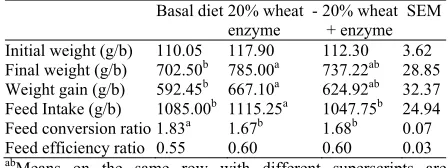
The result of proximate composition of experimental broiler finisher’s diets is as shown in Table 3. The crude protein and crude fibre of birds fed wheat based-diets ranged from 19.73 - 22.78% and 4.23- 4.62 respectively. Performance indices of broilers fed experimental diets are shown in Tables 4 and 5. There were no significant differences observed in the Initial Weight (IW) and Feed Efficiency Ratio (FER) of birds on the experimental diets. Meanwhile, the Final Weight (FW), Weight Gain (WG), feed intake and Feed Conversion Ratio (FCR) of birds were significantly (P<0.05) influenced by the dietary treatments at the starter phase (Table 4). The FW, WG, and FCR of birds fed 20% wheat-based diet with enzyme supplementation were not significantly different from those on 20% wheat diet without enzyme. However, birds fed 20% wheat-based diet with addition of enzyme compared favourably with those on the control diet. The feed intakes of birds on wheat diet with inclusion of Roxazyme 2G2 and those on the control diet were similar and significantly different from birds on wheat based-diet without enzyme supplementation.
There were significant (P<0.05) differences recorded in the initial weight, final weight, weight gain and FCR of birds on the experimental diets at the finisher’s phases (Table 5). However, the FW and WG of birds on 20% wheat based-diet without enzyme supplementation were significantly higher (2143.50g/b and 1358.50g/b) than FW and WG (2085.50g/b and 1348.28g/b) of those on wheat diet with inclusion of enzyme. There were no significant differences observed in the feed intake and FER of birds on the experimental diets.
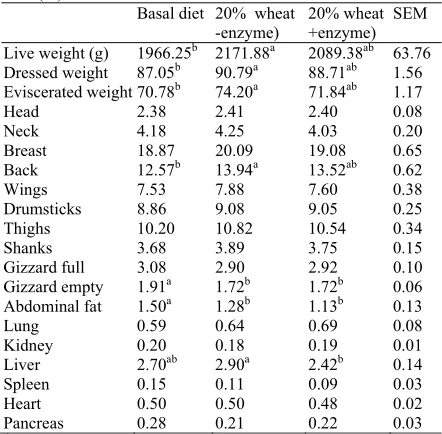
The results of carcass characteristics of birds fed wheat-based diets supplemented with Roxazyme G2G are shown in Table 6. Birds on 20% wheat without enzyme supplementation had the highest live weight (2171.88g/b) and percentage dressed weight (90.79%) though not significantly different from birds on 20% wheat with enzyme supplementation. Similar trend was observed on the percentage eviscerated weight and back of birds on the
Table 3: Proximate composition of experimental finisher diets
(g/100gDM)
Variable Basal diet 20% wheat
- enzyme 20% wheat + enzyme Dry matter 91.01 91.36 91.72 Crude protein 22.78 19.73 19.82 Crude fibre 4.62 4.31 4.23
Ether extract 7.79 8.06 8.01
Ash 6.21 7.30 7.36
Nitrogen Free Extract 58.60 60.60 60.58
Table 4: Performance indices of broilers fed wheat-based diets
(Starter phase) (7-21days)
Basal diet 20% wheat -
enzyme 20% wheat + enzyme SEM Initial weight (g/b) 110.05 117.90 112.30 3.62 Final weight (g/b) 702.50b 785.00a 737.22ab 28.85
Weight gain (g/b) 592.45b 667.10a 624.92ab 32.37
Feed Intake (g/b) 1085.00b 1115.25a 1047.75b 24.94
Feed conversion ratio 1.83a 1.67b 1.68b 0.07
Feed efficiency ratio 0.55 0.60 0.60 0.03
abMeans on the same row with different superscripts are
significantly (P<0.05) different. g/b- gram per bird, SEM: Standard Error of Mean.
Table 5: Performance indices of broilers fed wheat-based diets
(Finisher’s phase) (22 – 42days)
Basal diet 20% wheat
–enzyme 20% wheat +enzyme SEM Initial weight (g/b) 702.50b 785.00a 737.22ab 28.85
Final weight (g/b) 1927.00b 2143.50a 2085.50a 40.17
Weight gain (g/b) 1224.50b 1358.50a 1348.28a 49.89
Feed Intake (g/b) 2998.20 2872.10 2880.10 101.75 Feed conversion ratio2.45a 2.11b 2.14b 0.10
Feed efficiency ratio 0.41 0.47 0.47 0.03
abMeans on the same row with different superscripts are
significantly (P<0.05) different. g/b- gram per bird, SEM: Standard Error of Mean.
experimental diets. There were no significant differences recorded for the relative weight of the primal cuts- head, neck, breast, wings, drumsticks, thighs and shanks of birds on the dietary treatments. There were no significant differences observed on the visceral organs of birds on the experimental diets except the gizzard (empty), abdominal fat and liver. The liver of birds fed 20% wheat without enzyme supplementation had the highest value (2.90%) while the least value (2.42%) was recorded for birds on wheat based diet with enzyme inclusion. The gizzard (empty), abdominal fat, kidney, spleen and pancreas of birds on the control diet had highest percentage relative weight, though some were not significantly different from birds on other dietary treatments.
Table 6: Carcass characteristics of broilers fed wheat-based diets (%)
Basal diet 20% wheat
-enzyme) 20% wheat +enzyme) SEM Live weight (g) 1966.25b 2171.88a 2089.38ab 63.76
Dressed weight 87.05b 90.79a 88.71ab 1.56
Eviscerated weight 70.78b 74.20a 71.84ab 1.17
Head 2.38 2.41 2.40 0.08
Neck 4.18 4.25 4.03 0.20
Breast 18.87 20.09 19.08 0.65
Back 12.57b 13.94a 13.52ab 0.62
Wings 7.53 7.88 7.60 0.38
Drumsticks 8.86 9.08 9.05 0.25
Thighs 10.20 10.82 10.54 0.34
Shanks 3.68 3.89 3.75 0.15
Gizzard full 3.08 2.90 2.92 0.10 Gizzard empty 1.91a 1.72b 1.72b 0.06
Abdominal fat 1.50a 1.28b 1.13b 0.13
Lung 0.59 0.64 0.69 0.08
Kidney 0.20 0.18 0.19 0.01 Liver 2.70ab 2.90a 2.42b 0.14
Spleen 0.15 0.11 0.09 0.03
Heart 0.50 0.50 0.48 0.02
Pancreas 0.28 0.21 0.22 0.03
abMeans on the same row with different superscripts are
significantly (P<0.05) different. SEM: Standard Error of Mean.
Table 7: Cost benefit ratio of enzyme supplemented wheat
based diets fed to broilers.
Basal diet 20% wheat - enzyme 20% wheat + enzyme SEM Starter phase
Weight gain (kg/b) 0.59 0.67 0.62 0.03 Feed Intake (kg) 1.09 1.12 1.05 0.03 Feed Conversion Ratio 1.83 1.67 1.68 0.07 Feed cost/kg 102.90c 106.74b 107.81a 0.00
Feed cost (N/kg/bird) 111.65 118.75 112.66 2.60 Feed cost/kg weight
gain (N/kg)
189.49 177.49 187.58 7.67 Finisher phase
Weight gain (kg/b) 1.22 1.36 1.35 0.05 Feed Intake (kg) 3.00 2.87 2.88 0.10 Feed Conversion Ratio 2.45 2.11 2.14 0.10 Feed cost/kg 97.1c 103.5b 104.6a 0.00
Feed cost (N/kg/bird) 291.24 297.30 301.25 10.26 Feed cost/kg weight
gain (N/kg)
236.36 218.88 224.76 10.05
abcMeans on the same row with different superscripts are
significantly (P<0.05) different. Kg- kilogram, kg/b- kilogram per bird, N -naira, N/kg -naira per kilogram, N/kg/b -naira per kilogram per bird. 160 = 1US dollar,SEM: Standard Error of Mean
on the control diet and least value (N218.88) was recorded for birds fed wheat diet without enzyme supplementation at the finisher phase.
DISCUSSION
Supplementation of poultry diets with enzymes has been reported to destroy the anti-nutritive factors in cereals, by enhancing the overall digestibility of the feed and nutrient availability (Choct et al., 1999). The improved final weight, weight gain, feed intake and feed conversion ratio of birds fed 20% wheat diet with enzyme supplementation at both the starter and finisher phases support the findings of Awoyemi (2012) who reported increase in performance parameters measured when birds
were fed 20% wheat based-diets supplemented with exogenous enzyme at the starter phase. Similarly, according to Awoyemi (2012), an improved final weight, weight gain and feed intake of birds fed with 10% wheat diet with enzyme supplementation at the finisher phase was reported. In the present study, supplementation of diet with enzyme did not positively improve the growth performance of birds on the dietary treatments when compared with those on wheat diet without dietary supplemental enzyme inclusion. This was contrary to the findings of Lazaro et al. (2003) who reported that enzyme supplementation of wheat-based diets improved broiler performance through increased feed intake and improved nutrient digestibility. One obvious reason for an apparent lack of response is the possibility that the diets fed were of extremely good quality and allows the birds to perform close to their genetic potential. In such cases, enzyme supplementation would be likely to produce a negligible beneficial response (Acamovic, 2001). In many reports, there are frequent instances where enzyme supplementation has failed to result in improved performance. However, it is incorrect to come to the general conclusion, as is often done, that a particular enzyme supplement adds little value to the particular ingredient or component (Acamovic, 2001). Dietary constituents may also reduce the activity of supplementary enzymes either because the enzymes attach strongly to a component such as tannin or because a functional co-factor such as a particular trace element is replaced by another that hinders an activity (Bedford and Classen, 1992).
supplementation. Gao et al. (2007) reported that enzyme supplementation can change the nutritional status and improve growth performance of broiler chickens fed a wheat-based diet. Increased carcass yield by addition of enzymes has also been reported by Leeson et al. (1996). Decreased dressed weight observed in this study is in disagreement with the report of Omojola and Adesehinwa (2007), who noted superior significant difference in dressing percentage of birds on enzyme-supplemented diets. This could probably be that the enzyme effect was not pronounced because of a negative interaction between wheat and enzyme observed in the present study. According to Bedford (1996), the degree of improvement obtained by adding enzymes to the diet depends on many factors including the type and amount of cereal in the diet, the level of anti-nutritive factor in the diet, the spectrum and concentration of enzymes used etc. The differences observed in this present work and that of Omojola and Adesehinwa (2007), Iyayi and Yahaya (1999) and other several authors could be as a result of one of the factors mentioned above.
Birds fed wheat-based diets with or without enzyme had relatively high feed cost/kg/bird (N /kg) when compared to birds on the control diet. The feed cost per kilogram per bird was least in the control diet (N111.65) and (N291.24) for starter and finisher phases respectively when compared to feed cost of wheat-based diets. This is probably as a result of slight differences in the price of maize (N70.00/kg) and wheat (N80.00/kg) at the period of the experiment. This result corroborates with the findings of Awoyemi (2012) on cost benefits of birds fed varying levels of wheat diets supplemented without or with enzyme.
Conclusion and Recommendation
The results of this study showed that enzyme supplementation did not positively influence the growth performance and carcass characteristics of birds fed 20% wheat-based diets when compared to those without enzyme supplementation.
It can be recommended that the energy level of diets with enzyme inclusion should be lower than the diets not supplemented with enzyme for effectiveness in the activity of supplemental enzyme and to maximize enzyme-ingredients interactions.
REFERENCES
Abbas W, SH Khan and M Sarwar, 1998. Sunflower oil meal as a substitute for soyabean meal in broiler rations with or without multienzyme (Kemzyme). Pak Vet J, 18: 124-129.
Acamovic T, 2001. Commercial application of enzyme technology for poultry production. World's Poult Sci J, 57: 225-243.
Agboola AF, UO Inyang, OM Awoyemi and OH Osaiyuwu, 2013. Carcass characteristics of broiler chickens fed wheat-based diets supplemented with exogenous enzyme. Conference of the British Society of Animal Science and the Association of Veterinary Teaching and Research Work, University of Nottingham, Jubilee Campus, UK, pp: 178.
AOAC, 2000. Official Methods of Analytical Chemists. 16th Ed. Arlington, VA, USA.
Awoyemi MA, 2012. Nutrient digestibility and apparent metabolisable energy of broilers fed wheat-based diets supplemented with an exogenous enzyme. MSc Thesis, Department of Animal Science, University of Ibadan; pp: 58-62.
Bedford MR, 1996. Interaction between ingested feed and the digestive system in poultry. J Appl Poult Res 5: 86-95.
Bedford MR and HL Classen, 1992. Reduction of intestinal viscosity through manipulation of dietary rye and pentosanase concentration of broiler chicks. J Nutr, 122: 560-569.
Chesson A, 2001. Non- starch polysaccharide degrading enzymes in poultry diets: influence of ingredient on the selection activities. World’s Poult Sci J, 57: 251 262
Choct M, J Hughes and MR Bedford, 1999. Effects of a xylanase on individual bird variation, starch digestion through the intestine, and ileal and caecal volatile fatty acid production in chickens fed wheat. Br Poult Sci, 40: 419-422.
Classen HL and MR Bedford, 1991. The use of enzymes to improve the nutritive value of poultry feeds. in: Haresign W and Cole DJA (editors), Recent Advances in Animal Nutrition. UK, pp: 95-116. Cumming RB, 1994. Opportunities in whole grain
feeding. in: Proc. 9th European Poultry Conference. Vol 2. World Poultry Science Association (United Kingdom Branch), Glasgow, Scotland. pp: 219-222. Douglas MW, CM Parsons and MR Bedford, 2000. Effect
of various soybean meal sources and avizyme on chick growth performance and ileal digestible energy. J Appl Poult Res, 9: 74-80.
Gao F, Y Jiang, GH Zhou and ZK Han, 2007. The effects of xylanase supplementation on performance, characteristics of the gastrointestinal tract, blood parameters and gut microflora in broilers fed on wheat-based diets. Anim Feed Sci Technol, 142: 173-184.
Hetland H, M Choct and B Svihus, 2004. Role of insoluble non-starch polysaccharides in poultry nutrition. World’s Poult Sci J, 60: 415-422.
Hetland H, B Svihus and M Choct, M 2005. Role of insoluble fiber on gizzard activity in layers. World’s Poult Sci J, 60: 415-422.
Inyang UO, 2012. Ileal morphology, digesta viscosity and carcass characteristics of broilers fed wheat-based diets supplemented with Roxazyme. M.Sc Thesis, Department of Animal Science, University of Ibadan; pp: 45-62.
Iyayi EA and BA Yahaya, 1999. Performance of broilers maintained on diets supplemented with commercial polysaccharidase enzyme in the Tropics. Trop Anim Prod Invest, 122-130.
Khan AD, 2006. Chemical composition and nutritional evaluation of variously treated defatted rice polishing for broiler feeding. Asian-Aust J Anim Sci, 16: 873-879.
rye-based diets on nutrient digestibility and performance of laying hens. Br Poult Sci, 44: 256-265.
Leeson S, LJ Caston and D Yunblut, 1996. Adding roxazyme to wheat diets of chickens and turkey broilers. J Poult Res, 5: 167-172.
Mehri M, M Adibmoradi, A Samie and M Shivazad, 2010. Effects of β-Mannanase on broiler performance, gut morphology and immune system. Afr J Biotechnol, 37: 6221-6228.
Omojola AB and AOK Adesehinwa, 2007. Performance and carcass characteristics of broiler chickens fed diets supplemented with graded levels of Roxazyme G Int J Poult Sci, 6: 335-339.
Pasquier B, M Armand, F Gullon, C Castelain, P Borel, JL Barry, G Pieroni and D Lairon, 1996. Viscous soluble dietary fibre alter emulsification and lipolysis of triacylglycerols in duodenal medium in vitro. J Nat Biochem, 7: 293-302.
SAS, 2012. SAS Users Guide Statistics. Version 9.2. Ed, SAS Institute Inc, Cary, NC, USA.