Spatial Planning for Socio-Economic Development
Spatial Planning for Socio-Economic Development
Pritam Kumar Singh
Department of Geography, Faculty of Arts, University of Allahabad, Allahabad-211002, India
E-mail: [email protected]; Tel: +91-9839635458
In the socio-economic planning process, the understanding of the interrelationships underlying the two types of landscape above described is essential. Each regional context is characterized by particularities of history, by attitudes, beliefs and values, political and legal traditions different socio-economic patterns and concept of justice, interpretation of planning tasks and responsibilities and different structures of governance, in other terms: by its specific characteristics. In spatial planning, physical and social features like topography, drainage, climate, population settlements etc. are significant elements. They are interlinked and interdependent in such a way that they affect each other. So, change in any single element brings change in whole pattern of the region. This present review article attempts the analysis of different aspects of development in the region for its socio-economic development. It explains the concepts of space, region and planning and focuses on need of planning and types of planning locational theories of planning. The ideas of the present paper may be useful in generation of a platform for better spatial planning to bring improvement in social well- being of the people living in this region.
Keywords: Socio-economic development; spatial planning; locational theories; regional planning; space and region
INTRODUCTION
Planning is so much ingrained in our life that one cannot think of the existence of himself without thinking of centuries old planned human efforts for fighting different calamities. Most part of our country would have been in worse form if such efforts had not existed. A nation has a cultural landscape which is superimposed on its natural landscape. Although, it is the natural landscape on which the cultural patterns have been built, the details of the former do not coincide with the details of the latter. In the socio-economic planning process, the understanding of the interrelationships underlying the two types of landscape above described is essential (Misra, 1966). Each regional context is characterized by particularities of history, by attitudes, beliefs and values, political and legal traditions different socio-economic patterns and concept of justice, interpretation of planning tasks and responsibilities and different structures of governance, in other terms: by its specific characteristics. The role of culture can also be found in programmes of international collaboration in the field of spatial planning and development which have been practiced since 1990s for under developing areas (Nath et al., 2009). In the modern era of planning and
developmental schemes, information regarding condition of human resources of an area is prime consideration not only for determination of suitable strategy of development but also an assessment of developmental process at mass level.
Therefore, planners and planning systems need to be responsive to differences to be genuinely participatory and to strive to create deliberative contexts that, as for as possible, minimize inequalities of power and knowledge. Methods of planning, therefore, also emphasize the importance of listening to planner’s view of their worlds, tracing the form of communication they use among themselves and with their publics and understanding their ethical dilemmas. A major problem in planning for every large country is that of development of its different regions. It raises question of regional allocation of resources, location of major projects, and rates of growth of production, income and employment in different regions and allied question of inter-regional movements of goods and people. Planners in every country are concerned with these questions. However, regional planning problems
Review Article
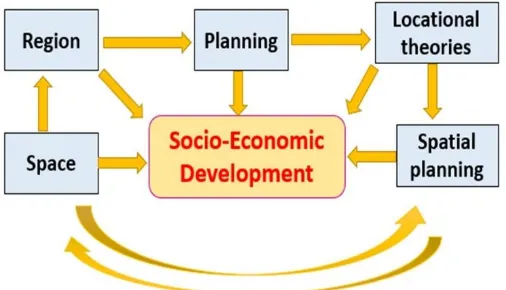
had not until recently, received adequate attention from planners in many countries. The national plans continued to be concerned primarily with overall growth of the economy and with sector wise and project wise allocations of investment and resources. Regional allocations of investment, rates of growths of different regions or special measures needed to accelerate growth in depressed or retarded regions received only secondary attention. One reason for inadequate interest in regional problems is that the issue of spatial location of economic activity has not received enough attention in economic analysis. This is due mainly to the fact that space and distance introduce a complicating factor in economic analysis (Nath et al., 2009). The socio-economic development of any region depends on their spatial planning. In spatial planning, physical and social features like topography, drainage, climate, population settlements etc. are significant elements. They are interlinked and interdependent in such a way that they affect each other. So, change in any single element brings change in whole pattern of the region. Thus, the regional planning consists an attempt at discovering the plans of betterment of human life; it visualizes industry as the servant of culture, and its chief concern is the guidance within a region of the flow of civilization. Thus, present review is focused to understand the application of -peoples plan at local level and its success. Technically this is called spatial planning categorized on the basis of purposes (Flow chart 3).Figure 1 showing interlinking among space, region, planning, locational theories, spatial planning and their impact on socio-economic development.
Figure 1. Interlink among space, region, planning, locational theories, spatial planning and their impact on socio-economic development
MEANING AND CONCEPT OF SPACE
Geographically space means that which is around everything that exists and which is continuous in all direction or an empty area which is available to be used (Cambridge Advanced Learner Dictionary). Thus, it is multi-dimensional concept and has a wide connotation ranging from personal to global. The concept of space may
be regarded as flexible and may be defined in particular context, to be symbolized particular ways and to be formalized in a variety of spatial languages. Concept of space may be varying as considered in different aspects like economic space, social space, political space etc. In this paper social and economic space have been focused much interpretation.
CONCEPT OF REGION
In fact, it is a broad concept itself. It is considered as a unit in geographical study. On the basis of the elemental factor of space, a region is a geographic or areal unit with certain limits and bounds. The unit may consist of a few villages or a number of countries. A region may, therefore be thought of as an aerial or spatial organization of varying dimensions. According to Joerg, "Any portion in the earth’s surface where physical conditions are homogeneous can be considered to be a region in the geographic sense." Isaiah Bowman, who was so much wedded to regional approach in geographic analysis, summed his views as, “We generalize real men and real places by grouping them according to likeness of function or location. To think of groups is at once to be aware of the relationships between groups. A given group has like any one of its members, a limited and particular set of conditions to face. These conditions are spread over an area or region. It is the purpose of the geographer to study limiting or significant environmental conditions in the regional association, basing his understanding upon physical examinations on the one hand and upon human reactions or relationships on the other.” Therefore, we can say that a region is a small or large area which is considered for according to need or for special purpose (Dawkins, 2003).
According to John Orchard, the optimum region for social and economic planning should possess certain characteristics: (a)There should be some unifying core; (b)Its area should include all the territory tributary to the core; (c)There should be an absence of serious conflicting interests within the areas; and (d)The region should not be so diversified that it will place too great a burden upon the ability and training of the planners.
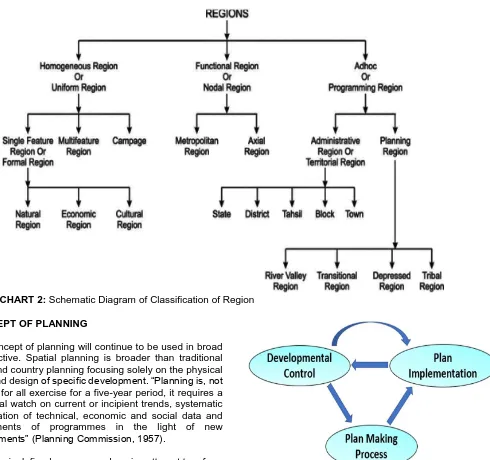
TYPES OF REGIONS
Spatial Planning for Socio-Economic Development FLOW CHART 2: Schematic Diagram of Classification of Region
CONCEPT OF PLANNING
The concept of planning will continue to be used in broad perspective. Spatial planning is broader than traditional town and country planning focusing solely on the physical form and design of specific development. “Planning is, not a once for all exercise for a five-year period, it requires a continual watch on current or incipient trends, systematic observation of technical, economic and social data and adjustments of programmes in the light of new requirements” (Planning Commission, 1957).
Planning is defined as a comprehensive attempt to reform all unsatisfactory condition by making of major economic decisions-what and how much is to be produced; how, when and where to be produced, and to whom it is to be allocated by conscious decision of determinate authority on the basis of a comprehensive survey of the economic system as a whole (Dickinsion, 1993). Regional planning, in the words of MacKaye (1928), "consists in the attempt at discovering the plans of the Nature for the attainment of man's ends upon the earth; it visualizes industry as the servant of culture, and its chief concern is the guidance within a region of the flow of civilization. This flow may consist of electric fluid, of lumber, of wheat, of beef, of dairy products. It may consist of the flow of population, of housing and living facilities." Figure 2 representing the plan of spatial planning that show high correlation between plan and spatial planning. The figure describes that the developmental control affects plan making process which affects plan implementation. The plan making process and developmental control affects each other.
Figure 2. The Flow of Spatial Planning
TYPES OF PLANNING
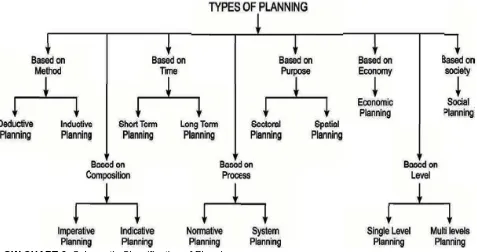
Types of planning depends upon base adopted according to need of planners like on the economic base it is called economic planning, on the time base it is called long term planning or short time planning or one year, two year …and so on (Flow Chart 3). In this article author has reviewed economic planning, social planning and spatial planning to analyze development.
IMPORTANCE OF SPATIAL PLANNING
FLOW CHART 3: Schematic Classification of Planning of land uses and the linkages between them, to balance demands for development with the need to protect the environment, and to achieve social and economic objectives. Spatial planning refers to the methods used by the public sector to influence the distribution of people and activities in spaces of various scales in order to improve the socio-economic development of economic and social environments of communities. Spatial planning takes place on local, regional, national and inter-national levels and often results in the conception of a spatial plan. Spatial planning tries to coordinate and improve the impacts of other sectoral policies on land use, in order to achieve a more even distribution of economic development within a given territory than would otherwise be created by market forces. Spatial planning is therefore an important lever for promoting sustainable development and improving the quality of life (Stead and Nadin, 2008; Assink and Groenendijk, 2009).
SPATIAL PLANNING AND REGIONAL DEVELOPMENT
Spatial planning aims to create and maintain the qualities of urban areas and countryside. Spatial planning attempts to determine allocation of sectorial resources in a way that “productive activities and social facilities are available to all those who need and deserve and minimize inequalities in incomes and welfare so that a spatial structure conducive to planned development of the country or region is evolved (Misra, 1990). Spatial organizations and human activities are determined by the nodes, the networks and the flows linking the nodes, through networks. “The efficiency of the spatial structures depends upon the location and density patterns of the nodes, the shape and density of the networks and quantity and quality and directions of the flows." The task of spatial planning is to analyze the spatial
structures, evaluate the efficiency against the needs of the national and regional economies and generate structural changes to meet the objectives of planned development (Misra, 1990). Figure 3 demonstrating the factors affecting spatial planning and regional development. Several factors are responsible for spatial planning and regional development of a particular area including climatic condition, technology, natural resources, economy, population and demography of that particular region.
Figure 3. Factors Affecting Spatial Planning and Regional Development
Spatial planning is an interface between development processes and spatial structures. Its logistics aim at building multi-level spatial structures in correspondence with the optimization of economic development, social well-being and political aspirations of the people because spatial structures are not inert but living entities which reflect temporal transformation that a particular region has undergone in response to the changing socio-economic
Spatial Planning for Socio-Economic Development
perspectives (Singh, 1986). That is why spatial organization is an important problem for all economies regardless of whether they are feudal, capitalist and socialist and yet the particular form of spatial organization will reflect the types of socio-economic relations encountered (Sayer, 1976). Accordingly, spatial planning should be viewed as strategy for regional development at local level and strengthening the district economy as well as national economy as a whole.
FLOW CHART 1: Schematic Diagram of Administrative Units of Government of India.
DEVELOPMENT OF LOCATIONAL THEORIES OF SPATIAL PLANNING
Location theory seeks to explain the distribution of activities in space, the aim being to identify the factors that influence the location of individual activities, the allocation of different portions of territory among different types of production, the dividing of a spatial market among producers, and the functional distribution of activities in space (Capello, 2011). Major change in planning approach can be traced from the third decade of development or 1970s when it was realized that in spite of success stories the thirty years of international development efforts, the hard core of mass poverty in the Third World countries remained unencroached (Higgins, 1980). The new approach of development planning emphasized on disaggregated planning at regional and local level from the below, participation of largest population itself both in planning and execution of development projects and improved style of development. This shift was that regional planning started occupying the centre of stage only in concept, but not in practice. Integrated area development programme postulated during this period refers to functional and spatial integration. Functional integration envisages integration of all economic and social activities
that influence the society. If spatial relationships among existing activities are observed, it will be noticed that there is a definite pattern in the dispersal or concentration of activities in space. The central place theory advanced by Walter Christaller (1933), and modified by Losch (1954) and Skinner (1956) attempted to provide explanation of phenomenological environment and bringing out orderliness in spatial structure. Prior to this it was Von Thunen who attempted to formulate certain basic principles to explain spatial distribution of land use way back in 1826. Dendritic central place system described by Johnson (1970) traces linkage for rural retail market at the bottom to the urban primate centre at the top. The basic element of central place theory is functional centralization, hierarchy, regional complementarity and economic distance.
growth centre project in India started in 1960 with formal approval of the Planning Commission as part of the fourth five-year plan under the direction of Ministry of Agriculture (Roy, 1972; Fisher, 1979). In the mid-seventies Sunder ban Development Board was set up to identify and promote service centres in 15 blocks of Southern 24 Parganas district of West Bengal. Comprehensive Area Development Programme (CADP) was also introduced in a number of states. However, the experiment could not produce anticipated results.
NECESSITY OF SPATIAL PLANNING
Strategies for sustainable development are currently being worked out in many different contexts. These include various local, regional, national and international geographical territories and various sectors of society. In this review, more forcefully emphasizing the role and potential of spatial planning in achieving some beneficial objectives. Spatial planning can be used as an instrument to co-ordinate socio-economic development by preventing environmental problems and simultaneously protecting the natural environment and the cultural environment .The challenge for planning is to ensure the efficient use of limited land resources and to contribute to balanced use of resources ,including natural and landscape resources, soil ,water air .Since Spatial planning has a long term perspective, it can also include important principles of development. Spatial planning is used to create solutions that are bound to specific geographical territories. Socio-economic development cannot solely be achieved at the local level because spatial planning enables various territorial dimensions to be considered: local, regional, interregional, intraregional and global. Spatial planning as an instrument creates solutions that target specific geographical territories while the solutions are integrated with solutions in other larger or smaller territories. The challenges of spatial planning change as society develops.
Spatial planning can co-ordinate various aspects of socio-economic development across the sectors of society: urban development in rural districts, urban rural relationships, the development of infrastructure and environmentally sound use of land and should be developed further to ensure the involvement of the public in a democratic decision-making process so that various societal interests can be weighed and balanced in decision on development (Roy and Singh, 2013). It is true that in many cases the size of the region will be determined by the problem in hand but it must also be realized to tackle it at its most appropriate spatial level. It means that if we want to develop an area through the technique and process of regional planning we have to work at a number of spatial levels. The success of regional planning will be determined partly by regional policies and partly by the success of sub-regional planning and programmes. Here it can be opined that in order to bring the backward areas and deprived people into the development process there is a need for multi-level regional planning within the framework of national planning.
CONCLUSION
The existing review article efforts to analyze the different aspects of development in the region for its socio-economic development. It elucidates the concepts of space, region and planning and emphases on need of planning and types of planning locational theories of planning. Spatial planning is a strategy for developmental change and also attentions towards prosperous and healthy society. People’s participation is a key characteristic of spatial planning. This is an attempt of bottom-up approach of developmental process. As aforesaid statements explain that the spatial planning needs for successful socio-economic development. Thus, the planning of the region needs to be developed through spatial planning strategies.
AUTHOR CONTRIBUTIONS
PKS wrote the article prepared and assembled the Figures and critically organized and revised the manuscript by incorporating significant reports.
ACKNOWLEDGEMENTS
PKS is grateful to the Department of Geography, Faculty of Arts, University of Allahabad, Allahabad, India and University Grant Commission, New Delhi, for providing financial assistance in the form of a Research Fellowship.
REFERENCES
Assink M, Groenendijk N (2009). Spatial quality, location theory and spatial planning, Conference: Regional Studies Association Annual Conference 2009, Understanding and Shaping Regions: Spatial, Social and Economic Futures.
Capello R (2011). Location, Regional Growth and Local Development Theories, AESTIMUM 58, Giugno 2011: 1-25.
Christaller W (1933). Die Zentralen Orte in Suddeutschland. (For English translation ref. Central Places in Southern Germany, by Baskin C.W., New Jersey, (1966).
Dawkins C J (2003). Regional Development Theory: Conceptual Foundations, Classic Works, and Recent Developments, Journal of Planning Literature 18: 131-172.
Fisher H B (1979). Growth Centre Planning in India. In R.P. Misra and K.V. Sundaram ed. Rural Area Development, Perspectives and Approaches, Starling Publishers Pvt. Ltd., New Delhi, pp. 92-121.
Spatial Planning for Socio-Economic Development
Johnson E A J (1970). The Organisation of Space in Developing Countries, Mass, Harvard University, Press.
Losch A (1944). The Economics of Location. Translated by W.F. Stopler, Yale University Press, New Haven. MacKaye and Benton (1928). New Exploration: A
Philosophy of Regional Planning (New Edition in 1962), University of Illinois Press, Alabama.
Misra R P (1966). Regional Planning, Concepts, Techniques, Policies and Case Studies, 2002, Concept Publishing Company, New Delhi p. 41.
Misra R P (1990). District Planning – A Handbook, Concept Publishing Co. New Delhi, p. 185.
Nath V (1964). Resource Development Regions and Division of India, Planning Commission, New Delhi. Nath V and Agrawal S K (edited) (2009). Regional
Development and Planning in India, Concept Publishing Company, New Delhi, p. ix
Roy K and Singh P K, (2013). Human resource and socio-economic development in sonebhadra district (U.p.), National Geographer, Vol, XLVIII:109-116.
Roy P (1973). Micro Regional Planning for the Management of Agriculture, Social Change No. 1, pp. 6-19.
Sen L K, Wanmali, Bose S, Misra S, G K and Ramesh K S (1971). Planning Rural Growth Centres for Integrated Area Development: A Study in Miryalguda Taluk, NICD (NIRD), Hyderabad. pp. vii + 245 pp.
Singh L R (ed) (1986). Regional Planning and Rural Development, Thinkers Library, Allahabad, p. xvi.
Skinner G W (1965). Marketing and Social Structure in Rural China, Part-II, Journal of Asian Studies, 24: 195-228.
Souza M L (1998). Some Notes on the Significance of Space for Social Development, Applied Geography and Development, 52: 71-92.
Stead D, Nadin V (2008). Spatial planning. Key instrument for development and effective governance with special reference to countries in transition, Report number: ECE/HBP/146, Affiliation: United Nations Economic Commission for Europe.
Accepted 12 March 2019
Citation: Singh PK (2019). Spatial Planning for Socio-Economic Development. International Journal of Geography and Regional Planning 5(1): 101-107.