Explaining Factors Affecting Strategic Planning Success (A Case Study of Iranian
Offshore Engineering & Construction Company)
Author’s Details: (1)Keivan Angoorani, (2)Kamran Yeganegi (3)Abolfazl Moghaddam
(1)
Department of Executive Management, Islamic Azad University-zanjan Branch, zanjan, Iran. (2)Department of Industrial Engineering, Islamic Azad University , Zanjan Branch , Zanjan, Iran (3)Department of Executive
Management, Islamic Azad University-zanjan Branch, zanjan, Iran.
Abstract
The main purpose of this article is to review the effect of a model to explain the effective factors in the success of strategic planning in Iranian Offshore Engineering & Construction Company (IOEC). The research, as it uses questionnaires, is a descriptive survey, and as all the goals of this research are chosen to acquire sufficient knowledge to fulfill a certain known need, this research is applied purpose-wise. The sample of this study consists of experts and active individuals (supervisors, high-end mid-ranking directors) in strategies planning projects of IOEC, who are 106 in total. To predict the size of the sample, Morgan’s table was used, and, as the initial sample was 106, a final tally of 85 was acquired. Simple random sampling was used to select the sample. By accounting for a %5 error in collecting the questionnaires, 90 questionnaires were distributed in total, out of which 85 were usable for the current research purposes. Therefore, the data in these questionnaires were entered into SPSS, and the relevant analyses were conducted. Using the researcher-made questionnaire, whose validity stood at 0.724 based on face validity and KMO method, and whose reliability was at 0.916 based on Cronbach’s Alpha, the data was gathered. The descriptive statistical analysis was used through SPSS to analyze the data. The acquired results show that there is a meaningful relationship between leadership, organization support, organization capabilities, leader-member relations, and organization culture with the success of strategic planning in IOEC.
Keywords: success, strategic planning, leadership, management
Introduction
Nowadays the speed of internal and international changes and developments in different political economic social and cultural fields on the one hand and the increasing competitiveness of the activities of local companies has LED many Iranian organizations to adopt new management approaches suitable with third generation organization characteristics. In this regard strategic management based on Strategic Thinking is one of the most fundamental Necessities of Iranian company directors. The Weakness of many Iranian organizations is the lack of necessity regarding the use of Strategic Thinking. Strategic planning, via observing internal and external environments, identifies Environmental opportunities and challenges as well as internal strengths and weaknesses, and by regarding company mission, arranges long-term objectives for the company. to achieve these purposes, from among different strategic choices, it chooses strategies remove weaknesses and avoids threats by relying on strengths and opportunities so that, if implemented accurately and correctly, they can bring about success in the field of competition and keep a competitive edge (Mohammad Sirous and Saboortinat, 1387, p. 1)
Complicated environmental conditions as well as numerous changes in business environments especially in Industries related to Oil and Gas which is greatly affected by environmental variables such as the price of oil international relations sanctions etc., establish new approaches and models in organizations regarding the success of Strategic planning. Active organization industry such as IOEC is always under the pressure of competition. Therefore, understanding the markets and choosing suitable consistent competitive strategies is a necessity. Lack of Strategic Thinking and approach leads to the loss of resources and organizational capabilities and, in the end, ruins the organization’s competitive position.
Strategic Management
concept, which includes both goals and the tools to reach them. They claim that in the Horizon of general management, formulating and implementing strategy are related to one another and there is no reason to separate them. Anyway, the paradigm of new strategy management clearly separates goals (structure of the Gaul and its formulation) from strategies (formulating, evaluating and implementing strategy) (Zarei Matin et al., 1389)
The process of strategic management includes the three levels of creating strategies, implementing strategies and evaluating the strategies. Henry Mintzberg, the famous Canadian strategist, offers five definitions of strategy that can be called the 5P. The strategy can be defined as a plan, a lineup, a model, a position or a viewpoint (Maleki, 1388).
The strategic management tries to observe and study a collection of achievements and results of practical and applicable services and products in the previous decade regarding management services and strategic planning. Strategic management can find the following axes in all organizations: Strategic entrepreneurship Thinking, strategic financial management, production, research and future studies, marketing, innovation and creativity, philosophy and attention to Strategic Thinking, human resources, strategic understanding of the environment and theories, planning on a national scale using mathematical models, technology, science, strategic planning and management models, successful trade, case studies on strategic planning, strategy planning NGOs, control systems and approaches, and evaluating Strategic Thinking.
Strategy Compilation
The aim of strategy compilation is to determine the mission of the company, including identifying factors that threaten the company from the outside environment or those factors that create opportunities, identifying the internal strengths and weaknesses of the company, determining long-term goals, observing different strategies and choosing special strategies to continue the activities.
Points that are proposed regarding the creation of strategies are as follows:
Determining the type of activity of the company Activities that the company wants to quit Method of allocating resources
Decision making regarding the expansion or variation of activities
The method of avoiding sudden movements and activities of the competition Merging with competition
Decision-making regarding the entrance to cross-border markets
Strategies determine company competition advantages, in the long run, meaning that decisions regarding a strategy have results with various aspects and long-term effects on the company (Afshari and Parsa Manesh, 1393).
Implementing Strategies
Implementing it strategies requires the company to observe annual goals, determine policies, create motivation in the staff, and allocate resources in the way that allows the implementation of strategies.Most people regard the implementation of the strategy as the practical stage of strategic management. Implementation of strategies means that the staff and directors come together to realise and putting to practice the implementation of created strategies. The success of strategy implementation depends upon the facts that directors be able to motivate staff, which in itself is an art and not a science.Main aspects of the stage of implementation are that directors and staff should be motivated to work in the company with passion, pride, and selflessness in order to achieve goals (Afshari and Parsa Manesh, 1393).
Evaluating strategies
In order to evaluate strategies the three following activities can be done:
Studying internal and external factors that are the basis of current strategies Calculating and evaluating performances
Strategies should be evaluated because today's success cannot guarantee tomorrow's success. Please pay attention that creating, implementing and evaluating strategies must be carried out in three managerial levels (organizational hierarchy): the entire company, department or division, and responsibility (Afshari and Parsa Manesh, 1393).
Strategic Management Model
Figure 1. A sample of Strategic Management Model
Advantages of Strategic Management
One can point to the following regarding the advantages of strategic management:
Clear definition of the organization's goals in order to create consistency regarding its mission based on the determined capacities and time framework
Expanding the sense of participation in programs During more efficient use of resources in the company Focusing on priorities and see resources
Creating a basis for the progress of the staff and the establishment of the facilities to pay more attention to efficiency and practicality
Creating a bridge between staff and the directors and the board of directors, creating a strong team on the board of directors and staff, creating bonds between the members of the board of directors
Creating more satisfaction among planners with a common viewpoint Increasing efficiency through improving performance and effectiveness
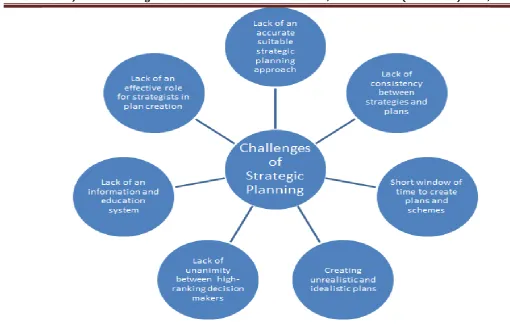
Figure 2. Challenges of Implementing Strategic Management
Case Studies
Doolen et al. (2008) have conducted research on organizational performance in which day describe the effects of Kaizen occurrences on organizational performance including results on human resources. Results from the quantitative (survey) and qualitative (interviews and company documents) data show that, even within a single organization, Kaizen occurrences can be implemented successfully. The described method can you evaluate the effect of Kaizen occurrences on business performance and the results of human resources. This study shows that initial success in business performance, as well as the results of human resources, are not necessarily related to each other and this success may vary through time.
Strategic approaches are the principles of effective guidance on marketing and choosing the strategies and activities of a company, and they reflect their strategic approaches of the company to create suitable behaviors, which lead to better performance and are based on the idea of a company about how to conduct business through an extensive system of values and deep beliefs. Research in the field of marketing has mainly focused on retaining market approaches on choosing and implementing the concept of marketing. Nevertheless, an increasing number of research emphasize choosing alternative strategic approaches such as innovative approaches, Technologic approaches, entrepreneurial approaches, quality approaches and Efficiency approaches. Researchers claim that companies can maximize their performance through complementary market approaches together with other important strategic approaches that are suitable with the conditions of the environment and characteristics of the company (Theodosiou et al., 2012).
Strategic approaches guide companies on how to categories and use company resources in order to achieve emerging market opportunities and exploiting current markets.
strategic approaches, limited models and the performance of big companies in dynamic Industries (Kumar et al., 2012).
Nandakumar et al. (2011), using the acquired evidence from production companies, studied the correlation between general strategies and performance. The aim of this research was to study the effects of business strategies and organizational performance, as well as to test the consistency of Porter’s general strategies in explaining the differences in organizational performance. This study focused on England’s production companies in the electrical and engineering fields. The data was gathered via a survey of 124 company, and visual and mental measures were taken to evaluate performance. The results showed that companies that have chosen one of the strategies of expenditure leadership or distinguishing outperform companies that have not adopted a dominant strategic approach. Integrated strategies have lower performance compared to expenditure leadership and distinguishing in measuring financial performance.
The role of strategic approaches in a company toward determining market tendencies have been studied by Johnson et al. As not many such research efforts have been conducted, the researchers have explored four key dimensions of strategic approaches of companies including Company misunderstandings, futuristic approaches, marketability, and risk aversion. Adjustment of two environmental factors, the pace of competition, and technology, based on their relation with different dimensions of strategic approaches and market tendencies have been observed via a survey in the clothing industry (Johnson et al., 2012).
The studies of Ming Lau (2011) show that companies in passing economies are learning to expand their strategies to benefit from new market opportunities. This article studies managerial approaches through high-ranking directors in a transition economy from China by focusing on teams of companies and organizational resources. The results show that these companies have an efficient management team with better managerial capabilities.
THeodosiou et al. (2012) have studied the effects between strategies approaches, marketing capacities and company performance, through which the relation between alternative strategic approaches and company performance was tested via a proxy effect from marketing capacities with an experimental model. The effect of environmental factors and company characteristics in the decision-making process regarding the continuation of beneficial strategic approaches were studied via data gathered from 316 branch directors. The researchers found out that market volatility, competition level, and lack of focus have an axial role in determining the priorities of strategic management.
In a study by Grawe et al., titled the effect between strategic approaches of innovative services and performance, it was aimed to determine the way company strategic approaches affect innovation capacities, and thus, study its feedback on market performance. In this study, structural modeling was used to study the relation between these fundamentals: Customer tendencies, competitor tendencies, cost tendencies, innovation services and market performance. Though no support has been given to the relation between cost tendencies and innovative services, the relations between Customer tendencies, competitor tendencies, and market performance has garnered support. Moreover, the relations between innovative service and market performance have been supported. This research is one of the few of its kind that has approached innovative services with a practical approach (Grawe et al., 2009).
Results of the Study
Table 1. Variable Normality Test Results*
First Conclusion
The behavior of the company’s leadership has a meaningful effect on the success of strategic planning in IOEC.
Table 2. Pearson correlation efficient between company leadership behavior and success of strategic planning
Test results Sig level
r correlation efficient No. Variables dependent Independent Meaningful relation 0.030 0.235 85
The success of strategic planning Company
leadership behavior
Table 3. ANOVA Analysis regarding regression model
Source of
changes Total measures Freedom level Average squares Statistical F P-value Regression 38.997 1 38.997 5.256
0.024 7.419 83 615.756 Remaining
Total 654.753
84
As it can be seen, based on P-value, it can be asserted that the acquired F is completely meaningful and confirm the idea that the independent variable has been effective in predicting the dependent variable. In the table below, the correlation of determining a model has been fitted, and the estimated linear regression correlations (together with their meaningful level) have been recorded.
The determining coefficient (0.060) shows that %6 of the changes of the dependent variable relying upon the success of strategic planning can be explained by the independent variable of organization leadership behavior. Other changes address other variables which have been excluded.
Variable Number
Kolmogorov Smirnoff Test Result
Sig
Decision-making Test Result
Organization Culture 56 85 0.095 0.146
Confirming Null Hypothesis
Normal distribution
Leader Behavior 36 85 0.099 0.141
Confirming Null Hypothesis
Normal distribution
Organization Support 16 85 0.102 0.135
Confirming Null Hypothesis
Normal distribution
Organization Capabilities 6 85 0.086 0.169
Confirming Null Hypothesis
Normal distribution
Leader-Member Relations 6 85 0.094 0.149
Confirming Null Hypothesis
Normal distribution
The success of Strategic Planning 32 85 0.109 0.123
Confirming Null Hypothesis
Organization capabilities have a meaningful effect on the success of strategic planning in IOEC.
Table 3. Pearson Correlation efficient between organization capabilities and success of strategic planning
Test results Sig level
r correlation efficient No. Variables dependent Independent Meaningful relation 0.000 0.397 85
The success of strategic planning Organization
capabilities
As it can be seen, the correlation efficient between these two variables, that is organization capabilities, and success of strategic planning is 0.397, and the positivity of these variables show that there is a direct relation between them. Moreover, based on Sig level that is lower than %1, H1 is confirmed, and there is a direct, meaningful relationship with an error level of %1.
Table 4. ANOVA regarding regression model
Source of
changes Total measures Freedom level Average squares Statistical F P-value Regression 68.256 1 68.256 9.659
0.003 7.066 83 586.497 Remaining
Total 654.753
84
As it can be seen, based on P-value, it can be asserted that the acquired F is completely meaningful and confirm the idea that the independent variable has been effective in predicting the dependent variable. In the table below, the correlation of determining a model has been fitted, and the estimated linear regression correlations (together with their meaningful level) have been recorded.
Third Conclusion
Organization culture has a meaningful effect on the success of strategic planning in IOEC.
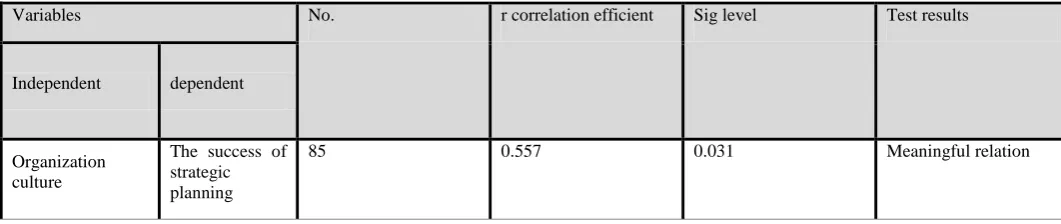
Table 5. Pearson Correlation efficient between organization culture and success of strategic planning
Test results Sig level
r correlation efficient No. Variables dependent Independent Meaningful relation 0.031 0.557 85
The success of strategic planning Organization
culture
As it can be seen, the correlation efficient between these two variables, that is organization culture and success of strategic planning is 0.557, and the positivity of these variables show that there is a direct relation between them. Moreover, based on Sig level that is lower than %5, H1 is confirmed, and there is a direct, meaningful relationship with an error level of %5.
Table 6. ANOVA related to Regression Model
Source of
changes Total measures Freedom level Average squares Statistical F P-value Regression 31.894 1 31.894 4.250
0.042 7.504 83 622.859 Remaining
Total 654.753
As it can be seen, based on P-value, it can be asserted that the acquired F is completely meaningful and confirm the idea that the independent variable has been effective in predicting the dependent variable.
Summary and Conclusion
The purpose of this study was to identify and priorities the effective factors regarding the success of the strategic planning in IOEC, and the acquired results of this article are suitable variables for the success of Strategic planning. The calculated coefficient shows that the Independent variables of this research have the capacity of predicting about 14.7 percent of the dependent variables.
A normality test was conducted for the variables, and its results, calculated through Kolmogorov Smirnoff method, were deemed as normal based on the meaningful level of the variables. Moreover, Pearson correlation tests showed that all hypotheses of the research are accepted. In a regression model, independent variables of this research are suitable variables for the possibility of implementing ideas.
References
i. Flemming, P.L; A study of the relationship between transformational leadership traits and organizational culture types in improving performance in public sector organizations: Caribbean perspective, Dissertation for the Degree Doctor of Philosophy, Capella University, 2009, p33.
ii. Aryee, S. & Chen, Z.X; Leader-member exchange in a Chinese context: Antecedents, the mediating role of psychological empowerment and outcomes. Journal of Business Research, 2006 Vol.59, p794.
iii. Lanefeld, I.D; The Role of Implicit Leadership Theories on Leader-Member Exchange and Follower Self-Efficacy, Dissertation for the Degree of Doctor of Philosophy Psychology, Walden University, 2009 p69.
iv. Turnley, W. H., & Bolino, M. C. 2001. Achieving desired images while avoiding undesired images: Exploring the role of self-monitoring in impression management. Journal of Applied Psychology, 86: 351-360.
v. Kacmar, K. M., Harris, K. J., & Nagy, B. G. 2007. Further validation of the Bolino and Turnley Impression Management Scale. Journal of Applied Behavioral Management, 9: 16-32.
vi. Barsness, Z. I., Diekmann, K. A., & Seidel, M. L. 2005. Motivation and opportunity: The role of remote work, demographic dissimilarity, and social network centrality in impression management. Academy of Management Journal, 48: 401-419.
vii. Conway , S.L. O'Keefe , P.A. Louise Hrasky, S. (2015) "Legitimacy, accountability and impression management in NGOs: the Indian Ocean tsunami", Accounting, Auditing & Accountability Journal, Vol. 28 Iss: 7, pp.1075 – 1098. viii.Fieseler , Ch. Ranzini , G. (2015) "The networked communications manager : A typology of managerial social media
impression management tactics ", Corporate Communications: An International Journal, Vol. 20 Iss: 4, pp.500 – 517. ix. Sandberg , M. Holmlund , M. (2015) "Impression management tactics in sustainability reporting", Social Responsibility
Journal, Vol. 11 Iss: 4, pp.677 – 689.
x. Bolino , m.C. Klotz , A.C. Daniels ,D. (2014) "The impact of impression management over time", Journal of Managerial Psychology, Vol. 29 Iss: 3, pp.266 – 284.
xi. Spear , S. Roper , S. (2013) "Using corporate stories to build the corporate brand: an impression management perspective", Journal of Product & Brand Management, Vol. 22 Iss: 7, pp.491 – 501.
xii. Roulin , N. Bangerter , A. Levashina , J. (2014) "Interviewers' perceptions of impression management in employment interviews", Journal of Managerial Psychology, Vol. 29 Iss: 2, pp.141 – 163.
xiii.Segev, R. Shoham, A. Ruvio, A. (2013) "Gift‐giving among adolescents: exploring motives, the effects of givers' personal characteristics and the use of impression management tactics", Journal of Consumer Marketing, Vol. 30 Iss: 5, pp.436 – 449.
xiv. Falschlunger , L.M. Eisl , Ch. Losbichler ,H. Michael Greil ,A. (2015) "Impression management in annual reports of the largest European companies: A longitudinal study on graphical representations", Journal of Applied Accounting Research, Vol. 16 Iss: 3, pp.383 – 399
xv. Herman H.M. Tse , (2014) "Linking leader-member exchange differentiation to work team performance", Leadership & Organization Development Journal, Vol. 35 Iss: 8, pp.710 – 724.
xvi. Breevaart , K. Bakker ,A.B. Demerouti ,E. van den Heuvel ,M. (2015) "Leader-member exchange, work engagement, and job performance", Journal of Managerial Psychology, Vol. 30 Iss: 7, pp.754 – 770.
xvii.Zhao, H. (2015) "Leader-member exchange differentiation and team creativity: A moderated mediation study", Leadership & Organization Development Journal, Vol. 36 Iss: 7, pp.798 – 815.
xviii. Ishfaq, A. Khairuzzaman, W. Ismail , W. Mohamad Amin, S. (2014) "Guanxi network and leader member exchange: The impetus for employee creative involvement", Asia-Pacific Journal of Business Administration, Vol. 6 Iss: 1, pp.64 – 77.
xix. Ishfaq, A. Khairuzzaman, W. Ismail , W. Mohamad Amin, S. (2014) "Employee’s reciprocation of organizational support and leader – member exchange", Management Research Review, Vol. 37 Iss: 11, pp.930 – 943.
xxi. Buch , R. Kuvaas ,B. Dysvik , A. Schyns , B. (2014) "If and when social and economic leader-member exchange relationships predict follower work effort : The moderating role of work motivation", Leadership & Organization Development Journal, Vol. 35 Iss: 8, pp.725 – 739
xxii.Liao, W.M. Finley, D.R. Shafer, W.E. (2004), EFFECTS OF RESPONSIBILITY AND COHESIVENESS ON GROUP ESCALATION DECISIONS, in (ed.) Advances in Management Accounting (Advances in Management Accounting, Volume 13) Emerald Group Publishing Limited, pp.245 – 259.
xxiii. Huang, Ch. Ch. (2009). Knowledge sharing and group cohesiveness on performance: An empirical study of technology R&D teams in Taiwan. Technovation. Volume 29, Issue 11, November 2009, Pages 786–797.
xxiv. Pillai, R. Williams, E.A. (2004) "Transformational leadership, self‐efficacy, group cohesiveness, commitment, and performance", Journal of Organizational Change Management, Vol. 17 Iss: 2, pp.144 – 159.
xxv.Bell , S.T. Brown, Sh. G. (2015), Selecting and Composing Cohesive Teams, in Eduardo Salas , William B. Vessey , Armando X. Estrada (ed.) Team Cohesion: Advances in Psychological Theory, Methods and Practice (Research on Managing Groups and Teams, Volume 17) Emerald Group Publishing Limited, pp.181 – 209.
xxvi. Artemis, Ch. Julie, D. Prashant , B. (2006) Understanding the Multidimensionality of Group. Development . Small Group Research 37(4):pp. 327-350.
xxvii. schreiner , E. (2010) , Techiques of Impression management . updated : August 2011 , e How contributor xxviii. Rang, Catharine O., (2002). "The relationship between group cohesion and leadership style and win / loss
record in collegiate soccer player". Unpublished Thesis, San Diego State university, USA
xxix. Grieve, Frederick G., (2000). "An experimental examination of the cohesion – performance relationship in an interactive team sport". Journal of applied sport psychology, Vol. 12, PP: 219-235. 28. Huang, Yen – Hsiang, (2004). "The effectiveness of charismatic leadership and support toward team behavior and cohesion".Research quarterly for exercise and sport, Vol. 75, Iss. 1, PP: 243-256.
xxx.Ariely, G. (2014). Does Diversity Erode Social Cohesion? Conceptual and Methodological Issues. Political Studies, 62(3), 573-595. http://dx.doi.org/10.1111/1467-9248.12068
xxxi. Dion, K. L. (2000). Group cohesion: From “field of forces” to multidimensional construct. Group Dynamics: Theory, Research, and Practice, 4(1), 7. http://dx.doi.org/10.1037//1089-2699.4.1.7
xxxii. Carron, A. V., & Brawley, L. R. (2012). Cohesion Conceptual and Measurement Issues. Small Group Research, 43(6), 726-743. http://dx.doi.org/10.1177/1046496412468072
xxxiii. Nasr Esfahani, A. VaezShahrestani, H. BagheriIraj, A2013; The Study of the Relationship between Cultural Intelligence and Impression Management in Isfahan University Staff. Journal of Organizational Behavior Studies. No. 4. P. 122-138.
xxxiv. YazdaniZiarat, M. Rastegar, A. 2013. The Effect of Political Skills on the Ability of Using Impression Management Techniques (Case Study: Governor's Office Staff). Human Resources Management Research. Number 3 . P. 111-134.
xxxv. Tahmasebi, R. Ghaffari, H. Shabani, M., 2014. The study of self-esteem effects on impression formation in Sepah Bank employees. Management of Organizational Culture. No. 3. Pages 333410.
xxxvi. Habibi, R., Saki, M. 2012. Self-impression Management and organizational justice: successful actors or successful managers. Journal of Educational Management Research. Second Issue.
xxxvii. Hadavinezhad, M. Danaeifard, H Azar, A.KhaefElahi, A. 2013. Hypocritical behaviors in the organization's interpersonal communication. The Perspective of Public Administration. No. 13. p. 11-40.
xxxviii. Hadavinezhad, M. Danaeifard, H Azar, A.KhaefElahi, A. 2010. Exploration of the process of hypocritical behaviors in interpersonal communication in organization using data base theory. Strategic Management Thought.No. 1. p. 81-130.
xxxix. Danaeifard, H. RajabzadehGhatari, A. Maki Nayeri, P. 2013. Impression Management in Upward Penetration. No. 4, P. 522-540