Original Article Published online: 20 March 2019.
Javad Akbari
1*, Azizeh Chalak
1* Correspondence:
1. English Department, Islamic Azad University, Isfahan (Khorasgan) Branch, Isfahan, Iran
Received: 16 August 2018
Revision: 30 September 2018
Accepted: 30 November 2018
Published online: 20 March 2019
Abstract
The power of praise in changing student behavior is that it both indicates teacher approval and informs the student about how the praised academic performance or behavior conforms to teacher expectations. Notably, praise plays a significant role in the rate and success of learning process in general, and in language learning classroom in particular. Accordingly, the present study sought to investigate the significant influence of praise on the growing trend of university students with different majors, namely, Teaching English as a Foreign Language (TEFL) and linguistics. To this end, from the population of students majoring in English, at the Islamic Azad University, Isfahan, Iran, two classes of sophomore students were selected, each containing thirty participants. Subsequently, the experimental group was exposed to a wide variety of distinguishing instructor praise expressions throughout the entire term while the students in the control group were not praised and encouraged. The results of the t- test revealed that the group which was praised by the instructor during the term progressed substantially in comparison with the other group. Moreover, there appeared to be a positive correlation between instructor praise and learner progress. Evidently, the results of the present study may have practical implications for EFL teachers, materials developers, and syllable designers.
Keywords: academic performance, instructor praise, learning process, learner progress
1. Introduction
A lack of participation and misbehavior are often generated as a way for students to avoid task demands, avert failure, and avoid peer embarrassment when failure occurs (Colvin, 2004; Miles & Stipek, 2006; Scott, Nelson, & Liaupsin, 2001). To increase student participation, teachers need to acknowledge small successes each day immediately and consistently reinforcing student effort (Bost & Riccomini, 2006; Brophy, 1979; Scott et al., 2001). Yet teachers often lecture, model, ask questions, give directions, and monitor independent student practice increasing demands on compliant students while rarely incorporating motivational techniques or evidence-based instructional strategies into everyday teaching (Carr, Taylor, & Robin-son, 1991; Schumaker et al., 2002). When disruptive behaviors occur, teachers often respond with warnings, threats, or office referrals to gain compliance (Villa et al., 2005).
Praise is not only an integral part of learning and teaching process but also an indispensable part of the whole life of a human being. Although, praise influences what we do and how we learn from the very early life, it remains quite latent part of the process. In fact, this was the first idea behind this paper and a driving force to bring some of its secrets to the surface. Where it is a rather abstract topic, it should be possible to give some shape to things that all people perceive but often do not realize. Praise is a motivational factor that assists students in learning and progressing. Therefore, it is of utmost importance to find out what major role praise plays in the process of learning. To be able to do so, it is necessary to have a closer look at the effects praise may have on people (Skalecka, 2010). Until recently, there has been little evidence that the incorporation of praise and admiration into the process of learning and teaching can lead to considerable progress. By the utilization of praise, students will be motivated to proceed their lessons with more enthusiasm. Although, some research has been carried out on the influential role of praise and encouragement in educational settings, there have been few empirical investigations into the effects of using praise on university students.
Nowadays, adult learners are not adequately encouraged and praised not only in work-related situations but also in educational settings. They are often criticized for little mistakes they might perpetrate, however, not praised for good performance they may represent. Praising students in the target language is acknowledged to be an effective process in motivating them. Despite the fact that learners might face plenty of obstacles in learning English and may be demotivated to learn, praise words and notes identified by instructors can help learners adopt more positive attitudes towards language learning. The present study intents to shed some light on the significance of adopting and employing praise words in classes so that students will culminate in better understanding and learning. The main purpose of this research study is to investigate the profound impact of praise on the progress of students who are studying English in the university.
2. Literature Review
In relation to student motivation, discussions surrounding student praise have become increasingly prominent and varied. As Dweck (1999) points out, praise, if used correctly, is a powerful tool that can help students embrace intellectual challenges, understand the value of effort, and better deal with setbacks; however, if used improperly, praise can negatively impact students by rendering them passive and dependent on the opinion of others. Research appears to support the use of praise in classroom environments but only if used in certain capacities. Dweck (1999) explains that when we praise students solely for their intelligence, failure becomes more personal and, more of a disgrace; students consequently become less able to deal with their setbacks. Dweck (1999) found these negative impacts of praising intelligence to be true and equally strong for both high and lower achieving students. Students can be sensitive to comments made about their personal characteristics and thus educators need to always keep students’ feelings in mind when attempting to deploy praise.
Dweck (1999) explains that teachers should praise students but in a way that is enthusiastic about students’ strategies, not about how their performance reveals an attribute they may view as unchanging and beyond their control. Thus, Dweck is distinguishing between person praise and process praise by prioritizing the latter over the former. Person praise focuses more on the attributes tied to a specific individual where process praise focuses on the work, efforts, and processes endemic to completing a task. In a study of the effects of person praise and process praise on 111 students’ motivation, Haimovitz and Henderlong-Corpus (2011) found that process praise enhances intrinsic motivation and perceived competence more than person praise; person praise decreased motivation for students where process praise increased motivation for students.
Conroy, Sutherland, Snyder, Al-Hendawi, and Vo (2009) agree that process praise is more advantageous to increasing student performance (e.g. increasing students’ correct responses and the amount of work completed by students) and enhancing classroom atmosphere than person praise. Beyond this agreement, the research of Conroy et al. (2009) illuminates the importance of considering students’ individual and cultural differences when using praise. For example, students from different socioeconomic backgrounds and ability levels may respond differently to praise and thus these differences must always be considered before praising students. The authors also explain that effective praise should be teacher initiated, include specific statements about the appropriate behavior children display, immediately follow a desired behavior, consider where a student is in the process of attaining a particular skill, be sincere, and avoid comparisons across students (Conroy et al., 2009).
In addition, the research of Partin, Robertson, Maggin, Oliver, and Wehby (2010) shows that teacher praise as positive reinforcement for students’ appropriate behavior and the provision of high rates of opportunities for students to respond correctly to academic questions, tasks, or demands decreases inappropriate student behaviors and increases appropriate behaviors. Furthermore, consistent and appropriate use of teacher praise and increased OTR may serve as an important and crucial step to establish predictable and positive classroom contexts (Partin et al., 2010). Through a case-study examining the effect of praise on math instruction at a middle school, Haydon and Musti-Rao (2011) found that behavior-specific praise (the rewarding of a specific academic or social behavior with a verbal comment) had a positive influence on student participation, classroom atmosphere (specifically a significant reduction in disruptive classroom behavior), and teacher-student interactions (especially when used immediately following a desired behavior.) The authors also concluded that teachers can benefit from increasing their adeptness in using praise and suggested that praise is underused as an effective instructional strategy (Haydon & Musti-Rao, 2011).
Teacher-written praise notes can have a particularly positive impact on student engagement and learning. These notes have been proven to promote a positive environment and reinforce the appropriate use of social skills for students in elementary and middle school. For example, Nelson, Young, Young, and Cox (2010) show that the use of teacher-written praise notes in a middle school significantly reduced the number of student discipline referrals at the school; there was a strong negative correlation between the number of praise notes that were distributed and the number of discipline referrals that students received. In addition, Caldarella, Christensen, Young, and Densley (2011) show that teacher-written praise notes significantly decreased tardiness in an elementary school setting.
Praise notes may be used for all students in a particular school or class and can be purposely tailored for selected students who have demonstrated a specific need for behavioral redress. When choosing specific students with recurring behavior issues such as tardiness, it is important to confirm that the student demonstrates a clear pattern of tardiness worth addressing with praise notes instead of a tendency to show up late once or twice a year. Also, teachers and administrators should consider whether or not the student is likely to benefit from praise notes as some actions such as tardiness, may be out of a student’s control if he or she depends on someone else to get to school in the morning (Caldarella et al., 2011).
In order for praise notes to be successful, teachers need to monitor the effects of this practice. In line with the research presented above, teachers need to confirm that praise is given in a frequent, contingent, and specific manner to increase effectiveness. Initially, students should be given praise notes whenever they show the desired behavior. Subsequently, if the teacher notices that the desired target behavior has occurred and is occurring consistently, the frequency of the notes can be faded and potentially eliminated (Caldarella et al., 2011). When noticing that students are not continuously demonstrating the desired behavior after receiving initial praise notes, teachers should not give much attention to these students in order to eliminate potentially attention-seeking behaviors (Caldarella et al., 2011). If teachers notice that certain students never seem to receive praise notes, teachers can watch those students carefully for positive behaviors to praise.
Although most research surrounding the use of process praise is inherently supportive of the practice, there has been recent scholarship aimed at examining the value of process praise in relation to person praise and no praise at all. One such study by Skipper and Douglas (2012) showed that those in the process condition did not differ significantly from those in the control (no praise) group. This finding suggests that process praise may not be inherently positive. However, person praise was shown to be particularly detrimental which is consistent with other research findings and students respond to person, process, and no praise in equally positive manners when they are succeeding.
In fact, the research questions to be answered in this study look like the following:
1. Does incorporation of praise in class help university students majoring in TEFL and linguistics improve their collocational knowledge?
2. Is there a correlation between the number of praise expressions and the scores of collocational knowledge and competence?
3. Methodology
3.1 Design of the Study
All the data collected in this research study were numerical and objective. It was a quantitative research study that started with a quasi-experimental design in which a specific hypothesis precedes the quantification of data with follow-up numerical analyses. The investigation compared student test results before and after an instructional treatment in the pre-test and post-test respectively. This quantitative research study was confirmatory and outcome-oriented in nature.
3.2 Participants
Two parallel classes of sophomore students studying English in Islamic Azad University, Isfahan Branch, Iran were recruited for this study. They were attending the grammar course in an entire semester. Each class consisted of 30 students aged between 19 and 30 years. Participants were of both male and female genders. The subjects were selected on the basis of a degree of homogeneity of their English courses and the number of terms attended in the university. All the participants’ native language was Persian and they were generally studying English as a foreign language. 3.3 Instruments
To begin with, three particular instruments including a placement test, a pre-test, and a post-test were employed for the purpose of assessment and evaluation. Accordingly, the solution placement test was administered in the beginning of the investigation. The pre-test was given to participants prior to the treatment while the post-test was responded by students after the treatment. In order to determine the homogeneity of the sample classes, subjects were asked to take the Solution Placement Test (Edward, 2013) prior to the study. In a nutshell, this test includes 50 multiple-choice items which assesses students’ knowledge of general English. Both grammar proficiency and vocabulary knowledge are examined in this test. The whole administration took approximately forty minutes. Prior to the study, a pre-test was administered to find out students’ knowledge of collocations. To this end, a series of thirty intermediate English collocation items was given to the students for this purpose.
At the end of the term, a post-test comprised thirty collocation tests was given to both classes to determine their progress. In fact, one of the classes was taught collocations in which the instructor made use of praise and encouragement whereas the other one was not exposed to any encouraging expressions. Having considered the processes occurred in both classes, the post- test was delivered at the end of the semester. Furthermore, the reliability of both pre-test and post-test was 0.84 calculated by KR-21 formula. In order for the researcher to find out the content validity of the tests, a wide variety of different experienced and knowledgeable teachers were consulted.
3.4 Data Collection Procedure
Both groups of sophomore students were taught collocations and chunks throughout the whole term. The experiment was carried out over the course of the growing period of 16 sessions, each met once a week. Furthermore, it needs to be noted that both classes including experimental group and control group were taught by the same instructor throughout the semester. Another point worthy of mention is that instructions and methods employed to teach students in the experimental group and students in the control group were the same during the investigation. One of the classes was engrossed in a situation in which a big number of praise words and notes were employed by the instructor in the process of teaching. In addition, students were always encouraged to spend more time at home practicing the collocations. The instructor was stressing the importance of learning collocations and utilizing them in appropriate places as well. However, students in the other class did not receive much praise for the active participation and correct responses they had. Even though they were giving good contributions to the discussions under consideration, the students were not much praised and admired for their good work. From time to time, they were demotivated to take part in class and group activities.
In fact, the changes between groups cannot be attributed to different teaching approaches and training techniques adopted by the instructor but to various praise and encouraging expressions utilized in the classroom. In essence, the number of praise features generated in the classroom setting in each session substantially affected the performance of students throughout the semester. The number of praise words rewarded in the first group was quite a lot in comparison with the second group’s praise notes. The encouraging expressions and praise notes were recorded and stored for later analysis. Moreover, the number of praise words that were employed in each session was counted and written to be interpreted subsequently. In the experimental class, the number of praise notes attributed to students throughout the teaching process was written for later analysis. Also, the scores obtained from the pre-test and post-test were recorded for the comparison analysis. Conversely, the instructor in the control class did not use any praise words and pre-test and post-test scores were just recorded.
3.5 Date Analysis
The numerical and statistical data were elicited and gathered throughout data collection measures illuminated previously and then they were employed for subsequent analysis and interpretation. All the data and results gained through pre-test and post-test were fed into the computer and then analyzed employing SPSS software program. Data management and analysis were performed using statistical package for the social science (SPSS) 24.0 (2010) version. Technically, both qualitative and quantitative data were analyzed with the help of SPSS program. Participants received 1 point for each correct answer in multiple-choice items in the pre-test and post-test. Descriptive statistics (frequency, mean, and standard deviation), independent sample t-test and paired sample t-test were used for the analysis of the quantitative data. In fact, paired sample t-tests for TEFL and linguistic groups were utilized. Descriptive statistics were applied to analyze all quantitative data.
4. Results
4.1 Independent Sample t-test before the Treatment
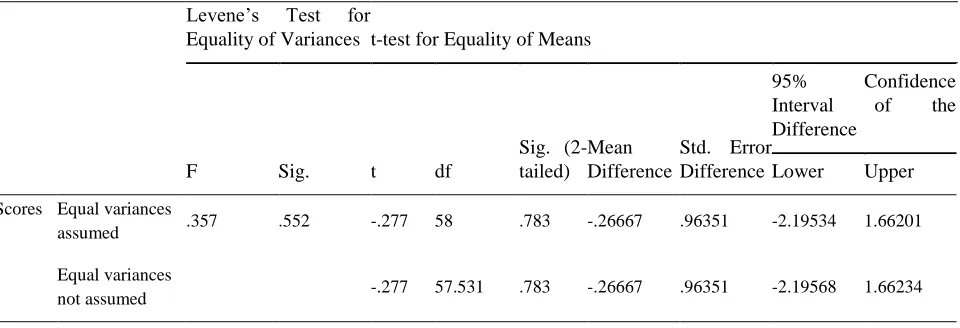
Table 1 represents the number of students in each group, the mean scores, and standard deviation points. In table 2, significance is .552 that is more than .05 which means that the two groups were homogeneous at the beginning of the treatment.
Table 1. Group statistics
Major N Mean Std. Deviation Std. Error Mean
Scores TEFL 30 15.3000 3.89651 .71140
Linguistics 30 15.5667 3.55919 .64982
Table 2. The results of the Independent-Sample t-test for the pre-test Levene’s Test for
Equality of Variances t-test for Equality of Means
F Sig. t df
Sig. (2-tailed)
Mean Difference
Std. Error Difference
95% Confidence Interval of the Difference
Lower Upper
Scores Equal variances
assumed .357 .552 -.277 58 .783 -.26667 .96351 -2.19534 1.66201
Equal variances
not assumed -.277 57.531 .783 -.26667 .96351 -2.19568 1.66234
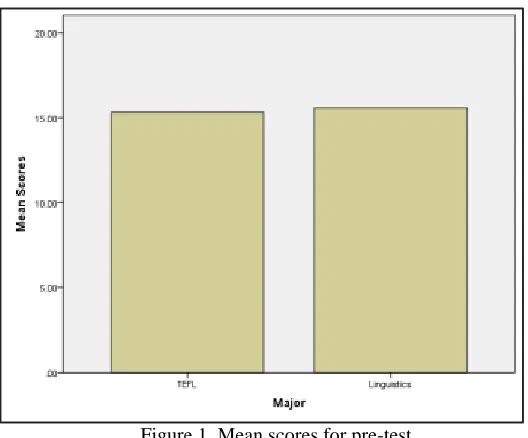
As Figure 1 depicts, the mean scores for both TEFL and Linguistics groups are approximately the same and it means that the two groups were homogeneous in terms of collocational knowledge in the beginning of the investigation.
Figure 1. Mean scores for pre-test 4.2 Independent Sample t-test after the Treatment
In Table 3, the number of students in each group, the mean scores of the two groups, and the standard deviation point are presented. According to the result of the independent sample t-test in Table 4, sig.= .044 that is less than .05 (cut-off point). Therefore, the null hypothesis is rejected.
Table 3. Descriptive statistics for the post-test
Major N Mean Std. Deviation Std. Error Mean
Post-test TEFL 30 20.7000 3.88765 .70978
Linguistics 30 18.4667 4.47779 .81753
Table 4. The results of the Independent-Sample t-test for the post-test Levene’s Test for
Equality of Variances t-test for Equality of Means
F Sig. t df
Sig. (2-tailed)
Mean Difference
Std. Error Difference
95% Confidence Interval of the Difference
Lower Upper
Post-test Equal variances
assumed 1.402 .241 2.063 58 .044 2.23333 1.08266 .06616 4.40051
Equal variances not
assumed 2.063 56.879 .044 2.23333 1.08266 .06525 4.40142
As Figure 2 represents, students in the TEFL group had better performance as compared to students in the Linguistic cohort due to the fact that TEFL students were exposed to a wide variety of different praise words and expressions throughout the sessions.
Figure 2. Mean scores for post-test 4.3 Paired Sample t-test for TEFL Group
According to paired sample t-test for TEFL, the fifth Table shows the descriptive statistics for paired samples t-test. The mean scores, the number of students, and standard deviation points are presented in Table 5. Accordingly, the mean score for the pre-test is 15.3 while the mean score for the post-test is 20.7 which means that there was a considerable progress after the treatment in the experimental group.
Table 5. Descriptive statistics for Paired Samples t-test for TEFL
Mean N Std. Deviation Std. Error Mean
TEFL Pretest 15.3000 30 3.89651 .71140
Posttest 20.7000 30 3.88765 .70978
As Table 6 illustrates, the significance is .00 that is less than .05, as a result, the treatment was effective. It means that praise had a significant effect on the experimental group.
Table 6. Paired Samples correlation for TEFL
N Correlation Sig.
TEFL Pre-test & Post-test 30 .969 .000
Furthermore, in Table 7 sig. (2-tailed)= .000 that is less than cut-off point (.05) which means that the treatment was influential and effective and praise had a positive influence on collocational knowledge of students.
Table 7. The result of Paired Samples t-test for TEFL Paired Differences
t df
Sig. (2-tailed) Mean
Std. Deviation
Std. Error Mean
95% Confidence Interval of the Difference
Lower Upper
TEFL Pretest Posttest 5.40000 .96847 .17682 -5.76163 -5.03837 -30.540 29 .000
4.4 Paired Sample t-test for Linguistics Group
Based on paired sample t-test for Linguistics, Table 8 shows the descriptive statistics for paired samples t-test. The mean scores, the number of students, and standard deviation points are identified in this table. As such, the mean score for the pre-test is 15.5667 while the mean score for the post-test is 18.4667 which show that there was not as much progress as the one in the TEFL group. In line with that, the progress in the experimental (TEFL) group was much more than the improvement in the control (Linguistic) cohort due to the fact that the experimental group was exposed to a lot of praise expressions.
Table 8. Descriptive statistics for Paired Samples t-test for linguistics
Mean N Std. Deviation Std. Error Mean
Linguistics Pre-test 15.5667 30 3.55919 .64982
Post-test 18.4667 30 4.47779 .81753
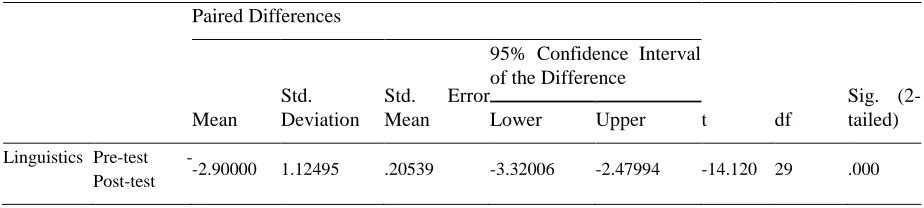
As Table 9 depicts, the significance is .00 that is less than .05, as a result, the treatment was effective. Furthermore, in Table 10 sig. (2-tailed) is .000 that is less than cut-off point (.05) which means that the treatment was influential.
Table 9. Paired Samples correlation for linguistics
N Correlation Sig.
Linguistics Pre-test & Post-test 30 .987 .000
Table 10. The result of Paired Samples t-test for linguistics Paired Differences
t df
Sig. (2-tailed) Mean
Std. Deviation
Std. Error Mean
95% Confidence Interval of the Difference
Lower Upper
Linguistics Pre-test -
Post-test -2.90000 1.12495 .20539 -3.32006 -2.47994 -14.120 29 .000
5. Discussion
The present study investigated the significance of adopting and employing praise words in classes so that students will culminate in better understanding and learning. The main purpose of this research study was to examine the profound impact of praise on the progress of students who are studying English in the university. In line with Dweck (1999), this study revealed that using praise words can have a positive influence on English knowledge of university students. In addition, praise, if used correctly, is a powerful tool that can help students embrace intellectual challenges, understand the value of effort, and better deal with setbacks. Furthermore, praise can help students take part in all class activities and exercises and share their opinions.
Teacher-written praise notes can have a particularly positive impact on student engagement and learning. These notes have been proven to promote a positive environment and reinforce the appropriate use of social skills for students in educational and academic settings. The results of the study revealed that the experimental group possessed better collocational knowledge than the control group.
In agreement with Nelson, Young, Young, and Cox (2011), there was a positive correlation between the number of praise words and the scores of the collocation test. It means that the utilization of praise expressions and collocational scores on the test can have a close and interdependent relationship with each other. In line with this, the more praise words and expressions the instructor uses while teaching, the better scores and results students can achieve in the collocation test, writing exercises, and speaking activities.
The authors concluded that teachers can benefit from increasing their adeptness in using praise and suggested that praise is underused as an effective instructional strategy. There is a consensus that behavior and performance praise (the rewarding of a specific behaviour or an academic performance with a verbal comment) can have a positive influence on student participation, classroom atmosphere particularly a significant reduction in disruptive classroom behavior, and teacher-student interactions especially when used immediately following a desired behavior.
The results of the current investigation is in agreement with Haydon and Musti-Rao (2011) and confirmed that the instructor praise played a pivotal role in improving and augmenting the classroom behaviour and achievement of university students. Moreover, praise can sow in students’ mind the seed of motivation and enthusiasm so that they can produce a lot more utterances and sentences not only in speaking tasks but also in writing activities.
6. Conclusion
The present study attempted to investigate the contributory role of praise notes and encouragement in improving collocational knowledge of Iranian university students majoring in TEFL and linguistics. In a sense, this research study proved that using praise expressions and encouragement not only help students speak more fluently but also lead to better confidence. Furthermore, the number of praise words that instructors use in their teaching processes inevitably influences the scores they accomplish in collocation tests. The results of the t-test revealed that the experimental group possessed better collocational ability based on the occurrences of lexical chunks. There was a positive correlation between the number of praise expressions and the scores of collocation test. In line with this, the more praise notes instructors use while teaching lessons the better scores learners may achieve in the collocation tests. To conclude, utilization of these expressions and encouragement improves the collocational knowledge of Iranian university students of TEFL and linguistics in all classes.
Evidently, the findings of the present study may have implications for EFL teachers and syllabus designers, and materials developers. Another application to be included is that the lesson planners, policy makes, and school managers can benefit from the contributory role of praise and encouragement in stimulating and motivating English teachers and university instructors to lead the classes more confidently and successfully. In addition, the results of this research study may provide significant help for students who are learning English as a foreign language and seeking ways to improve their collocational knowledge through social interactions. The present research study was completed at the university level which included students majoring in TEFL and Linguistics and did not encompass translation students. Furthermore, another limitation of this investigation is that it did not take account of school students but university students. The present examination was oriented and manipulated at the Islamic Azad University and was not accounted for in other universities such as the state university, Payam Noor University, and etc. This study can be carried out in other educational settings such as high schools, junior high schools, and vocational centers. Moreover, the present study might be replicated in other provinces, cities, and ethnics with different English language exposures, language backgrounds, and proficiency levels. Last but not least, it can be conducted in overseas countries with non-native and immigrant students including both males and females and different age groups.
References
Bost, L. W., & Riccomini, P. J. (2006). Effective instruction: An inconspicuous strategy for dropout prevention.
Remedial and Special Education, 27(5), 301-311. https://doi.org/10.1177/07419325060270050501
Brophy, J. E. (1979). Teacher behavior and its effects. Lansing, MI: Michigan State University Institute for Research on Teaching.
Caldarella, P., Christensen, L., Young, K. R., & Densley, C. (2011). Decreasing tardiness in elementary school students using teacher-written praise notes. Intervention in School & Clinic, 47(2), 104-112. http://dx.doi.org/10.1177/1053451211414186
Carr, E. G., Taylor, J. C., & Robinson, S. (1991). The effects of severe behavior problems in children on the teaching behavior of adults. Journal of Applied Behavior Analysis, 24(3), 523-535. doi: 10.1901/jaba.1991.24-523 Colvin, G. (2004). Managing the cycle of acting-out behavior in the classroom. Eugene, OR: Behavior Associations. Conroy, M. A., Sutherland, K. S., Snyder, A., Al-Hendawi, M., & Vo, A. (2009). Creating a positive classroom atmosphere: Teachers’ use of effective praise and feedback. Beyond Behavior, 18(2), 18-26. https://eric.ed.gov/?id=EJ869681
Dweck, C. S. (1999). Caution – praise can be dangerous. In B.A. Marlowe & A.S. Canestrari (Eds.), Educational
psychology in context: Readings for future teachers (pp. 207-217). Thousand Oaks: Sage .
Edwards, J. K. (2013). Strengths-based supervision in clinical practice. Thousand Oaks, CA: SAGE.
Haimovitz, K., & Henderlong-Corpus, J. (2011). Effects of person versus process praise on student motivation: Stability and change in emerging adulthood. Educational Psychology ,31(5), 595-609. http://dx.doi.org/10.1080/01443410.2011.585950
Haydon, T., & Musti-Rao, S. (2011). Effective use of behavior-specific praise: A middle school case study. Beyond
Behavior, 20(2), 31-39. https://eric.ed.gov/?id=EJ958714
Miles, S. B., & Stipek, D. (2006). Contemporaneous and longitudinal associations between social behavior and literacy achievement in a sample of low-income elementary school children. Child Development, 77(1), 103-117. doi: 10.1111/j.1467-8624.2006.00859.x
Nelson, J. A. P., Young, B. J., Young, E. L., & Cox, G. (2010). Using teacher-written praise notes to promote a positive environment in a middle school. Preventing School Failure, 54(2), 119-125. http://dx.doi.org/10.1080/10459880903217895
Partin, T. C. M., Robertson, R. E., Maggin, D. M., Oliver, R. M., & Wehby, J. H. (2010). Using teacher praise and opportunities to respond to promote appropriate student behavior. Preventing School Behavior, 54(3), 172-178. http://dx.doi.org/10.1080/10459880903493
Schumaker, J. B., Deshler, D. D., Bulgren, J. A., Davis, B., Lenz, B. K., & Grossen, B. (2002). Access of adolescents with disabilities to general education curriculum: Myth or reality? Focus on Exceptional Children, 35(3), 1-16. doi: 10.17161/fec.v35i3.6795
Scott, T. M., Nelson, C. M., & Liaupsin, C. J. (2001).Effective instruction: The forgotten component in preventing school violence. Education and Treatment of Children, 24(3), 309-322. https://www.jstor.org/stable/42899664
Skalecka, K. (2010). The effective use of praise in teaching adults. University of Pardubice Faculty of Arts and Philosophy.
Skipper, Y., & Douglas, K. (2012). Is no praise good praise? Effects of positive feedback on children’s and university students’ responses to subsequent failures. BritishJournal of Educational Psychology, 82(2), 327-339. doi: 10.1111/j.2044-8279.2011.02028.x
Villa, R. A., Thousand, J. S., Nevin, A., & Liston, A. (2005). Successful inclusive practices in middle and secondary schools. American Secondary Education, 33(3), 33-52. https://www.jstor.org/stable/41064553