Improving Competitiveness Trough Creation of Knowledge and Reverse Logistics
Antonio Mihi Ramírez, Víctor Jesús García Morales
University of Granada
Campus Cartuja s/n, 18071, Granada, Spain e-mail: [email protected], [email protected]
From the perspective of Resource Based View Theory companies pursue sustainable competitive advantages in their resources and capabilities, analyzing and strengthening them (Penrose, 1959; Wernerfelt, 1984; Barney 1991; Amit & Schoemaker, 1993; Peteraf, 1993). So strategy of the organization should focus on its core competencies because they allow maximize value of the organization (Prahalad & Hamel, 1990). Therefore knowledge has become one of the most important intangible assets for the company (Nonaka, 1994; Scarborough et al., 1999; Storey & Barnett, 2000; Lee & Sukoco, 2007; Carbonara & Caizza, 2008; Li et al., 2009) and in particular the process of creation of knowledge within the organization (Nonaka, 1994, Nonaka & Konno, 1998).
Similarly, consideration of a reverse flow in logistics amplify the company's competitive capabilities in the sense of increasing resources and capabilities on which to develop the potential of the organization and to achieve, in this way, the desired competitive advantage sustainable, because to meet the increasing needs of customers demanding, the product must be not only quality but also highly competitive, be available when and where appropriate and be respectful of the environment (Stock, 1992; Tibben-Lembke & Rogers, 2002). The study of all this product flow in the opposite way and how to deal with all things entailed for the organization is what has been called in recent years Reverse Logistics (Rogers & Tibben-Lembke, 1999, 2001; Dowlatshahi, 2000; Tibben-Lembke & Rogers, 2002; Council of Logistics Management, 2003; Krikke et al., 2003; Stock et al., 2002).
Activities of Reverse Logistics require adequate knowledge management in all phases of return of the product that may help to solve problems it faces in all these processes (Wadhwa & Madaan, 2007), and also may approach the current goals of customer satisfaction and business benefit to the legislation for the environment. In this sense, it is fundamental for the organization to have ability to generate new knowledge to reduce the high uncertainty of Reverse Logistics activities (Arrow, 1962; Galbraith & Kazanjian, 1986; Murdick & Munson, 1988; Drucker, 1993).
Even with growing importance of both variables, there is a lack of scientific literature that attempt to analyze the relationship between the creation of knowledge and Reverse Logistics and their possible implications. So it is very interesting to analyze the relationship between the creation of knowledge and the importance of Reverse Logistics, and their influence on organizational performance. Using Nonaka and Takeuchi's model of knowledge creation (SECI model, Nonaka & Takeuchi,
1995), we develop and test hypotheses on such relationship using a sample of 284 Spanish firms by examining the direct and indirect effects of knowledge creation and Reverse Logistics upon firm performance. The rest of the paper is set out as follows. The next section considers the previous literature and sets out the hypotheses of this study. The following part is the methodology for the study. Then, the paper presents the results of the empirical study in achieving the goals as those set out above. Discussion and conclusions are provided in the last section. Results of this investigation support that the creation of knowledge positively affects Reverse Logistics and it improves company performance
Keywords: Creation of Knowledge, Reverse Logistics, Knowledge Management, Resource Based View Theory, Organizational Performance.
Introduction
Resource Based View theory recognizes knowledge as a strategic resource of firms (Hunt, 1995; Grant, 1996; Hunt & Morgan, 1996; Teece, 1998). The capability to create and utilize knowledge enables a firm to develop sustainable competitive advantage because knowledge possesses the characteristics of heterogeneity, uniqueness, and immobility (Barney, 1991; Grant, 1996; Hunt & Arnett, 2006; Zack, 1999; Li et al., 2009). Previous studies have revealed the critical role of knowledge creation in a successful organizations (Nonaka & Takeuchi, 1995; Matusik & Hill, 1998; Gold et al., 2001; Kogut & Zander, 2003; Chia, 2003) Organizations that better utilize knowledge creation process can connect knowledge in new and distinctive ways, and develop market offerings to provide value to customers (Hunt & Morgan, 1997; Lee & Choi, 2003; Nonaka & Konno, 1998).
contains not only knowledge transfer but also knowledge creation. Third, the SECI model has been widely used in many research areas such as organizational learning and new product development (Nonaka et al., 2000; Lee & Choi, 2003). In addition, according to the Resource Based View theory the source of competitive advantage in dynamic environments where there is high uncertainty (Koster & Malhotra, 1999) rests on the essential capabilities that are difficult to imitate (Prahalad & Hamel, 1990) as are knowledge (Scarborough et al., 1999; Storey & Barnett, 2000; Carbonara & Caizza, 2008) and Reverse Logistics activities (Kotler, 1994; Rogers & Tibben-Lembke, 1999; Lambert & Burduroglu, 2000).Currently the number of products returned or out of use is increasing significantly, so management of these products from the point of collection to the origin present a high degree of additional uncertainty on the customer service time, on the origin and the quality of the materials returned. So Reverse Logistics is critical, its importance increases and even greater is the need for information to the proper management of material flow returned (Day 1994; Bowersox et al., 1999; Daugherty et al., 2002). Even it influences the form of recovery to be used and the sequence of steps that must follow the process of collection and recovery of returned material (Wadhwa & Madaan, 2007). Gradually with the increase of published papers on Logistics and Reverse Logistics some studies have emerged that point, at first, the relationship between Logistics and knowledge creation (Christopher, 1994; Dunn et al., 1994; Jones et al., 1997; Wijnhoven, 1998; Garver & Mentzer, 1999; Martin & Casadesus, 1999; Arlbjorn & Halldorsson, 2002; Chapman et al., 2002; Moreno, 2005; Manzano & Segui, 2007). Also in recent years, with an increasing number of studies on Reverse Logistics, there is emerging the research that analyzes the relationship between Reverse Logistics and knowledge creation, although it is still very scarce (Arlbjorn & Halldorsson, 2002; Wadhwa & Madaan , 2004, 2007). We told that the role of Reverse Logistics is critical, its importance increases and even greater is the need of information of the proper management of material flow returned (Day, 1994; Bowersox et al., 1999; Daugherty et al., 2002). So processes of knowledge creation that enable the capture, storage, retrieval and dissemination of knowledge logistics in the organization become fundamental (Nonaka & Konno, 1998; Rogers &Tibben-Lembke, 1999; Martínez & Ruiz, 2006)
The aim of this research is to analyze the relationship between the creation of knowledge and the importance of Reverse Logistics, and how it improves organizational performance.
Research object is the relationship between SECI model and Reverse Logistics.
Research method. Based on theoretical review of scientific literature on SECI model and Reverse Logistics the direct and indirect effects of relations between constructs was analyzed by structural equations model.
Theoretical framework and proposals
To analyze creation of knowledge we have based on the creative organization of knowledge by Nonaka &
Takeuchi (1995) where the epistemological dimension of knowledge interrelate through a full cycle of knowledge creation across different ontological levels. We have considered the 4 knowledge conversion modes of this popular model of knowledge creation: Socialization, Externalization, Internalization and Combination, studying every relationship between these modes of knowledge conversion. We will discuss the forms of knowledge creation and its relationship with the importance of Reverse Logistics (Takeuchi & Nonaka, 1986; Henderson & Clark, 1990; Brancheau et al., 1996; Sánchez & Mahoney, 1996; Byrd & Turner, 2000; Robertson & Sribar, 2002; Schalken et al., 2005; Chan et al., 2006). Then we analyze how this relationship affects performance of the firm because these variables are essential for effective management of any organization (Griffis et al., 2007).
For these constructs we propose next hypothesis: 1. The influence of Socialization on Externalization Socialization processes such as direct interaction, brainstorming, and informal meetings help employees to share and exchange valuable knowledge (Zhang, et al., 2004). Socialization process seeks to collectivize knowledge embedded in individual members. Frequently social interaction and perception help organizational members to share mental modes and experiences (Nonaka et al., 2000b). Employees empathize with colleagues to exchange a variety of knowledge for their work and problem-solving (Becerra-Fernandez & Sabherwal, 2001), and thus diminish communication barriers between individuals (Nonaka et al., 2000a). Then, through externalization, employees can understand new product development and increase their involvement in the activities of articulating tacit knowledge into substantial concepts and notions (Nonaka & Takeuchi, 1995; Nonaka & Konno, 1998; Nonaka & Toyama, 2005). When tacit knowledge is converted to explicit knowledge, it is easier understood by employees. Externalization facilitates employees to express images or ideas as substantial concepts and notions that are needed for new product innovation and development. The newly explicit knowledge is then integrated and disseminated at the group as well as the organizational level (Nonaka & Takeuchi, 1995; Nonaka et al., 2000b).
Konno, 1998) to share it in the organization (Nonaka & Takeuchi 1995; Nonaka & Toyama, 2003). Processes of Socialization affect processes of Externalization because participants of these processes must share time and space to work through direct experience for the interaction of these tacit and explicit knowledge (Nonaka & Toyama, 2003). Therefore, tacit knowledge of Socialization is articulated into explicit forms through Externalization activities (Li et al., 2009).
Thus, we suppose that: Hypothesis 1: Socialization will be positively related to Externalization.
2. Externalization influence Combination
Combination process can make innovative ideas more usable, thereby crystallizing knowledge into new products or services (Li et al., 2009). The newly created knowledge from Externalization is then combined, edited, or processed to form more complex and explicit knowledge through the combination process (Nonaka & Konno, 1998).
Each of the four modes of knowledge conversion represent the ways in which existing knowledge can be "converted" into new knowledge and every mode can create new knowledge independently, but in this case knowledge created may be limited and difficult to apply (Nonaka et al., 1994). That is knowledge creation centers on interrelations between different modes of knowledge conversion (Nonaka, 1994). Thus, Externalization needs Combination “to embody knowledge in a form that is concrete enough to facilitate further knowledge creation in a wider social context” (Nonaka et al., 1994, 341).
The use of documents, meetings, and computerized communication networks facilitates this mode of knowledge conversion (Nonaka, & Takeuchi, 1995). In Combination the knowledge from Externalization is shared within the organization, thus new superior explicit knowledge is disseminated in the company (Nonaka & Konno, 1998). The combination activities edit and integrate knowledge from Externalization by using documents or databases to generate new knowledge application (Li et al., 2009). Firms can use Combination process to create new knowledge from existing knowledge from Externalization and generate new knowledge application (Nonaka et al., 2000a).
Also empirical analysis of the 4 dimensions of knowledge creation and relationship between all these dimensions have demonstrated through a confirmatory analysis that the relationship between Externalization and Combination showed the highest values, thus proving to be the dimensions with the most significant relationship of all this analysis (Nonaka et al., 1994).
Thus, we propose that: Hypothesis 2: Externalization will be positively related to Combination
3. Combination influence Internalization
Internalization process promotes the actualization of new product innovation or the improvement within the organization. Internalization activities accumulate and systemize the experiences and concepts of employees to the organizational tacit knowledge (Li et al., 2009). Trough internalization activities, employees learn by doing autonomously to enrich their experiences and accumulate valuable knowhow in an organization (Nonaka et al., 1996). New knowledge and skill will enhance the firm's ability to innovate with new products and services, or
improve existing ones more efficiently, thereby reducing redundancies and costs (Grant, 1996; Gold et al., 2001; Lee & Choi, 2003; Droge et al., 2003). The firm utilizes its human capital to transfer tacit knowledge, which becomes the base for further innovation and new routine (Nonaka et al., 2000a; Kogut & Zander, 2003; Lee & Choi, 2003). So the new higher explicit knowledge obtained and shared through the Combination is applied and used in practical situations that are the basis of new organizational routines, making new tacit knowledge by individuals in the organization through the process of Internalization (Nonaka, 1991; Nonaka, 1994; Nonaka & Takeuchi 1995; Nonaka et al., 2000b; Nonaka & Toyama, 2003). Also, the spread of explicit knowledge of the combination also occurs through the processes of Internalization (Nonaka & Takeuchi, 1995).
Through Internalization, knowledge from Combination is transformed into organizational memory and is actualized in practical operations such as new product development or manufacturing procedure (Nonaka et al., 2000b). To get competitive advantages organizations need to raise superior knowledge maximizing its value (Nonaka, 1994; Lee & Sukoco, 2007; Li et al., 2009; Uziene, 2010). Therefore Internalization must use knowledge from Combination to start again the whole cycle of knowledge (Nonaka & Takeuchi, 1995; Nonaka et al. 2000a). So Firms are trying program sequentially all knowledge creation steps for getting successful strategies of knowledge (Duoba & Savaneviciene, 2004). Thus, Internalization allows to continue the creation of knowledge at a higher level using tacit knowledge of a previous cycle (Nonaka & Takeuchi 1995, Nonaka et al. 2000), so it is fundamental to maintain sustainable competitive advantage of the firm (Nonaka, 1994; Lee & Sukoco, 1999).
Thus, we propose that: Hypothesis 3: The Combination will be positively related to the Internalization.
4. The influence of the Internalization on the Importance of Reverse Logistics
Internalization requires the updating of concepts or explicit methods (Nonaka & Konno, 1998), so it means that it facilitates data processing of operations, reducing response times and improving decision making in Reverse Logistics processes (Lau & Lee, 2000), so Internalization develops the flow of information management and it is needed to reduce uncertainty of Reverse Logistics processes (Ketzenberg, 2004; Wadhwa & Madaan, 2007).
Thus, we propose that: Hypothesis 4: The Internalization will be positively related to the Importance of Reverse Logistics.
5. The influence of the Importance of Reverse Logistics on the performance
Performance measures are essential for effective management of any organization (Griffis et al., 2007). Continuous changes in the way of competing and technology mean that the company must maintain a customer-centric strategy and focus on those factors that provide value to them (Drucker, 1954; Johnson, 1998), which include not only low costs, but also Reverse Logistics (Stock et al., 2002; Tibben-Lembke & Rogers, 2002; De Brito, 2004; Griffis et al., 2007; Sols et al., 2007), Knowledge Management (García et al., 2009), and within it, the knowledge creation (Nonaka & Takeuchi, 1995).
Many research works have demonstrated that Reverse Logistics is important to enhance organizational performance (Dutton & Dukerich, 1991; Fawcett & Clinton, 1996; Rogers & Tibben-Lembke, 1999; Lambert & Burduroglu, 2000; Zhao et al., 2001; Daugherty et al., 2002; Stock et al., 2002; Tibben-Lembke & Rogers, 2002; De Brito, 2004; Griffis et al., 2007; Sols et al., 2007).
Reverse Logistics could be considered as intangible assets of the firm (Russo & Fouts, 1997; Wadhwa & Madaan, 2007). Thus, organizations that have begun taking the account of these assets have obtained benefits that could support competitive advantage (Kannan & Aulbur, 2004). Through this intangible knowledge the firm is able to increase the value of its products and service, a much more meaningful interaction with customers, develop new skills in workers to recover the economic value of life products and all of this is reflected on performance (Dutton & Dukerich, 1991; Chan et al., 2005). Also to develop Reverse Logistics programme is extremely important to
increase organizational performance (Bowersox et al., 1989; Fawcett et al.1996; Closs et al., 2005).
Thus we propose that: Hypothesis 5. The Importance of Reverse Logistics will be positively related to the Organizational Performance.
Methodology
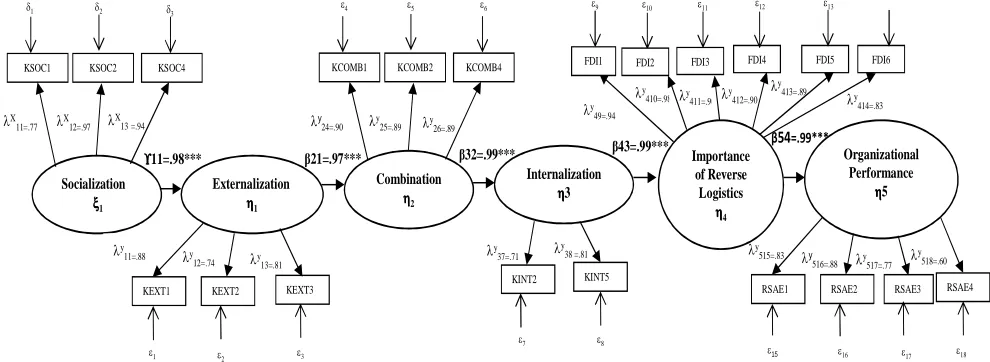
The LISREL 8.70 program was used to test the theoretical model. Then once measuring instruments were estimated and adjusted, we propose a structural equations model based on theoretical framework which incorporating the factors used to investigate the set of hypotheses. There are significant and positive correlations among the study variables. A series of tests (e.g. tolerance, variance inflation factor) shows the non-presence of multicolinearity (Hair et al., 1999). Figure 1 shows the model proposed, together with the hypotheses contrasted and results.
Our findings show that Socialization is highly related and affects to Externalization (γ11=.98, p<.001) and also it is explained very well by the model, supporting Hypothesis 1. Externalization is also highly related and affects Combination (β21=.97, p<.001), as it was predicted in Hypotheses 2. Externalization is explained very well by the model. Furthermore, we have shown an indirect effect of Socialization on Combination (.95, p<.001) through Externalization (.98x.97; see, for instance, Bollen, 1989 for calculation rules). Combination is also highly related and affects Internalization (β31=.99, p<.001) supporting Hypothesis 3. Also Socialization has an indirect effect on Internalization (.94, p<0.01) by Externalization and Combination (.98x.97x.99).
Internalization is also highly related and affects the Importance of Reverse Logistics (β43=.99, p<.001) supporting Hypothesis 4. Globally, the importance of Internalization is explained very well by the model. Furthermore we have shown an indirect effect of Socialization on Importance of Reverse Logistics (.93, p<0.01) by Externalization, Combination and Internalization (.98x.97x. 99x.99).
Finally, Organizational performance is directly influenced by the Importance of Reverse Logistics (β54=.99, p<.001) and is explained well by the model, supporting Hypothesis 5.
λy 518=.60 λy 517=.77 λy 516=.88 λy 515=.83
β54=.99***
β43=.99*** λy 26=.89 β32=.99*** β21=.97*** ϒ ϒϒ ϒ11=.98*** Socialization ξξξξ1 Importance of Reverse Logistics η ηη η4 Externalization η ηη η1 Organizational Performance η ηη η5 Combination η ηη η2 Internalization η ηη η3
δ2 δ3
δ1
KSOC4 KSOC2
λX
11=.77 λX12=.97 λX13 =.94
KSOC1 λy 13=.81 λy 12=.74 λy 11=.88 ε3 ε2 ε1
KEXT1 KEXT2 KEXT3
λy 42=.89 λy 25=.89 λy 24=.90
ε4 ε5 ε6
KCOMB4 KCOMB2 KCOMB1 ε8 λy 38 =.81 λy 37=.71 ε7 KINT2 KINT5 λy
410=.98 λy411=.90λ y 412=.90 λy 413=.89 λy 414=.83 λy 49=.94
ε11 ε12 ε13
ε9 ε10
FDI2
FDI1 FDI3 FDI4 FDI5 FDI6
RSAE1 RSAE2 RSAE4
ε15 ε16 ε17 ε18
RSAE3
Conclusions
This study develops a conceptual model to examine the relationship between a knowledge creation process and the importance of Reverse Logistics, and how both intangibles affect firm performance. The results show that four modes of conversion of knowledge affect directly and indirectly the importance of Reverse Logistics, that means the greater presence of the processes of knowledge creation in the organization, more important are the processes of Reverse Logistics, enhancing firm performance. To check these findings we have proposed a positive relationship between the four modes of knowledge conversion: socialization (H1), externalization (H1), combination (H2) and internalization (H3). This is the popular model of creation of knowledge development by Nonaka and Takeuchi (1995). We have shown this model is related positively to the importance of Reverse Logistics (H4), and this one is directly related to Organizational Performance (H5). Four modes of the conversion of knowledge have indirect effects on performance.
Our model put emphases on the creation of knowledge and Reverse Logistics with the main objective of contrasting influencing factors. This explains the relationship between the creation of knowledge and the importance of Reverse Logistics. Furthermore, we explore whether the relationship between these variables affects organizational performance. All hypotheses were verified.
For the set of hypotheses about the creation of knowledge our results have been very significant. Furthermore, socialization directly affects externalization and it has an indirect influence on combination and internalization. Externalization affects combination, the latter affecting internalization. So we confirm a close relationship between different forms of knowledge conversion model proposed by the creation of knowledge by Nonaka and Takeuchi (1995) who proposed creation of knowledge through interaction of tacit and explicit knowledge between the four forms of knowledge conversion. The importance of Reverse Logistics is increasing (Dowlatshahi, 2000; Wadhwa & Madaan, 2007). In general, at a theoretical level we find enough
literature that supports the main hypothesis of the relation between the creation of knowledge and Reverse Logistics. It is necessary that the organization had capacity to generate new knowledge, which reduces the uncertainty of Reverse Logistics processes (Arrow, 1962; Galbraith & Kazanjian, 1986; Murdick & Munson, 1988; Drucker, 1993; Rogers & Tibben-Lembke, 1999). Thus, our results confirm the existence of direct and indirect effects of four modes of creation of knowledge on the importance of Reverse Logistics, and it reinforces the belief that these intangibles are important in dynamic environments with high uncertainty, such as stated in the Resources Based View Theory (Prahalad & Hamel, 1990; Nonaka & Konno, 1998; Koste & Malhotra, 1999; Scarborough et al., 1999; Storey & Barnett, 2000; Stentoft & Halldorsson 2002; Carbonara & Caizza, 2008).
Regarding an organizational performance, results provide empirical evidence on the existence of a positive and direct relationship between importance of Reverse Logistics and organizational performance, and the existence of positive indirect effects of four modes of conversion of knowledge and performance. Such knowledge conversion enables firms to integrate an emerging knowledge into its strategic development (Nonaka, 1994), and they can create new knowledge and develop new product at a lower cost and more speedily than competitors do (Droge et al., 2003). Thus, knowledge creation provides an opportunity for firms to enhance efficiency and sustain competitive advantages (Nonaka et al., 2000a; Chia, 2003). Also through Reverse Logistics the firm is able to increase value of its products and service, a much more meaningful interaction with customers, develop new skills in workers to recover the economic value of life products and all of this is reflected on performance (Dutton & Dukerich, 1991; Chan et al., 2005). So, given a higher level of competition and complexity of environment, to implement Reverse logistics programs must be a key objective for companies since it leads the organization to limit its competitiveness, reducing uncertainty and anticipating the ever changing characteristics of these activities (Bowersox et al., 1989; Fawcett et al.1996; Closs et al., 2005).
References
Adler, N. J. (1983). Psychological Safety and Learning Behavior in Work Teams. Administrative Science Quarterly, 14 (44), 350-383.
Amit, R., & Schoemaker, P. J. (1993). Strategic Assets and Organizational Rent. Strategic Management Journal, 14(1), 33-46.
Arlbjorn, J. S. & Halldorsson, A. (2002). Logistics Knowledge Creation: Reflections on Content, Context and Processes. International Journal of Physical Distribution & Logistics Management, 32, (1-2), 22-39.
Arrow, K. J. (1962). The Economic Implications of Learning by Doing. Review of Economic Studies, 29, 155-73. Barney, J. (1991). Firm Resources and Sustained Competitive Advantage. Journal of Management, 17(1), 99-120.
Becerra-Fernández, I., & Sabherwal, R. (2001). Organizational Knowledge Management: a Contingency Perspective. Journal of Management Information Systems, 18(1), 23-55.
Carbonara, G., & Caizza, R. (2008). From Knowledge to Dynamic Capabilities: Double Learning Process in Unordinary Events. The Business Review, 11(2), 247-251.
Chia, R. (2003). From Knowledge-Creation to the Perfecting of Action: Tao, Basho and Pure Experience as the Ultimate Ground of Knowing. Human Relation, 56(8), 953-981.
Council of Logistics Management (2003). (On Line) Www.Clm1.Org
Daugherty, P., Matthew B. M., & Richey, R. G. (2002). Information Support for Reverse Logistics: the Influence of Relationship Commitment. Journal of Business Logistics, 23, 85-106.
Day, G. S. (1994).The Capabilities of Market-Driven Organizations. Journal of Marketing, 58, (4), 37-52.
De Brito M. P., Dekker R., & Flapper S. D. P. (2004). Reverse Logistics: A Review of Case Studies. In: Fleischmann M, Flapper Sd, Editors. Reverse Logistics. Quantitative Models for Closed-Loop Supply Chains. Berlin: Springer. Duoba, D., & Savaneviciene, A. (2004). Distinctions of a Learning Process in Virtual Organizations. Inzinerine
Ekonomika-Engineering Economics(2), 63-69.
Dowlatshahi, S. (2000). Developing A Theory Of Reverse Logistics. Interfaces, 30 (3), 143-155.
Droge, C., Claycomb, C., & Germain, R. (2003). Does Knowledge Mediate the Effect of Context on Performance? Some Initial Evidence. Decision Sciences, 34 (3), 541-568.
Dun, & Bradstreet. (2008). Database: fttp://www.Dnb.Com/Us/
Dutton, J. E. & Dukerich, J. M. (1991). Keeping an Eye On The Mirror: Image And Identity In Organizational Adaptation. Academy Of Management Journal, 34, 517-554.
Fawcett, S. E., Calantone, R. J., & Smith, S. R. (1996). An Investigation of the Impact of Flexibility on Global Reach And Firm Performance. Journal of Business Logistics, 17 (2), 167-96.
Galbraith, J. R. & Kazanjian, R. J. (1986). Strategy Implementation; Structure, Systems and Process. California: West Publishing.
García V. J., Lloréns, F. J., & Verdú, A. J. (2009). The Influence of Ceo Perceptions of Personal Mastery, Shared Vision, Environment And Strategic Proactivity on the Level of Organizational Learning: Single-Loop And Double-Loop Learning. International Journal of Manpower, 30(6), 567-590.
Grant, R. M. (1996). Prospering In Dynamically Competitive Environments: Organizational Capability as Knowledge Integration. Organization Science, 7 (4), 375-87.
Griffis, S. E., Goldsby, T. J., Cooper, M., & Closs, D. J. (2007). Aligning Logistics Performance Measures to the Information Needs Of The Firm. Journal of Business Logistic, 28 (2), 35-53.
Gold, A. H., Malhotra, A., & Segars, A. H. (2001). Knowledge Management: an Organizational Capabilities Perspective. Journal of Management Information Systems, 18 (1), 185-214.
Hair, J. F., Anderson, R. E., Tatham, R. L., & Black, W. C. (1999). Análisis Multivariante. Prentice Hall: Madrid.
Hunt, S. D. (1995). The Resource-Advantage Theory of Competition: Toward Explaining Productivity And Economic Growth. Journal of Management Inquiry, 4 (4), 317-332.
Hunt, S. D., & Arnett, D. B. (2006). Does Marketing Success Lead To Market Success? Journal of Business Research, 59 (7), 820-828.
Hunt, S.D., & Morgan, R. M. (1997). Resource-Advantage Theory: A Snake Swallowing Its Tail or a General Theory of Competition. Journal of Marketing, 61 (3), 74-82.
Johnson, M.D. (1998). Customer Orientation and Market Action. Upper Saddle River, N.J. Prentice – Hall.
Kannan, G., & Aulbur, W. G. (2004). Intellectual Capital: Measurement Effectiveness. Journal of Intellectual Capital, 5 (3), 389-413.
Kogut, B., & Zander, U. (2001). Knowledge of the Firm, Combinative Capabilities and the Replication of Technology. Organization Science, 3(3), 383-97.
Koste, L., & Malhotra M. K. (1999). A Theoretical Framework for Analyzing the Dimensions of Manufacturing Flexibility. Journal of Operations Management, 18, 75-93.
Kotler, P. (1994). Dirección De Marketing. 8ª ed. Prentice Hall.
Krikke, H., Bloemhof, J., & Van Wassenhove, L. (2003). Concurrent Design of Closed Loop Supply Chains: A Production And Return Network For Refrigerators. International Journal of Production Research, 41 (16), 3689-3719.
Lambert, D. M. & Burduroglu, R. (2000). Measuring and Selling the Value of Logistics. The International Journal of Logistics Management, 11 (1), 1-17.
Lee, H. L., & Choi, B. (2003). Knowledge Management Enablers, Processes, and Organizational Performance: an Integrative View and Empirical Examination. Journal of Management Information Systems, 20 (1), 179-228. Lee, L.T., & Sukoco, B. M. (2007). The Effects of Entrepreneurial Orientation and Knowledge Management Capability on
Organizational and Knowledge Effectiveness in Taiwan: The Moderating Role of Social Capital. International Journal of Management, 24 (3), 549-572.
Li, Y., H., Huang, J. W., & Tsai, M. T. (2009). Entrepreneurial Orientation and Firm Performance: the Role of Knowledge Creation Process. Industrial Marketing Management, 38, 440-449.
Matusik, S. F., & Hill, C. W. L. (1998). The Utilization of Contingent Work, Knowledge Creation, And Competitive Advantage. Academy Of Management Review, 23 (4), 680-697.
Murdick, R. G., & Munson, J. C. (1988). Sistemas De Información Administrativa. México. Prentice Hall Hispano Americana.
Nonaka, I. (1991). The Knowledge-Creating Company. Harvard Business Review, November-December, 96-104. Nonaka, I. (1994). A Dynamic Theory of Organizational Knowledge Creation. Organization Science, 5(1) 1, 14-37. Nonaka, I., & Konno, N. (1998). The Concept of Ba: Building a Foundation for Knowledge Creation. California
Nonaka, I., & Takeuchi, H. (1995). The Knowledge-Creating Company: How Japanese Companies Create the Dynamics of Innovation. Oxford: Oxford University Press.
Nonaka, I., & Toyama, R. (2003). The Knowledge-Creating Theory Revisited: Knowledge Creation as a Synthesizing Process. Knowledge Management Research & Practice, 1(1), 2-10.
Nonaka, I., & Toyama, R. (2005). The Theory of the Knowledge Creation Firm: Subjectivity, Objectivity, and Synthesis. Industrial And Corporate Change, 14 (3), 419-436.
Nonaka, I., Toyama, R., & Nagata, A. (2000a). A Firm as a Knowledge-Creating Entity: a New Perspective on the Theory of yhe Firm. Industrial and Corporate Change, 9 (1), 1-20.
Nonaka, I., Toyama, R., & Konno, N. (2000b). Seci, Ba and Leadership: a Unified Model of Dynamic Knowledge Creation. Long Range Planning, 33 (1), 5-34.
Nonaka, I., Byosiere, P., Borucki, C., & Konno, N. (1994). Organizational Knowledge Creation Theory: a First Comprehensive Test. International Business Review, 3 (4), 337-351.
Penrose, E. (1959). The Theory of the Growth of the Firm. New York: Oxford University Press.
Peteraf, M. (1993). The Cornerstones of Competitive Advantage: A Resource-Based View. Strategic Management Journal, 14, 179-191.
Prahalad, C., & Hamel, G. (1990). The Core Competence of the Corporation. Harvard Business Review, 68,(3), 79-111. Quinn, J. B. (1992). Intelligent Enterprise: A Knowledge and Service-Based Paradigm Or Industry? New York, Ny: The
Free Press.
Rogers, D. S., & Tibben-Lembke, R. S. (1999). Going Backwards: Reverse Logistics Trends and Practices. Pittsburgh, Parlec Press.
Savaneviciene, A., & Stankeviciute, Z. (2010). The Models Exploring the “Black Box” between HRM and Organizational Performance. Inzinerine Ekonomika-Engineering Economics, 21(4), 426-434.
Scarborough, H., & Swan J. (1999). Knowledge Management and the Learning Organization. London: J. Preston - Institute of Personnel and Development.
Sols, A., Nowick, D., & Verma, D. (2007). Defining the Fundamental Framework of an Effective Performance-Based Logistic. Engineering Management Journal, 19 (2), 40-50.
Stock, J. R. (1992). Reverse Logistics. Council of Logistics Management. Illinois: Oak Brook.
Stock, J. R., Speh, T. W., & Shear, H. W. (2002). ‘Many Happy (Product) Returns. Harvard Business Review, 80 (7), 16-17.
Storey J., & Barnett E. (2000). Knowledge Management Initiatives: Learning From Failure. Journal of Knowledge Management, 2 (4), 145-156.
Takeuchi, H., & Nonaka, I. (1986). The New Product Development Game. Harvard Business Review, 64 (1), 137-146. Tibben-Lembke, R. S., & Rogers D. S. (2002). Differences between Forward and Reverse Logistics In A Retail
Environment. Supply Chain Management, 7 (5), 271- 296.
Uziene, L. (2010). Model of Organization’s Intellectual Capital Measurement. Inzinerine Ekonomika-Engineering Economics, 21 (2), 151-159.
Wadhwa, S., & Madaan, J. (2007). Conceptual Framework for Knowledge Management in Reverse Enterprise System. Journal of Knowledge Management Practice, 8 (2), 1-22.
Wadhwa, S., & Madaan, J. (2004). Role of Quality Management Self-Assessment Model to Promote Reverse Logistics Operations. Bangkok: International Conventions on Quality Control Circles.
Wernerfelt, B. (1984). A Resource-Based View of the Firm, Strategic Management Journal, 5, 171-180. Zack, M. (1999). Developing a Knowledge Strategy. California Management Review, 41 (3), 125-146.
Zhang, Q., Lim, J., & Cao, M. (2004). Innovation-Driven Learning in New Product Development: a Conceptual Model. Industrial Management and Data Systems, 104 (3), 252-261.
Zhao, M., Dröge, C., & Stank, T.P. (2001). The Effects of Logistics Capabilities on Firm Performance: Customer-Focused Versus Information-Focused Capabilities. Journal Business Logistics, 22, 91-107.
Antonio Mihi Ramírez 1, Víctor Jesús García Morales
Konkurencingumo gerinimas kuriant žinias ir grįžtamąją logistiką
Santrauka
Remiantis ištekliais paremto požiūrio teorija, kompanijos siekia gauti darnios konkurencijos rezultatus savo resursų ir geb÷jimų srityse juos analizuodamos ir stiprindamos (Penrose, 1959; Wernerfelt, 1984; Barney 1991; Amit ir Schoemaker, 1993; Peteraf, 1993). Taigi organizacijos strategija tur÷tų būti nukreipta į pagrindines kompetencijas, nes jos leidžia kiek įmanoma labiau padidinti organizacijos vertę (Prahalad ir Hamel, 1990). Tod÷l žinios, ypač žinių kūrimas, tapo svarbiausiu kompanijos neapčiuopiamu turtu (Nonaka, 1994; Scarborough et al., 1999; Storey & Barnett, 2000; Lee & Sukoco, 2007; Carbonara & Caizza, 2008; Li et al., 2009).
Priešingos t÷km÷s pripažinimas logistikoje taip pat didina kompanijos konkurencines galias plečiant išteklius ir geb÷jimus, kai pl÷tojamas organizacijos potencialas; taip galima pasiekti subalansuotą konkurencinę pažangą, nes norint patenkinti vis did÷jančius vartotojų poreikius, produktas turi būti ne tik kokybiškas, bet ir konkurencingas, atitinkantis aplinkos reikalavimus (Stock, 1992; Tibben-Lembke & Rogers, 2002). Kita vertus, šių
produktų t÷km÷s ir šio proceso poveikio organizacijai tyrimas pastaraisiais metais ir sukūr÷ vadinamąją grįžtamąją logistiką (Rogers & Tibben-Lembke, 1999, 2001; Dowlatshahi, 2000; Tibben-Lembke & Rogers, 2002; Council of Logistics Management, 2003; Krikke et al., 2003; Stock et al., 2002).
teisinius aplinkos tikslus. Svarbu, kad organizacija sugeb÷tų kurti naujas žinias ir sumažinti grįžtamosios logistikos netik÷tumus (Arrow, 1962; Galbraith & Kazanjian, 1986; Murdick & Munson, 1988; Drucker, 1993).
Nors abu kintamieji tampa vis svarbesni, tačiau nuolat trūksta mokslin÷s literatūros, kurioje būtų analizuojamas santykis tarp žinių kūrimo ir grįžtamosios logistikos, taip pat jų poveikio organizacijos konkurencingumui svarba. Taigi įdomu analizuoti santykį tarp žinių kūrimo proceso ir žinių
kūrimo modelio, kurį pasiūl÷ Nonaka ir Takeuchi (SECI modelis, Nonaka & Takeuchi, 1995). Remdamiesi šiuo modeliu, autoriai kūr÷ ir tikrino hipotezes, tirdami šių santykių priklausomybę, taip pat r÷m÷si 284 Ispanijos firmų pavyzdžiais, kurie parodo tiesioginį ir netiesioginį žinių kūrimo ir grįžtamosios logistikos poveikį firmos veiklai. Vienoje straipsnio dalyje įvertinta ankstesn÷ mokslin÷ literatūra ir pateiktos tyrimo hipotez÷s. Toliau nurodomi tyrimo metodologija ir empirinio tyrimo rezultatai. Paskutin÷je dalyje pateikiamos išvados. Šio tyrimo rezultatai remiasi tuo požiūriu, kad žinių
kūrimas teigiamai veikia grįžtamąją logistiką, o tai gerina kompanijos veiklą.
Raktažodžiai: žinių kūrimas, grįžtamoji logistika, žinių valdymas, ištekliais paremto požiūrio teorija, organizacijos veikla.
The article has been reviewed.