www.geosci-model-dev.net/7/1535/2014/ doi:10.5194/gmd-7-1535-2014
© Author(s) 2014. CC Attribution 3.0 License.
An investigation into the performance of four cloud droplet
activation parameterisations
E. Simpson, P. Connolly, and G. McFiggans
Centre for Atmospheric Science, School of Earth, Atmospheric and Environmental Sciences, University of Manchester, Manchester, M13 9PL, UK
Correspondence to: G. McFiggans ([email protected])
Received: 16 January 2014 – Published in Geosci. Model Dev. Discuss.: 10 February 2014 Revised: 9 June 2014 – Accepted: 13 June 2014 – Published: 24 July 2014
Abstract. Cloud droplet number concentration prediction is central to large-scale weather and climate modelling. The benchmark cloud parcel model calculation of aerosol parti-cle growth and activation, by diffusion of vapour to aerosol particles in a rising parcel of air experiencing adiabatic ex-pansion, is too computationally expensive for use in large-scale global models. Therefore the process of activation of aerosol particles into cloud droplets is parameterised with an aim to strike the optimum balance between numerical ex-pense and accuracy. We present a detailed systematic evalu-ation of three cloud droplet activevalu-ation parameterisevalu-ations that are widely used in large-scale models and one recent update. In all cases, it is found that there is a tendency to overes-timate the fraction of activated aerosol particles when the aerosol particle “median diameter” is large (between 250 and 2000 nm) in a single lognormal mode simulation. This is due to an infinite “effective simulation time” of the parameterisa-tions compared to a prescribed simulation time in the parcel model. This problem arises in the parameterisations because it is assumed that a parcel of air rises to the altitude where maximum supersaturation occurs, regardless of whether this altitude is above the cloud top. Such behaviour is problematic because, in some cases, large aerosol can completely sup-press the activation of drops. In some cases when the “me-dian diameter” is small (between 5 and 250 nm) in a single lognormal mode the fraction of activated drops is underesti-mated by the parameterisations. Secondly, it is found that in dual-mode cases there is a systematic tendency towards un-derestimation of the fraction of activated drops, which is due to the methods used by the parameterisations to approximate the sink of water vapour.
1 Introduction
Clouds are important components in understanding climate change and therefore must be accurately represented in large-scale (regional and global) weather and climate models so that we can make realistic future climate predictions. The ef-fective radiative forcing of aerosol and cloud interactions (in-cluding cloud albedo enhancement and cloud lifetime effect) have some of the largest uncertainties of all considered com-ponents of radiative forcing as reported in the IPCC 5th An-nual Report (Myhre et al., 2013, p. 123, Fig. 8.20). Aerosol particles interact with clouds by acting as nuclei on which water vapour can condense under liquid water supersaturated conditions. A change in the concentration of the subset of aerosol particles that act as cloud condensation nuclei (CCN) within a cloud will lead to a change in cloud droplet num-ber concentration. The albedo of a cloud is dependent on the number concentration of cloud drops (Twomey, 1974) as is the cloud lifetime (Albrecht, 1989). It is therefore key to un-derstanding the role of clouds in climate that the activation of cloud droplets is well represented in numerical models.
The ability of a particle to act as a CCN is dependent on its size, composition and the ambient conditions – most notably the supersaturation (Pruppacher and Klett, 1997). Köhler the-ory determines the size to which an involatile deliquesced particle must grow in order to activate as a cloud drop, which is determined by the particle dry size, composition and the ambient supersaturation.
in fewer “smaller” particles activating (e.g. Ghan et al., 1998; Sander, 1999). Some large particles do not grow quickly enough to reach their critical diameter before peak supersat-uration and therefore remain as unactivated particles, reduc-ing the total fraction of activated drops. The large amount of water condensing in the growth of large particles leads to a suppression ofSmax.
Sectional cloud parcel models provide a physically realis-tic and internally consistent calculation of parrealis-ticle activation and droplet growth in a parcel of air undergoing adiabatic ascent. In this study we use the Aerosol-Cloud-Precipitation Interaction Model (ACPIM) (Connolly et al., 2012). ACPIM calculates both the sub-saturated growth of aerosol particles as well as their supersaturated growth by water vapour dif-fusion. This model makes very few simplifications of the condensation process giving confidence that the predictions are physically realistic. We acknowledge that the dynami-cal framework employed in this work does not allow repro-duction of realistic atmospheric dynamics, nevertheless the initial formation period of clouds can often be assumed to be adiabatic (Heymsfield et al., 1978). For a detailed de-scription of processes represented in ACPIM, that are rel-evant to this paper, see the supplementary information of Topping et al. (2013).
Cloud parcel models such as ACPIM are too computa-tionally expensive to be used in large-scale global climate models. It is therefore necessary to rely on parameterisa-tion schemes to estimate the number of activated cloud drops within large-scale models. The most widely used parameter-isation schemes fall into two families – those based on the work of Abdul-Razzak et al. (1998), Abdul-Razzak and Ghan (2000) and those following Fountoukis and Nenes (2005). The differences between these two sets of parameterisations are discussed in Sect. 2.1. A synopsis of these parameterisa-tions is given in Connolly et al. (2013).
Ghan et al. (2011) provide an evaluation of two of the parameterisations evaluated in this study: Abdul-Razzak and Ghan (2000) and Fountoukis and Nenes (2005) with Barahona et al. (2010) extension. In this work we explore the performance of the parameterisations over a larger pa-rameter space and run many more simulations. In general our results are similar to those of Ghan et al. (2011): Abdul-Razzak and Ghan (2000) consistently underestimate the frac-tion of activated drops in a dual-mode aerosol size distri-bution and Fountoukis and Nenes (2005), with Barahona et al. (2010) extension, underestimates the fraction of acti-vated drops to a lesser extent than Abdul-Razzak and Ghan (2000), in simulations where the total number concentration of aerosol in a dual-mode size distribution is>2000 cm−3. Ghan et al. (2011) make a suggestion for further work to pro-vide a comparison of parameterisations against different nu-merical models such as the results presented here.
Table 1. Initial conditions for the simulations.
Temperature Pressure Runtime (ACPIM only) RH 290.15 K 950 hPa 2000 s 0.90
2 Method
ACPIM is a detailed bin-resolving cloud parcel model and is taken as the benchmark for comparison of the parameterisa-tion methods. It is therefore used as the reference model for this study. The three widely used parameterisation schemes and one recent update are evaluated for their ability to repro-duce accurate values of the fraction of activated drops, for a large parameter space. We now explain the salient points of the parameterisations.
2.1 Description of parameterisations
Each of the parameterisation schemes used in this study can be used to represent the activation of single or multiple log-normal aerosol size distributions or “modes”. A loglog-normal distribution, describing the number of aerosol particles per natural logarithm of the bin width,d lndND
p, is described by the
following equation:
dN
d lnDp
= Nap
lnσ √
2πexp
− ln2Dp
dm
2 lnσ2
, (1)
whereNapis the total number concentration of aerosol par-ticles, lnσ is the natural logarithm of the geometric standard deviation anddm is the median diameter (Jacobson, 1999). The values for the median aerosol diameter of a lognormal mode,dm, are given in Table 2 along with the breadth of the
mode, lnσ.
The first scheme, originally described in Abdul-Razzak et al. (1998), is further developed in Abdul-Razzak and Ghan (2000) to include multiple modes, hereafter referred to as ARG. The second scheme is of Fountoukis and Nenes (2005), hereafter referred to as FN, and the third is an ex-tension of FN that includes the effects of large (giant) CCN described in Barahona et al. (2010), hereafter referred to as FN GCCN. The fourth scheme is an update to the FN and FN GCCN schemes by Morales Betancourt and Nenes (2014), hereafter referred to as FN GCCN BM.
The ARG and FN families of parameterisations find ap-proximate values for the maximum supersaturation achieved by a rising parcel of air,Smax, in different ways. FN sets the
equation for the rate of change of supersaturation to zero and then iteratively finds a value forSmaxthat satisfies the
2005). ARG also sets the equation for the rate of change of supersaturation to zero, then after neglecting the effects of curvature, gas kinetics and solute (in the equation for droplet radius growth rate) an approximate expression forSmaxis
de-rived (Abdul-Razzak et al., 1998). ARG is written in terms of dimensionless parameters to account for the errors made by simplifying the droplet growth rate (see Abdul-Razzak et al., 1998, for details).
ARG approximates the maximum supersaturation by as-suming that all particles start at their equilibrium size and then grow further depending on the supersaturation. FN splits the population of aerosol into two separate groups: those par-ticles that are small and are therefore assumed to start at their equilibrium size and then grow further depending on the su-persaturation, (similar to ARG) and those particles that are large and take time to grow to their equilibrium size before growing further. This method takes into account kinetic lim-itations to the growth of larger particles.
In both parameterisations the number of CCN that activate given the maximum supersaturation is then calculated by ap-plying Köhler theory to make a change of variable of Smax
toDp, which is then used in conjunction with the prescribed
lognormal size distributions to calculate the number of acti-vated particles. The number of actiacti-vated aerosol determined by both types of schemes, ARG and FN, is considered to be the number of aerosol with diameter greater than the small-est activated aerosol diameter (Abdul-Razzak et al., 1998; Fountoukis and Nenes, 2005).
Barahona et al. (2010), further develop the FN method to account for the fact that giant CCN – i.e. CCN with dry aerosol diameters greater than approximately 500 nm – may have insufficient time to grow to their activation size.
A recent update to the FN parameterisation and the Barahona et al. (2010) development has been made by Morales Betancourt and Nenes (2014). This update aims to better account for the growth of inertially limited particles and their subsequent contribution to the water vapour sink, by only allowing the growth of the largest particles to be calcu-lated by the Barahona et al. (2010) parameterisation (Morales Betancourt and Nenes, 2014). The update also adds an addi-tional term to the equation for the rate of change of super-saturation that allows for a smoother transition between the two populations of aerosol created by the population splitting technique (Morales Betancourt and Nenes, 2014).
2.2 Model inputs
ACPIM allows the size distribution and any variation of com-position of aerosol to be defined in addition to the particle mixing state. Updraft velocity is prescribed and the rate of change of pressure with respect to time, ddPt = − P
T Ragw, is determined assuming an atmosphere in hydrostatic balance. Importantly, ACPIM is time dependent and the maximum simulated ascent time in the model is controlled. This en-sures that the height that the parcel rises and hence the cloud
depth for the simulation (for a given updraft velocity) is held within atmospherically reasonable bounds. The model as-sumes moist adiabatic ascent, no mixing with ambient air and outputs the supersaturation and the number distribution of activated and unactivated aerosol particles as a function of time. Only aerosol with diameters larger than their criti-cal diameter are recorded as activated drops. Here we use the number of activated drops at the end of the simulation time in the parcel model to compare with the number of activated drops calculated by the parameterisations.
Evaluations of all of the mentioned parameterisation schemes against detailed numerical parcel models are re-ported in their respective studies. In this study we use a simi-lar evaluation method to Barahona et al. (2010). However, to avoid any bias in our results we use a Monte Carlo sampling technique to explore the parameter space over an atmospher-ically relevant range of conditions.
Barahona et al. (2010) use a very wide parameter space, where the number concentration of the two lognormal modes and the median aerosol diameter in the first mode are chosen from Seinfeld and Pandis (1998) to be atmospherically repre-sentative (p. 2470, Barahona et al., 2010). The range of me-dian aerosol diameters investigated in their study is chosen to represent all possible sizes of aerosol, from that of newly nu-cleated particles to giant CCN (as described by Pruppacher and Klett, 1997).
Here we have chosen a large parameter space for the single-mode case similar to the one used by Barahona et al. (2010) to enable us to demonstrate the accuracy of the parameterisations under many conditions.
In the dual-mode case the parameter space is also simi-lar to that used by Barahona et al. (2010). In the Supple-ment of this paper the parameter space used in dual-mode experiments has been reduced to avoid extreme concentra-tions of small and large particles (that are rarely found in the atmosphere) and a smaller range of updraft velocities so that experiments only represent cloud depths more reason-ably likely to exist. Such parameter space reduction reduces potential biases in the parameterisations that would be driven by unphysical parameter combinations.
Table 2. Parameter space investigated for both ACPIM and the parameterisations. Two evaluations were done: single mode and dual mode
experiments.
Dual-mode experiment Variable Single-mode experiment MODE 1 MODE 2 Number conc. of aerosol 50–2000 cm−3 2000 cm−3 400 cm−3
lnσ 0.2–0.8 0.46 0.46
Median diameter 50–1000 nm 80 nm 5–5000 nm Updraft velocity 0.01–10 m s−1 0.01–10 m s−1 0.01–10 m s−1
3 Results
3.1 Demonstration of time dependency in model simulations
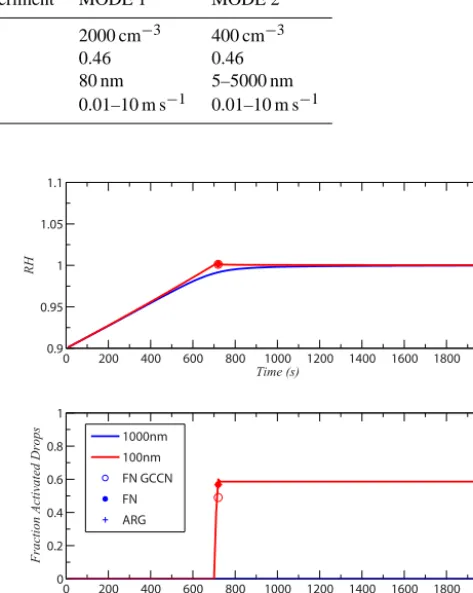
First, to explore and illustrate the time dependency in the growth of larger aerosol, ACPIM was run for two cases: small aerosol median diameter (100 nm, the “small aerosol” case) and large aerosol median diameter (1000 nm, the “large aerosol” case), both with total number concentrations of 500 cm−3. The results from the parameterisations and ACPIM are shown in Fig. 1, for the same initial conditions.
In the “small aerosol” case the parameterisations repro-duce the fraction of activated drops and maximum supersat-uration well. However, in the “large aerosol” case, the par-cel model does not reach the maximum possible supersat-uration because it takes too long for the larger aerosol to reach the size required for activation. The result is that no aerosol activate in the simulated time of 2000 s for the large aerosol case. The results from the parameterisations effec-tively have no run time limit and therefore activate nearly all of the large aerosol. This would be equivalent to running ACPIM for an unrealistically long time such that the parcel of air reaches an unrealistic height before activating the large particles into cloud drops. We refer to this as an “infinite ef-fective simulation time” artifact for the case of the parame-terisations. Figure S1 in the Supplement shows that the ac-tual amount of time the parcel model requires to activate the same fraction of large drops as the parameterisations,∼0.8, is∼56 000 s. This equates to 16.8 km for the updraft veloc-ity of 0.3 m s−1 that was used. Unperturbed ascent of this extent does not happen in the atmosphere; hence, the param-eterisation appears to activate an unphysical fraction of the particles under these conditions (albeit with a population of unphysically large particles). Elimination of unrealistically high number concentrations of large particles from our sim-ulations ensures that such obvious biases are not introduced in our evaluation, but the effect of overestimated activated fractions with unrealistic “effective simulated time” will still occur. This is a feature throughout the comparisons presented in the following sections.
0 200 400 600 800 1000 1200 1400 1600 1800 2000
0.9 0.95 1 1.05 1.1
Time (s)
RH
0 200 400 600 800 1000 1200 1400 1600 1800 2000
0 0.2 0.4 0.6 0.8 1
Times (s)
Fraction Activated Drops
1000nm 100nm FN GCCN FN ARG
Figure 1. Time series of RH (top panel) and fraction of
acti-vated drops (bottom panel) as calculated by ACPIM with ini-tial conditions described in Table 1, a number concentration of aerosol 500 cm−3, with median aerosol diameters 100 nm (red) and 1000 nm (blue). Using the same initial conditions, results from the parameterisations are plotted as single points at the time of maxi-mum supersaturation (which is calculated from the parcel model).
3.2 Single-mode experiment
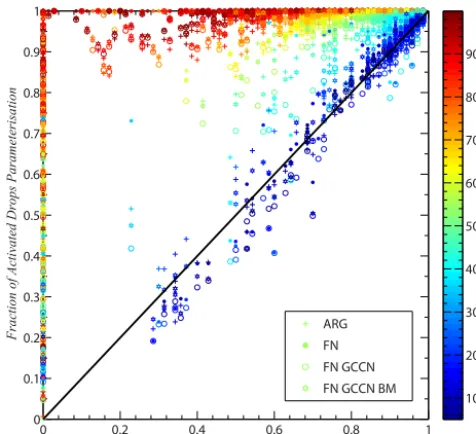
1500 simulations were conducted using single lognormal modes of particles randomly selected from the parameter ranges shown in Table 2.
Figure 2 shows that for aerosol median diameters, dm, of less than∼300 nm the fraction of activated drops calcu-lated by the parameterisations agrees reasonably well with the parcel model – see also Fig. S2 in the Supplement. Fig-ure S2 shows results from simulations with high concentra-tions (10 000 cm−3) of aerosol with small median diameters (5–250 nm) and that there is a general tendency to underesti-mate the fraction of activated drops at small sizes. At larger sizes (dm>300 nm) the parameterisations tend to
0 0.2 0.4 0.6 0.8 1 0
0.1 0.2 0.3 0.4 0.5 0.6 0.7 0.8 0.9 1
Fraction of Activated Drops Parcel Model Fraction of Activated Drops Parameterisation ARGFN
FN GCCN FN GCCN BM
100 200 300 400 500 600 700 800 900
Figure 2. Results from 1500 runs with 1 lognormal mode of
am-monium sulfate aerosol with randomly sampled variable values as detailed in Table 2 and initial conditions described in Table 1. Sym-bols are coloured by median aerosol diameter (nm).
concentrations (100 cm−3) of aerosol with large median di-ameters (250–2000 nm). This overestimation of the parame-terisation relative to the parcel model increases as the median diameter increases for values ofdm>300 nm. In many cases the parameterisations activate all of the available aerosol where the parcel model only activates a small fraction of available aerosol. In other cases the parcel model does not activate any aerosol where the parameterisations do. This is due to the unrealistic “effective simulation time” effect de-scribed in Sect. 3.1.
No clear relationship between lnσ, the total number con-centration of aerosol, or the fraction of activated drops can be drawn from the results of this study – see also Figs. S4 and S5 in the Supplement which are similar to Fig. 2 with data points colour coded by lnσ and aerosol number concentra-tion respectively.
3.3 Dual-mode experiment
Using a similar parameter space as that used in Barahona et al. (2010) a further 1500 simulations were conducted with two lognormal modes of aerosol. Figure 3 has a very no-ticeable feature: the overestimation of the fraction of acti-vated aerosol by all three parameterisations below approx-imately 0.16 fraction activated. The value of 0.16 is equal to the fraction of the total aerosol loading comprising the second aerosol mode (400 cm−3: 2400 cm−3). In many cases (mostly at updraft velocities above 2 m s−1) the parameter-isations activate all of the second mode and none of the first mode. At updraft velocities between 2 and 6 m s−1this
0 0.2 0.4 0.6 0.8 1
0 0.1 0.2 0.3 0.4 0.5 0.6 0.7 0.8 0.9 1
Fraction of Activated Drops Parcel Model Fraction of Activated Drops Parameterisation ARGFN
FN GCCN
FN GCCN BM 1
2 3 4 5 6 7 8 9
Figure 3. Results from 1500 runs with a bimodal aerosol size
distri-bution. Only the median diameter of aerosol in the second mode and updraft velocity were changed between runs. Symbols are coloured by updraft velocity, m s−1, see colour bar. For initial conditions and parameter ranges see Tables 1 and 2 respectively.
results in an overestimation of the fraction of activated drops and at updraft velocities larger than 6 m s−1an underestima-tion. This is a feature of the time-independent nature of the parameterisations, which can be demonstrated by increasing the run time of the parcel model from 2000 to 8000 s – see Fig. 4, which shows that the feature at 0.16 fraction activated, present in Fig. 3, is less pronounced with a longer run time. It should be noted that we had to reduce the maximum values ofw,dmof the second mode and number concentration in the
second mode. For the larger values realistic cloud base alti-tudes were not modeled and hence should not be compared to parameterisations.
In cases where the fraction of activated drops is greater than 0.16 in the parcel model FN GCCN performs well with a generally small underestimation. FN GCCN BM also pre-forms well with generally less of an underestimation than FN GCCN and slight overestimation at low updraft velocities,
0.1 0.2 0.3 0.4 0.5 0.6 0.7 0.8 0.9 1 0.1
0.2 0.3 0.4 0.5 0.6 0.7 0.8 0.9 1
Fraction of Activated Drops Parcel Model Fraction of Activated Drops Parameterisation ARGFN
FN GCCN FN GCCN BM
600 650 700 750
Figure 4. Results from 100 runs with bimodal aerosol size
distribu-tions, 500 cm−3in the first mode and 100 cm−3in the second and a run time of 8000 s. Only the median diameter of the aerosol in the second mode and the updraft velocity were changed between runs, within the ranges of 550≤dm≤800 nm and 0.2≤w≤0.5 m s−1
respectively. Symbols are coloured by median diameter (nm) of the second mode, see colour bar. For initial conditions see Table 1.
population between these two groups and is estimated using an empirical function derived from parcel model simulations over a limited range of aerosol characteristics. It would ap-pear that this function is not appropriate for all aerosol dis-tributions tested here and results in two little competition for water vapour in this scheme. The method for approximating the integral forSmaxin ARG is therefore too negative and in
FN, too positive. FN GCCN corrects this with an additional term in the integral (Barahona et al., 2010).
As expected, ARG also underestimates the peak in RH in the majority of cases (see Fig. 5 that shows results of peak RH achieved in each simulation in the dual-mode case with a limited parameter space), which also shows that FN GCCN and FN GCCN BM perform best out of the three parameter-isations at predicting the peak RH. Figure 5 also shows that the spread of peak RH values calculated by the parameteri-sations increases with updraft velocity, rather than a strong systematic offset.
The difference between FN GCCN and FN can clearly be seen in Fig. 3. Without the inclusion of effects of large aerosol in the parameterisation, FN overestimates the number of activated drops and this overestimation increases with me-dian diameter of second aerosol mode (see Fig. S6 in the Sup-plement) and updraft velocity. Since the FN GCCN scheme shows a marked improvement when compared with FN in cases where large aerosol particles are present we have ex-cluded the FN results in the comparison between the single
1 1.001 1.002 1.003 1.004 1.005 1.006 1.007 1.008 1.009 1
1.001 1.002 1.003 1.004 1.005 1.006 1.007 1.008 1.009
Relative Humidity Parcel Model
Relative Humidity Parameterisation
ARG FN GCCN
FN GCCN BM 0.5 1 1.5 2 2.5 3 3.5 4 4.5 5
Figure 5. Results for peak RH from 1500 runs with bimodal aerosol
size distributions. Only the median diameter of the aerosol in the second mode and updraft velocity were changed between runs within the ranges of 100≤dm≤800 nm and 0.2≤w≤5 m s−1
re-spectively. Symbols are coloured by updraft velocity, see colour bar. For initial conditions see Table 1.
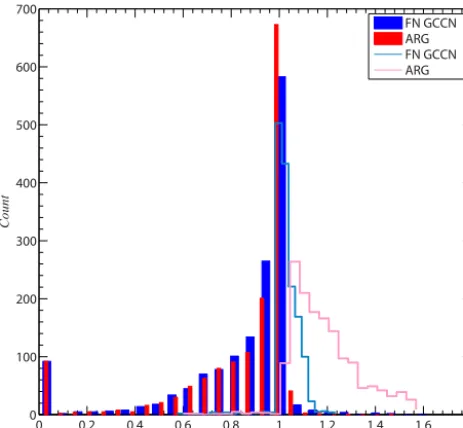
and dual mode experiments below. Also as FN GCCN and FN GCCN BM are very similar only one, FN GCCN, is used in the comparison below.
3.4 Comparison between single- and dual-mode cases
0 0.2 0.4 0.6 0.8 1 1.2 1.4 1.6 1.8 0
100 200 300 400 500 600 700
Ratio Parcel Model to Parameterisation
Count
FN GCCN ARG FN GCCN ARG
Figure 6. Histogram of the ratio of number of activated drops
culated by the parcel model to the number of activated drops cal-culated by FN GCCN and ARG parameterisations. Solid bars for monomodal runs and lines for bimodal runs.
4 Conclusions
While the parameterisations evaluated in this paper perform well under a range of atmospherically relevant conditions, they also produce results that differ notably from the re-sults of the parcel model under a wide range of conditions. Such conditions could provide the input distributions for the parameterisations when used within global climate mod-els, producing significantly unphysical estimates of activated drop number concentrations.
The main conclusions from this study are as follows.
– First, there is a systematic tendency in the parameter-isations towards overestimating the activated fraction of drops when the median aerosol particle diameter is large,&250 nm. This is a result of parcel models con-sidering the time required for activation and cloud de-velopment, whilst the parameterisations implicitly al-low an infinite “effective simulation time”.
– Second, the estimation ofSmaxwithin the parameterisa-tions leads to apparent opposite behaviour between the ARG and FN families of parameterisations. FN GCCN performs better with the additional term in the Smax
integral approximation. There is a small residual ten-dency towards underestimation of the fraction of acti-vated drops, but with less of a low bias than ARG. FN GCCN BM accounts for this slight low bias by only in-cluding the largest particles in the Barahona et al. (2010) development, however this does lead to a slight over-estimation in the fraction of activated drops in some
low-updraft cases. The ARG parameterisation repre-sents too much competition for water vapour resulting in an underestimation of the fraction of activated drops. Hence, in a general sense, the parameterisations evaluated here tend to overestimate the number of activated drops in a single lognormal aerosol size distribution and underesti-mate the number of activated drops in dual lognormal aerosol size distribution. The overestimation in the single-mode case is a result of an infinite “effective simulation time” in the pa-rameterisations. The underestimation in the dual-mode case results from the methods used to approximateSmax within the parameterisations.
Due to the substantial improvement that the Barahona et al. (2010) amendment makes to the FN parameterisation, we recommend that the effects of large unactivated particles on the maximum supersaturation be included in cloud mod-els.
It should be noted that the performance of the parameteri-sations is very dependent on the parameter ranges chosen for the comparisons as illustrated throughout the Supplement for both single- and dual-mode simulations.
The Supplement related to this article is available online at doi:10.5194/gmd-7-1535-2014-supplement.
Acknowledgements. This work was funded by the NERC
ACID-PRUF programme, grant code NE/I020121/1, NCAS and a NERC studentship.
Edited by: H. Tost
References
Abdul-Razzak, H. and Ghan, S. J.: A Parameterization of Aerosol Activation, Part II: Multiple Aerosol Types, J. Geophys. Res., 105, 6837–6844, doi:10.1029/1999JD901161, 2000.
Abdul-Razzak, H., Ghan, S. J., and Rivera-Carpio, C.: A parameter-ization of aerosol activation. 1. Single aerosol type, J. Geophys. Res., 103, 6123–6131, 1998.
Albrecht, B. A.: Aerosols, cloud microphysics and fractional cloudiness, Science, 245, 1227–1230, 1989.
Barahona, D., West, R. E. L., Stier, P., Romakkaniemi, S., Kokkola, H., and Nenes, A.: Comprehensively accounting for the effect of giant CCN in cloud activation parameterizations, Atmos. Chem. Phys., 10, 2467–2473, doi:10.5194/acp-10-2467-2010, 2010.
Connolly, P. J., Emersic, C., and Field, P. R.: A laboratory in-vestigation into the aggregation efficiency of small ice crystals, Atmos. Chem. Phys., 12, 2055–2076, doi:10.5194/acp-12-2055-2012, 2012.
effects of semi-volatile organics, Atmos. Chem. Phys. Discuss., 13, 14447–14475, doi:10.5194/acpd-13-14447-2013, 2013. Fountoukis, C. and Nenes, A.: Continued development of a cloud
droplet formation parameterization for global climate models, J. Geophys. Res., 110, doi:10.1029/2004JD005591, erratum, 2005. Ghan, S. J., Guzman, G., and Abdul-Razzak, H.: Competition be-tween sea salt particles as cloud condensation nulcei, J. Atmos. Sci., 55, 3340–3347, 1998.
Ghan, S. J., Abdul-Razzak, H., Nenes, A., Ming, Y., Xiaohong, L., Ovchinnikov, M., Shipway, B., Meskhidze, N., Xu, J., and Shi, X.: Droplet nucleation: physically-based parameterizations and comparative evaluation, J. Adv. Model. Earth Syst., 3, M10001, doi:10.1029/2011MS000074, 2011.
Heymsfield, A. J., Johnson, P. N., and Dye, J. E.: Observations of moist adiabatic ascent in Northeast Colorado cumulus congestus clouds, J. Atmos. Sci., 35, 1689–1703, 1978.
Jacobson, M. Z.: Fundamentals of Atmospheric Modelling, Cam-bridge University Press, 1999.
Miles, R. E., Reid, J. P., and Riipinen, I.: Comparison of approaches for measuring the mass accommodation coefficient for the con-densation of water and sensitivities to uncertainties in thermo-physical properties, J. Phys. Chem. A, 116, 10810–10825, 2012. Morales Betancourt, R. and Nenes, A.: Droplet activation param-eterization: the population splitting concept revisited, Geosci. Model Dev. Discuss., 7, 2903–2932, doi:10.5194/gmdd-7-2903-2014, 2014.
Myhre, G., Shindell, D., Bréon, F.-M., Collins, W., Fuglestvedt, J., Huang, J., Koch, D., Lamarque, J.-F., Lee, D., Mendoza, B., Nakajima, T., Robock, A., Stephens, G., Takemura, T., and Zhang, H.: Anthropogenic and Natural Radiative Forcing. In: Climate Change 2013: The Physical Science Basis. Contribution of Working Group I to the Fifth Assessment Report of the Inter-governmental Panel on Climate Change, edited by: Stocker, T. F., Qin, D., Plattner, G.-K., Tignor, M., Allen, S. K., Boschung, J., Nauels, A., Xia, Y., Bex, V., and Midgley, P. M., Cambridge University Press, Cambridge, United Kingdom and New York, NY, USA, 2013.
Pruppacher, H. R. and Klett, J. D.: Microphysics of Clouds and Precipitation, 2nd Edn., Kluwer Academic Publishers, Boston, 1997.
Sander, R.: Modeling atmospheric chemistry: interactions between gas-phase species and liquid cloud/aerosol particles., Surv. Geo-phys., 20, 1–31, 1999.
Seinfeld, J. H. and Pandis, S. N.: Atmospheric Chemistry and Physics, John Wiley and Sons, New York, 1998.
Topping, D., Connolly, P., and McFiggans, G.: Cloud droplet number enhanced by co-condensation of organic vapours, Nat. Geosci., 6, 443–446, doi:10.1038/NGEO1809, 2013.