1
THE RELATIONSHIP BETWEEN THE PERCEPTIONS OF
MANAGER'S SKILLS WITH THE COMPONENT OF TOTAL
QUALITY MANAGEMENT (TQM) WITH AN EMPHASIS ON
CUSTOMER-ORIENTATION AND SELF-ASSESSMENT
Ziba Besharat Ghotb Abadi1*, Narges Saeedian2 *1
Khorasgan (Isfahan) Branch, Islamic Azad University, Isfahan, Iran
2
Department of Educational management, Khorasgan Branch, Islamic Azad University, Isfahan, Iran
Abstract
This study investigated the relationship between managers' perceptions of the skills component of the overall quality of governmental and nongovernmental public and private schools were conducted. The study is descriptive correlation method. 250 samples were selected by multistage random cluster sampling. Measurement tool was the number two Skills Inventory management and Quality management. Customer subscales internal consistency coefficient 0.94 self-assessment and 0.84 respectively. Descriptive statistics for questions and one-way analysis of variance, correlation, regression were used to test the hypotheses. The correlation coefficient between the components of customer orientation, self-evaluation and perception of Total Quality Management Skills is 0.396 and 0.526. Based on gender and work experience variables were significant differences between managers.
Keywords: management skills, components of total quality management, customer-oriented, self-assessment
1- Introduction
Development of human society increasingly depends on creating new ideas and developments in the education system. In the modern world, science and technology to speed development and creative management plays a major role in these developments [1].
Current situation of management in global organizations shows that traditional management methods to be able to coordinate with organizational and technical development of rapid changes in technology, so the new management patterns of traditional management practices have been replaced [2].
Total quality management continuous improvement is a philosophy of scientific tools and techniques that can be set to meet the needs, demands and expectations of current and future provide each institution [3].
2
TQM aims to eliminate defects and deviations by improving the wrong reasons. One of the main reasons for this is the fact that TQM requires a relatively long time (between 2 to 5 years) to show its positive effects, on the other hand, contrary to what appears to be, its implementation cost and it is not easy [5]. Perhaps the most significant barriers to implementing TQM in Iranian schools, despite the complex structure and administrative bureaucracy.
The tools used in TQM are permanent mechanism is designed and implemented in an organization to consistently identify problems and obstacles in order to improve people's efforts. The index of a proper strategy to help organizations continuously monitor organizational bottlenecks caused by sensitivity to time, to apply innovative solutions, organizational and individual self-sustained, integrated circuit process and results-oriented approach to prevent the crisis institutional assistance and management easy and fun it.
The four most important words are hard to distinguish from Total Quality Management: 1 - Based on cooperative communication: an organization based on the principles of total quality management should be focused on customers' needs;
2 - Continuous improvement and self-evaluation, including the provision of information to employees to continuously improve personal and collective;
3 - There is a systematic process activities performed within the organization must be examined as a continuous process;
4 - Leadership is the ability to meet high-level management; managers must provide their employees with the talents to earn ongoing reforms.
On the other hand, some management experts, management-related skills including negotiation skills, political skills, analytical skills, computer skills, interpersonal skills, and interpersonal skills, functional skills, interpersonal and organizational know [6].
But the most common classification of managers' skills is presented by Robert Katz. A Katz skill to perform the duties of the capabilities inherent in the definition of breeding is not available. He knows that the manager takes responsibility for the actions of others to achieve specific objectives to take. According to them, skills necessary for successful management of the three technical, human, and cognitive [7].
Today a lot of talk about the quality and importance, particularly with the managers. In higher education, the role of the human factor, increasing the quality of collaboration needs of all individuals. In practice, it seems that little attention has been paid to this principle. Despite efforts in the industrial sector, with the aim of improving the quality of education and health, which is done in some respects, our society still suffer from low quality schools.
3 2- Background research
In some research (1388) Research on the relationship between technical skills, human resource managers' perception of the effectiveness of high schools in Shiraz Region 1 began. The sample consisted of 150 principals and teachers have been stratified random sampling of the population examined. Results showed that
A. There is no significant relationship between organizational effectiveness and management skills
B. managers increased human skills, organizational efficiency increases
C. Increasing the perceptual skills of managers and increase organizational effectiveness. D. When the perception of managers and managerial skills trilogy, there was no
significant difference [8].
In another research, examines the relationship between teachers' preparedness to implement total quality management and organizational culture and effectiveness of secondary school principals. Results showed that TQM can predict the effectiveness of the management and evaluation of customer orientation are the most effective managers [9].
Attitudes of professors and students from preschool to high school students about the suitability of TQM in education pay. The results showed that applying TQM in education with little resistance among faculty and students and teachers are facing. Analysis of variance showed that there is no significant difference between the groups [10].
Alobiedat
(2011), research on the effectiveness of the Quality Management school administrators and school performance pay. In this study, the researchers sought to answer two questions:1 - Is Total Quality Management on effective school performance?
2 - Do no significant difference in the effectiveness of the overall quality of schools using the variables gender, employment status there?
The second answer is that the difference between male and female managers, there was no significant difference in terms of work experience [11].
3- The research questions
1. Do have relationship between managers ' skills of perception and self-evaluation component of the total quality management?
2. Do have relationship between the perceptions of managers with the skills component of total quality management of customer orientation?
3. Do have significant difference between the perception of the dimensions of the skills of managers in terms of demographic variables (gender, work experience and educational degree)?
4- Methodology
4
Table 1, coefficient alpha, Guttmann and Spearman - Brown TQM questionnaire for assessment Spearman – Brown's coefficient Alpha's coefficient Guttmann's coefficient Dimension
0.92
0.94
0.92
Customer-oriented
0.82
0.84
0.81
Self-assessment
Inventory management career triple skills (conceptual, human and technical), coefficient of internal consistency of the questionnaire on various aspects including respectively was cognitive skills, with 0.98human skill with 0.95 and technical skills with 0.96. (Table 2)
Table 2, coefficient alpha, Guttmann and Spearman - Brown questionnaire to assess management skills.
Spearman – Brown's coefficient Alpha's coefficient Guttmann's coefficient Dimension
0.93
0.96
0.93
Technical Skill0.97
0.98
0.97
Conceptual Skill0.9
0.95
0.88
Human SkillData analysis was carried out at two levels: descriptive statistics and inferential statistics. Descriptive statistics using statistical indices such as frequency, percentage, mean and standard deviation of the data analysis was performed. Inferential statistics at the level of the test analysis of variance test of Pearson, a one-sided test is used.
5- Findings
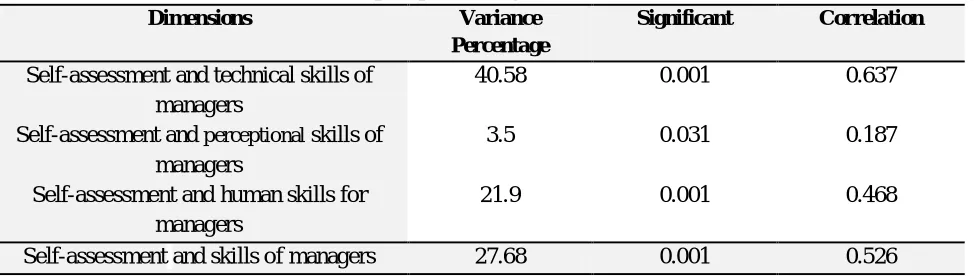
The first question: Do have relationship between managers ' skills of perception and self-evaluation component of the total quality management?
Table 3: The correlation between self-assessment component of a comprehensive quality management and perception management skills
Correlation Significant Variance Percentage Dimensions 0.637 0.001 40.58 Self-assessment and technical skills of
managers
0.187 0.031
3.5 Self-assessment and perceptional skills of
managers
0.468 0.001
21.9 Self-assessment and human skills for
managers
0.526 0.001
27.68 Self-assessment and skills of managers
5
The above equation shows that one can say with 99% 27.68% of the variance in perception of skills in educational managers of the city's self-evaluation. Components in terms of management skills, perceptual skills, managers are correlated with higher self-evaluation. Cognitive skills and human skills correlated with self evaluation.
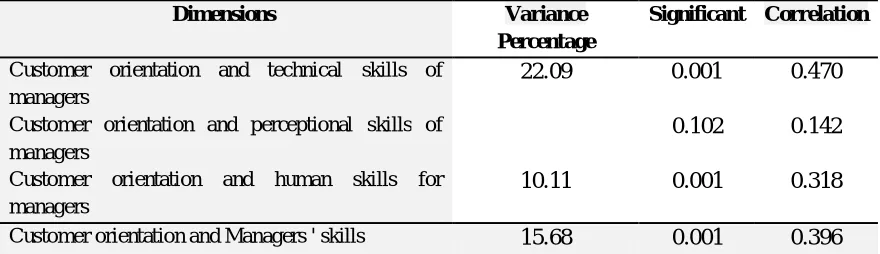
Second question: Do have relationship between the perceptions of managers with the skills component of total quality management of customer orientation?
Table 4: The correlation between the components of a comprehensive quality management and customer perceptions of management skills
Correlation Significant
Variance Percentage Dimensions
0.470 0.001
22.09 Customer orientation and technical skills of
managers
0.142 0.102
Customer orientation and perceptional skills of managers
0.318 0.001
10.11 Customer orientation and human skills for
managers
0.396 0.001
15.68
Customer orientation and Managers ' skills
As Table 4 - shows the correlation between customer component 0.396, which is the level of statistical significance (p <0.01). The above equation shows that one can say with 99% ,15.68% of the variance associated with the customer's perception of management skills. Given the positive correlation can be said to increase the customer-perceived management skills will increase. Components in terms of perception management skills, perceptual skills, just the perception of the customer relationship management and technical skills, human skills, but was not significantly correlated with customer.
Third question Do you have significant difference between the perception of the dimensions of the skills of managers in terms of demographic variables (gender, work experience and educational degree)?
3.1: do have the difference between the perceptions of the elements in terms of skills, managers work experience?
Table 5 - Results of one-way ANOVA with variables related work experience
Dimensions Sum of the
square Df
Mean of
square F Significant
Technical skills 3930.323 5 786.065 4.599 0.001
Perceptional
skills 461.865 4 115.466 0.983 0.419
6
Table 5 - is shown significant difference between the component management skills of managers
(Technical skills, human skills) of there working experience. Based solely on perception skills and work experience perceptionalcomponent, there is no difference. It can be expressed in terms of management experience in various technical skills, human skills and general management skills are significantly different.
3.2: Is there any difference between components skills of managers' perceptions of sex?
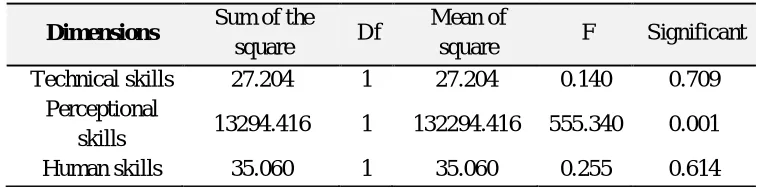
Table 6 - Results of one-way ANOVA with the variables of gender
Dimensions Sum of the
square Df
Mean of
square F Significant
Technical skills 27.204 1 27.204 0.140 0.709
Perceptional
skills 13294.416 1 132294.416 555.340 0.001
Human skills 35.060 1 35.060 0.255 0.614
As shown in Table 6 - is found only among the variables of cognitive skills, there was no significant difference between men and women. No other significant differences were noted. According to tables 6 it can be concluded that cognitive skills are significantly higher in men than women.
3-3: Are the differences between managers' perceptions of the components of skills in terms of degree are there?
Table 7 - Results of one-way ANOVA with variables of degree
Dimensions Sum of the
square Df
Mean of
square F Significant
Technical skills 86.250 1 56.250 0.436 0.510
Perceptional
skills 16.282 1 16.282 0.137 0.712
Human skills 2.844 1 2.844 0.021 0.886
As can be seen in Table 7- times a degree in any of the components of the study showed there was no significant difference.
6- Discussion and conclusions
7
scientific knowledge and experience made the double. These managers with training on other jobs on direct influence to strive to contribute as a whole society [12].
In the case of this study, it can be said that the perception of the dimensions of the skills of managers in terms of demographic variables (gender, work experience and educational degree) there is a difference. Research on the gender dimensions of skill between the variables and the leadership of the merely in among women and men the difference was significant. Also, depending on the degree of customer orientation in the educational component of their assessment, the difference was significant. The realization of universal quality management requires the existence of a few vital operating supports and commitment of managers, management quality, efficient and capable organization and increased understanding of the Organization's goals of employees. In explaining these findings can be said to improve the quality of education, through the construction and improvement of processes, organization, the first thing that will be discussed the role of managers of training centers and their skills in the continuous improvement of the quality with a very constructive role based indicators.
Comprehensive quality management of schools is that student, and their demands to meet the needs and special attention. Therefore, in front of their needs as well as social changes and transformation of CRP is able to show rapid and may be their limited resources focus on activity that will be to the satisfaction of the contempt for them. To change and improvement of the quality of the school, the Manager must know that a key factor in the level of the school. Our schools are in need of effective leaders and managers of knowledge and transformation-oriented managers, managers are circuit process of gathering financial resources, human and knowledge required for effective innovation, you will know the lesson well. Means of entry to the school system in focus, attention, and the process of the future and some way to change the proposal. He uses quality tools, the collection has been identified and the causes that they try to make them invisible problems does the cycle of quality improvement as they used to in the way of progress and a step by step upgrade.
7- References
[1] Jona Daniel.2010. Empowering project portfolio managers: How management involvement impacts project portfolio management performance. International Journal
of Project Management, Volume 28, Issue 8, December 2010, Pages 818-831.
[2] Cheng-Hua Wang, Kuan-Yu Chen, Shiu-Chun Chen. Total quality management, market orientation and hotel performance: The moderating effects of external environmental factors. International Journal of Hospitality Management, Volume 31, Issue 1,
March 2012, Pages 119-129.
[3] Huai Jinmei. Apply TQM to E-Government Outsourcing Management. Physics Procedia,
Volume 24, Part B, 2012, Pages 1159-1165.
[4] Baidoun S, Zairi M. A proposed model of TQM implementation in Palestinian context. TQM & Business Excellence. 2003; 14 (10): 1193-211
[5] salis , Edward.2001. Total quality management in education, translation by Ali hadiqi, Tehran: nashr hastan
8
[7] Akbari, A r. 2001. Examine ways to improve the quality of management of high schools of the city of Isfahan Managers, officials and education, educational management master thesis Islamic Azad University of khorasgan branch
[8] Ahmadi A dustmohammadlo H. 2009. A study on the relationship between human and technical skills, and effectiveness of local managers with perceptual regin1 city of Shiraz. New rahiafat in educational management. 2 (4): 137-119
[9] Temponi, C. 2005. Continuous improvement framework: implications for academia. Quality Assurance in Education 13, 1, 17-36
[10] Alobiedat A.2011. The Effectiveness of the School Performance, by Using the Total Quality Standards within the Education District of Al-Petra Province, from the Perspective of the Public Schools Principals and Teachers. Journal International Education Studies. Vol. 4, No. 2.
[11] Basri M MohdDaud B Asimiran S.2011. Applying Total Quality Management in the Classroom and Solving Students Failure. Journal KASBIT Business: 4:69-76