Consumer’s perception and knowledge concerning safety of street food services in
Pantnagar, India
Shivani Vyasa, Archana Kushwaha b
a Government Girls Senior Secondary School, LBD, Raghunathsar Kua, Bikaner, India
b Department of Food and Nutrition, Govind Ballabh Pant University of Agriculture and Technology, Pantnagar, India
ARTICLEINFO ABSTRACT
Article history: Received 30 Jun. 2017 Received in revised form 27 Jul. 2017
Accepted 08 Aug. 2017
Keywords: Street foods; Food safety; Foodborne disease; Consumer; Knowledge
Food safety refers to the conditions and practices that protect the quality of food to prevent contamination and subsequent foodborne illnesses. Consumer’s food safety knowledge and practices determine their food choices and ultimately their health. The aim of the present study was to examine the knowledge of consumers and their perception concerning street food safety in Pantnagar. A survey was conducted on 70 consumers belonging to two sites namely hostels and markets, by using structured schedule containing 20 questions regarding the safety of street food services. Among the consumers, there was a lack of knowledge about food vehicles and etiologic agents associated with foodborne diseases and proper temperature of storage of cold and hot ready to eat foods. Educational level of consumers had the most significant effect on the knowledge of consumers regarding safe food handling practices with particular reference to safe ways to manage leftover food; bad habits that should not be practiced by food handlers; improper food handling can affect the food quality; contaminants that make food unsafe; and reasons of food spoilage. Results strongly emphasize the need for a properly designed food safety public education campaign, to enhance food safety awareness in consumers and thus prevent foodborne illnesses.
Citation: Vyas Sh, Kushwaha A. Consumer’s perception and knowledge concerning safety of street food services in
Pantnagar, India. J Food Safe & Hyg 2017; 3(1-2): 34-39.
1. Introduction
In the last decades, the epidemiology of the foodborne disease is changing with new or unexpected pathogens often emerging on a countrywide or worldwide scale. Epidemiological and surveillance data suggest that faulty practices in food processing plants, food service establishments and home play a crucial role in the causal chain of foodborne diseases (1). Street foods are defined as, “Ready to eat foods and/ or beverages sold by vendors and hawkers especially in the streets and other similar places” (2). In other words, “Street food and beverages are prepared and/ or sold by vendors in street and other places for immediate consumption or consumption at a later time
Corresponding author. Tel.: +91-5944-233509
E-mail address: [email protected]
Consumers have an important role to play in preventing food-borne disease. Though consumers are now more aware of the appropriate steps to take to prevent illness when preparing and handling food, many are not putting that knowledge into practice (5). Education of consumers has a significant effect on their knowledge and attitude towards food hygiene and safety whereas the demographic profile of consumers had no effect on food handling practices (6). These findings increase concerns about consumer’s food safety knowledge and practices. Consumers' purchasing practices influence the quality and safety of food bought in the households, which is the main source of risk (7). Also, food hygiene practices adopted by consumers while cleaning, cooking, preparation, serving and storage of food cause a large number of foodborne disease (7). Working women showed higher mean knowledge and practice than nonworking in all parameters with significant variation between their mean knowledge scores except in personal hygiene (8). The education level of nurses inconsistently influenced their knowledge, attitude and practices regarding reheating and refreezing foods, cross contamination and transmission of Hepatitis B virus (1). University students more easily tend to engage in risky eating behaviors and hence are more susceptible to food-borne illnesses. Assessment of food safety knowledge, attitude and practice university students as the target groups are very important visualizing their future roles as head of the family as well as food preparers for his/her family (7). Urban and suburban adolescents were reported to be significantly equal with the overall parental influences towards food hygiene practices (9), thereby proving that parental influences may play important roles in improving food hygiene practices among them. According to many cited literature, public awareness campaigns tailored to local circumstances and cultural factors are the need of an hour to positively influence consumers’ behavior and to encourage them to apply care when buying, storing, handling and preparing food (10). Thus the aim of present study was to examine the consumer’s knowledge and their perception concerning food hygiene and safety of street foods in Pantnagar and to analyze the extent to which food safety KAPs are influenced by socioeconomic factors.
2. Materials and methods 2.1. Sample selection
A cross-sectional study of consumer’s knowledge of street food safety was conducted in Pantnagar, a
town in U.S. Nagar, Uttarakhand, India. Thirty five consumers from each of two sites viz. girls’ hostel and street food joints in three local markets were randomly selected for the study.
2.2. Survey instrument
A structured survey schedule comprising of 25 questions was prepared for interviewing consumers. Initially, the survey schedule was pilot tested by 10 participants for content validity, resulting in minor modifications with the question wording and answers. The schedule included various sections like General information; Education; Frequency of taking meals outside from home; Degree of satisfaction; Food safety knowledge. Each schedule took about 25 minutes to administer.
Does poor handling of foods makes them unsafe? (Yes, poor handling leads to poor quality of food and makes the food unsafe for consumption.); (L) Does the use of artificial color in food makes them unsafe? (No, the only use of non-permitted artificial color to the food is not good for health because they are carcinogenic, allergic and can cause gastrointestinal problems.); (M) What is the purpose of ISI and Agmark on packed food items? (ISI and Agmark on packed food items assure food quality and safety.); (N) What are the safe ways to manage leftover food? (Immediate cooling under refrigeration and reheating thoroughly before serving is the safe way to manage leftover food.); (O) Name a few foodborne illnesses? (Cholera, typhoid, gastroenteritis, and amoebiasis are foodborne illnesses.); (P) Name a few rich food sources of protein? (Milk and milk products, pulses and legumes, Eggs and meat are rich sources of protein.); (Q) Name a few rich food sources of vitamins? (Green leafy vegetables, fruits, milk and milk products, meat etc. are rich sources of vitamins.); (R) What is the wrong personal behavior during food handling? (Tobacco chewing, smoking, food tasting by hands in between preparation is bad habits which should not be practiced by food handlers.); (S) What are the ways to conserve nutrients in vegetables? (Peeling/ cutting after washing vegetables; use of just enough water to cook; not discarding water used for soaking; use of pressure cooker instead of open pan cooking and by avoiding overcooking of vegetables are safe ways to conserve
Table 1. General information of survey respondents
nutrients while processing and cooking.); (T) Does the use of disposable utensils promote food safety? Yes. Utensils made from dry leaves aluminum lined paper, thermocol vessels are disposables do promote food safety.)
Data was collected in evenings of weekdays and weekends when the members of the particular target group were available at the moment.
2.3. Data collection
Schedules were administered on a total of 70 consumers from both sites i.e. hostels and market to assess their knowledge regarding food safety. The purpose and nature of the study were explained in brief to each respondent and consent was taken prior to data collection.
2.4. Data analysis
Knowledge scores received from respondents were calculated based on each answer. Each question was assigned a score of +1 when the answer was correct, -1in the case of an incorrect answer and 0 if the respondents answered don't know. Data were analyzed by the chi-square test to determine the relationship between the consumer's knowledge and their education level. All the parameters were analyzed at the significance level of P = 0.05. If the values of p > 0.05 results are non-significant, while, the results would be
Hostels(n=3) Market (n=35) Total (n=70) p value
Gender Male Female 0 35 (100%) 20 (57.14%) 15 (42.86%) 20 (28.57 %) 50 (71.43%) p<0.05
Age (yrs.) Below 18 18-35 35-50 Above 50 0 35 (100%) 0 0 1 (2.86%) 21 (60 %) 11 (31.43%) 2 (5.71%) 1 (1.43%) 56 (80%) 11 (15.71%) 2 (2.86%) p<0.05 Education Illiterate Up to primary Primary to high school
High school to graduation Above graduation 0 0 0 20 (57.14%) 15 (42.86%) 5 (14.29%) 2 (12.85%) 10 (28.57%) 7 (20%) 11 (31.43%) 5 (7.14%) 2 (2.86%) 10 (14.29%) 27 (38.57%) 26(37.14%) p<0.05 Degree of satisfaction Excellent Good Fair Satisfactory Poor 6 (17.14%) 10 (28.57%) 5 (14.29%) 13 (37.14%) 01 (2.86%)
4 (11.43 %) 8 (22.86%) 4 (11.43 %) 17(48.57%) 2 (5.71% )
10 (14.29 %) 18 (25.71%) 9 (12.86 %) 30 (42.86 %) 3 (4.29 % )
p≥0.05
significant for all parameters wherein p< 0.05.
3. Results
All of the total consumers consuming street food in markets, 57.14% were male and 42.86% were female indicating that more males have access to street foods than the female. Street food was found to be most popular in the consumers belonging to the age of 18-35 years (80%). Around 15.71% of consumers were in the age group 35-50 years. Majority of the consumers residing in the hostels reported that they frequently consume street foods every weekend (45.71%) whereas consumers (57.14%) found at the market site reported that they rarely consumed street food. The relationship was found to be nonsignificant with the frequency of taking meal outside among
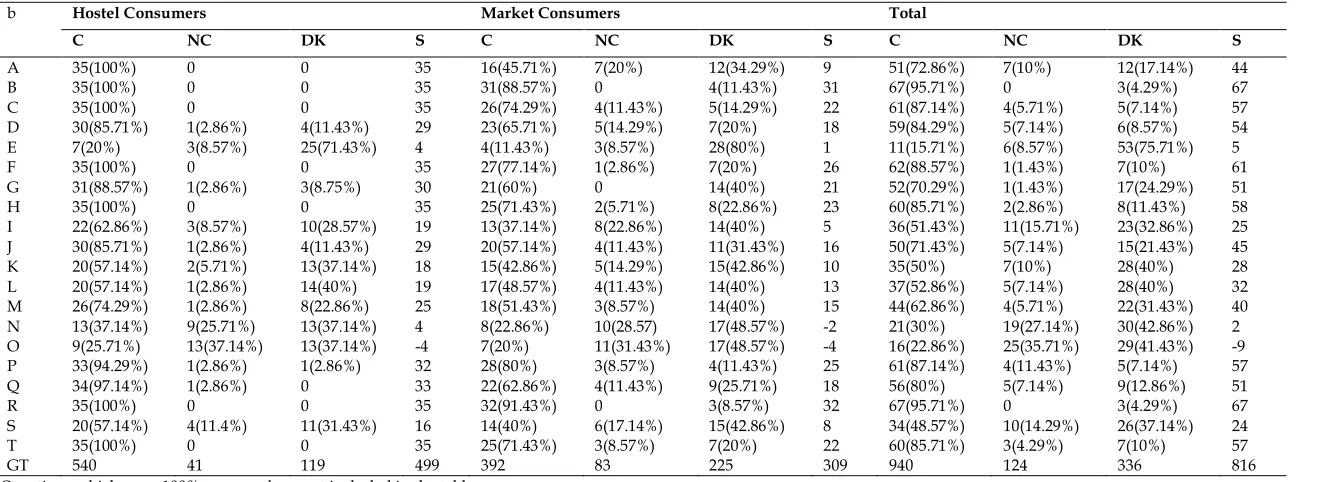
consumers from different sites. Majority of the consumers had the education above high school. Education level significantly influenced the frequency of consumption of street foods. Consumers from the two sites, hostels and market reported that street foods just satisfy their taste buds. There was no significant difference in the degree of satisfaction from street foods among consumers from different sites. Table 2 reveals the information that the majority of consumers (88.57%)knew the food safety risks related to food stored at room temperature for a longer time, left uncovered, contaminated water is used for cooking and almost all (95.71%) agreed that tobacco chewing, smoking, food tasting in between preparation are bad habits which should not be practiced by food handlers. Questions about foodborne illnesses like cholera, typhoid, gastroenteritis and amoebiasis were
Table 2. Consumer’s food quality and safety knowledge responses
*Questions which were 100% answered are not included in the table
# Details of questions and their answers is given the materials and methods section C = Correct (+1) NC = Not correct (-1) DK = Don’t Know (0) S = Score GT= Grand total
(Hostel Consumers) Total score = 499 / 700= 71.28% (Market Consumers) Total score = 309 / 700= 44.1% Overall Total score = 816 / 1400= 58.28%
b Hostel Consumers Market Consumers Total
C NC DK S C NC DK S C NC DK S
A 35(100%) 0 0 35 16(45.71%) 7(20%) 12(34.29%) 9 51(72.86%) 7(10%) 12(17.14%) 44
B 35(100%) 0 0 35 31(88.57%) 0 4(11.43%) 31 67(95.71%) 0 3(4.29%) 67
C 35(100%) 0 0 35 26(74.29%) 4(11.43%) 5(14.29%) 22 61(87.14%) 4(5.71%) 5(7.14%) 57 D 30(85.71%) 1(2.86%) 4(11.43%) 29 23(65.71%) 5(14.29%) 7(20%) 18 59(84.29%) 5(7.14%) 6(8.57%) 54 E 7(20%) 3(8.57%) 25(71.43%) 4 4(11.43%) 3(8.57%) 28(80%) 1 11(15.71%) 6(8.57%) 53(75.71%) 5 F 35(100%) 0 0 35 27(77.14%) 1(2.86%) 7(20%) 26 62(88.57%) 1(1.43%) 7(10%) 61 G 31(88.57%) 1(2.86%) 3(8.75%) 30 21(60%) 0 14(40%) 21 52(70.29%) 1(1.43%) 17(24.29%) 51 H 35(100%) 0 0 35 25(71.43%) 2(5.71%) 8(22.86%) 23 60(85.71%) 2(2.86%) 8(11.43%) 58 I 22(62.86%) 3(8.57%) 10(28.57%) 19 13(37.14%) 8(22.86%) 14(40%) 5 36(51.43%) 11(15.71%) 23(32.86%) 25 J 30(85.71%) 1(2.86%) 4(11.43%) 29 20(57.14%) 4(11.43%) 11(31.43%) 16 50(71.43%) 5(7.14%) 15(21.43%) 45 K 20(57.14%) 2(5.71%) 13(37.14%) 18 15(42.86%) 5(14.29%) 15(42.86%) 10 35(50%) 7(10%) 28(40%) 28 L 20(57.14%) 1(2.86%) 14(40%) 19 17(48.57%) 4(11.43%) 14(40%) 13 37(52.86%) 5(7.14%) 28(40%) 32 M 26(74.29%) 1(2.86%) 8(22.86%) 25 18(51.43%) 3(8.57%) 14(40%) 15 44(62.86%) 4(5.71%) 22(31.43%) 40 N 13(37.14%) 9(25.71%) 13(37.14%) 4 8(22.86%) 10(28.57) 17(48.57%) -2 21(30%) 19(27.14%) 30(42.86%) 2 O 9(25.71%) 13(37.14%) 13(37.14%) -4 7(20%) 11(31.43%) 17(48.57%) -4 16(22.86%) 25(35.71%) 29(41.43%) -9 P 33(94.29%) 1(2.86%) 1(2.86%) 32 28(80%) 3(8.57%) 4(11.43%) 25 61(87.14%) 4(11.43%) 5(7.14%) 57 Q 34(97.14%) 1(2.86%) 0 33 22(62.86%) 4(11.43%) 9(25.71%) 18 56(80%) 5(7.14%) 9(12.86%) 51
R 35(100%) 0 0 35 32(91.43%) 0 3(8.57%) 32 67(95.71%) 0 3(4.29%) 67
S 20(57.14%) 4(11.4%) 11(31.43%) 16 14(40%) 6(17.14%) 15(42.86%) 8 34(48.57%) 10(14.29%) 26(37.14%) 24 T 35(100%) 0 0 35 25(71.43%) 3(8.57%) 7(20%) 22 60(85.71%) 3(4.29%) 7(10%) 57
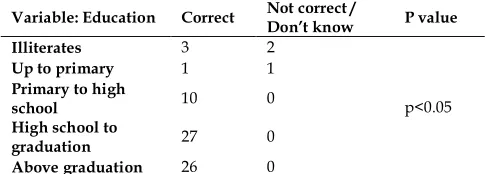
frequently replied with an incorrect option (35.71%) or unanswered with don't know option (41.43%). Only 30% of respondents knew how to manage leftover food safely. Market respondent’s scores were only 44.14% while hostel respondent’s scores were higher 71.28%indicating the effect of education on their knowledge and awareness of food hygiene and safety. The most significant response for education level and knowledge of consumers may be seen in Table 3.
Table 3. Association between education level and consumer’s knowledge level
Variable: Education Correct Not correct / Don’t know P value
Illiterates 3 2
p<0.05
Up to primary 1 1
Primary to high
school 10 0
High school to
graduation 27 0
Above graduation 26 0
Statement 3: Cross-contamination in food takes place through the use of dirty water, poor personal hygiene of handler and poor environmental hygiene.
Statement 23: Improper food handling practices include food handlers chewing tobacco, tasting food by hands in between preparation and often touching/ scratching body parts.
Variable: Education Correct Not correct /
Don’t know P value
Illiterates 2 3
p<0.05
Up to primary 0 2
Primary to high
school 7 3
High school to
graduation 27 0
Above graduation 26 0
Statement 7: Food gets spoiled due to storage at room temperature for a longer time, left uncovered, contaminated water used for cooking and exposure to microbes.
Variable: Education Correct Not correct / Don’t know P value
Illiterates 0 5
p<0.05
Up to primary 0 2
Primary to high
school 2 8
High school to
graduation 16 11
Above graduation 17 9
Statement 15: Poor handling leads to poor quality of food increases the chances of contamination and make unsafe for consumption.
Statistically significant differences were found in the consumer's knowledge of food safety issue when comparing replies to four statements 3, 7, 15 and 23. Indeed, consumers with higher education level (up to graduation and above graduation) were significantly more knowledgeable about ways of cross-contamination and improper food handling practices
(p<0.05). Responses to statements 7 and 15 revealed the information that consumer with higher education level was significantly (p<0.05 and p<0.05, respectively) more aware about food spoilage and proper food handling practices. For rest of the 21 statements, education level did not influence their knowledge of food hygiene and safety.
4. Discussion
Consumers from girl hostels gave most of the correct answers in comparison to consumers of the market. There was a generalized lack of knowledge about etiologic agents and food vehicles associated to foodborne diseases and proper temperature of storage of cold and hot ready to eat foods as the consumers from both sites gave most of the incorrect answer or don’t know response for statements 14 and 19. Occupation affected the mean score of KAP of foodborne diseases (11). In comparison to the local community, the university community was more aware of food safety issues and related practices that enhance safe food (12). A mail survey
conducted in 1993 to assess consumer perception of food risks, knowledge and behavior related to specific food handling practices indicated that they did not know how to reduce risks from microbiological hazards (13).
The educational level had a highly significant effect on knowledge of respondents regarding food safety. Hostel consumers were more knowledgeable than market consumers as they got the highest score of 35 in most of the questions. Consumers of the market who were taking higher education gave mostly correct answers regarding food hygiene and safety. Illiterate persons (7.14%) and persons with education level up to primary (2.86%) in the market got lowest scores. Well educated customers were found to be more concerned about food safety although in general, they seem to have relatively high levels of confidence (14).
They scored 44.14% and 71.28% scores, respectively as all the hostel consumers were from higher education level. Similar to the present study, consumers who had a higher education above graduation level scored better than illiterates and consumers educated till primary level (15). Educational level of consumers was strongly correlated with awareness of hazards in foods in Nigeria (16) and the authors also emphasized the need to translate this knowledge into practices. In Bulgarian students, the years of study had a direct influence on food safety knowledge whereas age and gender had no effect on awareness of food safety (17). However, in another study, gender, level of study, the field of study and father's educational level were significant predictors of knowledge on food hygiene among tertiary based university students in Malaysia (18).
5. Conclusions
The present study elucidated the critical features of information about the knowledge, attitude and practices of consumers with respect to street food hygiene and safety. The education of consumers significantly influenced their knowledge of food safety but no difference was found in their food handling practices and behavior. Highly educated consumers were found to be more concerned and aware about the food safety. Viewing the outreach of street foods in the society, the results strongly emphasize the need for a properly designed campaign for food safety public education to enhance awareness of food safety in consumers.
Conflict of interest
The authors have no conflict of interest.
Acknowledgements None
References
1. Buccheri C, Casuccio A, Giammanco S, et al. Food safety in hospital: knowledge, attitudes and practices of nursing staff of two hospitals in Sicily, Italy. BMC Health Service Research 2007; 7:45.
2. Lewis JE, Thompson P, Rao B, et al. Human bacteria in street vended fruit juices: a case study of Visakhapatnam city, India. Int J Food Safe 2006; 8:35-38.
3. Bhat RV, Waghray K. Profile of street foods sold in Asian countries. World Rev. Nutr. Diet 2000; 86:53-99.
4. Chandrasekhar U, Kowsalya S, Hemamalini S. A study on selected street foods of Coimbatore. The Indian J. Nutr. Diet 2001; 38:216-222.
5. Wilcock A, Pun M, Khanona J, et al. Consumer attitudes, knowledge and behavior: A review of food safety issues. Trends Food Sci. Technol 2004; 15:56-66.
6. Unusan N. Consumer food safety knowledge and practices in the home in Turkey. Food Control 2007; 18:45-51.
7. Sanlier N, Konaklioglu E. Food safety knowledge, attitude and food handling practices of students. Br Food J 2012;114: 469-480.
8. Farahat MF, El-Shafie MM, Waly MI. Food safety knowledge and practices among Saudi women. Food Control 2015; 47:427-435.
9. NSA Ab, Hamid MR, Asmawi UMM, et al. Food hygiene's knowledge, attitudes and practices between urban and suburban adolescents. Proceed – Soc. Behav. Sci 2016; 234:36-44.
10. Food safety knowledge, attitudes and practices (KAP) among food consumers in the West Bank and Gaza Strip. Available at www.fao.org/3/a-i8013e.pdf Cited Jul 10, 2018.
11. Talaeia M, Holakouie-Naienib K, Foroushanib AR, et al. Knowledge, attitude and practice of people about the foodborne outbreak in Isfahan city, Iran. J Food Safe Hyg 2015; 1:39-45.
12. Idasa A. Knowledge, Perception and attitude of university community towards food safety. Available at http://foodtech.uonbi.ac.ke/sites/default/files/cavs/agric ulture/foodtech/Idasa%20Antony0001.pdf Cited Jun 3, 2018.
13. Bruhn CM, Schutz, HG. Consumer food safety
knowledge and practices. Available at
http://ucanr.edu/datastoreFiles/234-2474.pdf Cited Jul 10, 2018.
14. Van Fleet DD, Van Fleet EW. Food safety attitudes among well-educated consumers. Int J Food Safe 2009; 11:88-97.
15. Gurudasani R, Sheth M. Food safety knowledge and attitude of consumers of various food service establishments. J Food Safe 2009; 29:364–380.
16. Ajayi OA, Salaudeen T. Consumer food safety awareness and knowledge in Nigeria. Int J Food Safe 2014; 16:17-24.
17. Stratev D, Odeyemi OA, Pavlov A. Food safety knowledge and hygiene practices among veterinary medicine students at Trakia University, Bulgaria. J Infect Public Health 2017; 10: 778-782.