Professional standards as a factor of adaptation of human resources to the industry
4.0: approaches to development and implementation
Zaure K. Chulanova
A B ST R AC T K E Y W O R D S
Journal of HUMAN RESOURCE MANAGEMENT
www.jhrm.eu • ISSN 2453-7683
1 INTROdUCTION
In the modern world there is a trend of a significant change in the paradigm of economic development. The creation and expansion of Industry 4.0 based on the digitalization of the economy, the use of innovative computerized systems and high technologies, increasing the speed of diffusion of innovations and their implementation on a global scale. This changes the economy and society as a whole, creates new opportunities for economic, social and personal development.
Under these conditions, the country's strategic resource becomes human capital, the quality of which, in terms of intelligence, education, and qualification skills, plays a major role in creating a new economy. Its role is due to the fact that the creator and holder of new knowledge, norms and values is a human being whose activity is associated with the creation and dissemination of new knowledge, with the active practical use of specialized knowledge in various sectors of the economy.
The fourth industrial revolution has enormous potential to increase the standard of living of the population, to solve many pressing problems, but it also generates many new problematic issues. modernization of industrial production, development of new technologies increase the requirements for the quality of the workforce. As a result of the development of technology, there is a significant shift in business models in all sectors, an increase in the rate of elimination and creation of jobs - including new forms of labor - as well as the redistribution of skills within existing jobs. This requires the mobility of human resources on the basis of a qualitative change in the skills of workers and the development of digital culture.
The most important strategic task for the countries developing Industry 4.0 is to identify the needs for professional competencies and their impact on the labor market, as well as the general directions for the development of professional knowledge and skills in the industrial sector. Under these conditions, the most important direction in the qualitative modernization of the vocational education sphere is the formation of a national qualifications system based on applying professional standards.
e aim of the work is to study approaches to the development and implementation of professional standards in order to improve the adaptability of human resources to the Industry 4.0. e article examines the possibilities and problems of qualitative modernization of vocational education based on formation of the national system of qualifications with the use of professional standards. e methodology of development of professional standards is investigated, and recommendations on improvement of this process with the use of competence-based approach are given. e main directions of policy at the macro and micro levels for the development of professional standards that meet the requirements of the labor market of the new industry are determined.
human resources, professional standards, vocational education, Industry 4.0, digital competencies
J E L C o d e : 0 1 5
manuscript re ceive d 13 februar y 2019 Accepte d 25 march 2019
CONTACT INfORmATION:
Zaure K. Chulanova / Institute of Economics of the ministry of Education and Science of the Republic of Kazakhstan / Kazakhstan / [email protected]
Journal of HUMAN RESOURCE MANAGEMENT
www.jhrm.eu • ISSN 2453-7683
The article discusses the possibilities and problems of developing and implementing professional standards. The methodology of development of professional standards is investigated, and recommendations on improvement of this process with the use of competence-based approach are given.
The aim of the work is to study approaches to the development and implementation of professional standards in order to improve the adaptability of human resources to the Industry 4.0.
2 INdUSTRY 4.0 OPPORTUNITIES ANd CHALLENGES
FOR HUMAN RESOURCES
Industry 4.0 creates a number of new opportunities for the development of human resources, in particular: the growth of labor productivity; reduction of production losses and its rational use due to additive technologies; new opportunities for the placement of industries; moving routine, repetitive and dangerous tasks from human being to machines and robots; combining human resources, machines and algorithms to create the industries of the future. This opens up new opportunities for developing countries due to the general re-shaping of the global labor market and the decreasing role of some limiting factors, such as geographical location, institutional underdevelopment and other similar ones (Craft & Zaytcev, 2017).
However, according to some scientists, the development of industry 4.0 causes many challenges and risks (Schwab, 2016). They will appear in different directions. One of them is the problem of adapting human resources to new conditions and high rates of technological change. Some scientists note the risks of the disappearance of about half of the existing professions in the coming decades, including the most highly qualified (Brynjolfsson & mcAfee, 2014).
The massive introduction of new technologies in the industrial and service sectors will cause an unprecedented high level of unemployment (frey & Osborne, 2013). According to some estimates, as a result of labor automation, the number of jobs will be halved, but according to other forecasts, such a reduction will be much lower - 9% of the current number of jobs (WEf, 2018). more moderate forecasts take into account specific work tasks within the profession, in which significant changes will occur without automation. On average, a third of the skill required to perform current types of work will be fully updated by 2020.
The other side of the problem is that education and training systems that have not developed for decades and lacked investment are now unable to meet new needs. According to “The future of Jobs” research, 65% of children who are now in primary school will be employed in professions that do not yet exist and for which the education system will not be able to prepare them. This will increase the skills and knowledge gaps as well as the unemployment rate of the future labor force (WEf, 2018). In addition, the training and skills systems of the adult working population, which are poorly developed in most economies of the world, slow the pace of adaptation of the current working-age population of 3 billion people to new conditions.
Speaking of Kazakhstan, it is to the point to note the impending imbalance of competencies in the labor market, which consists in the growth of unemployment, on the one hand, and the lack of qualified personnel, on the other. The analysis showed that the majority of Kazakhstani enterprises are not ready for a full transition to Industry 4.0. According to our research, 84% of manufacturing enterprises and more than 56% of mining enterprises correspond only to the level of Industry 2.0. The analysis identified constraints for the introduction of elements of Industry 4.0. These include the lack of business understanding of the economic benefits of digitalization, limited financial resources, and infrastructural limitations. A special place in this list is the lack of qualified personnel and the weak development of competencies in automation and digitalization. This problem is particularly acute in the regions (Kasymbek, 2018).
The problem of the quality of human resources exacerbated by Kazakhstan's accession to the WTO. membership in this organization opens up broad prospects for access to the latest technologies, on the one hand, but on the other – there is a need for openness of the labor market, what will significantly increase competition with foreign specialists with higher qualifications for the newly created jobs.
In Kazakhstan, until recently, the system of higher and specialized secondary education mainly focused on public demand, determined by the “fashionable and prestigious” professions. That is, the choice of employment and the specific workplace of graduates and young professionals do not always coincide with the needs of the economy, the requirements of modern life and new labor markets. Therefore, a certain part of graduates of higher and secondary professional institutions experiences difficulties in finding a job, or are not ready for an enterprise requirements.
etc. Under the conditions of innovative development, constant change of actual popular professions, transformation of the professional image of the economy in a short time, only a mobile professional person can successfully live and work. Accordingly, the education system should be transformed from Education 3.0 to Education 4.0. (Austin & Harkins, 2008). Education 4.0 should integrate knowledge of the real and virtual worlds. (Katharina & Dominic, 2015). This, in turn, will require the introduction of relevant competences in educational standards.
Our assessment of human capital at three levels - macro, micro and individual, showed that each level includes indicators that somehow characterize the educational system. (Chulanova et al., 2018).
Improving the quality and competitiveness of national labor force requires a transition to a new level of quality education. This makes it a priority to develop new approaches to the education and training of specialists, in particular, the universalization of professional skills that are adequate to the demands of the innovation economy, and the improvement of the qualitative characteristics of specialists (Nazarbayev, 2017).
One of the integral elements of the qualitative modernization of the vocational education sphere is the formation of a national system of qualifications based on the use ofprofessional standards.
3 THEORETICAL APPROACHES TO THE dEVELOPMENT
OF PROFESSIONAL STANdARdS
Professional standards in developed countries act as an effective mechanism for regulating the labor market. Correctly developed professional standards are a reliable reference point for educational standards used in educational institutions in the training of specialists. This is due to the inclusion in them of the requirements for the content of labor at a specific workplace, level of qualification and, consequently, the process and outcomes of education. In this regard, the professional standards are widely used for the recruitment of new employees, as well as in the process of ongoing staff assessment, certification, development of individual career plans, etc.
The study of theory and practice, world experience in the development of professional standards allowed to determine that the use of the basic principles of thecompetence-based approachis important in their development (Rankin, 2005).
The analysis of the special literature shows that currently in the theory and practice of personnel management regarding the competence approach there are two fundamentally different concepts – American and British. Consider the differences between them.
In the United States a behavioral (personal) approach is used, sponsored by David mcClelland and his follower Richard Boyatzis, who creatively developed his ideas. Their research focused on studying the behavior of managers whose activities were considered successful. Their point of view was the following: "competence" is "the fundamental characteristic of a person which is causally linked to the effective work" (maklelland, 1961). Later, mr Boyatsis made the following clarification: “Effective work is the achievement of certain results (success) through certain actions and thanks to the maintenance of a single line of conduct, order of actions and organization conditions” (Boyatzis, 1952). In this case, it is implied that the dominant value for the successful performance of a certain work belongs to the appropriate personality-professional and individual-psychological aptitudes of a person.
In the UK, a functional approach is used to define the concept of “competence,” which implies a clear formal description of the requirements for a candidate or employee in a particular job position. In this regard, this term meant a specific set of skills and abilities required for the performance of their official duties, which became known under the name "competence standards". Later they were transformed into “professional standards” (Sofinsky, 2012).
Each of these approaches has its strengths and weaknesses, the consideration of which is not part of the objectives of this study. It should be noted that in most companies these approaches are not used in a “pure” form, which, in our opinion, is quite reasonable. The formal and informal components were present in both described approaches. The difference was in the dominance of one of these components.
requires an adaptable, personalized version of education that simply cannot be provided by the current model of broadcast education” (moravek, 2013).
3.1 dIFFICULTIES IN dEVELOPING PROFESSIONAL STANdARdS IN KAZAKHSTAN
World experience shows that the development and introduction of professional standards is a lengthy and complicated process. This position confirmed by the Kazakhstan practice. Based on the analysis of normative and methodological basis for the development of professional standards in Kazakhstan, we identified two stages, differing in the used methodology and the organization of work. The analysis of the results ofthe first stage (2014-2016) leads to the following conclusions:
- Developed at the first phase the methodological and institutional framework for professional standards designing was imperfect;
- The professional standards developed on its basis do not correspond to the modern achievements of science and world practice in terms of the use of a competency approach;
- The sampling analysis of the professional standards developed in the first phase identified certain errors and omissions;
- The use of only one method of functional analysis in the development of professional standards is inappropriate, since its application does not allow to take into account the set of worker’s personal and professional qualities, necessary for him to effectively perform the work functions;
- The process of selecting and training experts, who were responsible for the development of professional standards, was imperfect, as evidenced by errors and failures identified during the analysis.
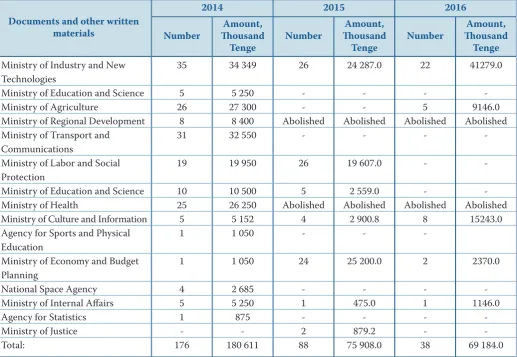
In addition, methodological and organization, regulatory and legal acts that regulate the composition, structure and procedure for the implementation of professional standards, are not pretested in practice, as is customary in developed countries. As a result, the work connected with this work carried out by the method of "trial and error", which in the conditions of limited budget funds is inadmissible. This led to irrevocable budget losses of about 250 million KZT (1 250 000 USD), as evidenced by the data presented in Table 1.
Table 1: Distribution of funds for the development of professional standards for 2014-2016
Source: Resolutions of the Government of the Republic of Kazakhstan “On the approval of the distribution and the Rules for the use of funds for the development of professional standards” for 2014, 2015, 2016.
documents and other written materials
2014 2015 2016
Number Amount, ousand Tenge Number Amount, ousand Tenge Number Amount, ousand Tenge
ministry of Industry and New Technologies
ministry of Education and Science ministry of Agriculture
ministry of Regional Development ministry of Transport and
Communications
ministry of Labor and Social Protection
ministry of Education and Science ministry of Health
ministry of Culture and Information Agency for Sports and Physical Education
ministry of Economy and Budget Planning
At thesecond stageof the work, the National Chamber of Entrepreneurs together with the interested state authorities started the formation of a new methodological base. is base took into account the principles of competent approach, with the development of a card of professions structured with the allocation of specific knowledge, skills, and corresponding skills for each labor function and relevant personal competencies.
However, as practice shows, in the second phase of development of professional standards has already appeared in the organizational and institutional problems. for example, the new guidelines for the development of professional standards was approved mTSS in July 2016. In October 2016, they had made certain changes and additions. is indicates entrenched in government agencies the practice of “trial” and “error”.
It should be noted that this phenomenon was quite widespread in the practice of state bodies of Kazakhstan, can be described asorganization and institutional dysfunction. e results of these studies show that its main reason is the lack of personal liability of authorized officers for substandard performance of their duties in the development and implementation of documents.
4 RECOMMENdATIONS ON THE METHOdOLOGY FOR dEVELOPING
PROFESSIONAL STANdARdS
Since the process of development and implementation of professional standards in Kazakhstan is at an early stage, we considered the feasibility of using the approach used in most European countries. Its name “integrated” is due to the fact that the development of professional standards is integrated into the design process of educational standards. In this case, first of all professional standards are developed; then on their basis educational standards and evaluation standards are designed. is approach is successfully used in Germany, france, Austria and other countries. A distinctive feature of these countries is the use of the state model of regulation of vocational education. e greatest successes in its use are observed in Germany, which has one of the most advanced systems of dual education.
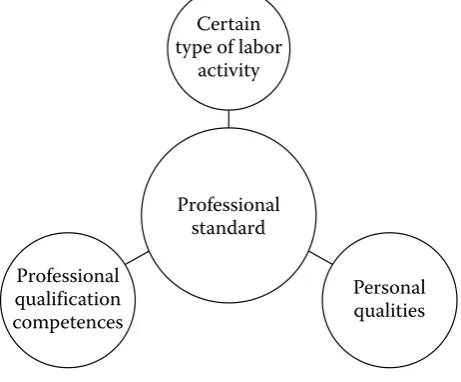
e main elements of the professional standard being developed in Kazakhstan using a competency-based approach should be:
- A certain type of work that determines the qualitative composition of knowledge, abilities and skills and a corresponding set of personal and business qualities that ensure its successful implementation;
- Professional and qualification characteristics based on knowledge, experience and developed skills that are acquired in the process of learning and practice. ey reflected and confirmed with diplomas and certificates, and called “Hard skills” ;
- Personal and professional qualities that characterize the behavioral responses of the individual in various situations, which in the literature is known under the name of “Soft Skills” (Ivanov, 2010). Some authors call them individual and psychological characteristics. ey acquired not only during work but also in everyday life, as well as of the birth. One of them, for example, includes initiative, ability to communicate, establish interpersonal relations, to mobilize, etc.
us, the schematic diagram of the elementary model of the professional standard will look as shown in figure 1. figure 1: Schematic diagram of the elementary model of the professional standard
As already mentioned, the expansion potential of Industry 4.0 associated with the necessary digital skills to use new intelligent systems and adapt them to future technologies. In these conditions, training in digital competencies is increasingly included in the standard training programs for working specialties, involving work on numerical control machines. Digital technologies also bring changes in approaches to the study of Humanities, focused on the knowledge of the social structure using certain communicative competencies. All this actualizes the intensification of the training of specialists in the field of digital technologies, and not only technical specialties, but also communicative, as well as other areas. is require the introduction of relevant competences in educational standards.
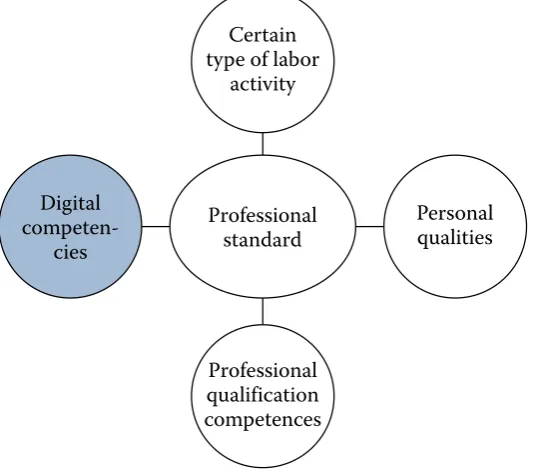
Accordingly, we propose in the conditions of Industry 4.0 development to introduce “Digital skills” into professional standards as a separate element of digital competence. In this case, the elementary model of the professional standard will look like that shown in figure 2, which reflects the new quality of human capital at the primary level under digitalization conditions.
figure 2: Schematic diagram of the elementary model of professional standard in the context of Industry 4.0
Source: Own research
e introduction into Kazakhstani practice the digital competences, which should be reflected in the professional standards, requires the solution of two organically interrelated tasks. e first task of the methodological nature is that: for each type of work (profession, professional group) in addition to the basic professional and personal competencies, as is currently done, it is necessary to determine the appropriate digital competence.
is involves the use of a functional analysis methodology. World theory and practice developed several of its definitions. In practical terms, the following is the most commonly used: “functional analysis is a method of step-by-step description of hierarchical levels in the field of professional activity used in the development of professional standards.
e algorithm for conducting functional analysis to identify specific functions consists in the sequential determination of elements at different levels of the hierarchy” (Oleynikova & muravieva, 2011). In our opinion, the above formulation and others like it do not reflect the essence of the method under consideration. In this regard, we propose the following interpretation of the concept.
e method of functional analysisin relation to the development of professional standards is the decomposition of certain types of work into measurable labor functions and actions. e key value in the development of professional standards using this method belongs to the functional map. It reflects labor functions and corresponding labor actions in an orderly hierarchical form. e methods of expert-analytical assessments, analogies and questionnaires are used in the development of the functional map.
e method of analogiesconsists in studying the tools used by other organizations and creatively adapting them to local conditions.
e method of questioningis that as a questionnaire, respondents (respondents) are offered a mockup of a functional map, which contains the following interrelated attributes:
- types of employment; - labor functions;
- knowledge necessary to perform the relevant functions; - skills necessary to perform the relevant functions.
In addition, for each job function it is proposed to assess its importance on a four-level scale: very high, high, medium, low. We believe that in order to build a full-fledged digital society in Kazakhstan, computer literacy should cover all segments of the population, including the unemployable part – students, pensioners and socially vulnerable groups of population. for this, it is necessary to develop appropriatedigital profiles of competenciesfor certain groups of the population. ey should contain the minimum necessary requirements for knowledge and skills in the use of ICT, which should be possessed by wider population. On the basis of these competency profiles training programs are developed for teaching the population advanced information technologies to be used in everyday life.
In this regard, it would be important to open courses for older people, whose computer literacy skills would help them to continue their work, which would have a positive impact on reducing the unemployment of people in this age group. Actively participating in the process of social modernization as carriers of knowledge and experience, this category of workers fulfills the mission of the keepers of the most important spiritual and moral values, providing a link between generations, which is especially important in the light of the spiritual revival of society.
e second task is to improve the existing institutional and organizational framework for the development and implementation of professional standards, the structure of which is shown in Table 2. first of all, it is necessary to provide for the introduction of relevant changes and additions to the guidelines for the development and design of professional standards and other related documents (ministry of Labor, 2018).
Table 2: Institutional and organizational basis of the system of professional standards
Source: Own research
Atthe macro level, policies and the main objectives for their implementation are defined. e main function is to create a framework of conditions defining the legal framework within which the government and the authorized state bodies regulate the process of development and implementation of professional standards.
Level of government Institutional and legal framework Subjects of management (organizational basis)
macroeconomic
Administrative
micro level
– Guidelines for the development and
design of professional standards
– Rules for the development,
maintenance, replacement and
revision of professional standards
– Strategic plans of interested central
and local executive bodies
– Orders of heads of enterprises and organizations on the implementation of professional standards
– e president,
– Parliament,
– Government
– ministry of Labor and Social Protection of the Republic of Kazakhstan
– Interested central and local government bodies
– National Chamber of Entrepreneurs of Kazakhstan
– Industry Councils Research institutes and centers – professional standards developers
– Heads of economic entities – e Labour Code of the
Republic of Kazakhstan – e Law „On the state budget
of the Republic of Kazakhstan“ – State program
e averageadministrativelevel is considered by some scientists as” the sphere of functional management”, in which “any activity is analyzed and decomposed into various organizational and managerial components – planning, organization, management, control, and others” (Kozbanenko, 2000). In our opinion, this interpretation is incorrect, since these functions are performed at all levels of management.
At the administrative level, the content of the activities of the authorized state bodies is to perform functions called Executive. ey include the definition of a set of measures that are reflected in the regulatory, legal, policy and other documents aimed at the implementation of the policy in the field of development of professional standards in Kazakhstan. e works consist in the development and testing of organizational and methodological support with the subsequent development of professional standards. en, on their basis, educational programs are developed, as well as curricula for training centers for continuing professional education.
e analysis of institutional and organizational bases of the given structural model consists in assessing the quality of documents for compliance with the methodological and regulatory documents that determine their structure and content. It is also envisaged to evaluate the effectiveness of budget funds allocated for development in conjunction with the quality of provided services.
It should be noted that in countries where a full-fledged institutional and organizational framework has been established, significant progress has been made in the development of a new quality of human capital.
5 CONCLUSION
Industry 4.0 is changing the way workers and labor interact, opening up new opportunities. On the one hand, the rapid pace of technological change is a major challenge for workers, who must adapt to new conditions in a short time. On the other hand, human resources acts as a driver for the transformation of production systems, and human ingenuity and creativity are necessary for the production of the future. is sets the task of adapting the vocational education system to the needs of the new industrialization. As practice shows, modern vocational training requires a competence-based approach. e potential for the expansion of Industry 4.0 is linked to the necessary digital skills to use new smart systems and adapt them to future technologies. Along with basic digital literacy, that is, digital skills and understanding of how to apply them, education must go further, giving students a deep understanding of how to apply and implement technologies so that they can play an active role in shaping the tools of the future. It is vital to ensure that training programs remain relevant, and that teachers have a regular opportunity to improve their own skills and knowledge. Although education systems remain highly dependent on specific realities, there is a common vision of the basic principles and fundamental characteristics that can best cope with the challenges and maximize the opportunities of the Industry 4.0. One of the essential elements of the qualitative modernization of the vocational education sphere is the formation of the national system of qualifications based on the use of professional standards. e growing pace of technological changes and globalization increases the importance of adapting public policies, education and training systems to today's skills needs. We outlined the main areas of action that will guide policy for universities and private sector in creating an appropriate, adaptable vocational education system that can meet the requirements of the current and future labor market.
Speaking of Kazakhstan, when developing professional standards as a real basis for a system for training in-demand personnel, it is necessary to eliminate existing methodological and organizational problems, namely: - To introduce the passage of preliminary trials in pilot organizations of methodological and organizational
normative legal acts regulating the composition, structure and procedure for the introduction of professional standards in practice, as is customary in developed countries;
- To overcome the practice of making amendments and changes in the process of developing professional standards by the method of "trial and error", which slows down the implementation of the process and is costly in the face of limited budgetary resources;
- To provide for the personal responsibility of persons who develop and approve recommendations in the event that they discover later defects that are subjective in nature;
- To define methods, as well as a set of measures to stimulate the introduction of professional standards at enterprises in the private sector of the economy;
- To make provisions in the Labor Code of the Republic of Kazakhstan obliging organizations with state participation to introduce professional standards developed by the authorized institutions.
REFERENCES
Austin, m. S., & Harkins, D. A. (2008). Assessing change: Can organizational learning “work” for schools?“The Learning Organization,15(2), 105-125.
Boyatzis, R. E. (1982).The competent manager: A model for effective performance.New York: John Wiley & Sons. Brynjolfsson, E., & mcafee, A. (2014).The second machine age. New York: W. W. Norton & Company, Inc.
Chulanova, Z. K., Satybaldin, A. A., & Koshanov, A. K. (2019). methodology for assessing the state of human capi-tal in the context of innovative development of the economy: A three-level approach.Journal of Asian Finance, Economics and Business,6(1), 321-328.
Craft Y., & Zaytcev A. V. (2017).One onset of the Fourth Industrial revolution and the formation of market structures.
St-Petersbourg: Creative economy.
frey, C. B., & Osborne, m. A. (2013).The future of employment: How susceptible are jobs to computerization.United Kingdom: University of Oxford.
Government of the Republic of Kazakhstan (2013). On the approval of the distribution and the Rules for the use of funds for the development of professional standards for 2013. Resolution No. 406. Retrieved September 14, 2016, from http://tengrinews.kz/zakon/pravitelstvo_respubliki_kazahstan_premer_ministr_rk/trud/id-P1300000406/ Government of the Republic of Kazakhstan (2014). On the approval of the distribution and the Rules for the use of funds for the development of professional standards for 2014. Resolution No. 323. Retrieved September 19, 2016, from https://tengrinews.kz/zakon/pravitelstvo_respubliki_kazahstan_premer_ministr_rk/trud/id-P1400000323/ Government of the Republic of Kazakhstan (2015). On the approval of the distribution and the Rules for the use of funds for the development of professional standards for 2015. Resolution No. 257. Retrieved September 20, 2016 from http://massaget.kz/laws/rus/docs/P1500000257.
Hecklau, f., Galeitzke, m., flachs, S., & Kohl H. (2016). Holistic approach for human resource management in In-dustry 4.0.Procedia CIRP, 54, 1-6.
Ivanov, D. (2010). The way to the top. factors of success.Managing Human Potential,7(3), 15-29.
Kozbanenko, V. (2000). forms and methods of government.Problems of Theory and Practice of Management, 14(2), 46-49.
mcClelland, D. C. (1961). The achieving society. martino fine Books.
ministry for Investment and Development of RK (2018). Digitalization Industry Report. Retrieved October 15, 2018, from http://mid.gov.kz/ru/pages/doklad-ministra-kasymbek-zhm-po-cifrovizacii-gornodobyvayushchey-promyshlennosti-rk-i
ministry of Labor and Social Protection of the Population of the Republic of Kazakhstan (2018). Guidelines for the development and execution of professional standards. Retrieved December, 5 2018, from http://www.enbek.gov.kz/ru/node/349535
moravec, J. W. (2013).Knowmad society. minneapolis: Education futures.
Nazarbayev, N. A. (2017). Social-economic modernization as a main vector of Kazakhstan development. Akorda site. Retrieved January 27, 2017, from http://www.akorda.kz/ru/addresses/addresses_of_president/poslanie-prezidenta-respubliki-kazakhstan-n-a-nazarbaeva-narodu-kazakhstana_1339760819
Oleynikova O. N., & muraveva A. A. (2011).Professional standards: principles of formation, purpose and structure.
moscow: Toolkit.
Quint f., mura K., & Gorecky D. (2015). In-factory learning - qualification for the factory of the future.Acta Uni-versitatis Cibiniensis. Technical series, 1(66), 159-164.
Rankin, N. (2005). The new prescription for performance: The eleventh competency benchmarking survey. Com-petency & Emotional Intelligence Benchmarking, 5(20), 81-91.
Sofinsky, N. A. (2012). Professional standards. Institute of the Labor studies. Retrieved July 25, 2018, from http://www.niitss.ru/analytics/publications/post_62.html