I. INTRODUCTION
With the rapid development in the internet and multimedia communication, a great deal of concerns have been raised in the security of multimedia information transmitted or stored over the open networks. Ensuring security to the multimedia information is a vital issue. A way out is to encrypt the information so that only authorized persons with a valid key can use the information. A number of encryption schemes have been proposed and widely used such as the DES, AES, LUCIFER, FEAL, IDEA etc. However, these algorithms are suitable for text information but not for the images due to the special features of the images such as the high correlation, high redundancy and bulk volume of data [1-10].
Chaotic map based encryption schemes typically possesses high speed with low cost, which makes them better candidates than the traditional cryptosystems for the multimedia encryption [1-5]. Moreover, the encryption algorithms based on the chaotic systems offer the advantages to be very sensitive to the initial conditions,
ergodicity, randomness and simplicity. Hence, there is a growing research interest from the cryptographers on the chaotic map based cryptosystems.
Recently, a number of chaotic based image encryption schemes have been proposed; however, the majority of them have their own strengths and weaknesses in terms of the security and performance [1-5]. This paper proposes an efficient image encryption scheme based on quadruple encryption with Henon and Circle maps. The proposed scheme is resistant to a variety of attacks such as the brute force, statistical, differential and entropy and is computationally fast over the other schemes in the literature.
The novelty of this paper is listed below.
i) The quadruple encryption is explored for the images with four different keys.
ii) The Circle and Henon map are explored together for the image encryption.
iii) The encryption operations are carried with new methods.
iv) The proposed image encryption/decryption scheme is computationally fast.
Image Encryption Based on Quadruple Encryption using Henon and
Circle Chaotic Maps
Author: Gururaj Hanchinamani
1,*Linganagouda Kulkarni
2Abstract
In this paper a new approach for image encryption based on quadruple encryption with dual chaotic maps is proposed. The encryption process is performed with quadruple encryption by invoking the encrypt and decrypt routines with different keys in the sequence ܧܦܧܧǤ
The decryption process is performed in the reverse direction ܦܦܧܦǤThe key generation for the quadruple encryption is achieved with a 1D Circle map. The chaotic values for the encrypt and decrypt routines are generated by using a 2D Henon map. The Encrypt routine ܧ is composed of three stages i.e. permutation, pixel value rotation and diffusion. The permutation is achieved by: row and column scrambling with chaotic values, exchanging the lower and the upper principal and secondary diagonal elements based on the chaotic values. The second stage circularly rotates all the pixel values based on the chaotic values. The last stage performs the diffusion in two directions (forward and backward) with two previously diffused pixels and two chaotic values. The security and performance of the proposed scheme are assessed thoroughly by using the key space, statistical, differential, entropy and performance analysis. The proposed scheme is computationally fast with security intact.
Key Words: Quadruple encryption, Circle map, Henon map, Differential attacks
Manuscript received May 31, 2015 ; Revised June 10 ; Accepted June 29, 2015. (ID No. JMIS-2005-11)
Corresponding Author(*): Gururaj Hanchinamani , College of Engineering and Technology, Hubli-580031, Dharwad, Karnataka, India, 091 9341961485,[email protected].
1
BVB College of Engineering & Technology, Hubli, India , [email protected]
2
The rest of the paper is organized as follows. In section 2, the literature survey is presented. The 1D circle map and 2D Henon map are discussed in section 3. In section 4, the proposed encryption scheme is described in detail. Experimental results and the security analysis are presented in section 5 to show the efficacy and validity of the algorithm. Finally, the conclusions are drawn in the last section.
II. LITERATURE SURVEY
Chaotic based image cryptosystems typically consist of iteration of two processes: permutation and diffusion [1-10]. The permutation stage is employed to decorrelate the adjacent pixels and the diffusion stage is employed to spread the effect of individual pixels across the entire image [1-5]. However, as many rounds of permutation and diffusion or iterations should be taken, the overall encryption speed is slow. A short summary of the recently proposed chaotic based encryption schemes is given hereafter.
The authors of [1], proposed an image encryption scheme based on a generalized Arnold cat map. The chaotic sequences are generated by employing two generalized Arnold cat maps. The typical permutation diffusion architecture is employed. The scheme has three parts: circular permutation, positive diffusion and opposite diffusion. The authors of [2], employed multiple chaotic maps to increase the key space. The chaotic maps used are: Logistic map, Cubic map, Sin map and Tent map. The scheme consists of three modules: Key expansion, encryption and decryption. The encryption scheme consists of eight w-bit registers ܴሺ݅ ൌ ͳǡʹǡ ǥ ǡͺሻ, which contain the initial input plain image as well as the output cipher image at the end of the encryption process. The encryption is performed by using a xor and the pixel value circular rotations. In [3], an image encryption scheme based on the transformed Logistic maps is presented. The encryption operations employed are: permutation of all pixels based on keys, nonlinear diffusion and xor. The authors of [4], presented an image encryption scheme based on coupling of chaotic maps and an xor operator. The encryption process is straightly realized on the bits of the plain image. The image is shuffled by using a chaotic function based on linear congruence. In [5], a combinational domain image encryption scheme is presented that encrypts important data in spatial domain and the irrelevant data in wavelet domain. The proposed scheme considers the varying data significance and supports dissimilar security level to regions of the different significance. The scheme makes use of Prewitt edge detector, discrete wavelet transform, Arnold cat map
and Logistic map. In [6], an image encryption scheme based on an intertwining chaotic map is proposed. The scheme uses multiple chaotic maps to increase the key space. The authors of [7], proposed an image encryption scheme based on chaotic Chebyshev generator. The scheme employs multiple permutations and a diffusion step. The permutation is based on row and column scrambling. The diffusion is based on addition and xor
operations.
The authors of [8], proposed an image encryption scheme based on self adaptive wave transmission. The self adaptive encryption is implemented by using one half of the image to encrypt the other half of the image reciprocally. In [9], a symmetric encryption scheme based on cyclic elliptic curve and chaotic system is presented. The round keys are generated based on piecewise nonlinear chaotic maps. The authors of [10] proposed a gray level encryption scheme to eliminate the image outlines and to disrupt the distributional characteristics of gray level. The scheme makes use of Chua chaotic system. In [11], an image encryption scheme based on a large pseudorandom permutation is proposed which is combinatorially generated from small permutation matrices based on the chaotic maps. The authors of [12], introduced a hierarchy of 2D piecewise nonlinear chaotic maps with an invariant measure. In [13], chaos based image encryption is merged with pixel bit. The scheme uses a single chaotic system, which is applied directly to the position scrambling encryption; moreover, it also performs the gray encryption at the same time. In [14], a common framework of guidelines for developing the image cryptosystems is provided, and it addresses three issues: implementation, key management and security analysis. The authors of [15], proposed an image cipher based on substitution diffusion architecture by using Standard and Logistic chaotic maps. In [16], an image encryption scheme based on two Logistic maps and an external 80-bit key is proposed. The initial conditions for the Logistic maps are derived by using external keys. The encryption is performed by using eight different operations.
III. CHAOTIC MAPS
Chaotic maps are nonlinear maps that are sensitive to initial conditions and parameters, periodic, non-convergent, and topologically mixing [1-5]. The proposed scheme uses two chaotic maps: 1D circle map and 2D Henon map are discussed hereafter.
The 1D circle map is a discrete-time dynamical system, and is defined as,
ܼାଵൌ ඥଵ ଶൈ ܼ ʹߨଷܼሺͳሻ
where ܼ is the current chaotic value, ܼାଵ is the next chaotic value and ଵǡ ଶǡ ଷ are the control parameters. The key set of the Circle map is {ܼ,ଵǡ ଶǡ ଷ}. In the proposed scheme the Circle map is used to generate the keys for the Henon map.
The 2D Henon map is a discrete-time dynamical system, and is defined as,
ܺାଵൌ ͳ െ ܽ ൈ ܺଶ ܻሺʹሻ
ܻାଵൌ ܾ ൈ ܺሺ͵ሻ
where X_i,Y_i are the current chaotic values and ܺାଵǡ ܻାଵare the next chaotic values and ܽǡ ܾ are the control parameters. The key set for the Henon map is ሼܺǡ ܻǡ ܽǡ ܾሽ. In the proposed scheme, the Henon chaotic values are used during the permutation, pixel value rotation and the diffusion stages of the encrypt and decrypt functions.
The propositions of the chaotic maps are given in Eq. (4-6). The chaotic outputs of the above two chaotic maps are analyzed by computing the mean and the self-correlations according to the propositions given in Eq.(4-6). It is observed that the mean values are close to 0.5 and the self correlations within the sequence and across the two sequences are very close to 0.
Proposition 1. The mean value of the chaotic sequence is defined as,
ݔൌ
ே՜
ͳ ܰ ݔ
ேିଵ
ୀ
ൌ ͲǤͷሺͶሻ
Proposition 3. Correlation function between two chaotic sequences is given as,
ܵʹሺߚሻ ൌ
ே՜
ͳ
ܰሺݔെ ݔሻሺݕെ ݕሻ
ேିଵ
ୀ
ൌ Ͳሺሻ
IV. PROPOSED ENCRYPTION SCHEME
The proposed encryption scheme is based on multiple encryption, specifically quadruple encryption. The reason being; it is stronger than the triple encryption against the man-in-the-middle attack [17]. Multiple encryption is one combination technique which uses an algorithm to encrypt the same plaintext multiple times with multiple keys. The proposed quadruple encryption operates on a plain image and then on modified a plain image four times with four different keys. The sender, first encrypts, with the first key, then decrypts with the second key, then encrypts with the third key and finally encrypts with the fourth key according to Eq.(7). This is called as encrypt-decrypt-encrypt-encrypt (EDEE) mode. The receiver decrypts with the fourth key, then decrypts with the third key, then encrypts with the second key and finally decrypts with the first key according to Eq.(8).
ܥ ൌ ܧరቆܧయ൬ܦమቀܧభሺܲሻቁ൰ቇሺሻ
ܲ ൌ ܦభቆܧమ൬ܦయቀܦరሺܥሻቁ൰ቇሺͺሻ
where ܲ is a plain image, ܥ is a cipher image, ܧ is an encrypt function, ܦ is a decrypt function and ܭଵǡ ܭଶǡ ܭଷǡ ܭସ are the keys at respective invocations.
4.1. Key generation and scheming
The keys ܭଵǡ ܭଶǡ ܭଷǡ ܭସ are used to generate the Henon chaotic values. The keys can be described as,
ܭଵൌ ሼܺଵǡ ܻଵǡ ܽଵǡ ܾଵሽ
ܭଶൌ ሼܺଶǡ ܻଶǡ ܽଶǡ ܾଶሽ
ܭଷൌ ሼܺଷǡ ܻଷǡ ܽଷǡ ܾଷሽ
ܭସൌ ሼܺସǡ ܻସǡ ܽସǡ ܾସሽሺͻሻ
So the modified keys can be described as,
ܭଵൌ ሼܺଵൌ ܿଵǡ ܻଵൌ ܿଶǡ ܽǡ ܾሽ
ܭଶൌ ሼܺଶൌ ܿଷǡ ܻଶൌ ܿସǡ ܽǡ ܾሽ
ܭଷൌ ሼܺଷൌ ܿହǡ ܻଷൌ ܿǡ ܽǡ ܾሽ
ܭସൌ ሼܺସൌ ܿǡ ܻସൌ ଼ܿǡ ܽǡ ܾሽሺͳͲሻ
So the key set for the quadruple encryption/decryption process is,
ܭ݁ݕ ൌ ሼܼǡ ଵǡ ଶǡ ଷǡ ܽǡ ܾሽሺͳͳሻ
4.2. Encrypt function
The encrypt function consists of three stages: permutation, pixel value rotation and diffusion and are discussed hereafter.
4.2.1. Permutation
The purpose of the permutation is to decorrelate the adjacent pixels in the plain image. Let I be a gray original image of size ܯ ൈ ܰ, it is a matrix containing ܯ rows and N columns, and the gray values ranges from 0 to 255. The following are the operations performed in this stage.
1 Initially ܯ ܰ Henon chaotic valuesሼሺܺଵǡ ǥ ǡ ܺெሻǡ
ሺܻଵǡ ǥ ǡ ܻேሻ} are generated by using Eq.(2,3), after doing iterations in chaos maps. Let ܲܯ ൌ ሼܺଵǡ ǥ ǡ ܺெሽ andܲܰ ൌ ሼܻଵǡ ǥ ǡ ܻேሽ. Then ܲܯ and ܲܰ are sorted, and the positions of the sorted chaotic values in the original chaotic sequence are found and stored in ܲܯᇱ and ܲܰᇱ. The next step is to shuffle the row position of all the values from the first column to last the column according to ܲܯଵᇱǡ ǥ ǡ ܲܯ
ெᇱ. Similarly shuffle the column position of all the values from the first row to the last row according to ܲܰଵᇱǡ ǥ ǡ ܲܰ
ேᇱ.
2 Generate ܯ ൈ ܰ Henon chaotic values
ሼሺܺଵǡ ǥ ǡ ܺெൈேሻǡ ሺܻଵǡ ǥ ǡ ܻெൈேሻ} by using Eq.(2,3) after doing iterations in chaos maps. Then, exchange the lower principal diagonal element with the corresponding upper principal diagonal element based on the chaotic condition ܺ ܻ.
3 Exchange the lower secondary diagonal element with the corresponding upper secondary diagonal element based on the chaotic condition ܺ൏ ܻ.
This stage shuffles all pixels and decorrelates the neighboring pixels.
4.2.2. Pixel value rotation
Initially, the real chaotic values are transformed into the integer form with the following transform.
ܺᇱൌ ሺܺ
כ ͳͲ଼ሻ݉݀݉ሺͳʹሻ
where ܺ is the real chaotic value, ܺᇱ is the transformed integer value, and ݉is 256 for 8-bit gray image.
The circular rotations are applied on pixel by pixel basis as follows.
Circularly rotate right 3 times, if Ͳ ܺᇱ ͵ Circularly rotate left 2 times, if Ͷ ܺᇱ ͳʹ Circularly rotate right 5 times, if ͳʹͺ ܺᇱ ͳͻͳ Circularly rotate left 6 times, if ͳͻʹ ܺᇱ ʹͷͷሺͳ͵ሻ
where {ܺᇱǡ ݅ ൌ ͳݐܯ ൈ ܰሽ are the chaotic values in the integer form.
4.2.3. Deffusion
The diffusion function is used to ensure the plain image sensitivity i.e., a 1-bit change in any one pixel of the plain image should spread out to almost all pixels in the whole image.
The 2D permuted image is transformed into 1D array ܲଵൈெே by scanning the image from left to right and from top to bottom. The diffusion process is performed in two directions (forward and backward) with two previously diffused pixels and two chaotic values of the Henon map {ܺǡ ܻ}. The computed and encrypted pixel values depend on the previously encrypted pixels and chaotic sequences, hence the algorithm shows the resistance against the differential attacks.
The forward diffusion is performed by using the following equation,
ܧൌ ൫ሺሺሺሺܲ ܧିଶሻ݉݀ʹͷሻ ܧିଵሻ݉݀ʹͷ ْ ܺ൯ ܻሻ݉݀ʹͷǡ ݅ ൌ ͳǡʹǡ ǥ ǡ ܯܰሺͳͶሻ
where indicates the modulo addition, ْ is the bitwise ܱܴܺ, ܧ is the current pixel, ܧିଵ and ܧିଶ are the previously encrypted pixels, ܲis the permuted pixels, ܺ and ܻ are the 2D Henon chaotic values and ܧିଵ and ܧ can be considered as the constants.
The backward diffusion is performed by using the following equation to make the influence of every pixel equal.
ܨൌ ൫ሺሺሺሺܧ ܨାଶሻ݉݀ʹͷሻ ܨାଵሻ݉݀ʹͷ ْ
ܺ൯ ܻሻ݉݀ʹͷǡ ݅ ൌ ܯܰǡ ǥ ǡͳሺͳͷሻ
image pixel,ܺ and ܻ are the 2D Henon chaotic values
and ܧெேାଵ and ܧெேାଶcan be considered as constants. Finally, the encrypted image is obtained after the diffusions using Eq.(14,15) in two directions.
4.3 Decrypt function
Decryption involves the reconstruction of the gray levels of the original image from the encrypted image. It is an inverse process of the proposed encrypts function. Initially, the diffusion process is carried out, first backward then forward. Then, the pixel values are circularly rotated in reverse rotate direction. Lastly, the permutation steps are carried out in reverse order.
The reverse forward diffusion is calculated by Eq.(16), and the reverse backward diffusion with Eq.(17).
ܲൌ ቆ൬ቀ൫ሺܧെ ܻሻ݉݀ʹͷ ْ ܺ൯ െ ܲାଵቁ ݉݀ʹͷ൰ െ
ܲାଶቇ ݉݀ʹͷǡ ݅ ൌ ܯܰǡ ǥ ǡͳሺͳሻ
ܧൌ ቆ൬ቀ൫ሺܨെ ܻሻ݉݀ʹͷ ْ ܺ൯ െ ܧିଵቁ ݉݀ʹͷ൰ െ
ܧିଶቇ ݉݀ʹͷǡ ݅ ൌ ͳǡ ǥ ǡ ܯܰሺͳሻ
4.4 Encryption algorithm
The encryption algorithm makes use of the following three routines: Main routine for the encryption process, Encrypt routine and Decrypt routine.
4.4.1 Main routine for the encryption process
1 Read the original image and store the pixel values in the matrix ܫெൈே.
2 Initialize the Circle map and generate eight chaotic values ( ܿଵ to ଼ܿ ) by using Eq.(1).
3 Initialize four Keys ܭଵǡ ܭଶǡ ܭଷǡ ܭସ by using Eq.(10). 4 Invoke the Encrypt function with ܭଵ for an original
image.
5 Invoke the Decrypt function with ܭଶ for a modified image.
6 Invoke the Encrypt function with ܭଷ for a modified image.
7 Invoke the Encrypt function with ܭସ for a modified image.
4.4.2 Encrypt function
The encrypt function is composed of the following fifteen steps.
1 Get the image.
2 Generate ܯ chaotic values of the ܺ
sequenceሺܺଵǡ ǥ ǡ ܺெሻǡ and ܰ chaotic values of the ܻ sequenceሺܻଵǡ ǥ ǡ ܻேሻ using Eq.(2,3).
3 Copy ܺ chaotic values to ܲܯ and ܻchaotic values toܲܰ.
4 Sort ܲܯ and ܲܰ, find the position of the sorted chaotic values in the original chaotic sequence and store in ܲܯᇱ and ܲܰᇱ.
5 Shuffle all the rows using ܲܯᇱ. 6 Shuffle all the columns using ܲܰᇱ.
7 Generate ܯ ൈ ܰ chaotic values ሼሺܺଵǡ ǥ ǡ ܺெൈேሻǡ
ሺܻଵǡ ǥ ǡ ܻெൈேሻ} using Eq.(2,3).
8 Exchange the lower principal diagonal element with the corresponding upper principal diagonal element if ܺ ܻ, Repeat this for all the lower diagonals. 9 Exchange the lower secondary diagonal element with
the corresponding upper secondary diagonal element if ܺ൏ ܻ , Repeat this for all the lower diagonals. 10 Transform the real chaotic values into integers using
Eq.(12).
11 Perform left or right circular rotations based on the chaotic values for all the pixels according to Eq.(13) 12 Transform the 2D processed image into 1D array i.e.
dimension transform from ܯ ൈ ܰݐͳ ൈ ܯܰ. 13 Perform the forward diffusion using Eq.(14). 14 Perform the backward diffusion using Eq.(15). 15 Transform the 1D encrypted array into 2D array i.e.
dimension transform from ͳ ൈ ܯܰݐܯ ൈ ܰ.
4.4.3 Decrypt function
The decrypt function is composed of the following fifteen steps.
1 Get the image.
2 Generate ܯ ൈ ܰ chaotic values ሼሺܺଵǡ ǥ ǡ ܺெൈேሻǡ
ሺܻଵǡ ǥ ǡ ܻெൈேሻ} using Eq.(2,3).
3 Transform the real chaotic values into integers using Eq.(12).
4 Transform the 2D image into 1D array, i.e. dimension transform ܯ ൈ ܰ݅݊ݐͳ ൈ ܯܰ.
5 Perform the reverse backward diffusion using Eq.(17).
6 Perform the reverse forward diffusion using Eq.(16). 7 Transform the 1D array into 2D array, i.e. dimension
transform ͳ ൈ ܯܰ݅݊ݐܯ ൈ ܰ.
8 Change the direction of rotation and perform left or right circular rotations based on the chaotic values for all pixels according to Eq.(13).
9 Exchange the lower secondary diagonal element with the corresponding upper secondary diagonal element if ܺ൏ ܻ , Repeat this for all the lower diagonals. 10 Exchange the lower principal diagonal element with
the corresponding upper principal diagonal element if ܺ ܻ, Repeat this for all the lower diagonals. 11 Generate ܯ chaotic values of the ܺ
ܻ sequenceሺܻଵǡ ǥ ǡ ܻேሻ using Eq.(2,3).
12 Copy ܺ chaotic values to ܲܯ and ܻchaotic values toܲܰ.
13 Sort ܲܯ and ܲܰ, find the position of the sorted chaotic values in the original chaotic sequence and store in ܲܯᇱ and ܲܰᇱ.
14 Shuffle all the columns using ܲܰᇱ. 15 Shuffle all the rows using ܲܯᇱ.
4.5 Decryption algorithm
The decryption algorithm makes use of three routines: Main routine for the decryption process, Encrypt routine and Decrypt routine.
4.5.1 Main routine for the decryption process
1 Read the encrypted image and store the pixel values in the matrixܧܰெൈே.
2 Initialize the Circle map and generate eight chaotic values ( ܿଵ to ଼ܿ ) using Eq.(1).
3 Initialize four Keys ܭଵǡ ܭଶǡ ܭଷǡ ܭସ using Eq.(10). 4 Invoke the Decrypt function with ܭସ for an
encrypted image.
5 Invoke the Decrypt function with ܭଷ for a modified image.
6 Invoke the Encrypt function with ܭଶ for a modified image.
7 Invoke the Decrypt function with ܭଵ for a modified image.
4.5.2 Encrypt and decrypt functions
The encrypt and decrypt functions for the decryption process are the same as given in sections 4.4.2 and 4.4.3.
IV. EXPERIMENTS AND SECURITY
ANALYSIS
An image encryption scheme is expected to resist the various attacks such as the brute-force attacks, statistical attacks, differential attacks and entropy based attacks [1-10]. This section analyzes the properties of the proposed encryption scheme to demonstrate its effectiveness in resisting these attacks.
5.1 Experimental setup
The proposed algorithm is implemented by using C programming language under the Linux platform by using a personal computer with an intel (R) Core(TM) i3-2120 CPU at 3.30 GHz with 2.91 GB of RAM. According to Eq.(11), the initial parameters of the quadruple encryption process is randomly set to ሼܼൌ ͲǤͺǡ ଵൌ ͲǤͷǡ ଶൌ ͲǤǡ ଷൌ ͲǤǡ ܽ ൌ ͳǤͶǡ ܾ ൌ ͲǤ͵ሽ . The test images are chosen from the USC-SIPI image database
(sipi.usc.edu/database/) and are gray-scale images(ʹͷ ൈ ʹͷሻ.
5.2 Visual assessment
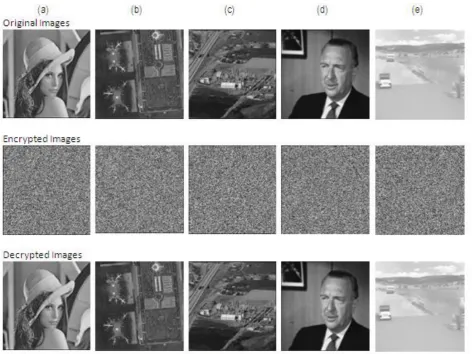
The proposed encryption scheme has been tested with a number of test images of differing contents. Fig.1 shows the visual assessment of the original, encrypted and decrypted images of five different images. The encrypted images are non-recognizable in appearance, unintelligible, incomprehensible, disordered, random and noise-like images without any outflow of the original information. The decrypted images are exactly alike to the original images.
5.3 Key-space analysis
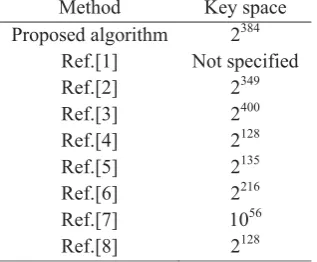
Brute-force attacks are based on the exhaustive search with each and every possible key. Hence, the encryption schemes are expected to provide large key-space. The proposed encryption scheme makes use of two chaotic maps. The key set of the Circle map is {ܼ,ଵǡ ଶǡ ଷ} and the Henon map is {ܺ,ܻǡ ܽǡ ܾ}. The proposed scheme uses all the four parameters of the Circle map and the last two values of Henon map as its key set, so the key set is {ܼ,ଵǡ ଶǡ ଷǡ ܽǡ ܾ}. With 64 bits for each parameter and there are six real parameters, thus the key-length is 384 bits and the key-space is 2384. Hence, the proposed algorithm has adequate key-space and is defiant to the brute-force attacks. Table 1 shows the key space size of the proposed scheme and the other schemes in the literature. It can be seen that the proposed scheme has competitive and adequate key space of 2384.
Table 1. Key-space of the proposed scheme and some of the other methods in the literature
Method Key space
Proposed algorithm 2384 Ref.[1] Not specified
Ref.[2] 2349
Ref.[3] 2400
Ref.[4] 2128
Ref.[5] 2135
Ref.[6] 2216
Ref.[7] 1056
Ref.[8] 2128
5.4 Statistical tests
5.4.1 Histogram analysis
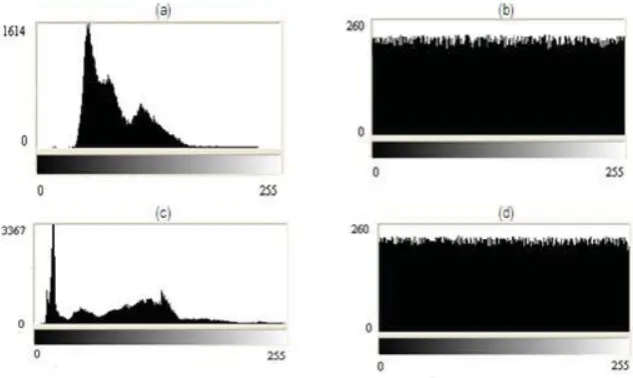
An image histogram plots the frequency of each gray level. An encrypted image is anticipated to have no statistical similarity with the original image to prevent the outflow of the information. The histogram of the original image normally consists of huge spikes with some profiles. These spikes correspond to the gray values that occur more often in the image. The histogram of the encrypted image is expected to be adequately uniform to resist the statistical attacks. The histograms of a number of plain images are plotted and analyzed. The histograms for Airport and Walter Cronkite images are shown in Fig.2. The histograms of the encrypted images are uniformly spread and are entirely different from that of the original image, and bear no statistical resemblance to the original images. Hence, the proposed scheme is resistant to the histogram based statistical attacks. Majority of the schemes in the literature produce uniformly distributed histograms.
5.4.2 Correlation analysis
In most cases, for any original plain image having specific visual content, each pixel is highly correlated with its neighboring pixels in all the three directions: horizontal, vertical and diagonal. A good quality encryption scheme is anticipated to produce the encrypted images with no such correlations in the adjacent pixels. The correlation coefficient of the adjacent pixels is calculated according to Eq.(18-21).
ܧሺݔሻ ൌ ͳ
ܰ ݔ
ே
ୀଵ
ሺͳͺሻ
ܦሺݔሻ ൌ ͳ
ܰሺݔെ ܧሺݔሻሻ
ଶ ே
ୀଵ
ሺͳͻሻ
ܿݒሺݔǡ ݕሻ ൌ ͳ
ܰ൫ݔെ ܧሺݔሻ൯
ே
ୀଵ
൫ݕെ ܧሺݕሻ൯ሺʹͲሻ
ݎ௫௬ൌ ܿݒሺݔǡ ݕሻ
ඥܦሺݔሻඥܦሺݕሻሺʹͳሻ
Fig. 1. Original images, encrypted images and decrypted images with the proposed algorithm (a) Lena (b) Airport (c) Chemical Plant (d) Walter Cronkite (e) Toy vehicle
where ݔ and ݕ are the adjacent pixels of the original or encrypted images, ܧሺݔሻ is the mean value, ܦሺݔሻ is the deviation with regard to the mean, ܿݒሺݔǡ ݕሻ is the covariance between the adjacent pixels, and ݎ௫௬ is the correlation coefficient. To assess the correlation in the original and encrypted images, 5096 pairs of the adjacent pixels are randomly selected in horizontal, vertical and diagonal directions, and their correlation coefficients are computed by using Eq.(21). The Table 2 lists the computed correlation coefficients of the original and encrypted images for different images. From Table 2, it is observed that the two adjacent pixels in the original image are greatly correlated to each other, whereas the correlation coefficients for the encrypted images are extremely close to zero. Hence, the proposed scheme is resistant to the correlation based statistical attacks. The comparison of the correlation results with the other scheme is listed in Table 3. It can be seen that correlation results of the proposed scheme is extremely close to zero and comparable to the other schemes in the literature.
5.5 Sensitivity tests
The differential attacks are based on how to differ in input can influence the resultant difference at the output. An image encryption scheme is anticipated to be sensitive to both the keys and the plain image and these are discussed below.
5.5.1 Key sensitivity analysis
Key sensitivity implies that a minute change in the secret key should generate entirely different encrypted image. The key sensitivity test is conducted with the following approach.
1 The original image is encrypted by using a test key
ܭଵ to produce cipher image ܥଵ.
2 The original image is encrypted again with a very small change in the test key ܭଵ, i.e. ܭଶ to produce cipher image ܥଶǤ
3 The two cipher images ܥଵand ܥଶwith little different keys are compared with pixel by pixel to observe the number of differing pixels.
The ܰܲܥܴ and ܷܣܥܫ measures are used to evaluate the key sensitivity and are discussed hereafter.
ܰܲܥܴ (Number of Pixels Change Rate) is used to compute the percentage of the total number of different pixels in two images and is calculated by using Eq.(22).
ܰܲܥܴ ൌ σ ܦሺ݅ǡ ݆ሻǡ
ܯ ൈ ܰ ൈ ͳͲͲΨሺʹʹሻ
ܦሺ݅ǡ ݆ሻ ൌ ൜ͳǡ݂݅ܥଵሺ݅ǡ ݆ሻ ് ܥଶሺ݅ǡ ݆ሻ
Ͳǡ ܱݐ݄݁ݎݓ݅ݏ݁ሺʹ͵ሻ
where ܥଵ and ܥଶ are the two encrypted images with slightly different keys ܭଵand ܭଶ. ܥଵሺ݅ǡ ݆ሻ and ܥଶሺ݅ǡ ݆ሻ are the pixel values of ܥଵ and ܥଶ at position ሺ݅ǡ ݆ሻ. ܦ is a bipolar array with the same size as ܥଵ and ܥଶ and its contents are either Ͳ or ͳ based on Eq.(23).
ܷܣܥܫ (Unified Average Changing Intensity) is used to compute the percentage of the average changing intensity difference between the two encrypted images and is computed as,
ܷܣܥܫ ൌ ͳ
ܯ ൈ ܰቈ
ܥଵሺ݅ǡ ݆ሻ െ ܥଶሺ݅ǡ ݆ሻ
ʹͷͷ
ൈ ͳͲͲΨሺʹͶሻ Fig. 2. Histograms of the original and encrypted images (a) Histogram of the Airport image (b) Histogram of encrypted image of the Airport image (c) Histogram of the Walter Cronkite image (d) Histogram of the encrypted image of Walter Cronkite
Table 2. Correlation coefficients of the adjacent pixels in different directions for the original and encrypted images
Image
Correlation coefficients for encrypted images
Correlation coefficients for original images
Horizontal Vertical Diagonal Horizontal Vertical Diagonal
Lena 0.005794 0.005644 0.003480 0.968683 0.943269 0.933408
Airport 0.003446 -0.007657 0.002155 0.850811 0.800954 0.729673
Chemical plant 0.002155 -0.002842 0.000282 0.916546 0.947592 0.896024 Walter Cronkite -0.000058 0.002272 0.001407 0.987105 0.987038 0.978499 Toy Vehicle 0.000192 -0.013196 -0.002466 0.943520 0.982781 0.933587
Table 3. Comparison of the correlation coefficients of the proposed scheme with the other methods
Method
Correlation coefficients Horizontal Vertical Diagonal Proposed algorithm 0.005794 0.005644 0.003480
Ref.[1] 0.077000 -0.072360 -0.061530
Ref.[2] 0.003200 0.002424 0.001520
Ref.[3] 0.006300 0.005900 0.007300
Ref.[4] -0.001700 0.005900 -0.001900
Ref.[5] -0.044500 0.004100 Not specified
Ref.[6] 0.004800 0.002700 0.003600
Ref.[7] -0.097360 -0.070680 0.048440
Ref.[8] 0.011830 0.001600 0.014800
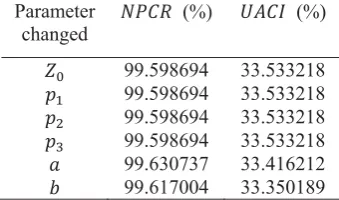
The key sensitivity is assessed by testing one parameter at a time with a very small change in the key. The proposed scheme has six parameters {ܼ,ଵǡ ଶǡ ଷǡ
ܽǡ ܾ}. Table 4 shows the ܰܲܥܴ and ܷܣܥܫ values for six different parameters. From Table 4, it is observed that the ܰܲܥܴ and ܷܣܥܫ values are close to their ideal values of 99.6% and 33.4%. Hence the proposed approach has high key sensitivity. The key sensitivity results in the literature are satisfactory and are demonstrated in the visual form hence are not shown here.
Table 4. Key sensitivity results with different parameters of the chaotic map
Parameter changed
ܰܲܥܴ (%) ܷܣܥܫ (%)
ܼ 99.598694 33.533218
ଵ 99.598694 33.533218
ଶ 99.598694 33.533218
ଷ 99.598694 33.533218
ܽ 99.630737 33.416212
ܾ 99.617004 33.350189
Furthermore, the key sensitivity is also assessed pictorially with the following approach. The original key is altered with a minute change and a different key is generated. The keys can be described as, original key ࡷࢋ࢟= (0.8, 0.5, 0.6, 0.7, 1.4, 0.3), and the slightly modified key ࡷࢋ࢟= (0.80000000001, 0.5, 0.6, 0.7, 1.4, 0.3). The two encrypted images (ܥଵand ܥଶ) with slightly different keys (ܭ݁ݕଵand ܭ݁ݕଶ) are shown in Fig.3b-c respectively.
Although both look alike, they are totally different from each other. This can be confirmed by finding the difference image between ܥଵ and ܥଶ. Fig.3d shows the difference image between ܥଵand ܥଶ. From Fig.3d it is observed that the majority of the pixels in the difference image are nonzero.
In addition, the key sensitivity test is also analyzed for the decryption process. The decryption is performed with the correct key and the slightly different keys. The Fig.4a shows the decrypted image with correct keyࡷࢋ࢟= (0.8, 0.5, 0.6, 0.7, 1.4, 0.3) and Fig.4b-c are the decrypted images with slightly altered keys ࡷࢋ࢟= (0.80000000001, 0.5, 0.6, 0.7, 1.4, 0.3) and ࡷࢋ࢟= (0.8, 0.50000000001, 0.6, 0.7, 1.4, 0.3). Hence, the correct decryption cannot be attained if there is a little change in the key.
5.5.2 Plain-image sensitivity analysis
Plain-image sensitivity means, a little change in the original plain image should cause a considerable change in the encrypted image. The plain-image sensitivity assessment is conducted with the following steps.
1 Encrypt the original plain-image to produce a cipher imageܥଵ.
2 Change one bit of the original plain-image at any random location, and encrypt again to produce a cipher imageܥଶ.
Fig. 3. Key sensitivity analysis for the encryption process for Chemical plant image (a) original image (b) encrypted image with the correct key ࡷࢋ࢟ (c) encrypted image with slightly different key ࡷࢋ࢟ (d) difference image between and
Fig. 4. Key sensitivity analysis for the decryption process for Chemical plant image. (a) decryption with the correct key (b-c) decryption with slightly changed keys
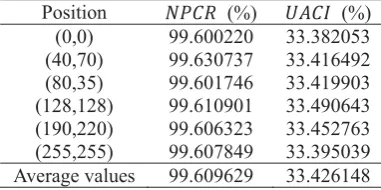
Two measuresܰܲܥܴ and ܷܣܥܫ are used to assess the plain-image sensitivity as given in Eq.(22-24). The ܰܲܥܴ and ܷܣܥܫ values are calculated for different randomly chosen positions by altering one bit at a time and the results are listed in Table 5. From Table 5, it is observed that the ܰܲܥܴand ܷܣܥܫ values are close to their ideal values of 99.6% and 33.4% irrespective of the pixel position. Thus the proposed approach has high sensitivity to plain-images and is defiant to the differential attacks. Table 6 lists the plain image sensitivity results of the proposed scheme and the other schemes in the literature. The plain image sensitivity results of the proposed scheme are comparable to other schemes and are close to the ideal values.
Table 5. Plain-image sensitivity test at different positions of the image
Position ܰܲܥܴ (%) ܷܣܥܫ (%)
(0,0) 99.600220 33.382053
(40,70) 99.630737 33.416492
(80,35) 99.601746 33.419903
(128,128) 99.610901 33.490643 (190,220) 99.606323 33.452763 (255,255) 99.607849 33.395039 Average values 99.609629 33.426148
Table 6. Comparison of the plain-image sensitivity results with other schemes in the literature
Method
Plain image sensitivity
NPCR % UACI %
Proposed algorithm 99.609629 33.426148
Ref.[1] 99.576000 33.441000
Ref.[2] 99.610000 33.450000
Ref.[3] 99.609200 33.489100
Ref.[4] 99.610000 33.450000
Ref.[5] 60.00 – 94.00 15.00 – 38.00
Ref.[6] 99.562100 33.432400
Ref.[7] 99.233000 33.479000
Ref.[8] 50.200000 25.200000
5.6 Information entropy analysis
The information entropy is a measure of the amount of unpredictability in information content, and is defined as,
ܪሺܭሻ ൌ σ ܲሺܭሻ݈݃ଶ
ଵ
ሺሻ
ିଵ
ୀ ሺʹͷሻ
hence the entropy value is usually smaller than the ideal
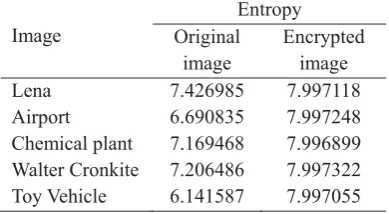
value of 8. The entropy reaches the maximum ideal value of 8 when all the pixels are randomly scattered. Table 7 shows the entropy values for the original plain images and the encrypted images. From the results, it is observed that the entropies of the encrypted images are extremely close to the ideal value of 8. The information outflow in the proposed encryption scheme is insignificant and is secure against the entropy based attacks. The comparison of the entropy outcome with other schemes is listed in Table 8. The entropy outcome of the proposed scheme is close to the ideal value of 8 and is comparable to other schemes in the literature.
Table 7. Entropy values for the original and encrypted images for different images
Image
Entropy Original
image
Encrypted image
Lena 7.426985 7.997118
Airport 6.690835 7.997248
Chemical plant 7.169468 7.996899 Walter Cronkite 7.206486 7.997322
Toy Vehicle 6.141587 7.997055
Table 8. Comparison of the entropy values of the proposed scheme with the other methods
Table 8. Comparison of the entropy values of the proposed scheme with the other methods
Method Entropy
Proposed algorithm 7.997118
Ref.[2] 7.996991
Ref.[3] 7.993000
Ref.[6] 7.994000
Ref.[1,4,5,7,8] Not specified
5.7 Other tests
5.7.1 Peak signal to noise ratio (۾܁ۼ܀) analysis
By considering the original plain image as a signal and the encrypted image as noise, the objective evaluation of the encryption scheme can be performed by computing the ܴܲܵܰ [5]. The ܴܲܵܰ is computed as follows,
ܴܲܵܰ ൌ ʹͲ ൈ ݈݃ଵቀଶହହ
ξெௌாቁ ݀ܤሺʹሻ
where ܯܵܧ is the mean square error and is calculated as follows,
ܯܵܧ ൌ ͳ
ܯܰ ሺȁܫሺ݅ǡ ݆ሻ െ ܫ′ሺ݅ǡ ݆ሻȁሻ
ଶሺʹሻ
ே
ୀଵ ெ
ୀଵ
where ܫሺ݅ǡ ݆ሻ is the pixel intensity value of the original plain image and ܫ′ሺ݅ǡ ݆ሻ is the pixel intensity value of the encrypted image at locationሺ݅ǡ ݆ሻ. The ܴܲܵܰ values for different test images are computed and are shown in Table 9. From Table 9, it is observed that the ܴܲܵܰ values are small, which indicate the complexity in getting the original plain image from the encrypted image for invaders. The comparison of the ܴܲܵܰ outcome with other schemes is listed in Table 10. The entropy outcome of the proposed scheme is lower and is comparable to other schemes in the literature.
Table 9. The ࡼࡿࡺࡾ values for different test images
Image ܴܲܵܰ(dB)
Lena 9.244208
Airport 8.871231
Chemical plant 8.729025 Walter Cronkite 8.092808
Toy Vehicle 7.805952
Table 10. Comparison of the ܴܲܵܰ values of the proposed scheme with the other methods
Table 10. Comparison of the PSNR values of the proposed scheme with the other methods
Method ܴܲܵܰ(dB)
Proposed algorithm 7.805952 – 9.244208
Ref.[5] 8.2462 – 9.7322
Ref.[1,2,3,4,6,7,8] Not specified
5.7.2 Gray value degree ሺ۵܄۲ሻ analysis
The gray difference of a pixel with its four neighborhood pixels in an image is defined as [13],
ܩ ൌσ ሾܫሺ݉ǡ ݊ሻ െ ܫሺ݉
′ǡ ݊′ሻሿଶ
Ͷ ǡ݄݁ݎ݁ሺ݉′ǡ ݊′ሻ
ൌ ൞
ሺ݉ െ ͳǡ ݊ሻ ሺ݉ ͳǡ ݊ሻ ሺ݉ǡ ݊ െ ͳሻ ሺ݉ǡ ݊ ͳሻ
ሺʹͺሻ
where ܫሺ݉ǡ ݊ሻ represents the pixel intensity value at locationሺ݉ǡ ݊ሻ, and ܫሺ݉′ǡ ݊′ሻ denotes the pixel intensity values of the four neighborhood pixels. The average neighborhood gray difference for the whole image can be computed as,
ܹሺܩሺ݉ǡ ݊ሻሻ ൌ σಾషభసమσಿషభసమீሺǡሻ
ሺெିଶሻൈሺேିଶሻ ሺʹͻሻ
ܩܸܦ ൌܹ
′൫ܩሺ݉ǡ ݊ሻ൯ െ ܹሺܩሺ݉ǡ ݊ሻሻ
ܹ′൫ܩሺ݉ǡ ݊ሻ൯ ܹሺܩሺ݉ǡ ݊ሻሻሺ͵Ͳሻ
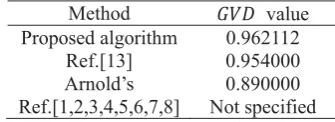
where ܹ′ and ܹ denote the average neighborhood gray difference of the original plain image and the encrypted image. Table 11 lists the computed gray value degree values for different images by the proposed approach. From Table 11, it is observed that the gray value degrees computed by the proposed method are close to the ideal value of 1. Table 12 shows the comparison of the ܩܸܦ value with other methods.
Table 11. Gray value degree values for different test images
Image ܩܸܦ
value
Lena 0.962085
Airport 0.936894
Chemical plant 0.961973 Walter Cronkite 0.986525
Toy Vehicle 0.994267
Table 12. The ࡳࢂࡰ values of the proposed scheme and other approaches
Method ܩܸܦ value
Proposed algorithm 0.962112
Ref.[13] 0.954000
Arnold’s 0.890000
Ref.[1,2,3,4,5,6,7,8] Not specified
5.8 Computational speed analysis
The running time of an encryption scheme can be determined by several factors such as the programming language, operating system, system configuration etc. Table 13 shows the computational time requirement of the proposed scheme and other schemes in the literature. The proposed scheme requires only 0.000009 seconds, and is fast compared to [3,6] with similar computer speed. The proposed scheme is also faster compared to [2,4] with similar programming language. The comparison of the time complexities is shown in Table 14. It can be seen that the time complexity of the proposed scheme is lower and is fast compared to other schemes.
VI. CONCLUSIONS
In this paper, a new approach for the image encryption based on Quadruple encryption with dual chaotic maps is proposed. The proposed approach has a key space of 2384 which is large enough to prevent the brute-force attacks. Moreover, the correlations are close to zero and the histogram is almost uniformly spread, so the statistical attacks are resisted. Furthermore, the ܰܲܥܴ and ܷܣܥܫ values are close to their ideal values of 99.6% and 33.4%
for both the key sensitivity and the plain image sensitivity tests, hence the scheme is defiant to the differential attacks. The average entropy attained is 7.997128, which is close to the ideal value of 8, and hence the information outflow is insignificant. The ܩܸܦ is near to 1 and the ܴܲܵܰ is lower. The proposed scheme is implemented under the Linux platform by using C language, and the speed attained is 0.000009 seconds for a ʹͷ ൈ ʹͷimage. Accordingly, the image encryption scheme proposed in this paper will render excellent image encryption effects and high speed. The proposed scheme can also be applied for color images.
REFERENCES
[1] Guodong Ye and Kwok-Wo Wong, “An efficient chaotic image encryption algorithm based on a generalized Arnold map,” Nonlinear Dynamics, vol. 69, no. 4, pp. 2079-2087, Sep. 2012
[2] Ahmed A. Abd El-Latif, Li Li, Tiejun Zhang, Ning
Wang, Xianhua Song and Xiamu Niu, “Digital image
encryption scheme based on multiple chaotic systems,” Sensing and Imaging, vol. 13, no. 2, pp. 67-88, Jun. 2012
[3] Shatheesh Sam, P. Devaraj and Raghuval S. Bhuvaneswaran, “A novel image cipher based on a mixed transformed logistic maps,” Multimedia Tools and Applications, vol. 56, no. 2, pp. 315-330, Jan. 2012
[4] M. Francois, T.Grosges, D.Barchiesi and R.Erra, “A new image encryption scheme based on a chaotic function,”Signal Processing: Image Communications,
vol. 27, no. 3, pp. 249-259, Mar. 2012
[5] Nidhi Taneja, Balasubramanian Raman and Indira Gupta, “Combinational domain encryption for still visual data,” Multimedia Tools and Applications, vol. 159, no. 3,pp.775-793, Aug. 2012
[6] Shantheesh Sam, P. Devaraj and R.S. Bhuvaneswaran,
“An intertwining chaotic maps based image encryption scheme,” Nonlinear Dynamics, vol. 69, no. 4, pp. 1995-2007, Sep. 2012
[7] Xiaoling Huang, “Image encryption algorithm using chaotic chebyshev generator,” Nonlinear Dynamics, vol. 67, no. 4, pp. 2411-2417, Mar. 2011
[8] Xiaofeng Liao, Shiyue Lai and Qing Zhou, “A novel image encryption algorithm based on self-adaptive wave transmission,” Signal processing, vol. 90, no. 9, pp. 2714-2722, Sep. 2010
“Implementation of gray image encryption with pixel
shuffling and gray-level encryption by single chaotic system,” Telecommunication Systems, vol. 52, no. 2, pp. 563-571, Feb. 2013
[11] Ji won Yoon and Hyoungshick Kim, “An image encryption scheme with a pseudorandom permutation based on chaotic maps,” Communications in Nonlinear Science and Numerical Simulations, vol. 15, no. 12, pp. 3998-4006, Dec. 2010
[12] A. Akhshani, S. Behnia, A. Akhavan, H. Abu Hassan and Z. Hassan, “A novel scheme for image encryption based on 2D piecewise chaotic maps,” Optics Communications, vol. 283, no.17, pp. 3259-3266, Sep. 2010
[13] Guodong Ye, “Image scrambling encryption algorithm of pixel bit based on chao map,” Pattern Recognition Letters, vol. 31, no. 5, pp. 347-354, Apr. 2010
[14] Gonzalo Alvarez and Shujun Li, “Some basic cryptographic requirements for chaos-based cryptosystems,” International Journal of Bifurcation and Chaos, vol. 16, no. 8,pp. 2129-2151, Aug. 2006 [15] V. Patidar, N.K. Pareek and K.K. Sud, “A new
substitution diffusion based image cipher using chaotic standard and logistic maps,” Communications in Nonlinear Science and Numerical Simulations. vol. 14, no. 7, pp. 3056-3075, Jul. 2009
[16] N.K. Pareek, V. Patidar and K.K. Sud, “Image encryption using chaotic logistic map,” Image Vision and computing, vol. 24, no. 9, pp. 926-934, Sep. 2006
[17] Bruce schneier, Applied cryptography. Singapore: John Wiley & sons, 2001
A
UTHORSGururaj Hanchinamani received ME degree in computer science and engineering from Walchand college of engineering Sangli, India. He is pursuing PhD degree at Visvesvaraiah technological university Belgaum. His research interests are information security and computer architectures. He is currently working as associate professor at computer science department, BVB college of engineering and technology, Hubli, Karnataka, India.