Drowsiness Detection
–
A Visual System
for Driver Support
Nilesh J. Uke, Dr. Ravindra C. Thool, Prashant S. Dhotre
Abstract—Driving is a complex task that requires constant attention from all senses. Vision based Driver Assistance System in comprise of various sub systems like lane departing warning, traffic sign recognition, intelligent head lamp control, pedestrian detection etc. This paper demonstrates a work towards safety system especially for fatigue car drivers so as to prevent accidents. The system uses a small monochrome camera that points directly
towards the driver’s face and monitors the driver’s eyes in
order to detect fatigue. In such a case when fatigue is detected, a warning signal is issued to alert the driver. This paper describes the procedure to detect eyes, and also to determine if the eyes are open or closed. The proposed system uses information obtained form of the image to find the edges of the face, and finds the possibility of area of eyes. Once edge detection has been done, the eyes are found by using Circular Hough Transform. Taking into account the knowledge that number of circles found for every image, we decide whether eyes are closed or opened. An absence of circles corresponds to eye closure. If the eyes are found closed for 8 consecutive frames, the system draws the conclusion that the driver is falling asleep and issues a warning signal. The system works under reasonable lighting conditions.
Key Words—Computer Vision, driver assistance system, edge detection, moving object detection
I. I
NTRODUCTIONDriver Support Systems that help drivers react to changing road conditions can potentially improve safety, which is the key goal in intelligent vehicle development. During the calendar year 2010, there were close to 5 lakh road accidents in India, which resulted in more than 1.3 lakh deaths and inflicted injured on 5.2 lakh persons. These numbers translate into one road accident every minute and one road accident death every 4 minute [1]. More than half of these victims are in active age group of 25-65 years. Reducing the number of fatigue-related accidents would save the society a significant amount financially. The development of technologies for detecting or preventing drowsiness at the present is a major challenge in the field of Accident Avoidance Systems. Drowsiness while driving may cause serious damage therefore there is ultimate need of novel method development for counteracting the dangers. Two of the most urgent symptoms that are consider feasible to detect such activities accurately are a) microsleeps are short periods (2–3 seconds) during which the driver rapidly loses consciousness and b) forward “bouncing”
movement of the head [2].
The focus will be placed on designing a system that will accurately monitor the open or closed state of the driver’s eyes in real-time. By monitoring the eyes, it is believed
that the symptoms of driver fatigue can be detected early enough to avoid a car accident. Detection of fatigue involves taking sequence of images of a face and observation of eye movements. The analysis of face images is a popular research area with applications such as face recognition, virtual tools, and human identification security systems. Developed system works efficiently even in the presence of different illumination sources in the background, unlike the previous research [3] which requires that there should be dark background behind the user.
II. S
YSTEMS FORD
RIVERS
UPPORTToday driving is getting complex with ever growing popularity in in-car decorations, electronics, navigational devices, cell phones and other devices. In an intelligent vehicle a Driver Support System (DSS) should work as a driver copilot, continuously monitoring the driver, vehicle and the environment in order to facilitate human decisions about immediate vehicle guidance and navigation [4]. Car manufacturers have continually strive to devise innovative DSS that can reduce such risks and make the driving experience more pleasurable. Few important vision based systems for driver support are briefly explained below.
1) Adaptive Cruise Control help the driver to remain at constant speed/ adapts the car speed regarding to safety distances, is an extension of ACC. In addition to measuring the distance to a vehicle in front, we also exchange information with a predecessor by wireless communication. This enables a vehicle to follow its predecessor at a closer distance [5]. 2) Driver (unsafe) State Monitoring, which checks the
status of the driver to check level of inattentiveness of the driver. Parameters such as eye-closing duration, mouth-opening duration, mouth state change frequency (from opening to closure or from closure to opening), face detection failure duration, and historical information are calculated [6].
3) Global Positioning System which can determine a vehicle's location by using a network of satellites 4) Lane Departure Warning which checks and generates
a warning signal if the vehicle is departing from its current lane. The angles between lanes and the horizontal axis in captured image coordinate are used in [7] as the criterion for lane departure decision-making.
5) Lane Change Assistance is to monitor the approaching traffic from behind and issue a warning if necessary. System described in [8] helps the driver avoiding some of these critical situations like
dangerous object detected in the neighboring lane. will not distract the driver. Also it’s areal-time monitoring 6) Forward collision warning systems (FCW) target a system using camera, to insure accuracy in detecting
major crash type: rear-end collisions [9]. FCW drowsiness. The above requirements are subsequently the systems warn drivers of an imminent collision, such aims of this project. The project will consist of a concept that the driver can take appropriate corrective actions level system that will meet all the above requirements. in order to mitigate or to completely avoid a collision. Work in [13] relies on estimation of global motion and 7) Pre-crash system (PCS) is to improve the color statistics to track a person's head and facial features
effectiveness of safety restraints and subsequently to detects eye/mouth occlusion, eye blinking and eye minimize injury severity, by activating them before a closure, and recovers the three dimensional gaze of the
collision occurs, in case this collision is assessed as eyes.
imminent and unavoidable. Activities of driver such as talking on a cellular 8) High Beam Detection which counters the glaring telephone, eating, or adjusting the dashboard radio system
effect of host vehicle head light on road surface and is detected in [14] which are non safe while driving. They on outgoing vehicles rear surface. used a side-mounted camera looking at a driver's profile 9) Zebra Crossing Detection which detects the zebra and utilize the silhouette appearance obtained from
skin-signs on the road in advance to alert the driver. color segmentation for detecting these activities. System 10) Traffic Signs Detection and Recognition warn against described in [15] consists of two modules, the
possible dangers and road condition. These systems physiological signal-acquisition module and embedded are able to collect a wide range of information signal-processing module for long-term EEG monitoring automatically and quickly, with the aim of improving and real-time drowsiness detection, respectively. The
road safety. [10] describes an approach to the advantages of low owner consumption and small volume VISUAL Inspection of Signs and panEls of the proposed system are suitable for car applications.
(“VISUALISE”), which is an automatic inspection Moreover, a real-time drowsiness detection algorithm was system, mounted onboard a vehicle, which performs also developed and implemented in this system. Artificial inspection tasks at conventional driving speeds. intelligence algorithms are used by [16] to process the 11) Pedestrian Detection and Tracking alert the driver if a visual information in order to locate, track and analyze
pedestrian or a vulnerable object enters the path of the both the driver's face and eyes to compute the drowsiness vehicle. a monocular vision system for real-time and distraction indexes.
pedestrian detection and tracking during nighttime
IV. D
ROSSYS
YSTEMO
VERVIEWdriving with a near-infrared (NIR) camera. Three modules described in [11] region-of-interest
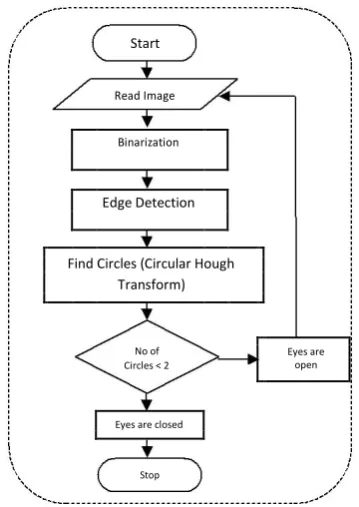
generation, object classification, and tracking are The flow chart of the functionality of developed system integrated in a cascade to distinguish the objects from is shown in Figure 1. Camera continuously focused on the cluttered background in the range of 20-80 m. drivers face to generate its video.
12) Bind Spot Information System is a system that can warn the driver of a risk of blind spots when driving a
Start car. These can incidents when driving, especially
when changing lanes.
Video-based system developed in [12] uses PERCLOS, Read Image
a scientifically supported measure of drowsiness
associated with slow eye closure. The other detection Binarization
method is based on a model to estimate PERCLOS based on vehicle performance data. A neural network model was
used to estimate PERCLOS using measures associated Edge Detection with lane keeping, steering wheel movements and lateral
acceleration of the vehicle.
Find Circles (Circular Hough
III. P
ROPOSEDS
YSTEMO
BJECTIVES Transform)During getting sleepiness most of the driver’s eye found
No of
closed for short duration of time and here some camera Circles < 2 Eyes areopen
should be installed to continuously focus on drivers face and to generate his/her captured video. The edge detection
for every input image has to be done. Eyes are located by Eyes are closed
finding number of circles that will be detected on image. If
The recorded video is converted to respective frames at running time. After reading the image (RGB image), it is converted into grayscale image. Edges of the image are detected by applying Sobel filters. Assuming circle matrix values, numbers of center points of circles are calculated. This uses Circular Hough Transform. The possible circles are plotted on original frame. After checking every eight consecutive frames, we can conclude that the eyes are closed if numbers of circles are less than 2 else eyes are opened. System flow is based on static video as well as live video. Runtime video is captured and in parallel respective frames/images is processed. Figure shows system flow of stored and live video.
V. D
EVELOPEDT
ECHNOLOGYDetection of Drowsiness in user/driver is divided into the following steps:
A. Capturing Video:
The most important aspect of implementing a machine vision system is the image acquisition. Any deficiencies in the acquired images can cause problems with image analysis and interpretation. The next item to be considered in image acquisition is the video camera. Review of several journal articles reveals that face monitoring systems use an infrared-sensitive camera to generate the eye images. This is due to the infrared light source used to illuminate the driver’s face. CCD cameras have a spectral range of 400-1000nm, and peak at approximately 800nm. The camera used in this system is a Sony CCD black and white camera. CCD camera digitize the image from the outset, although in one respect– that signal amplitude represents light intensity–the image is still analog.
B. Framing
The read video is framed so as to have its respective RGB frames. 25 frames are generated per second. But to make our system as faster and faster, we take alternative frames into the consideration.
C. Binarization
Intensity of an image is the average of the three color elements. So the gray scale image that represents the original color image can be computed as:
Io= (Ri+Gi+Bi)/3
Io is the output intensity, Ri, Gi, and Bi are the red, green, and the blue element intensity. The formula for more realistic result is by adding different weight for each R, G, and B element. We normally percept green color brighter that red color, and red color brighter than blue color. That's why we usually set the weight higher for red and higher for green.
Io=(0.299Ri + 0.587Gi + 0.144Bi)/3
Actually there is no absolute reference for each weight values because it depends on the display technology that
might change in the future. The above formula is standardized by NTSC (National Television System Committee), and its usage is common in computer imaging. [2].
D. Edge Detection
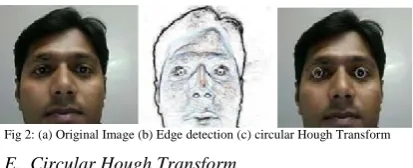
There are many methods available for edge detection. But we prefer Sobel Edge Detection. It has two 3x3 convolution masks are applied to each pixel, one color at a time - one with a horizontal trend and one with a vertical trend. The result of the each convolution is treated a vector representing the edge through the current pixel. If the magnitude of the sum of these two orthogonal vectors is greater than some user-specified threshold, the pixel is marked in black as an edge. Otherwise, the pixel is set to white [17]. Every frame that has been created from input video is read. Sobel edge detector is applied to every image. The result of edge detection is input to next step. Sobel edge detector applied on input image that produces image with only edges. Figure 2 shows the result.
Fig 2: (a) Original Image (b) Edge detection (c) circular Hough Transform
E. Circular Hough Transform
This is the main step of our system to know the position of eyes on original image using Edge detected image. We chose to use an algorithm based on Circular Hough Transform. The Circular Hough Transform detects circles in an image by letting each edge point of the image
to “vote” for all circles (with given radius) it may belong to. Circles with maximum votes “win”. The circular
Hough transform maps a two-space (x,y) to a three-space of circles (x,y,r). Performing Circular Hough transform and drawing the circles detected on the original images. Figure 2 shows the circles that were detected on the original image.
F. Generating Alarm
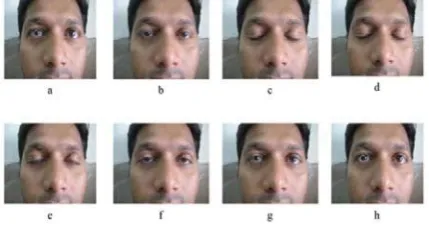
As soon as circle marking has been done, next step is to find first frame with eyes closed by setting a flag value and next consecutive 7 frames i.e. total 8 frames. If all 8 frames are with eyes closed then alarm is generated. This procedure is carried out until last frame is encountered. Figure 3 shows consecutive 8 frames from an input video. Every image is an output from Circular Hough Transform. All Images shown in Figure 3 gives the status as the eyes are open. The conclusion is drawn since not all frames with eyes closed.
Fig 3. Sequence of Frames for Drowsiness Detection
Frame ‘a’ to ‘h’ shows circles on eyes region if eyes
found open else they are not shown. For example frame
’a’ is with two circles where as frame ‘e’ is eye closed
frame, hence the circles are absent. If we found all eight frames with eyes closed then we come to know that driver is in fatigue state. Immediate alarm signal has to be generated to vehicle driver
VI. J
UDGINGD
ROWSINESSPhysiological measures related to changes in blink behavior can be relatively well defined and calculated from the EOG (electrooculogram) signal [18]. Other measures used include blink duration, delay of eye-lid reopening, lid closure speed, lid opening speed as indicators. In our system when there are 8 consecutive frames find the eye closed, then the alarm is activated, and a driver is alerted from his drowsiness. Consecutive number of closed frames is needed to avoid including instances of eye closure due to blinking. A previous study in [19] explains the criteria for judging the alertness level on the basis of eye closure count. Diminished alertness is detected on the basis of the degree to which the driver's eyes are open or closed [20].
VII. R
ESULTSA
NDD
ISCUSSIONSThe developed system is implemented in real time and work successfully. We measured the accuracy of the detection of open/closed eyes for evaluation purpose. We restricted the driver for less rapid movements, where obvious results were not accurate. It was experimented on 6 different people and gave accuracy more than 90%. Currently camera movements and zooming operations are not considered.
Existing manual approach to have a medical checkup physically is time consuming process. Sensing electrodes attached directly on to the driver’s body is impractical,
and hence be annoying and distracting to the driver. Our system is independent of sensors and do not have those limitations of sensor devices.
VIII. C
ONCLUSIONLooking at the road safety statistics and new algorithms development in computer vision, we see many opportunities of implementing vision based assistance system for commercial drivers to protect potential dangers. In this paper, a user alertness detection system has been developed based on eye detection. The system continuously captures the image of the subject on site and detects eyes to determine if eyes are closed or open, if eyes found to be closed for 8 consecutive frames then it is concluded that the subject is falling asleep or having state of drowsiness therefore fatigue is detected and a warning alarm issued. The developed system can be applied to large number of applications like in vehicles to detect drowsiness level of user, in software industries where developers works continuously for 14-15 hours to detect their vigilance level, for computer operators, operating critical operations on distant machines, hands free interaction with computational devices/machines, controlling heavy machineries like cranes etc. Best part the developed system is accuracy and reliable detection of drowsiness in real time.
R
EFERENCES[1] Report on “Road Accident In India”, Government of India, Ministry of road transport and highway , transport research wing, New Delhi, 2010
[2] Martin Eriksson, Nikolaos P Papanikolopoulos, “Driver fatigue: a vision-based approach to automatic diagnosis”, Transportation Research Part C: Emerging Technologies, Volume 9, Issue 6, December 2001, Pages 399-413
[3] A Barón and P Green, “Safety and Usability of Speech Interfaces for In-Vehicle Tasks while Driving: A Brief Literature Review”, University of Michigan TRI, Technical Report , 2006
[4] P. Paclic, J. Novovikova, P. Pudit, P. Somal, ”Road sign classification using Laplace kernel classifier”, Pattern Recognition Letters 21 (2000)
[5] Van Arem, B.; Van Driel, C.J.G.; Visser, R.; , "The Impact of Cooperative Adaptive Cruise Control on Traffic-Flow Characteristics," Intelligent Transportation Systems, IEEE Transactions , vol.7, no.4, pp.429-436, Dec. 2006
[6] Jing Li; Zehong Yang; Yixu Song; , "A hierarchical fuzzy decision model for driver's unsafe states monitoring," Fuzzy Systems and Knowledge Discovery (FSKD), 2011 Eighth International Conference, vol.1, no., pp.569-573, 26-28 July 2011
[7] Bing Yu; Weigong Zhang; Yingfeng Cai; , "A Lane Departure Warning System Based on Machine Vision," Computational Intelligence and Industrial Application, 2008. PACIIA '08. Pacific-Asia Workshop, vol.1, no., pp.197-201, 19-20 Dec. 2008 [8] Ruder, M.; Enkelmann, W.; Garnitz, R.; , "Highway Lane
Change Assistant," Intelligent Vehicle Symposium, 2002. IEEE , vol.1, no., pp. 240- 244 vol.1, 17-21 June 2002
[9] Nakaoka, M.; Raksincharoensak, P.; Nagai, M.; , "Study on forward collision warning system adapted to driver characteristics and road environment," Control, Automation and Systems, 2008. ICCAS 2008. International Conference , vol., no., pp.2890-2895, 14-17 Oct. 2008
Systems," Intelligent Transportation Systems, IEEE Transactions , vol.10, no.2, pp.283-298, June 2009
[12] Grace, R.; Byrne, V.E.; Bierman, D.M.; Legrand, J.-M.; Gricourt, D.; Davis, B.K.; Staszewski, J.J.; Carnahan, B.; , "A drowsy driver detection system for heavy vehicles," Digital Avionics Systems Conference, 1998. Proceedings of 17th DASC. The AIAA/IEEE/SAE , vol.2, no., pp.I36/1-I36/8 vol.2, 31 Oct-7 Nov 1998
[13] Smith, P.; Shah, M.; da Vitoria Lobo, N.; , "Determining driver visual attention with one camera," Intelligent Transportation Systems, IEEE Transactions on , vol.4, no.4, pp. 205- 218, Dec. 2003
[14] Veeraraghavan, H.; Atev, S.; Bird, N.; Schrater, P.; Papanikolopoulos, N.; , "Driver activity monitoring through supervised and unsupervised learning," Intelligent Transportation Systems, pp. 580- 585, 13-15 Sept. 2005
[15] Chin-Teng Lin; Che-Jui Chang; Bor-Shyh Lin; Shao-Hang Hung; Chih-Feng Chao; I-Jan Wang; , "A Real-Time Wireless Brain–Computer Interface System for Drowsiness Detection," Biomedical Circuits and Systems, IEEE Transactions on , vol.4, no.4, pp.214-222, Aug. 2010
[16] Flores, M.J.; Armingol, J.M.; de la Escalera, A.; , "Driver drowsiness detection system under infrared illumination for an intelligent vehicle," Intelligent Transport Systems, IET , vol.5, no.4, pp.241-251, December 2011
[17] Davies, E.R. “Machine Vision: theory, algorithms, and practicalities”, AcademicPress: San Diego
[18] Anna Vadeby, Åsa Forsman, Göran Kecklund, Torbjörn Åkerstedt, David Sandberg, Anna Anund, "Sleepiness and prediction of driver impairment in simulator studies using a Cox proportional hazard approach", Accident Analysis and Prevention 42 (2010) 835–841
[19] Weirwille, W.W. (1994). “Overview of Research on Driver Drowsiness Definition and Driver Drowsiness Detection,” 14th International Technical Conference on Enhanced Safety of Vehicles, pp 23-26
[20] Ueno, H.; Kaneda, M.; Tsukino, M.; , "Development of drowsiness detection system," Vehicle Navigation and Information Systems Conference, 1994. Proceedings., 1994 , vol., no., pp.15-20, 1994
Prashant Dhotre
received his BE (Computer Science) from Bidve College of Engineering, Latur, India and ME in Information Technology from Sinhgad College of Engineering, Pune, India in 2005 and 2010 respectively. He is currently Assistant Professor in Computer Science and Engineering Department, Sinhgad Institute of Technology and Science, Narhe, Pune, India. He is Life member of ISTE. [email protected]
A
UTHOR’
SP
ROFILENilesh J. Uke
received the BE degree in computer science and engineering from Amravati University, Maharashtra, India, in 1995 and the ME in computer Engineering in 2005 from Bharathi University Pune. He is Assistant Professor with the department of Information Technology, Sinhgad College of Engineering Pune. Currently he is pursuing his PhD in Computer Vision from SRTM University. His research area includes Computer Vision, Human Computer Interface and Artificial Intelligence. He is member of IEEE, ACM, Life member of ISTE and Indian Science Congress. [email protected]
Dr. Ravindra C. Thool
received his BE, ME and Ph.D. in Electronics from SGGS College of Engineering & Technology, Nanded, Maharashtra, India, in 1986, 1991 and 2003 respectively. He is professor and head with Computer Science Engineering in the same organization. His research area includes Computer Vision, Image processing and multimedia information systems. He has published several research papers in refereed journals and professional conference proceedings. He is member of IEEE and Life member of [email protected]