Doctor of Ministry Theses and Dissertations
9-2019
Learning in the Midst of Action: Phronesis in the Seminary
Learning in the Midst of Action: Phronesis in the Seminary
Kyle J. Chalko
Follow this and additional works at: https://digitalcommons.georgefox.edu/dmin
GEORGE FOX UNIVERSITY
LEARNING IN THE MIDST OF ACTION:
PHRONESIS IN THE SEMINARY
A DISSERTATION SUBMITTED TO
THE FACULTY OF PORTLAND SEMINARY
IN CANDIDACY FOR THE DEGREE OF
DOCTOR OF MINISTRY
BY
KYLE J. CHALKO
PORTLAND, OREGON
Portland Seminary George Fox University
Portland, Oregon
CERTIFICATE OF APPROVAL ________________________________
DMin Dissertation
________________________________
This is to certify that the DMin Dissertation of
Kyle J. Chalko
has been approved by
the Dissertation Committee on October 7, 2019
for the degree of Doctor of Ministry in Leadership and Global Perspectives
Dissertation Committee:
Primary Advisor: Mary Pandiani, DMin
Secondary Advisor: Mark Chironna, DMin
Lead Mentor: Jason Clark, PhD, DMin
iii
Dedicated to my wife, Anna,
iv
Table of Contents
ABSTRACT ... VI
SECTION 1: THE PROBLEM... 1
INTRODUCTION ... 1
HOW WE GOT HERE ... 2
A Brief History ... 2
Pentecostal Values ... 5
American Values ... 8
WHY IS THIS A PROBLEM? ...11
The Danger of the Status Quo... 11
AG: A Pioneer in Non-Traditional Education ... 13
True Stories from AG Pastors ... 14
Ministerial Statistics and Insights ... 15
Assemblies of God Statistics ... 18
THE DISCONNECT ...21
Why Didn’t They Teach You That in Bible College? ... 23
A Word of Warning for Seminaries ... 25
SECTION 2: OTHER SOLUTIONS ...27
INTRODUCTION ...27
HIGHER EDUCATION PERSEVERANCE:TRADITIONAL MODELS PERSIST ...27
Is the Sky Falling? ... 27
The End is Not Nigh ... 32
HIGHER EDUCATION RENOVATION:NON-TRADITIONAL EDUCATION ...36
Non-traditional Education Remains the Majority ... 37
Failing Extension Sites ... 39
HIGHER EDUCATION REVOLUTION:THE NEXT BIG THING ...41
A New Set of Values ... 41
Context is Queen ... 44
ACUTTING-EDGE SNAPSHOT:AFEW GOOD INSTITUTIONS ...45
Duke University, Villanova University and Whitworth University ... 46
George Fox University ... 47
Northwest University ... 47
A New Mega University ... 48
STILL LACKING ...49
SECTION 3: THE HYPOTHESIS ...51
INTRODUCTION ...51
THEOLOGICAL FOUNDATION ...51
Conceptual Framework ... 51
Biblical Framework ... 54
An Ecclesiological Framework – The Harvest and the Laborers ... 56
The History of Seminary ... 57
Paul, the Wise-Master Builder... 60
v
Effectiveness of Practicum... 66
Effectiveness of Online Learning ... 68
Online and Practicum Together... 71
THE METHODOLOGIES ...73
Competency-based ... 73
Prior Learning Assessment ... 76
Hand-Picked Lead Mentor ... 79
Concentrated Online Peer Interaction ... 80
Quality Control ... 82
THE MARKERS ...83
Teaching Spiritual Formation ... 83
Teaching Character ... 86
Teaching Wisdom and Lifelong Learning ... 89
POSSIBLE GAPS ...89
PERSONALLY COMMISSIONED BARNA GROUP STUDY ...91
MARKETING CONSIDERATIONS ...95
CONCLUSION ...96
SECTION 4: THE ARTIFACT ...98
SECTION 5: ARTIFACT SPECIFICATION... 100
GOALS AND STRATEGIES ... 100
AUDIENCE ... 100
ARTIFACT SCOPE AND CONTENT ... 101
BUDGET ... 101
PROMOTION ... 102
STANDARDS OF PUBLICATION ... 102
ACTION PLAN... 102
SECTION 6: POSTSCRIPT ... 103
SUMMARY OF EXECUTION ... 103
PERSONAL DISCOVERY ... 104
POST-GRADUATION CONSIDERATIONS ... 104
BIBLIOGRAPHY ... 106
APPENDICES ... 120
APPENDIX 1—DEGREE PLAN ... 120
APPENDIX 2—COURSE DESCRIPTIONS ... 122
APPENDIX 3—ABBREVIATED COURSE SYLLABUS #1 ... 123
APPENDIX 4—ABBREVIATED COURSE SYLLABUS #2 ... 128
APPENDIX 5—LEAD MENTOR REQUIREMENTS AND APPLICATION ... 132
vi ABSTRACT
The U.S. Assemblies of God Cooperative Fellowship (AG) remains one of the
least educated, and least interested in education, denominations. A perceived disconnect
between graduate-level learning and practical application deters many AG pastors away
from continuing their education, leading to a nationwide trend of not being
“well-educated.” AG pastors have a different set of values than mainstream evangelical
denominations. Thus, the pastors seek their pastoral development from sources other than
mainstream higher education. If universities can create more opportunities for practical
training within typical course work, provide wisdom and character development, and
facilitate mentoring relationships, then AG ministers would be much more likely to
consider returning to higher education for further development.
This dissertation will focus on bringing online practicum learning experiences
into leadership and ministerial graduate studies in the Assemblies of God denomination.
This dissertation asks the question, in what ways will offering an online practicum
experience increase higher education attractiveness and effectiveness to AG pastors, as
opposed to a typical online program? This dissertation postulates that communicating the
practical usefulness of a master’s degree in Ministry Leadership by incorporating
practical learning within the MA will attract more AG pastors to higher education.
Incorporating new-to-seminary methodologies, such as competency-based education,
prior learning experience, a hand-picked lead mentor, and more concentrated peer
interactions will encourage AG pastors to consider and attend higher education in greater
numbers. This dissertation will explain the nature of this problem within the AG and the
vii
recipe made from old elements that will produce an entirely new product. Like in
chemistry, how just changing the amount or method of delivery of a familiar compound
can change the chemical entirely, so can this new combination of pedagogical ideas
change the end product. The artifact presented with this dissertation will outline some of
the technical requirements and aspects, such as a degree plan, course descriptions, and a
SECTION 1: THE PROBLEM
Introduction
The Assemblies of God denomination is one of the most under-educated religious
groups in America. While some may look down on the Assemblies of God (AG) because
of this, many AG ministers are proud of that statistic. Benefits come with being a
grassroots movement, and maintaining Jesus’ “take nothing for your journey” mentality
of evangelism is one of them. However, being under-educated has its limitations.
This dissertation seeks to create a mechanism that will encourage pastors to
consider returning for graduate studies and believes this will have a huge positive effect
on the pastor’s life and ministry. Imagine a world where the church and seminary formed
a mutual apprenticeship with each other;1 a mutual apprenticeship between church and
university that will allow both parties to fully understand each other, and to more
accurately understand the people they try to serve. With the seminary and church more
intimately, intentionally, and respectfully tied together, realistic and potent breakthroughs
shape the next generation of students who will be taught. To accomplish this, this paper
will begin by providing an argument for why AG ministers should consider more
education in their ministerial pursuits. This introduction will briefly survey AG history,
heritage, and values and educational statistics compared to other denominations. This
section will then conclude with a look at what currently exists within higher education’s
current paradigm.
How We Got Here
A Brief History
On New Year’s Day 1901, the Pentecostal Revival sparked as Agnes Ozman gave
an utterance of tongues after receiving the baptism of the Holy Spirit. This
turn-of-the-century event ignited into a movement that today includes almost 10% of the world’s
population and growing. After this initial event in 1901, the Holy Ghost movements
spread around America to many others who had never2 seen this experience before. Yet
despite not having any formal written theology or leadership structure in place, these
people continued to passionately pursue God and figure out their theology as they went
along. This observed history of AG, and Pentecostal movements in general, has led to
some theologians and academics poking fun at the phrase “Pentecostal theology” by
calling it an oxymoron.
But with an influx of people from all over the world joining their ranks as they
flew in to witness and experience this new outpouring, especially at Azusa Street, the
movement had trouble keeping up with its own growth, especially in the areas of church
polity and administration. The evangelical core value of being driven to win conversions
was exponentially elevated for Pentecostals because of their belief in the imminent return
of Christ. The Pentecostal movement saw more missions impact in the world than any
other denomination or movement before it, evidenced by the fact that today, there are
over 600 million Pentecostals and Charismatics globally. Within this group of many
2 Roswell Flower, “The Genesis of the Pentecostal Movement,” Enrichment Journal, 1970.
denominations, one of the largest is AG, which has over 67 million adherents. All of this
growth happened from a vastly undereducated group that compiled their theology as they
ministered.
The Pentecostals’ emphasis on conversion doesn’t leave as much room for other
values that other denominations traditionally held in its place. Most obvious of these is
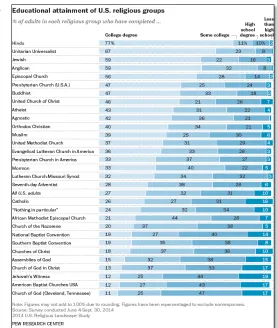
the value of education. As Figure 1 shows, the AG has placed far less importance on
education than almost all other denominations in the U.S. The lack of value on education
by the AG is best reflected by the level of education of its ministers. While some
denominations, like the United
Methodists, require a Master of
Divinity for ordainment before
one can even begin pastoral
ministry, the AG only requires
basic, non-college-level
education. Specifically, they
require 28 classes that can be
taken from non-accredited
Bible institutes, the most
common being the Berean
School of the Bible3 which is
unaccredited and intentionally
3 “Berean School of the Bible,” Global University, accessed January 31, 2019,
https://www.globaluniversity.edu/berean_index.cfm.
not college-level. To achieve the minimum level of credentialing through the AG,
students need only eight of these Berean classes. This low educational standard for AG
ministers represents its values.
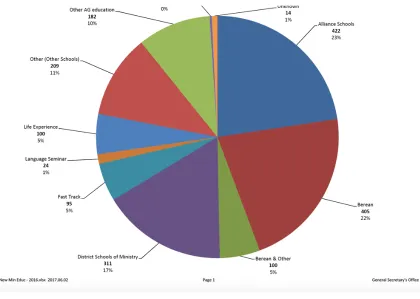
The national office of the AG tracks the educational sources (Figure 2)4 from
which their ministers have received their educational requirements for ordainment. As
Figure 2 shows, only about 25% of AG ministers have completed their schooling from
Berean, while another quarter have gotten their requirements through a “District School
of Ministry,” which offers a variance of Berean, and about 5% have been awarded their
4 James T. Bradford, AG USA New And Transferred Ministers Education 2016 Overview (N.p.:
General Secretary's Office, 2017), 3.
educational requirements through “life experience” while only 23% of AG ministers
come from the regionally accredited “alliance schools.”
In the AG, cultural norms reflect that no one values higher education. To some,
this may sound irrational and might lead one to hold less respect for the AG and other
Pentecostal denominations, but it is important to understand that these values are simply
the consequences of a people who are passionately devoted to the Missio Dei.5 This is the
language of an evangelistic (not evangelical) movement, of a denomination that went
from zero to over 600 million in less than 100 years. The attitude of these people was,
and still is to a certain degree, “Jesus is coming back SOON, so we need to save souls
NOW.” For the AG, if people are getting saved, that is good enough.
Pentecostal Values
James K.A. Smith writes in his book Thinking in Tongues about the five tenets of
Pentecostalism. Smith’s list includes: radical openness, enchanted theology, a
non-dualistic affirmation, an affective epistemology, and an eschatological orientation.6 This
important clarification actually places Pentecostalism in an entirely separate category
than evangelicalism as understood by a handful of theologians, including Smith and
others like Pentecostal scholar Amos Young. In fact, these tenets of Pentecostalism differ
significantly from what David Bebbington identifies in Modern Evangelicalism in Britain
5 The Missio Dei, being the mission of God (that all should be saved) that began in the heart of
God.
6 James K. A. Smith, Thinking in Tongues: Pentecostal Contributions to Christian Philosophy
as the four pillars of evangelicalism: conversionism,7 activism, biblicism, and
crucicentrism.8 Pentecostals will attest to the four pillars of evangelicalism, but Smith’s
five tenets identify that five foundational ways Pentecostals differ from evangelicals. The
various ways these two different value sets get played out can hardly be understated. One
of the most marked differences is the Christian’s reaction and responsiveness to their
personal experiences.
Bebbington says of the Charismatics and Pentecostals in Britain that “experience
was… elevated above theology in the charismatic scale of values.”9 This holds true today
in AG, but it should be pointed out that although Pentecostals may view their experiences
as authoritative over theology, they do not elevate personal experience over the word of
God. In line with the first tenet of radical openness, Pentecostals are open to new
experiences and actively seek God within them. This is not an absurd notion. After all,
when the original Pentecost came, there was no precedent for what was happening! Peter
and the other disciples must have been very surprised to see tongues of fire come down
and hear many different languages spoken at once.10 Part of the DNA of Pentecostals is to
be open to God doing the unexpected in our midst, and then reflecting afterward to
determine if it was God’s work, just as Peter did that first day of Pentecost. For the
7 Bebbington defines Conversionism as the “belief that lives need to be transformed through a
“born-again” experience and a lifelong process of following Jesus.” National Association of Evangelicals, “What is an Evangelical,” accessed August 20, 2019, https://www.nae.net/what-is-an-evangelical/
8 David W. Bebbington, Evangelicalism in Modern Britain: A History from the 1730s to the 1980s (N.p.: Routledge, 2015).
9 Bebbington, Evangelicalism in Modern Britain, 242.
Pentecostals at the turn of the century who saw God moving in new and powerful ways in
the lives of the poor, uneducated, and outcast, it was logical to treat education as
unnecessary. What is the point of apologetics when miracles occur daily, and Jesus could
return any day?11 God blessed this movement without requiring education; their numbers
grew without years of study. Consider these three lines of dialogue that capture the
practical mindset of the Pentecostal.
Does it work? – “Yes.”
Is it sin? – “No.”
“Then let’s do it!”
This attitude and their expectation of Jesus’ imminent return are why many
church12 buildings in Pentecostalism were built very cheaply. They didn’t think they
would have to worry about passing the building down to the next generation. And, to
some degree, Pentecostals treated education the same way they built their buildings early
on. Pentecostals invested the least amount of resources and took the cheapest and
quickest route. Bob L. Johnson Jr. writes, “A review of the modern Pentecostal
movement does indeed provide evidence that substantiates the anti-intellectual sentiment
found within the evangelical movement and wider American society.”13 But this
11 Albert E. Stuernagel, “Signs of the Approaching End of the Age : An Interpretation of the
Times in Which We Are Living,” The Latter Rain Evangel (May 1, 1927): 4-7.
12 Bill Bishop, “Americans Have Lost Faith in Institutions. That's Not Because of Trump or 'Fake
News.',” The Washington Post, March 3, 2017,
https://www.washingtonpost.com/posteverything/wp/2017/03/03/americans-have-lost-faith-in-institutions-thats-not-because-of-trump-or-fake-news/?noredirect=on&utm_term=.65b649bcb4ce.
13 Bob L Johnson, “In Search of a Pentecostal Theology of Knowledge-Work: Exploring the
sentiment was not out of laziness, but out of an intense conviction for the salvation of the
lost: they put other things to the side that would slow them down from the immediate
conversions and results they were praying for so fervently.
American Values
In the 1960s, almost by accident, a phrase struck a chord with the masses. It was
Jack Weinberg who first uttered, “Don’t trust anyone over 30,”14 but it quickly became
the mantra for the decade. This distrust of authority and the system was being applied to
politicians and clergy alike. The trust and respect that Americans once had in the clergy
began to sharply decline. Without realizing it at first, America entered a cultural shift as
the postmodern value of deconstructionism began to rise. A wide-ranging sense of
distrust toward all those in power became more prevalent in the population.
This shift happens as secularism becomes the dominant worldview in America.
Charles Taylor writes about this in his landmark book, A Secular Age,15 where he
provides a compelling theory of the past, present, and future trajectory of Western
intellectual thought. In it, Taylor offers a socio-philosophical account of the shift from a
theistic to a non-theistic orientation in society and its defining institutions.16The
significance of this transition and the effect it had on the world cannot be understated.
14 Berkeley Daily Planet, “Don’t Trust Anyone Over 30, Unless It’s Jack Weinberg,” Berkeley
Daily Planet, April 6, 2000,
http://www.berkeleydailyplanet.com/issue/2000-04-06/article/759?headline=Don-t-trust-anyone-over-30-unless-it-s-Jack-Weinberg--Daily-Planet-Staff
15 Charles Taylor, A Secular Age (Cambridge: The Belknap Press of Harvard University Press,
2018).
Specifically, in regard to education though, Taylor writes about how higher
education is particularly affected by the world’s paradigm shift into secularism and late
modernity. Bob L. Johnson Jr. summarizes, “Whereas prior to the Enlightenment it was
impossible not to believe in God, Taylor argues that it is now impossible to believe in
transcendence. The default orientation that marked the philosophical orientation of the
pre-modern period –belief in a transcendent reality –has given way to the unbelief of late
modernity.”17 Additionally, as James K.A. Smith notes in How Not to Be Secular, being
secular today really means not just a new belief, but that there are more options of what
to believe today than at any other time in human history. Smith states that we are “caught
between myriad options for pursuing meaning, significance and fullness.”18 This shift of
attitude, trust, and values cannot be understated. Johnson continues, “Secularization has
come as the sacred roots of higher education have been severed. The once pervasive
influence of religion on the intellectual life of America's preeminent institutions of higher
education has all but vanished.... In today’s academy non-belief is the only legitimate
academic perspective.”19 This cultural shift set the seminary up for a large drop in interest
and enrollment. With the plummeting of perceived respect/admiration of clergy and the
rising frequency of scandals, skepticism, and suspicion of the public to the pulpit, many
students found callings that were more respected and financially viable. Because of this
distrust in the system and institutions, seminaries experienced huge drops in attendance,
17 Johnson, “In Search of a Pentecostal Theology,” 15.
18 James K. A. Smith, How (Not) to Be Secular: Reading Charles Taylor (Grand Rapids, MI, Mi:
William B. Eerdmans Publishing Company, 2015), 62.
which then then led to budgetary concerns, and many institutions began to water down
their admission process or grow hybrid programs incorporating a profession beyond
pastoral ministry to try to attract more students. This trend of institutions migrating away
from ministry degrees is bigger than just an AG issue; it happens across all
denominations nationwide.20
As a result of this cultural shift, students’ enrollment continues to trend toward
pursuing ministerial type work but in the secular sector.21 This type of altruistic work
might be secular in nature, but it still allows the student to be on the front lines, actively
doing the same type of work that they might have been doing in ministry, e.g., counseling
or teaching. This attitude shift was also accelerated by the America’s new desire to prefer
therapy over theology, and counseling over pastoral care. Douthat writes in his book Bad
Religion,
As [the philosopher] Ronald Dworkin pointed out … the United States has witnessed a hundredfold increase in the number of professional caregivers since 1950. Our society boasts 77,000 clinical psychologists, 192,000 clinical social workers, 105,000 mental health counselors, 50,000 marriage and family
therapists, 17,000 nurse psychotherapists, 30,000 life coaches—and hundreds of thousands of nonclinical social workers and substance abuse counselors as well.22
This trend continues where universities today offer many alternative options for would-be
pastors. Perhaps if a higher education institution can understand that people stopped
valuing ministry degrees, perhaps there is a way they can recalibrate their degree that will
20 Ross Gregory Douthat, Bad Religion: How We Became a Nation of Heretics (New York: Free
Press, 2013), 80-81.
21 Douthat, Bad Religion, 240-241.
make it more applicable to the current generation, more effective at equipping its saints
and ministers all the while not losing its core convictions.
Why Is This a Problem?
The Danger of the Status Quo
Daniel Tomberlin articulates the issue with our current state of biblical education:
“There is a crisis of Biblical illiteracy in evangelical and Pentecostal churches, the very
churches that claim a high view of Biblical inspiration.”23 In the AG, those pastors who
are educated have settled for, at best, what Stanley Grenz and Roger Olson, in Who Needs
Theology, label as lay theology, that is, theology that is informed but isn’t mature and
able to articulate itself.24 It is functional and acceptable (see Figure 3), although not quite
consciously understood. Relatively speaking, this is still a step up for AG, whose
movement came from grassroots “folk theology” experiences. Folk theology is the kind
23 Daniel Tomberlin, “The Real Crisis in Christian Education,” August 4, 2019,
http://www.danieltomberlin.net/the-real-crisis-in-christian-education/.
24 Stanley J. Grenz and Roger E. Olson, Who Needs Theology?: An Invitation to the Study of God
(Downers Grove, IL: InterVarsity Press, 1996), chapter 2.
of theology “that rejects critical reflection and enthusiastically embraces simplistic
acceptance of an informal tradition of beliefs and practices composed mainly of clichés
and legends.”25 As Figure 3 shows, according to Grenz, folk theology is the lowest form
of theology, while lay theology is merely passable. AG pastors maintain this lay theology
(not ministerial theology or professional theology) because it was what was modeled for
and handed down to them.
If that is folk theology, then what is the defintion of good theology? That is, of
course, a hard question to answer specifically. But taking a step back, there is a bigger
resolution to this question, one that would unify denominations more than it would
separate them. To do this, we look back at a concept that was one of the most important
concepts in the early church, that is the Regula Fidei, or rule of faith.26 This rule of faith
is a unifying creed that many can buy into. This rule eventually became refined enough
that the Regula Fidei became the Nicene Creed. Grenz and Olsen state it this way: “Good
theology, therefore, brings the theoretical, academic intellectual aspect of Christian faith
into Christian living. In so doing, theology becomes immensely practical—perhaps the
most practical endeavor one ever engages in!”27 While it’s impossible to articulate what
good theology is based on denominational differences and preferences, Olson and
25 Stanley J. Grenz and Roger E. Olson, Who Needs Theology?: An Invitation to the Study of God
(Downers Grove, IL: InterVarsity Press, 1996), Chapter 2.
26 Another Benedict, “Regula Fide,” 2018,
https://www.anotherbenedict.org/regula-vita/regula-fide/
Grenz’s definition provides a strong framework to work from, which primarily points
back to the fundamentals represented in the Nicene Creed.
A congregation can only rise to the level of the pastor, which is frightening if the
leader’s theology is only folk or lay theology. If AG pastors maintain their current level
of theology, how can they raise the theological level of the church? A better educated
pulpit will lead to a better educated pew.28 More than this, without good theology, bad
theology will sprout up like weeds among the saints. Good theology, and the good
practices that come from good theology, takes intentionality of study, training, reflection
and feedback. Seminary has historically not always provided access to these types of
good practices.
AG: A Pioneer in Non-Traditional Education
Despite the fact that the AG doesn’t prioritize higher education, they have been a
pioneer in non-traditional education. Even from the first general council at the inception
of the AG, preparing and training more ministers of the Gospel was a primary concern. It
is listed in the minutes of the meetings from the first council that the five priorities of the
AG would be, “Agreement in Doctrine, Conservation of word, Facilitating foreign
missions, Chartering church in accordance with law, and Proposing bible training school
to train young people.”29 The fifth priority mentioned was education and training, but the
words “college”, “university” or “seminary” are never mentioned. It seems what was
28 Tomberlin, “The Real Crisis in Christian Education.”
29 The Assemblies of God: Our Heritage in Perspective, Flower Pentecostal Heritage Center
important for those founders was simply developing ministers, not achieving some level
of accredited education. This focus is born out of a heart for missions and extending the
gospel to the ends of the earth. Today, Global University has been a forerunner on this
front. Dr. James E. Book writes in “A History of AG Non-Traditional Education”30 about
some of the amazing achievements accomplished by men and women who were called to
extend basic Christian education to the corners of the earth. This education endeavor was
a world mission dedicated to saving the lost, not just bringing more education. Education
was the vehicle to better reach more unsaved nationals. Book shows that the AG and
Global University working together has been a testament that through non-traditional
education, unbelievers can be converted at remarkable rates. Book writes that many
hundreds of thousands of new believers were discipled because of this effort, and of those
many became ministers.
True Stories from AG Pastors
Beyond statistical data and history lessons about the AG, it is helpful to hear
directly from some AG pastors to understand their ethos in relationship to education. A
prime example is one Bay Area senior pastor who, in a conversation about bringing an
accredited practicum experience to their church interns, said, “our slogan for our program
is Come and Die. If someone is worried about accreditation and a degree, then they are
30 James E. Book, “A History of AG Non-traditional Education Part 1,” AG Heritage 23, no. 2
not fit for our program.”31 For this church, it was considered harmful and even worldly to
be concerned about more education, worldly accolades, or accreditation.
Beyond this, there are stories from pastors who say 30 years ago they were fired
from their churches for bringing up to their senior pastors that they wanted to go to night
school to get their master’s degree. Today in the AG, there are youth pastors, associate
pastors, and even senior pastors who don’t have a single credit of college to their name.
Some might gasp at this, while many from within the AG would say, “So? Let’s look at
how effective they are.” And indeed, many are effective without higher education.
Furthermore, among AG pastors who already have some education, there is hardly any
interest in going back to get their master’s. Their question is, “How will help this my
ministry?” They have the perception that a university is not where you go to learn
ministry. It is the perception that the university only has, as Grenz labels it, academic
theology to offer.32 To them, the Master of Divinity is rightly named because it has no
earthly value.
Ministerial Statistics and Insights
In the 2017 edition, Barna Institute (Barna) published State of the Pastors, which
provides some insights on the state of the American Clergy. Barna states, “Church
leaders are educated and (usually) well-prepared. Three-quarters have pursued higher
education—most commonly a bachelor’s degree or M.Div.—and feel it was good
31 “Glad Tidings’ Discipleship Institute,” Glad Tidings San Francisco, accessed January 31, 2019,
https://www.gtsf.org/gtdi/.
training. Despite how graduates rate their personal experience, the overall reputation of
seminary, however, is far less positive.”33 Additionally, Barna research shows that “the
most common degrees among pastors include a Bachelor of Arts / Science (70%) and a
Master of Divinity (49%). One out of five pastors (21%) has received a doctoral degree
of some kind, most often a D.Min. (14%).”34 Barna’s research speaks definitively that
across all denominations, “pursuing higher education remains a popular choice for
pastors.”35 Seventy-three percent of pastors have studied for ministry at a college or
university, and 45% have attended an official seminary, while only 2% have not attended
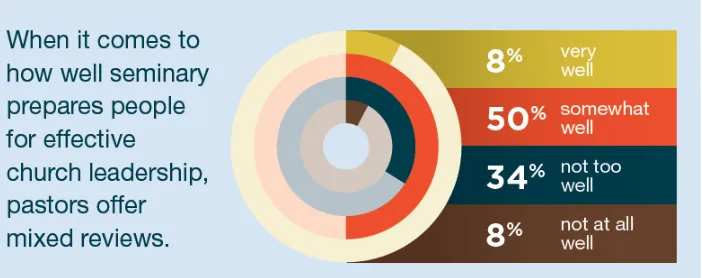
any type of formal Bible school.36 As Figure 4 illustrates, pastors also provided an
opinion of how well seminary prepares them for ministry, and 42% of those surveyed do
not think that seminaries prepare people well.
33 Barna and Pepperdine University, eds., The State of Pastors: How Today's Faith Leaders Are Navigating Life and Leadership In An Age of Complexity, vol. 2016 (Barna Group, 2017), 60.
34 Barna and Pepperdine University, eds., The State of Pastors, 62.
35 Barna and Pepperdine University, eds., The State of Pastors, 62.
36 Barna and Pepperdine University, eds., The State of Pastors, 62.
Barna mentions a statistic that is not entirely surprising, that those who actually
attended seminary rated seminaries as much better at preparing pastors for ministry than
did those who did not actually attend. Barna writes,
Whether a pastor attends seminary seems to bias him or her toward or against its practical value. That is, pastors who attended seminary are twice as likely as those who did not attend to say such institutions are doing very well at preparing people to effectively lead churches today. And those who did not attend are twice as likely as those who did to say seminaries are doing not at all well when it comes to preparing pastors for ministry.37
This is an important distinction. From the outside, it is easy to complain at the big
institution claim that it is wasteful and anitiquated. But those who have experienced what
it is supposed to be often appreciate their time spent there.
Focusing on Pentecostal clergy, Barna found that “advanced education appears to
be more important in mainline denominations than in non-mainline churches [Pentecostal
churches are considered non-mainline by Barna’s definition]. One reason is that it’s more
common for mainline denominations to require a seminary degree before one may be
37 Barna and Pepperdine University, eds., The State of Pastors, 65.
considered for ordination.”38 This is undoubtedly the primary reason that pastors in
mainline denominations are also “more apt to have earned a Master of Divinity (83% vs.
37%) or a Doctor of Ministry (22% vs. 11%).”39This emphasis apparently affects the
type of congregation that is attracted to the church; as Figure 5 shows, only 4% of the
Assemblies of God adherents have a master’s degree, which ranks as the second lowest
of the thirteen different denominations listed in Figure 5.40
Assemblies of God Statistics
The AG score for educational attainment is among the lowest of all U.S. religious
groups, not just Christian denominations.41 Pew Research confirms that this is not just
true for the AG congregants, but for the AG clergy as well. There are, of course,
anomalies, but by and large, the AG as a denomination does not emphasize education or
38 Barna and Pepperdine University, eds., The State of Pastors, 65.
39 Benjamin Wormald, “Religious Landscape Study,” Pew Research Center's Religion & Public
Life Project, May 11, 2015, http://www.pewforum.org/religious-landscape-study/religious-denomination/assemblies-of-god/.
40 Wormald, “Religious Landscape Study.”
41 Caryle Murphy, “The Most and Least Educated U.S. Religious Groups,” Pew Research Center,
November 4, 2016, http://www.pewresearch.org/fact-tank/2016/11/04/the-most-and-least-educated-u-s-religious-groups/.
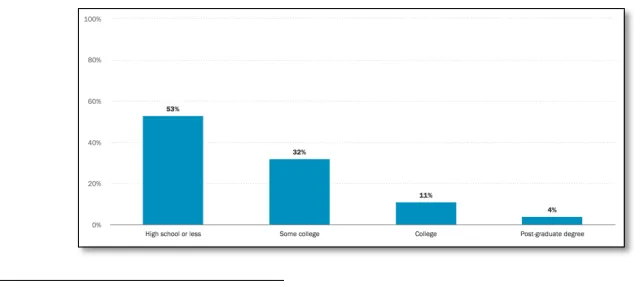
continuing education. As Figure 6 shows, only 4% of AG adherents have a post-graduate
degree.42 Less than half the 9.3% of the general population of the U.S. has a
post-graduate degree.43
The AG also currently lacks any sort of requirements for its clergy regarding
continuing education. In 2015, the idea of mandating continuing education for pastors
was denied by an overwhelming vote from the General Council of the AG pastors.44 This
denial was alarming considering all of the other professions that require continuing
education. Doctors, nurses, psychologists, teachers, therapists, insurance salespeople,
managers, lawyers, logisticians, and analysts all require continuing education to keep
credentials.
In a recent interview with Dr. George Wood, former General Superintendent of
the AG, Dr. Wood explained that the ethnic diversity of the AG is a partial explanation
for why the AG has less educated ministers than other denominations.45 The Pew
Research Center presents data that shows the AG being significantly more diverse than
other U.S. Protestant denominations,46 and much of that diversity is represented by
ethnicities that do not, on average, acquire as much education as Caucasian
42 Wormald, “Religious Landscape Study.”
43 Reid Wilson, “Census: More Americans Have College Degrees than Ever Before,” The Hill,
April 3, 2017, http://thehill.com/homenews/state-watch/326995-census-more-americans-have-college-degrees-than-ever-before.
44 “Minutes of the 56th Session of The General Council of the Assemblies of God,” AG
Constitution and Bylaws (The General Council of the Assemblies of God, August 7, 2015),
https://ag.org/About/About-the-AG/Constitution-and-Bylaws. Resolution 5, Continuing Education. 57.
45 Personal interview with Dr. Wood, April 28, 2019.
46 Pew Forum, “Racial and Ethnic Composition,” accessed June 15, 2019,
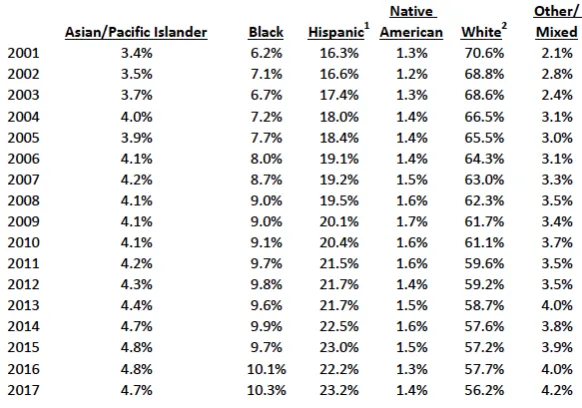
demographics. There are 23 Ethnic fellowships within the US AG all of which have
additional layers of leadership and governance. As shown in Figure 747 the ethnic AG
population is significant and continues to increase steadily. These diversity numbers are
even higher than the overall US diversity ratios, which lists Caucasian as 76.5% as
compared to the AG which is only 56.2% white.48
Figure 7 – Percentage of AG Adherents by Race
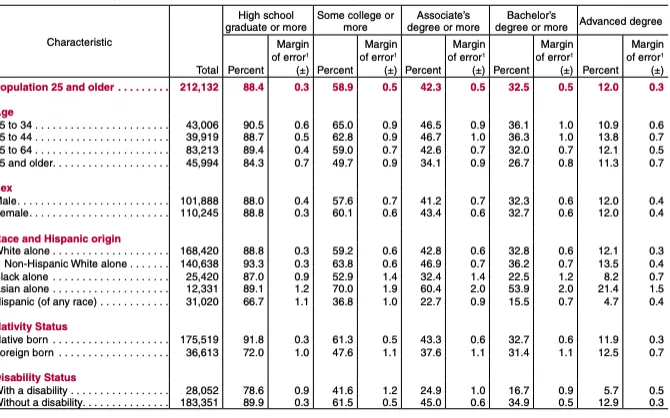
When you take these numbers in comparison with the educational attainment by
ethnicity, it’s clear that this is a significant contributing factor for the overall averages for
the AG. As Figure 8 shows, 32.8% of caucasians have a Bachelor’s, while only 22.5% of
the black population and 15.5% of the hispanic population have a Bachelor’s degree.49
47 “AG USA Aderence by Race, 2001 to 2017,” Ethnic Relations, accessed August 5, 2019,
https://ethnicrelations.ag.org/-/media/Ethnic-Relations/Resources/Adherents_by_Race.pdf.
48 “U.S. Census Bureau QuickFacts: United States,” Census Bureau QuickFacts, January 2018,
https://www.census.gov/quickfacts/fact/table/US/PST045218.
49 Camille L Ryan and Kurt Bauman, “Educational Attainment in the United States: 2015,” United
While this explains some of the discrepancy, it does not fully answer why the educational
gap is so big between the AG and other denominations.
Figure 8 – Educational Attainment by Race
The Disconnect
The real question to be asked is, does higher education equip pastors to be more
effective in ministry? If the answer to this question is not a clear yes, it only follows that
Pentecostal churches will have some strong criticism toward spending valuable resources
of time and money on accredited education. In the past, the pendulum of education in
Christianity has swung too far both ways. On one side, there are the over-theologized
priests of monasticism and the bishops debating about angels on a needle, while on the
other side are the evangelists who shout and holler sermons, unaware of themselves using
scriptures out of context. There are some pastors who have been marginalized because
have failed at pastoring a church and yet were accepted to teach ministerial, pastoral, and
leadership classes because they had a Ph.D. in “leadership.”
When a student only has academic education and no hands-on training, they
inevitably enter the ministry unprepared. Researchers at Barna identified pastors who had
been through seminary but still felt unprepared in many areas of ministry. And, as Figure
9 shows, “many pastors feel they were not adequately prepared for leading people,
dealing with conflict and the administrative tasks that are part and parcel of being a
pastor in the 21st century.”50 Higher education is, of course, still a powerful tool for the
50 Barna and Pepperdine University, eds., The State of Pastors, 66.
Christian community, and this dissertation simply argues for a more centered way.
Despite the discouraging statistics that have been shared about Christian higher
education, Daniel O. Aleshire, author of Earthen Vessels: Hopeful Reflections on the
Work and Future of Theological Schools, writes “persons educated for ministry tend to
end up in ministry, stay in ministry, and believe that their education provided good
preparation for what they are doing.”51 Therefore, it is worth reiterating that those pastors
who had not been to seminary also confessed to feeling ill-prepared for ministry and, in
most cases, they felt this to a greater degree than those who had been to seminary.52
When a student only has experience and no studies, they are unprepared for many
inevitable issues. They are in danger of falling susceptible to and teaching distorted
theology. They are unaware of the possibilities of their own growth, and they cap the
growth of their own congregation by having capped their own.
Why Didn’t They Teach You That in Bible College?
It’s common to hear amongst pastors, “They didn’t teach me that in Bible
college.” This idiom is a fun jab pastors like to throw at their alma maters to show that
what they are doing is a lot harder than they thought it would be. While the critique is
valid to some degree, this statement gives the educational system too bad of a reputation.
First and foremost, Bible colleges were not designed to teach students that, whatever that
may be. They were not ready to learn it! The students weren’t asking those questions,
51 Daniel O. Aleshire, Earthen Vessels: Hopeful Reflections on the Work and Future of Theological Schools (Grand Rapids, MI: Eerdmans, 2008), 131.
either. If they had, many of the professors could have answered with ease. It is only when
the students were finally given an opportunity for real leadership that those practical
questions became urgent. How to deal with the angry church member; what to do when
someone keeps shouting in tongues in back the of your church; how to attract, recruit,
and develop teams of people; and how to lead leaders is not immediately pressing when
students are sitting in a hermeneutics or a systematic theology course. It’s also not as
pressing when the student is playing intermural Frisbee for their whole college
experience rather than being actively involved in ministry alongside their studies. Had
they been in active ministry, their questions would have changed, and their learning
experience along with it. While the institution is to blame for what it has chosen to
systematize, the student is also to blame for not diving into ministry throughout school.
What the seminary wishes they could retort to “they didn’t teach me that in Bible
college” is to share the long list of things that can’t be learned in the busy pastorate, like
thinking theologically instead of pragmatically, receiving feedback from peers and
and reading books harder than current pop-theology books.53 Both education and
practical experience are vital for making an effective ministry in today’s world. The
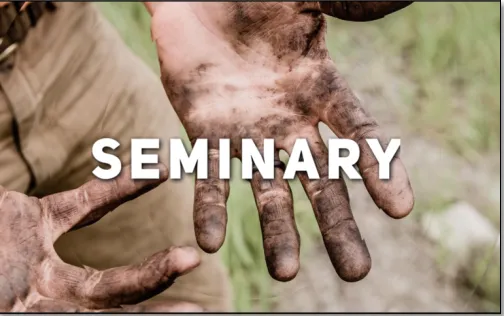
solution is a meshing. As Figure 9 illustrates, the institution should mandate getting your
hands dirty. Smith clarifies, it is fieldwork, the actual getting your hands dirty in ministry,
that should be theology’s self-critique.54 When theology is immediately placed in church,
it allows for an immediate real-world evaluation of the theology and theory.
A Word of Warning for Seminaries
While this dissertation strongly advocates that AG pastors should consider more
higher education, it’s crucial to point out that this does not mean that more education is
always helpful. It’s a fair question to ask: how well are the more highly educated
denominations doing, in terms of growth, in comparison to the less educated Assembles
of God? As shown in Figure 11, over the past 40 years, the number of adherents of
53 Greg Lanier, “15 Things Seminary Teaches Me That My Busy Pastor(ate) Can't,” Greg Lanier,
April 19, 2018, https://glanier.wordpress.com/2018/04/18/15-things-seminary-teaches-me-that-my-busy-pastorate-cant/.
54 Scharen, Fieldwork in Theology, 113.
mainline Protestant denominations has declined significantly, while the AG has
experienced continued significant growth.55 The AG is one of the few denominations still
growing in the U.S. (the Roman Catholic Church and Southern Baptist Convention both
show modest increases, although their growth has plateaued in recent years,),56 and yet
it’s one of the least educated. More education is not the universal answer to more
effectiveness.
55 “Church Stats, 1975-2015,” Flower Pentecostal Heritage Center, May 10, 2017,
https://ifphc.wordpress.com/2017/05/10/church-stats-1975-2015-charts-show-decline-of-mainline-protestants-and-growth-of-pentecostals/.
SECTION 2: OTHER SOLUTIONS
Introduction
Institutions have been looking for more effective and attractive ways to deliver
education for many years now. Whether they’re driven to have increased impact or
increased enrollment, they continually search for ways to improve. The ideas presented in
this dissertation are just a small addition to the very long conversation that pedagogy has
had. In some ways, this section is reminiscent of a state of the union address for higher
education. Although it is impossible to look at every individual program being brewed
into existence by the higher education universe, both traditional and non-traditional
trends will be discussed. This section will start by looking at all of higher education while
focusing most on ministerial training within higher education. Voices from the
traditionalists, non-traditionalists, and the total revolutionaries will all be considered.
This section ends with discussing a few cutting-edge practices currently being
implemented. Some of these will be adapted in section three, which will present a
program that seminaries can use to bring more action and experiential learning into their
ministerial education.
Higher Education Perseverance: Traditional Models Persist
Is the Sky Falling?
It’s been heralded for many years that the sky is falling on higher education, and
that its collapse is inevitable. The threat to higher education is real and constant. From
College services57 where students can shop around and attend many different colleges at
the same time to get exactly the classes they want, new concepts constantly threaten the
current system. Some of these methods are attempts to refine traditional education, while
others want to dismantle the system and start again.
Despite these threats, enrollment in higher education continues to trend upward
(although it has dipped the last few years). The National Center for Education Statistics
(NCES) states, “Enrollment in 2-year and 4-year colleges rose 37 percent from 15.3
million in fall 2000 to 21.0 million in fall 2010, and then decreased 6 percent to 19.8
million in fall 2016.”58 However, the 2016 number is still 28% larger than the 2000
number, so the recent dip is not as alarming as it sounds. For perspective the 2016
enrollment of 19.8 students comes to 6.1% of the total American population.
Part of the reason this “sky-is-falling” attitude continues to abound is the
misplaced admiration given to the idea of the classic “self-made man.” America idolizes
the self-made person who can pull themselves up by their own boot straps. One can be
christened a hero if they drop out of college and become a first-generation millionaire, or
even billionaire. A millionaire is one thing, but a millionaire college dropout is another
thing entirely. Steve Jobs, Jay Z, Richard Branson, Aretha Franklin, Quentin Tarantino,
James H. Clark, Bill Gates, and Evan Williams are the poster children of this archetype
57 “Unbound Gives You a Proven Plan to Reduce Your College Expenses and Graduate Faster,”
Unbound, accessed December 9, 2018, https://getunbound.org/how-it-works.
58 Thomas D. Snyder, Mobile Digest of Education Statistics, National Institute for Education
(Figure 12).59 This model is celebrated and pursued, but unfortunately, it’s also
unrealistic. These people are the exceptions and that’s exactly why their stories are
sensational and entertaining. By definition, most people are not the exception, and most
people benefit from systematic education. The rise of Steve Jobs or Jan Koum cannot be
duplicated on a mass scale.
59 Rachel Gillett, “11 Wildly Successful People Who Dropped Out of High School,” Business
Insider, September 27, 2015, https://www.businessinsider.com/wildly-successful-people-who-dropped-out-of-high-school-2015-9.
Even in the ministerial world, people love stories of someone who skipped the
typical steps. Pastor Perry Noble writes in the forward of What They Didn’t Teach You in
Seminary: 25 Lessons for Successful Ministry in Your Church by James Emery White,
“I’m a seminary dropout.”60 This is a shocking statement considering the background of
Perry Noble,61 who, at the time he wrote this forward, was pastor of a quickly growing
megachurch. This invites the reader to think, “Well, he didn’t need seminary; maybe I
don’t, either.” Ironically, but not surprisingly, Perry Noble has gotten himself into hot
water multiple times by veering too far theologically, like when he changed the 10
Commandments to try to be more relevant.62 This is not to discredit all pastors who have
succeeded without education, as there are always exceptions to the rules, and God in his
sovereignty can choose to use anybody.
Perhaps, though—as this paper will attempt to show—if a seminary was
intentionally designed around building practical wisdom, a pastor like Perry Noble might
have had a different experience and saved himself from unnecessary conflict, burnout, or
theological controversy. Who knows what might have been if there had been an attractive
and more practical seminary available to him that added to his character and biblical
formation?
60 James Emery White, What They Didn't Teach You in Seminary: 25 Lessons for Successful Ministry in Your Church (Grand Rapids, MI, MI: Baker Books, 2011), foreword by Perry Noble, i.
61 Sarah Eekhoff Zylstra, “How Perry Noble’s Alcohol Firing by NewSpring Compares to Other
Churches,” Christianity Today, August 8, 2017, https://www.christianitytoday.com/news/2016/july/how-perry-noble-alcohol-firing-by-newspring-church-compares.html.
62 Tim Brown, “Mega Church Leader Perry Noble Rewrites Ten Commandments,” Freedom
As recently as August 2018, Craig Groeschel, pastor of America’s third-largest
church, shared at the Global Leadership Summit some of the reasons he believes deep
change is coming to higher education. He points out that the return on investment (ROI)
for higher education is not the same as it used to be.63 A bachelor’s degree, which some
say has suffered academic inflation to the brink of being worthless, can cost on average
“$19,488 [per year] at public 4-year institutions and $41,468 [per year] at private 4-year
institutions,”64 which can total over $150,000 for four years. That’s a lot of money that I
is being invested into this system when you consider that in the 2015-2016 academic year
colleges and universities awarded 1,008,000 associates degrees; 1,921,000 bachelor’s
degrees and 786,000 master’s degrees.65 Groeschel argues that if you were to spend that
money on a house instead, the ROI would be much greater, and this is how he is
considering advising his children.66
Groeschel brings up a strong point, but this logic shows short-term thinking. It’s
more plausible that Craig Groeschel has forgotten how much of what he knows actually
came from his time acquiring his M.Div. When someone learns so much, it’s hard to
realize how much you know—until you’re put next to someone who has a different
foundation. Groeschel, like others, fails to give proper credit to the impact higher
education has had in his own life. Nonetheless, Groeschel’s comments are not isolated,
63 Craig Groeschel, “Anticipatory Leadership,” Global Leadership Summit (lecture, Willow Creek
Community Church, August 16, 2018).
64 Snyder, Mobile Digest of Education Statistics, 53.
65 Snyder, Mobile Digest of Education Statistics, 36.
66 Craig Groeschel, “Anticipatory Leadership,” July 31, 2018, 21:48,
and this is the voice that has continued to rise in America. In response to this feeling,
some have attempted to improve the world of higher education, and some have sought to
abandon it all together; examples of each will be discussed over the remainder of
Section 2.
The End is Not Nigh
For traditional students, cost-savings and convenience of schedule, or rigorous
practical internships do not seem to interest a certain demographic, as made obvious by
the amount of students still flocking to traditional education. There is a population of
students who want, and can afford, to spend their resources on what a traditional college
class offers. That is, students still crave the “college experience” and many of their
parents are also desiring it for them. Although it’s undoubtedly more expensive than
other options, the traditional brick-and-mortar college education is not as expensive as
the general public likes to bemoan. Robert B. Archibald, author of Why College Costs So
Much, explains that the cost of higher education has risen in proportion to the
white-collar job salaries that their degrees send new graduates into.67 Expensive yes, but not
unrealistic. Unfortunately, despite usually requiring a degree, ministerial jobs do not pay
as well and have not risen in salary like white-collar jobs.68
67 Robert B. Archibald, Why Does College Cost So Much? (N.p.: Oxford University Press, 2014).
68 C. Kirk Hadaway and Penny Long Marler, “What Pastors Get Paid, and When It’s Not
Traditional brick-and-mortar education with live classroom settings do not seem
to be going anywhere. It is worth mentioning that Dr. Richard Chromey, professor at
George Fox University, predicted in 2007 that the traditional model will continue, and
eleven years later this has proven true.69 Despite all of “higher education is doomed”
rhetoric, the traditional western Socratic model of education has stood the test of time.
Massive Online Open Courses (MOOCs), for example, came and went, and
traditional education is still here. With the concept of providing quality lectures and
coursework at scale at an incredibly reduced tuition, many people thought MOOCs meant
the end for traditional models. The MOOC system gained a lot of publicity and scared
many institutions, but they became a minor player in post-secondary education. If
MOOCs were to disrupt higher education, they would have already done so.70 Similar to
other great-sounding ideas like Webvan—considered now to be one of the greatest
dotcom disasters71—that some predicted would be the end of all grocery stores, it was
quickly discovered that most people just didn’t want the groceries delivered that way.
Perhaps there is a similar explanation for why MOOCs did not catch on. People like their
education like they like their groceries, touchable. There is a hesitation with getting your
degree—or your tomatoes—from such an impersonal, disconnected force. To go one step
69 Richard Chromey, “E-Learning and the Academy: A New Paradigm for Training Youth
Ministry Students” (DMin diss., Portland Seminary, 2007), http://digitalcommons.georgefox.edu/dmin/168, 19-24.
70 Robert Schuwer et al., “Opportunities and Threats of the MOOC Movement for Higher
Education: The European Perspective,” The International Review of Research in Open and Distributed Learning, November 2015, http://www.irrodl.org/index.php/irrodl/article/view/2153/3522.
71 Nate Lanxon, “The Greatest Defunct Web Sites and Dotcom Disasters,” CNET, November 18,
further, if MOOCs are enticing to people, then surely accessing free quality teaching
from sources like YouTube is even more enticing. Yale University, for example, has
posted full undergrad courses for free on their YouTube channel.72 Hear and see
everything everyone else does in the classroom, and buy and read the text book on your
own, for free. All that’s missing is the accredited stamp.
Although the demand is certainly less than it has been in the past, there is still a
large demand for this traditional type of education. In the 2016-2017 school year, there
were 3,895 degree-granting post-secondary institutions (down from 2015-2016 with
4,147 institutions).73 This huge number of post-secondary institutions allows students
who are interested in the traditional education experience to be able to it in almost any
style or location, which further makes it an alluring options for some students.74 As
72 YaleCourses, YouTube Playlist, 2012, https://www.youtube.com/user/YaleCourses/playlists.
73 National Center for Education Statistics, The Condition of Education 2018 At a Glance,
(National Center for Education Statistics, 2018), 4-5.
74 Jeffrey J. Selingo, “How Many Colleges and Universities Do We Really Need?” The
Washington Post, July 20, 2015, https://www.washingtonpost.com/news/grade-point/wp/2015/07/20/how-many-colleges-and-universities-do-we-really-need/?noredirect=on&utm_term=.aaa2160b6ad3.
Figure 13 shows, the overall enrollment for higher education is still on an upward trend.
Even though non-traditional students outnumber traditional students almost three to
one,75 there are still students seeking to get that traditional college experience. It’s true
that the overall traditional student enrollment has gone down for six years in a row,
although the slide downward is slowing.76 Percentages aside, the overall numbers of
traditional college students is still incredibly large. The American Association of State
Colleges and Universities (AASCU) states that, “16 percent of college students today fit
the so-called traditional mold: 18 to 22 years-old, financially dependent on parents, in
college full time, living on campus.”77 But sixteen percent of 19.9 million college
students is still over three million students, which is more than enough of a demand to
keep the system going.78 On top of this, the NCES projects that total college enrollment
“is expected to increase 13 percent between fall 2015… and fall 2026,”79 which would
add almost another 2.6 million students to higher education in the next 10 years. It is
worth noting that this sizeable traditional student chunk continues to be true even though
75 U.S. Department of Education, comp., Digest of Education Statistics, 2016, report, 2018,
https://nces.ed.gov/fastfacts/display.asp?id=80.
76 Paul Fain, “Enrollment Slide Continues, at Slower Rate,” Inside Higher Ed, December 20, 2017,
https://www.insidehighered.com/news/2017/12/20/national-enrollments-decline-sixth-straight-year-slower-rate.
77 Stephen G. Pelletier, “Success for Adult Students,” Public Purpose, September 2010,
https://www.aascu.org/uploadedFiles/AASCU/Content/Root/MediaAndPublications/PublicPurposeMagazi nes/Issue/10fall_adultstudents.pdf.
78 “U.S. College Enrollment Statistics 1965-2027,” The Statistics Portal, 2018,
http://www.statista.com/statistics/183995/us-college-enrollment-and-projections-in-public-and-private-institutions/.
79 William J. Hussar and Tabitha M. Bailey, Projections of Education Statistics to 2026, April
the traditional students for almost two decades have known about the many
non-traditional and cost savings options of other hybrid programs. Because the non-traditional
students are so different than the non-traditional student, the concepts that will be
presented in section three are not a threat to higher education as we know it, but rather an
opportunity for those who would never consider traditional environments.
Higher Education Renovation: Non-Traditional Education
Barna reported in their recent a study, “What’s Next for Christian Higher
Education”80 that many Americans have an unsettling feeling toward higher education.
Although these reports challenged the construct of higher education, Barna still presents
an overall positive attitude toward Christian higher education, stating, “Perceptions
surrounding Christian colleges and universities are positive or neutral regarding
high-quality and a well-rounded education.”81 Later, Barna lists what needs to change about
Christian higher education if they are to stay competitive. Barna states nine cultural
trends—not fads—that are forcing Christian higher education institutions to adapt. Some
of these are newer insights and others have gained momentum for decades. Barna’s
cultural categories that need to be addressed are: demographic, social, economic,
vocational, institutional, legal, digital, moral, and spiritual82 Each of these nine categories
must be addressed if there is to be a more accessible educational model.
80 David Kinnaman, ed. “What’s Next for Biblical Higher Education?” (Barna, 2017).
81 Kinnaman, “What’s Next for Biblical Higher Education?” 4.
Most importantly, though, this report concludes with the idea that Christian higher
education needs to remember its why, how, and what if it is to remain a viable institution
in our modern world. In this report, Kinnaman hints toward a few ideas that are already
being implemented by a few churches—some of which will be presented later in this
paper. Kinnaman states that Bible colleges have begun to compete for students with
churches who are developing their own Leadership Academies or Bible Institutes. These
programs are attractive to churches because they prevent their future ministers from
leaving their church to go to Bible college in the big city, never returning to their ministry
home. While churches may like this, Kinnaman points out that this is competition for the
university. However, the artifact of this dissertation can make it so these two entities are
no longer opposed. There is a way that higher education could seamlessly blend into the
church so that their academy is the university and therefore no longer an adversary.
Non-traditional Education Remains the Majority
Non-traditional education has been a hallmark and an attractive element of many
universities for many decades, with each new non-traditional university besting the last in
the flexibility, customization, and practicality of their degrees. Non-traditional students
have made up about 70% of the student body for the last 10 years. And the numbers of
non-traditional students continue to grow, rising 7.1% at private universities just between
2015 and 2016 alone.83 Looking more specifically at the data, the numbers are not quite
as drastic as they seem. This is because the National Center for Education Statistics
83 U.S. Department of Education, comp., Digest of Education Statistics, 2016, 2018,
(NCES) as of 1996 has given a rather inclusive definition of non-traditional students in
which a student is defined as non-traditional if they meet any one of seven characteristics:
delayed enrollment into post-secondary education; attends college part-time; works
full-time; is financially independent for financial aid purposes; has dependents other than a
spouse; is a single parent; or does not have a high school diploma.84 Those criteria fit a
wide array of today’s college students and the recent re-definitions began to add a lot
more into this category. This means that a student might be 90% traditional and take 10%
of their required classes through a non-traditional format, and they would still be
categorized entirely as non-traditional. While the previous statistics given in this paper
show that number of traditional students is increasing, they cannot show how
non-traditional these non-non-traditional students are.
What non-traditional means today is much different than it would have meant for
the distance education student who submitted his essays via mail in the 1980s. Students
today can take entire degrees on their phone, view classes for free online, take classes for
a lesser level of accreditation, or have more hands-on training from the real-life
practitioners of their degree. The American Association of State Colleges and
Universities (AASCU) goes as far as to say that “non-traditional is new the traditional.”85
When emphasis is placed away from philosophical thought centers and into the
workspace of the true practitioners, students will be naturally attracted to a program.
84 “Who Is Nontraditional?” National Center for Education Statistics (NCES), accessed December
9, 2018, https://nces.ed.gov/pubs/web/97578e.asp.
85 Stephen G. Pelletier, “Success for Adult Students,” Public Purpose, September 2010,