This research was undertaken for the Higher Education Academy (HEA) by Dr Sarah Wilson, Professor Gordon Becket, Katie Greenwood, Dr Julie Prescott (School of Pharmacy and Biomedical Sciences, University of Central Lancashire) and Matthew Stoddart (School of Health).
We would like to acknowledge the contribution and support of our colleagues in conducting this research, and the contribution and enthusiasm of all our participating students.
For more information about the research please contact Sarah Wilson, School of Pharmacy and Biomedical Sciences, Maudland Building, University of Central Lancashire (UCLan), Preston, Lancashire, PR1 2HE. 01772895821 [email protected]
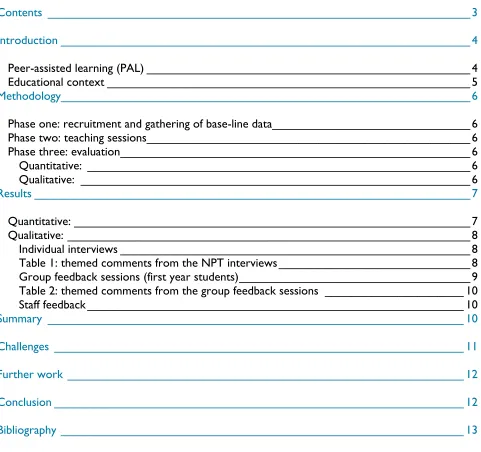
Contents
Contents ________________________________________________________________ 3 Introduction ______________________________________________________________ 4
Peer-assisted learning (PAL) _________________________________________________ 4 Educational context _______________________________________________________ 5
Methodology______________________________________________________________ 6
Phase one: recruitment and gathering of base-line data______________________________ 6 Phase two: teaching sessions_________________________________________________ 6 Phase three: evaluation _____________________________________________________ 6 Quantitative: __________________________________________________________ 6 Qualitative: ___________________________________________________________ 6
Results __________________________________________________________________ 7
Quantitative: ____________________________________________________________ 7 Qualitative: _____________________________________________________________ 8 Individual interviews _____________________________________________________ 8 Table 1: themed comments from the NPT interviews _____________________________ 8 Group feedback sessions (first year students) ___________________________________ 9 Table 2: themed comments from the group feedback sessions _____________________ 10 Staff feedback _________________________________________________________ 10
Introduction
This pilot project builds upon and evaluates innovative teaching methods in the Master of Pharmacy degree at the University of Central Lancashire (UCLan). In this pilot project, higher year students acted as facilitators to first year students: ‘near-peer tutoring’ (see Bulte 2007). The student facilitators worked with students, and alongside academic staff during existing timetabled teaching sessions. A mixed-methods approach was used to evaluate how the teaching experience has impacted on teaching and learning for both ‘taught’ and ‘teaching’ students, and how it can enable the ‘teaching’ students to develop transferrable teaching skills for practice and to be co-producers of aspects of the curriculum. Although this was a small pilot project, it has provided a rich source of information, and a firm foundation to integrate further student involvement within the teaching year.
This project draws on recent policy and theoretical work which emphasises the importance of student engagement as both a necessary element of a valuable student experience, and as a counter-balance to the increasing rhetoric of students as consumers (QAA 2012a; HEA 2010). Pedagogic theory emphasises the importance of students as co-producers of knowledge, actively “engaged in a cooperative enterprise focused on the production, dissemination and application of knowledge” (McCulloch 2009, p. 171). Knowledge becomes embedded, and students move from surface to deep learners when fully engaged with the learning process. As Fry et al. note, “learning best takes place in or related to a relevant context (to facilitate the ‘making of meaning’)” (2003, p. 22), and students are able to gain a deeper understanding of the knowledge through the application to particular situations. In building a community of practice (Fry et al. 2003, p. 12), that is, exposing students to variety of views, and encouraging speaking and listening around a topic, learning is enhanced: “discussion of what is being learnt in a peer (small) group can be a powerful learning tool” (Fry et al. 2003, p. 31). It is this concept of peer learning that informed the development of this project.
Peer-assisted learning (PAL)
Peer-assisted learning (PAL) has been defined as “the use of teaching and learning strategies in which students learn with and from each other without the intervention of a teacher”(Boud et al. 1999, p. 41).
PAL is interesting for educationalists as the technique offers reciprocity in learning between the student tutor and the student tutee. Both student tutor and student tutee have the ability to learn through the process. Through this preparation student tutors are deepening their learning (Evans and Cuffe 2009; Cate and Durning 2007). At the same time, the learners of the process gain not only content learning but also receive emotional support and greater self-confidence (Field et al. 2007; McKeena and French 2011).
The most common model of PAL is that of cross-level peer tutoring (Falchikov 2001), whereby a student leader from a higher year level helps to facilitate classroom-based activities.
Versions of PAL have been widely implemented in schools and colleges, as well as undergraduate and postgraduate teaching in the United States (US) where the technique is often known as supplemental instruction (Hammond et al. 2010) and the technique is starting to have an increasing uptake in United Kingdom (UK) educational institutions. Capstick et al. (2004) note that there is no rigid definition of PAL, but that often it takes place outside of the usual scheduled teaching sessions.
Aside from academic benefits, research suggests that PAL can help reduce drop out and encourages student-centred learning (Coe et al. 1999), learn about learning (Price and Rust 1995), and provides psychological support and aids both personal and professional development (Escovitz 1990). Ginsburg-Block et al. (2006) conducted a meta-analytic review of the social, self-concept and behavioural outcomes of PAL. The study found PAL increased not only academic outcomes but also improved social and self-concept outcomes such as feelings of self-efficacy. In a recent UK study, Hammond et al. (2010) conducted a study of same year PAL finding that the majority of students found PAL helped with social aspects of learning such as learning with others, and gaining other perspectives which contributed to their enjoyment of learning but that it did not improve study skills or assignment preparation.
More recently Campolo et al. (2013) used a technique of PAL, near peer teaching (NPL) which is a teaching model whereby the students of similar backgrounds, separated by a year of two, teach each other (Bulte et al. 2007). Campolo et al. (2013), from interviews with student tutors involved in the NPL, process found
benefits of the process in four common themes: confidence – which included confidence in their knowledge as well as their leadership skills; collaboration – which included helping their peers and collaborations with fellow student tutors; pressure – as a result of their own high expectations of being a tutor; and learning of content and the teaching process. The transition from school or college to higher education may be particularly challenging for some students, and the use of PAL may help with this transition by providing an opportunity for students to discuss topics raised from the curriculum in a non-threatening environment (Boud et al. 2001). The term near peer tutor (NPT) will be adopted in this report to describe the student tutors.
In general, PAL is viewed as a valuable supplement to traditional teaching and education, with some provisos. Wallace (1997) suggests that the technique provides a good source of facilitation, rather than teaching, and Hammond et al. (2010) found that PAL is helpful for clarifying basic concepts but less so for understanding complex concepts. Bulte et al. (2007) found that some student learners involved in the PAL process felt they may not have received the correct answers from student tutors. In order to reduce this, student tutors need to be well prepared and research has found that student tutors need formalised training to help them to be adequately prepared for their teaching role (Bulte et al. 2007; McKenna and French 2011; Campolo et al. 2013). Hammond et al. (2010) found that students imposed pressure on themselves to adequately fulfil the student tutor role and their research suggests that students need help to structure teaching sessions which will help reduce the pressure on them.
Educational context
The Masters in Pharmacy (MPharm) is an integrated Masters degree (QAA 2012b), a four year honours degree leading to the award of the MPharm. Graduates then complete a pre-registration year, working as a pre-registration pharmacist, and must pass a registration exam in order to apply to be registered as a
pharmacist. One of the core skills of a pharmacist is to supply medicines to patients on the presentation of a prescription: a process known as dispensing. The core competencies of dispensing include: the ability to accurately interpret prescriptions; to label dispensed items; to conduct an accuracy check, and to undertake pharmaceutical calculations. These skills are examined in the registration exam and the pass mark is set at 70%, reflecting the importance of these skills as a key professional requirement. At the University of Central Lancashire (UCLan) these skills are taught throughout the four years, with dedicated dispensing workshops in three of the four years (years one, two and four). In order to prepare students for the registration exam, students sit a dispensing exam in years two and four, with a 70 % pass mark. Because of the core nature of these skills, and the integration throughout the years, the dispensing workshops were chosen for the pilot study.
individual support, and group feedback on each exercise is given during and at the end of each workshop. Alongside summative assessments, students complete a competency-based evaluation document based on the core skill areas, at the beginning and end of the series of dispensing classes in years one, two and four with increasing levels of competencies being assessed throughout the course.
Methodology
The project utilised a mixed-methods approach to evaluate the impact of the teaching sessions. A quantitative assessment of the near peer tutors’ (NPT) skills and knowledge was conducted both before and after the teaching session. The qualitative element consisted of individual interviews with the NPTs, and group feedback sessions with the first year students. The project progressed in three distinct phases. Ethical approval was obtained from UCLan’s university ethics committee.
Phase one: recruitment and gathering of base-line data
Students in years two, three and four of the MPharm were invited to volunteer to assist in the teaching of first year dispensing workshops. Students were asked to commit to attending a minimum of three first year
dispensing workshops over an eight-week period. An information session was held to brief students on the project. Students (henceforth NPTs) who wished to go ahead completed a consent form.
The NPTs then undertook a prescription-checking exercise and completed a dispensing competency assessment workbook to establish a baseline of their knowledge in this area.
The dispensing workshops are part of the existing teaching structure, and as such ‘taught’ students are already participants. Students could opt out of working with the NPTs. All students would be invited to participate in the evaluation of the process.
Phase two: teaching sessions
NPTs attended a minimum of three first year dispensing workshops over an eight-week period, for between one and three hours each workshop. Each week the NPTs volunteered to help with several stations. This varied so that experience was gained in all teaching areas, for example: calculations, labelling, and accuracy checks. They were able to use their own choice of method for helping the students. NPTs were also offered the opportunity to lead and deliver the feedback sessions.
First year students could choose to actively opt-out of any one-to-one or small group work with an NPT.
Phase three: evaluation
Quantitative:
After they had supported three dispensing workshops, the NPTs repeated the prescription-checking exercise and the dispensing competency assessment.
Qualitative:
Individual interviews
perspective of the participant, including how it has impacted on their learning. The interview schedule included questions relating to perceived benefits, experience of the sessions themselves, and the opportunity to suggest improvements.
Group feedback sessions
During the final dispensing workshop of the academic term, once all the NPT-supported sessions had finished, first year students were invited to attend one of a series of group feedback sessions, to share their
experiences of the NPT supported sessions.
The feedback sessions were designed to encourage discussion about the session, but also allowed the opportunity for students to make their own individual comment.
Students were asked to write down individual comments on sticky notes for the following four questions; whether they felt they had benefited from the process;
what they enjoyed about taking part in the process; what they did not like about the process;
what they would improve or like see changed to improve the process if it was to run again.
Students were allowed to discuss amongst themselves but were informed that they did not need to write anything down if they did not have any comments about the process, in order to keep the process voluntary. Students were also encouraged to comment because the aim of writing comments on sticky notes was to provide a level of anonymity.
Staff feedback
Staff who had taken part in the dispensing workshops attended by the NPTs were invited to give verbal or written feedback to the project co-ordinator.
Results
Fourteen students originally volunteered to take part as NPTs, with thirteen students going on to take part in the workshop support sessions.
Ten NPTs attended for the face-to-face interviews, and seven NPTs completed the repeat assessment. The interviews lasted between ten and twenty minutes.
130 first year pharmacy students who had taken part of the peer-assisted learning process took part in group feedback sessions. The number of students per group was between six and ten, and each group took
between ten and twenty minutes to complete. A total number of 16 groups were conducted over two three-hour teaching sessions.
Three of the four members of staff involved provided written or verbal feedback.
Quantitative:
Only seven of the fourteen completed the repeat assessment. The results of the prescription-checking exercise and the dispensing competency assessment were reviewed and analysed descriptively. In general the NPTs improved in their score in the prescription-checking exercise, with the average increasing to 87%. In particular all completing NPTs improved in the key legal and clinical areas which, if missed, would lead to a fail both in the university’s summative assessment, and in the professional registration exam.
The dispensing competency assessments also showed an upward trend, with an average high competency rating of 65 out of 69, with all but one student indicating that their competency levels had improved.
Qualitative:
The interviews were recorded and transcribed. The written comments from the group feedback sessions were transcribed. The transcripts were analysed thematically by two members of the research team.
Individual interviews
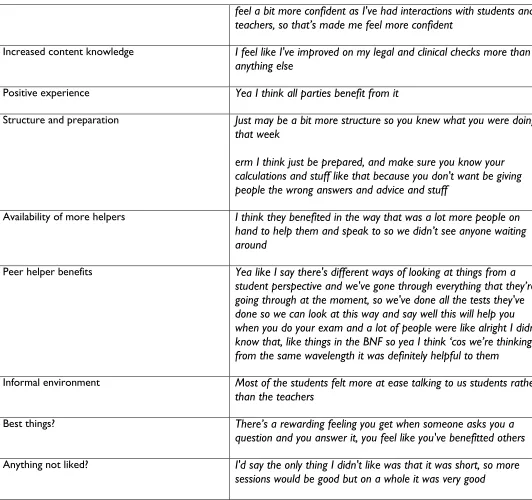
Table 1 presents some themed comments from the interviews.
The NPTs were overwhelmingly positive about the experience. All of the NPTs would recommend the experience to others, and all of them would repeat the experience.
NPTs talked about their own experience, and their perceptions of the experience for the first year students. For the NPT perspective, five themes emerged:
increased confidence in content skills; increased confidence generally;
increased content knowledge; the experience as positive for all;
comments related to structure and preparation.
NPTs expressed a desire to be provided with more structure for the teaching sessions. In relation to preparation, although none of the students prepared and all thought they were well prepared, when it came to advising future NPTs, seven out of the ten advised preparation as their top tip.
In commenting on what they perceived as the benefits for the first year students, three themes emerged: the availability of more helpers; the benefits of having peer helpers (shared experience); and the benefits of the informal environment.
In responding to specific questions, when asked the best thing about the experience, nine out of ten identified this as the way they had been able to help the first year students. When asked if there was anything they had not liked about the experience, the majority of NPTs said there was not anything they had not liked, and where comments were made these were only minor comments relating to the timing and scheduling of the sessions.
Table 1: themed comments from the NPT interviews
Theme Examples
Increased confidence: content skills and generally Yea after helping other people and seeing what other people get wrong, helps me a bit more when I'm doing it myself
feel a bit more confident as I've had interactions with students and teachers, so that’s made me feel more confident
Increased content knowledge I feel like I've improved on my legal and clinical checks more than anything else
Positive experience Yea I think all parties benefit from it
Structure and preparation Just may be a bit more structure so you knew what you were doing that week
erm I think just be prepared, and make sure you know your calculations and stuff like that because you don't want be giving people the wrong answers and advice and stuff
Availability of more helpers I think they benefited in the way that was a lot more people on hand to help them and speak to so we didn’t see anyone waiting around
Peer helper benefits Yea like I say there's different ways of looking at things from a student perspective and we've gone through everything that they’re going through at the moment, so we've done all the tests they've done so we can look at this way and say well this will help you when you do your exam and a lot of people were like alright I didn't know that, like things in the BNF so yea I think ‘cos we’re thinking from the same wavelength it was definitely helpful to them
Informal environment Most of the students felt more at ease talking to us students rather than the teachers
Best things? There’s a rewarding feeling you get when someone asks you a question and you answer it, you feel like you've benefitted others
Anything not liked? I'd say the only thing I didn't like was that it was short, so more sessions would be good but on a whole it was very good
Group feedback sessions (first year students)
Table 2 presents some themed comments from the group feedback sessions.
The vast majority of comments in the session were positive, with only a small number of negative comments.
With regards to the positive aspects of the experiences, these can be grouped into five general themes:
NPTs sharing their experiences and tips; more help being available;
approachable NPTs and an informal environment; having a shared perspective;
The main benefit was the theme of NPTs sharing experience and tips. These themes appeared in discussion of benefits and of the things the students enjoyed.
The negative aspects reflected three themes. Two of these were the negative side of the above themes, in that some NPTs were not approachable, and some were not helpful. A further theme was introduced: this was a content-related theme, in that some NPTs did not have sufficient knowledge. Students particularly commented on the lack of knowledge of some of the NPTs from the second year.
With regards to the areas for improvement with the PAL process, the most common comment was having more NPTs helping per session, and more time with the NPTs.
Table 2: themed comments from the group feedback sessions
Theme Examples
NPTs sharing experience Passing on their experience and knowledge
Availability of more helpers Extra attention on top of teaching
Approachable NPTs and informal environment:
Positive and negative More approachable … friendly Less formal … felt less intimidated
Certain students didn’t help much just acted like a lecturer
Shared perspective Were able to explain from a student’s point of view
Content specific: benefits and negatives Made using the labelling software on the computers easier
Some students did not know how to explain things well Lack of knowledge from year two students
Staff feedback
Staff identified positive themes similar to those emerging from the NPTs and the first year students:
confidence building; content building; shared perspective; and informal environment. In particular, staff noted that there were more concrete benefits for the NPTs in terms of their learning and experience, than for the first year students, whilst acknowledging the high levels of enjoyment and satisfaction. Staff also commented on the need for more structure, and to ensure that NPTs were well prepared and could give the correct information. A further set of themes emerging from the staff feedback related to the administrative and organisation aspects of the process. In particular, the additional work involved for staff in setting up and ensuring the sessions ran smoothly; timetable issues; the appropriate place in the yearly timetable; and how future sessions might become an integrated part of the curriculum.
Summary
was not so obvious, but did appear in both the NPT interviews – in the need for preparation being a ‘top tip’, and in the critical comments of the first year students who were disappointed when the NPTs did not meet their expectations.
In general, it is apparent that the first year students involved in the PAL sessions enjoyed the process and believed they benefited, both academically and socially. This is apparent from the sheer number of comments for the ‘benefits and enjoyment’ questions compared to the number of responses to the question of ‘dislike and improve’. Similarly, the results from the NPT interviews express a high level of enjoyment with the sessions. The near peer element appears to be central to the benefits identified by both sets of participants, grounded in the shared experience of studying the same course and the same set of skills. These positive elements were also recognised by staff. The findings from this study do suggest a small improvement in the content knowledge of the NPTs. It is possible that those students who volunteered for this study were already very competent (and assessed themselves as such), and therefore there was little room for improvement, although this is obviously arguable.
Challenges
This pilot study has identified several key challenges, which are likely to be applicable to many educational contexts:
structured sessions;
adequate preparation of NPTs; resources;
sensitive and robust evaluation measures; selection/recruitment of NPTs;
clear rationale.
The strongest requirement coming through from both NPTs and staff was the need for more structure in the sessions. A linked theme was the need for the NPTs to make sure they have undertaken appropriate
preparation. Staff raised the issue of the additional workload for staff in supporting the NPTs, and this would increase if greater preparation time were required. Staff also identified issues related to the integration of PAL sessions with the existing timetable and curriculum. Obviously there are resource implications to consider when introducing any similar scheme.
Although it has been suggested above that the existing benefits are sufficient justification for the value of PAL, it may be important to demonstrate improvements in learning. This pilot study has highlighted the need for sensitive and robust evaluation measures.
Although the near peer element of the process was highly valued, both first year students and staff identified a lack of appropriate knowledge as a negative aspect, with the first year students commenting particularly on the NPTs who were only one year ahead of them. How NPTs are selected or recruited is therefore a major challenge. It will be necessary to address whether taking part as an NPT should be compulsory or voluntary, what might be an appropriate selection process, and what resources would be necessary to support all students to undertake the NPT role.
Underpinning all of these challenges is the need for a clear rationale for introducing further PAL. As one of the staff involved commented:
Further work
The social benefits of PAL seem to be well established, but there is still a need to explore the academic benefits of the process. Further work is needed to develop sensitive and robust measures to evaluate whether PAL can consistently improve academic performance for both tutor and tutee. To meet the challenges set out above it will also be necessary to explore how students with any level of initial academic performance might be supported to become effective tutors.
A practical step emerging from the pilot study will be the development of a training package for near peer tutors, and we will invite participants from this pilot study to help us with this.
In line with the current ‘Students as Partners’ agenda (HEA) we will also look to supporting the greater involvement of students in the development of PAL within the curriculum.
Conclusion
Whilst Hammond et al. (2010) found that enjoyment does not necessarily equate to any improvement in learning or skills, it could be argued the role modelling and cross-year socialisation apparent from this study is sufficient justification for developing an integrated programme of near peer teaching. In addition, the NPTs benefit through increased confidence and communication skills, and in providing evidence for portfolios and CVs when seeking employment. Although there are some concerns over resourcing, there are clearly benefits for the course in terms of enhanced student satisfaction, and in meeting the requirements of the employability agenda. Although small, this pilot study has shown the benefits that can come from peer
assisted learning, and the very great impact that the process can have, as expressed by one of our participants:
Bibliography
Boud, D., Cohen, R., Sampson, J. (1999). Peer learning and assessment. Assessment in Higher Education Research. 24, 413-26.
Boud D, Cohen, J., Sampson, J. (2001) Peer Learning in Higher Education. London: Kogan Page.
Bulte, C., Betts, A., Garner, K., Durning, S. (2007). Student teaching: views of student near-peer teachers and learners. Medical Teacher. 29, 583-90.
Campolo, M., Maritz, C.A., Thielman, G., Packel, L. (2013). An evaluation of peer teaching across the curriculum: student perspectives. International Journal of Therapies and Rehabilitation Research. 2 (1), 1-7. Capstick, S., Fleming, H., Hurne, J. (2004) Implementing Peer Assisted Learning in Higher Education: The experience of a new university and a model for the achievement of a main stream programme [online]. Available from: http://pal.bournemouth.ac.uk/#publications
Cate, O.T., Durning, S. (2007) Peer teaching in medical education: twelve reasons to move from theory to practice. Medical Teacher. 29, 591-99.
Coe, E.M., McDougall, A.O., McKeown, N.B. (1999) Is peer assisted learning of benefit to undergraduate chemists? University Chemistry Education. 3 (2), 72-75.
Dunn, L (2002) Learning and Teaching Briefing Papers Series [online]. Oxford Centre for Staff and Learning Development. Oxford Brookes University. available from:
http://www.brookes.ac.uk/services/ocsd/2_learntch/briefing_papers/index.html
Escovitz, E.S. (1990) Using senior students as clinical skills teaching assistants. Academic Medicine. 65, 733-34. Evans, D.J.R., Cuffe, T. (2009) Near-peer teaching in anatomy: An approach for deeper learning. Anatomical Sciences Education. 2, 227-33.
Falchikov, N. (2001) Learning together. Peer tutoring in Higher Education. London, UK: Routledge.
Field, M., Burke, J., McAllister, D., Lloyd, D. (2007) Peer-assisted learning: a novel approach to clinical skills learning for medical students. Medical Education. 41, 411-18.
Fry, H., Ketteridge, S., Marshall, S. (2003) A handbook for teaching and learning in Higher Education: Enhancing Academic Practice. 2nd Edn. London and Sterling, VA: Kogan Page.
Ginsburg-Block, M.D., Rohrbeck, C.A., Fantuzzo, J.W. (2006) A meta-analytic review of social, self-concept, and behavioural outcomes of peer-assisted learning. Journal of Educational Psychology. 98 (4), 732-49.
Glynn, L.G., MacFarlane, A., Kelly, M., Cantillon, P., Murphy, A.W. (2006) Helping each other to learn – a process evaluation of peer assisted learning. BMC Medical Education. 6 (18), 1-9.
Higher Education Academy (2010) Student as Producer [online].University of Lincoln (project 2012-13). Available from: http://studentasproducer.lincoln.ac.uk/.
McCulloch, A. (2009) The student as co-producer: learning from public administration about the student-university relationship. Studies in Higher Education, 34 (2), 171-83.
McKenna, L., French, J. (2011) A step ahead: teaching undergraduate students to be peer teachers. Nurse Education in Practice. 11, 141-45.
Moon, J. (1999) Reflection in Learning & Professional Development – theory & practice. London: Kogan Page. Price, M., and Rust, C. (1995) Laying firm foundations: the long-term benefits of supplemental instruction for students in large introductory courses. Innovations in Education and Training International. 15, 155-68.
Quality Assurance Agency. (2012a) UK Quality Code for Higher Education Chapter 5B Student Engagment [online], available from: http://www.qaa.ac.uk/publications/informationandguidance/pages/quality-code-B5.aspx
Quality Assurance Agency. (2012b) UK Quality Code for Higher Education Part A: Setting and maintaining threshold academic standards Chapter A1: The national level [online], available from:
http://www.qaa.ac.uk/Publications/InformationandGuidance/Documents/Quality-code-Chapter-A1.pdf
Ramsden, P. (2003) Learning to Teach in Higher Education. London: Routledge Falmer.
Roberts, D. (2008) Learning in clinical practice: the importance of peers. Nursing Standard. 23 (12), 35-41.
Rohrbeck, C.A., Ginsburg-Block, M.D., Fantuzzo, J.W., Miller, T.R. (2003) Peer-assisted learning interventions with elementary school students: a meta-analytic review. Journal of Educational Psychology. 95 (2), 240-57. Tariq, V.N. (2005) Introduction and evaluation of peer-assisted learning in first year undergraduate bioscience.
Bioscience Education. 6.
Topping, K. (1996) The effectiveness of peer tutoring in further and higher education: a typology and review of the literature. Higher Education. 32, 321-45.