Factor Analysis and Psychometric Characteristics of the Persian
Version of Savoring Belief Inventory (SBI)
Elham Aghaie,
1Rasol Roshan,
2,*Parvaneh Mohamadkhani,
3Mohamadreza Shaeeri,
4and Mohammad
Gholami-Fesharaki
51PhD Candidate of Clinical Psychology, Department of Clinical Psychology, Faculty of Humanistic Sciences, Shahed University, Tehran, Iran 2PhD of Psychology, Department of Clinical Psychology, Faculty of Humanistic Sciences, Shahed University, Tehran, Iran
3PhD of Clinical Psychology, Department of Clinical Psychology, University of Social Walfare and Rehabilitation Sciences, Terhran, Iran 4PhD of Psychology, Faculty of Humanistic Sciences, Shahed University, Tehran, Iran
5PhD of Biostatistics, Department of Biostatistics, Faculty of Medical Sciences, Tarbiat Modares University, Tehran, Iran
*Corresponding author: Rasol Roshan, Department of Clinical Psychology, Faculty of Humanistic Sciences, Shahed University, Tehran, Iran. Tel: +98-9121303758, E-mail:
Received2016 September 03;Revised2016 October 15;Accepted2016 November 09.
Abstract
Background:The concept of “savoring” is the ability to regulate positive emotions through perceiving pleasurable life events. The savoring beliefs inventory (SBI) is a self-report instrument for “savoring” assessment. Objective: This study is aimed to investigate the psychometric characteristics of the Persian version of SBI in a non-clinical sample.
Methods:Factor analysis, structural, translation, divergent and convergent validities, as well as retest reliability of SBI were investi-gated in 365 students of Shahed University. The tools used in the present study included satisfaction with life scale (SWLS), neuroti-cism and extraversion subscales of NEO five-factor inventory, life orientation (LOT), Rosenberg self-esteem, Beck hopelessness scale (BHS), and prosocial tendencies measure revised (PTM-R).
Results:The results of the confirmatory factor analysis showed that 5 factors (reminiscing, not reminiscing, anticipating, not antic-ipating, and savoring the moment) of the Persian version of the SBI are more valid and reliable. Divergent and convergent validity of the questionnaire were evaluated by satisfaction with life scale (SWLS), neuroticism and extraversion, life orientation (LOT), Rosen-berg self-esteem, and Beck hopelessness scale (BHS) were suitable. Prosaical tendencies measure was only correlated with one of the factors of savoring belief inventory. The results of confirmatory factor analysis supported the goodness of fit of the five-factor structure of the questionnaire.
Conclusions:The results indicated that the Persian version of the savoring belief inventory has good psychometric characteristics in the general population. Thus this instrument can be used in research and clinical fields with confidence.
Keywords:Savoring Beliefs Inventory, Psychometric Characteristics, Factor Analysis
1. Background
Psychology is traditionally concentrated on distur-bances and malfunctions. However, there is an increas-ing interest towards positive performance, its causes, and consequences. The positive psychology approach was in-troduced in 1988 by Martin Seligman (1), and the notion of well-being was then emerged, which its meaning is not restricted to lack of psychological distress (2-4). The abil-ity to manage negative events reduces distress while there is no guarantee that positive events could promote well-being (5). In positive psychology, “savoring” involves notic-ing and appreciatnotic-ing the positive aspects of life - the pos-itive counterpart to coping. Savoring is more than “plea-sure” - since it also involves mindfulness and conscious at-tention to the experience of “pleasure” (6). “Savoring” is
the self-regulation of positive emotions in an attempt to create, maintain, or increase positive affection by accom-panying positive experiences in the past, present, and fu-ture (7,8). Therefore, our “savoring” capacity depends on intentionally and voluntarily creating, strengthening, and lengthening the savoring as well as experiencing positive events. Active management of positive emotions not only entails the “savoring” capacity but also requires manipu-lation and perpetuation of the positive emotions. The dif-ference in the capacity of positive delightful experiences can lead to a difference in positive well-being; for exam-ple, it is hard to enjoy predictions of positive events that we are not sure whether we will enjoy them. Therefore, understanding individual differences in terms of “savor-ing” might help understand differences in positive perfor-mance (8). To explain the concept of “savoring” it is
tant to distinguish between conceptual components in-cluding “savoring experience”, “savoring process”, “savor-ing strategy”, and “savor“savor-ing beliefs”. “Savor“savor-ing experience” involves senses, perceptions, thoughts, behaviors, and feel-ings that accompany the mindfulness and perception of a positive stimulus, such as spending time with a good friend. “Savoring process” is a series of psychological and physical activities, which increase over time and turns a positive stimulus that the person enjoys into positive feel-ings. “Savoring strategy” deals with the components of the “savoring process” - a specific objective thinking or behav-ior that either increases or decreases the intensity and du-ration of positive emotions, such as closing eyes, focusing, and avoiding distraction once drinking a delicious bever-age. “Savoring beliefs” are one’s perceptions of his abil-ity to enjoy positive experiences (5,6,8). Bryant (8) devel-oped the Savoring Beliefs Inventory (SBI) as a self-report tool for assessing savoring beliefs with respect to “enjoy-ment at a mo“enjoy-ment”, “savoring by reminiscing”, and “savor-ing through anticipat“savor-ing”. Accord“savor-ing to Bryant (8), “savor-ing” beliefs include at least 3 distinct orientations: 1. before a good upcoming event and while waiting for it, individu-als may create good feelings within themselves (savoring through anticipating). 2. While a good event is happen-ing, individuals may lengthen and strengthen their posi-tive feelings through specific thoughts or behaviors (enjoy-ment at a mo(enjoy-ment). 3. After a good event, people somehow try to lengthen and strengthen their positive feelings by recalling them (savoring by reminiscing). These processes create a sense of control over the positive emotions once they are reflected in stronger “savoring” beliefs. Studies on “savoring” has been significantly increased (9). Based on these studies, the score of SBI is positively correlated with levels of positive affection, optimism, and life satis-faction, as well as has a negative relationship with neuroti-cism, hopelessness, and depression (8,10,11). The ability of "savoring" predicts the intensity and frequency of pos-itive emotions, pospos-itive affections, and life satisfaction (8,
12,13). In a study conducted in South Korea, the psycho-metric characteristics of “savoring” inventory completed by Seoul college students were examined and the confir-matory factor analysis of 5 factors including anticipation (positive and negative), present enjoyment, and reminis-cence (positive and negative) was found to be more appro-priate. In this study, “savoring” was positively associated with “life satisfaction”, “positive emotion”, “extroversion”, and “optimism”, as well as negatively associated with neg-ative emotions; there was no relationship between that and prosocial (socially desirable) responses (14). Obviously, the difference in “savoring” beliefs has important clinical implications. A tool for evaluating individual beliefs re-garding the “savoring” capacity helps clinicians assess the
strengths and weaknesses of their patients in managing positive affections. For example, some people may have problems in anticipating positive outcomes and be scared of the imminence of positive events. Some may not feel good about their past because they are incapable of recall-ing positive events in a delightful way. Others may not encounter problems in anticipating forthcoming positive events or recalling old positive events, but feel that they can’t enjoy their experiences as much as they want. The current tools are not sufficient to fully understand the itive performance (frequency, severity, and duration of pos-itive affections). For example, consider 2 people who report a low frequency, a low intensity, and a short period of pos-itive affection in face of pospos-itive events; one of which be-lieves that despite all his efforts he hasn’t been able to feel positive about positive events while the other believes that he could have fully enjoyed positive events, but has tem-porarily chosen to eliminate such pleasure in favor of other activities. The current measurement tools, given the low positive affection reported, assume that these 2 are equally well below positive performance levels. However, it is ob-vious that the first person has some weaknesses in some of the necessary skills for positive performance, while the other has no such weaknesses. Therefore, it is essential to evaluate psychometric characteristics as an instrument for “savoring” beliefs measurement, so that in Iran, the levels of positive performance of the patients can be more accu-rately examined. In the present study, we examine factor analysis, convergent validity, and reliability of this instru-ment.
2. Methods
2.1. Statistical Population, Sample and Methodology
prosocial tendencies questionnaires were also completed. 30 subjects were reevaluated within 2 weeks.
2.2. Research Tools
2.2.1. Savoring Beliefs Inventory (SBI)
Studies revealed that based on people’s beliefs, the ca-pacity of “savoring” positive outcomes is a form of per-ceived control over positive emotions, which is indepen-dent of beliefs about coping (a form of perceived control over negative emotions). The 24-item SBI is a valid and re-liable scale to assess beliefs about one’s capacity to savor positive experiences through anticipation, present enjoy-ment, and reminiscence. This scale has a positive relation-ship with extroversion, optimism, internal locus of con-trol, self-control behaviors, life satisfaction, values fulfill-ment, self-esteem, intensity, and frequency of happiness (a correlation between 0.17 and 0.49) as well as a negative one with neuroticism, anhedonia, hopelessness, and depres-sion (a correlation between -0.19 and -0.58) (11). The Cron-bach’s alpha coefficient for the whole scale was 0.90, which varied between 0.68 and 0.89 for the subscales (11).
2.2.2. Life Orientation Test (LOT)
This 8-item questionnaire evaluates the expectations one has about the outcomes of his life. The items are an-swered on a four-point Likert scale (strongly agree, agree, disagree, and strongly disagree). Cronbach’s alpha and test-retest reliability were 0.74 and 0.87, respectively (15). Kajbaf, Oreizi and Khodabakhshi (16) performed a test on 120 subjects who resided in Isfahan and calculated percent-age ratings and T scores as a norm. Cutting points were re-ported based on 10% and 90% ratings. The concurrent va-lidity of LOT with depression and self-control were 0.649 and 0.725, respectively. The factor analysis also revealed 2 factors of hope for the future and positive attitude towards the events.
2.2.3. Satisfaction with Life Scale (SWLS)
This scale is a 5-item instrument developed by Diener et al. (17) to measure the cognitive component of the subjects’ well-being. This scale was translated into German, Spanish, and Japanese by Suh, Diener, Oishi, and Triandis (17) in an intercultural study. Each item has 7 options and is scored from 1 to 7. In Iran, Tagharrobi, Sharifi, Sooki, and Taghar-robi (18) reported that internal consistency coefficient of this scale in nursing and midwifery faculty students varies in the range of 0.85 - 0.95. The validity of this instru-ment determined by the short form of quality of life en-joyment and satisfaction questionnaire (QLES-QSF) was 0.7 and 0.78, respectively. According to the Bayani, Koochaki, and Goodarzi (19) study, the reliability of SWLS in Azad Uni-versity students was found to be 0.96 using the test-retest
method and 0.84 using Cronbach’s alpha method. The construct validity of SWLS was estimated by convergent validity (Oxford happiness questionnaire (OHQ) and Beck depression inventory (BDI)). The correlation of SWLS with OHQ reported to be 0.78 in boys and 0.62 in girls and its correlation with BDI was 0.59.
2.2.4. Rosenberg Self-Esteem Scale (RSES)
This scale consists of 10 items, half of which are ex-pressed by negative sentences (I wish I could have more respect for myself) and the others by positive sentences (I have a positive attitude towards myself). In the study car-ried out by Alizadeh (20), the reliability of RSES determined by Cronbach’s alpha and retest method was reported to be 0.74 and 0.82-0.88, respectively (20).
2.2.5. Beck Hopelessness Scale (BHS)
BHS is a 20-item self-report inventory designed to mea-sure respondents’ negativity and pessimism regarding the future. BSH items are in the form of true/false questions and its total score varies between 0 to 20. The higher scores mark the more severe hopelessness. The internal consis-tency of BSH estimated by Cronbach’s alpha in Iran was 0.79. In addition, using factor analysis 5 factors including hopelessness in achieving desires, hopelessness about the future, attitudes towards the future, future prospects, and trust in the future were extracted, which account for 48.9% of the total variance.
2.2.6. NEO Five-Factor Inventory (NEO.FFI) (Neuroticism and Ex-troversion Subscales)
In 1989, Costa and McCrae designed NEO Five-Factor In-ventory to measure 5 main personality factors known as big main personality traits (21). NEO.FFI is composed of 60 items, which merely measure the big main personal-ity traits. Test-retest reliabilpersonal-ity of this inventory was be-tween 0.86 - 0.90. Moreover, the calculated internal con-sistency of subscales was 0.44 to 0.89 (22). The short form of NEO.FFI has been translated into many languages and has then been validated. Roshan and colleagues (22) were among Iranian researchers who sought to translate and validate NEO.FFI.
2.2.7. Prosocial Tendencies Measure -Revised (PTM-R) (Carlo et al., 2003)
Cronbach’s alpha coefficients are: public (4 items, 0.78), anonymous (5 items, 0.85), dire (3 items, 0.63), emotional (4 items, 0.75), compliant (2 items, 0.80), and altruistic (5 items, 0.74) prosocial behaviors. In another study con-ducted by Carlo and his colleagues (25) the following val-ues were obtained for Cronbach’s alpha: public (4 items, 0.56), anonymous (5 items, 0.78), dire (3 items, 0.63), emo-tional (4 items, 0.82), compliant (2 items, 0.73), and altru-istic (5 items, 0.73). PTM-R is answered on a five-point lik-ert scale ranging from 1 (does not describe me at all) to 5 (describes me completely), which the 5th item score is re-versed. The minimum and maximum scores the respon-dent can achieve are 25 and 125, respectively. Cronbach’s alpha determined in the study carried out by Kajbaf, Sajja-dian, and Noori (25) was 0.861 and the concurrent validity of PTM-R with scales including global prosocial behaviors, sympathetic concerns, altruistic values, and social respon-sibility motivation was found to be statistically significant.
3. Results
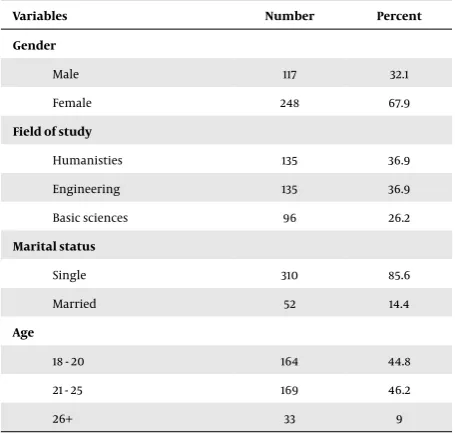
The studied sample was composed of 365 individuals, out of which, 248 (67.9%) were women and 117 (32.1%) were men. 310 (85.6%) participants were single and 52 (14.4%) were married. 135 (36.9%) subjects were from the faculty of humanities, 135 (36.9%) were from the faculty of engineer-ing, and 96 (26.2%) were from the faculty of basic sciences. All subjects were undergraduate students out of which 164 (44.8%) were 18 - 20, 169 (46.2%) were 21 - 25, and 33 (9%) were 26 years old.
Table 1.Frequency Distribution and Percentage of Participants in the Study
Variables Number Percent
Gender
Male 117 32.1
Female 248 67.9
Field of study
Humanisties 135 36.9
Engineering 135 36.9
Basic sciences 96 26.2
Marital status
Single 310 85.6
Married 52 14.4
Age
18 - 20 164 44.8
21 - 25 169 46.2
26+ 33 9
3.1. Validity Evaluation
In order to investigate the validity of SBI, various meth-ods such as translation validity, construct validity, and con-vergent as well as dicon-vergent validity were used.
3.2. Translation Validity
In this study, forward-backward translation validity method was applied for translation validity assessment. To this end, 2 psychologists who spoke English fluently were initially provided with SBI and were asked to translate this questionnaire independently and then resolve their trans-lations problems and drawbacks through an efficient dis-cussion. Then, 2 others who were fluent in both Persian and English and know nothing about the subject of the SBI were asked to retranslate the translated questionnaire into English. In addition, the new questionnaire and the orig-inal one were then given to a team of experts who were also fluent in both Persian and English with the aim of re-solving the possible problems of translation to ensure the translation validity. Afterward, the obtained questionnaire was performed on a few subjects so that the probable er-rors can be corrected for the final application.
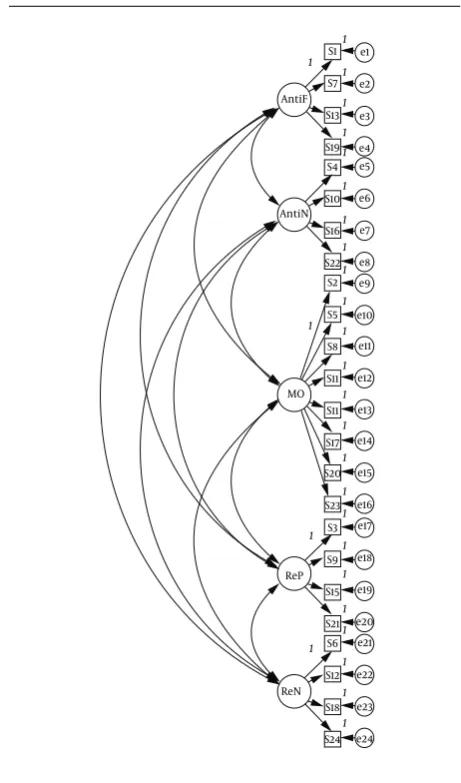
3.3. Structural Validity
Table 2.Results of Confirmatory Factor Analysis of Savoring Beliefs Inventory Items
Variables Results of Confirmatory Factor
RMSEA 0.05 Less than 0.05
GFI 0.913 Up to 0.9
χ2/df 1.95 Less than 2
P Value < 0.001 Up to0.05
df 223
χ2 434.25
Table 3.Factor Loading Coefficient of Confirmatory Factor Analysis
Variables Question Factor Loading
Anticipation
1 0.393
7 0.676
13 0.717
19 0.854
Not anticipation
4 0.444
10 0.616
16 0.423
22 0.667
Savoring the moment
2 0.495
5 0.476
8 0.568
11 0.530
14 0.658
17 0.547
20 0.605
23 0.608
Reminiscing
3 0.677
9 0.669
15 0.658
21 0.740
Not reminiscing
6 0.684
12 0.659
18 0.686
24 0.645
3.4. Convergent and Divergent Validity
To evaluate convergent and divergent validity, signif-icance and the correlation between the scores obtained from delightful experiences scales and their subscales and satisfaction with life scale (SWLS), neuroticism and extro-version subscales of NEO five-factor inventory, optimism,
life orientation test (LOT), Beck hopelessness scale(BHS), and Rosenberg self-esteem scale were examined. Based on the results, the convergent and divergent validity of the questionnaire can be verified.
3.5. Reliability
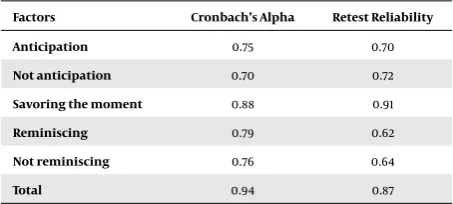
As shown inTable 5, the Cronbach’s alpha of the total scale was 0.94 while it was 0.70 or higher for each subscale, which demonstrates the good internal consistency of the questionnaire.
S1
S7
S13
S19 S4
S10
S16
S22 S2
S5
S8
S11
S11
S17
S20
S23 S3
S9
S15
S21 S6
S12
S18
S24 e1
e2
e3
e4 e5
e6
e7
e8 e9
e10
e11
e12
e13
e14
e15
e16 e17
e18
e19
e20 e21
e22
e23
e24 AntiF
AntiN
MO
ReP
ReN 1 1
1
1
1
1 1
1
1
1 1
1
1
1
1
1
1
1 1
1
1
1 1
1
1
1 1 1
Figure 1.Factor Model Fitted for SBI Inventory Data
4. Discussion
Table 4.Correlation results SBI inventory and subscales with satisfaction with life scale (SWLS , neuroticism and extraversion subscales of NEO five-factor inventory ,optimism, Rosenberg self-esteem, Beck hopelessness scale (BHS), as well as prosocial tendencies measure revised(PTM-R).
Scales Total Score Savoring the Moment Anticipating Not Anticipating Reminiscing Not Reminiscing
Self-esteem 0.38a 0.49a 0.29b -0.10 0.35a 0.23
Satisfaction With Life 0.47a 0.55a 0.25 0.35a 0.35a 0.21
Prosocial Tendencies 0.21 0.16 0.37b 0.14 0.06 0.13
Extraversion 0.46b 0.47a 0.28b 0.35b 0.40b 0.28a
Neuroticism -0.35b -0.45a -0.22 -0.36b -0.24 -.012
Hopelessness -0.62a -0.64a -0.55a -0.53a -0.54a -0.66a
Optimism 0.53a 0.59a 0.32a 0.45a -0.36a 0.38a
aP < 0.01. bP < 0.05.
Table 5.The Results of Retest Reliability and Cronbach‘s Alpha SBI Inventory and Its Factors
Factors Cronbach’s Alpha Retest Reliability
Anticipation 0.75 0.70
Not anticipation 0.70 0.72
Savoring the moment 0.88 0.91
Reminiscing 0.79 0.62
Not reminiscing 0.76 0.64
Total 0.94 0.87
study was carried out with the aim of determining the psy-chometric characteristics of “savoring” beliefs inventory. The results of confirmatory factor analysis provided robust evidences for the validity and reliability of “savoring” be-liefs inventory in the Iranian society. This finding is con-sistent with the results of the study conducted by Kwon and Yang Jin (14). Thus, the five-factor version was used to measure this factor. The results of the convergent va-lidity indicated that all factors of the “savoring” beliefs in-ventory are correlated with hopelessness and optimism while some factors are correlated with self-esteem, life sat-isfaction, and extraversion. These results correspond with the findings of earlier studies (8,10-14). Prosocial tenden-cies scale is only correlated with one of the factors of “sa-voring” beliefs inventory (anticipating the “positive” plea-sure). Moreover, no relationship was found between SBI factors and prosocial behaviors in previous studies (9,15). In addition, the reliability of SBI was assessed using in-ternal consistency and test-retest methods. The results showed that SBI is highly reliable in the students’ popula-tion. Cronbach’s alpha coefficient showed a high internal consistency between items which was consistent with the findings of Bryant (8) as well as Kwon and Yang Jin (14).
Ac-cording to the results, the 24-item version of SBI has appro-priate psychometric characteristics in the Iranian society so it can be used to measure “savoring” since there is no longer any uncertainty about its efficiency.
One of the limitations of the present study is its stu-dent population. It is suggested that the psychometric characteristics of SBI be investigated in non-student pop-ulations so that it can be used for other groups if it has proper psychometric characteristics.
The “savoring” beliefs inventory is also helpful in clin-ical settings. For example, experts can use this tool as a means to identify people’s weaknesses in “savoring” capac-ity, which are most likely prevalent in depression, anxiety, schizophrenia, and life-threatening situations (8). The SBI is effective in evaluating the effectiveness of therapeutic in-terventions aimed at educating people about how to pre-dict or sustain their pleasures. For example, in those who feel they are incapacitated in gaining pleasure, effective treatment may include eliminating the factors that oblit-erate happiness. People who are weak in reminiscing and sustaining their pleasures may wonder how they can ac-tively create happy memories by going to their positive ex-periences.
Instead of reacting to positive events, people can learn to actively savor those events. To consciously anticipate positive experiences, pleasant moments should be exacer-bated and perpetuated by the presence of mind and such experiences should be deliberately recalled. SBI can help experts to evaluate the effect of such treatments on “savor-ing” skills.
regarding pleasant experiences (6) and no other means to measure the positive experiences’ savoring. Thus, to assess the level of positive emotional regulation of patients, it is recommended that clinicians use strategies such as “savor-ing” beliefs inventory along with other evaluation tools to improve their positive performance.
References
1. Rashid T. Positive psychotherapy: A strength-based approach.J Posit Psychol. 2014;10(1):25–40. doi:10.1080/17439760.2014.920411. 2. Bryant FB, Veroff J. Dimensions of subjective mental health in
Amer-ican men and women. J Health Soc Behav. 1984;25(2):116–35. doi:
10.2307/2136664. [PubMed:6470455].
3. Campbell A.The sense of well-being in America. New York: McGraw-Hill; 1980.
4. Ryff CD. Happiness is everything, or is it? Explorations on the mean-ing of psychological well-bemean-ing.J Pers Soc Psychol. 1989;57(6):1069–81. doi:10.1037/0022-3514.57.6.1069.
5. Bryant FB, Ericksen CL, DeHoek AH. Savoring. In: Lopez SJ, editor. Ency-clopedia of positive psychology. 2 ed. New York: Wiley/Blackwell; 2008. p. 857–9.
6. Bryant F, Veroff J.Savoring: A new model of positive experience. Mahwah, NJ: Lawrence Erlbaum Associates; 2007.
7. Bryant FB. A four-factor model of perceived control: Avoiding, coping, obtaining, and savoring.J Pers. 1989;57(4):773–97. doi:
10.1111/j.1467-6494.1989.tb00494.x.
8. Bryant F. Savoring Beliefs Inventory (SBI): A scale for measur-ing beliefs about savourmeasur-ing.J Ment Health. 2009;12(2):175–96. doi:
10.1080/0963823031000103489.
9. Geiger PJ, Morey JN, Segerstrom SC. Beliefs about savoring in older adulthood: Aging and perceived health affect temporal components of perceived savoring ability.Pers Individ Dif. 2017;105:164–9. doi:
10.1016/j.paid.2016.09.049. [PubMed:28740321].
10. Rendell PG, Bailey PE, Henry JD, Phillips LH, Gaskin S, Kliegel M. Older adults have greater difficulty imagining future rather than atemporal experiences.Psychol Aging. 2012;27(4):1089–98. doi:
10.1037/a0029748.
11. Spreng RN, Levine B. The temporal distribution of past and fu-ture autobiographical events across the lifespan. Mem Cognit. 2006;34(8):1644–51. doi:10.3758/BF03195927. [PubMed:17489291].
12. Hurley DB, Kwon P. Results of a Study to Increase Savoring the Mo-ment: Differential Impact on Positive and Negative Outcomes.J Hap-piness Stud. 2011;13(4):579–88. doi:10.1007/s10902-011-9280-8. 13. Quoidbach J, Berry EV, Hansenne M, Mikolajczak M. Positive
emo-tion regulaemo-tion and well-being: Comparing the impact of eight savor-ing and dampensavor-ing strategies.Pers Individ Dif. 2010;49(5):368–73. doi:
10.1016/j.paid.2010.03.048.
14. Kwon SM, Young-jin L. Validation of the Korean version of the savor-ing belief inventory(SBI).Korean J Clin Psychol. 2010;29(2):349–65. doi:
10.15842/kjcp.2010.29.2.001.
15. Scheier MF, Carver CS. Optimism, coping, and health: assessment and implications of generalized outcome expectancies.Health Psychol. 1985;4(3):219–47. doi:10.1037/0278-6133.4.3.219. [PubMed:4029106]. 16. Oreizi MR, Khodabakhshi M.Kajbaf. Standardization, reliability, and
validity of optimism scale in Esfahan and a survey of relationship be-tween optimism, self mastery, and depression [In Persian].Psychol Stud. 2006;2(1,2):51–68.
17. Diener E, Emmons RA, Larsen RJ, Griffin S. The Satisfaction With Life Scale.J Pers Assess. 1985;49(1):71–5. doi:10.1207/s15327752jpa4901_13. [PubMed:16367493].
18. Tagharobi Z, Sharifi KH, Sooky Z, Tagharrobi L. psychometric evalua-tion of the satisfacevalua-tion with life scale (SWLS) in the students of Kashan Nursing amp, midwifery Faculty, Kashan, Iran [In Persian].Qom Univ Med Sci J. 2012;6(1):89–98.
19. Bayani AA, Koocheky M, Goodarzi H. The reliability and validity of the satisfaction with life scale [In Persian].J Iran Psychol. 2007;3(11):259–65. 20. Alizadeh T, Farahani MN, Shahraray M, Alizadegan S. Relationship be-tween self-esteem and control source with infertility stress in infertile women and men.J Reprod Infertil. 2005;6(2):194–204.
21. New Approach to Personality Evaluation (Factor Analysis in Personality Studies). Tabriz: Daniel Publishing; 2001.Garoosi Farshi. M. 22. Roshan R, Shairi MR, Atrifar M, Nikkhah A, Ghaem Maghami B,
Rahimirad. A . AInvestigation Psychometric properties of NEO-Five Factor inventory (NEO-FFI).Clin Psychol Pers. 2006;1(16):27–36. 23. Carlo G, Randall BA. The development of a measure of prosocial
behaviors for late adolescents.J Youth Adolesc. 2002;31(1):31–44. doi:
10.1023/a:1014033032440.
24. Carlo G, Hausmann A, Christiansen S, Randall BA. Sociocognitive and behavioral correlates of a measure of prosocial tendencies for adoles-cents.J Early Adolesc. 2003.