VOLUME NO.5(2015),ISSUE NO.10(OCTOBER) ISSN 2231-5756
A Monthly Double-Blind Peer Reviewed (Refereed/Juried) Open Access International e-Journal - Included in the International Serial Directories Indexed & Listed at:
VOLUME NO.5(2015),ISSUE NO.10(OCTOBER) ISSN 2231-5756
INTERNATIONAL JOURNAL OF RESEARCH IN COMMERCE, IT & MANAGEMENT
CONTENTS
Sr.
No.
TITLE & NAME OF THE AUTHOR (S)
Page
No.
1
.
SYMBOLS: AN EFFECTIVE MARKETING COMMUNICATION TOOL IN BRANDING
DR. AJAY SAHNI
1
2
.
INCORPORATING SUSTAINABILITY INTO HIGHER INDIAN EDUCATION
RAHUL BASU
5
3
.
INTERLINKAGE BETWEEN FUND OF MUTUAL FUNDS RETURNS AND GDP IN THE INDIAN ECONOMY
M. GOWRI & MALABIKA DEO
11
4
.
GROWTH OF INDIAN COMMODITY DERIVATIVE MARKET OVER THE YEARS AND ITS CURRENT SCENARIO
PRABHU C BASARKOD & DR. BASAVARAJ C S
16
5
.
A STUDY ON JOB SATISFACTION OF PUBLIC, PRIVATE AND FOREIGN BANK EMPLOYEES IN CHANDIGARH
AND PUNJAB
MANVEEN GREWAL & S. K. BANSAL
21
6
.
SYNTHETIC REVIEW: A REVIEW OF LITERATURE
DR. K. K. DAVE & SONAL SINGHVI
24
7
.
A REVIEW OF THE FINANCES OF KERALA 1990-2015
DR. V JOHNSON
28
8
.
GSCM PRACTICES AND ITS RELATIONSHIP WITH ECONOMIC PERFORMANCE IN SELECT ISO 14001
CERTIFIED COMPANIES IN (GUJARAT) INDIA
DR. HEENA SUNIL OZA & ANITA TOMAR
34
9
.
TOURISM DESTINATION DEFICIENCY: A STUDY WITH REFERENCE TO KANNIYAKUMARI DISTRICT
DR. A. RAMACHANDRAN
38
10
.
5S METHODOLOGY TO IMPROVE THE QUALITY AND ENVIRONMENT OF THE ORGANIZATION
K. MADHAVI & D. PRANAYA
41
11
.
THE MAJOR ROLE AND EFFECTS OF SOCIAL MEDIA ON STUDENTS
JAYADATTA S & B.Y.KRISHNA MURTHY
43
12
.
A STUDY ON THE IMPACT OF INFORMATION TECHNOLOGY ON ACCOUNTING PRACTICES WITH SPECIAL
REFERENCE TO AUDITING FIRMS IN BANGALORE
CAMILLO JOSEPH
45
13
.
EMOTIONAL INTELLIGENCE AND EMOTIONAL LABOR: AN EMPIRICAL STUDY ON ORGANIZED RETAIL
SECTOR
ASHA CHAUDHARY
49
14
.
A STUDY ON SWOT ANALYSIS WITH SPECIAL REFERENCE TO PERSONNEL MANAGEMENT IN AUROFOOD
LTD., PUTHUCHERRY
C. SURESH & DR. P. KOMARASAMY
55
15
.
IMPORTANCE OF PERFORMANCE APPRAISAL AND ITS EVALUATION PARAMETERS OF EMPLOYEES IN
INSURANCE COMPANIES
RAJENDRA PRASAD G R & DR. MANJUNATH, K. R
58
16
.
EVALUATION OF EQUITY FINANCE OPTION AND PERFORMANCE OF COOPERATIVE BUSINESS ENTERPRISES
IN NJIKOKA LOCAL GOVERNMENT AREA OF ANAMBRA STATE
TAIWO ABDULAHI OLABISI, LAWAL KAMALDEEN, A., AGBASI OBIANUJU E & OKAFOR IFEOMA P.
63
17
.
A STUDY OF FINANCIAL PERFORMANCE: A COMPARATIVE ANALYSIS OF BANGALORE AND GULBARGA
MILK UNION
JAYALAKSHMI. H.Y
67
18
.
POLITICAL- AWARENESS AMONG MUSLIM STUDENTS: A STUDY OF ALMORA TOWN (UTTARAKAND)
FAROOQ AHMAD BAKLOO & ASMA
72
19
.
HISTORICAL DEVELOPMENT OF FINANCIAL DERIVATIVES AND ITS CURRENT POSITION IN INDIAN
DERIVATIVE MARKET
MUHAMMED JUMAN.B K
75
20
.
GENDER BUDGETING: A DESCRIPTIVE STUDY
T. ARYAMALA
87
VOLUME NO.5(2015),ISSUE NO.10(OCTOBER) ISSN 2231-5756
CHIEF PATRON
PROF. K. K. AGGARWAL
Chairman, Malaviya National Institute of Technology, Jaipur
(An institute of National Importance & fully funded by Ministry of Human Resource Development, Government of India)
Chancellor, K. R. Mangalam University, Gurgaon
Chancellor, Lingaya’s University, Faridabad
Founder Vice-Chancellor (1998-2008), Guru Gobind Singh Indraprastha University, Delhi
Ex. Pro Vice-Chancellor, Guru Jambheshwar University, Hisar
FOUNDER PATRON
LATE SH. RAM BHAJAN AGGARWAL
Former State Minister for Home & Tourism, Government of Haryana
Former Vice-President, Dadri Education Society, Charkhi Dadri
Former President, Chinar Syntex Ltd. (Textile Mills), Bhiwani
FORMER CO-ORDINATOR
DR. S. GARG
Faculty, Shree Ram Institute of Business & Management, Urjani
ADVISORS
PROF. M. S. SENAM RAJU
Director A. C. D., School of Management Studies, I.G.N.O.U., New Delhi
PROF. M. N. SHARMA
Chairman, M.B.A., Haryana College of Technology & Management, Kaithal
PROF. S. L. MAHANDRU
Principal (Retd.), Maharaja Agrasen College, Jagadhri
EDITOR
PROF. R. K. SHARMA
Professor, Bharti Vidyapeeth University Institute of Management & Research, New Delhi
CO-EDITOR
DR. BHAVET
Faculty, Shree Ram Institute of Engineering & Technology, Urjani
EDITORIAL ADVISORY BOARD
DR. RAJESH MODI
Faculty, Yanbu Industrial College, Kingdom of Saudi Arabia
PROF. SANJIV MITTAL
University School of Management Studies, Guru Gobind Singh I. P. University, Delhi
PROF. ANIL K. SAINI
Chairperson (CRC), Guru Gobind Singh I. P. University, Delhi
DR. SAMBHAVNA
VOLUME NO.5(2015),ISSUE NO.10(OCTOBER) ISSN 2231-5756
INTERNATIONAL JOURNAL OF RESEARCH IN COMMERCE, IT & MANAGEMENT
DR. MOHENDER KUMAR GUPTA
Associate Professor, P. J. L. N. Government College, Faridabad
DR. SHIVAKUMAR DEENE
Asst. Professor, Dept. of Commerce, School of Business Studies, Central University of Karnataka, Gulbarga
ASSOCIATE EDITORS
PROF. NAWAB ALI KHAN
Department of Commerce, Aligarh Muslim University, Aligarh, U.P.
PROF. ABHAY BANSAL
Head, Department of I.T., Amity School of Engineering & Technology, Amity University, Noida
PROF. A. SURYANARAYANA
Department of Business Management, Osmania University, Hyderabad
PROF. V. SELVAM
SSL, VIT University, Vellore
DR. PARDEEP AHLAWAT
Associate Professor, Institute of Management Studies & Research, Maharshi Dayanand University, Rohtak
DR. S. TABASSUM SULTANA
Associate Professor, Department of Business Management, Matrusri Institute of P.G. Studies, Hyderabad
SURJEET SINGH
Asst. Professor, Department of Computer Science, G. M. N. (P.G.) College, Ambala Cantt.
FORMER TECHNICAL ADVISOR
AMITA
Faculty, Government M. S., Mohali
FINANCIAL ADVISORS
DICKIN GOYAL
Advocate & Tax Adviser, Panchkula
NEENA
Investment Consultant, Chambaghat, Solan, Himachal Pradesh
LEGAL ADVISORS
JITENDER S. CHAHAL
Advocate, Punjab & Haryana High Court, Chandigarh U.T.
CHANDER BHUSHAN SHARMA
Advocate & Consultant, District Courts, Yamunanagar at Jagadhri
SUPERINTENDENT
VOLUME NO.5(2015),ISSUE NO.10(OCTOBER) ISSN 2231-5756
CALL FOR MANUSCRIPTS
We invite unpublished novel, original, empirical and high quality research work pertaining to recent developments & practices in the areas of Computer Science & Applications; Commerce; Business; Finance; Marketing; Human Resource Management; General Management; Banking; Economics; Tourism Administration & Management; Education; Law; Library & Information Science; Defence & Strategic Studies; Electronic Science; Corporate Governance; Industrial Relations; and emerging paradigms in allied subjects like Accounting; Accounting Information Systems; Accounting Theory & Practice; Auditing; Behavioral Accounting; Behavioral Economics; Corporate Finance; Cost Accounting; Econometrics; Economic Development; Economic History; Financial Institutions & Markets; Financial Services; Fiscal Policy; Government & Non Profit Accounting; Industrial Organization; International Economics & Trade; International Finance; Macro Economics; Micro Economics; Rural Economics; Co-operation; Demography: Development Planning; Development Studies; Applied Economics; Development Economics; Business Economics; Monetary Policy; Public Policy Economics; Real Estate; Regional Economics; Political Science; Continuing Education; Labour Welfare; Philosophy; Psychology; Sociology; Tax Accounting; Advertising & Promotion Management; Management Information Systems (MIS); Business Law; Public Responsibility & Ethics; Communication; Direct Marketing; E-Commerce; Global Business; Health Care Administration; Labour Relations & Human Resource Management; Marketing Research; Marketing Theory & Applications; Non-Profit Organizations; Office Administration/Management; Operations Research/Statistics; Organizational Behavior & Theory; Organizational Development; Production/Operations; International Relations; Human Rights & Duties; Public Administration; Population Studies; Purchasing/Materials Management; Retailing; Sales/Selling; Services; Small Business Entrepreneurship; Strategic Management Policy; Technology/Innovation; Tourism & Hospitality; Transportation Distribution; Algorithms; Artificial Intelligence; Compilers & Translation; Computer Aided Design (CAD); Computer Aided Manufacturing; Computer Graphics; Computer Organization & Architecture; Database Structures & Systems; Discrete Structures; Internet; Management Information Systems; Modeling & Simulation; Neural Systems/Neural Networks; Numerical Analysis/Scientific Computing; Object Oriented Programming; Operating Systems; Programming Languages; Robotics; Symbolic & Formal Logic; Web Design and emerging paradigms in allied subjects.
Anybody can submit the soft copy of unpublished novel; original; empirical and high quality research work/manuscript anytime in M.S. Word format after preparing the same as per our GUIDELINES FOR SUBMISSION; at our email address i.e. [email protected] or online by clicking the link online submission as given on our website (FOR ONLINE SUBMISSION, CLICK HERE).
GUIDELINES FOR SUBMISSION OF MANUSCRIPT
1. COVERING LETTER FOR SUBMISSION:
DATED: _____________
THE EDITOR
IJRCM
Subject: SUBMISSION OF MANUSCRIPT IN THE AREA OF .
(e.g. Finance/Mkt./HRM/General Mgt./Engineering/Economics/Computer/IT/ Education/Psychology/Law/Math/other, please specify)
DEAR SIR/MADAM
Please find my submission of manuscript entitled ‘___________________________________________’ for possible publication in one of your journals.
I hereby affirm that the contents of this manuscript are original. Furthermore, it has neither been published elsewhere in any language fully or partly, nor is it under review for publication elsewhere.
I affirm that all the co-authors of this manuscript have seen the submitted version of the manuscript and have agreed to their inclusion of names as co-authors.
Also, if my/our manuscript is accepted, I agree to comply with the formalities as given on the website of the journal. The Journal has discretion to publish our contribution in any of its journals.
NAME OF CORRESPONDING AUTHOR :
Designation :
Institution/College/University with full address & Pin Code :
Residential address with Pin Code :
Mobile Number (s) with country ISD code :
Is WhatsApp or Viber active on your above noted Mobile Number (Yes/No) :
Landline Number (s) with country ISD code :
E-mail Address :
Alternate E-mail Address :
VOLUME NO.5(2015),ISSUE NO.10(OCTOBER) ISSN 2231-5756
INTERNATIONAL JOURNAL OF RESEARCH IN COMMERCE, IT & MANAGEMENT
NOTES:
a) The whole manuscript has to be in ONE MS WORD FILE only, which will start from the covering letter, inside the manuscript. pdf. version is liable to be rejected without any consideration.
b) The sender is required to mention the following in the SUBJECT COLUMNof the mail:
New Manuscript for Review in the area of (e.g. Finance/Marketing/HRM/General Mgt./Engineering/Economics/Computer/IT/ Education/Psychology/Law/Math/other, please specify)
c) There is no need to give any text in the body of mail, except the cases where the author wishes to give any specific message w.r.t. to the manuscript.
d) The total size of the file containing the manuscript is expected to be below 1000 KB.
e) Abstract alone will not be considered for review and the author is required to submit the complete manuscript in the first instance.
f) The journal gives acknowledgement w.r.t. the receipt of every email within twenty four hours and in case of non-receipt of acknowledgment from the journal, w.r.t. the submission of manuscript, within two days of submission, the corresponding author is required to demand for the same by sending a separate mail to the journal.
g) The author (s) name or details should not appear anywhere on the body of the manuscript, except the covering letter and the cover page of the manuscript, in the manner as mentioned in the guidelines.
2. MANUSCRIPT TITLE: The title of the paper should be bold typed, centeredand fully capitalised.
3. AUTHOR NAME (S) & AFFILIATIONS: Author (s) name, designation, affiliation (s), address, mobile/landline number (s), and
email/alternate email address should be given underneath the title.
4. ACKNOWLEDGMENTS: Acknowledgements can be given to reviewers, guides, funding institutions, etc., if any.
5. ABSTRACT: Abstract should be in fully italicized text, ranging between 150 to 300 words. The abstract must be informative and explain the background, aims, methods, results & conclusion in a SINGLE PARA. Abbreviations must be mentioned in full.
6. KEYWORDS: Abstract must be followed by a list of keywords, subject to the maximum of five. These should be arranged in alphabetic order separated by commas and full stop at the end. All words of the keywords, including the first one should be in small letters, except special words e.g. name of the Countries, abbreviations.
7. JEL CODE: Provide the appropriate Journal of Economic Literature Classification System code (s). JEL codes are available at www.aeaweb.org/econlit/jelCodes.php, however, mentioning JEL Code is not mandatory.
8. MANUSCRIPT: Manuscript must be in BRITISH ENGLISH prepared on a standard A4 size PORTRAIT SETTING PAPER. It should be free from any errors i.e. grammatical, spelling or punctuation. It must be thoroughly edited at your end.
9. HEADINGS: All the headings must be bold-faced, aligned left and fully capitalised. Leave a blank line before each heading.
10. SUB-HEADINGS: All the sub-headings must be bold-faced, aligned left and fully capitalised.
11. MAIN TEXT:
THE MAIN TEXT SHOULD FOLLOW THE FOLLOWING SEQUENCE:
INTRODUCTION
REVIEW OF LITERATURE
NEED/IMPORTANCE OF THE STUDY
STATEMENT OF THE PROBLEM
OBJECTIVES
HYPOTHESIS (ES)
RESEARCH METHODOLOGY
RESULTS & DISCUSSION
FINDINGS
RECOMMENDATIONS/SUGGESTIONS
CONCLUSIONS
LIMITATIONS
SCOPE FOR FURTHER RESEARCH
REFERENCES
APPENDIX/ANNEXURE
VOLUME NO.5(2015),ISSUE NO.10(OCTOBER) ISSN 2231-5756
12. FIGURES & TABLES: These should be simple, crystal CLEAR, centered, separately numbered & self explained, and titles must be above the table/figure. Sources of data should be mentioned below the table/figure. It should be ensured that the tables/figures are referred to from the main text.
13. EQUATIONS/FORMULAE: These should be consecutively numbered in parenthesis, horizontally centered with equation/formulae number placed at the right. The equation editor provided with standard versions of Microsoft Word should be utilised. If any other equation editor is utilised, author must confirm that these equations may be viewed and edited in versions of Microsoft Office that does not have the editor.
14. ACRONYMS: These should not be used in the abstract. The use of acronyms is elsewhere is acceptable. Acronyms should be defined on its first use in each section: Reserve Bank of India (RBI). Acronyms should be redefined on first use in subsequent sections.
15. REFERENCES: The list of all references should be alphabetically arranged. The author (s) should mention only the actually utilised references in the preparation of manuscript and they are supposed to follow Harvard Style of Referencing. Also check to make sure that everything that you are including in the reference section is duly cited in the paper. The author (s) are supposed to follow the references as per the following:
•
All works cited in the text (including sources for tables and figures) should be listed alphabetically.•
Use (ed.) for one editor, and (ed.s) for multiple editors.•
When listing two or more works by one author, use --- (20xx), such as after Kohl (1997), use --- (2001), etc, in chronologically ascending order.•
Indicate (opening and closing) page numbers for articles in journals and for chapters in books.•
The title of books and journals should be in italics. Double quotation marks are used for titles of journal articles, book chapters, dissertations, reports, working papers, unpublished material, etc.•
For titles in a language other than English, provide an English translation in parenthesis.•
Headers, footers, endnotes and footnotes should not be used in the document. However, you can mention short notes to elucidate some specific point, which may be placed in number orders after the references.PLEASE USE THE FOLLOWING FOR STYLE AND PUNCTUATION IN REFERENCES:
BOOKS
•
Bowersox, Donald J., Closs, David J., (1996), "Logistical Management." Tata McGraw, Hill, New Delhi.•
Hunker, H.L. and A.J. Wright (1963), "Factors of Industrial Location in Ohio" Ohio State University, Nigeria.CONTRIBUTIONS TO BOOKS
•
Sharma T., Kwatra, G. (2008) Effectiveness of Social Advertising: A Study of Selected Campaigns, Corporate Social Responsibility, Edited by David Crowther & Nicholas Capaldi, Ashgate Research Companion to Corporate Social Responsibility, Chapter 15, pp 287-303.JOURNAL AND OTHER ARTICLES
•
Schemenner, R.W., Huber, J.C. and Cook, R.L. (1987), "Geographic Differences and the Location of New Manufacturing Facilities," Journal of Urban Economics, Vol. 21, No. 1, pp. 83-104.CONFERENCE PAPERS
•
Garg, Sambhav (2011): "Business Ethics" Paper presented at the Annual International Conference for the All India Management Association, New Delhi, India, 19–23UNPUBLISHED DISSERTATIONS
•
Kumar S. (2011): "Customer Value: A Comparative Study of Rural and Urban Customers," Thesis, Kurukshetra University, Kurukshetra.ONLINE RESOURCES
•
Always indicate the date that the source was accessed, as online resources are frequently updated or removed.WEBSITES
VOLUME NO.5(2015),ISSUE NO.10(OCTOBER) ISSN 2231-5756
INTERNATIONAL JOURNAL OF RESEARCH IN COMMERCE, IT & MANAGEMENT
5S METHODOLOGY TO IMPROVE THE QUALITY AND ENVIRONMENT OF THE ORGANIZATION
K. MADHAVI
ASST. PROFESSOR
DEPARTMENT OF M.B.A.
ADITYA INSTITUTE OF TECHNOLOGY AND MANAGEMENT
TEKKALI
D. PRANAYA
ASST. PROFESSOR
ADITYA INSTITUTE OF TECHNOLOGY AND MANAGEMENT
TEKKALI
ABSTRACT
The aim of this paper is showing the 5S methodology. In this paper it was introduced the way of implementing the 5S methodology in the company. We provided some vast literature on the implementation of 5S in any industry. This strategy involves the study and change in the work place of a manufacturing industry post implementation of 5S. This strategy helps in minimizing the time of manufacturing and also increases the area of work place. Thus, the solution found by our approach solely minimizes several kinds of wastes in the production process and which finally helps in the development of the organization. An Inspection process has been executed on the basis of 5S check lists and the results analyzed to confirm great changes like increasing efficiency in production and quality, improves safety.
KEYWORDS
5s methodology, organisation environment.
INTRODUCTION
s – Sorting through the suitable sorting it can be identified the materials, tools, equipment and necessary information for realization of the tasks. Sorting eliminates the waste material (raw materials and materials), nonconforming products, and damaged tools. It helps to maintain the clean workplace and improves the efficiency of searching and receiving things, shortens the time of running the operation. The 1s rule’s proceedings [5]:
1) On the first stage one should be able to answer to the control questions:
• Does an unnecessary thing create the problem in work area?
• Does unnecessary odds and ends of materials thrown anywhere in the work area?
• Do tools and rest of materials of production place on the shop floor?
• Are all necessary things sorted, ordered and retain at their own place?
• Are all measuring tools sequentially kept?
On the basis of answers to the above questions it is possible for the assessment of work area in terms of the 1s rule. If any question’s answer is yes, it should carry out sorting of items, which are in work area.
2) On the second stage one should carry out the review of all things which are in the work area and arrange them. According to established sorting it should execute the elimination of items from work area, which were unnecessary.
3) To continual usage the 1s rule is the movement of the red tag. It means giving red tag to items, which operator will make out as useless within his work area. At the beginning of each month, put a red tag on every item. During the month, remove the red tag when item is used. At the end of the month, decide whether the item with the tag is necessary or not.
2 s – Set in order especially important is visualization of the workplace (e.g. Painting the floor helps to identify the places of storage of each material or transport ways, drawing out the shapes of tools makes possible the quick putting aside them on the constant places, colored labels permit to identify the material, spare parts or documents etc.). Implementing the 2s rule [3]: it should execute the segregation of things and mark the places of their storing. Used things should always be divided on these, which should be: - in close access (1st degree sphere), - accessible (2nd degree sphere), - in the range of hand (3rd degree sphere).
• Reduce preparation time for tool setting.
• Reduce waiting time for parts, materials, papers and files
• Reducing processing time and cycle time by improving the plant layout of work area.
• Time and strength spent on looking for jigs, fixture tools etc.
• Run down for parts in stores.
• Searching for files and information in computers.
• Labels are attached so that items can be recognized.
• At a glance and clear
3 s – Shine Regular cleaning permits to identify and to eliminate sources of disorder and to maintain the clean workplaces. During cleaning it is checked the cleanness of machine, workplace and floor, tightness of equipment, cleanness of lines, pipes, sources of light, current data, legibility and comprehensibility of delivered information etc. Indispensable is also taking care of and maintenance the personal tidiness of the operator.
4s – Standardize Standards should be worked out and implemented in the work place. Management should pass instructions in order to set the work place on order. The instructions should be clear and easily understandable to workers. All the workers in the shop floor should be involved in this activity; the workers group knows specificity of their own activities and process of elaboration along with the usage gives them the possibility of understanding the importance of each aspect of the operation. The aim of the easy access of the obligatory standards for constant and visible places should be assured.
5S – Sustain The principle is to establish the maintenance of a clean environment as an ongoing process for ever. This increases the consciousness of the workers and decreases the number of non-confirming products and defective products. This process also increases the internal communication and human relations in the organization. It is also essential to understand the need and importance of the inspections for 5S. The inspections are executed with the help of Check list prepared on the basis of the radar charts of 5S. This also helps in estimating the work place. The inspection of the realization of 5S standards is executed once a month by the team.
5s APPROACH IN INDUSTRY
The 5s methodology depends upon the capacity of creating and maintaining a well organized, clean, effective and high quality work place. Our research was carried out in a manufacturing company of the metal doors. In the first phase of research, we executed the selection of things in the production process of the work place.
VOLUME NO.5(2015),ISSUE NO.10(OCTOBER) ISSN 2231-5756
We introduced 5s methodology to the workers on the shop floor and carried out a questionnaire for them. After that all the 5 rules of the 5s has been implemented on the shop floor in a systematic order. We appointed one of the workers as a person responsible for the implementation of 5s for that department and so with the other departments of the industry. This resulted in great changes on the shop floor.
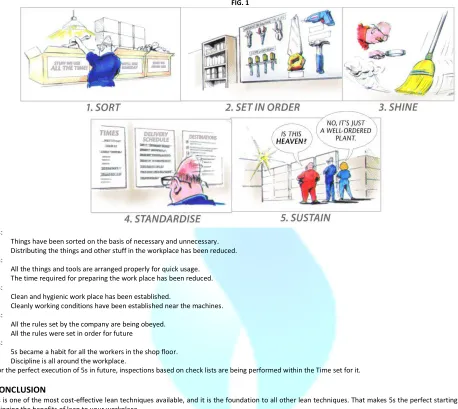
FIG. 1
1s:
• Things have been sorted on the basis of necessary and unnecessary.
• Distributing the things and other stuff in the workplace has been reduced.
2s:
• All the things and tools are arranged properly for quick usage.
• The time required for preparing the work place has been reduced.
3s:
• Clean and hygienic work place has been established.
• Cleanly working conditions have been established near the machines.
4s:
• All the rules set by the company are being obeyed.
• All the rules were set in order for future
5s:
• 5s became a habit for all the workers in the shop floor.
• Discipline is all around the workplace.
For the perfect execution of 5s in future, inspections based on check lists are being performed within the Time set for it.
CONCLUSION
5s is one of the most cost-effective lean techniques available, and it is the foundation to all other lean techniques. That makes 5s the perfect starting point for bringing the benefits of lean to your workplace.
It is simple to get started with 5s. It begins with cleaning and organization. Using a durable label printer and you can mark and label everything so that tools, supplies, equipment and materials can be properly identified and stored. Mark machines and equipment with labels providing standardized operating and maintenance instructions. Ensure you are fully in compliance with all requirements by making needed safety signs, pipe markers and ghs labels. Make way-finding signs to identify work locations and the safest and most efficient paths through your facility.
5s is foundation to all other lean techniques and having proper labeling and signs is foundational to 5s. The key benefits of 5s are:
• less waste (improved efficiency)
• reduced space used for storage
• improved maintenance
• improved safety
• better, more committed employees
• improved quality
REFERENCES
1. 5s for the office: organizing the workplace to eliminate waste by Thomas fabrizio, don tapping
2. Cambridge, ma: productivity press. Isbn 978-1-56327-047-5.
3. Goetsch, d.l, and s.b.davis. Total quality handbook.Upper saddle river, nj: prentice hall, 2001
4. J.peterson, r.smith, the 5s pocket guide, quality Resources, new york,2001
5. Lingareddy et al., international journal of advanced engineering technology e-issn 0976-3945Hirano, hiroyuki (1995). 5 pillars of visual workplace.
6. Ohno, taiichi. Toyoyto production system (tps).Isbn 978-0915299140
7. Quality improvement using 5s concept in Manufacturing industry by sravin (university Teknikal amlasia melaka)
8. Risk of the processes in the aspect of quality, natural Environment and occupational safety t.karkoszka,D.szewieczek jamme
9. Strach.p and a. Everett. “is there anything left to Lean from japanese companies?” Sam advanced Management journal 69, no:3(2004):43
VOLUME NO.5(2015),ISSUE NO.10(OCTOBER) ISSN 2231-5756
INTERNATIONAL JOURNAL OF RESEARCH IN COMMERCE, IT & MANAGEMENT
REQUEST FOR FEEDBACK
Dear Readers
At the very outset, International Journal of Research in Commerce, IT & Management (IJRCM) acknowledges
& appreciates your efforts in showing interest in our present issue under your kind perusal.
I would like to request you tosupply your critical comments and suggestions about the material published in
this issue as well as on the journal as a whole, on our E-mail
for further improvements
in the interest of research.
If youhave any queries please feel free to contact us on our E-mail
.
I am sure that your feedback and deliberations would make future issues better – a result of our joint effort.
Looking forward an appropriate consideration.
With sincere regards
Thanking you profoundly
Academically yours
Sd/-
Co-ordinator
DISCLAIMER