DYNAMIC ANALYSIS OF MOVING CABLES WITH VARIABLE
TENSION AND VARIABLE SPEED
M. H. Korayem*
School of Mechanical Engineering,
Iran University of Science and Technology, Tehran, Iran, [email protected]
A. Alipour
School of Mechanical Engineering,
Iran University of Science and Technology, Tehran, Iran
*Corresponding Author
(Received: June 5, 2009 – Accepted in Revised Form: March 11, 2010)
Abstract Dynamic Analysis of an axially moving cable with time dependent tension and velocity is studied in this paper. Tension force and the moving speed are assumed to be harmonic.
It is found that there exists a specific value of speed in which natural frequency of the system approaches zero. This specific speed for such a critical condition is called critical speed and it will be proved that increasing the cable tension increases critical speed of the moving cable. Multiple-Scales perturbation technique is used to discretize the nonlinear equations of motions. Critical speeds are then obtained in which vibrations of motion become unstable. Stability analysis is carried out for different sets of excitation frequency. Dynamic responses of the system are calculated using Galerkin’s method. A comprehensive parametric study is carried out and effects of different parameters like the moving speed and tension force on the responses are studied both in frequency and time domain
Keywords Dynamic Analysis, Moving Cable, Multiple Scales Technique, Galerkin’s method
هﺪﻴﻜﭼ
ﻣﻦﻳارد ﻘ دﻞﻴﻠﺤﺗﻪﻟﺎ ﻳﻨ
ﺎ ﻴﻣ ﻜ ﻲ ﻲﻣراﺮﻗﻪﻌﻟﺎﻄﻣدرﻮﻣﻲﻧﺎﺳﻮﻧﺶﺸﻛيوﺮﻴﻧوﺖﻋﺮﺳﺎﺑكﺮﺤﺘﻣيﺎﻬﻠﺑﺎﻛ
دﺮﻴﮔ . ﻣ ﻦﻳارد ﻘ ﺖﻛﺮﺣ تﻻدﺎﻌﻣ نﻮﺘﻠﻴﻤﻫ ﻞﺻا ﻚﻤﻛ ﻪﺑو ﻪﺒﺳﺎﺤﻣ كﺮﺤﺘﻣﻞﺑﺎﻛ ﻞﻴﺴﻧﺎﺘﭘ و ﻲﺸﺒﻨﺟيژﺮﻧا ﻪﻟﺎ
وﺮﻴﻐﺘﻣﺖﻋﺮﺳﺎﺑكﺮﺤﺘﻣﻞﺑﺎﻛتﺎﺷﺎﻌﺗرا ﺎﺑ
ددﺮﮔﻲﻣجاﺮﺨﺘﺳاﺮﻴﻐﺘﻣﺶﺸﻛيوﺮﻴﻧ .
رد ﻪﺑ ﺖﻛﺮﺣﺔﻟدﺎﻌﻣ،ﻪﻣادا
شورﻚﻤﻛ
Multiple Scales
وهﺪﺷﻊﻗاوﻞﻴﻠﺤﺗدرﻮﻣ ﺮﺛﻮﻣيﺎﻫﺮﺘﻣارﺎﭘوﺎﻬﺘﻋﺮﺳﺐﺴﺣﺮﺑﻲﺴﻧﺎﻛﺮﻓيﺎﻫرادﻮﻤﻧ
ددﺮﮔﻲﻣﻢﺳرنآﺮﺑ .
ﻲﻣﺮﻔﺻكﺮﺤﺘﻣﻞﺑﺎﻛتﺎﺷﺎﻌﺗراﻲﻌﻴﺒﻃﺲﻧﺎﻛﺮﻓ،ﺎﻬﺘﻋﺮﺳنآيازاﻪﺑﻪﻛﻲﻧاﺮﺤﺑيﺎﻬﺘﻋﺮﺳ
ﺪﻧﻮﺷﻲﻣﻪﺒﺳﺎﺤﻣ،ددﺮﮔ .
ﻲﻜﻴﻣﺎﻨﻳدﺔﻟدﺎﻌﻣ ،ﻲﻄﺧﺮﻴﻏتﻼﻤﺟونﺎﻣزﻪﺑﻪﺘﺴﺑاوﺐﻳاﺮﺿﻦﺘﻓﺮﮔﺮﻈﻧردﺎﺑﺖﻛﺮﺣ
دﺮﻳﺬﭘﻲﻣمﺎﺠﻧاﺖﻛﺮﺣتﻻدﺎﻌﻣيراﺪﻳﺎﭘﻞﻴﻠﺤﺗوﻪﺘﻓﺮﮔراﺮﻗﻪﻌﻟﺎﻄﻣدرﻮﻣ .
شورزاهدﺎﻔﺘﺳاﺎﺑ
Multiple Scales
فاﺮﺤﻧا ﺮﺘﻣارﺎﭘراﺪﻘﻣﺐﺴﺣﺮﺑﻢﺘﺴﻴﺳيﺎﻬﺨﺳﺎﭘيراﺪﻳﺎﭘ يﺎﻫزﺮﻣﻚﻳﺮﺤﺗيﺎﻬﺴﻧﺎﻛﺮﻓ ﻒﻠﺘﺨﻣﺮﻳدﺎﻘﻣيازاﻪﺑ
) Detuning parameter (
ﺪﻧﻮﺷ ﻲﻣﻪﺒﺳﺎﺤﻣ .
ﻞﺑﺎﻛ ﻲﻜﻴﻣﺎﻨﻳدﺦﺳﺎﭘ ﻞﻴﻠﺤﺗﻪﺑ ﻦﻴﻛﺮﻟﺎﮔشور زاهدﺎﻔﺘﺳا ﺎﺑ ﺲﭙﺳ
دﻮﺷﻲﻣﻪﺘﺧادﺮﭘنﺎﻣزﺎﺑﺮﻴﻐﺘﻣﺶﺸﻛيوﺮﻴﻧوﺖﻋﺮﺳﺎﺑكﺮﺤﺘﻣ .
رد ﻲﻄﺧﺮﻴﻏﻞﻴﺴﻧاﺮﻔﻳدتﻻدﺎﻌﻣ،شورﻦﻳا
ﺪﺒﺗ ،هﺪﺷ ﺖﻔﺟ ﻲﻧﺎﻣز ﻲﻄﺧ ﺮﻴﻏ ﻞﻴﺴﻧاﺮﻔﻳد تﻻدﺎﻌﻣ هﺎﮕﺘﺳد ﻪﺑ ﻲﺋﺰﺟ تﺎﻘﺘﺸﻣ ﺎﺑ و ﻞﻳ
ﺎﺑ ﻞﺻﺎﺣ تﻻدﺎﻌﻣ
زاهدﺎﻔﺘﺳا درﻮﻣ ﺐﺳﺎﻨﻣيدﺪﻋشور
دﻮﺷ ﻲﻣﻊﻗاو ﻞﻴﻠﺤﺗ .
ﺔﻣﺎﻧﺮﺑ ﻚﻳ،هﺪﺷ هدادحﺮﺷ ﻞﺣ ﻢﺘﻳرﻮﮕﻟاسﺎﺳاﺮﺑ
ﺮﺑﻚﻳﺮﺘﻣارﺎﭘﺔﻌﻟﺎﻄﻣﻚﻳنآزاهدﺎﻔﺘﺳاﺎﺑوﻪﻴﻬﺗياﻪﻧﺎﻳار ﺮﺛايور
ﻒﻠﺘﺨﻣيﺎﻫﺮﺘﻣارﺎﭘ ﺲﻧﺎﻛﺮﻓوﻪﻨﻣادﻪﻠﻤﺟزا
،ﻒﻠﺘﺨﻣ يﺎﻬﺴﻧﺎﻧوزر رد ﺶﺸﻛ يوﺮﻴﻧ و ﺖﻋﺮﺳ رد يﺎﻫدﻮﻣ داﺪﻌﺗ ﺮﺛا
يﺎﻬﺨﺳﺎﭘ يور ﺮﺑ هﺪﺷ ﻪﺘﻓﺮﮔ ﺮﻈﻧ
ﺖﻓﺮﻳﺬﭘﺪﻫاﻮﺧمﺎﺠﻧاﻲﻜﻴﻣﺎﻨﻳد .
ﻪﺑ نﺎﻨﻴﻤﻃارﻮﻈﻨﻣ ﺖﺤﺻزا
ﻞﺣﻢﺘﻳرﻮﮕﻟا و
ﻪﻧﺎﻳارﺔﻣﺎﻧﺮﺑ ودياﺮﺑ،هﺪﺷﻪﻴﻬﺗيا
ﺎﺑﻲﻜﻴﻣﺎﻨﻳد يﺎﻬﺨﺳﺎﭘودﺮﻳﺬﭘ ﻲﻣمﺎﺠﻧاﻲﻜﻴﻣﺎﻨﻳد يزﺎﺳﻪﻴﺒﺷ،ﻦﻴﻘﻘﺤﻣ ﺮﮕﻳدتﻻﺎﻘﻣ رددﻮﺟﻮﻣصﺎﺧ درﻮﻣ دﻮﺟﻮﻣﺞﻳﺎﺘﻧ دﻮﺷﻲﻣﻪﺴﻳﺎﻘﻣ
.
1. INTRODUCTION
Due to their technological importance, the dynamics of axially moving materials has received considerable attention from many researchers.
Wickert and Mote [1]. They presented the complex modal analysis for exact solutions to linear vibration as well as approximate solutions for nonlinear vibration. Pakdemirli and Ulsoy presented the dynamic stability of an axially accelerating string by using the method of multiple scales [2]. Chen et al. studied the steady-state transverse vibration of a parametrically excited axially moving string with geometric nonlinearity [3]. Chen et al. investigated an axially traveling viscoelastic string by using the Boltzmann superposition principle along with the Galerkin method, and presented chaotic behaviors and bifurcation diagrams with varying parameters [4]. A detailed literature review can be found in Pellicano [5] on the nonlinear vibration and complex dynamic behaviors associate with general moving media. Recently, by using the Hamiltonian dynamics in the symplectic space, Wang, Huang and Liu studied the eigenvalue problem of the axially moving string again and presented bifurcation of eigenvalues and stability properties of the motion at the critical transport speed [6]. Hwang and Perkins [7,8] investigated the effect of an initial curvature due to supporting wheels and pulleys on bifurcation and the stability of equilibrium. Ravindra and Zhu [9] studied pitchfork-type bifurcation and chaos in an axially accelerating beam in a supercritical regime, and Pellicano et al. [10] and [11] studied post-bifurcation velocity with viscous damping and external harmonic excitation in the supercritical speed range using a high-dimensional discrete model obtained by the Galerkin procedure. Parametrically excited vibration of a moving string was studied by Pakdemirli et al [12] using two approaches of Floquet theory and Galerkin’s approach.
Nonlinear free vibration and stability analysis of an axially moving string in transverse motion was studied by Wang et al. in [13]. Based on the Routh–Hurwitz criterion, the condition for Hopf bifurcation was presented in that paper with multiple parameters for transverse motions perturbed in the vicinity of the equilibrium configurations. In [14], vibration characteristics of a light axially moving band were investigated by a numerical study in the subcritical and supercritical speed ranges. The vibration examined through the dependences between the fundamental frequency,
axial velocity and vibration amplitude resulting from nonlinear free vibration.
The latest progresses and future directions on nonlinear dynamics for transverse motion of axially moving strings have been summarized in [15]. An asymptotic approach was proposed by Chen et al [16] to investigate nonlinear parametric vibration of axially accelerating viscoelastic strings. Effects of the initial stress, the parameters in the Kelvin model, and the axial speed fluctuation amplitude on the amplitudes and the existence conditions of steady-state responses were studied. Transversal nonlinear vibration of an axially moving viscoelastic string supported by a partial viscoelastic guide was analytically investigated in [17]. In the case of principal parametric resonance, the stability and bifurcation of trivial and non-trivial steady-state responses were analyzed through the Routh–Hurwitz criterion in that paper.
Surveying the literature indicates that in most cases the speed of the moving belt is assumed to be constant for simplification. In very few published papers the speed is adopted to be a harmonic function. In our present study in order to generalize the study and approaching to the real case both the tension and moving speed are simultaneously assumed to be harmonic functions.
Importance of the subject arises from the following reasons:
1-Oscillating of the cables or belts leads to dynamic deflection and consequently dynamic stresses in their structures. Therefore, undesired vibrations yield to fatigue phenomena and dramatically reduce the life of cables and belts. 2-Uncontrolled vibrations in cables and belts may
finally lead to instability of vibration and failure of the transmission system.
3-In sense of energy consumption, undesired vibrations result in undesired energy loss in the system. In other words, a considerable part of energy is wasted in cable or belt oscillation. 4-Vibration of system may produce a lot of noise
especially in power transmission systems like chain-sprocket driver systems.
5-Vibration of the cable or belt system may lead to excessive force on pulley’s bearings and supports, furthermore increases the level of vibration transmitted to the body frame.
allowable operational speed of the transmission systems. The limitation arises from the belt potential to be separated from its pulley at high speed operation.
Dynamic Analysis of an axially moving cable with time varying tension and velocity is studied in this paper. Tension force and the moving speed are assumed to be harmonic. Multiple Scales technique is used to discretize the nonlinear equations of motions. Critical speeds, in which vibrations of motion become unstable, are then obtained and its different parameters are recognized. Stability analysis of the system is carried out for different sets of excitation frequency. Vibration responses of the system are calculated using an approximate method i.e. Galerkin’s method. A comprehensive parametric study is carried out and effects of different parameters like the moving speed and tension force on the responses are studied.
2. MATHEMATICAL MODELING
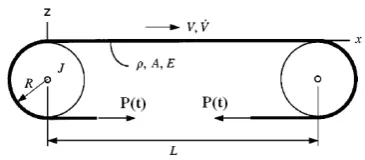
Schematic picture of the moving belt is shown in Figure 1. The belt is modeled by a moving cable traveling with time dependent tension and speed. V and P are the cable tension and speed respectively and ρ, A and E are respectively mass density, cross sectional area and Yang modulus of the cable. R is the pulley radius and L is the cable length between the two spans.
The mathematical model is simulating vibration of moving belts as shown in Figure 2. u(x,t) and w(x,t) are axial and transversal displacements respectively and F(x,t) represents external force per unit length of the cable.
Kinetic energy of the systems can be derived as
A L ut V ux wt Vwx dx
T
{[ (1 )] [ ] }
2
1 2 2
(1)
The large deformation strain of the systems is defined as
2 x x
xx w
2 1 u
e (2)
And potential energy of the systems is
L
xx
xx EAe dx
e t P U
2 ]
1 ) (
[ 2 (3)
Using Hamilton’s principle one can reach to
0 ) } ] ) 2 [( )
(
) 2
( {
) (
)] 1 (
2 [ (
0 ) (
2 2
2 2
1 2
1
dxdt w w w u x EA w t P
w V Vw w V w A
u w w u EA u V
u V Vu u A dt U T
x x x xx
x xt xx tt t
t L
xx x xx x
xx xt tt t
t
(4)
Since equation (4) are valid for any arbitrary
w and
u then0 ) 2 w u ( x EA )] u 1 ( V
u V Vu 2 u [ A
2 x x x
xx 2 xt tt
(5)
Figure 1. Schematic picture of the moving belt with time dependent tension and velocity
Figure 2. Schematic picture of the moving cable with axial
) t , x ( F w ) 2 w u ( x EA w ) t ( P ) w V w V Vw 2 w [ A x 2 x x xx x xx 2 xt tt (6) ) ( ) ( 2 1 ) ,
( 1 2
0 2 t f t xf dx w t x u x
x
(7)Implementing the boundary conditions:
0 ) , 0 ( t
u f2(t)0 (8)
0 ) , 1
( t
u
1 0 2 1 2 1 )
(t w dx
f x
Substituting Equation (7) into (6) the following result can be achieved
L 0 2 xx xx x xx 2 xt tt dx w EAw 2 1 w ) t ( P ) t , x ( F ) w V w V w V 2 w ( A (9)
Variable speed and cable tension are assumed to be
t Sin V V
V 1 * 1 (10)
t Sin P P
P 2 * 2 (11)
Using two dimensional perturbation techniques, solution of the eaquation of motion can be assumed to be
) ( 0 ) T , T , x ( w ) T , T , x ( w T , T , x w ) T , T , x ( w ) T , T , x ( w ) T , T , x ( w ) , t , x ( w 3 1 0 5 2 2 1 0 4 2 1 1 0 3 2 1 1 0 2 2 1 0 1 1 1 0 0 (12) Where ... ) ( ) ( 2 ..., ) ( ) ( , 2 1 2 2 1 1 2 1 2 2 2 1 2 1 2 1 1 D D D D dt d D D dt d t T t T (13)
where i i T D
. Substation of the above equation in
(9) results in
w w w w w w
0) t cos V ( w w w w w w D ) ( D ) t sin V V ( 2 w w w w w w ) A /( t sin p p ] t sin V V 2 t sin V V w w w w w w D ) ( D D ) ( 2 D 5 2 2 4 2 1 3 2 1 2 2 1 1 0 1 1 * 1 5 2 2 4 2 1 3 2 1 2 2 1 1 0 1 2 1 0 1 * 1 0 5 2 2 4 2 1 3 2 1 2 2 1 1 0 2 * 2 0 1 * 1 0 1 2 * 2 1 2 0 5 2 2 4 2 1 3 2 1 2 2 1 1 0 2 1 2 2 1 1 0 2 1 2 0 (14)
If one assumes the coefficients of the same power of
1 and
2 equal to zero0 2
, 20 02 0 02 0 0 0 0 0 0
0
1 w VDw
A P w V w D
(15)
(16) 0 w t cos V w D t sin V 2 w D V 2 w D v 2 w A P w t sin V V 2 w V w D D 2 w D 0 1 1 * 0 0 1 * 0 1 0 1 0 0 1 0 0 1 * 0 1 2 0 0 1 0 1 2 0 1 1 (17) 0 w D V 2 w D V 2 w A P w t sin A P w V w D D 2 w D 0 1 0 2 0 0 2 0 0 2 2 2 0 0 1 0 2 2 0 1 2
Solution of the equation (15) can be assumed as t
i n
e W
W0 0 (18) Substitution of the equation (18) in (15) leads to
0 W W ) V i 2 ( W A P V 0 W ) i ( V 2 W A P W V W 0 2 n 0 0 n 0 0 2 0 0 n 0 0 0 0 2 0 0 2 n
(19)
Using the following transformation
0 V 2 A P V 0 ) i ( V i 2 ) i ( A P V i t 2 n n 0 2 0 2 0 2 n 0 n 2 0 2 0
(20)
One can assume
x i x i
n x Ae Be
and using the boundary conditions (Yn(0)Yn(L)0)
A P
V A P
L n L
n 2
A P V
A P 2
,... 2 , 1 n , L n 2
0 2 0 0
n 0
2 0
0 n
1 2
(22)
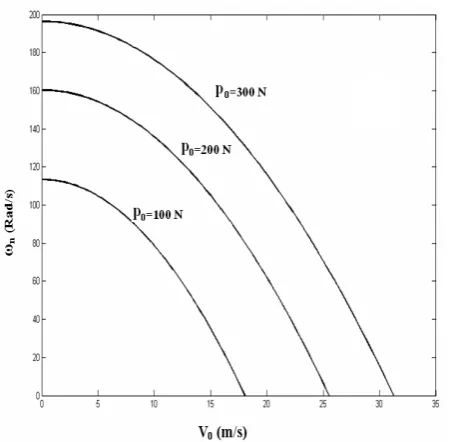
For a typical power transmission belt with properties listed in Table 1, two first natural frequencies are obtained using the presented method in this paper (equation (22)) and illustrated in Figures 3 and 4.
As it is seen from the two Figures, natural frequency decreases by increasing the cable or belt speed. There is a specific speed for each case in which the natural frequency approaches to zero. This specific value of the speed is called the critical speed and as it is seen, the critical speeds are increasing by increasing of the cable tension.
3. SOLUTION OF THE EQUATIONS OF MOTION
Galerkin’s method is used as the solution technique. In this method, solution is approximated with the below equation:
) t ( q ) x ( )
t , x (
W n
1 n
n
(23)
In which, Φ is the mode shape functions and q(t) is unknown functions of time to be determined. If one substitutes Equation (23) into (9) and for a four-term approximation one can reach
) q 06 . 1 q 66 . 2 ( V
) q 06 . 1 q 66 . 2 ( V 2 q ) P V
P V ( q
4 2
4 2 1
2 1 0 2 0
2
1
2
4 1 2
2 1 2
3 1 3
1
2 48.7q 348.34qq 194.81qq 779.27qq
L
E
(24)
) q 89 . 4 q 66 . 2 ( V
) q 8 . 4 q 66 . 2 ( V 2 q ) P V
P V ( q
3 1
3 1 2
2 2 0 2 0
2
2
TABLE 1. Mechanical properties of the simulated belt [14]
Symbol Value Unit
ρ 7.68 X10³ kg m3
A 4 X10⁻⁵ m2
L 1.0 m
E 3 X10⁹ N/ m2
ε1=ε2 0.1
Figure 3. Variation of the first natural frequency versus the
cable speed
Figure 4. Variation of the second natural frequency versus
2 4 2 3 2 2 3 2 2 1 2 q q 3117 q 27 . 779 q q 36 . 1753 q 8 . 194 L E
(25)
) 8 . 4 85 . 6 ( 2 )
( 33 3 4 2
0 2 2
3 q V q q
P V
P V
q
2 4 3 3 2 3 2 3 2 1 3 2 2 4 q q 45 . 7013 q q 36 . 1753 q 3945 q q 34 . 438 L E ) q 8 . 4 q 85 . 6 ( V (26) 3 4 2 2 4 2 3 4 2 1 4 2 1 3 1 3 4 2 4 0 2 0 2 4 q 36 . 12468 q q 09 . 3117 q q 45 . 7013 q q 27 . 779 L E ) q 06 . 1 q 85 . 6 ( V ) q 06 . 1 q 85 . 6 ( V 2 q ) P V P V ( q (27)
To solve the above sets of nonlinear coupled differential equations, the flowchart is used as shown in Figure (5).
4. VALIDATION OF SIMULATION
A special case of a moving cable with constant tension and variable speed [12] in the literature is considered in this section. For such a special case differential equations of motion can be derived as [12] 0 y ) v P ( ) y v 2 y v y ( 2
0
(28)
In which k is pulley effect coefficient and the speed is assumed to have sinusoidal variation
t sin v ) t (
v 0 0 . For a real case with mechanical parameters listed in Table 1 numerical simulation has been carried out and the results are shown in Figures (6) and (7)
Figure 5. Schematic picture of the simulated program
(A)
(B)
Figure 6. Comparison between the results from the present
5. NUMERICAL RESULTS AND DISCUSSIONS
Using the prescribed method of solution provided for differential equations of motion a computer program has been written employing MATLAB (R2006b) software and a comprehensive parametric study is carried out.
For a real case with mechanical properties listed in Table 1, different approximations for the response of the midpoint of the cable are illustrated in Figures (8) to (10). It is seen that the procedure converges with acceptable accuracy for approximations with four parts in Galerkin series.
(A)
(B)
Figure 7. Comparison between the results from the present
work (A) and Reference [12] (B) v0=90, ω0=42
W(
L/
2
,t)
(m
)
Time (s)
Figure 8. Response of the midpoint
Galerkin method second order approximation Galerkin method first order approximation
W(
L/
2
,t)
(m
)
Time (s)
Figure 9. Response of the midpoint
Galerkin method second order approximation Galerkin method third order approximation
W(
L/
2
,t)
(m
)
Time (s)
Figure 10. Response of the midpoint
As seen the harmonic tension force acts as the control force and reduces the amplitude of vibration even up to 10%. This means that if the moving cable is excited with the harmonic variable tension with the same frequency and phase of the natural vibration the vibration amplitude will decrease noticeably. That result is quite matched with physical experience when someone applies a harmonic tension on a vibrating rope with the same frequency and phase of its vibration to suppress the
oscillations. Effects of the amplitude of harmonic tension on reduction of the vibration amplitude are illustrated in Figure 12. As it is seen, amplitude of vibration reduces by increasing of the amplitude of the variable tension.
Effects of the frequency of harmonic tension on reduction of the vibration amplitude are illustrated in Figure (13). As it is seen, the variable tension acts as a controller force to reduce the vibration of the cable. It is seen that if the frequency of the
Time (s)
Figure 11.Effect of the harmonic tension on reduction of the
vibration amplitude
Ω1=1.0*ω1=42.83 Rad/s Ω2=1.0*ω1=42.83 Rad/s V*=4 m/sP*=40 N
Ω1=1.0*ω1=42.83 Rad/s Ω2=0 V*=4 m/s P*=0 N
Figure 12. Effect of the amplitude of harmonic tension on
reduction of the vibration amplitude
( Ω1=1.0*ω1=42.83 Rad/s Ω2=1.0*ω1=42.83 Rad/s V*=4 m/s )
Figure 13. Effect of the frequency of harmonic tension on
reduction of amplitude
( Ω1=1.0*ω1=42.83 Rad/s V*=4 m/s P*=40 N )
variable tension is exactly equal to the first natural frequency of the cable, it has its highest performance in reducing the vibration level of the cable.
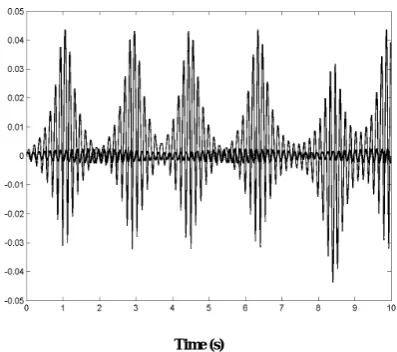
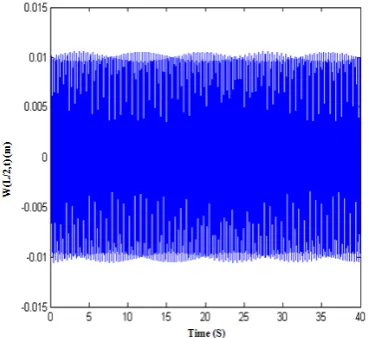
Figure 14 shows dynamic responses of the system when excitation frequency is less than natural frequency of the cable. The response of the systems is shown to be harmonic and stable.
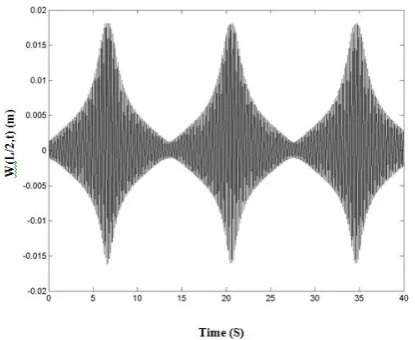
Figure 15 shows dynamic responses of the system when excitation frequency is exactly equal to natural frequency of the cable. The response of the systems is shown to have beating behavior.
Maximum amplitude reaches to 2.5 times of the initial condition.
Figure 16 shows dynamic responses of the system when excitation frequency is equal to 1.0 times of natural frequency of the cable and amplitudes of the variation of the cable tension and also speed are increasing. In Figure (16) amplitudes of the harmonic parts of the speed and tension are both getting twice with respect to the Figure (15). A comparison between two Figures (15) and (16) shows that by increasing of the amplitude of variation of tension and speed frequency of beating
Figure 15. effect of the frequency of variation of tension and
speed on reduction of the vibration amplitude
(Ω1=1.0*ω1=42.83 Rad/s Ω2=1.0*ω1=42.83 Rad/s V*=2 m/s P*=20)
Figure 16. Effect of the amplitude of variation of tension and
speed on reduction of the vibration amplitude
(Ω1=1.0*ω1=42.83 Rad/s Ω2=1.0*ω1=42.83 Rad/s V*=4 m/s P*=40) N
Figure 17. Effect of the frequency of variation of tension and
speed on reduction of the vibration
(Ω1=1.5*ω1=64.24 Rad/s Ω2=1.5*ω1=64.24 Rad/s V*=2 m/s P*=20 N )
Figure 18. Effect of the frequency of variation of tension and
speed on reduction of the vibration amplitude
increases.
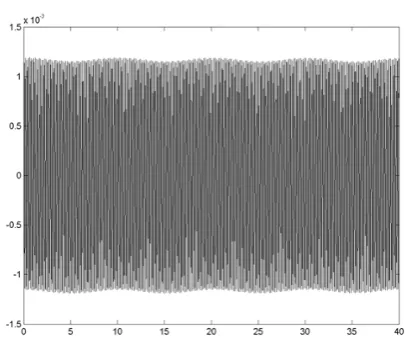
Figure 17 shows dynamic responses of the system when excitation frequency is equal to 1.5 times of natural frequency of the cable. The response of the systems is shown to have harmonic behavior again. Figure 18 shows dynamic responses of the system when both excitation frequencies are equal to 2 times of natural frequency of the cable. The response of the systems is shown to have beating behavior again.
Figure 19 shows effects of the magnitude of variation of the tension force and moving speed when the excitation frequency is exactly two times of the natural frequency of the system.
Figure 20 shows effects of the frequency of variation of the tension force and moving speed when the frequency variation of the variable tension is equal to two times of the natural frequency and simultaneously frequency of variation of the speed is exactly the natural frequency of the system. A comparison between two Figures (18) and (20) shows that beating frequency is considerably increasing if one of the excitation frequencies drops from two times to exactly the natural frequency of the system.
Figure 21 shows effects of the frequency of variation of the tension force and moving speed when the frequency variation of the variable speed is equal to two times of the natural frequency and simultaneously frequency of variation of the variable tension is exactly the natural frequency of the system. Again, a comparison between two Figures (18) and (21) shows that beating frequency is considerably increasing if one of the excitation frequencies drops from two times to exactly the natural frequency of the system.
Figure 22 shows effects of the frequency of variation of the tension force and moving speed when the frequency variation of the variable tension is equal to three times of the natural frequency and simultaneously frequency of variation of the variable speed is exactly the natural frequency of the system. Again, a comparison between three Figures (20), (21) and (22) shows that beating frequency is lower than two previous cases (Ω1=2.0*ω1 , Ω2=1.0*ω1) and (Ω1=1.0*ω1 و Ω2=2.0*ω1) and also magnitude of the vibration is considerably lower.
Figure (23) shows effects of the frequency of variation of the tension force and moving speed
when the frequency variation of the variable speed is equal to three times of the natural frequency and simultaneously frequency of variation of the variable tension is exactly the natural frequency of the system. Again, a comparison between three Figures (21), (22) and (23) shows that beating frequency is lower than two previous cases (Ω1=2.0*ω1 , Ω2=1.0*ω1) and (Ω1=1.0*ω1 و Ω2=2.0*ω1) and also magnitude of the vibration is considerably lower.
Figure 21. Effect of the frequency of variation of tension and
speed on reduction of the vibration amplitude
(Ω1=2.0*ω1=85.67 Rad/s Ω2=1.0*ω1=42.83 Rad/s V*=2 m/s P*=20 N)
Figure 22. Effects of the frequency of variation of tension and
speed on reduction of the vibration amplitude
Figure 24 shows effects of the frequency of variation of the tension force and moving speed when the frequency variation of the variable speed is three times of the natural frequency and simultaneously frequency of variation of the variable tension is also three times of the natural frequency of the system. A comparison between three Figures (22), (23) and (24) shows that beating phenomena vanishes and amplitude of vibration considerably decreases.
5. CONCLUSION
Dynamic Analysis of an axially moving cable with time dependent tension and velocity was developed. It was found that a specific value of speed in which natural frequency of the system approaches to zero do exist. This specific speed is called critical speed and it was proved that increasing the tension will increase the critical speed of the moving cable. In addition to that the harmonic tension can act as a controller and reduces the amplitude of vibration up to 25 times. Optimal frequency of the variable tension was found to be exactly the same as the first natural frequency of the systems and also it was proved that increasing the amplitude of the variable tension can considerably reduce the level of vibration. It was found that the behavior of the systems is harmonic when the excitation frequency is higher or lower than the natural frequency. At the natural frequency, the system has beating behavior and by increasing the amplitude of the moving speed, the variable tension and the frequency of beating will also increase. It was shown that the dynamic response of the system when both excitation frequencies are equal to 2 times of natural frequency of the cable has beating behavior. The beating frequency is considerably increasing if one of the excitation frequencies drops from two times to exactly the natural frequency of the system. In the case, the frequency variation of the variable speed and tension are simultaneously three times of the natural frequency of the system, beating phenomena vanishes and the amplitude considerably decreases.
6. REFERENCES
1. Wickert, J.A., Mote, C.D., “Classic vibration analysis of axially moving continua”, ASME Journal of Applied
Mechanics, Vol. 52, (1990), 738–744.
2. Pakdemirli, M., Ulsoy, A.G., “stability analysis of an axially accelerating string”, Journal of sound vibration,
Vol. 203, (1997), 815-832.
3. Chen, L.Q. , Zu, J.W., Wu, J., “Steady-state response of the parametrically excited axially moving string constituted by the Boltzmann superposition principle”,
Acta Mech, Vol. 162, (2003), 143–155.
4. Chen, L.Q., Wu, J., Zu, J.W., “The chaotic response of
Figure 23. Effects of the frequency of variation of tension and
speed on reduction of the vibration amplitude
(Ω1=3.0*ω1=128.49 Rad/s Ω2=1.0*ω1=42.83 Rad/s V*=2 m/s P*=20 N)
Figure 24. effects of the frequency of variation of tension and speed on reduction of the vibration amplitude
the viscoelastic traveling string: an integral constitutive law”, Chaos, Solitons & Fractals, Vol. 21, (2003),
349–357.
5. Pellicano, F., “Complex dynamics of high speed axially moving systems”, Journal of sound vibration, Vol.
258, (2002), 31–44.
6. Wang, Y.F., Huang, L.H., Liu, X.T., “Analysis for transverse vibrations of axially moving strings based on Hamiltonian dynamics”, Acta Mech Sinica, Vol. 21,
(2005), 485–494.
7. Hwang, S. J., Perkins, N.C., “Supercritical stability of an axially moving beam—part I: model and equilibrium analysis”, Journal of Sound and Vibration, Vol. 154,
(1992), 381–396.
8. Hwang, S. J., Perkins, N.C., “Supercritical stability of an axially moving beam—part II: vibration and stability analysis”, Journal of Sound and Vibration, Vol. 154,
(1992), 397–409.
9. Ravindra, B., Zhu, W.D., “Low-dimensional chaotic response of axially accelerating continuum in the supercritical regime”, Archives of Applied Mechanics,
Vol. 68, (1998), 195–205.
10. Pellicano, F., Fregolent, A., Bertuzzi. A., Vestroni, F., ”Primary and parametric non-linear resonances of a power transmission belt: experimental and theoretical analysis”, Journal of Sound and Vibration, Vol. 244,
(2001), 669–684.
11. Pellicano, F., Catellani, G., Fregolent, A., “Parametric instability of belts: theory and experiments”, Computers
& Structures, Vol. 82, (2004), 81–91.
12. Pakdemiril, M., Ulsoy, A.G., Ceranoglu, A., “Transvers vibration of an axially accelerating string”, Journal of
Sound and Vibration, 169(2), (1994), 179-196
13. Wang, Y., Liu, X., Huang, L., “Stability analyses for axially moving strings in nonlinear free and aerodynamically excited vibrations”, Chaos, Solitons
and Fractals, Vol. 38, (2008), 421–429.
14. Koivurova, H., “The numerical study of the nonlinear dynamics of a light, axially moving string”, Journal of
Sound and Vibration, 320 (2009) 373–385.
15. Chen, L. Q., Zhang, W., Zu, J.W., “Nonlinear dynamics for transverse motion of axially moving strings”, Chaos,
Solitons and Fractals, Vol. 40, (2009) 78–90.
16. Chen, L. Q., Chen, H. b, Lim, C.W., “Asymptotic analysis of axially accelerating viscoelastic strings”,
International Journal of Engineering Science, Vol. 46
(2008) 976–985.
17. Ghayesh, M. H., “Nonlinear transversal vibration and stability of an axially moving viscoelastic string supported by a partial viscoelastic guide”, Journal of
![Figure 6. Comparison between the results from the present work (A) and Reference [12] (B) for v0=92, ω0=38](https://thumb-us.123doks.com/thumbv2/123dok_us/239845.2018670/6.595.305.522.79.275/figure-comparison-results-present-work-reference-b-w.webp)
![Figure 7.work (A) and Reference [12] (B) v0=90, ω0=42](https://thumb-us.123doks.com/thumbv2/123dok_us/239845.2018670/7.595.332.523.320.458/figure-work-reference-b-v-w.webp)