RESEARCH NOTE
A NEW MULTI-OBJECTIVE MODEL FOR A CELL FORMATION
PROBLEM CONSIDERING MACHINE UTILIZATION AND
ALTERNATIVE PROCESS ROUTES
R. Tavakkoli-Moghaddam*
Department of Industrial Engineering and Department of Engineering Science College of Engineering, University of Tehran
P.O. Box 11155-4563, Tehran, Iran [email protected]
M. Ranjbar-Bourani
Department of Industrial Engineering, Graduate School Islamic Azad University-South Tehran Branch, Tehran, Iran
H. Mirzahosseinian and M.B. Aryanezhad
Department of Industrial Engineering, Iran University of Science and Technology P.O. Box 16844, Tehran, Iran
[email protected] - [email protected]
*Corresponding Author
(Received: March 9, 2008 – Accepted in Revised Form: September 25, 2008)
Abstract This paper presents a novel, multi-objective mixed-integer nonlinear programming
(MINLP) model for a cell formation problem (CFP) with alternative means. Due to existing contradiction among objectives, three are considered: 1) Minimizing the total cost consisting of; intercellular movements, purchasing, operation, and maintenance; 2) maximizing the utilization of machines in the system; 3) minimizing the deviation levels between the cell utilization (i.e., balancing the workload between cells). Furthermore, alternative process for each part, which is a key characteristic for flexible manufacturing systems, is considered in this paper. The main goals of our proposed model are to; 1) Select a process plan for each part with minimum cost, simultaneous machine grouping and complete series of all parts; 2) Identify the appropriate level of overall utilization of machines; 3) Balancing the workload among the cells in the production system.
Keywords Multi-Objective Cell Formation Problem, Alternative Process Plan, Alternative Routes
ﻩﺪﻴﻜﭼ
ﻪﻣﺎﻧﺮﺑﻪﻓﺪﻫﺪﻨﭼﺪﻳﺪﺟ ﻝﺪﻣﮏﻳ،ﻪﻟﺎﻘﻣ ﻦﻳﺍﺭﺩﻪﻟﺎﺴﻣﻱﺍﺮﺑﻲﻄﺧﺮﻴﻏ ﺕﺭﻮﺼﺑﻂﻠﺘﺨﻣﺢﻴﺤﺻﺩﺪﻋ ﻱﺰﻳﺭ
ﻱﺪﻴﻟﻮﺗﻝﻮﻠﺳﻞﻴﮑﺸﺗ ﻪﻧﺎﮔﺪﻨﭼﯽﺗﺎﻴﻠﻤﻋﯼﺎﻫﺮﻴﺴﻣﻦﺘﻓﺮﮔﺮﻈﻧﺭﺩﺎﺑ
ﻪﺋﺍﺭﺍ ﻲﻣ ﺩﻮﺷ
.
ﻑﺍﺪﻫﺍﻥﺎﻴﻣﺽﺭﺎﻌﺗﺩﻮﺟﻭﻞﻴﻟﺩﻪﺑ
ﺕﺭﻮﺻ ﻪﺑ ﻑﺍﺪﻫﺍ ﺯﺍ ﮏﻳ ﺮﻫ ﯼﺯﺎﺳ ﻪﻨﻴﻬﺑ ،ﻪﻌﻟﺎﻄﻣ ﺩﺭﻮﻣ
:
١
(
ﻞﻗﺍﺪﺣ ﻞﻘﻧ ﻭ ﻞﻤﺣ ﻪﻨﻳﺰﻫ ﻞﻣﺎﺷ ﻞﮐﻪﻨﻳﺰﻫ ﻥﺩﻮﻤﻧ
ﻦﻴﺑ ﻲﻟﻮﻠﺳ ، ﻦﻴﺷﺎﻣﻱﺭﺍﺪﻬﮕﻧﺰﻴﻧﻭﻲﺗﺎﻴﻠﻤﻋ،ﺪﻳﺮﺧﻪﻨﻳﺰﻫ ؛ﺎﻫ
٢
(
ﻩﺮﻬﺑﺢﻄﺳﻥﺩﻮﻤﻧﺮﺜﮐﺍﺪﺣ ﻦﻴﺷﺎﻣﺯﺍﯼﺮﻴﮔ
ﻢﺘﺴﻴﺳﺭﺩﺎﻫ
ﻭﯼﺪﻴﻟﻮﺗ ٣
(
ﻥﺩﺮﻛﻞﻗﺍﺪﺣ ﺡﻮﻄﺳﻥﺎﻴﻣﻑﺍﺮﺤﻧﺍ
ﻩﺮﻬﺑ ﻝﻮﻠﺳﺯﺍﯼﺮﻴﮔ ﺎﻫ
)
ﻝﻮﻠﺳﻦﻴﺑﯼﺭﺎﮐﺭﺎﺑﻥﺩﻮﻤﻧﺲﻧﻻﺎﺑﻲﻨﻌﻳ ﺎﻫ
(
ﻪﺋﺍﺭﺍ
ﻲﻣ ﺩﻮﺷ
.
ﯽﮔﮋﻳﻭﺯﺍﻪﮐﻪﻧﺎﮔﺪﻨﭼﯽﺗﺎﻴﻠﻤﻋﯼﺎﻫﺮﻴﺴﻣﻖﻳﺮﻃﺯﺍﺕﺎﻌﻄﻗﺪﻴﻟﻮﺗﺖﻴﻠﺑﺎﻗﻦﻴﻨﭽﻤﻫ ﻢﺘﺴﻴﺳﻢﻬﻣﯼﺎﻫ
ﯼﺪﻴﻟﻮﺗﯼﺎﻫ
ﻑﺎﻄﻌﻧﺍ ﺖﺳﺍﻩﺪﺷ ﻅﺎﺤﻟﻪﻟﺎﻘﻣ ﻦﻳﺍﺭﺩ،ﺖﺳﺍ ﺮﻳﺬﭘ
.
ﺯﺍﺖﺳﺍ ﺕﺭﺎﺒﻋﻱﺩﺎﻬﻨﺸﻴﭘ ﻝﺪﻣﻲﻳﺎﻬﻧ ﻑﺪﻫ ۱
(
ﻪﻣﺎﻧﺮﺑ ﺏﺎﺨﺘﻧﺍ
ﺮﮔ ﻥﺎﻣﺰﻤﻫﻞﻴﮑﺸﺗ ﺎﺑﻩﺍﺮﻤﻫ ﻞﮐ ﻪﻨﻳﺰﻫ ﻞﻗﺍﺪﺣﺎﺑ ﻪﻌﻄﻗ ﺮﻫﻱﺍﺮﺑ ﻱﺪﻨﻳﺍﺮﻓ ﻦﻴﺷﺎﻣ ﻩﻭ
ﺕﺎﻌﻄﻗﻩﺩﺍﻮﻧﺎﺧ ﻭ ﺎﻫ ۲
(
ﻦﻴﻴﻌﺗ
ﺐﺳﺎﻨﻣ ﻩﺮﻬﺑﺢﻄﺳﻦﻳﺮﺗ ﯼﺮﻴﮔ
ﻞﮐ ﻦﻴﺷﺎﻣﺯﺍ ﻭﺎﻫ ۳
(
ﻝﻮﻠﺳﻥﺎﻴﻣﻱﺭﺎﮐﺭﺎﺑﻥﺩﺮﻛﺲﻧﻻﺎﺑ ﯼﺪﻴﻟﻮﺗﻢﺘﺴﻴﺳﻒﻠﺘﺨﻣﯼﺎﻫ
.
1. INTRODUCTION
Cellular manufacturing (CM) is the application of
families and the machines into cells, by considering the similarity of parts in processing and design functions. Since GT allows for the combined benefits of mass production while dealing with multi-product small lot-sized production. The reported benefits of CM are simplified and reduced to material handling, reduced set-up time, shorter lead times, reduced work-in-process, improved productivity, simplified scheduling and better overall control of operations [1]. Identification of similar parts (part families) and machine cells in the design of a cellular manufacturing system (CMS) is commonly referred to as cell formation. A number of current cell formation problems have been developed based on single process plan for each part. While, we assume that there are many machine type with high capability, so that each part can be processed on machines with having the capability of doing related operation for specific part. Alongside the alternative process routes (APR) issue, the competitive nature which is imposed on the manufacturer, entails a number of conflicting criteria in a cell design. With these criteria taken into consideration, a multi-objective problem is formed. In order to enlighten the readers as to the necessity of this creative approach, a review of the most previous research done in this area is introduced in the following section.
2. LITERATURE REVIEW
In the first step, a brief description of the work addressed alternative route issue in CMSs is provided, and then multi-objective approaches in CMS are briefly discussed.
2.1. Alternative Process Routes
Most cellformation methods in the literature assume that parts have only a unique process routing. However, it is well known that alternatives may exist in any level of a process plan. When each part can have more than one process routing, the CF problem becomes generalized [2] or CF problem with APR. Explicit consideration of alternative process routings provides some additional flexibility in the design of cellular manufacturing systems, so that a lower material flow cost can be achieved. The
following researches have considered APR while dealing with the CF problem:
Kusiak, et al [3] proposed a generalized p-median model in the presence of alternative routings. Adil, et al [4] considered the APR in their model, considering a nonlinear integer programming to identify part families and machine cells. They used a binary machine-component matrix to model this situation. The model uses a weighting approach to deal with minimizing voids and exceptional elements simultaneously. Furthermore, they used a linearization of the model procedure. Tavakkoli-Moghaddam, et al [5] developed a model, which was first proposed by Chen [6], with additional assumptions, such as alternative process plan, sequence operation, machine capacity, and machine replication with the aim of minimizing the sum of machine total costs and inter-cell movements cost simultaneously. Caux, et al [7] considered machine capacity constraints in the traditional CF problem with the APR. They used an approach combining the simulated annealing (SA) method for the CF problem and a branch-and-bound method for a routing selection problem. Hwang, et al [8] proposed a two-stage procedure for the CF problem with the APR. The first stage tries to solve the routing selection problem with the objective of maximizing the sum of compatibility coefficients among selected process plans. Through a p-median model, the second stage forms the part families by means which had resulted from the first stage.
2.2. Multi-Objective CFP
Although, numerous heuristic or meta-heuristic methods have been proposed for the single-objective version of CF problems, there has been relatively little research on the multi-objective version of the given problem, despite the fact that practical considerations during the design of a manufacturing system are most likely to consider multiple conflicting objectives.Kim, et al [12] presented a two-phase heuristic algorithm to deal with multi-objective CF problems. This problem is characterized as determining part route families and machine cells so that the total sum of intercellular part movements and maximum machine workload imbalance are minimized simultaneously. Tavakkoli-Moghaddam, et al [13] proposed a new multi-objective mixed-integer nonlinear programming (MINLP) model for a cell formation (CF) problem under fuzzy and dynamic conditions with three objectives. Their objectives are to minimize the total cost consisting of the costs of intercellular movements, subcontracting, purchasing, operation parts, maintenance, and reconfiguration of machines, to maximize the preference level of the decision making, and to balance the intracellular workload. Shafer, et al [14] presented a goal programming model to deal with three objectives as follows: minimizing intercellular movements, minimizing the investment in new equipment, and maintaining an acceptable utilization level. Their proposed model composes the p-median to specify part families and the traveling salesman problem to identify the optimal sequence of parts. They also applied heuristic to solve real world problems. Venugopal, et al [15] proposed a bi-criteria mathematical model for the machine-component grouping problem in such a way that the volume of inter-cell moves and the total cell load variation were minimized.
Mansouri, et al [16] employed a multi-objective genetic algorithm, called XGA, to provide the decision-makers with Pareto-optimal solutions. Their model aims at deciding on which parts to subcontract and which machines to duplicate in a CMS which exists in some exceptional elements. The main objectives of their model are to minimize intercellular movements, minimize the total cost of machine duplication and part subcontracting,
minimize under-utilization of machines in the system, and to minimize the imbalance of the workloads among the cells. Yasuda, et al [17] presented a grouping genetic algorithm to solve the multi-objective cell formation problem. Processing time, production requirements, and available time on machine in a given period have been considered for the two objectives, inter-cell flows and cell load variation. Liang, et al [18] developed a bi-criteria nonlinear integer programming model to improve the efficiency and flexibility on the production floor. The weighted approach is employed to unify the two objectives, (i.e. maximizing the system flexibility and efficiency). No inter-cell movement is allowed and all exceptional parts must be sub-contracted. They used a degree of similarities of parts and a number of part types, accommodated into the focused cell, to measure the efficiency and flexibility, respectively.
Mansouri, et al [19] provided comprehensive reviews of multi-criteria decision-making (MCDM) in the design of manufacturing cells considering the inputs comparison, criteria, solution approaches, and outputs across selected models.
The rest of this paper is organized as follows: detailed description of the proposed model is described in Section 3. Section 4 discusses some approaches to multi-objective CF problems. Numerical examples and the related computational results are reported in Section 5. Finally, conclusion and direction for future research are presented in Section 6.
3. PROBLEM FORMULATION
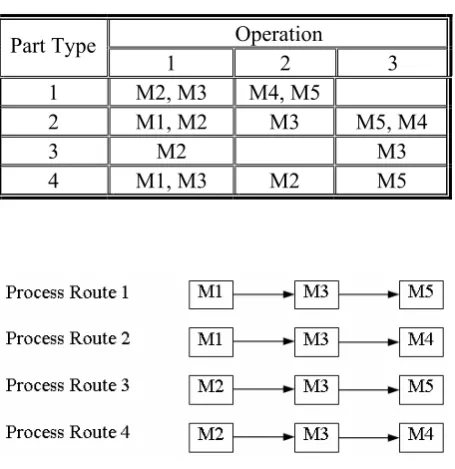
TABLE 1. Capability of Five Machines for Four Parts in a Cell.
Operation Part Type
1 2 3 1 M2, M3 M4, M5
2 M1, M2 M3 M5, M4
3 M2 M3
4 M1, M3 M2 M5
Figure 1. Alternative process routes for part type 2.
For instance, either M1 or M2 can be used to process part type 2 in operation 1. By considering three operations for this type part, there are 2 × 1 × 2 ways to proceed with these machines. This part (type 2) may be processed using any of four process routes as depicted in Figure 1. Feasibility of these routes primarily depends on time capacity of corresponding machines.
In our proposed model, parts families and machine groups are formed simultaneously. However, it can be more complicated to model, which requires a substantial amount of time to solve. We also assume that no part splits into different cells for the processing of an operation. Moreover machines can be duplicated to meet capacity requirements and to reduce (or eliminate) inter-cell movements.
The following assumptions are considered in the given problem:
• The processing time for all types of part operations on different machine types are known and constant.
• Each part must be processed according to a known sequence of operations.
• The demand for each part is known.
• The capabilities and capacity of each machine type is known and constant over planning horizon.
• The number of cells used must be specified prior to the operation.
• Bounds and quantity of machines in each cell need to be specified in advance and they remain constant over time.
• Parts are moved between cells in batches. The inter-cell material handling cost for each batch between cells is known and constant (i.e., independent of quantity of cells).
• Each machine type can perform one or more operations (i.e., machine flexibility).
• Each operation can be done on one machine type with different times (i.e., routing flexibility).
• Delayed order is forbidden. • No inventory is considered. • Setup times are not considered. • No queue in production is allowed. • Machine breakdowns are not considered. • Batch size is constant for all productions.
3.1. Definition of Objectives
The following set of criteria is considered for developing the multi-objective CFP model:1. Minimizing the total sum of machine maintenance costs, machine operating costs, inter-cell material handling costs, and machine purchase costs.
2. Maximizing the overall utilization of machinery in manufacturing system.
3. Minimizing deviation caused by imbalanced levels of utilization among cells.
It is worthy noting that the considered objectives in the form of a total cost (i.e., first objective function) have different and conflicting natures. For instance, minimization of inter-cell traffic, as a major CMS design goal, increases the system efficiency through decreasing the required movement, reducing mean flow time, and simplifying shop floor control. However, considering minimization of machines duplication conflicts with the former objective (i.e., decreasing machine number will result in an increase in intercellular movements). Therefore, all these objectives are proposed as a total cost in an integrated objective function in order to overcome the inherent conflict [13].
As the second independent objective, maximizing the overall utilization of machinery in manufacturing system or minimizing the overall under-utilization of all machines present in the system has been considered. The aim of this term is to reduce the under-utilization of machinery, which is increased by the first objective function. As a final point, we propose the third objective function as minimizing the load variation among cells, which is computed as the difference between the utilization of each cell and the overall utilization of machines, which aids to smooth out the workload between the cells to increase the balancing amount of work for the operators working in each cell.
3.2. Notations
The notations of the proposedmodel are described as follows: P Number of parts
M Number of machines
Jp Number of operations for part type p
C Number of manufacturing cell to be formed p Part types; p = 1,2,…, P
m Machine types; m = 1,2,…, M
j Operations required by part P; p = 1,2,…, P c Manufacturing cell; c = 1,2,…, C
Tm Capacity of machine type m
Dp Demand of part type p during planning
horizon
Bp Batch size of part type p
αm Purchase cost of machine type m
βm Operating cost per hour of machine type m
Mm Maintenance cost of machine type m
γp Inter-cell material handling cost for each
batch of part type p
tjpm Time required performing operation j of part
type p on machine type m αjpm ⎪⎩ ⎪ ⎨ ⎧ = otherwise , 0 type machine on done be can part type of operation if , 1 m p j
UB Upper bound for the cell size LB Lower bound for the cell size
ou Overall utilization of machines in the system (total average of workload on all machines in the system)
cuc Utilization of machines in cell c (total
average of workload on all machines in each cell)
3.3. Decision Variables
Nmc Number of machines type m required in cell c
Xjpmc ⎪⎩ ⎪ ⎨ ⎧ = otherwise ,
0 on machine type in cell
done is part type of operation if , 1 c m p j zjpch ⎪⎩ ⎪ ⎨ ⎧ = otherwise , 0 cell in done is part type of operation if , 1 c p j
3.4. Mathematical Formulation
According tothe above-mentioned definitions, the objective function and constraints of our proposed model are given in the following equations.
m jpm jpmc C c M m P p J j p m M m C c mc m M m C c mc J j C c jpc pc j P p p p O t X D N M N Z Z B D F p p . . . . . . 2 1 Min
1 1 1 1
1 1 1 1 1 1 1 ) 1 ( 1 1
∑∑∑∑
∑∑
∑∑
∑∑
∑
= = = = = = = = − = = + = + + + − × ⎥ ⎥ ⎥ ⎤ ⎢ ⎢ ⎢ ⎡ = α γ (1) 1 Min F 2= ou−p j X a C c M m jpmc
jpm. 1 ,
1
1 1
∑∑
== =
∀
= (2)
c m N T X t
D jpm jpmc m mc
P p J j p p , . . 1 1 ∀ × ≤
∑∑
= = (3)∑
= ∀ × = M 1 m jpmc jpmjpc a X ,jp,c
Z (4)
∑∑
= = ∀ ≤ P p jpmc J j jpmmc a x mc
N
p
1 1
,
. (5)
c UB
N
M
m
mc≤ ∀
∑
=1 (6) c LB N M mmc≥ ∀
∑
=1
(7)
1 1 1 1
. .
C M C M
c m mc m mc
c m c m
ou cu T N T N
= = = =
⎛ ⎛ ⎞⎞ ⎛ ⎞
=⎜ ×⎜ ⎟⎟ ⎜ ⎟
⎝ ⎠ ⎝ ⎠
⎝
∑
∑
⎠∑∑
(8)1 1 1 1
. . . ;
p
O
M P M
c p jpm jpmc m mc
m p j m
cu D t X T N c
= = = =
⎛ ⎞ ⎛ ⎞
=⎜ ⎟ ⎜ ⎟ ∀
⎝ ⎠
⎝
∑∑∑
⎠∑
(9)c m p j N Z
Xjpmc, jpc∈(0,1 )and mc≥0 ∀, , , (10)
The multi-objective function given in Equation 1 is a mixed-integer nonlinear equation consisting of three sub-functions. The first function (F1)
minimizes the total sum of inter-cell material handling costs, machine maintenance costs, machine purchase costs and machine operating costs. The first term is obtained by summing the products of the number of inter-cell transfers in batches and the unit batch inter-cell movement cost. The operation sequence directly affects the intercellular movements; i.e. if two consecutive operations must processed by two machines in two different cells, only one unit inter-cell movement cost will incur. The second term of this equation is obtained by the product of the number of machine type m in cell c and their associated constant costs. The third term is the machine procurement cost. The forth term is the sum of the product of the
operational time that each machine needs to process the allocated quantity of parts and their associated variable costs.
The second and third functions (i.e., F2 and F3),
are to overcome the deviation of the desired overall machinery utilization and average workload among cells, respectively. F2 tries to minimize the
deviation of the overall utilization from the ideal overall machinery utilization (i.e., 1) or all parts and in the whole planning horizon. The last objective function also minimizes the deviation of each cell utilization as well as the overall, in order to balance the workload among cells because of parts processing.
Equation 2 guarantees that each part's operation is assigned to a machine, which has the required tools for processing the job. Equation 3 ensures that machine capacities are not exceeded and can satisfy the demand. Moreover, this constraint determines the desired number of each machine type in each cell. In Equation 4, if at least one operation of type p part proceeds in cell c, then the value of zjpch is equal to one; otherwise, it is equal
to zero. This constraint is used to compute the inter-cell material movements in the first term of the first objective function. Equation 5 guarantees that each machine type can be added in any cell providing the capability to do at least one operation required for that cell. Equations 6 and 7 specify the upper and lower boundary of the cell size, respectively. Equation 8 computes overall utilization of all machines in manufacturing system. Equation 9 identifies the utilization of all machines in each cell.
3.5. Linearizing the Absolute Function
Thefirst term in the objective function can be linearized by introducing two non-negative variables τ+jpc and τ−jpc. The first objective function is rewritten as follows [6]:
(
)
m jpm jpmc C c M m P p J j p m M m C c mc m M m C c mc J j C c jpc jpc P p p p O t X D N M N B D p p . . . . . . 2 1 F Min1 1 1 1
By adding the following set of constraints: c p j Z
Zj 1,pc− jpc= jpc+ − −jpc ∀, ,
+ τ τ (12)
4. MULTI-OBJECTIVE SOLUTIONS
A mono-objective optimization algorithm is terminated upon obtaining an optimal solution, yet it is unlikely to find a single solution for a multi-objective problem and due to the contradictory objectives, we generally find a set of solutions. There are many available methods to tackle multi-objective optimization problems. Collette, et al [21] classified these methods into five sets: scalar methods, interactive methods, fuzzy methods, methods using meta-heuristics and decision aid methods.
In the first approach, which is applied in this paper, a set of objectives which are considered is converted into a single objective by the weight sum of individual objectives. Although this approach offers only a compromised solution whose non-dominance is not guaranteed, it provides the flexibility of assigning different weights to different objectives based on decision maker (DM) requirements, which is a great advantage in MODM and fuzzy environments [15]. It looks very complicated for the proposed model, where solving the model by exact method requires a substantial amount of time. For this reason, the use of meta-heuristics is more suitable than other methods for solving multi-objective optimization problems. Some work has been done in multi-objective optimization area from which the following can be mentioned: multi-objective simulated annealing (MOSA), multi-objective genetic algorithm (MOGA), vector evaluated genetic algorithm (VEGA), Niched Pareto genetic algorithm (NPGA), Pareto archive evaluation strategy (PAES), non-dominated sorting genetic algorithm (NSGA and NSGAII), strength Pareto evolutionary genetic local search (MOGLS), multi-objective scatter search (MOSS) [22].
These methods are not addressed in this paper; however, they are recommended for future studies to prevail over computational complexity of our novel proposed model. Since the proposed triple-objective model consists of a total cost function,
overall utilization, and deviation minimization objectives, we use a type of the weighting method and consider two monetary penalty parameters, named λ1 and λ2, to overcome the decline of the
desired overall machines utilization and average workload among cells, respectively.
λ1 Unit penalty of the overall utilization
deviation from ideal utilization (i.e., one)
λ2 Unit penalty of each cell utilization
deviation from the overall utilization
Consequently, the multi-objective function proposed by Equation 1 is converted to an integrated cost-based single-objective one.
1 1 1 2 2 2 3 3
Min=W .( . )λ F +W .( . )λ F +W F. (13) In addition, the DM defines the penalties in order
to provide required flexibility and consider the real-world conditions. However, by the prescribed range to both, the parameters can be obtained by analyzing multiple examples with different values.
5. COMPUTATIONAL RESULTS
To illustrate the behavior of the proposed model and verify the performance of the developed approach, three numerical examples generated at random, in which the first one is solved by a branch-and-bound (B and B) method and the rest are solved by a global solver using the LINGO 8 software package and run on the Pentium 4, processor at 2.4 GHz and Windows XP using 512 MB of RAM. Then, the associated computational results are reported.
As a general setting, all relative weights have the same importance and are equal to 1, in the last two examples. In addition, the maximum cell size (number of machines in each cell) is set to 10 and some of the operations can be done on two or three alternative machines with different processing times. In addition, the deviation penalties, λ1 and
λ2, are assumed to be 100,000 monetary units. The
TABLE 2. Input Data for the First Test Problem.
UB 10 Dp 300 250 275
LB 2 γp 30 35 25
Cell Info.
C 3
Part Info.
BP 15 18 12
Machine Info. p1 p2 p3
βm αm Mm Tm
tjpm
j1 j2 j1 j2 J3 j1 j2
5 20000 200 2900 m1 7 7 6 7
4 18000 380 3800 m2 8 10 10 8
6 22000 350 3200 m3 6 5 9
7 19000 300 3100 m4 6 5 8
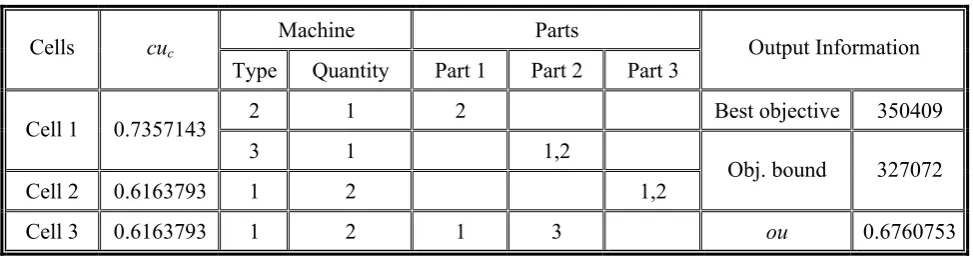
TABLE 3. Solution of the First test Problem Considering Only the First Objective Function.
Machine Parts Cells cuc
Type Quantity Part 1 Part 2 Part 3 Output Information
2 1 2 Best objective 350409
Cell 1 0.7357143
3 1 1,2
Cell 2 0.6163793 1 2 1,2 Obj. bound 327072
Cell 3 0.6163793 1 2 1 3 ou 0.6760753
amount of time for real-world instances. Because of its nonlinear and NP-hard nature for this reason, the software run time is limited to half hour (i.e. 1800 seconds).
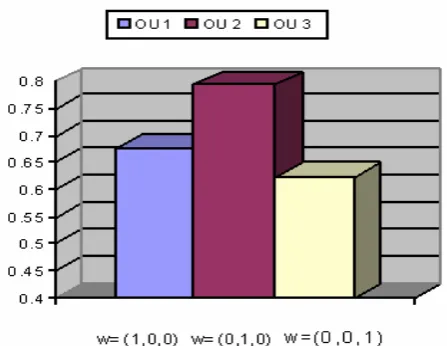
The first example considers M = 4, P = 3, and C = 3 to produce parts that must be processed under 2 through 3 operations. This instance considers that only one function is optimized in each time (related weighting value is 1), that are illustrated in Tables 3 to 5, respectively (i.e., Table 2 shows the solution of instance 1 while w1 = 1, w2 = 0 and w3 = 0 and the
like). Data required for this example is based on Table 2. As shown in Tables 3 to 5, data include the machine type, quantity of required machine type, machine grouping, utilization of each cell, overall utilization, objective function, objective function bound obtained according to LINGO
documentation and operations of each part must be done in per cell.
Table 3 illustrates part 2 is processed in cell 1 and cell 2, in which first two operations are done in cell 1 and the last one is done in cell 3.
TABLE 4. Solution of the First Test Problem Considering Only the Second Objective Function.
Machine Parts Cells cuc
Type Quantity Part 1 Part 2 Part 3 Output Information
Cell 1 0.9736842 2 2 2 1,3 Best Objective 20685.3
1 1 1 Obj. Bound 20685.3
Cell 2 0.6833333
4 1 2 Gap % 0 %
1 1 1 Cell 3 0.6762295
3 1 2 ou 0.7931472
TABLE 5. Solution of the First Test Problem Considering Only the Third Objective Function.
Machine Parts Cells cuc
Type Quantity Part 1 Part 2 Part 3 Output Information 2 1 1
Cell 1 0.6231884
4 1 1 Best Objective 274.909
1 2 1,2 Cell 2 0.6223958
2 1 2 Obj. Bound 0
1 1 3 Cell 3 0.625
4 1 2 ou 0.6233333
The second example is a small-sized problem considering M = 4, P = 3, and C = 3 to produce parts, in which each product must be processed under 3 operations and some operations can be done on 2 alternative machines with different processing times. Moreover, all relative weights for each objective function have the same importance and are equal to 1. In fact, this problem is solved as integrated form with the presence of all objectives. Table 6 shows the input data required for instance 2. Table 7 illustrates solutions of the second example.
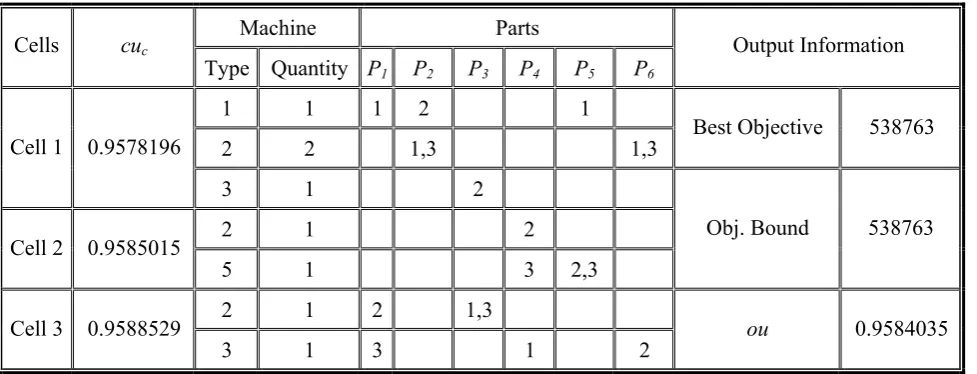
The third example is a medium-sized problem considering M = 5, P = 6, and C = 3 to produce parts, in which each product must be processed under three operations and some operations can be done on two alternative machines with different
processing times. The whole data set is based on Table 8. In this example, the global optimal solution has been reached and the objective function is equal to 538763 that is the same as the objective bound. Table 9 shows the related results and values.
6. CONCLUSION
Figure 2. Utilization of each cell with regards to the presence of each objective function value.
Figure 3. Overall utilization of machinery with regards to the
presence of each objective function value.
function. The main advantages of our proposed model are to form part families and machine cells simultaneously, and to determine the best processing route for each part type.
This model also considers the alternative routing, alternative process plan, operation sequence, machine duplication, inter-cell material handling into batches. We have solved an example and verified that the approach can determine the optimal cellular configuration for planning horizon. The proposed model cannot be solved within a
reasonable time even for small-sized problems, due to the NP-completeness of the model; thus, the use of meta-heuristics for solving such a hard problem, and to obtain solutions that are more efficient and also is suggested for future research.
7. ACKNOWLEDGEMENT
This study was supported partially by the University of Tehran under the research grant No. 8106043/1/08. The first author is grateful for this financial support.
8. REFERENCES
1. Wemmerlov, U. and Johnson, D. J., “Cellular Manufacturing at 46 user Plants: Implementation Experiences and Performance Improvements”,
International Journal of Production Research, Vol.
35, (1997), 29-49.
2. Kusiak A., “The Generalized Group Technology Concept”, International Journal of Production
Research, Vol. 25, (1987), 561-569.
3. Kusiak, A., “The Generalized Group Technology Concept”, International Journal of Production
Research, Vol. 20, No. 2, (1987), 117-133.
4. Adil, G. K., Rajamani, D. and Strong, D., “Cell Formation Considering Alternate Routings”,
International Journal of Production Research, Vol.
34, No. 5, (1996), 1361-1380.
5. Tavakkoli-Moghaddam, R., Aryanezhad, M. B., Safaei, N. and Azaron, A., “Solving a Dynamic Cell Formation Problem using Metaheuristics”, Applied
Mathematics and Computations, Vol. 170, No. 2,
(2005a), 761-780.
6. Chen, M., “A Mathematical Programming Model for Systems Reconfiguration in a dynamic Cell Formation Condition”, Annals of Operations Research, Vol. 77,
No. 1, (1998), 109-128.
7. Caux, C., Bruniaux, R. and Pierreval, H., “Cell Formation with Alternative Process Plans and Machine Capacity Constraints: A New Combined Approach”,
International Journal of Production Economic, Vol.
64, (2000), 279-284.
8. Hwang, H. and Ree, P., “Routes Selection for the Cell Formation Problem with Alternative Part Process Plans”, Computers and Industrial Engineering, Vol.
30, No. 3, (1996), 423-431.
9. Sofianopoulou, S. “Manufacturing Cells Design with Alternative Process Plans and/or Replicate Machines”,
International Journal of Production Research, Vol.
37, No. 3, (1999), 707-720.
TABLE 6. Input Data for the Second Test Problem.
UB 10 Dp 240 280 290
LB 2 γp 32 28 30
Cell Info.
C 3
Part Info.
BP 14 15 12
Machine info. p1 p2 p3
βm αm Mm Tm
tjpm
j1 j2 j3 j1 j2 j3 j1 j2 j3
6 20000 210 2800 m1 7 9 5 7 6 7
5 18000 360 3400 m2 6 8 10 10
5 22000 340 2900 m3 5 6 9 6
6 19000 290 3300 m4 8 8 8 7
TABLE 7. Solution of the Second Test Problem Considering Same Importance (i.e., one) for Each Objective Function.
Machine Parts Cells cuc
Type Quantity Part 1 Part 2 Part 3 Output Information
2 1 Best Objective 397614
Cell 1 0.7108955
4 1 3
1 1 2,3 2 Cell 2 0.8787640
4 1 1
Obj. Bound 396614
1 1 1 Cell 3 0.8 213
3 1 2 1 3 ou 0.835436
International Journal of Advanced Manufacturing
Technology, Vol. 32, (2007), 531-536.
11. Askin, R., Selim, H. and Vakharia, A., “A Methodology for Designing Flexible Cellular Manufacturing Systems”,
IIEE Transactions, Vol. 29, No. 7, (1997), 599-610.
12. Kim, C. O., Baek J. G. and Baek J. K., “A Two-Phase Heuristic Algorithm for Cell Formation Problems Considering Alternative Part Routes and Machine Sequences”, International Journal of Production
Research, Vol. 42, No. 18, (2004), 3911-3927.
13. Tavakkoli-Moghaddam, R., Minaeian, S. and Rabbani, S., “A New Multi-Objective Model for Dynamic Cell Formation Problem with Fuzzy Parameters”,
International Journal of Engineering-Transactions A.
Basic, Vol. 21, No.2, (2008), 1-14.
14. Shafer, S. M. and Rogers, D. F., “A Goal Programming Approach to the Cell Formation Problem”, Journal of
Operations Management, Vol.10, (1991), 28-43.
15. Venugopal, V. and Narendran, T. T., “A Genetic Algorithm Approach to the Machine-Component Grouping Problem with Multiple Objectives”,
Computers and Industrial Engineering, Vol. 22,
(1992), 469-480.
16. Mansouri, S. A., Moattar-Husseini, S. H. and Zegordi, S. H., “A Genetic Algorithm for Multiple Objective Dealing with Exceptional Elements in Cellular Manufacturing”, Production Planning and Control,
Vol. 14, No. 5, (2003), 437-446.
17. Yasuda, K., Hu, L. and Yin, Y., “A Grouping Genetic Algorithm for the multi-Objective Cell Formation Problem”, International Journal of Production
Research, Vol. 43, No. 4, (2005), 829-853.
18. Liang, M. and Taboun, S. M., “Converting Functional Manufacturing Systems into focused Machine Cells-a Bi-Criterion Approach”, International Journal of
TABLE 8. Input Data for the Second Test Problem.
UB 10 Dp 250 275 310 220 290 320
LB 2 γp 25 32 37 31 29 28
Cell Info.
C 3 Part Info. BP 12 15 14 16 12 19
Machine Info. P1 P2 P3 P4 P5 P6
βm αm Mm Tm
tjpm
j1 j2 j3 j1 j2 j3 j1 j2 j3 j1 j2 j3 j1 j2 j3 j1 j2 j3
6 20000 220 2200 m1 6 8 4 7 5 9 4 9
5 18000 400 3600 m2 4 7 5 8 7 7 8 8 7
5 22000 350 3200 m3 7 9 8 3 6 8 4
6 19000 390 3300 m4 8 8 9 8 8
4 21000 370 3500 m5 5 9 9 3 9 9 8
TABLE 9. Solution of the Second Third Test Problem Considering Same Importance (i.e., one) for Each Objective Function.
Machine Parts Cells cuc
Type Quantity P1 P2 P3 P4 P5 P6
Output Information
1 1 1 2 1
2 2 1,3 1,3 Best Objective 538763
Cell 1 0.9578196
3 1 2
2 1 2
Cell 2 0.9585015
5 1 3 2,3
Obj. Bound 538763
2 1 2 1,3
Cell 3 0.9588529
3 1 3 1 2 ou 0.9584035
19. Mansouri, S. A., Moattar-Husseini, S. M. and Newman, S. T., “A Review of the Modern Approaches to Multi-Criteria Cell Design”, International Journal of
Production Research, Vol. 38, No. 5, (2000),
1201-1218.
20. Logendran, R., “Effect of the Identification of Key Machines in the Cell Formation Problem of Cellular Manufacturing Systems”, Computers and Industrial
Engineering, Vol. 20, No. 4, (1990), 439-449.
21. Collette, Y. and Siarry, P., “Multi-Objective Optimization: Principles and Case Studies”, Springer, (2003).
22. Aramoon Bajestani, M., Rabbani, M., Rahimi-Vahed, A. R. and Baharian Khoshkhou, G., “A Multi-Objective
Scatter Search for a Dynamic Cell Formation Problem”,
Computers and Industrial Engineering, Doi: 10.1016/j.
Cor.2007.10.026, To Appear In (2008).
23. Mungwatanna A., “Design of Cellular Manufacturing Systems for Dynamic and Uncertain Production Requirement with Presence of Routing Flexibility, Ph.D. Thesis, Blacksburg State University Virginia, Virginia, U.S.A., (2000).
24. Vin, E., Lit, P. and Delchambre, A., “A Multiple-Objective Grouping Genetic Algorithm for the Cell Formation Problem with Alternative Routings”, Journal
of Intelligent Manufacturing, Vol. 16, (2005),