TECHNICAL NOTE
CHARACTERIZATION OF CONSTRAINED AGED NiTi STRIPS
FOR USING IN ARTIFICIAL MUSCLE ACTUATORS
N. Hassanzadeh Nemati
Department of Biomedical Engineering, Science and Research Branch Islamic Azad University, P.O. Box 14767-66981, Tehran, Iran, Tel. +9821-44474326, Fax: +9821-44474319
[email protected] S.K. Sadrnezhaad*
Center of Excellence for Production of Advanced Materials, Department of Materials Science and Engineering Sharif University of Technology, P.O. Box 11365-9466, Tehran, Iran
[email protected] *Corresponding Author
(Received: November 22, 2009 – Accepted in Revised Form: October 20, 2011)
doi: 10.5829/idosi.ije.2011.24.04a.01
Abstract Marvelous bending/straightening effects of two-way shape memory alloy (TWSMA) help their employment in design and manufacturing of new medical appliances. Constrained ageing with bending load scheme can induce two-way shape memory effect (TWSME). Scanning electron microscopic (SEM) analysis, electrical resistivity measurement (ERM) and differential scanning calorimetry (DSC) are employed to determine the property change due to flat strip constrained aging. Results show that flat-annealing prior to the aging shifts NiTi transformations temperatures to higher values. Superelastic behavior of the as-received/flat-annealed/aged samples with more adequate transition temperatures due to biological tissue replacement is studied by three-point flexural tests. Results show that curing changes the transition points of the NiTi strips. These changes affect the shape memory behavior of the NiTi strips embedded within the biocompatible flexible composite segments.
Keywords Annealing, Constrained ageing, TWSME, Artificial muscles
1. INTRODUCTION
Three decades has past from the NiTi shape memory alloy (SMA) industrial/scientific introduction as an attractive smart functional material [1]. Exhibition of shape memory behavior (SME) [2], superelastic (SE) effect [3], corrosion resistance [4] and biocompatibility [5] attract many
medical applications [6-11].
SME is a reversible thermoelastic behavior that transforms monoclinic martensitic phase into BCC (CsCl-like) austenitic phase [12]. In some special situations of heat treatment processes and the alloy compositions, existence of an intermediate phase (R-phase) with a trigonal structure is not inevitable [12-14].
.ﺩﺮﻴﮔﺭﺍﺮﻗﻪﺟﻮﺗﺩﺭﻮﻣﺭﺎﮔﺯﺎﺳﺖﺴﻳﺯﻒﻄﻌﻨﻣﻲﺘﻳﺯﻮﭙﻣﺎﻛﺕﺎﻌﻄﻗ
ﺭﺩﻁﺎـﺤﻣNiTi ﻱﺎـﻫﺭﺍﻮﻧﺭﺎـﺘﻓﺭﺡﻼـﺻﺍﻱﺍﺮﺑﺪﻧﺍﻮﺗﻲﻣﺕﺍﺮﻴﻴﻐﺗﻦیﺍ .ﺩﻮﺷﻲﻣﺮﺗﺐﺳﺎﻨﻣﻲﻜﻳﮊﻮﻟﻮﻴﺑﻱﺎﻫﺖﻓﺎﺑ
ﻱﺎﻫﻦﻳﺰﮕﻳﺎﺟﻱﺍﺮﺑﺖﺨﭘﺪﻨﻳﺁﺮﻓﺮﻴﺛﺎﺗﺖﺤﺗﮊﺎﻴﻟﺁﺖﻟﺎﺣ ﺮﻴﻴﻐﺗﻱﺎﻫﺎﻣﺩﻦﻴﻨﭽﻤﻫ .ﺪﻫﺩﺶﻳﺍﺰﻓﺍﺍﺭﻪﻟﺎﺤﺘﺳﺍﻱﺎﻫﺎﻣﺩ
ﺪـﻧﺍﻮﺗﻲـﻣ ﻱﺮـﻴﭘﺪﻨﻳﺁﺮﻓﺯﺍﻞﺒﻗﻭﺮﻴﻧﺖﺤﺗﻥﺩﺮﻛﻞﻴﻧﺁﻪﻛﺩﺍﺩﻥﺎﺸﻧﺞﻳﺎﺘﻧ .ﺪﺷﻩﺪﻴﺠﻨﺳﻱﺍﻪﻄﻘﻧﻪﺳﺶﻤﺧﻥﻮﻣﺯﺁ
ﺮـﺑﺩﺭﻮـﻣﺶﻨNiTiـﺗ ﺮـﺛﺍ ﻱﺎـﻫﺭﺍﻮﻧﺮـﺿﺎﺣﺶﻫﻭﮋـﭘﺭﺩﺪـﻧﺍﻮﺗﻲـﻣﺭﺩ .ﺪﻳﺎﻤﻧﻪﻛﺖﺳﺍﺩﺎﺠﻳﺍﻱﺪﻨﻳﺁﺮﻓﻪﻓﺮﻃﻭﺩﻭﺮﻴﻧﻱﺭﺍﺩﻪﻈﻓﺎﺣﺖﺤﺗﻱﺮﻴﭘﺮﺛﺍ .ﻲﻋﻮﻨﺼﻣﺖﺳﺍﻪﺘﺧﺎﺳﻪﭽﻴﻫﺎﻣﺪﻋﺎﺴﻣﻱﺎﻫﻪﻧﻮﻤﻧﻲﻜﺷﺰﭘﺭﺩﺕﻻﺁﺭﺍﺰﺑﺍﻩﺩﺎﻔﺘﺳﺍ
ﺖﺧﺎـﺳﻭﻲـﺣﺍﺮﻃﻱﺍﺮـﺑﺍﺭﻥﺁﺩﺮﺑﺭﺎـﻛﻪﻓﺮﻃﻭﺩﻱﺭﺍﺩﻪﻈﻓﺎﺣﺎﺑﮊﺎﻴﻟﺁﺰﻴﮕﻧﺍﺕﺮﻴﺣﻥﺪﺷﺖﺳﺍﺭﻭﻢﺧ
ﻩﺪﻴﻜﭼ
Another phenomenon related to a shape recovery by an unloading cycle at a particular temperature is known as pseudoelastic. This effect is of concern to a reversible microstructural deformation mechanism that generates a phase named stress induced martensite [15].
Using NiTi alloys in thermal actuators is one of their important applications [9]. The actuators have industrial [16] and also medical [10] uses. In order to manufacture smart and flexible composites, SMAs actuators are sometimes embedded into a different polymeric Matrix.
Compounding SME of NiTi strips with viscoelastic behavior of well known biocompatibility of silicone can lead to invention of a smart composite usable for manufacturing of artificial muscles [17]. In this application performing two-way SME (TWSME) in the metal strips is necessary. The effect occurrs through different thermomechanical treatments [16-20]. For example, Gyobu et al. [20] have suggested that TWSME occurred by constrained ageing. The recent technique was used for inducing the effect.
Most of TWSME induced medical devices that are topics of a number of articles function in bending [19], so the load scheme that was chosen in this present research was bending. Alloy compositions and the conditions of heat treatment are the key factors influencing this property [16].
In the present work, a constrained ageing after flat annealing under stress and stress-free conditions order to verify the effect of load in the annealing stage on transformation temperatures were investigated. SE behavior and SME of the sample with more suitable transition temperatures for using in medical implants also were investigated before embedding in a silicone matrix. Recently many articles have been published about some parameters affecting the functionality of NiTi-polymer smart composites, specially regarding the adhesion strength in the interface [21-27].However, little work has been reported on the effect of curing treatment on shape memory properties of the SMA compounds [17,28]. Therefore, SME of the suitable sample was studied after the curing treatment.
2. MATERIALS AND EXPERIMENTS
Investigations have been carried out on strips with
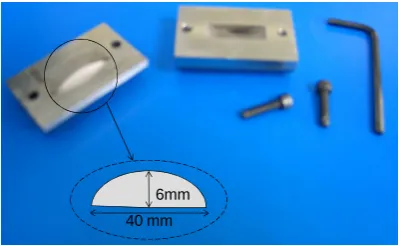
dimensions 40mm×2mm×0.77mm cut from flat oxide-free surface of superelastic NiTi purchased from Memory Metalle, Germany. Two sets of samples were studied: one (group 1) in a quartz glass tube under vacuum (10-6 torr), and another (group 2) under constrained form (held between two 1 centimeter thick steel plates which were screwed to each other tightly.). Both sets were solution annealed at 850 °C in an uncontrolled atmosphere furnace for 60 minutes, water quenched, and subsequently constrained aged at 450 °C for 480 minutes in a steel mould (Fig. 1). Local composition measurements were made by an EDS system (Rontec, Germany). Specimens for metallographic investigations were cut from the strips and ground on SiC-paper to a final mesh size of 1200 and polished. The samples were etched in a solution containing HF:HNO3:H2O= 1:4:5 for
study under scanning electron microscope (SE,
6mm 6mm
40 mm
Figure 1. Steel mold used for constrained aging
the specimens were washed out with the acid solution (4HNO3 + HF + 5H2O) before the test to
remove any residual surface oxide layer.
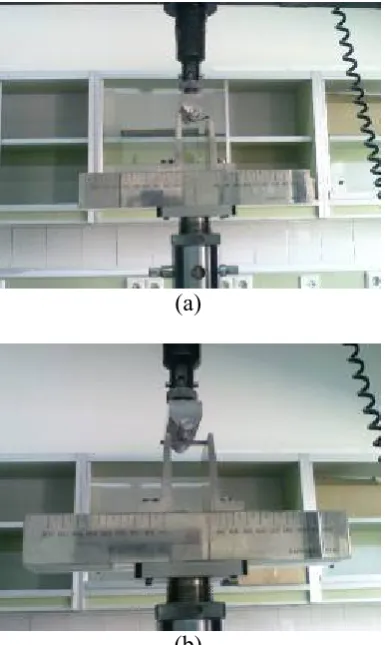
Three point flexural tests were performed at a deformation rate of 8 mm/min (Instron, model 6029 as shown in Fig. 2).
(a)
(b)
Figure
2. Three point flexural test during: (a)
loading and (b) unloading situation
Commercial Elastosil 401/60 supplied by Wacker, Germany, was employed as silicone matrix. This material was mixed with 0.7% Dicumyl peroxide (98%) as curing agent at 50 °C by polymix 200 (Schwabenthan, U.K.) in order to obtain a transparent uniform mixture. NiTi strips were embedded into a silicone blocks. The blocks were then pressed up to 150 bar at 170 °C for 20 minutes. The polymer embedding steel mold is shown in Fig. 3. The block was subsequently post cured at 200 °C for 240 minutes in a preheated
oven.
Pull-out tests were conducted with Gotech tensile testing machine(TCS2000, Taiwan) to evaluate the influence of shape memory behavior on adhesion strength of the alloy to the silicone matrix. A loading rate of 5 mm/min was used for all samples. Average of four measurements was attributed to each sample-strength data point.
Figure3. Block of silicone-embedding NiTi strips in the steel mold
.
3. RESULTS AND DISCUSSION
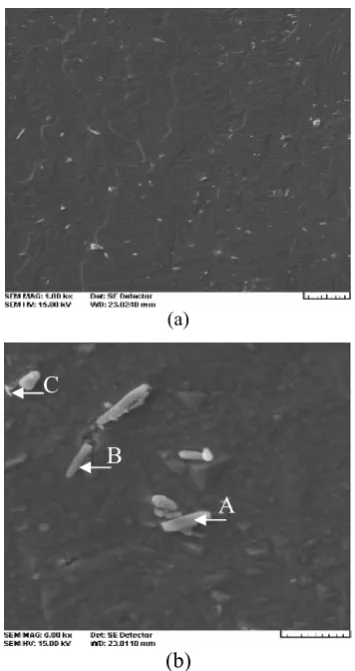
Fig. 4a shows the microstructure of the as-received alloy. It is completely in austenite phase form. The EDS quantitative analysis result of atomic composition of the alloy was Ti–49.53 at.% Ni. The alloy includes some precipitates with different shapes shown in Fig. 4b pointed out as A, B and C. EDS analysis shows that the precipitates are Ti and C-rich, which can be identified as titanium carbides. Presence of TiC particles in the alloy may be attributed to the reaction between the molten titanium and the graphite crucible [29] in the manufacturing process of the as-received NiTi alloy.
The strips were solution annealed at 850 °C for 60 minutes to memorize a flat shape which is recovered in the low temperatures (about 37 °C and lower). At lower annealing temperatures the shape memory effect is weak [30], so 850 °C was chosen as flat annealed temperature. Annealing provokes softening processes of the rolled as-received metal including stress relaxation and recrystallization of austenite and performs a simpler possibility for regulating the shape memory properties [19].
Silicone matrix
NiTi strips Steel
(a)
(b)
Figure4. SEM micrographs of the as-received alloy with magnifications: (a) 1000x and (b) 6000x.
Fig. 5 shows the BSD micrographs of solution treated specimen of group 1 (S) and aged specimens chosen from group 1 (A1) and 2 (A2) specimens. The microstructure of the specimen (S) is predominantly NiTi phase including some of the
metal precipitates. The result of the atomic composition from the EDS quantitative analysis in Fig. 4a was Ti–49.79 at. % Ni for the matrix and the precipitates are also identified as titanium carbide.
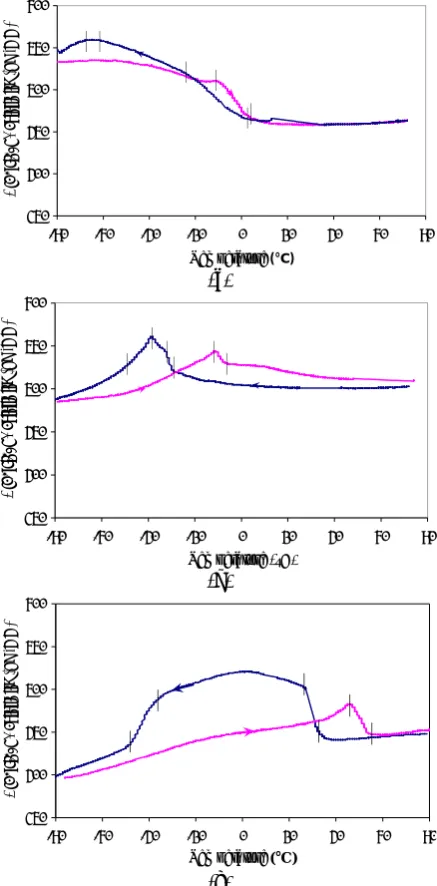
Fig. 6 shows the results of ER measurements for as-received alloy, specimens S and A1. The transformation temperatures achieved of ER curves are shown in Table 1. One can find that the austenite transformation temperatures of specimen S decrease comparing to as-received one (Fig. 6a and 6b). It may be due to different amounts of Ni in the samples. Increasing the amount of Ni in the matrix decreases the temperatures [30]. The transformation temperatures of the as-received alloy are also low because of carbon and oxygen impurities [31].
Specimens A1 and A2 are the specimens which were constrained aged in the steel mould. The heat treatment was done on strips to memorize a curve shape which is recovered in the high temperatures (higher than 37 °C). The constrained aging of the strips performed two way shape memory effect in them. The schematic of the effect of heat (in force free conditions) is shown in Fig. 7.
The results of EDS analysis of A1 show a reduction in Ni content of thematrix (about 2.87% reduction to S). Reduction of Ni contentmakes a sharp increase in its transformation temperatures (Fig. 6c and Table 1). Annealing under load with higher cooling rate in specimen A2 makes the precipitates smaller (Figs. 5b and 5c). Fig. 8 shows the result of DSC measurement for the A2 specimen and Table 1 reports its transformation temperatures.
(a) (b) (c)
Figure 5.BSD micrographs of: (a) S, (b) A1 and (c) A2 specimens
C
B
350 400 450 500 550 600
-80 -60 -40 -20 0 20 40 60 80
Temperature (°C)
E le ct ri ca l R es is tiv ity (μ Ω .m m ) (a) 350 400 450 500 550 600
-80 -60 -40 -20 0 20 40 60 80
Temperature (°C) E le ct ri ca l R es is tiv ity (μ Ω .m m ) (b) 350 400 450 500 550 600
-80 -60 -40 -20 0 20 40 60 80
Temperature (°C)
E le ct ri ca l R es is ti vi ty ( μΩ .m m ) (c)
Figure 6.Electrical resistivity vs. temperature curves of: (a) as-received, (b) S and (c) A1 strips
TABLE 1.Transformation temperatures of the as-received alloy, samples S, A1 and A2.
Strip Transition Temperatures (C)
As Af Rs Rf Ms Mf
As-received -10 3 1 -23 -61 -68
S -11 -6 -30 -32 -39 -49
S* -15 0 -20 -42 -47 -59
A1 47 55 37 27 -32 -48
A1* 25 47 38 27 -34 -48
A2 52 87 57 - - -35
*After curing treatment.
Figure 7.Schematic of TWSME
-0.3 -0.2 -0.1 0.0 0.1 0.2
-100 -80 -60 -40 -20 0 20 40 60 80 100
Temperature (°C) D S C ( m W /m g )
Figure 8. DSC curve of A2 alloy.
Aging at temperatures lower than 500°C often exhibits R-phase transformation before matensitic transformation, and the hysteresis is smaller than 10°C, and R-phase transformation is often used to realize the actuation function [32]. Larger precipitates because of higher dislocation density make the situation adjutant performing R-phase in lower temperatures [33] (A1 compared to A2). It is obvious that annealing under load before ageing makes the transition temperatures higher.
The starting and the finishing temperatures of R-phase and austenite phase transformations of specimen A1 are more suitable for medical applications, so the results of the following tests are reported about the as-received, S and A1 strips.
TABLE 2.Results of three flexural bending test.
Modulus (GPa) Stress at yield
(MPa) Load at yield
(N) Strain at
yield Displacement at yield
(mm) Strip
68.930 751.9
20.3 0.0159
3.402 As-received
75.000 741.6
32 0.0178
3.649 S
26.580 163.1
4.2 0.0215
4.823 A1
0 2 4 6 8 10 12 14 16 18 20 22
0 1 2 3 4 5 6 7
Displacement (mm)
L
o
a
d
(
N
)
as-recieved annealed
(a)
(b)
Figure 9. (a) Load vs. Displacement curves of as-received and the annealed (S) specimens and (b) stress vs. strain curve of a typical superelastic alloy with a perfect luder-type deformation during
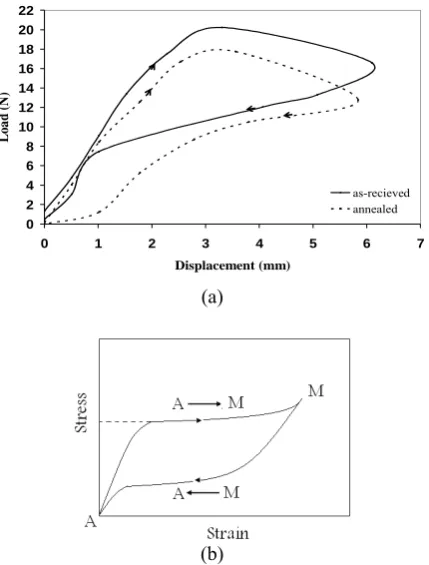
temperatures below the expected operating temperature. If the austenite phase is strained with an applied load, a martensite phase is stress – induced and the twinning process occurs as if the material has been cooled to its martensitic temperature. When the applied load is removed, the material inherently prefers the austenite phase at the operating temperature and its strain is instantly recovered [34]. Both samples, as-received and S alloys, showed complete pseudoelastic recovery after pre-deformation to about 2.87% in bending (6mm deflection of the center of the strip) at room temperature. Perfect Luder-type deformation during A↔M (such as it is shown in
Fig. 9b) transformation on both loading and unloading because of low strain did not occur. The critical stress for the forward and the reverse transformations were lowered after the free annealing treatment, whereas the pseudoelastic hysteresis appeared to remain unchanged.
At room temperature, the aged sample (A1) is in the R-phase state. Fig. 10 shows load-displacement curve of this sample. If the alloy is in the martensitic state at room temperature, force-displacement curves and similarly the ress curves, can be divided into four sections: (1) an initial elastic region; (2) a pseudoplastic region which is associated with untwining of a martensitic structure and coalescence of martensitic variants; the more extended pseudoplastic region, the higher is the useable shape memory effect; (3) an increase of stress due to the elastic straining of the untwined martensite; and finally (4) a region where the untwined martensite deforms plastically [35]. R-phase is like martensite R-phase, so curve shown in Fig. 10 has the same behavior.
0 1 2 3 4 5
0 1 2 3 4 5 6
Displacement (mm)
L
o
a
d
(
N
)
Figure 10.Load vs. Displacement curve of the aged sample (A1).
Comparing Figs. 9 and 10 shows that the critical stress decreases in aged sample. It is predominantly related to the increase of the transformation temperatures [36].
A1 after curing treatment and pulling out from polymeric matrix are shown in Fig. 11.
350 400 450 500 550 600
-80 -60 -40 -20 0 20 40 60 80
Temperature (°C)
E
le
ct
ri
ca
l
R
es
is
ti
vi
ty
(
μ
Ω
.m
m
)
(a)
350 400 450 500 550 600
-80 -60 -40 -20 0 20 40 60 80
Temperature (°C)
E
le
ct
ri
ca
l R
es
is
ti
vi
ty
(
μΩ
.m
m
)
(b)
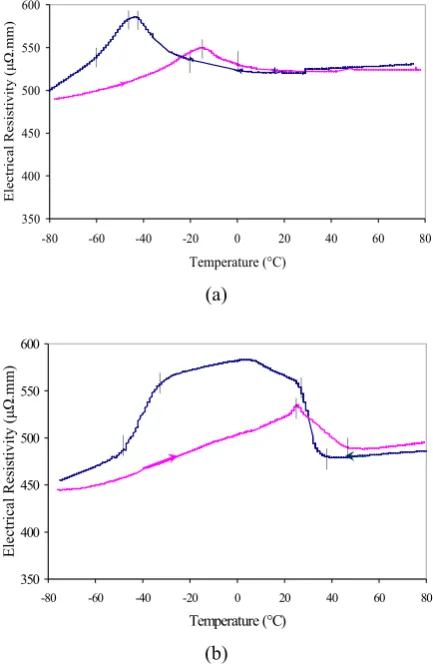
Figure 11. Electrical resistivity vs. temperature curves of: (a) S and (c) A1 strips after pulling out from polymeric matrix
One can find that the curing treatment changes the transformation temperatures of the strips by increasing Af during heating and decreasing Rf
during cooling about S alloy (Af and Rf are the
important temperatures in artificial muscles actuators). Two factors, heat and pressure, during the process make the changes. Alloy A1 began to bend for shape recovering during the curing treatment, because of increasing the temperature. But the imposed pressure from the matrix prevented from complete shape recovery. In such situations some stresses would be created. Due to the stress, the martensitic transformation is different from that in a free condition [37]. When polymeric matrix became cold the SMA strips became flat and some debonding took place along
the interface and also the transformation temperature decrease during cooling. Zheng and et al. (37) indicate that a pre-strain SMA alloy will transform the self accommodating martensite (SAM) into preferentially oriented martensite (POM). If the alloy is heated to about Af, the POM
cannot completely transforms into parent phase and during cooling the performed parent phase cannot transforms completely into POM either. So the bended strips remained in curved shape at room temperature and the pulling out force became larger than the flat form from 80.85 N to 51.64 N (comparing S and A1 strip pulling out force in typical load/elongation curve shown in Fig. 12).
Figure 12. Typical load–deflection curves of the NiTi strip types : (a) S & (b) A1. Points 1 represents the maximum adhesion force between the strips to the polymeric mat
4. CONCLUSIONS
Flat annealing under force before ageing made the existing precipitates in the alloy smaller. So, lower dislocation density made the situation adjutant performing R-phase in higher temperatures. The
1
other transition temperature also became higher and not suitable for artificial muscular actuators. Compounding NiTi strips with silicone matrix for using in artificial muscles changed their SME behavior because of curing treatment of the polymeric matrix. It increases the heat and decreases the chill needed for recovering the parent and R-phase shapes. According to above concepts, affection is needed.
Bent shape of strips increases the pulling-out force.
5. REFERENCES
1. Zhang, X. and Sehitoglu, H., "Crystallography of the B2-R-B19' phase transformation in NiTi", Materials
Science and Engineering A, Vol. 374, (2004), pp.
292-302.
2. Ucil, J., Baraz Ferdanandes, F.M. and Mahesh, K.K., "X-ray diffraction study of the phase transformation in NiTi shape memory alloy", Materials Characterization, Vol. 58, (2007), pp. 243-248.
3. Antonucci, V., Faiella, G., Giordano, M., Mennella, F. and Nicolais, L., "Electrical resistivity study and characterization during NiTi phase transformations",
Thermochimica Acta,Vol. 462, (2007), pp. 64-69.
4. Wang, J., Li, N., Han, E. and Ke, W., "Effect of PH, temperature and Cl- consentration on electrochemical
behavior of NiTi shape memory alloy in artificial saliva", Journal of Materials Science: Materials in
Medicin,Vol. 17, (2006), pp. 885-890.
5. Li, C. Y., Yang, X. J., Zhang, L. Y., Chen, M. F. and Cui, Z. D., "In vivo histological evaluation of bioactive NiTi alloy after two years implantation", Materials
Science and Engineering C,Vol. 27, (2007), pp.
122-126.
6. Iijima, M., Ohno, H., Kawashima, I., Endo, K. and Misoguchi, I., "Mechanical behavior at different temperatures and stresses for superelastic Nickel-Titanium orthodontic wires having different transformation temperatures", Dental Materials, Vol. 18, (2002),pp. 88-93.
7. Kugala, S., Ryhanen, J., Jamsa, T., Danilov, A., Saaranen, J., Pramila, A. and Tuukkanen, J., "Bone modeling controlled by a Ni-Ti shape memory alloy intramedullary nail", Biomaterials,Vol. 23, (2002), pp. 2535-2543.
8. Takashi, M., Toshiaki, M., Yushiyuki, W., Seiya, K., Youichi, H. and Masayoshi, E., "An active guide wire with shape memory alloy bending actuator fabricated by room temperature process", Sensors and Actuators A, Vol. 97-98, (2002), pp. 632-637.
9. Koray, K., George, G. and Adams, S., "Modeling and simulation of an artificial muscle and its application to biomimetic robot posture control", Robotics and
Autonomous Systems,Vol. 41, (2002), pp. 225–243.
10. Fu, Y., Du, H., Huang, W., Zhang, S. and Hu, M., "TiNi-based thin films in MEMs applications: a
review", Sensors and Actuators A, Vol. 112, (2004), pp. 395–408.
11. Nah, S.K. and Zhong, Z.W., "A microgripper using piezoelectric actuation for micro-object manipulation",
Sensors and Actuators A: Physical, Vol. 133, No.1,
(2007), pp. 218-224.
12. Uchil, J., Ganesh, K. and Mahesh, K., "Effect of thermal cycling on R-phase stability in a NiTi shape memory alloy", Materials Science and Engineering A,Vol. 322, (2002), pp. 23-28.
13. Fan, G., Zhou, Y., Cen, W., Yang, S., Ren, X. and Otsuka, K., "Precipitation of Ti3Ni4 in polycrystalline
Ni-rich TiNi alloys and its relation to abnormal multi-stage transformation behaviour", Materials Science and
Engineering A,Vol. 438-440, (2006), pp. 622-626.
14. Khalil-Allafi, J. W., Schmahl, W. M. and Toebbens, D., "Space group and crystal structure of the R-phase in binary NiTi shape memory alloys", Acta Materallia, Vol. 54, (2006), pp. 3171-3175.
15. Antonucci, V., Faiella, G., Giordano, M., Mennella, F. and Nicolais, L., "Electrical resistivity study and characterization during NiTi phase transformations",
Thermochimica Acta,Vol. 462, (2007), pp. 64-69.
16. Wang, Z. h., Xiaotao, Z., Xiangdong, F. and Jingyi, D., "Effect of Thermomechanical Treatment on the Two Way Shape Memory Effect of NiTi Alloy Spring",
Materials Letters,Vol. 54, (2002), pp. 55-61.
17. Sadrnezhaad, S.K., Hassanzadeh Nemati, N., Bagheri, R., "Improved Adhesion of NiTi Wire to Silicone Matrix for Smart Composite Medical Applications",
Materials and design, Vol. 30, No.9, (2009), pp.
3667-72.
18. Wada, K. and Liu, Y., "Thermomechanical training and shape recovery characteristics of NiTi alloys",
Materials Science and Engineering A, Vol. 481-482,
(2008), pp. 166-169.
19. Ryklina, E., Prokoshkin, S., Khmelevskaya, I. and Shakhmina, A., "One-way and Two-way Shape Memory Effect in Thermomechanically Treated TiNi-based Alloys", Materials Science and Engineering A, Vol. 481-482, (2008), pp. 134-137.
20. Gyobu, A., Kawamura, Y., Horikawa, H. and Suburi, T., "Martensitic Transformation and Two-way Shape Memory Effect of Sputter Deposited Ni-rich Ti-Ni Alloy Films", Materials Science and Engineering A, Vol. 273, (1999), pp. 749-753.
21. Zhang, R. X., Ni, Q. Q., Natsuki, T. and Iwamoto, M., "Mechanical properties of composites filled with SMA particles and short fibers", Journal of Composites
Structures,Vol. 79, (2007), pp. 90-6.
22. Smith, N. A., Antoun, G. G., Ellis, A. B. and Crone, W. C., "Improved adhesion between nickel-titanium shape memory alloy and a polymer matrix via silane coupling agents", Composites, Vol. A35, (2004), pp. 1307-1312. 23. Wetterhold, R. C. and Bos, J., "Ductile reinsforcements
for enhancing fracture resistance in composite materials", Journal of Thoretical Applied Fracture
Mechanic, Vol. 33, No2, (2000), pp. 330-333.
Structural Dynamics and Materials Conference, (1992), pp. 556–65.
25. Jonnalagada, K., Kline, G. E. and Sottos, N. R., "Local displacement and load transfer in shape memory alloy composites", EXP Mechanic,Vol. 37, No.1, (1997), pp.
78-85.
26. Payandeh, Y., Meraghni, F. and Eberhardt, A., "Effect of martensitic transformation on the debonding propagation in Ni–Ti shape memory wire composite",
Materials Science and Engineering A, (2009); In press.
27. Burke, M., Clarke, B., Rochev, Y., Gorelov, A. and Carroll, W., "Estimation of the strength of adhesion between a thermoresponsive polymer coating and nitinol wire", Journal of Materials Science: Materials
in Medicicn,Vol. 19, (2008), pp. 1971–1979.
28. Vokun, D., Sittner, P. and Stalmans. R., "Study of the effect of curing treatment in fabrication of SMA/polymer composites on deformational behavior of NiTi-5at% Cu SMA wires", Journal of Scripta
Materialia, Vol. 48, (2003), pp. 623-7.
29. Nayan, N., Govind Saikrishna, C.N., Venkata Ramaiah, K., Bhaumik, S.K., Suseelan, Nair K. and Mittal, M. C., "Vacuum induction melting of NiTi shape memory alloys in graphite crucible", Materials Science and
Engineering A,Vol. 465, (2007), pp. 44–48.
30. Mehrabi, K., Bahmanpour, H., Shokuhfar, A., Kneissi, A., "Influence of chemical composition and manufacturing conditions on properties of NiTi shape
memory alloys", Materials Science and Engineering A, Vol. 481-482, (2008), pp. 693-696.
31. Otubo, J., Rigo, O. D., Moura Neto , C. and Mei, P.R ., "The Effects of Vacuum Induction Melting and Electron Beam Melting Techniques on the Purity of NiTi Shape Memory Alloys", Materials Science and Engineering A,Vol. 438-440, (2006), pp. 679-682.
32. Yang, J. and Wu, Y., "Shape Memory Alloys and Its Application", Science and Technology University of China Press, 1993, 204.
33. Chrobak, D. and Stro´z, D., "Two-stage R phase transformation in a cold-rolled and annealed Ti–50.6 at.%Ni alloy", Scripta Materialia,Vol. 52, (2005), pp. 757–760.
34. Schwartz, M., New materials processes & methods technology, Taylor & Fransis press, USA, ISBN 0-8493-2053-4, (2006).
35. Johansen, K., Voggenreiter, H., Eggeler, G., Material
Science and Engineering: A, (1999), pp. 410–414.
36. Favier, D., Liu, Y., Org´eas, L., Sandel, A., Debove, L. and Comte-Gaz, P., "Influence of thermomechanical processing on the superelastic properties of a Ni-rich Nitinol shape memory alloy", Materials Science and
Engineering A, Vol. 429, (2006), pp. 130–136.
37. Zheng, Y., Schrooten, J., Cui, L. and Van Humbeeck, J., "Constrained thermoelastic martensitic transformation studied by modulated DSC", Acta Materialia,Vol. 51,