5001 REPORTS OF SELECTED INFECtIOUS DISEASES, NSW,
12 MONTHS TO MAY 1996, BY DATE OF ONSET (WITH AN HISTORICAL COMPARI5ON)
Arbovirus
Hepatitis A
22
Invasive
H.
Jnfiuenwe
10type b disease
Legionnaires'
disease
___________________Leptospirosis
June 95-May 95 -Mean June 92-May 95
000
MeasIe
Invasive
10meningococCal
disease
105
•
Pertussls
101)'.__•/
55
40fl
Q fever
200J
Rubella
160
Salmonellosis
J J A 5 0 II C J F 1) A U
iNFECTIOUS DISEASES
TRENDS
e arrival of winter was associated with a seasonal decrease in notifications for arboviruses (Figure 4), and a seasonal increase in respiratory pathogens. Influenza A and respiratory syrseytial virus (RSV) have begun to reappear, and there have been increased notifications of meningococcal disease. There were reports of nine cases of meningococcal disease with onsets in May 1996 (Figure 4), ansI another 12 so far in June. These cases appear to have been unrelated. Notifications of h.epatitis A and leptospirosis have continued at relatively high levels, but
reports of Haemophitus influenzae type b disease and
pertussis have been lower than usual for this time of year (Figure 4).
BRONcHI0LITI5
RSV was the agent chiefly responsible for a run of
bronchiolitis in infants in June 1996. A telephone survey of the two Sydney paedliatric hospitals and the paediatric unit in the Hunter revealed that more than 170 infants had been admitted with bronchiolitis in June. Laboratories at Liverpool, Prince of Wales and Westmead hospitals reported that RSV was the most commonly diagnosed respiratory virus, with more than 150 isolates hi June and 75 diagnoses in the first half of July.
Bronchiolitis is an acute respiratory disease of infants aged <2 years. It is characterised by a prodromal mild fever lasting 1-7 days, cough, wheeze, coryza, irritability, anorexia and respiratory distress (signified by increased respiratory and heart rates, refracted chest wall, nasal flaring and grunting). Dehydration may be a complication, resulting from vomiting, tachyprioea and anorexia. Patients are acutely ill for 3-4 days, and may take 1-2 weeks to recover completely'.
Most bronchiolitis cases are caused by RSV. Other causative agents include parainfluenza viruses, adenoviruses and rhinoviruses. Cases generally peak in winter and early spring (coincident with the peak of RSV infection), and more than 10 per cent of children aged <1 year and 5 per cent of children aged 1-2 years can be affected. Risk factors for illness include age 2-10 months, attendance at child care facilities, male sex, crowded living conditions, atopy and lack of breast feeding. Infants with underlying heart or lung disease, and premature and very young babies, are at greatest risk of severe disease'.
Infection leads to inflammation and necrosis of the bronchial and bronchiolar epithelium; sloughing can cause a ball-valve effect in the peripheral lungs. Diagnosis is supported by a chest radiograph showing hyper-inilation, and the causative virus can be isolated from respiratory secretions1.
Parents should be warned to monitor their affected infants closely for signs of deterioration, and encouraged to return for reassessment and possible admission if the child's condition deteriorates. Treatment is primarily supportive, with oxygen the mainstay of therapy. Aerosolised ribaviran (an antiviral drug) is thought to be helpful in severe eases, and bronchodilators may assist in overcoming coexisting bronchoconstriction'.
RSV can also cause serious infections, including bronchopneurnonia, in elderly and immunocompromised patients. It is primarily transmitted by direct contact or aerosolised droplets2, so transmission can easily occur
within households, or in children's and adult respiratory or geriatric wards. Symptomatic adults should avoid small children, and practise thorough handwashing after nose-blowing and before handling small children and others
at risk.
INFLUENZA
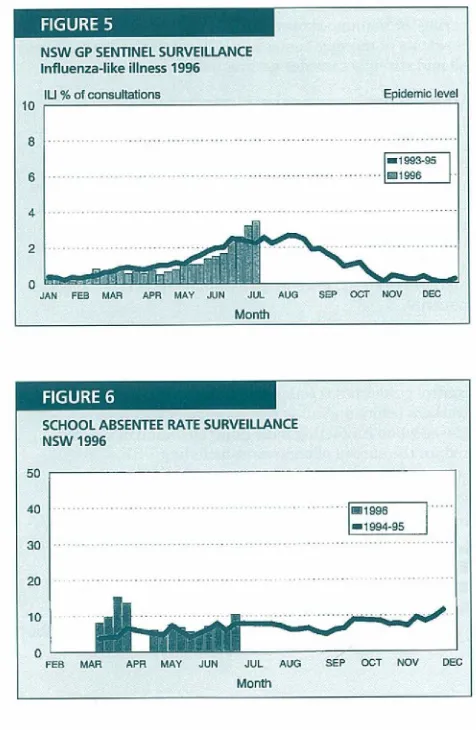
Influenza activity continued to increase up to the second week of July 1996, reaching levels slightly higher than the historical average for this time of year.
Reports of influenza-like ifiness (ILl) from the NSW Sentinel General Practitioner (GP) Survefflance Scheme are received through six Public Health Units (PHIJs) from more than 50 GPs carrying out about 7,000 consultations a week. Figure 5 shows that the average consultation rate for ILl in the first week of July was 3.5 per cent, slightly higher than the average for the previous few years. Western Sydney had the highest consultation rate at 4.5 per cent. The epidemic level (defined as 10 per cent) has not been reached since 1992. ILl activity actually decreased late in June or early in July in Western Sydney, Southern NSW and New England Areas.
School absentee rates are monitored through seven PH1Ts from 12 schools with a total of about 11,000 students. Figure 6 shows that the average absentee rate hi the second half of June was similar to the historical average for this time of year.
;Ict!fl1!
NSW GP SENTINEL SURVEILLANCE
I nfluenza-like illness 1996
IU % of consultations Ep5smio !evsl 10
8
- 55.55 6
AN FEB MAR APR GAY JUN JUL AUG SEP OCT NOV EEC
Month
SCHOOL ABSENTEE RATE SURVEILLANCE NSW 1996
30
20
0
FER MAR Ape MAY JN JUL AUG SEP OCT NOV DEC
I
I
Infectious diseases
Continued from page 79
Reports from the laboratories of Liverpool, Prince of Wales and Westmead hospitals indicate that, during the first two weeks of July 1996, diagnoses of influenza A continued to increase (10 serological, 25 virologicall diagnoses). There were no diagnoses of influenza B in that period.
New Zealand influenza epidemic
New Zealand is experiencing a large influenza A outbreak. At the end of June 1996 the numbers of both virus isolations and doctor consultations for influenza were three times the peak reached in 1995. The predominant strain detected so far this season in New Zealand and Australia has been iVWuhan/359!95 (H3N2), which is antigenically similar to this year's H3N2 vaccine component AlJohannesburg/33/94.
Historically, the peak influenza season has typically occurred in Australia about 4-6 weeks later than in New Zealand. Serologic studies of human sera indicate that the current Australian vaccine components will protect against the circulating viruses. The same vaccine is used in New Zealand and anecdotal reports from there suggest it has been protective. Therefore, people at high risk of severe disease, i.e. Aboriginal people and Torres Strait Islanders aged >50 years old and others aged >65 years old, adults with chronic debffitating diseases, children with cyanotic congenital heart disease, and people on immunosuppressive therapy who have not been imanunised this year should seek irnmuriisation as soon as possible. In addition, staff caring for immunocompromised patients, and staff and residents of nursing homes and other chronic care facilities should strongly consider getting irmnunised.
VANCOMYCIN-RESISTANT ENTEROCOCCI
In May 1996 four patients with vancomycin-resistant enterococci (VRE) were identified in NSW. Previously only one case - in a liver transplant recipient - had been reported in Australia3. Enterococci are common bacteria in the human gut. In recent years, resistance to vancomycin -an import-ant broad spectrum -antibiotic - has been increasingly reported overseas, associated with overuse of vancomycin in humans. Development of resistance leaves extremely limited antibiotic treatment options for infected patients.
VRE is spread via direct contact or indirectly via hands of health care workers or contaminated patient care equipment or environmental surfaces. NSW infection control guidelines recommend hand-washing by health care workers before and after any patient contact, and wearing gloves when contacting body fluid, including faeces, to reduce the spread of organisms including VRE. The United States Centers for Disease Control and Prevention (CDC) recommended the following measures in 1995 to prevent and control the spread of VRE4: • prudent use of vancomycin by clinicians; • education of hospital staff about VRE;
• surveillance of VRE by hospital laboratories; and • immediate implementation of infection control
measures to prevent person-to-person transmission of VRE.
Where VRE.4nfected patients are identified, the CDC recommends that:
• they should be placed in a single room, or in the same room as other infected or colonised patients; • persons entering that room should:
- wear gloves which should be changed when soiled; and
- wear a gown if substantial contact with the patient or environmental surfaces is anticipated, or if the patient is incontinent, has diarrhoea, or has an ileostomy, a colostomy or uncontaiiried wound drainage;
• persons leaving the room should: - first remove gloves and gown;
- wash hands immediately with an antiseptic soap or waterless antiseptic agent; and
- ensure that clothing and hands do not contact potentially contaminated surfaces;
• non-critical items (e.g. stethoscopes) should be dedicated to that room; and
• other patients who had been in the same ward as the patient should be screened for VRE.
Available evidence suggests that imtil local guidelines have been agreed upon, CDC recommendations should be followed in NSW.
In response to reports of VRE in NSW, the Chief Health Officer wrote to all Area Chief Executives in May 1996 requesting that active surveillance be undertaken and that laboratories report isolates of VRE to the NSW Health Department's AIDS/Infectious Diseases Branch. At the time of writing, no additional reports have been received. NSW surveillance data will be used to develop local prevention strategies, including the education of clinicians and other hospital staff regarding vancomycin use and infection control.
To reiterate, laboratories and hospitals are encouraged to notil)j any VRE cases to the NSW Health Department's AIDS/Infectious Diseases Branch (phone 02 9391 9192), either directly or through local Public Health Units.
HEPATITIS ADVISORY COMMflTEE
The Hepatitis Advisory Committee met on June 17, 1996. Issues discussed included:
a Blood Bank 'lookback', where people will be offered testing if they received blood after 1983 from donors later found to have hepatitis C;
a draft circular on hepatitis C-infected health care workers;
provision of limited ftmding to authorised public laboratories for supplemental hepatitis C testing; and
response to the National Health and Medical Research Coundll Draft Report on a Strategy for the Detection and Management of Hepatitis C
in Australia.
CIRCULARS
There have been many inquiries from private nursing homes about record-keeping and reminder systems for staff hepatitis B immunisation (NSW Health Department Circular 96/40 Hepatitis B and Health Care Workers). Methods of record-keeping were not specified in the circular.
Ms Helen Taylor, of the Department's AIDS! Infectious Diseases Branch, would be pleased to hear from any health facility which has developed an efficient and user-friendly record-keeping system which could be adopted by others (phone 02 9391 9408).
IMMUNISATION ADVERSE EVENTS CLINIC, NEW CHILDREN'S HOSPITAL, WESTMEAD
Margaret Burgess
Physician in Preventative Medicine Royal Alexandra Hospital for Children
The New Children's Hospital, Westmead, is introducing a clinic to which infants or children who have had a serious adverse event following an immunisation, or who have a signiflcunl medical condition, may be referred for evaluation ofthei ±i:unu;nsation schedule.
Children whom you may wish to refer to the Immunisation Adverse Events Clinic are likely to have one of the following:
. .
previous anaphylactoid reaction to a vaccine; encephalopathy after a vaccine;
condition requiring hospitalisation after vaccination; severe anaphylactoid reaction to egg (for
measles/mumps/rubella immunisation only); prolonged afebrile fit within 24 hours of vaccination; severe hypotonic hypo-responsive episode following vaccination; or
very severe local reaction.
Children with pre-existing medical conditions such as epilepsy or immunodeficiency are usually advised about immurilsation by their neurologist or immunologist. If children with similar conditions do not have subspecialists involved, this clinic can help with irnrnunisation advice.
The clinic is not for the immunisation equivalent of the "worried well". There is no evidence that parents who have doubts about the safety of immunisation benefit from attendance at an Adverse Events Clinic. The
Commonwealth Department of Health and Family Services produces two booklets which parents find very helpful.
These are entitled Understanding Childhood Immunisation,
and I,nmunisation Myth.s. The booklets may be obtained by faxing the National Childhood Immunisation Program Education Section on (06) 289 6838.
The Immunisation Adverse Events Clinic will be held every second Friday morning from September. Appointments may be made by phoning (02) 9845 2525. If indicated, and if the parents agree, the children will be vaccinated in the clinic.
1. Hall CS, Hall WJ. Bronchiolitis. In: Mandell GL, Benr.ett .IE, Dolin R (Eds). Principles and Practice of Infectious Diseases (4th Edition). Churchill Livingetone. New York: 1995.
2. Benenson AS (Ed). Control of Communicable Diseases Manual (16th Edition). American Public Health Association. Washington: 1995. 3. Heath CII, Blackmare TIC, Gordon DL. Emerging resistance in enterococcus spp. Med JAust 1996; 164:116-120.
4. Hospital Infection Control Practices Advisory Committee. Recommendations for preventing the spread of vancomycin resistance. In/ct Control Hosp Epidemiol 1995; 16:105-113.
PUBLIC HEALTH EDITORIAL STAFF
The editor of the NSW Public Health Bulletin is Dr Michael Frommer, Director, Centre for Research and Development, NSW Health Department. Dr Lyiine Madden is production manager.
The Bulletin aims to provide its readers with population health data and information to motivate effective public health
action. Articles, news and comments should he 1,000 words or less in length and include a summary of the key points to be made in the first paragraph. References should be set out using the Vancouver style, the full text of which can be found in Briti.sh
Medical Journal 1988; 296:401-5.
Please submit items in hard copy and on diskette, preferably using WordPerfect, to the editor, NSW Public Health Bulletin, Locked Mail Bag 961, North Sydney 2059. Facsimile (02) 9391 9029.
Please contact your local Public Health Unit to obtain copies of the NSW Public Health Bulletin. The Bulletin can be accessed via the Internet from the NSW Health Department's World Wide Website, at
http://www.health.nsw.gov.au/public-health!phb/phb.html
Back issues can be obtained from the Better Health Centre, Locked Mail Bag 961, North Sydney 2059. Telephone: (02) 9954 1193, Facsimile (02) 9955 5196.
-y1I*
INFECTIOUS DISEASE NOTIFICATIONS FOR NSW IN 1996. RECEIVED BY THE END OF JUNE
BY PUBLIC HEALTH UNIT, AND BY PERIOD OF ON5ET OR SPECIMEN DATE
Publ ic Health Unit Period
Total Total Condition CCA CSA ON ESA HUN ILL NC ND NSA SE SSA SW SWS WEN WN WSA to date for June
Blood-borne and sexually transmitted
AIDS 5 27 - 52 5 - 7 - 19 3 1 18 4 - 4 145 12
HIV infection Fromthis month H)V data will be reported b/-monthly
Hepatitis B - acute viral 1 - - 11 - - I - - - 1 2 - 2 2 20 2
HepatitisE-other 37 218 19 202 40 46 43 10 262 9 345 14 769 20 22 333 2,389 255*
Hepatitis C- acute viral 1 2 1 - - - 1 - - - 1 6
-Hepatitis C-other 164 377 134 437 276 239 344 102 311 100 231 85 540 175 46 367 3,878 382*
Hepatitis 0-unspecified - - - 1 2 - - - 3
Hepatitis, acute viral (Not) - - 1 1 - - - 1 3
Gonorrhoea 4 26 6 119 2 2 8 11 13 3 12 - 9 5 20 17 257 30
Syphilis 5 33 8 79 16 4 22 29 21 2 18 1 63 3 32 25 362 38
Vector-borne
Arboviral infection 8 3 20 5 69 10 374 254 14 15 4 90 7 1 182 6 1,062 41
Malaria 3 15 2 10 12 7 5 4 18 3 11 6 5 4 1 13 119 22
2oonoses
Brucellosis - - - 1 1
-Hydatid disease - 1 2 - 1 - 1 - - - - 1 1 - - 7
-Leptospirosis - - 1 - 5 - 7 4 - - - - 2 - - - 19 2
Qfever - 1 6 - 7 - 16 27 - 19 - 9 - - 56 - 143 28
Respiratory/Other
Legionnaires' disease 2 2 2 - 3 1 2 - 2 3 2 - 6 2 - 8 35 1
Meningococcal (invasive) infection 3 4 4 1 8 4 5 1 1 4 1 3 4 S 3 52 14
Leprosy - - - 1 - - - 1
-Tuberculosis 6 11 2 13 3 10 3 1 28 2 22 4 41 4 - 28 178 15
Mycobacteria other than TB 13 20 1 30 7 - 17 3 26 - 13 2 24 7 2 23 188 12
Vaccine-preventable
Adverse event after immunisation - - 2 1 - - 2 2 - 8 1 1 1 - 3 22 1
I-I. lnf/uenzae (invasive) infection - 1 2 1 - - - - 1 - 1 - - 2 8 1
Measles 1 3 5 4 2 9 7 4 1 3 7 5 12 4 7 17 91 8
Mumps - 1 - 1 2 - 1 - 5 - 1 1 1 - - - 13 1
Pertussis 4 13 5 20 55 23 54 21 38 18 13 38 19 8 5 51 385 32
Rubella - 40 1 1 3 9 2 3 1 3 7 - - 17 - 48 135 7
Faecal-oral
Cholera - - - 1 - - - 1 - - - 2
-Foodborne illness (NOS) 14 3 - 1 2 1 - 1 - - 2 2 4 - 10 - 40 2
Gastroenteritis (Instit) - 51 - - 48 - - 1 - - - - 1 8 5 29 143 64
HepatitiS A 16 75 19 154 12 92 14 8 35 10 28 4 25 5 9 35 541 59
Listeriosis - - - - 1 - - - - 1 1 - 2 - - - 5 1
Salmonellosis (Not) 31 18 10 34 45 24 76 39 67 10 55 30 79 17 27 44 607 42
Typhoid and Paratyphoid - 6 - 1 2 1 - - 1 - 1 - 7 - - 1 20 1
* includes acute
Abbreviations used in this Bulletin:
CSA Central Sydney Health Area, SSA Southern Sydney Health Area, ESA Eastern Sydney Health Area, SWS South Western Sydney Health Area, WSA Western Sydney Health Area, WEN Wentworth Health Area, NSA Northern Sydney Health Area, CCA Central Coast Health Area, ILL Illawarra Health Area, HUN Hunter Health Area, NC North Coast Public Health Unit,
ND Northern District Public Health Unit, WN Western New South Wales Public Health Unit, CW Central West Public Health Unit, SW South West Public Health Unit, SE South East Public
Health Unit, 0TH Interstate/Overseas, U/K Unknown, NOS Not Otherwise Stated.