Journal of Research & Health
Social Development & Health Promotion Research Center
Vol. 3, No. 1, 2013
Pages: 303-309
Original Article
1. PhD Candidate, Institute of Philosophy and Political-Law Researches, Azerbaijan National Academy of Sciences, Baku, Azerbaijan
2. Correspondence to: PhD Candidate, Department of Health Education & Promotion, School of Health, Isfahan University of edical Sciences, Isfahan, Iran
Tel/Fax:+98 311792661 Email: [email protected] 3. MSc, Department of Health Education & Promotion, Isfahan University of edical Sciences Isfahan, Iran
4. Associate Professor, Department of Psychiatry, School of Medicine, Isfahan University of Medical Sciences, Isfahan, Iran
5. MSc, Department of Psychology, Payam-e Noor University, Tehran, Iran.
Received: 17 Feb 2012 Accepted: 28 Dec 2012
How to cite this article: Abbasian F, Najimi A, Ghasemi Gh, Afshar H, Meftagh SD. The Effectiveness of the cognitive - behavioral strategies of stress management training on social adjustment of depressed women. J Research Health
2013; 3(1):303-309.
strategies of stress management training on social
adjustment of depressed women
Farahzad Abbasian1, Arash Najimi2, Gholamreza Ghasemi3, Hamid Afshar4, Sayyed Davood Meftagh5
Abstract
The present study aimed at determining the effectiveness of Stress management training using cognitive - behavioral strategies on social adjustment of depressed women. 40 Samples were selected from among patients with depression disorders referring to counseling centers and psychiatric clinics of Isfahan. Samples were randomly placed in two intervention and control groups 20 each. The intervention group received eight 90 minutes sessions of stress management training using cognitive-behavioral method. Both groups were asked to fill in cooper's stress and bell's adjustment Inventory Questionnaires both before the intervention and one month after. The data collected were analyzed using covariance analysis. Results indicated an equality of variance in stress and social adjustment variables. The intervention group Showed a significant difference between pre-test and post-test scores on stress and social adjustment levels (P<0.001). There also existed a Significance difference between post-test adjusted means of both groups regarding stress (F=12.45, P<0.001) and social adjustment (F=6.88, P=0.01). It is concluded that Stress management training using cognitive-behavioral strategies plays a major role in correcting social information processing patterns and consequently in the formation of social adjustment in the patients under study.
Keywords: Behavior, Depression, Social adjustment
Introduction
Adjustment and coordination with oneself and environment are essential for each living being. All daily efforts of human beings are
affected by adjustment. Each person
consciously or unconsciously tries to satisfy his own diverse and sometimes conflicting demands in the environment where he lives [1-3]. Adjustment, in a broader sense social
in other words, flow of adjustment is
disturbed, maladaptive behaviors or
behavioral disorders might occur. [5]
Stress, adjustment and coping are
interdependent concepts that influence daily life. Adjustment in psychology means maintaining individual identity and self– confidence. Stress, on the other hand, applies to such responses that suppress adjustment capacity. Finally, coping comprises adaptive strategies [6, 7]. By spreading stress over
society, psychological disorders like
depression affect many people and contain most of patients’ complaints. According to WHO, depression will be the leading cause of disability in the world by year 2020 [8]. Clinical researches confirm this claim; when depression is stabilized in an individual, some factors like weak social skills, extreme reaction to loss, and defective communication will be considered as preservatives factor. In this way, a depressed person feels to be more isolated, and stressful environmental stimuli will aggravate the situation [9].
Women suffer from depression twice as much as men. In fact, 10 or 25% of women experience acute depression during their life. Experts believe that women suffer from depression more than men because of various factors like hormonal changes [8].
Nowadays, there are lots of approaches
toward prevention, coping with and
controlling stress, one of the most effective approaches is cognitive-behavioral stress management that includes identifying the source of stress, changing the individual’s reaction to stress and finding some solutions to decrease stress [10]. Different studies have
shown that cognitive–behavioral stress
management, while decreasing depression in study population, can also play an important role in increasing social adjustment in depressed patients [11, 12].
Cognitive–behavioral approach is a mixture of cognitive and behavioral treatment. In this therapeutic approach, patient is helped to recognize his erroneous thought inefficient behaviors. To this end, regular discussion and
precisely organized behavior assignments are used. So in some aspects, cognitive approach is emphasized, and in other aspects, behavioral approach is emphasized [10]. Given the significant role of stress in adjustment process and also its connection to depression, we aimed to examine the effectiveness of educating stress management by cognitive behavioral method on social adjustment of depressed women.
Method
In this quasi-experimental study, 40
housewives suffering from depression were studied. Study population was selected by simple sampling from housewives who went to psychiatric and psychology clinics and centers in Isfahan, and were diagnosed with depression by a psychiatrist. Then they were assigned to the intervention or control group based on even and odd numbers of their record files. The sample size was determined as 18 people at type I error of 0.05, and type II error of 20%, but 20 people were selected for each group. The inclusion criteria were definite diagnosis of depression by a psychiatrist, no medication, age between 20 and 45 years old, being married, being a housewife, duration of illness less than 2 years and also signing the informed consent. Moreover, some cases who had Mental disabilities, missed more than one session or were not willing to continue were excluded. Data collection tool included: A) Social Adjustment Questionnaire to measure the adjustability level of each individual, Bell's
Adjustment Inventory was used. This
B) Cooper's Life Stress Inventory: This questionnaire has 29 items about stress symptoms that Cooper designed in 1983. Scoring was based on four-option Likert style (very much, much, a little, never) and each expression was assigned a score 1 to 4. Bagherian et al., according to Gharaat and Mashhadi, reported the reliability of this questionnaire as 0.94 by using correlational method as compared with General Health Questionnaire, and reported an acceptable
content validity through expert panel
comments [16].
Prior to pre-test, research objectives were presented to participants and their consent was obtained. After that, they were given the Social Adjustment Inventory and Cooper’s Stress Questionnaire, were instructed how to answer, and were asked to fill them out. Training intervention was performed in the intervention group. Information of both groups (intervention and control) was collected again after one month. Members of both groups, intervention and control, were connected to their psychologist and attended their individual consultation sessions. Stress management was taught in 8 sessions of 90 minutes for the intervention group. The objectives of these sessions include: Session 1. Introduction, definition of stress, its sources, symptoms and consequences; session
2. Cognitive reconstruction; session 3. Training communication skills; session 4. Training Self-expression skills; session 5. Training anger management skills; session 6. Training breathing techniques; session 7. Training relaxation techniques, and session 8. Training problem-solving skills and planning. At the beginning of each session, the subject of that session was written on board; contents and assignments of previous session were discussed briefly. Probable problems were resolved. Then, the subject of new session was taught. After answering participants’ questions, exercises were done, problems were solved, and assignments were given for next session. In this study, data were analyzed by SPSS 15 software. In order to analyze the
data, independent t test and covariance analysis were used. In this study, hypothesis zero was that variances of dependent variable are equal in both groups or their differences are zero in society. This hypothesis was examined by Leven test.
Results
The mean age of the participants was 36.82±7.67 years, that in the intervention group was 36.82±7.67 years, and in the control group was 37.41±9.48 years (P=0.19). Most women in this study had high school diploma (73%), while there was no significant differences between the two groups in regard to the level of education (P=0.51). According to t-test, there was no meaningful difference between the two groups with respect to severity of depression at the beginning of the study (P=0.27).
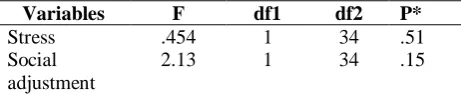
The hypothesis of equality of variances was investigated in order to analyze variances for comparing the results of the two groups and to control grades at the beginning of the study. Table 1 show that the hypothesis of variance equality regarding stress and adjustment variables is confirmed.
Table 1- Hypothesis of Equal Variances for Stress and Social Adjustment
P* df2 df1
F Variables
.51 34 1
.454 Stress
.15 34 1
2.13 Social
adjustment
*Results of Levin’s Test
The mean stress score of intervention and control groups in pre-test was 45.23±1.42 and 46.72±1.62, and in post-test was 35.47±1.78 and 44.69±1.77, respectively. Results showed a significant decrease in stress level of intervention group in post-test (P<0.001). After controlling the effect of initial
differences between pre-test scores,
difference or the influence of training stress management was 27%. Test power was 92%. In this experimental study, covariance analysis was used to determine significance of
differences in stress scores in post-test after controlling the effects of differences in pre-test (Table 2).
Table 2- Results of Covariance Analysis in Stress Scores in Post Test
Power η2
P-value F
Adjusted Mean difference df
Test
1.00 0.53
<0.001 37.29
1971.89 1
Pre
0.92 0.27
<0.001 12.45
658.67 1
Post
η2: Percentage of variability
The mean scores of social adjustment in intervention and control groups in pre-test are 89.53±1.98 and 88.31±2.05 and the results of post-test are 97.27±1.85 and 90.27±1.83. Table 3 shows the significant decrease in
mean scores of post-test regarding
intervention group’s depression (P<0.001).
The adjusted mean of social adjustment in post-test of intervention and control groups (group membership) showed a significant difference (P=0.01, F=6.88). Variance of total scores was 17% in post-test regarding the effect of training intervention. Power of the test was 72%.
Table 3- Results of covariance analysis in social adjustment scores in post test
Power η2
P-value F
Adjusted Mean difference df
Test
.990 371
. <0.001
19.44 1193.04
1 Pre
.721 173.
<0.01 6.88
422.26 1
Post
In this experimental study, covariance analysis was used to determine significance of differences in social adjustment scores in post-test after controlling the effects of differences in pre-test.
η2: Percentage of variability
Discussion
This study attempted to study the
improvement of adjustment of depressed women by training stress management using cognitive–behavioral method. According to the results, training stress management with cognitive-behavioral method decreases stress
in the intervention group. Moreover,
decreasing stress results shows an increase in social adjustment level. It seems that the structure of group sessions and using various cognitive-behavioral methods, each of which had its impact on decreasing stress, and also doing assignments at home and reviewing previous session’s subject at the beginning of each session can explain the decreasing stress in the intervention group. Resick et al. defines cognitive-behavioral methods as the most effective interventions in decreasing stress of women who suffered post-traumatic stress disorder with long time effect [17]. In line with this research, the effectiveness of cognitive-behavioral strategies is reported to
decrease stress and also to adjust its symptoms in other interventions [18-20]. The effect of stress and other negative life events has been considered as one of the determining factors in different studies. As Coplan et al. express in their studies,
behavioral problems and social
and compared them with similar couples who were waiting for treatment. The results show a reduction in intensity of symptoms and a simultaneous increase in adjustment by measuring patient’s spouse’s satisfaction [22]. Freedland et al. also introduced stress management by cognitive-behavioral method as an effective intervention in order to treat depression after surgery [23].
It seems that high social adjustment effects both directly on reductions of stress and indirectly on depression in women. These two aspects used in intervention can be explained by considering the role of cognitive and behavioral strategies. Cognitive-behavioral strategies primarily emphasize on intellectual
processes related to emotional and
psychological problems. Patients will be encouraged by helping them to change their thought of personal experiences and their behavior, and consequently it leads to a change in their feeling toward themselves. In addition, the use of cognitive strategies in stress management helps people change their belief about stress and also examine perspective of the stressful situation. These strategies help them change their irrational understanding and beliefs to more efficient ones to be able to deal with stress. Also, behavioral strategies which are learned and practiced can be used in real life situations. In addition to assignments in class, practicing assignments at home are also important because they are a kind of practice in dealing with problematic and challenging situations in everyday life which reinforces the efficacy of treatment. In addition, the impact of group meetings enables the person to get feedback from other team members, creates empathy, and sees how others cope with stressors. Many researchers believe that incorrect patterns of social information processing play an important role in the formation of incorrect social adjustment. Thus, by using a variety of interventional methods based on cognitive-behavioral strategies, they can solve these problems. Bell and Dezorilla investigated the
role of cognitive abilities on daily stress and coping [24]. While Brown et al. showed applying cognitive-behavioral method in stress management is an important factor in increased adjustment of patients with acquired immune deficiency syndrome [25].
In line with many studies, the present study shows that teaching strategies based on cognitive-behavioral was effective on social adjustment and mental health problems of patients [26-28]. Limitation in the choice of subjects, limited number of participants in the present study, lack of generalizability to males, lack of matching for economic factors in the two groups, failure to follow the patient and time limits are factors needing more caution in concluding the results.
Conclusion
According to the findings of the present study, stress management training based on cognitive-behavior not can only reduce stress in women with depression but also can improve their social adjustment.
Acknowledgement
This study, derived from a master dissertation in General Psychology, was approved in Islamic Azad University, Isfahan. We would like to thank all staffs of the university. Also, I would like to express my appreciation to all women participating in the present study. This study, derived from a master dissertation in General Psychology, was approved in Islamic Azad University, Isfahan. We would like to thank all staffs of the university. Also, I would like to express my appreciation to all women participating in the present study.
Contributions
Study design; Data collection and analysis: A F, G Gh, A H
Manuscript preparation: N A, M SD
Conflict of interest
References
1- McHale JP, Vinden PG, Bush L, Richer D,
Shaw D, Smith B. Patterns of personal and social
adjustment among sport-involved and
noninvolved urban middle-school children. Sociol
Sport J2005; 22(2): 119-136.
2- Estrada L, Dupoux E, Wolman C. The
relationship between locus of control and
personal-emotional adjustment and social
adjustment to college life in students with and without learning disabilities. Coll Student J2006; 40(1): 43-54.
3- Park CL. Making sense of the meaning
literature: An integrative review of meaning making and its effects on adjustment to stressful
life events. Psychol Bull2010; 136(2): 257-301.
4- Grunebaum MF, Galfalvy HC, Mortenson L,
et al. Attachment and social adjustment: Relationships to suicide attempt and major
depressive episode in a prospective study. J Affect
Disord2010; 123(1-3): 123-130.
5- American psychiatric association. diagnostic
and statistical manual of mental disorders. 4th ed, revised. Washington, DC: American psychiatric publishing; 2000.URL:
6- http://books.google.com/books/about/Diagno
stic_and_statistical_manual_of_men.html?id=3Sq rtpnhb9MC
7- Najimi A, Moazemi Goudarzi A, Sharifirad
GH. Causes of job stress in nurses: A
cross-sectional study. I J Nursing and Midwifery
Research2012; 17(4): 301-305. [In Persian]
8- Bolger N, Zuckerman A, Kessler RC.
Invisible support and adjustment to stress. J Pers Soc Psychol2000; 79(6): 953-961.
9- Hammen C. Stress and depression. Annu Rev
Clin Psychol2005; 1: 293–319.
10- Bhatia SC, Bhatia SK. Depression in women:
Diagnostic and treatment consideration. Am Fam
Physician1999; 60(1): 239-248.
11- Persons JB, Davidson J, Tompkins MA.
Essential components of cognitive-behavior
therapy for depression. Behav Cogn
Psychother2003; 31(1): 113-122.
12- Thorpe GL, Olson SL. Behavior therapy:
Concepts, procedures, and applications. needham heights: Allyn & Bacon Allyn & Bacon; 1997.
13- Antoni MH, Lehman JM, Klibourn KM, et
al. Cognitive-behavioral stress management
intervention decreases the prevalence of
depression and enhances benefit finding among women under treatment for early-stage breast
cancer. Health Psycho2001; 20(1): 20-32.
14- Warbah L, Sathiyaseelan M, VijayaKumar C,
et al. Psychological distress, personality, and
adjustment among nursing students. Nurse Educ
Today2007; 27(6): 597–601.
15- Hoseini S, Moghtader L. The effectiveness of
the approaches to coping with stress on social
adjustment. Thought and behavior in clinical
Psychology2010; 3(12): 66-73. [In Persian]
16- Azin A, Mousavi SM. The role of school
factors on social adjustment of high school
students in fereydunshahr city.Journal of applied
sociology2011; 22(1): 183-199. [In Persian]
17- Bagherian R, Pourkazem T, Nouri A, Adibi
P. The Effects of Stress Management Training on
Symptoms of Medical Treatment-Resistant
Functional Dyspepsia. Govaresh Journal2009;
14(1): 15-22. [In Persian]
18- Resick PA, Williams LF, Suvak MK,
Monson CM, Gradus JL. Long-term outcomes of cognitive-behavioral treatments for posttraumatic
stress disorder among female rape survivors. J
Consult Clin Psychol2012; 80(2): 201-210.
19- Kowalik J, Weller J, Venter J, Drachman D.
Cognitive behavioral therapy for the treatment of pediatric posttraumatic stress disorder: A review
and meta-analysis. J Behav Ther Exp
Psychiatry2011; 42(3): 405-413.
20- Dorrepaal E, Thomaes K, Smit JH, et al.
Stabilizing group treatment for complex
posttraumatic stress disorder related to child abuse
based on psychoeducation and cognitive
behavioural therapy: A multisite randomized
controlled trial. Psychother Psychosom2012;
81(4): 217-225.
21- Scheeringa MS, Weems CF, Cohen JA,
Amaya-Jackson L, Guthrie D. Trauma- focused cognitive-behavioral therapy for posttraumatic stress disorder in three- through six year-old children: A randomized clinical trial. J Child Psychol Psychiatry2011; 52(8): 853-860.
22- Coplan RJ, Bowker A, Cooper SM. Parenting
daily hassles, child temperament, and social adjustment in preschool. Early Child Res Q2003; 18(3): 376–395.
23- Monson CM, Fredman SJ, Macdonald A,
Pukay-Martin ND, Resick PA, Schnurr PP. Effect of cognitive-behavioral couple therapy for PTSDA randomized controlled trial
cognitive-behavioral couple therapy for PTSD. JAMA2012;
308(7): 700-709.
24- Freedland KE, Skala JA, Carney RM, et al.
bypass surgery: A randomized controlled trial.
Arch Gen Psychiatry2009; 66(4): 387-396.
25- Bell AC, D’Zurilla TJ. The influence of
social problem-solving ability on the relationship
between daily stress and adjustment. Cognit Ther
Res2009; 33(5): 439-448.
26- Brown JL, Vanable PA. Cognitive-
behavioral stress management interventions for persons living with HIV: A review and critique of
the literature. Ann Behav Med2008; 35(1): 26-40.
27- Grant S, Elliot R, Giger N, Bartoluci A.
Social problem solving abilities, social support,
and adjustment among family caregiver’s
individuals with a stroke. J rehabil psycho2001; 46(1): 44-57.
28- Teglasi H, Rottman L. Stories a
classroom-based program to reduce aggressive behavior. J
school psychol2001; 39: 71-49.
29- Harvey R, Fletcher J, French D. Social
reasoning: A source of influence on aggression.