*Corresponding author:GurjarM.M
ISSN: 0976-3031
Research Article
PYRETHROID-CYPERMETHRIN DEGRADATION USING SOIL MICRO FLORA AND
PARAMETER OPTIMIZATION FOR THE DEGRADATION
GurjarM.M
1and Hamde V.S
21
Department of Microbiology, Fergusson College, Pune-411004 (M.S.) India
2
Department of Microbiology, Yogeshwari Mahavidyalaya, Ambejogai-431517 (M.S.) India
DOI: http://dx.doi.org/10.24327/ijrsr.2018.0902.1618
ARTICLE INFO ABSTRACT
Pyrethroids are the botanical origin pesticides commonly used in agriculture for fruit and vegetable protection against various pests. Cypermethrin belongs to fourth generation of pyrethroids effective at very low concentration. Cypermethrin shows insecticidal activity by interfering with the nervous system functioning of insects. Generally Cypermethirin is applied in the form of sprays on the crops. Along with the beneficial effects of this pesticide, it also shows toxicity towards aquatic life, shows carcinogenic effects on human beings. So removal of the remaining amount of Cypermethrin is important and microorganisms are found to be important in removal of this pesticide from the soil. Present study focuses on removal of Cypermethrin from the soil by using microorganisms. For this the soil samples were obtained from different farms sprayed with cypermethrin for last few years. Microorganisms capable of utilizing pyrethroid insecticide -cypermethrin were isolated from this soil by enrichment method. These microorganisms were identified by morphological, biochemical characterization and 16srRNA sequencing.
The isolated microorganism P. aeruginosa showed capacity of growing in presence of 200mg/L
concentration of cypermethrin.Parameters such as pH, temperature and incubation time were optimized by single parameter at a time for cypermethrin degradation. The organism degraded cypermethrin as evidenced by isolation and identification of metabolite extracts by thin layer
chromatography. Thus, P.aeruginosa was found to be versatile in degradation of pyrethroid
-cypermethrin.
INTRODUCTION
India is an agro based country. But nowadays for industrialization and urbanization, maximum land is being used. Due to this there is reduction in the land surfaces available for plantation. But at the same time there is an increase in population and hence increase in demand for the quality and quantity of agricultural crops. In order to achieve this, farmers are making increased use of chemical and biological fertilizers. Also there is an increase in use of different pesticides to control the crop losses and to control the human diseases like malaria, dengue spread by mosquito bite. (Pandey and Singh, 2004)
Pesticides are used to control pests that are considered to be harmful. For example, they are used to kill mosquitoes that can transmit potentially deadly diseases like viruses, malarial parasites and number of other viral infections.(Miligiet al.,2006). In recent years use of cypermethrin has increased extensively due to restrictions or ban over highly toxic
organochlorine and organophosphate pesticides and it has become the dominant pesticide among retail sales to consumers. (Western et al, 2009). Cypermethrin [(+/-)-α-cyano-3-phenoxybenzyl (+/-)-cis, trans-3 (2, 2dichlorovinyl)-2, 2-dimethylcyclopropane carboxyl ate] is a synthetic pyrethroid pesticide, have uses in cotton, cereals, vegetables and fruit, for food storage, in public health and in animal husbandry. It is also used in home and garden pest control worldwide (Talluret al 2008; Lin et al.2011). It has been said that “no pesticide is perfect, but the pyrethroids come close”.
Recently cypermethrin is studied extensively due to its aquatic life toxicity as well as high risk to human health. (Zhang et al.,2011). Cypermethrin has been classified as a possible human carcinogen by US Environmental protection agency (EPA) of the USA (Zhang et al.,2010) and also it has neurotoxicity, (Wolansky and Harrill,2008), genotoxicity (Ansari et al.,2011). So, it is very necessary to develop an
Available Online at http://www.recentscientific.com
International Journal of
Recent Scientific
Research
International Journal of Recent Scientific Research
Vol. 9, Issue, 2(
G), pp. 24211-24216, February, 2018
Copyright © GurjarM.M and Hamde V.S, 2018, this is an open-access article distributed under the terms of the Creative Commons Attribution License, which permits unrestricted use, distribution and reproduction in any medium, provided the original work is properly cited.
DOI: 10.24327/IJRSR
CODEN: IJRSFP (USA)
Article History:
Received 20th November, 2017
Received in revised form 29th
December, 2017
Accepted 30th January, 2018
Published online 28th February, 2018
Key Words:
effective and rapid method for degradation and removal of cypermethrin from the environment.
Different methods like use of ozone for oxidation, photodegradation, incinerationetc. are available to remove cypermethrin from the environment. (Segal Rosenheimer and Dubowski, 2007;Xie et al.,2011). But these methods are found to be expensive and less effective.(Yang et al.,2011). Therefore microbial degradation is found to be the most significant method for removal of cypermethrin.(Fenlon et al.,2011).
However, to remove these chemicals from soil, biological treatment is used which involves transformation of these chemical compounds in to non-Hazardous form. (Saraswat and Gaur, 1995).References shows that different bacterial genera like Micrococcus, Klebsiella, Serratia etc. have capacity of cypermethrin degradation.(Grant et al., 2002).These organisms degrades the pesticides and uses them as sole carbon source for their energy metabolism (Baxter et al., 1975).It is also found that cypermethrin affects the soil flora as well as the ammonification and nitrification processes. (Rangaswamy and Venkateswarlu, 1993). The present study aims to isolate cypermethrin degrading organisms from the soil samples, identification of isolate by biochemical characterization and 16srRNA sequencing and optimization of parameters like PH, temperature, incubation time for cypermethrin degradation.
MATERIALS AND METHODS
Collection of soil sample
Soil samples were collected from different sites of Brinjal cultivated sites from Baramati, Theur and Manjari, Dist. Pune. These farm fields were sprayed with cypermethrin for past few years. Soil samples were taken from the top 0-15 cm of field plots collected in sterile polythene bags with the sterile scalpel. These soil samples were then brought to the laboratory and stored at room temperature for further study.
Chemicals used
Pesticide
The cypermethrin -25EC was purchased from local market shop from Hadapsar and Swargate, Pune M.S. India.
All other solvents and reagents were purchased from Hi media and Sigma Aldrich, USA.
Cypermethrin IUPAC Name:[(RS)-α-cyano-3-phenoxybenzyl
(1RS)-cis-trans-3-(2, 2-dichlorovinyl)-1,1-dimethyl-cyclopropanecarboxylate.]
Isolation of pesticide degrading microbes
Primary screening of isolates
Microorganisms capable of cypermethrin degradation were isolated by using the enrichment technique. For this the soil samples were inoculated into nutrient broth containing cypermetrhin at a concentration of 1mg/lit, 2 mg/lit and 3 mg/lit .Broth was incubated at room temperature. After every 24hrs, sample was taken from each broth and spread plated on nutrient agar medium supplemented with cypermethrin at same concentrations as 1mg/lit, 2 mg/lit, 3 mg/lit. Individual colonies were sub cultured on nutrient agar plates containing same concentration of cypermethrin until pure culture was obtained. Microorganisms capable of growing on nutrient agar medium
with different cypermethrin concentrations were selected for further study. These organisms were labeled as FCM1, FCM2; FCM3 etc. The isolated cultures were maintained at 40C and as glycerol stocks at -200C and sub cultured after every three months.
Secondary screening of isolates
Isolates obtained by primary screening were further used for secondary screening. Secondary screening was performed by checking growth of isolated organisms on minimal medium (K2HPO4-7g, KH2PO4-3g, MgSO4-0.1g, (NH4)2SO4-1g, 5mL Trace element solution) supplemented with cypermethrin. These isolates were maintained as stock cultures and working cultures were used for further study.
Checking tolerance of isolates to increased cypermethrin concentrations
Isolated organisms were grown in presence of minimal medium containing Cypermethrin as sole carbon source. These isolated organisms were checked for growth in presence of increased cypermethrin concentrations as 1mg/lit, 10mg/lit, 100mg/lit, 150mg/lit, 200mg/lit.
Morphological, Biochemical characterization and identification of isolated organism
The pure bacterial cultures obtained were identified using morphological, cultural and biochemical characteristics as described by Colins and Lyne (1985) up to the genus level. Initial identification was done by referring to Bergey’s manual of determinative bacteriology. Further the isolate was identified by 16srRNA sequencing from Agharkar research institute Pune, India.
Optimization of parameters for cypermethrin degradation:
Optimization of pH
For optimization of pH, minimal medium was used with cypermethrin at a concentration of 50mg/lit as a sole source of carbon. Different pH values selected were 5, 5.5, 6, 6.5, 7, 7.5, and 8. Isolated organism P. aeuruginosa was inoculated in100ml minimal medium broth with cypermethrin and different pH values. Incubation was done at room temperature on rotary shaker at 150rpm for 24 hrs. After incubation, absorbance was taken at 600nm and TVC was determined from each flask by spread plate technique.
Optimization of incubation temperature
For optimization of temperature, minimal medium was used with cypermethrin at a concentration of 50mg/lit as a sole source of carbon. Different temperature values selected were 200c, 250c, 300c, 350c, 400c. Isolated organism P.aeuruginosa was inoculated in100ml minimal medium broth with cypermethrin. Incubation was done at different temperatures on rotary shaker at 150 rpm for 24 hrs. After incubation, absorbance was taken at 600nm at different temperatures and TVC was determined from each flask by spread plate technique.
Optimization of incubation time
72hrs and 96 hrs. Absorbance was taken at 600nm each time interval and TVC/mL was determined by spread plate technique.
Growth kinetic studies for P. aeuruginosa
P. aeuruginosa was inoculated in minimal medium broth with different cypermethrin concentrations as 50mg/lit, 100mg/lit, 150mg/lit and 200mg/lit. Incubation was done at 300C for 48 hrs. Absorbance was determined for each cypermethrin concentration at 600nm.
Detection of cypermethrin degradation products
An isolated organism P.aeuruginosa was inoculated in 100ml minimal medium with cypermethrin. Incubation was done at 300C temperature on rotary shaker at 150rpm for 48 hrs. After incubation centrifugation was done at 10000 rpm for 10 minutes to separate pellet and supernatant. Then the supernatant was used for detection of metabolite of cypermethrin degradation by thin layer chromatography. The solvent system used was chloroform: acetic acid (95:5). Detector system used contain K3Fe (CN) 6 - 1% w/v & FeCl.6H2O -1%w/v.
RESULTS
Soil sample collection
Soil samples were collected from different sites of Brinjal cultivated sites from Baramati, TheurandManjari, Dist. Pune
Isolation of pesticide degrading microorganisms
1Primary screening of isolates
Microorganisms capable of cypermethrin degradation were isolated from different soil samples. 96 different isolates were obtained by soil enrichment technique and out of them ten cultures showing growth in presence of minimal medium are used for further study.
Fig 1 Growth of isolates on minimal agar plate
Secondary screening of isolates
Isolated organisms were screened by checking growth of the isolates on minimal medium containing cypermethrin as sole carbon source. Isolates were primarily labeled as FCM1, FCM2 and so on. Isolated organisms were primarily characterized by Gram staining and motility.
Table 1 Gram staining and motility characteristics of isolates
Isolate no. Gram character Motility
FCM1 Gram negative short rods Motile
FCM2 Gram positive cocci Non motile
FCM3 Gram negative rods Motile
FCM4 Gram positive cocci in
clusters
Non motile
FCM5 Gram positive roods Non motile
FCM45 Gram positive cocci Non motile
FCM46 Gram positive rods Non motile
FCM49 Gram positive cocci Non motile
FCM68 Gram negative rods Motile
Checking tolerance of isolates to increasing concentrations of cypermethrin
Table 2 Checking tolerance of isolates to increased concentration of cypermethrin
Isolate No. Cypermethrin concentration(mg/lit)
1 10 50 100 150 200
FCM1 + + + + + + - - -
FCM2 + + + + + + + + + - -
FCM3 + + + + + + + + - -
FCM4 + + + + + + + - - -
FCM5 + + + + + + + - - -
FCM45 + + + + + + + + - -
FCM46 + + + + + + + - -
FCM49 + + + + + + + - -
FCM68 + + + + + + + + + + + + + + +
FCM93 + + + + + + + + + + + + +
Key: + + + : Maximum turbidity + + : Less turbidity
+ : Minimum turbidity - : No turbidity
Morphological characterization of isolated organism
Fig 2 Gram staining photo of FCM68
Biochemical characterization
Table 3 Biochemical test characteristic for P.aeruginosa
Test Catalase Oxidase Gelatin
hydrolysis Nitrate reduction
Glucose
utilization OF test
Growth on cetrimide agar plate
Result Positive Positive Positive Positive Positive Positive Positive
Identification of isolate FCM 68 by 16SrRNA sequencing
Strain Designation
Closest Phylogenetic affiliation
Max ident
Accession number
FCM68 Pseudomonas aeruginosa 100%
MF423469
Identification report by 16SrRNA gene sequencing approach
Optimization of parameters for cypermethrin degradation
Optimization of pH
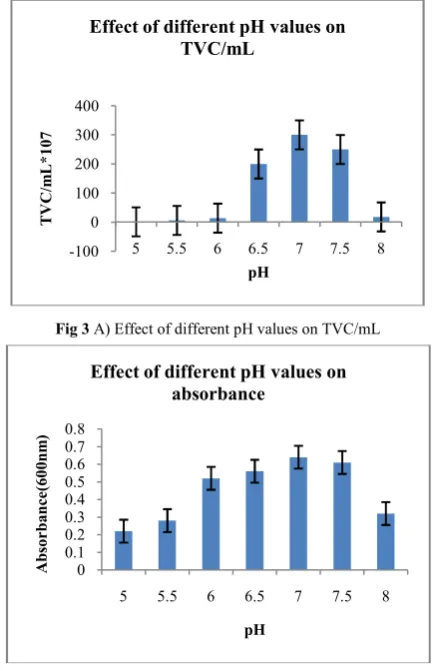
The P.aeruginosa showed maximum TVC/mL and Absorbance at 600nm at PH near 7±0.2 indicating organisms capacity of using cypermethrin as carbon source and thus showing its degradation.
Fig 3 A) Effect of different pH values on TVC/mL
Fig 3 B) Effect of different pH values on absorbance
Optimization of temperature
The isolated organism P. aeruginosa showed maximum TVC/mL and Absorbance at 600nm at 30OC of incubation temperature indicating organisms capacity of using cypermethrin as carbon source and thus showing its degradation.
Fig 4 A) Effect of different temperature values values on TVC/mL
Fig 4 B) Effect of different temperature absorbance
Optimization of incubation time
The isolated P. aeruginosa showed maximum pesticide degradation at 48 hrs of incubation time.
Fig 5 A) Effect of different incubation time on TVC/mL
Pseudomonas guangdongensis SgZ-6T/JX274436
Pseudomonas linyingensis LYBRD3-7T/HM246142
Pseudomonas resinovorans LMG 2274T/Z76668
Pseudomonas otitidis MCC10330T/AY953147
FCM68
Pseudomonas aeruginosa JCM 5962T/BAMA01000316
Pseudomonas alcaligenes NBRC 14159T/BATI01000076
Pseudomonas indica IMT37T/AF302795
Pseudomonas indoloxydans IPL-1T/DQ916277
Pseudomonas stutzeri ATCC 17588T/CP002881
Pseudomonas panipatensis Esp-1T/EF424401
Pseudomonas citronellolis DSM 50332T/Z76659
Pseudomonas delhiensis RLD-1T/DQ339153
Pseudomonas nitritireducens WZBFD3-5A2T/HM246143
Pseudomonas knack mussii B13T/HG322950
Pseudomonas nitroreducens DSM 14399T/AM088474
99 61
40
70 42
69
78
70
89 49 100 52
0.005
-100 0 100 200 300 400
5 5.5 6 6.5 7 7.5 8
TVC/m
L*
1
07
pH
Effect of different pH values on TVC/mL
0 0.1 0.2 0.3 0.4 0.5 0.6 0.7 0.8
5 5.5 6 6.5 7 7.5 8
Ab
sor
bance
(60
0n
m
)
pH
Effect of different pH values on absorbance
-100 0 100 200 300 400 500
20 25 30 35 40
TVC/m
L*
10
6
Temperatureo C
Effect of temperature on TVC/mL
0 0.1 0.2 0.3 0.4 0.5 0.6 0.7
20 25 30 35 40
Ab
sor
bance(6
0
0
nm
)
Temperatureo C
Effect of temperature on Absorbance
-400 -200 0 200 400 600 800 1000 1200
24 48 72 96
TVC/m
L*
10
7
Incubation time(hrs)
Fig 5 B) Effect of different incubation time on absorbance
Growth kinetic studies
Growthkinetic studies with P.aeruginosa showed increase in absorbance at 600nm as the cypermethrin concentration was increased. After 150mg/L concentration of cypermethrin, absorbance was decreased indicating that at higher cypermethrin concentration, growth rate was decreased not inhibited.
Detection of cypermethrin degradation products by Thin Layer Chromatography
Chromatographic properties
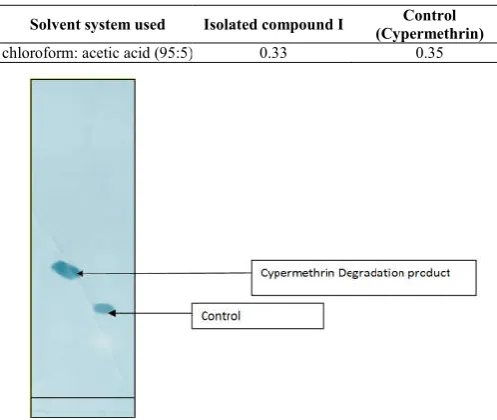
Rf values of metabolites of cypermethrin degradation by Pseudomonas aeruginosa are as Follows:
Fig 6 Thin layer chromatogram showing different spots for standard and
cypermethrin degradation product
DISCUSSION
In the present study microorganisms were isolated from soil samples sprayed with cypermethrin for last few years. These isolates were screened by checking ability to grow on minimal medium containing cypermethrin as sole carbon source. Growth of organisms was studied initially in presence of 1-3mg/lit of cypermethrin. Isolate no FCM68 showed maximum growth at higher cypermethrin concentration up to 200mg/lit and hence was studied further. On the basis of morphology, biochemical characteristics as per Bergey's manual of determinative Bacteriology 9th edition and 16srRNA, the isolated organism was identified as P. aeruginosa.
P. aeruginosa showed good growth at higher cypermethrn concentration as indicated by increasing absorbance at 600nm and increased TVC/mL. In 1992, similar observations were reported Lee et al. stating that the genus Pseudomonas which was Gram negative, rod shaped, highly oxidative and metabolically versatile and it shows ability to degrade aromatic hydrocarbons and pesticides up to 100mg/lit concentration. It was seen from the present study that at higher concentration of cypermethrin that is above 200mg/lit, P. aeruginosa showed decreased growth indicated by decrease in absorbance and decreased TVC/mL. As the Similar findings were reported by Jilani and Khan, 2006 that increasing in concentration of insecticide decreases the activity of microorganisms.
The result of pH analysis indicated that the cypermethrin degradation by P. aeruginosa showed satisfactory degradation even at alkaline PH (6.5-7.5) and was found to degrade the cypermethrin at 50mg/lit to 150mg/lit and200mg/lit effectively and less degradation was found above this concentration. Hanel, (1988) reported that the tolerable limits for pH is between 6.0-9.0 and even the influent pH values outside this range are of little or no practical significance. The similar results were obtained in this study.
During experimental study conducted in scale up process revealed P. aeruginosa had retained its degradation capacity at wide range of PH 6.5 to 7.53.
Various researchers also showed that P.aeruginosa was more potent for cypermethrindegradation (R.J. Grant, T.J. Daniell and W.B. Betts 2002, S.Jilani and M. Altaf Khan 2004, D. Malik, M. Singh & P. Bhatia 2009, M.H. Fulekar 2009, A.G Murugesanet al 2010).
Kinetic studies with P.aeruginosa showed maximum absorbance at 200mg/lit and then absorbance has decreased. Similar findings are also made by Nilesh P. Bhosle eat.al in 2013. P. aeruginosa degraded cypermethrin producing end product. Some end products can be detected from TLC by comparing the Rf value of degraded product with standard compounds.
The analysis of culture extracts of P. aeruginosa on cypermethrin containing media by thin layer chromatography (TLC) revealed presence of degradation products.
CONCLUSION
The isolated organism P. aeruginosa showed capacity of growing at high concentration of cypermethrin. The microbial degradation using P. aeruginosa showed capacity of
0 0.1 0.2 0.3 0.4 0.5 0.6 0.7 0.8 0.9
24 48 72 96
Ab
sor
bance
(60
0
nm
)
Incubation time(hrs)
Effect of incubation time on absorbance
Table 4 Absorbance of P. aeruginosa in presence of different cypermethrin concentrations
Sr.No. Inoculum 50mg/L
(Ab600nm)
100mg/L (Ab600nm)
150mg/L (Ab600nm)
200mg/L (Ab600nm)
1 Control 0.032± 0.000472 0.039± 0.00124 0.042± 0.000816 0.049± .001247
2 P.aeruginosa 0.68± 0.024495 0.76± 0.020548 0.82± 0.012472 0.54± 0.012472
Value expressed as means of triplicates ±S.D
Table 5 Rf values of compounds separated by thin layer chromatography
Solvent system used Isolated compound I Control
(Cypermethrin)
cypermethrin degradation as revealed by thin layer chromatography. This is the primary stage work related to cypermethrin degradation.
Future prospects
Other parameters are to be optimized for cypermethrin degradation and the metabolites are to be found out by GC-MS. The isolated organisms are to be used in association with the natural soil microorganisms and cypermethrin degradation capacity of the isolate is to be found out. The toxicity of the degraded products is to be checked.
Acknowledgement
Authors hereby are thankful to all those who are directly or indirectly helped to complete this research work. Authors are also thankful to Principal Fergusson College, Pune,Principal Yogeshwary Mahavidyalaya Ambajogai and Head department of Microbiology for allowing the work to be done in the department.
References
1. Ansari AR, Rahman S, Kaur M et al. 2011. “In vivo cytogenetic and oxidative stress-inducing effects of cypermethrin in freshwater fish, Channa punctate”. Bloch. Ecotoxicol Environ Saf (74):pp.150–156. 2. Grant, R. J., Daninell, T. J. and Betts, W. B., 2002.
“Isolation and identification of synthetic pyrethroid-degrading bacteria”. J. Appl. Microbiol., 92 (3), pp.534-540.
3. Hanel, K., 1988. “Biological treatment of sewage by the activated sludge process”. Ellis Horwood Publisher, John Wiley and Sons. New York, USA.
4. Jilani S., Altaf Khan M. 2006. “Biodegradation of Cypermethrin by pseudomonas in a batch activated sludge process”. Int. J. Environ. Sci. Technol. 3(4):pp. 371-380.
5. Lee, S. G., Yoon, B. D., Park, Y. H., Oh, H. M., 1998. “Isolation of a novel pentacholorophenol-degrading bacterium, Pseudomonas sp. Bu 34. J”. Appl. Microbiol., 85, pp.1-8.
6. M. H Fulekar 2009. “Bioremediation of Fenvalerate by Pseudomonas aeruginosa in scale up bioreactor”. Romanian biotechnological letters, (14), No.6, pp 4900-4905.
7. Miligi, L., Costantini, A.S., Veraldi, A., Benvenuti, A., &Vineis, P. 2006: “Cancer and pesticides: an overviewand some results of the Italian multicenter case-control study on hematopoietic malignancies”. Ann N YAcadSci (1076), pp. 366-377.
8. Murugesan,A G; Jeyasanthi, T,;Maheswari, S.,2010. “Isolations and characterization of cypermethrin utilizing bacteria from brinjal cultivated soil”. Afr. J. Microbiol. Res. 4(1), pp.10-13.
9. Nilesh P. Bhosle1, Zafar S. Khan and SaheraNasreen2013. “In-vitro degradation of Cypermethrin through microorganisms by scale up technique”. International Journal of Advanced Research, (1, Issue 7), pp.229-238.
10. Pandey, S. and D.K. Singh, 2004. “Total bacterial and fungal populations after chlorpyrifos and quinalphostreatments in groundnut (ArachishypogaeaL.) soil”. Chemosphere, (55, 2): pp.197-205.
11. Romaskevic T, Budriene S, Pielichowski K et al.2006. “Application of polyurethane-based materials for immobilization of enzymes and cells”: A review. CHEMIJA (17):pp.74–89.
12. S.Jilani and M. Altaf Khan 2004. “Isolation characterization and growth response of pesticide degrading bacteria”. J. of biological sciences 4(1): pp.15-20.
13. Saraswat, R, Gaur A.K. (1995). Bioremediation of endosulfan by Rhodococcus Sp., Ind. J. Mirobiol, 35(3): 249 – 253.
14. Segal-Rosenheimer M, Dubowski Y. Heterogeneous ozonolysis of cypermethrin using real-time monitoring FTIR techniques. J Phys Chem C. 2007; 111:11682– 11691.
15. TallurPreetiN.andVeena B. Megadi.2007. “Biodegradation of Cypermethrin by Micrococcus sp. strain CPN 1”. Biodegradation. (19):pp.77–82.
16. Weston DP, Holmes RW, Lydy MJ. Residential runoff as a source of pyrethroid pesticides to urban creeks. Environ Pollut. 2009; 157:287–294.
17. Wolansky MJ, Harrill JA. Neurobehavioral toxicology of pyrethroid insecticides in adult animals: a critical review. NeurotoxicolTeratol. 2008; 30:55–78.
18. World health organization.1989. Environmental Health Criteria. Cypermethrin.(Vol.82).Geneva: United Nations Environmental Programme, The International Labor Organization, and the World health organization 19. Xie JM, Wang PL, Liu J et al.2011. “Photo degradation
of lambda-cyhalothrin and cypermethrin in aqueous solution as affected by humic acid and/or copper: intermediates and degradation pathways”. Environ ToxicolChem (30) pp.2440–2448.
20. Yang L, Chen SH, Hu MY et al.2011. “Biodegradation of carbofuran by Pichia anomala strain HQ-C-01 and its application for bioremediation of contaminated soils”. BiolFertil Soils (47): pp.917–923.
21. Zhang C, Jia L, Wang S et al. 2010. “Biodegradation of Beta-cypermethrin by two Serratia spp. with different cell surface hydrophobicity”. Bioresour Technol (101):pp.3423–3429.
22. Zhang C, Wang SH, Yan YC. Isomerization and biodegradation of beta-cypermethrin by Pseudomonas aeruginosa CH7 with bio surfactant production. Bio resource Technol. 2011; 102:7139–7146. doi: 10.1016/j.biortech.2011.03.086.
How to cite this article: