Professor Mark Harris and Gawaine Powell Davies Centre for Primary Health Care and Equity University of New South Wales
This paper describes an implementation trial, conducted in two divisions of general practice, of evidence-based interventions to manage behavioural risk factors in general practice. This arose from the Smoking, Nutrition, Alcohol, Physical Activity (SNAP) policy framework developed by the federal and NSW governments in 2001, which was in turn based on a review of the evidence. The trial broadly demonstrated that such implementation was feasible and identified a number of attitudinal, organisational, financial and work practice barriers. This helped in the development of further national initiatives and is now the subject of a trial in community health services in NSW.
Smoking, poor nutrition, hazardous and harmful use of alcohol and declining levels of physical activity are major contributors to the burden of chronic disease in Australia.1 There is increasing evidence that measures to change behaviour are at least as important in reducing the population’s risk of developing a chronic disease as medical interventions are in reducing physiological risk factors such as hypertension and dyslipidaemia.2 Much of this can and should be addressed at the population level, for example by legislative mechanisms to control marketing of foods, alcohol or tobacco. However, there is also an opportunity to address the common behavioural risk factors in general practice. This is because of its high population reach, the high frequency of presentation of patients with the risk factors and because addressing behavioural risk factors is accepted by consumers as part of a general practitioner’s role.3 Interventions in general practice have been demonstrated to be effective in changing risk behaviours, especially among patients who are at higher risk.4–9
SNAP fRAmeWoRk
Despite this, however, there is little evidence to support systematic implementation of interventions in general practice.3,10,11 This led the Commonwealth Government’s Joint Advisory Group on General Practice and Population Health to establish a working group to develop policy and strategy to address the issue. This work culminated in the SNAP Framework in 200212, which was endorsed by the National Public Health Partnership Group (NPHPG). The framework suggests actions at the levels of clinical consultations, general practice, the Division of General Practice, and state and national levels in seven broad outcome areas:
organisational structures and roles financing systems
workforce planning, education and training •
• •
SNAP: A joURNeY fRom ReSeARCH to PoLICY to
ImPLemeNtAtIoN AND BACk
information management and information technology communication, community awareness and patient education
partnerships and referral mechanisms research and evaluation.
Although there was a high level of commitment, the framework was generally not translated into specific programs, the main exception being the Diabetes Service Incentive Program, which identified assessment of the SNAP risk factors to be a key part of the ‘annual cycle of care’ for people with diabetes. However, this coincided with NSW Health developing its Chronic Disease Prevention Strategy, which identified the importance of linking population health activities with the SNAP approach to risk factor management in general practice(see Figure 1).13 This led NSW to fund an implementation trial in an urban and rural division of general practice during 2003 and 2004. This was intended to help inform and stimulate further implementation in NSW and through national initiatives.
ImPLemeNtAtIoN tRIAL
This project was coordinated by the University of New South Wales and conducted in the Sutherland and Hastings Macleay divisions of general practice together with the South Eastern and Mid North Coast area health services and other organisations in the National Heart Foundation of Australia. The intervention was planned in close collaboration with the area health service and implemented through the divisions as an integral part of their activities, which included:
developing referral pathways and a referral directory for practices to use to support referral to local services for each of the SNAP risk factors.
visits to each practice to determine practice needs and support practices to make changes in order to improve the quality of behavioural risk factor management and encourage teamwork and communication within the practice to support this
practically orientated clinical training for general practitioners and nurses in SNAP, behaviour change (based on Stages of Change theory), motivational interviewing and information management
providing resources for practice staff, including the Royal Australian College of General Practitioners evidence-based SNAP Guideline, a 5A’s chart and other support material to general practitioners and other practice clinical staff
providing resources to support patient self-management, including patient education materials and information on self help and community organisations.
• •
• •
•
•
•
•
eVALUAtIoN
The trial was evaluated through surveys of self-reported practices in risk factor management, assessments of changes in practice organisation and capacity, and in-depth interviews with division project staff and collaborators from other services and with a subset of participating practices.
The trial demonstrated that the partnership between divisions and the area health service could be sustained, and that a structured preventive intervention could influence clinical general practice. SNAP implementation was integrated with different programs in the two divisions. In both divisions it was integrated with physical activity programs, and the program to enhance recall and reminders for the diabetes practice incentives program and service incentive payment. There was good evidence of linkage with area health service programs for physical activity but less for smoking and healthy eating programs, largely because these programs did not have the capacity to absorb more referrals.
Practice visits and the provision of support resources achieved some change. However, there was only limited impact on the organisation and capacity of practices (especially teamwork and communication), partly because of the lack of financial support for activities outside of the general practitioner consultation and the other pressures operating on practices, including workforce shortages.
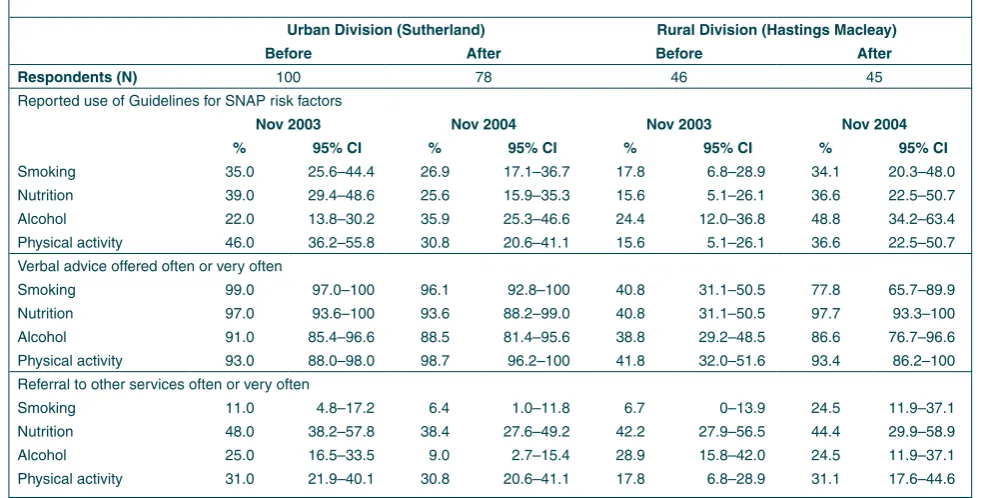
The survey of all general practitioners in the division before and after the trial revealed an improvement in the proportion using guidelines and the reported frequency of verbal advice by general practitioners to patients in the rural division (Table 1). Referral rates were also higher for nutrition in both divisions and did not change after the trial. They were lowest for smoking and alcohol. Referrals for smoking increased in the rural division. Major barriers remained, including frustration with the difficulty motivating patients, lack of time, ease of referral and competing demands, including the expectations of patients that their presenting problems were the main priority. Despite these limitations the trial has been useful in providing a practical demonstration of the implementation of at least four of the seven elements of the SNAP framework. A number of the tools and guidelines developed in the trial have been widely disseminated across Australia – notably the SNAP guide, which was published by the Royal Australian College of General Practitioners and distributed to all general practitioners, using funding from the Australian Government Department of Health and Ageing. The general practitioners survey and practice assessment tools have been disseminated widely to divisions and a majority of other divisions across Australia have implemented SNAP strategies within their chronic disease, population health or practice visits programs. 14 The experience of the trial has been used to inform the development of the Lifestyle Prescription package developed by the Australian
tABLe 1
SURVeY of GeNeRAL PRACtItIoNeRS BefoRe AND AfteR ImPLemeNtAtIoN of tHe SNAP tRIAL IN tWo DIVISIoNS of GeNeRAL PRACtICe IN NeW SoUtH WALeS
Urban Division (Sutherland) Rural Division (Hastings macleay)
Before After Before After
Respondents (N) 100 78 46 45
Reported use of Guidelines for SNAP risk factors
Nov 2003 Nov 2004 Nov 2003 Nov 2004
% 95% CI % 95% CI % 95% CI % 95% CI
Smoking 35.0 25.6–44.4 26.9 17.1–36.7 17.8 6.8–28.9 34.1 20.3–48.0
Nutrition 39.0 29.4–48.6 25.6 15.9–35.3 15.6 5.1–26.1 36.6 22.5–50.7
Alcohol 22.0 13.8–30.2 35.9 25.3–46.6 24.4 12.0–36.8 48.8 34.2–63.4
Physical activity 46.0 36.2–55.8 30.8 20.6–41.1 15.6 5.1–26.1 36.6 22.5–50.7
Verbal advice offered often or very often
Smoking 99.0 97.0–100 96.1 92.8–100 40.8 31.1–50.5 77.8 65.7–89.9
Nutrition 97.0 93.6–100 93.6 88.2–99.0 40.8 31.1–50.5 97.7 93.3–100
Alcohol 91.0 85.4–96.6 88.5 81.4–95.6 38.8 29.2–48.5 86.6 76.7–96.6
Physical activity 93.0 88.0–98.0 98.7 96.2–100 41.8 32.0–51.6 93.4 86.2–100
Referral to other services often or very often
Smoking 11.0 4.8–17.2 6.4 1.0–11.8 6.7 0–13.9 24.5 11.9–37.1
Nutrition 48.0 38.2–57.8 38.4 27.6–49.2 42.2 27.9–56.5 44.4 29.9–58.9
Alcohol 25.0 16.5–33.5 9.0 2.7–15.4 28.9 15.8–42.0 24.5 11.9–37.1
fIGUR e 1 NSW He AL t H C om PR e H e NSIV e mo D e L of CHR o NIC DIS e AS e PR e V e N t Io N
11
W el l p op ul at io n A t r is k P eo pl e with di ag no se d co nd iti on s P eo pl e w ith c on tr ol le d ch ro ni c di se as e H ea lth p ro m ot io n Seconda ry prevention/ pr im ary health care
P rim ar y pr ev en tio n Specia lis t t re at m en t an d ac ut e ca re T er tia ry pr evention S ta ge s of Chronic Di se as e P ro gr es si on • Screening • E ar ly d et ec tio n • E ar ly in te rv en tio n • C on tr ol r is k fa ct or s • S up po rt s el f c ar e • C lin ic al m an ag em en t • H os pi ta lis at io n • M an ag em en t o f co m pl ic at io ns • D is ch ar ge p la nn in g • M ai nt enance • R eh ab ili ta tio n • C on tin ui ng c ar e • S el f m an ag em en t • S oc ia l s up po rt Health promotion Im pr ove/maintain pop ul at io n he al th . P re ve nt m ov em en t t o th e ‘a t r is k’ group P re ve nt p ro gr es si on to es ta bl is he d di se as e and ho sp ita lis at io n. M in im is e se ve rit y P re ve nt r ea dm is sions a nd pr ev en t/d el ay progression to co m pl ic at io ns /p re m at ur e de at h. P ro m ote q ualit y of li fe S tr at eg ie s to p ro m ot e he al th a cr os s th e lif ec ou rs e • H ea lth y be ha vi ou rs •
Healthy envi
ro nm en ts U ni ve rs al /s el ec tiv e T ar ge t p op ul at io n (H ea lth B en ef it G ro up s) Le ve ls o f p re ve nt io n an d ca re Support syst em s an d dr iv er s of ef fe ct iv e ac tio n (e xa m pl es ) In te rv en tio n an d se rv ic e m ix (H ea lth R es ou rc e Gr ou ps ) O bj ec tiv es a t e ac h st ag e of continuu
m of care
Consistent lif es tyle ad vi ce , pro m
otion of health
li te ra cy and co ns um er e m po w er m en t a cr os s sp ec tr um o f c ar e Health pr om otion •
Research and de
velopmen t • Evidence base • Quality •
Best practice—guidelines and standard
s • ‘Best bu ys ’ •
Equity impact assessment
•
Monitor
ing and per
fo
rm
ance measuremen
t
•
Funding arrangements and financial incentiv
es • W or kf orce • P ar
tnerships—intersectoral action on
deter
minants of healt
h • Ef fe ctiv e co m m un ity / co ns um er par ticipation Health promotion Source:
NSW Chronic Disease Pre
vention Str
ategy:
Discussion P
aper
. Pub
Government Department of Health and Ageing to distribute to all divisions of general practice.15
exteNDING SNAP to CommUNItY HeALtH SeRVICeS
The next phase of the research has been to extend this approach to community health services in NSW. This is challenging given the variety of services delivered within community health and the very different opportunities that they have for addressing risk factors. This trial includes an urban community nursing team and a rural health service. It will include many of the basic elements of the general practitioner SNAP trial, including development of options for clinicians that fit within their patterns of client contact, development of resources and referral options to support their interventions and organisational development to build support for risk factor management into their teams and services.
LINkING PoLICY, PRACtICe AND ReSeARCH The general practitioners and community health SNAP trials have played a number of roles in linking policy, practice and research to advance the development of risk factor management. They have been a mechanism to take ideas that were seen as an important part of the chronic disease agenda and provided specific opportunities to put them into action. This has provided a way of moving policy into action at limited cost and without the risk of moving directly into larger scale implementation. They are helping link policy development at the local level across settings that are often dealt with independently. The fact that community health and general practice work in the same communities and rely on the same referral agencies opens up other challenges for policy and practice relating to relationships between the two sectors and opportunities for collaborating to improve population health.
There is always a danger of too many trials, which are not broadly implemented. On the other hand there are numerous examples of policies hastily introduced without adequate evidence of how they will work, particularly at service provider level. The general practitioners trial has provided information for those in the field—for example staff in divisions of general practice—who wanted to put the ideas from the SNAP framework into practice but lacked the resources to undertake the development on their own. It also helped inform policy at national and state levels. There is now a much stronger basis for implementation across both the seven areas of the national SNAP framework and a key component of the NSW model of chronic disease prevention.
Successful strategies in the SNAP trial included evidence-based guidelines, training using simulated patients, and practice visits to provide tailored support and education. Key facilitators of implementation were links to existing division and area health service programs and the fit
between the SNAP approach and clinical general practice. Major barriers included the lack of teamwork and capacity within general practice and limited availability of, or communication with, some referral services.
Preventive care requires the involvement of all staff in the practice. Unfortunately, current financing mechanisms do not readily support the involvement of non-medical staff in SNAP interventions and workforce and other pressures reduce the amount of time which general practitioners themselves can devote to these. While new Medicare funding for allied health and practice nurses is welcome, this is mainly focused on patients with chronic or complex needs. Until this is corrected, opportunities for systematic chronic disease prevention will continue to be missed.
RefeReNCeS
Australian Institute of Health and Welfare. The burden of
disease and injury in Australia, 2000.
Unal B, Critchley JA, Capewell S. Modelling the decline in coronary heart disease deaths in England and Wales, 1981-2000: Comparing contributions from primary prevention and
secondary prevention. BMJ 2005; 331: 614.
Britt H, Miller G, Knox S, Charles J, Valenti L, Pani Y, et al. General practice activity in Australia 2003-4. Australian Institute of Health and Welfare Cat. No. GEP 16. Canberra 2004 ISSN 1442–3022.
Ashenden R, Silagy C, Weller D. A systematic review of promoting the effectiveness of promoting lifestyle change in
general practice. Family Practice 1997; 14: 160–76.
Beresford SAA, Curry SJ, Kristal AR, Lazovich D, Feng Z, Wagnew EH. A dietary intervention in primary care practice:
The eating patterns study. American Journal of Public Health
1997; 84(4): 610–16.
Ashenden R, Silagy C, Weller D. A systematic review of the effectiveness of promoting lifestyle change in general practice.
Fam Pract 1997; 14: 160–76.
Steptoe A, Perkins-Porras L, McKay C, Rink E, Hilton S, Cappuccio FP. Behavioural counselling to increase consumption of fruit and vegetables in low-income adults:
Randomised trial. BMJ 2003; 326: 855–7.
Whitlock E, Polen M, Green C, Orleans T, Klein J. Behavioural counselling interventions in primary care to reduce risky/harmful alcohol use by adults: summary of the
evidence for the US Preventive Services Task Force. Annals
of Internal Medicine 2004; 140(7): 557–68.
Smith BJ, Bauman AE, Bull F. C, Booth ML, Harris MF. Promoting physical activity in general practice: A controlled
trial of written advice and information materials. British
Journal of Sports Medicine 2000; 34: 262–7.
Young JM, Ward JE. Implementing guidelines for smoking cessation advice in Australian general practice: Opinions, current practices, readiness to change and perceived barriers.
Family Practice 2001 Feb; 18: 14-20
Steven ID, Thomas SA, Eckerman E. Browning C, Dickens E. The provision of preventive care by general practitioners
measured by patient completed questionnaires. J of Quality
in Clinical Practice 1999; 19: 195–201.
Australian Government Department of Health and Ageing.
Smoking, Nutrition, Alcohol, Physical Activity (SNAP)
1.
2.
3.
4.
5.
6.
7.
8.
9.
10.
11.
Framework for General Practice. Available at www.health. gov.au/internet/wcms/publishing.nsf/Content/health-pubhlth-about-gp-snap-cnt.htm. Accessed September 2005.
NSW Health. NSW Chronic Disease Prevention Strategy:
Discussion Paper. Sydney, Public Health Division, NSW
Health, September 2001.
Kalucy E, Hann K, Guy S. Divisions: The network evolves:
Report of the 2003–2004 Annual Survey of Divisions of
13.
14.
General Practice. Adelaide: Primary Health Care Research &
Information Service, Department of General Practice, Flinders University, and Commonwealth Department of Health and Ageing, 2005.
Australian Government Department of Health and Ageing.
Lifestyle Prescriptions. Available at www.seniors.gov.au./
internet/wcms/Publishing.nsf/Content/health-pubhlth-strateg-lifescripts-index.htm, accessed 20 September 2005.
15.
Danielle Campbell The Sax Institute George Rubin
Centre for Health Services Research
University of Sydney and Sydney West Area Health Service
In partnership with the NSW Department of Health, the Sax Institute has established a Getting Research into Policy and Practice (GRIPP) Program to improve the integration of population health and health services research with policy. The program is overseen by the GRIPP Steering Committee, which is co-chaired by the NSW Chief Health Officer (Dr Greg Stewart until February 2005, then Dr Denise Robinson) and Professor Anthony Zwi (University of NSW). One initiative of the GRIPP Program is an Evidence Check system to facilitate the commissioning of high quality research reviews relevant to policy issues. This article outlines the background to Evidence Check and describes how the system was developed and implemented.
BACkGRoUND
Reviews of Australian health research at both the national1 and state2 levels have called for the establishment of priority-driven research programs supported by initiatives to improve the transfer of research findings into policy and practice. However, there are several known barriers to the integration of research and policy, including limited contact between researchers and policy makers, research that is untimely or not relevant to policy priorities, and the availability of competing forms of evidence of varying quality.3-5 It has been suggested that better exchange between the policy and research communities requires a cultural shift toward ‘decision-relevance’ in research and a ‘research-attuned’ approach to policy6, alongside the development of new organisational structures, improved linkage activities, and innovative human resource approaches.7
One strategy for encouraging the consideration of evidence in policy development is the production of targeted
AN ‘eVIDeNCe CHeCk’ SYStem foR fACILItAtING
eVIDeNCe-INfoRmeD HeALtH PoLICY
syntheses of research evidence relevant to policy issues. Such reviews can be useful in assembling the ‘evidence jigsaw’ and highlighting the causal links that are relevant to policy decisions8, while avoiding some of the risks of relying on results from individual studies.9,10 Another strategy for promoting exchange between the research and policy communities is the use of knowledge brokers. Brokers are intermediaries who can foster relationships and facilitate communication between researchers and policy makers, so that the respective needs, values and priorities of both groups are considered.11 The concept of knowledge brokering in public policy is not new12, but attempts to develop and evaluate the role in health contexts have emerged only recently.11
tHe eVIDeNCe CHeCk SYStem
While these strategies are useful in theory, there is little empirical evidence to suggest how best to implement them in practice. Guided by expert members of the GRIPP Steering Committee and the experiences of groups such as the Canadian Health Services Research Foundation, the Evidence Check system was developed to facilitate access to high quality research reviews that could inform policy development across NSW Health.
Evidence Check has three components. First, an Evidence Check Commissioning Tool was developed, using the findings of a targeted literature review and consultations with senior policy makers and researchers about three hypothetical policy issues. The tool aims to elicit policy makers’ needs so that an expert reviewer has the right information to produce a useful review. When completing the tool, policy makers are encouraged to act as ‘intelligent customers’13 of evidence by considering and articulating:
the background to and purpose of the policy
targeted questions to be answered by the review, including the intervention(s), population(s) and outcomes of interest
the timeframe and funds available to conduct the review
• •