the resiliency of mothers of children with learning
disability
Tahereh Saeedifard1, Ali Mohamad Nazari1, Farshad Mohsenzadeh1
Abstract
Feelings of frustration and deprivation due to lack of normal children can cause isolation of mother and lack of interest in relationship with outcome of self-esteem depression and endangerment of mother's mental health. This study aimed to evaluate the effect of treatment based on acceptance and commitment on resiliency of the mothers of children with learning disability. The method of study was experimental with pretest-posttest and control group. The participants consisted all of mothers of children with learning disability who referred to Raha learning center that 30 subjects were selected by simple random sampling. Group Training was held in 9 sessions during 9 weeks for the experimental group. Connor-Davidson resiliency scale were used to collect data. The results indicated that training program is based on acceptance and commitment increased resiliency of mothers of children with learning disability. This study showed that training based on acceptance and commitment applicability can be used as psychological intervention beside of other interventions.
Keywords: Commitment, Learning Disorders, Resilience Journal of Research & Health
Social Development & Health Promotion Research Center
Vol. 6, No. 2, May & Jun 2016 Pages: 263- 271
Original Article
1. Department of Counseling, Faculty of Educational Sciences & Psychology, Kharazmi University, Tehran, Iran
Correspondence to:Tahereh Saeedifard,
Department of Counseling, Faculty of Educational Sciences & Psychology, Kharazmi University, Tehran, Iran
Email: [email protected]
Received: 27 Feb 2015 Accepted: 9 May 2015
How to cite this article: Saeedifard T, Nazari AM, Mohsenzadeh F. Effect of acceptance and commitment therapy on the resiliency of mothers of children with learning disability. J Research & Health2016; 6(2): 263-271.
Introduction
Usually at an early age, parents are especially sensitive to their children and detecting any
serious problem such as learning difficulties for
children have destructive effects on parents’
mood that influences the ability of parents to help
their sick children. Learning disability is usually
defined as physical or neurological injury which
disrupts academic performance [1] Unlike disable individuals People with mental disabilities do not necessarily have lower IQ, but despite considerable
as an important factor in its formation of learning disability in addition to neurological sources and reported that the parents of these children have higher parental stress, lower reading skills and unsuitable parenting styles [6]. Thus, in the case of detecting such disorders, parents are also subject of treatment to manage this stressful situations and also facilitate their children’s treatment, especially mothers who are more involved in child’s mental health problems and experience
more mental crisis [7,8], because they are the first
person who communicate directly to child and emotions like guilt and frustration and deprivation and abnormality of child lead to lack of self-esteem, inferiority complex, sadness ,sorrow and put parents' mental health at risk [9]. Otherwise, it is even possible that child's learning disability leads to more serious problems in psychological, social and academic aspects. Kaposi et al [10] suggested that parents' insecure attachment styles of children with learning disability create disability in emotional and behavioral strategies and is considered as risk factor for the development of their problem. Coping with stress of having a child with learning disability is imperative issue for mothers and they should be able to overcome their negative feelings and control the present crisis. This skill which is known as resiliency does not only mean to be stable in dealing to traumatic situation that is requirement of passive situation but it means to participate actively and constructively in environmental conditions and providing biological and psychological balance [11]. Due to the high importance of resiliency in mental health of people [12], it has always been tried to recognize the effective factors in its’ increasing. Some researchers, such as Eisen [13] reported that t people with resiliency have different attitudes in stressful situations and focus on themselves instead of focusing on the problem and people like Hawkins, Katalanou and Miller [14] considered it as a cognitive structure. Keholik [15] also reported that cognitive skills especially meta-cognitive skills such as mindfulness with increasing person's ability can improve resiliency to regulate emotions and coping skills. The third wave of cognitive therapies is characterized by greater focus on performance to have an
increasingly growth conditions [16] and focus on concepts such as mindfulness and context-oriented. One of these treatments is the therapy based on acceptance and commitment which has special attention on mindfulness skills. Kabat-Zin [17] as one of the pioneers of components of
mindfulness program, defines it as the attention
without person’s judgment to the present and instant experience. This treatment believes that pathology is the result of kind of psychological rigidity that occurs as result of the avoidance of thoughts and annoying feelings. This treatment by increasing mindfulness, cognitive distance (observing thoughts) and a commitment to active involvement in the external world and the quest for a meaningful life and noble aim of increasing
psychological flexibility helps the individual
to cope with stressful situations [18,19].
Psychological flexibility is improvement of
clients' ability to communicate their experience at the present time to choose as what is possible for them at that moment and act in a manner which is consistent with their values [20]. This treatment is an evidence-based intervention and encourages clients to test their negative thoughts and unlike traditional cognitive therapy which explicitly rejects the cognitive restructuring because it has focused on the performance not to the content of cognition [21].
Berjis et al. [22] found out that mothers of children with learning disability have less hope and sense of meaning than mothers of normal children. Also, these parents have lower quality of life than parents of normal children [23]. Several researches believe that there is relationship between psychological acceptance and quality of life in middle age [24] and even some of them introduce acceptance and mindfulness as basic elements of resiliency [25]. This treatment has a long background in the treatment of anxiety disorders [26], as well as marital problems,
so that Imani et al. [27] evaluated the efficacy
positive effects on the target treatment. It also
reported that it increases social efficiency [28].
Thus, because of the destructive effect of learning disability on mental health of parents especially mothers and their important role in improving children's health, any effort to increase their mental health is essential and as earlier it was said that resiliency is an important factor mental health, so this research is aimed to help in increasing resiliency of mothers by group therapy based on acceptance and commitment. Most of the studies in Iran are about the families with disable children, the study is about caring and rehabilitation of children with disabilities and few studies have compared the different groups of exceptional children's mothers, therefore, this study tries to examine the other side of the psychological conditions of those who bear the highest emotional and behavioral problems of these children, it means pay to mothers of children with learning disability and
academic recognition and reflection of the results
to parents and authorities. Therefore, this study aimed to evaluate the effect of treatment based on acceptance and commitment on resiliency of the mothers of children with learning disability.
Method
The population in this study consisted all of mothers of children with learning disability, who referred to the learning disability center of Raha (Hashtgerd city) in 2014. 90 participants were chosen by having low resiliency after clinical interview and Connor-Davidson’s resiliency questionnaire in order to select sample among 250 mothers who refer to learning disability center. The sample size was 15 participants for each group according to size medium was (0.25), power (0.95) alpha (0.05), the number of measurements (2). Among these groups, 30 participants were selected by simple random sampling and assigned to experimental and control groups randomly then psycho-therapy was provided based on acceptance and commitment for 9 sessions for the experimental group. Members of the control group did not receive any training during this period. After
finishing the training sessions, test was repeated
at the same time and in the same condition to
evaluate control and experimental groups. Finally, for ethical issues, the therapy based on acceptance and commitment was provided for the control group as well.
In this study, the statistical indicators such as the mean and standard deviation (SD) were used to analyze the data. Univariate analysis of covariance (ANCOVA) was used to test the research hypothesis after examining the normality of the distribution scores and investigating the basic assumptions of the parametric tests. Data analysis was also performed by using SPSS-20. The method of study was experimental with pretest-posttest and control group.. This experiment was
conducted by the first author of the paper who was teacher and have training's certificate of
acceptance and commitment therapy at center of learning disability.
Connor-Davidson Resiliency Scale: This questionnaire was prepared by Connor and Davidson [11] through review of literature's researches among 1979 to 1991 in the area of resiliency [29] and included 25 items to measure the resiliency in different people. Its responding spectrum was Likert-type and scores of all items should be added to obtain an overall score of the questionnaire. The scores will range from 0 to 100. The higher score indicates the higher resiliency level of the respondent and vice versa. The cut-off point of questionnaire is 50. In other words, a score higher than 50 indicates people's resiliency and whatever this score is higher than 50, as well as the severity of a person's resiliency will be higher and vice versa. Reliability of the questionnaire was obtained 0.89 in study conducted by Basharat et al. [30]. In a study conducted by Ranjbar et al. [31] reliability of the questionnaire was examined by using
Cranach's alpha coefficient that was 0.84.
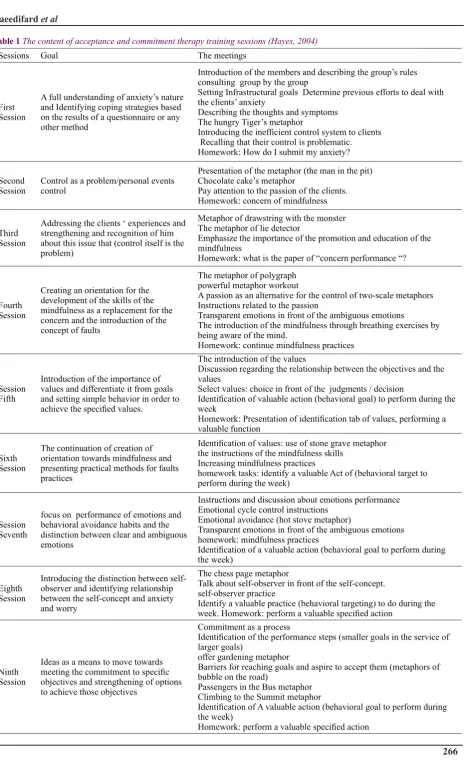
Table 1 The content of acceptance and commitment therapy training sessions (Hayes, 2004)
The meetings Goal
Sessions
Introduction of the members and describing the group’s rules consulting group by the group
Setting Infrastructural goals Determine previous efforts to deal with the clients’ anxiety
Describing the thoughts and symptoms The hungry Tiger’s metaphor
Introducing the inefficient control system to clients Recalling that their control is problematic. Homework: How do I submit my anxiety? A full understanding of anxiety’s nature
and Identifying coping strategies based on the results of a questionnaire or any other method
First Session
Presentation of the metaphor (the man in the pit) Chocolate cake’s metaphor
Pay attention to the passion of the clients. Homework: concern of mindfulness Control as a problem/personal events
control Second
Session
Metaphor of drawstring with the monster The metaphor of lie detector
Emphasize the importance of the promotion and education of the mindfulness
Homework: what is the paper of “concern performance “? Addressing the clients ‘ experiences and
strengthening and recognition of him about this issue that (control itself is the problem)
Third Session
The metaphor of polygraph powerful metaphor workout
A passion as an alternative for the control of two-scale metaphors Instructions related to the passion
Transparent emotions in front of the ambiguous emotions
The introduction of the mindfulness through breathing exercises by being aware of the mind.
Homework: continue mindfulness practices Creating an orientation for the
development of the skills of the mindfulness as a replacement for the concern and the introduction of the concept of faults
Fourth Session
The introduction of the values
Discussion regarding the relationship between the objectives and the values
Select values: choice in front of the judgments / decision
Identification of valuable action (behavioral goal) to perform during the week
Homework: Presentation of identification tab of values, performing a valuable function
Introduction of the importance of values and differentiate it from goals and setting simple behavior in order to achieve the specified values.
Session Fifth
Identification of values: use of stone grave metaphor the instructions of the mindfulness skills
Increasing mindfulness practices
homework tasks: identify a valuable Act of (behavioral target to perform during the week)
The continuation of creation of orientation towards mindfulness and presenting practical methods for faults practices
Sixth Session
Instructions and discussion about emotions performance Emotional cycle control instructions
Emotional avoidance (hot stove metaphor)
Transparent emotions in front of the ambiguous emotions homework: mindfulness practices
Identification of a valuable action (behavioral goal to perform during the week)
focus on performance of emotions and behavioral avoidance habits and the distinction between clear and ambiguous emotions
Session Seventh
The chess page metaphor
Talk about self-observer in front of the self-concept. self-observer practice
Identify a valuable practice (behavioral targeting) to do during the week. Homework: perform a valuable specified action
Introducing the distinction between self-observer and identifying relationship between the self-concept and anxiety and worry
Eighth Session
Commitment as a process
Identification of the performance steps (smaller goals in the service of larger goals)
offer gardening metaphor
Barriers for reaching goals and aspire to accept them (metaphors of bubble on the road)
Passengers in the Bus metaphor Climbing to the Summit metaphor
Identification of A valuable action (behavioral goal to perform during the week)
Homework: perform a valuable specified action Ideas as a means to move towards
meeting the commitment to specific objectives and strengthening of options to achieve those objectives
Results
The mean and SD of the subjects’ age has been 35.95±4.29 years old which was
35.47±5.48 for the experimental group and 36.44±2.75 years old for the control group.
Table 2 The mean and SD of resiliency in pretest and post-test of the experimental and control groups
Experimental group Control group
N Mean SD N Mean SD
Resiliency Pre-test 15 66.73 14.27 15 59 16.01
Post-test 15 87.33 7.06 15 58.80 15.85
Table 2 indicates the mean and SD values of resiliency and anxiety and its components in pre-test and post-test of both control and experimental groups. As Table 2 indicates, the mean scores of resiliency in the experimental group are 66.73 in the pre-test and 87.33 in
the post-test stage. As can be seen in the experimental group of resiliency in post-test scores increased, but knowing that this increase or decrease is statistically
significant or not should consider the
hypothesis that are presented in below. Table 3 Kolmogorov-Smirnov test results for assessing the normality of the distribution of resiliency score
Experimental group Control group
Z score Sig. Z-score Sig.
Resilienc Pre-test 0.635 0.814 0.695 0.720
Post-test 0.614 0.845 0.665 0.768
As shown in Table 3, since the values of Kolmogorov–Smirnov for the variable of
resiliency are not significant in any of the
pre-test and post-test stages in experimental
and control groups (p>0.05), therefore, it can be concluded that the distribution of scores is normal in the variable of resiliency.
Table 4 The results of Leven’s test: homogeneity of variances
Variable F Level of freedom 1 Level of freedom 2 Sig.
Resilienc 0.291 1 28 0.594
As can be seen in Table 4, since the amount
of F statistics is not significant (F=0.291
and p>0.05), the equality assumption of the variances of both experimental and control
groups are confirmed in the resiliency variable.
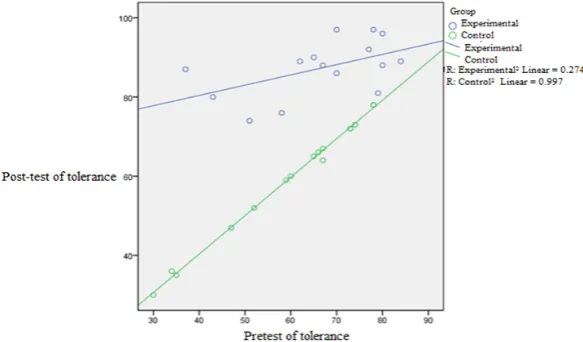
The analysis of variance is also the default for a linear relationship between the variables and the dependent variable along the plot was used for resiliency is formed in the following states.
Since the regression lines did not intersect, it can be concluded that there is a linear relationship between the synchronous variable and the dependent variable.
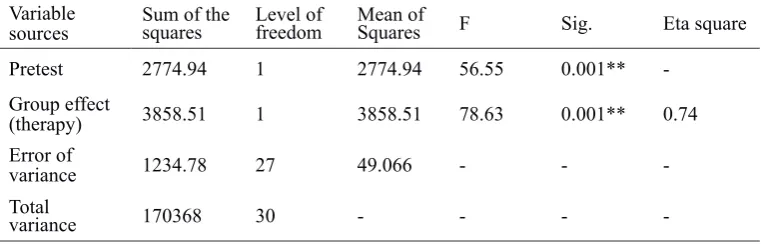
Considering that assumptions of using the univariate covariance analysis is considered, sothe results of this test are presented in Table 5.
Table 5 The results of univariate covariance analysis to test the effect of resiliency
Variable
sources Sum of thesquares Level offreedom Mean ofSquares F Sig. Eta square
Pretest 2774.94 1 2774.94 56.55 0.001**
-Group effect
(therapy) 3858.51 1 3858.51 78.63 0.001** 0.74
Error of
variance 1234.78 27 49.066 - -
Total
variance 170368 30 - - -
-**p<0.01
According to the analysis of univariate
covariance in the above Table, a significant amount of F for resiliency (F=78.63 and
p>0.01) indicated that the effect of (treatment)
group is statistically significant, meaning that
after calculating the effect of pretest, the created differences in the scores between the two
groups in amount of resiliency is significant.
Also, due to the resiliency mean scores of experimental group in the pretest (66.73) and posttest (87.33), it is clear that resiliency mean scores of experimental group in post-test group increased that shows the effect of therapy on increasing resiliency. Chi Eta also shows that 74 percent of the by changes caused the approach of acceptance and commitment therapy.
Discussion
Learning disability as a stressful situation has a lot of pressure on all family's members; especially mothers who have closer interact with the child and endanger their mental health. On the other hand, the family members are important source of support to improve the situation of suffered children and if they do not have high mental health they cannot help those children and perhaps calm and family resiliency can help children's resiliency [32]. Therefore the aim of this study was to determine effect of treatment based on acceptance and commitment on increasing resiliency of mothers with children who have learning disability and as expected the results showed that treatment
significantly increases resiliency of mothers. The present finding is consistent with Kehulik's
research [15]. He stated that techniques such as mindfulness improve emotional regulation and increases resiliency. Also are consistent with researches of Butler and Syaruchy [24], Thomson, Arnkoof and Glass [25] and Narimani and colleagues [27].
to connect with their experiences at the present time, so that they can choose based on what is possible for them at that moment and to act in a manner that is consistent with their selected values [20]. In fact, this treatment helps them even when they feel they have no control over it be able to observe and believe their ability in controlling the situation and to live and achieve meaningful and authentic life. This concept suggests that if mother as a primary care, does not have a happy personal life and does not have an enjoyable life; she cannot withstand the problems related to the child. As a result of this treatment, their quality of life increased [24] and perhaps the overall improvement in quality of life, strengthens the mother to face the disability of his child. So the therapy is based on acceptance and commitment by creating therapy atmosphere based on the thoughts and feelings of the mother even painful makes them to accept the reality even bitter. Because from the perspective of the treatment, it is avoiding the fact that worsen the problem and the mothers of the children instead of avoiding the thoughts and feelings of discomfort should be able to overcome them and control the crisis [10]. Mothers of children with learning disability in comparison of mothers of normal children have less hope and sense of meaning [22]. However, therapy based on acceptance and commitment can help those with more pronounced role in the challenges they face, their hope restored and step forward road of meaningful and genuine life. [18,
19]. Also, since some studies confirmed positive
role of acceptance and commitment therapy on their social performance (28), can also increase
self-efficacy and sense of empowerment is one
of the mechanisms to increase the resiliency of mothers. A feeling of competence and capability is necessary for resiliency only it is in this case that an individual can stand out of his passive position and deals with the challenges and participates in its management [11].
This research was only on mothers who went to Hashtgerd city's learning disability centers. In generalization of data and results should be cautious. Due to some limitations, such as the time limit, there was not the possibility
for holding follow-up. It is suggested other interventional procedures would be used instead of acceptance and commitment therapy to compare their results. It is recommended that therapy based on acceptance and commitment use on other families in larger sample size and the its results compared to results of this research. It is suggested that this study should be done on another population to evaluate and repeat due to different cultural backgrounds.
Conclusion
According to the results of this study, the importance of mothers' role in the lives of children with learning disability should be taken into concern and by knowing them some interventions in this regard should be increased. It also showed that approaches based on acceptance and commitment has applicability and can be used as psychological intervention with other interventions.
Acknowledgements
The authors extend their most sincere regards to all the participant mothers whose support and contribution made this research possible.
Contribution
Study design: TS, AMN
Data collection and analysis: TS, FM Manuscript preparation: TS
Conflicts of Interest
"The author declare that they have no competing interests."
Funding
The author (s) received no financial support
for the research, authorship and/or publication of this article.
References
1- Afrooz Gh. Psychology and educational of exceptional children Tehran (22nd edition). Tehran: Tehran University press; 2003.
2- Tabrizi M. Dictated writing disorders. Tehran. Fara-ravan 2001.
stress and involvement in children. Am J Ment
Retard1999;104(3): 422-36
4- Valentine DP, Mc Dermott S, Anderson D. Mothers of adults with mental retardation: is race a factor in
perceptions of burdens and gratification? Families in Society1998; 79(3): 577-84.
5- Quine L, Paul J. Examining the causes of stress in families with severely mentally handicapped children.
Brit J Soc Work1985; 15: 501-17.
6- Bonifacci P, Storti M, Tobia V, Suardi A. Specific
learning disorders a look inside children’s and parents’
psychological well-being and relationships. J Learn
Disabil2015; Jan 21. pii: 0022219414566681
7- Eisenhower AS, Baker BL, Blacher J. Preschool
children with intellectual disability syndrome specificity,
behavior problems, and maternal well-being. J Intellect
Disabil Res2005; 49(9): 657-71.
8- Ong L, Chandran V, Peng R. Stress experienced by mothers of Malaysian children with mental retardation.
J Paediatr Child Health1999; 35(4): 358-62.
9- Narimani M, Aghamohamadian HM, Rajabi S. Comparison of mental health and mental health of
mothers with normal children of exceptional children. J
Mental Health2007; 33(34): 15-24.
10- Capozzi F, Casini MP, Romani M, De Gennaro L, Nicolais G, Solano L. Psychiatric comorbidity in
learning disorder: Analysis of family variables. Child
Psychiatry Hum Dev2008; 39(1): 101-10.
11- Conner KM, Davidson JRT. Development of a new resiliency scale: the conner-davidson resiliency scale
(CD-RISC). Depress Anxiety2003; 18(2): 76-82.
12- Davydov DM, Stewart R, Ritchie K, Chaudieu I.
Resilience and mental health. Clin Psychol Rev2010;
30(5): 479-95.
13- Isen AM. Positive affect, systematic cognitive processing, and behavior: toward integration of affect, cognition, and motivation. In F Dansereau & FJ Yammarino, eds. Multi-level issues in organizational behavior and strategy. Oxford, UK: JAI/Elsevier science; 2003. PP:55–62.
14- Hawkins JD, Catalano RF, Miller JY. Risk and protective factors for alcohol and other drug problems in adolescence and early adulthood: Implications for
substance abuse prevention. Psychol Bull1992; 112: 6-105.
15- Coholic DA. Exploring the feasibility and benefits
of arts-based mindfulness-based practices with young people in need: aiming to improve aspects of self-awareness and resiliency. In child & youth care forum.
Springer US2011; 40(4): 303-17.
16- Young JE, Klosko JS, Weishaar ME. Schema therapy: a practitioner’s guide. New York: Guilford Press; 2003. 17- Kabat-Zinn J. Coming to our senses: healing ourselves and world through mindfulness. NewYork: Hyperion; 2005
18- Hayes SC. Acceptance and commitment therapy and the new behavior therapies: mindfulness, acceptance, and relationship. In SC Hayes, VM Follette, MM Linehan, eds. Mindfulness and acceptance: expanding the cognitive-behavioral tradition. New York: New York guilford press; 2004. PP: 1–29.
19- Forman E, Herbert J, Moitra E. A randomized controlled effective of acceptance and commitment therapy & cognitive therapy for anxiety & depression.
J Behav Modific2009; 31(6): 772-99.
20- Hayes SC, Pistorello J, Bigland A. Acceptance and commitment therapy: model, data, and extension to
the prevention of suicide cognitive. Brazilian J Behav
Cognitive Therapy2008; (1): 81-102
21- Arch JJ, Craske MG. Acceptance and commitment therapy and cognitive behavioral therapy for anxiety disorders: different treatments, similar mechanisms?
Clin Psychol: Science and Practice2008; 15(4): 263-79. 22- Berjis M, Javadi HM, Lavassani A, Khanzadeh A. Comparison of fear, hope and meaning of life in mothers of children with autism, deafness and learning
disabilities. J Learn Disabil2013; 3(1): 6-27.
23- Hosseini SF, Amiri Majd M, Parsley AA. Comparison of quality of life for parents with children with down syndrome, parents of children with learning disabilities and parents of normal children. Third national conference on business, city Khomeini, Islamic Azad University of Khomeini Shahr. Available atURL: httpcivilica.com/Paper-NCCG01-NCCG01_048. html2012.
24- Butler J, Ciarrochi J. Psychological acceptance and
quality of life in the elderly. Qual Life Res2007; 16(4):
607-15.
25- Thompson RW, Arnkoff DB, Glass CR. Conceptualizing mindfulness and acceptance as components of psychological resiliency to trauma.
Trauma Violence Abuse2011; 12(4): 220-35.
26- Swain J, Hancock K, Hainsworth C, Bowman J. Acceptance and commitment therapy in the treatment
of anxiety: A systematic review. Clin Psychol Rev2013;
33(8): 965-78.
27- Narimani M, Abbasi M, Begyan M, Bakhti M. Compare the effectiveness of the training approach is based on acceptance and commitment (ACT) and the story of a group of early maladaptive modulation scheme in divorce applicant clients. J Psych Other Family2014; 4(1): 1.
28- Mehrdoost Z, Neshat Doost HT, Abedi A. Effectiveness of acceptance and commitment therapy on decrease of self-focused attention and symptoms reduction in students
with social anxiety disorder. Counseling Research &
Developments2013; 3(6): 117-30.
29- Mohammadi M. Factors affecting resiliency in
Tehran: University of social welfare and rehabilitation sciences 2005.
30- Besharat MA. Psychometric properties of Farsi version of the Emotional Intelligence Scale-41
(FEIS-41). Personality and Individual Differences2007; 43(5):
991-1000.
31- Hagh Ranjbar F, Kakavand A, Borjali A, Bermas H. Resiliency and quality of mothers of children with
intellectual disability. Health Psychology2011; 1(1).