Please cite this article as: S. E. Mousavi, Performance of Non-fired Green Brick Containing Rice Husk as Sustainable Building Material, International Journal of Engineering (IJE), IJE TRANSACTIONS C: Aspects Vol. 29, No. 3, (March 2016) 306-312
International Journal of Engineering
J o u r n a l H o m e p a g e : w w w . i j e . i rPerformance of Non-fired Green Brick Containing Rice Husk as Sustainable Building
Material
S. E. Mousavi*
Civil Engineering Department, College of Engineering, Universiti of Tenaga Nasional, Ikram Uniten Road, Kajang, Selangor, Malaysia
P A P E R I N F O
Paper history: Received 04 January 2016
Received in revised form 16 January 2016 Accepted 26 January 2016
Keywords: Non-fired Brick Rice Husk Strength
Sustainable Material
A B S T R A C T
The demand for sustainable alternative construction materials to cement in modern technology cannot be underemphasized. This paper presents a non-fired green brick with an agriculture residue namely, rice husk. Although, high plasticity brown clay deposits are widely distributed in Malaysia and rice husk is a well known agriculture residue, research works on non-fired green brick with rice husk are relatively scarce. This research aims to investigate the strength development in non-fired bricks containing various amounts of rice husk. To achieve such aim, compression and flexural tests were conducted to evaluate compressive and flexural strengths of non-fired bricks. A series of brick specimens were cast with varying rice husk percentages. The test specimens were naturally sun dried. The effects of rice husk percentage (9-15%) and drying age (1, 7, 14, 21, and 28 days) on Atterberg limits; compressive strength; water absorption and flexural strength were investigated. The results indicate that, 12% rice husk is the optimum content to reach maximum 28-day compressive and flexural strengths of 10.4 MPa and 3.5 MPa, respectively. The results further showed that rice husk higher than 12% leads lower strength than control bricks for all the ages. In summary, it has been observed that rice husk enables a rapid strength development, enhancing the compressive and flexural strengths of the bricks. The results developed in this research work can contribute a cost-effective design of non-fired green brick as a sustainable building material.
doi: 10.5829/idosi.ije.2016.29.03c.04
1. INTRODUCTION1
The increase in the demand for low cost and environmental friendly building materials has imposed the investigation of the materials which affirmed in the standard [1]. Agricultural residue is extracted from organic source like rice straw. With regard to this, rice husk (RH) is an alternative material that has a great potential. Rice husk (RH) is one of the most commonly available lignocellulosic materials [2, 3]. The agricultural residue in the form of rice husk is available in many countries. Based on the research works that conducted by Fattah et al. [2] and Agbede and Joel [3], during the milling process of paddy grains approximately 78% of weight is received as rice and
1 1*Corresponding Author’s Email [email protected] (E.
Mousavi)
Previous researches were tried to incorporate different ashes such as fly and biomass ashes as well as various wastes such as foundry sand, steel dust and glass waste to design green bricks [5-8]. According to the Brick Development Association [9] and Javadpour et al. [10], a brick is building material used to make walls, pavements and other elements in masonry construction. So far, the strength development in non-fired brick containing rice husk has not completely investigated. Therefore, it is crucial to examine the compressive and flexural strengths of non-fired bricks for the cost-effective and reliable producing of building materials. The main goal of this research is to determine the compressive and flexural strengths of non-fired brick containing rice husk. In addition, Atterberg limits and water absorption of the brick specimens were examined.
2. EXPERIMENTAL STUDY
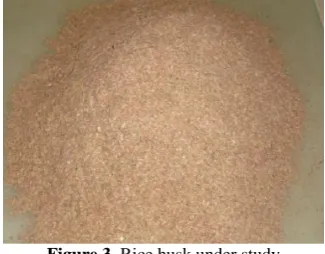
2. 1. Materials The soil sample from Infrastructure University Kuala Lumpur (IUKL) in the state of Selangor, Malaysia was used in this paper. The basic laboratory tests on the natural soil showed that the soil was in high plasticity, high compressibility and had a moisture content of 56%. The pH and specific gravity of the natural soil sample was discovered to be 8.1 and 2.68, respectively. This implies that the soil is in alkaline state. The particle size distribution curves of brown clay and rice husk are shown in Figures 1 and 2. Besides, rice husk residue was obtained from a rice mill at Sangar by-pass road, Sangar district in Guilan, Iran. Generally, rice husk is a by-product of the rice that could be converted to fuels and feed stocks through thermochemical processes [11]. The physico-chemial properties of the rice husk are tabulated in Table 1. Based on Table 1, the rice husk obtained from Sangar, Guilan, Iran has a moisture content of about 4%. The rice husk used for the research work is indicated in Figure 3. Based on manufacturer information, during milling process of paddy approximately 77% of weight is obtained as rice and broken rice. Rest 23% of the weight of paddy is obtained as husk.
Figure 1. Particle size distribution curve of the natural soil sample
Figure 2. Particle size distribution curve of the rice husk
Figure 3. Rice husk under study
TABLE 1. Physico-chemical properties of the additive
Property of the rice husk Value
Moisture content (%) 4.24
Average particle size (mm) 0.7
Bulk density (kg/m3) 341
Ash content (%) 21
Silica content of the ash (%) 93
Porosity (%) 59
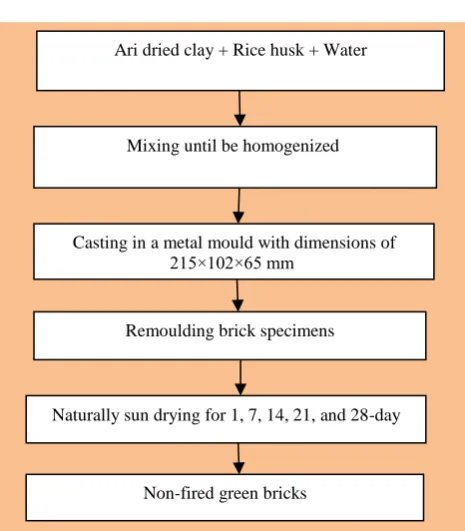
2. 2. Methodology The test specimen preparation initiated with the addition of different percentages of rice husk (3, 6, 9, 12, and 15% of dry mass of soil) to the air-dried soil. As such, rice husk was mechanically mixed with dry soil and water content was added to soil-rice husk mixture. All the test specimens were prepared at 30% water content which is yielded the highest compressive strength (Figure 4). Prior to casting, the air-dried soil was mechanically mixed with water in a pan in order to achieve a uniform soil admixture. The soil admixture was transferred to the mould with dimensions of 215×102×65 mm. The mixing and casting was completed in less than 1 hour. Previous researches have been reported two different technologies for preparing non-fired bricks namely, high pressure press-forming and autoclaving-curing process [12-17]. In the former, the bricks were press-70
80 90 100
0.001 0.01
Fi
nn
er
(
%)
Particle diameter (mm)
0 20 40 60 80 100
0.1 1
Fi
nn
er
(
%)
formed at pressures of 20 MPa to 40 MPa and then autoclaving–cured at temperatures of 100 to 180°C for 4 to 8 h under the pressures of 0.8 MPa to 1.2 MPa [4]. The two latter processes impose high energy intensive and high brick cost. To promote the recycling of rice husk via the non-fired green brick and to have a cost-effective production, this study proposed only the naturally sun dried process. The demoulded specimens were dried in the sun for 1, 7, 14, 21, and 28 days at the ambient temperature of 33°C. The flowchart of non-fired brick preparation process is illustrated in Figure 5. Besides, the water content required for the brick producing was optimized. With regard to that, various non-fired bricks were produced at different water contents. The test specimens were sun dried for 28 days and after that immediately tested under compression tests. The water content corresponding to the maximum compressive strength was chosen as optimum water content (Figure 4).
3. TESTING PROGRAM
Flexural center point loading and compression tests on non-fired brick specimens were carried out in accordance with ASTM C293 and ASTM C67, respectively. According to ASTM C67, the purpose of compression test is to evaluate compressive strength of the test specimen. The mould was used for compression test has dimensions of 215×102×65 mm. Before casting, the inner surface of the mould was lightly lubricated to prevent the specimen from being damaged while removing it from the mould. Next, the mould was assembled and the soil admixture was tamped into the mould. The test specimen was placed centrally on the platens of compression apparatus. After that, compression test was performed on the test specimen. The axial load was increased at a rate of 1% strain per minute and the load displacement curve was plotted (Figure 6 (d)). The flexure test method measures behavior of materials subjected to simple beam loading. In flexure 3-point test the area of uniform stress is quite small and concentrated under the center loading point. A flexure test produces tensile stress in the convex side of the specimen and compression stress in the concave side. This creates an area of shear stress along the midline. To ensure the primary failure comes from tensile or compression stress the shear stress must be minimized. This is done by controlling the span to depth ratio; the length of the outer span divided by the height (depth) of the specimen (ASTM C293). Aside from strength tests, the aim of water absorption test is to determine the percentage of water absorption of non-fired bricks. For this purpose, the test specimens were dried in a ventilated oven at the temperature of 105°C to 110°C.
Figure 4. Optimization of water content
Figure 5. Flowchart of test specimen preparation
(a) (b)
(c) (d)
(e) (f)
1 1.5 2 2.5 3
10 20 30 40 50
28
-da
y
co
m
pr
ess
iv
e
st
re
ng
th
(M
P
a)
Water content (%)
Casting in a metal mould with dimensions of 215×102×65 mm
Mixing until be homogenized Ari dried clay + Rice husk + Water
Remoulding brick specimens
Naturally sun drying for 1, 7, 14, 21, and 28-day
(g)
Figure 6. Laboratory testing (a) Metal moulds, (b) Casting, (c) Compression test, (d) Stress-strain curve of non-fired brick without rice husk after 24 h sun drying, (e) and (f) Flexural tests on test specimens, and (g) Schematic flexural test
Figure 7. Effect of rice husk addition on Atterberg limits of the soil sample
The test specimens were cooled to room temperature and weighed (M1). Then, dried specimens completely immersed in clean water at a temperature of 27+2°C for 24 hours. The specimens removed from water and wipe out any traces of water with damp cloth and weighed again after their have been removed from water (M2).
The water absorption, % by mass, after 24 hours immersion in cold water is given by the Equation (1). The test method is based on ASTM C20-00. In addition, Atterberg limits including liquid limit, plastic limit and plasticity index were examined in accordance with ASTM D4318.
(1)
4. RESULTS AND DISCUSSION
The variations of Atterberg limits with addition of rice husk to the soil sample are illustrated in Figure 7. As shown in Figure 7, the plastic limit of the soil specimens
generally increased with increasing rice husk content up to 12%. Though the liquid limit curve follows a discernible trend, a tendency to approach a constant liquid limit can still be observed. This can be due to the water sorptivity behavior of rice husk when added to the soil sample which is resulted an increase in plastic limit of the soil specimens. The similar trend and behavior of Atterberg limits can be found in the research that conducted by Agbede and Joel [3]. From Figure 6, it can be observed that the plasticity index decreased from 27% to 19% at 9% rice husk. An abrupt decrease in plasticity index implies a sign of improvement of the index properties of the soil sample during rice husk addition.
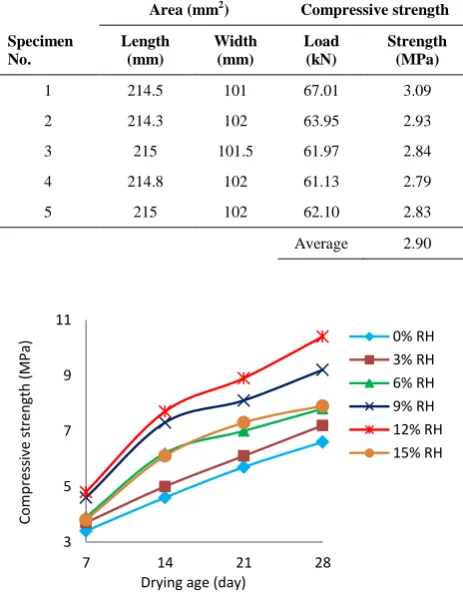
The results of compression tests on non-fired brick without rice husk are specified in Table 2. The length and width of each brick are shown in the table. It is necessary to note that in this section the test specimens were tested after 24 hours sun drying. The failure mechanism and stress-strain curve of the brick specimen under normal pressure can be observed in Figure 6 (c and d), respectively. The average value of compressive strength of 5 brick specimens was determined to be 2.90 MPa which is relatively low when compare to that of reported by Agbede and Joel [3].
TABLE 2. Compressive strength of non-fired bricks after 24 h without rice husk
Specimen No.
Area (mm2) Compressive strength
Length (mm)
Width (mm)
Load (kN)
Strength (MPa)
1 214.5 101 67.01 3.09
2 214.3 102 63.95 2.93
3 215 101.5 61.97 2.84
4 214.8 102 61.13 2.79
5 215 102 62.10 2.83
Average 2.90
Figure 8. Effect of aging on compressive strength of the test specimens
15 25 35 45 55 65
0 3 6 9 12 15
A
tt
er
be
rg
li
m
it
(
%)
Rice husk (%)
LL PL PI
3 5 7 9 11
7 14 21 28
C
o
m
pr
ess
iv
e s
tr
eng
th
(M
P
a)
Drying age (day)
Figure 9. Effect of rice husk on water absorption of the non-fired bricks
Figure 10. Effect of drying on flexural strength of non-fired bricks
The graphical relationships of compressive strength versus aging for both unreinforced and reinforced brick specimens with rice husk fibers are shown in Figure 8. After inspecting the figure, it was observed that there was a significant improvement in the 28-day compressive strength of the test specimen which reinforced with 12% rice husk. The highest compressive strength of the non-fired green brick with 12% rice husk after 28 days drying in the sun was determined 10.4 MPa. The positive results indicate a progressive improvement in the compressive strength of the test specimen. Also, it was noticed that the addition of 12% rice husk to host soil of the non-fired brick improved the 28-day compressive strength by almost 1.6-fold. The subsequent raise in the compressive strength with addition of rice husk up to 12% is attributed to the role of rice husk fibers as reinforcement for brown clay. The rice husk fibers create cementation links among the soil particles which increase its compressive strength and improve the soil matrix.
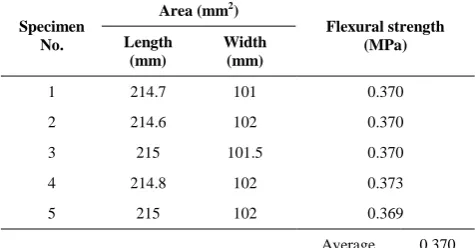
The results of water absorption tests on non-fired brick without rice husk fibers are shown in Table 3. Based on Table 3, the average value of water absorption for 5 test specimens was determined to be 10.89%. In addition, the relationships between water absorption of the non-fired bricks and various percentages of rice husk fibers were plotted in Figure 9. From Figure 9, it can be seen that the lowest water absorption is corresponding to the non-fired brick with 6% rice husk. The flexural center point loading test results of the non-fired brick without rice husk fibers after 24 hours are tabulated in Table 4. Based on Table 4, the average value of flexural strength of 5 test specimens is 0.37 MPa. The rather low flexural strength is due to early drying age of the bricks which required more sun drying.
TABLE 3. Absorption of non-fired brick without rice husk
Specimen No. Mass of
brick before soaked (g)
Mass of brick after soaked
(g)
Water absorption
(%)
1 1930 2150 11.40
2 1900 2100 10.53
3 2010 2225 10.70
4 2100 2330 10.95
5 2020 2240 10.89
Average 10.89
TABLE 4. Flexural strength of non-fired bricks after 24 h without rice husk
Specimen No.
Area (mm2)
Flexural strength (MPa) Length
(mm)
Width (mm)
1 214.7 101 0.370
2 214.6 102 0.370
3 215 101.5 0.370
4 214.8 102 0.373
5 215 102 0.369
Average 0.370
The relationships between flexural strength and drying age are established in Figure 10. The increase of rice husk addition is directly associated with increase of flexural strength of the non-fired bricks. Only for 15% rice husk addition the flexural strength decreased. This may be due to addition of 3 to 12% rice husk to clay which strengthened the clay to withstand flexural load. Whereas, the high contents of rice husk fibers weaken the ability of the clay to withstand flexural stress. In that sense, rice husk fibers create weak planes in the soil 0
2 4 6 8 10 12
Non-fired brick
3% RH 6% RH 9% RH 12% RH 15% RH
W
at
er
ab
so
rp
ti
o
n
(
%
)
Non-fired brick composition
0.6 1.1 1.6 2.1 2.6 3.1 3.6
7 14 21 28
Fl
exu
ra
l s
tr
en
gt
h
(
M
Pa
)
Drying gae (day) Non-fired brick without RH 3% RH
6% RH 9% RH
pastel which fasten the failure under flexural load. The maximum flexural strength was found to be 3.5 MPa which is corresponding to the non-fired brick with 12% rice husk after 28-day sun drying. Results show that the flexural strength of the non-fired brick with 12% rice husk improved by almost 2.2-fold. Therefore, the optimum content of the rice husk is 12%.
5. CONCLUSIONS
It can be concluded that the non-fired green brick containing rice husk was successfully produced based on the results of laboratory tests on the test specimens. From the results of this research, the following conclusions are drawn:
(1) The non-fired green brick has been successfully produced in the laboratory. The optimal content of the rice husk was found to be 12%.
(2) The non-fired green brick with 12% rice husk has the highest 28-day compressive and flexural strengths of 10.4 MPa and 3.5 MPa, respectively.
(3) There is a significant improvement in term of strength of the non-fired green brick at the optimal content of the rice husk. The compressive and flexural strengths of the test specimens are 1.6 and 2.2 times greater than that of without rice husk.
(4) Addition of high contents of rice husk (i.e. more than 12%) leads to reduction of the compressive and flexural strengths of the test specimens.
(5) It can be concluded that the rice husk fibers created cementation links among the soil particles which contributed an improvement of the soil matrix.
In summary, a notable discovery is that the non-fired green brick can be sustainably utilized as a building material.
6. ACKNOWLEDGEMENTS
The author would like to acknowledge the UNITEN for providing suitable facilities to conduct the laboratory investigation. I would also like to thank all the parties involved in this research.
7. REFERENCES
1. Shakir, A.A., Naganathan, S. and Nasharuddin, K.M., "Development of bricks from waste material", Australian
Journal of Basic and Applied Sciences, Vol. 7, No. 8, (2013),
812-818.
2. Fattah, M.Y., Rahil, F.H. and Al-Soudany, K.Y., "Improvement of clayey soil characteristics using rice husk ash", Journal of
Civil Engineering and Urbanism, Vol. 3, No. 1, (2013), 12-18.
3. Agbede, I. and Joel, M., "Effect of rice husk ash (rha) on the properties of ibaji burnt clay bricks", American Journal of
Scientific And Industrial Research, Vol. 2, No. 4, (2011),
674-677.
4. Zhou, J., Yu, D., Shu, Z., Li, T., Chen, Y. and Wang, Y., "A novel two-step hydration process of preparing cement-free non-fired bricks from waste phosphogypsum", Construction and
Building Materials, Vol. 73, (2014), 222-228.
5. Chee, M.C., "Effects of natural fibers inclusion in clay bricks: Physic-mechanical properties", Journal of International
Journal of Civil and Environmental Engineering, Vol. 1, (
2011), 51-57.
6. Raut, S., Ralegaonkar, R. and Mandavgane, S., "Development of sustainable construction material using industrial and agricultural solid waste: A review of waste-create bricks",
Construction and Building Materials, Vol. 25, No. 10, (2011),
4037-4042.
7. Ahmari, S. and Zhang, L., "Production of eco-friendly bricks from copper mine tailings through geopolymerization",
Construction and Building Materials, Vol. 29, (2012),
323-331.
8. Rahman, M., "Effect of rice husk ash on the properties of bricks made from fired lateritic soil-clay mix", Materials and
Structures, Vol. 21, No. 3, (1988), 222-227.
9. Association, B.D., "Bricks: Their properties and use, Construction Press Limited, (1974).
10. Javadpour, J., Hosseinzadeh, M. and Marghussian, V., "Effect of particle size distribution and chemical composition on properties of magnesia chromite bricks", International Journal of
Engineering-Transactions B: Applications, Vol. 15, No. 2,
(2002), 183-190.
11. Mansaray, K. and Ghaly, A., "Physical and thermochemical properties of rice husk", Energy Sources, Vol. 19, No. 9, (1997), 989-1004.
12. Yang, J., Liu, W., Zhang, L. and Xiao, B., "Preparation of load-bearing building materials from autoclaved phosphogypsum",
Construction and Building Materials, Vol. 23, No. 2, (2009),
687-693.
13. Shi, L., "Technology making use of waste phosphogypsum to produce gypsum block", State Intellectual Property Office of the People’s Republic of China, (2012).
14. Yin, X., "The method of manufacturing the high strength and proof-water and proof-fire non-fired bricks of the industrial by-production phosphogypsum", State Intellectual Property Office of the People’s Republic of China, (2007).
15. Method for producing baking-free brick by doping phosphogypsum and fly ash, (2012), Google Patents.
16. Sadrnezhaad, S., Bagheri, N. and Mahshid, S., "Effect of si antioxidant on the rate of oxidation of carbon in mgo–c refractory", International Journal of
Engineering-Transactions B: Applications, Vol. 24, No. 4, (2011), 357-366.
17. Rahemi, M.A., Tasnimi, A.A. and Sarvghad-Moghadam, A., "Micromechanical modeling of brick- masonry fracture", International Journal of Engineering Transactions C:
Performance of Non-fired Green Brick Containing Rice Husk as Sustainable Building
Material
S. E. Mousavi
Civil Engineering Department, College of Engineering, Universiti of Tenaga Nasional, Ikram Uniten Road, Kajang, Selangor, Malaysia
P A P E R I N F O
Paper history: Received 04 January 2016
Received in revised form 16 January 2016 Accepted 26 January 2016
Keywords: Non-fired Brick Rice Husk Strength
Sustainable Material
هديكچ
هب مربم زاین عیانص رد نامیس نیزگیاج داوم و حلاصم زاین نودب رجآ عون کی شهوژپ نیا رد .تسا راکنا لباق ریغ هتفرشیپ
هب سر کاخ هچرگ .تسا هدیدرگ یفرعم یبوک جنرب عیانص دنامسپ ناونع هب جنرب هتسوپ هارمه هب هروک رد تخپ دنیارف هب
هتخانش یدنامسپ زین جنرب هتسوپ و هدوب یسرتسد لباق روفو هب ینامتخاس رجآ یلصا هدام ناونع تاقیقحت یلو ،تسا هدش
رضاح قیقحت رد .دشاب یم دودحم رایسب جنرب هتسوپ اب هدش حلاصا یا هروک ریغ یاه رجآ صوصخ رد هتفرگ تروص
یسررب دروم دازآ یاوه رد هدش یروآ لمع یاهرجآ یشمخ و یراشف تمواقم رب جنرب هتسوپ فلتخم یاهدصرد ریثات
اگشیامزآ تاشیامزآ جیاتن .تسا هتفرگ رارق رادقم هک دنهد یم ناشن یه
21 و یراشف تمواقم نیرتشیب جنرب هتسوپ دصرد
زا دعب ار یشمخ 12
ربارب جنرب هتسوپ هنیهب رادقم نیاربانب .دهد یم هجیتن اهرجآ یروآ لمع دنور زور 21
.دشاب یم %