VOLUME NO.2(2012),ISSUE NO.12(DECEMBER) ISSN2231-5756
A Monthly Double-Blind Peer Reviewed (Refereed/Juried) Open Access International e-Journal - Included in the International Serial Directories
Indexed & Listed at:
VOLUME NO.2(2012),ISSUE NO.12(DECEMBER) ISSN2231-5756
INTERNATIONAL JOURNAL OF RESEARCH IN COMMERCE, IT & MANAGEMENT
CONTENTS
CONTENTS
CONTENTS
CONTENTS
Sr.No.
TITLE & NAME OF THE AUTHOR (S)
Page No.
1. EFFECTIVENESS OF PAY-FOR-PERFORMANCE AND FIXED-PAY PRACTICES: AN ASSESSMENT OF PAY SATISFACTION, COMMITMENT AND TURNOVER INTENTION
PRINCY THOMAS & DR. G. NAGALINGAPPA
1
2. ROLE OF CORPORATE GOVERNANCE ON PERFORMANCE OF PRIVATE COMMERCIAL BANKS IN BANGLADESH: AN ECONOMETRIC ANALYSIS
DR. MD NAZRUL ISLAM, MOHAMMAD MASUD ALAM & MOHAMMAD ASHRAFUL FERDOUS CHOWDHURY
6
3. IDENTIFYING OPPORTUNITIES, CHALLENGES AND INFRASTRUCTURE REQUIREMENTS FOR ESTABLISHING SECONDARY MARKETS IN ETHIOPIA
KANNAN SIMHAKUTTY ASURI & LETENAH EJIGU
12
4. A NOVEL BANKRUPTCY PREDICTION MODEL BASED ON SUPPORT VECTOR DATA DESCRIPTION METHOD
ALIREZA DEHVARI, FEZEH ZAHEDI FARD & MAHDI SALEHI
17
5. ANALYSIS OF FACTORS INFLUENCING EXPORT VOLUME: THE NIGERIAN EXPERIENCE
KAREEM, R.O, OKI A.S, RAHEEM, K.A & BASHEER, N.O
24
6. A MODEL FOR ORGANIZING, MEASURING, ANALYZING STUDENTS’ KNOWLEDGE AND PERFORMANCE
ROY MATHEW
32
7. DETERMINANTS OF CUSTOMER LOYALTY AND SUBSCRIBER CHURN OF MOBILE PHONE SERVICES IN GHANA
JACOB NUNOO & CHRISTIAN KYEREMEH
38
8. FACTORS AFFECTING CUSTOMERS’ ATTITUDE TOWARDS INFORMATION TECHNOLOGY ADOPTION IN COMMERCIAL BANKS OF ETHIOPIA: A CASE STUDY OF SELECTED BANKS IN MEKELLE CITY
ZEMENU AYNADIS
42
9. EFFECTIVE USE OF TRAINING FEEDBACK FOR REINFORCEMENT OF LEARNING AND EMPLOYEE DEVELOPMENT
AJAY KR VERMA, SUDHIR WARIER & LRK KRISHNAN
53
10. IMPACT OF DEMOGRAPHIC VARIABLES ON FACTORS OF JOB SATISFACTION OF EMPLOYEES IN PUBLIC SECTOR: AN EMPIRICAL STUDY
DR. RIZWANA ANSARI, DR. T. N. MURTY, NILOUFER QURAISHY & S A SAMEERA
62
11. SUBSCRIBERS’ ATTITUDE TOWARDS DTH SERVICES
M. J. SENTHIL KUMAR & DR. N. R. NAGARAJAN
69
12. ISSUES AND CHALLENGES INDIAN BUSINESS: VISION 2020 WITH THE REFERENCE OF MICRO, SMALL AND MEDIUM ENTERPRISES (MSMEs) IN INDIA
DR. M. L. GUPTA, DR. SHWETABH MITTAL & PRIYANKA GUPTA
73
13. ENHANCING JOB SATISFACTION OF SOFTWARE PROFESSIONALS: THE RELEVANCE OF EMOTIONAL QUOTIENT
V. ANOOPKUMAR & DR. R. GANESAN
82
14. A SURVEY ON CONSUMER ATTITUDE TO CHOOSE AND USE VARIOUS TELECOM SERVICES
V. BALAKUMAR & DR. C. SWARNALATHA
88
15. COUNTERPRODUCTIVE WORK BEHAVIOUR (CWB) AND LOCUS OF CONTROL (LOC) AMONG MANAGERS
DR. RISHIPAL & PAWAN KUMAR CHAND
94
16. CORPORATE GOVERNANCE FAILURES IN INDIA - A REVIEW
KAISETTY. BALAJI & DR. Y. VENU GOPALA RAO
98
17. SIGNIFICANCE OF INCLUSIVE GROWTH IN INDIAN ECONOMIC DEVELOPMENT – A STUDY
DR. T. C. CHANDRASHEKAR
103
18. A STUDY ON EMPLOYEE JOB PERFORMANCE (A COMPARATIVE STUDY OF SELECT PUBLIC AND PRIVATE ORGANIZATIONS)
S.FAKRUDDIN ALI AHMED & DR. G. MALYADRI
110
19. ORGANISATIONAL AND ENVIRONMENTAL DETERMINANTS OF PERFORMANCE APPRAISAL SYSTEM: A REVIEW AND FRAMEWORK FROM CONTEXTUAL PERSPECTIVE
SAPNA TANEJA, DR. RAVIKESH SRIVASTAVA & DR. N. RAVICHANDRAN
117
20. E-LEARNING INITIATIVES TO AUGMENT BUSINESS PERFORMANCE: AN EMPIRICAL STUDY OF SELECT AUTO COMPONENT FIRMS
DR. AISHA M. SHERIFF & GEETHA R
127
21. INTERPRETIVE STRUCTURAL MODELING BASED APPROACH FOR ADOPTING CPFR IN INDIAN INDUSTRIES
RAJESH A. KUBDE & DR. SATISH V. BANSOD
136
22. TECHNOLOGY TRENDS AND IMPACT OF ROBOTICS IN THE CORPORATE WORLD AT DIFFERENT LEVELS OF MANAGEMENT
P. POONGUZHALI & DR. A. CHANDRA MOHAN
141
23. PERFORMANCE APPRAISAL ACT AS A MAJOR MOTIVATIONAL SOURCE
NAILA IQBAL
147
24. FOREIGN DIRECT INVESTMENT FLOWS INTO INDIA AND THEIR CAUSAL RELATIONSHIP WITH ECONOMIC GROWTH SINCE LIBERALISATION
S. GRAHALSKSHMI & DR. M. JAYALAKSHMI
150
25. INCLUSIVE GROWTH AND REGIONAL DISPARITIES IN ANDHRA PRADESH
V. VANEENDRA NATHA SASTRY
159
26. STRATEGIES TO COPE UP WORK - PLACE STRESSORS: AN EMPIRICAL STUDY IN EDUCATIONAL INSTITUTIONS
B. LAVANYA
162
27. DETERMINANTS OF JOB SATISFACTION AMONG EMPLOYEES IN INFORMATION TECHNOLOGY INDUSTRY IN DELHI
BRAJESH KUMAR & DR. AWADHESH KUMAR
166
28. MODERN CHALLENGES TO WOMEN ENTREPRENEURSHIP DEVELOPMENT: A STUDY OF DISTRICT RAJOURI IN JAMMU AND KASHMIR STATE
AASIM MIR
169
29. INTERNATIONAL HRM CHALLENGES FOR MNC’s
B. G. VENKATESH PRASAD & N. CHETAN KUMAR
173
30. INSIDER TRADING: GOVERNANCE, ETHICAL AND REGULATORY PERSPECTIVE
NIDHI SAHORE
177
VOLUME NO.2(2012),ISSUE NO.12(DECEMBER) ISSN2231-5756
CHIEF PATRON
CHIEF PATRON
CHIEF PATRON
CHIEF PATRON
PROF. K. K. AGGARWAL
Chancellor, Lingaya’s University, Delhi
Founder Vice-Chancellor, Guru Gobind Singh Indraprastha University, Delhi
Ex. Pro Vice-Chancellor, Guru Jambheshwar University, Hisar
FOUNDER
FOUNDER
FOUNDER
FOUNDER PATRON
PATRON
PATRON
PATRON
LATE SH. RAM BHAJAN AGGARWAL
Former State Minister for Home & Tourism, Government of Haryana
Former Vice-President, Dadri Education Society, Charkhi Dadri
Former President, Chinar Syntex Ltd. (Textile Mills), Bhiwani
CO
CO
CO
CO----ORDINATOR
ORDINATOR
ORDINATOR
ORDINATOR
AMITA
Faculty, Government M. S., Mohali
ADVISORS
ADVISORS
ADVISORS
ADVISORS
DR. PRIYA RANJAN TRIVEDI
Chancellor, The Global Open University, Nagaland
PROF. M. S. SENAM RAJU
Director A. C. D., School of Management Studies, I.G.N.O.U., New Delhi
PROF. M. N. SHARMA
Chairman, M.B.A., Haryana College of Technology & Management, Kaithal
PROF. S. L. MAHANDRU
Principal (Retd.), Maharaja Agrasen College, Jagadhri
EDITOR
EDITOR
EDITOR
EDITOR
PROF. R. K. SHARMA
Professor, Bharti Vidyapeeth University Institute of Management & Research, New Delhi
CO
CO
CO
CO----EDITOR
EDITOR
EDITOR
EDITOR
DR. BHAVET
Faculty, M. M. Institute of Management, Maharishi Markandeshwar University, Mullana, Ambala, Haryana
EDITORIAL ADVISORY BOARD
EDITORIAL ADVISORY BOARD
EDITORIAL ADVISORY BOARD
EDITORIAL ADVISORY BOARD
DR. RAJESH MODI
Faculty, Yanbu Industrial College, Kingdom of Saudi Arabia
PROF. SANJIV MITTAL
University School of Management Studies, Guru Gobind Singh I. P. University, Delhi
PROF. ANIL K. SAINI
Chairperson (CRC), Guru Gobind Singh I. P. University, Delhi
DR. SAMBHAVNA
VOLUME NO.2(2012),ISSUE NO.12(DECEMBER) ISSN2231-5756
INTERNATIONAL JOURNAL OF RESEARCH IN COMMERCE, IT & MANAGEMENT
DR. MOHENDER KUMAR GUPTA
Associate Professor, P. J. L. N. Government College, Faridabad
DR. SHIVAKUMAR DEENE
Asst. Professor, Dept. of Commerce, School of Business Studies, Central University of Karnataka, Gulbarga
ASSOCIATE EDITORS
ASSOCIATE EDITORS
ASSOCIATE EDITORS
ASSOCIATE EDITORS
PROF. NAWAB ALI KHAN
Department of Commerce, Aligarh Muslim University, Aligarh, U.P.
PROF. ABHAY BANSAL
Head, Department of Information Technology, Amity School of Engineering & Technology, Amity
University, Noida
PROF. A. SURYANARAYANA
Department of Business Management, Osmania University, Hyderabad
DR. SAMBHAV GARG
Faculty, M. M. Institute of Management, Maharishi Markandeshwar University, Mullana, Ambala, Haryana
PROF. V. SELVAM
SSL, VIT University, Vellore
DR. PARDEEP AHLAWAT
Associate Professor, Institute of Management Studies & Research, Maharshi Dayanand University, Rohtak
DR. S. TABASSUM SULTANA
Associate Professor, Department of Business Management, Matrusri Institute of P.G. Studies, Hyderabad
SURJEET SINGH
Asst. Professor, Department of Computer Science, G. M. N. (P.G.) College, Ambala Cantt.
TECHNICAL ADVISOR
TECHNICAL ADVISOR
TECHNICAL ADVISOR
TECHNICAL ADVISOR
AMITA
Faculty, Government M. S., Mohali
FINANCIAL ADVISORS
FINANCIAL ADVISORS
FINANCIAL ADVISORS
FINANCIAL ADVISORS
DICKIN GOYAL
Advocate & Tax Adviser, Panchkula
NEENA
Investment Consultant, Chambaghat, Solan, Himachal Pradesh
LEGAL ADVISORS
LEGAL ADVISORS
LEGAL ADVISORS
LEGAL ADVISORS
JITENDER S. CHAHAL
Advocate, Punjab & Haryana High Court, Chandigarh U.T.
CHANDER BHUSHAN SHARMA
Advocate & Consultant, District Courts, Yamunanagar at Jagadhri
SUPERINTENDENT
SUPERINTENDENT
SUPERINTENDENT
SUPERINTENDENT
SURENDER KUMAR POONIA
VOLUME NO.2(2012),ISSUE NO.12(DECEMBER) ISSN2231-5756
CALL FOR MANUSCRIPTS
CALL FOR MANUSCRIPTS
CALL FOR MANUSCRIPTS
CALL FOR MANUSCRIPTS
Weinvite unpublished novel, original, empirical and high quality research work pertaining to recent developments & practices in the area of Computer, Business, Finance, Marketing, Human Resource Management, General Management, Banking, Insurance, Corporate Governance and emerging paradigms in allied subjects like Accounting Education; Accounting Information Systems; Accounting Theory & Practice; Auditing; Behavioral Accounting; Behavioral Economics; Corporate Finance; Cost Accounting; Econometrics; Economic Development; Economic History; Financial Institutions & Markets; Financial Services; Fiscal Policy; Government & Non Profit Accounting; Industrial Organization; International Economics & Trade; International Finance; Macro Economics; Micro Economics; Monetary Policy; Portfolio & Security Analysis; Public Policy Economics; Real Estate; Regional Economics; Tax Accounting; Advertising & Promotion Management; Business Education; Management Information Systems (MIS); Business Law, Public Responsibility & Ethics; Communication; Direct Marketing; E-Commerce; Global Business; Health Care Administration; Labor Relations & Human Resource Management; Marketing Research; Marketing Theory & Applications; Non-Profit Organizations; Office Administration/Management; Operations Research/Statistics; Organizational Behavior & Theory; Organizational Development; Production/Operations; Public Administration; Purchasing/Materials Management; Retailing; Sales/Selling; Services; Small Business Entrepreneurship; Strategic Management Policy; Technology/Innovation; Tourism, Hospitality & Leisure; Transportation/Physical Distribution; Algorithms; Artificial Intelligence; Compilers & Translation; Computer Aided Design (CAD); Computer Aided Manufacturing; Computer Graphics; Computer Organization & Architecture; Database Structures & Systems; Digital Logic; Discrete Structures; Internet; Management Information Systems; Modeling & Simulation; Multimedia; Neural Systems/Neural Networks; Numerical Analysis/Scientific Computing; Object Oriented Programming; Operating Systems; Programming Languages; Robotics; Symbolic & Formal Logic and Web Design. The above mentioned tracks are only indicative, and not exhaustive.
Anybody can submit the soft copy of his/her manuscript anytime in M.S. Word format after preparing the same as per our submission guidelines duly available on our website under the heading guidelines for submission, at the email address: [email protected].
GUIDELINES FOR SUBM
GUIDELINES FOR SUBM
GUIDELINES FOR SUBM
GUIDELINES FOR SUBMISSION OF MANUSCRIPT
ISSION OF MANUSCRIPT
ISSION OF MANUSCRIPT
ISSION OF MANUSCRIPT
1. COVERING LETTER FOR SUBMISSION:
DATED: _____________
THE EDITOR IJRCM
Subject: SUBMISSION OF MANUSCRIPT IN THE AREA OF .
(e.g. Finance/Marketing/HRM/General Management/Economics/Psychology/Law/Computer/IT/Engineering/Mathematics/other, please specify)
DEAR SIR/MADAM
Please find my submission of manuscript entitled ‘___________________________________________’ for possible publication in your journals.
I hereby affirm that the contents of this manuscript are original. Furthermore, it has neither been published elsewhere in any language fully or partly, nor is it under review for publication elsewhere.
I affirm that all the author (s) have seen and agreed to the submitted version of the manuscript and their inclusion of name (s) as co-author (s).
Also, if my/our manuscript is accepted, I/We agree to comply with the formalities as given on the website of the journal & you are free to publish our contribution in any of your journals.
NAME OF CORRESPONDING AUTHOR: Designation:
Affiliation with full address, contact numbers & Pin Code: Residential address with Pin Code:
Mobile Number (s): Landline Number (s): E-mail Address: Alternate E-mail Address:
NOTES:
a) The whole manuscript is required to be in ONE MS WORD FILE only (pdf. version is liable to be rejected without any consideration), which will start from the covering letter, inside the manuscript.
b) The sender is required to mention the following in the SUBJECT COLUMN of the mail:
New Manuscript for Review in the area of (Finance/Marketing/HRM/General Management/Economics/Psychology/Law/Computer/IT/ Engineering/Mathematics/other, please specify)
c) There is no need to give any text in the body of mail, except the cases where the author wishes to give any specific message w.r.t. to the manuscript. d) The total size of the file containing the manuscript is required to be below 500 KB.
e) Abstract alone will not be considered for review, and the author is required to submit the complete manuscript in the first instance.
f) The journal gives acknowledgement w.r.t. the receipt of every email and in case of non-receipt of acknowledgment from the journal, w.r.t. the submission of manuscript, within two days of submission, the corresponding author is required to demand for the same by sending separate mail to the journal. 2. MANUSCRIPT TITLE: The title of the paper should be in a 12 point Calibri Font. It should be bold typed, centered and fully capitalised.
3. AUTHOR NAME (S) & AFFILIATIONS: The author (s) full name, designation, affiliation (s), address, mobile/landline numbers, and email/alternate email address should be in italic & 11-point Calibri Font. It must be centered underneath the title.
VOLUME NO.2(2012),ISSUE NO.12(DECEMBER) ISSN2231-5756
INTERNATIONAL JOURNAL OF RESEARCH IN COMMERCE, IT & MANAGEMENT
5. KEYWORDS: Abstract must be followed by a list of keywords, subject to the maximum of five. These should be arranged in alphabetic order separated by commas and full stops at the end.
6. MANUSCRIPT: Manuscript must be in BRITISH ENGLISH prepared on a standard A4 size PORTRAIT SETTING PAPER. It must be prepared on a single space and single column with 1” margin set for top, bottom, left and right. It should be typed in 8 point Calibri Font with page numbers at the bottom and centre of every page. It should be free from grammatical, spelling and punctuation errors and must be thoroughly edited.
7. HEADINGS: All the headings should be in a 10 point Calibri Font. These must be bold-faced, aligned left and fully capitalised. Leave a blank line before each heading.
8. SUB-HEADINGS: All the sub-headings should be in a 8 point Calibri Font. These must be bold-faced, aligned left and fully capitalised. 9. MAIN TEXT: The main text should follow the following sequence:
INTRODUCTION
REVIEW OF LITERATURE
NEED/IMPORTANCE OF THE STUDY
STATEMENT OF THE PROBLEM
OBJECTIVES
HYPOTHESES
RESEARCH METHODOLOGY
RESULTS & DISCUSSION
FINDINGS
RECOMMENDATIONS/SUGGESTIONS
CONCLUSIONS
SCOPE FOR FURTHER RESEARCH
ACKNOWLEDGMENTS
REFERENCES
APPENDIX/ANNEXURE
It should be in a 8 point Calibri Font, single spaced and justified. The manuscript should preferably not exceed 5000 WORDS.
10. FIGURES & TABLES: These should be simple, crystal clear, centered, separately numbered & self explained, and titles must be above the table/figure. Sources of data should be mentioned below the table/figure. It should be ensured that the tables/figures are referred to from the main text.
11. EQUATIONS: These should be consecutively numbered in parentheses, horizontally centered with equation number placed at the right.
12. REFERENCES: The list of all references should be alphabetically arranged. The author (s) should mention only the actually utilised references in the preparation of manuscript and they are supposed to follow Harvard Style of Referencing. The author (s) are supposed to follow the references as per the following:
•
All works cited in the text (including sources for tables and figures) should be listed alphabetically.•
Use (ed.) for one editor, and (ed.s) for multiple editors.•
When listing two or more works by one author, use --- (20xx), such as after Kohl (1997), use --- (2001), etc, in chronologically ascending order.•
Indicate (opening and closing) page numbers for articles in journals and for chapters in books.•
The title of books and journals should be in italics. Double quotation marks are used for titles of journal articles, book chapters, dissertations, reports, working papers, unpublished material, etc.•
For titles in a language other than English, provide an English translation in parentheses.•
The location of endnotes within the text should be indicated by superscript numbers.PLEASE USE THE FOLLOWING FOR STYLE AND PUNCTUATION IN REFERENCES: BOOKS
•
Bowersox, Donald J., Closs, David J., (1996), "Logistical Management." Tata McGraw, Hill, New Delhi.•
Hunker, H.L. and A.J. Wright (1963), "Factors of Industrial Location in Ohio" Ohio State University, Nigeria.CONTRIBUTIONS TO BOOKS
•
Sharma T., Kwatra, G. (2008) Effectiveness of Social Advertising: A Study of Selected Campaigns, Corporate Social Responsibility, Edited by David Crowther & Nicholas Capaldi, Ashgate Research Companion to Corporate Social Responsibility, Chapter 15, pp 287-303.JOURNAL AND OTHER ARTICLES
•
Schemenner, R.W., Huber, J.C. and Cook, R.L. (1987), "Geographic Differences and the Location of New Manufacturing Facilities," Journal of Urban Economics, Vol. 21, No. 1, pp. 83-104.CONFERENCE PAPERS
•
Garg, Sambhav (2011): "Business Ethics" Paper presented at the Annual International Conference for the All India Management Association, New Delhi, India, 19–22 June.UNPUBLISHED DISSERTATIONS AND THESES
•
Kumar S. (2011): "Customer Value: A Comparative Study of Rural and Urban Customers," Thesis, Kurukshetra University, Kurukshetra.ONLINE RESOURCES
•
Always indicate the date that the source was accessed, as online resources are frequently updated or removed.WEBSITES
VOLUME NO.2(2012),ISSUE NO.12(DECEMBER) ISSN2231-5756
EFFECTIVE USE OF TRAINING FEEDBACK FOR REINFORCEMENT OF LEARNING AND EMPLOYEE
DEVELOPMENT
AJAY KR VERMA
DEPUTY GENERAL MANAGER & LEAD TRAINER
LEARNING CENTER
RELIANCE COMMUNICATIONS LIMITED
MUMBAI
SUDHIR WARIER
ASST. GENERAL MANAGER & LEAD
LEARNING CENTER
RELIANCE COMMUNICATIONS LIMITED
MUMBAI
LRK KRISHNAN
SENIOR VICE PRESIDENT & HEAD HR
NETWORK GROUP & LEARNING CENTER
LEARNING CENTER
RELIANCE COMMUNICATIONS LIMITED
MUMBAI
ABSTRACT
The technology intensive telecom industry mandates a radical approach to training management, delivery and calls for an integrated holistic feedback mechanism to positively impact employee productivity and performance. Organization learning and development function is an important catalyst that facilitates the creation of an agile and engaged workforce capable of meeting the current and future business requirements. An effective learning & development framework coupled with a multi dimensional feedback mechanism is a precursor to building a highly competent work force. This paper is based on primary research data from a leading telecom company, compiled over a span of ten months, and provides conclusive linkages between an effective feedback mechanism and employee competency development in the telecom industry.
KEYWORDS
CVP, EVA, EVP, Training Delivery Index, Trainee Satisfaction Index.
1.0
INTRODUCTION
he telecom industry is highly technology centric and requires a pool of highly skilled and technically competent workforce for managing its operations. This study is based on primary data from a integrated information and communications company with over 160 million subscribers and a pan-India, high-capacity, integrated (wireless and wireline), convergent (voice, data and video) digital network, offering services spanning the entire communication value chain. Its network is a convergence ready broadband network, spread over large geographical area through terrestrial, submarine and satellite links, with a scalable and restorable global NGN footprint, MPLS enabled CORE data network, certified MEN network (e.g. MEF forum), integrated BSS-OSS to support complex suite of services with end-to-end connectivity provided over fibre. The highlights of the network include the following:
• Over 800 global, regional and domestic carriers
• Over 2,100 Indian and Multinational corporations
• Providers of cutting edge connectivity to over 850 of top 1000 companies in India
• Connecting 2.5 million individual overseas customers
• 190,000 Kms of fiber optic cable connecting over 1 million buildings with over 1.4 million access lines
• 9 Data Centre’s with data storage space of over 6.5 Lakh sq. ft.
• Fiber-to-the-building approach helping in creating a network with unlimited capacity and ability to support gigabit per second bandwidth services for customers
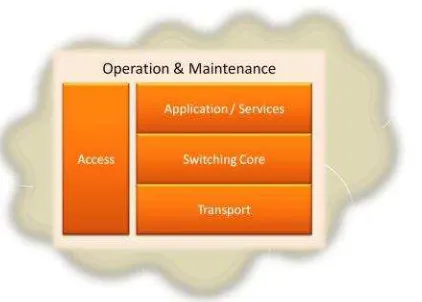
The present day telecom networks are layered as shown in figure 1. The transport layer provides the common photonic framework that interconnects the access networks and elements. Switching, signalling and NGN services are provided by the core layer in the middle which consists of MSCs, GSMCs, Fixed Line Switches, Trunk Automatic Exchanges, Home Location Registers, Value Added Services platforms etc. The application layer at the top hosts contents and services on application servers and access networks facilitates connectivity to the end-users. The technologies deployed include Plesiochronous Digital Hierarchy (PDH), Synchronous Digital Hierarchy (SDH), Dense Wavelength Division Multiplexing (DWDM), Optical Transport Network (OTN), Microwave, VSAT and Optical Burst Switching (OBS) on the transport domain, 2G to 3G, GSM to UMTS, CDMA to HSD in the Wireless domain, IP to MPLS, Circuit Switched to IP Multimedia Subsystem (IMS), Utilities, OSS and many more. The services provided includes POTS, PRI, Leased line, VoIP, HSD, Video Calling, Ethernet Leased Lines, L3-VPN, Mobile TV, Mobile broadband on 3G, etc.
VOLUME NO.2(2012),ISSUE NO.12(DECEMBER) ISSN2231-5756
INTERNATIONAL JOURNAL OF RESEARCH IN COMMERCE, IT & MANAGEMENT
FIGURE 1 – LAYERED TELECOM NETWORKThe Network entity of the telecom company is responsible for planning, deployment, monitoring, operation and maintenance of its overall telecom network. The primary network functions include Planning & Engineering, Installation & Commissioning, Provisioning & Fault Management, Operation, Maintenance, Administration & Performance (OMAP), Quality and other Support functions.
The Learning Center (LC), an ISO 9001:2008 certified entity established in the year 2002. Over the past ten years, LC has trained & certified more than 56,000 employees through instructor led trainings as well as distance learning programs. In addition over 61,000 employees were certified using proprietary self learning methodologies. The LC portfolio comprises of over 220 Instructor Led Training (ILT) courses and 92 Self Learning Modules (SLM) on cutting edge telecom equipment, technologies and services covering all telecom layers. The LC lead trainers (Subject Matter Experts – SME) are functionally aligned to the domain experts. Learning & Development function ensures the readiness of the organizational manpower to quickly adapt to the technological advancements and maintaining high quality standards as per the business requirements.
Individuals in an organisation are distinct in terms of their personality, experience, skills and capability. Meeting key performance indices (KPI) of a modern day telecom network calls for a team effort in order to deliver sustained performance. With the change in technology, increasing complexity of equipments and resultant operation & maintenance (O&M) issues inconsistencies in team & individual performance will translate into poor network performance. A holistic feedback mechanism is required in order to provide effective customised learning solutions targeted at satisfying the network requirements while measuring on-the-job impact of the trainees. The feedback mechanism should be capable of integrating participant perceptions, track assimilation of skill sets and on-on-the-job assessments of the participants and provide objective inputs to the design process. This will facilitate the design and development of customized learning solutions that will lead to employee competency development (as opposed to skill development using conventional design methodologies). A competent workforce forms the corner stone of an organization leading to enhanced EVA, employee (EVP) and customer value proposition (CVP).
2.0
RESEARCH PROBLEM
The design, deployment, maintenance and management of the modern day state-of-the-art telecom networks mandates a pool of competent technical manpower that is capable of quickly adapting to technological and product changes. A dynamic learning and development framework is an important precursor to employee competency development. A competent workforce helps an organization build and sustain a long-term competitive advantage. The major challenges faced by the telcom industry are enumerated below:
• Increasing number of customers, development of new bandwidth intensive applications, design and exponential growth in online gaming results in frequent network expansion for capacity expansions. This results in dynamic changes in network architecture, traffic engineering and deployment of new products and technologies. The technical manpower is thus expected to develop new skills and competencies to keep abreast of the latest technology and products deployed in the network. This calls for frequent “learning and un-learning” cycle putting additional pressure on the workforce
• There is a gap in academic learning verses skill requirement at the industry. Studies (NASSCOM-McKinsey report, 2005) have revealed that only about 25% of total engineering graduates passing out of colleges/universities are possessing skill sets relevant to the telecom industry
• The telecom industry has the highest rate of attrition in the industry. Organizations thus need to invest substantially on training to scale up its employee competencies
• More than 90% of the high end telecom equipments are manufactured in the American, European and Chinese markets. The availability of technical literature and trainings are thus at a very high premium
• In-depth knowledge is a pre-requisite to effective troubleshooting and impacts business performance A holistic feedback mechanism is thus imperative and a pre-cursor to organizational learning & development.
3.0
LITERATURE SURVEY
Literature survey was undertaken to study the subject in hand. The key works that were highly pertinent to the research problem have been reproduced in this section. The study of literature validated the research solution.
Training Needs Assessment (Janice A. Miller, February 1996 Reviewed July 2002)
This research paper highlights the importance of training need assessment. The training needs assessment is a critical activity for the learning and development function. This study provides an overview of the training and development function and highlights how the need assessment fits into this process, followed by an in-depth look at the core concepts and steps involved in conducting a training need assessment. Designing a training and development program involves a sequence of steps that can be grouped into five phases: needs assessment, instructional objectives, design, implementation and evaluation. To be effective and efficient, all training programs must start with a needs assessment. Long before any actual training occurs, the training manager must determine the who, what, when, where, why and how of training. To do this, the training manager must analyze as much information as possible about the following:
• Organization and its goals & objectives
• Jobs and related tasks that need to be learned
• Competencies and skills that are need to perform the job
• Individuals who are to be trained
There are three levels of needs assessment: organizational analysis, task analysis and individual analysis.
1. Organizational analysis looks at the effectiveness of the organization and determines where training is needed and under what conditions it will be conducted
VOLUME NO.2(2012),ISSUE NO.12(DECEMBER) ISSN2231-5756 The 360 degree feedback process involves gathering a full circle of ratings from various perspectives (self, manager, peers, subordinates and customers) in order to diagnose skills and provide feedback to participants. While 360 degree feedback has several advantages, they are often not fully realized due to flaws in the survey design and/or poor implementation of the 360 assessment process. This Insight white paper offers suggestions on how to develop a valid and effective 360 degree feedback survey, and how to conduct an effective process that can lead to valid assessments of capabilities and employee development.
Transfer of Training: The Role of Feedback In Supportive Social Networks (Piet Van den Bossche, June 2010)
The transfer of training to the workplace often fails to occur. The authors argue that feedback generated within the work environment about the application of newly learned skills in the workplace helps to close the gap between the current performance and the desired goal of full application of what is learned during training. This study takes a social network perspective and explores the role of feedback generated within the social network in fostering motivation-to-transfer and the transfer of training. The results show that the number of people providing feedback and the helpfulness of this feedback are positively related to the motivation for and actual transfer of training. The frequency of feedback appears to be negatively related. This study underlines the importance of feedback in turning the workplace into a learning environment fostering the transfer of training.
The literature survey helped to get insights about feedback from unconventional sources like employee mentoring, network performance report analysis, MTTR and even post training validation. The analysis of these feedbacks will form the basis of development of dynamic learning solution to cater to the changing requirements.
4.0
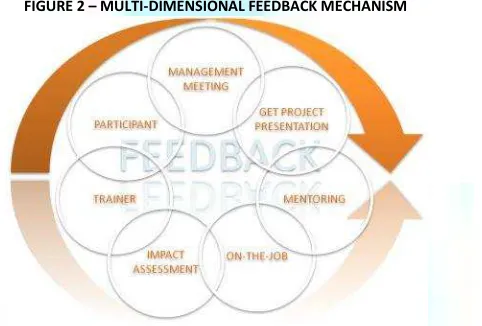
MULTI-DIMENSIONAL FEEDBACK MECHANISM
LC uses a proprietary multi-dimensional feedback mechanism for evaluating effectiveness of its training program. The figure 2 illustrates this feedback mechanism. The multi-dimensional model integrates feedback from multiple sources including participants of training programs – classroom, virtual and self learning, trainers, impact analysis reports, on-the-job training assessment sheets, mentoring reports, graduate engineering trainees (GET) 6-monthly and confirmation presentations, senior management reviews, open houses, quarterly quality management reviews (QMR), Network performance reports (Daily, Weekly, Fortnightly, Monthly, Quarterly and Annual), validation test scores and assessment, certification and online quizzes. The learning’s are translated to actionable points through integration with the development life-cycle.
FIGURE 2 – MULTI-DIMENSIONAL FEEDBACK MECHANISM
The conventional approaches of collating training feedbacks are not a sufficient indicator of the efficacy of the training programs. In fact there are many other avenues for tapping feedbacks for productivity and performance improvement of a telecom network. Current methods of participant validation involve a mandatory test at the end of a training program, the scores of which are deemed to be indicative of the participants’ knowledge of the subject. However unattempted or wrong answers in the validation test can provide ample insights into the learning gaps of the participants’ learning and are never looked into. In addition, network performance indicators, Mean-Time-To-Repair (MTTR), Root Cause Analysis (RCA), network failures etc provide good insights to potential learning gaps and should be used as training design inputs to improve upon the existing training modules and its delivery. In-depth knowledge is a pre-requisite to effective troubleshooting and impacts business performance.
Network performance reports of all the network elements (NEs) are generally captured by operation support systems. These reports provide key performance indices (KPIs) of cellular radio network, packet and TDM core networks, value added services (VAS) platforms etc. Performance parameters, its threshold settings and observed gap give insight on network quality, performance. These important feedbacks provide ample opportunity to uncover potential learning gaps and reinforcing redesigned course modules to improve competency level of employees. Return of investment (ROI) from training can be maximised when holistic feedback is taken into account in current training process.
The constituents of the multi-dimensional feedback system developed by the LC are enumerated in the following section:
• Trainer Feedback on any critical points or supplementary observations raised by training participants
• Impact Assessment is carried out by taking specific feedback (half-yearly) from the reporting managers of the training participants on the outcomes of training programs
• On-the-job feedback is used to evaluate and modify the trainings imparted to the fresh engineering recruits. This feedback also forms an important source for training need identification, course design & development and delivery
• Mentoring feedback provide details about the performance of the mentees. Because of their regular interaction with mentees, mentor is able to capture feedback which is not captured during normal training delivery
• GET project 6 monthly and confirmation presentations provide direct feedback on their learning and shortcomings during the training period
• Organizational learning and development activities and progress are presented and tracked at senior management meetings and the feedback obtained in ploughed back as a design input
Training programs supplemented with self learning modules (SLM) enhances the learning efficiency. A paradigm shift is required in Training Need Identification (TNI), equipping trainers (SMEs) with sufficient skills and knowledge, course design & development, thorough feedback capturing & analysis and training delivery. It is conclusively established that continuous learning and skill updation is mandatory to the various stakeholders in the telecom domain – the individuals as well as teams/organizations.
The following points summarises the need for a multi-dimensional feedback mechanism:
1. There are many potential areas for obtaining critical feedback for the learning & development function, which are not generally included in the normal evaluation process. These include on-the-job feedback, validation test, impact analysis, mentoring, presentations by participants, meetings, network performance reports, MTTR and downtime analysis among others
VOLUME NO.2(2012),ISSUE NO.12(DECEMBER) ISSN2231-5756
INTERNATIONAL JOURNAL OF RESEARCH IN COMMERCE, IT & MANAGEMENT
5.0
LEARNING AND DEVELOPMENT FRAMEWORK
LC has developed two models for providing customized learning solutions to meet the technological challenges, business requirements while keeping in mind the unique requirements of individual learners. The ALS model has been developed to accelerate the learning curve of fresh engineering graduate recruits while 3T’s model meets the requirements of the experienced engineers.
ACCELERATED LEARNING SOLUTION FRAMEWORK
The Accelerated Learning Solution Framework (ALS) offers instructor led conventional and virtual classroom (video conference) learning supplemented by a self learning framework.
3TS (TELECOMMUNICATION, TECHNOLOGY AND TRAINING)
3Ts (Telecommunication, Technology and Training) model is a cost effective learning solution in comparison with conventional & virtual classroom techniques. It is tempered with a voluntary self learning and mandatory certification mechanism, thereby increasing its effectiveness and creating a learning organization. The model goes beyond traditional e-learning and is an amalgamation of online learning, virtual learning, distributed learning, networked or web-based learning techniques. 3Ts training model includes hands-on experience on live equipments in training labs that can be accessed locally as well as remotely over Intranet/Internet. Trainers provide online guidance and evaluation to individual participants during practical sessions. 3Ts model facilitates balances learning while developing proficiencies required in managing huge multi service global networks within specified quality levels.
5.1 TRAINING NEED ASSESSMENT
Designing a training and development program involves a sequence of steps that can be grouped into five phases: needs assessment, instructional objectives, design, implementation and evaluation. The training needs are assessed by a 4-tier hierarchy comprising of the immediate supervisor, department head, Learning Center and HR. Training needs are assessed broadly based on
• Organization and its goals and objectives
• Jobs and related tasks that need to be learned
• Competencies and skills that are need to perform the job
• Individuals who are to be trained
The learning solutions are structured into three levels basic, intermediate and advanced. 5.2 CURRICULUM DEVELOPMENT
Learning solutions are developed based on the inputs received from training need analysis and the multi-dimensional feedback mechanism. These include conventional courseware, presentations supplemented with e-learning modules (self learning), videos, best practices, route cause analysis (RCA) duly validated by LC and functional subject matter experts.
5.3 TRAINING DELIVERY
The reinforcement of training solutions after taking into account all the training needs is done through following methods:
• Conventional classroom
• Video Conference (VC) based distance learning
• Voluntary self learning & mandatory certification
• On-the-job learning
Conventional classroom based training is primarily used for Induction training of fresh engineers and employees present at training location. To infuse required skills and capability, LC offers them 3Ts (Telecommunication, Technology and Training) blended learning exposure of theory and hands-on on telecom technology and network equipments. It is a cost effective learning solution, developed by leveraging LC’s experience in delivering learning solutions for over a decade, as compared to conventional & virtual classroom techniques. The model goes beyond traditional e-learning and is an amalgamation of online learning, virtual learning, distributed learning, networked or web-based learning techniques. Training on diverse and complex telecommunication technologies gives leverage to a corporate on doing strategic planning, data security, offering competitive B2B & B2C solutions, efficient network operation and management. 5.4 TRAINING EVALUATION & FEEDBACK
Training program include an evaluation mechanism to track employees learning. Certified task-force is the key in achieving set targets, productivity and growth. Improved service quality, customer satisfaction and retention, higher network usage and hence higher revenues are then achievable goals. Learning environment in an organisation creates a win-win situation for both employees and the organisation.
6.0
RESEARCH METHODOLOGY
The broad objective of this research is to present and analyze the impact of a multi-dimensional feedback mechanism on employee competency development and productivity improvement in the telecom industry.
6.1 RESEARCH OBJECTIVES The specific objectives include:
• To establish the impact of feedback on training delivery and employee competency development
• To measure the effectiveness of a holistic feedback mechanism on employee productivity and performance 6.2 HYPOTHESIS
Hypothesis for this research is as below:
H1: A multi-dimensional feedback mechanism positively impacts Employee Learning and Development
H2: A multi-dimensional feedback mechanism contributes to the development and delivery of effective enterprise Learning Solutions 6.3 SAMPLING DESIGN
The research employed stratified variable sampling with a sample size of 100. The issue of variable sampling has been used extensively in conceptual development but has received almost no empirical evaluation. The development of both validity and reliability models has used the concept of variable sampling. For example, content validity "is established by showing that the test items are a sample of a universe in which the investigator is interested" (Cronbach & Meehl, 1955, p. 285). Likewise, internal consistency definitions of reliability, such as KR-20 or coefficient alpha, have relied on variable-sampling arguments (Cronbach, 1951; Kuder & Richardson, 1937).
This research study was based on the data collected from the core network period 2011-2012. A sample size of 100 participants is deemed to be statically significant for the purpose of hypothesis testing.
6.4 DATA COLLECTION
The primary data for this research has been collected through online feedback system, LC management information system (MIS), PMS records, mentoring feedback, impact assessment, CTO review meetings, National Network Operation Center (NNOC) performance reports on core switch MTTR, switch availability & answer to seizure ratio.
6.5 DATA ANALYSIS AND INTERPRETATION
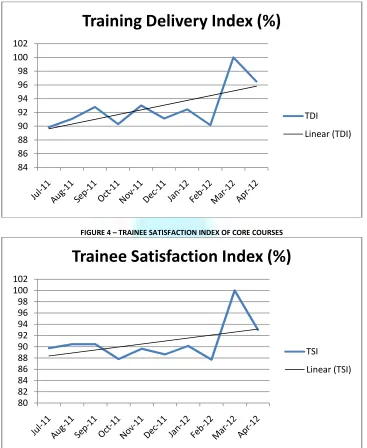
VOLUME NO.2(2012),ISSUE NO.12(DECEMBER) ISSN2231-5756 FIGURE 3 – TRAINING DELIVERY INDEX OF CORE DOMAIN - SWITCH
FIGURE 4 – TRAINEE SATISFACTION INDEX OF CORE COURSES
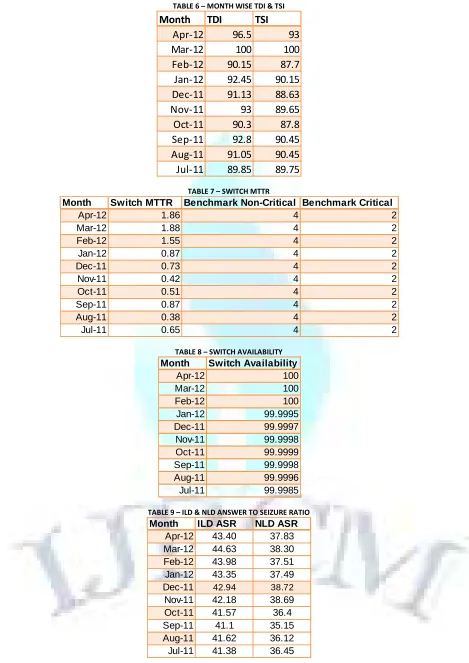
Feedback of participants and few main telecom network KPIs – MTTR, Availability and Answer to Seizure Ration (ASR) are analysed for hypothesis testing. MTTR is a basic measure of the maintainability of repairable items. It represents the average time required to repair a failed component or device. It is the total corrective maintenance time divided by the total number of corrective maintenance actions during a given period of time. Network MTTR for critical and non-critical faults is set at 2 hrs and 4 hrs respectively. The Switch MTTR in figure 5 shows that switch MTTR is well within the minimum limit of 2 hrs for all types of faults.
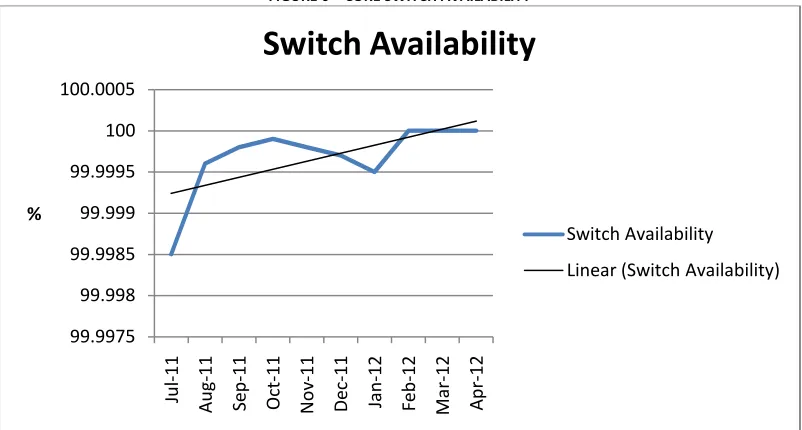
FIGURE 5 – CORE SWITCH MTTR
84
86
88
90
92
94
96
98
100
102
Training Delivery Index (%)
TDI
Linear (TDI)
80
82
84
86
88
90
92
94
96
98
100
102
Trainee Satisfaction Index (%)
TSI
Linear (TSI)
0
0.5
1
1.5
2
2.5
3
3.5
4
4.5
Hrs
Switch MTTR
Switch MTTR
Benchmark Non-Critical
VOLUME NO.2(2012),ISSUE NO.12(DECEMBER) ISSN2231-5756
INTERNATIONAL JOURNAL OF RESEARCH IN COMMERCE, IT & MANAGEMENT
Improved switch availability directly represents the readiness of the exchanges to carry subscriber call or services. It leads to increase in or sustained level of ARPU (Average Revenue Per User), Wireless MoU per sub (Minutes of Use), RPM (Revenue Per User), EBITDA (Earning Before Interest Tax Depreciation & Amortisation) and customer satisfaction. Figure 6 shows sustained high core switch availability over the observed period.FIGURE 6 – CORE SWITCH AVAILABILITY
Figure 7 represents Answer to Seizure ratio of telecom switches. ASR represents a ratio of successful call to all call attempts received by the exchange. All call attempts (seizures) do not result into revenue for the operator. An answered call ensures revenue from the call. There are many factors beyond network, affecting ASR. Some of the reasons of poor ASR is no answer by the called party, rejecting a call by the subscriber, ring out and no answer etc. Improvement on ASR can be achieved by high network availability and improved network KPI or quality. Improvement on ASR over a long period indicates improved and healthy network.
FIGURE 7 – CORE SWITCH - ANSWER TO SEIZURE RATIO
6.6 HYPOTHESIS TESTING Null Hypothesis
H01: A multi-dimensional feedback mechanism does not impact organizational learning and development
TABLE 1 – HYPOTHESIS TEST SUMMARY FOR FEEDBACK & LEARNING PAIRED SAMPLES TEST
Paired Differences t dfSig. (2-tailed)
Mean Std. Deviation Std. Error Mean95% Confidence Interval of the Difference Lower Upper
Pair 1ILDASR - TDI 4.12927 2.72879 .86292 2.17721 6.08133 4.785 9 .001 Pair 2SwitchAvail - TDI7.27668003.2222849 1.0189760 4.9715962 9.5817638 7.141 9 .000 Pair 3ILDASR - TSI 6.09427 3.17177 1.00300 3.82533 8.36322 6.076 9 .000 Pair 4NLDASR - TSI -6.06255 3.92055 1.23979 -8.86714 -3.25795 -4.890 9 .001 It can be observed that from Table 1 that p<0.05 for Pair 1 & 2. The null hypothesis stands rejected.
It can thus be inferred that a multi-dimensional feedback mechanism positively impacts organizational learning and results in employee competency development.
H02: A multi-dimensional feedback mechanism does not contribute to the development and delivery of effective enterprise learning solutions.
It can be observed that from Table 1 that p<0.05 for Pair 3 & 4. The null hypothesis stands rejected.
Thus it can be inferred that the multi-dimensional feedback mechanism results in the development and delivery of effective learning solutions that positively impacts employee and network performance.
99.9975
99.998
99.9985
99.999
99.9995
100
100.0005
Ju
l-1
1
A
u
g
-1
1
S
e
p
-1
1
O
ct
-1
1
N
o
v-1
1
D
e
c-1
1
Ja
n
-1
2
F
e
b
-1
2
M
a
r-1
2
A
p
r-1
2
%
Switch Availability
Switch Availability
Linear (Switch Availability)
0.00
5.00
10.00
15.00
20.00
25.00
30.00
35.00
40.00
45.00
50.00
Answer to Seizure
ILD ASR
VOLUME NO.2(2012),ISSUE NO.12(DECEMBER) ISSN2231-5756
7.0
KEY FINDINGS
7.1 DESCRIPTIVE STATISTICS
TABLE 2 - DESCRIPTIVE STATISTICS
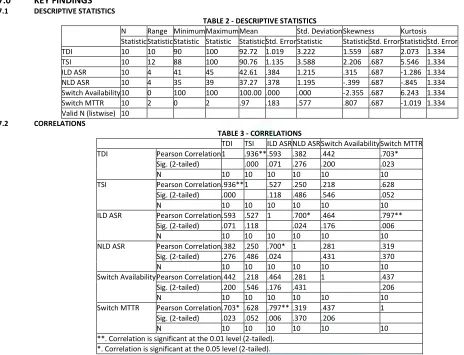
N Range MinimumMaximumMean Std. DeviationSkewness Kurtosis Statistic Statistic Statistic Statistic Statistic Std. Error Statistic StatisticStd. Error Statistic Std. Error TDI 10 10 90 100 92.72 1.019 3.222 1.559 .687 2.073 1.334 TSI 10 12 88 100 90.76 1.135 3.588 2.206 .687 5.546 1.334 ILD ASR 10 4 41 45 42.61 .384 1.215 .315 .687 -1.286 1.334 NLD ASR 10 4 35 39 37.27 .378 1.195 -.399 .687 -.845 1.334 Switch Availability10 0 100 100 100.00 .000 .000 -2.355 .687 6.243 1.334 Switch MTTR 10 2 0 2 .97 .183 .577 .807 .687 -1.019 1.334 Valid N (listwise) 10
7.2 CORRELATIONS
TABLE 3 - CORRELATIONS
TDI TSI ILD ASRNLD ASRSwitch AvailabilitySwitch MTTR TDI Pearson Correlation1 .936**.593 .382 .442 .703*
Sig. (2-tailed) .000 .071 .276 .200 .023
N 10 10 10 10 10 10
TSI Pearson Correlation.936**1 .527 .250 .218 .628 Sig. (2-tailed) .000 .118 .486 .546 .052
N 10 10 10 10 10 10
ILD ASR Pearson Correlation.593 .527 1 .700* .464 .797** Sig. (2-tailed) .071 .118 .024 .176 .006
N 10 10 10 10 10 10
NLD ASR Pearson Correlation.382 .250 .700* 1 .281 .319 Sig. (2-tailed) .276 .486 .024 .431 .370
N 10 10 10 10 10 10
Switch AvailabilityPearson Correlation.442 .218 .464 .281 1 .437 Sig. (2-tailed) .200 .546 .176 .431 .206
N 10 10 10 10 10 10
Switch MTTR Pearson Correlation.703* .628 .797** .319 .437 1 Sig. (2-tailed) .023 .052 .006 .370 .206
N 10 10 10 10 10 10
**. Correlation is significant at the 0.01 level (2-tailed). *. Correlation is significant at the 0.05 level (2-tailed). INTERPRETATION: Following is observed from the above correlations.
1. Training Delivery Index has strong correlation with Trainee Satisfaction Index. Multi-dimensional feedbacks when taken into account for course improvement and delivery, positively impacts trainee satisfaction i.e. improved training contents are helpful in achieving on-the-job competence.
2. Training Deliver Index has strong correlation with switch Mean-Time-To-Repair. MTTR is observed well within the allowed specification limits. Improvement in training programs by incorporating multi-dimensional feedbacks has led to high levels of competence among the participants resulting in efficient handling of network O&M issues. This is reflected in sustained high levels of Switch MTTR. Following can be inferred from the TDI & MTTR correlation.
a. A positive impact of training delivery on employee competencies b. Fulfilment of training needs
c. Training ROI
3. Answer-to-seizure ratio of international long distance calls has high correlation with MTTR and hence TDI. This shows that learning solutions developed taking into account the multi-dimensional training feedback has resulted in less downtime of the network and high amount of successful calls which results into enhanced MoU, ARPU and EBITDA.
7.3 RELIABILITY STATISTICS
TABLE 4 - RELIABILITY STATISTICS Cronbach's Alpha N of Items
.754 6
INTERPRETATION: Cronbach's (alpha) is a coefficient of reliability. Cronbach's alpha will generally increase as the inter-correlations among test items increase, and is thus known as an internal consistency estimate of reliability of test scores. Because inter-correlations among test items are maximized when all items measure the same construct, Cronbach's alpha is widely believed to indirectly indicate the degree to which a set of items measures a single uni-dimensional latent construct. Cronbach’s Alpha values > 0.7 shows an acceptable level of internal consistency.
7.4 FACTOR ANALYSIS
TABLE 5 - PRINCIPAL COMPONENT ANALYSIS TOTAL VARIANCE EXPLAINED
ComponentInitial Eigenvalues Extraction Sums of Squared LoadingsRotation Sums of Squared Loadings Total % of VarianceCumulative %Total % of Variance Cumulative % Total % of Variance Cumulative % 1 3.64460.731 60.731 3.644 60.731 60.731 2.554 42.565 42.565 2 1.01416.897 77.628 1.014 16.897 77.628 2.104 35.063 77.628 3 .759 12.655 90.282
4 .471 7.855 98.137 5 .097 1.620 99.757 6 .015 .243 100.000
Extraction Method: Principal Component Analysis.
VOLUME NO.2(2012),ISSUE NO.12(DECEMBER) ISSN2231-5756
INTERNATIONAL JOURNAL OF RESEARCH IN COMMERCE, IT & MANAGEMENT
account for more than 77 percent variability. In other words effective feedback has a direct positive impact on training, employee on-the-job competency development and telecom network productivity & performance.8.0
SCOPE FOR FURTHER STUDY
• Current study was conducted with 100 samples on Core Switch domain. Study may further be extended to other areas of telecom network e.g. GSM & CDMA Wireless, wireline, Access, Transport network etc with a large sample size
• To findings of this study may be validated through analysis of secondary data from similar studies in other telcos
9.0
CONCLUSION
• The study conclusively establishes the positive impact of feedback on training delivery and employee on-the-job competency development
• Holistic feedback mechanism ensures better training delivery. Effective training delivery enhances employee competencies and translates to effective O&M practices those results in improved network availability & performance
10.0
THEORETICAL, PRACTICAL IMPLICATIONS & LIMITATIONS OF THE STUDY
Evaluating training effectiveness is important because it sheds light on four aspects. This includes:
• How well the training program met the learner’s needs and objectives
• What knowledge and skills it has imparted to learners
• What desirable change it has brought in the learners’ performance
• What organizational benefits it has yielded
Financial assessment of a training program is crucial in that it provides useful insights into the Returns on Investment (ROI). This assessment depends on evaluating how well the employees implemented the skills they have learnt in the training program.
Effective use of training feedback for reinforcement of learning solutions is a pre-requisite for employee productivity enhancement and competency development. The proactively use of a feedback mechanism:
• Helps employees to monitor their own improvement
• Builds morale, by demonstrating an interest in staff development
• To maximize the training ROI (return on investment)
• Helps to determine the form of future training programs
• Assists with identifying the effectiveness of different forms of teaching (such as classroom based or distance learning)
11.0
REFERENCES
1. Corporation, C. (2007). Developing An Effective 360 Degree Feedback Survey And Conducting A Successful Campaign. SPHR
2. John W. Buelow, The Direct Path to Training ROI, Shapiro Negotiations Institute MS Johns Hopkins University, 2008 Shapiro Negotiations Institute, LLC 3. Ram Sreenivasan, Warier Sudhir, Krishnan LRK (Volume No. 2 (2012), Issue No. 4 (April)). Accelerated Learning Solutions (ALS) – A Model For Learning On
The Job & Productivity Enhancement Of Fresh Engineering Graduates Through TITP (Telecom Industry Training And Placement). International Journal Of Research In Computer Application & Management
4. Verma Ajay Kr, Warier Sudhir, Krishnan LRK (Volume No. 2 (2012), Issue No. 4 (April)). Telecommunication, Technology & Training (3Ts) - A Unique Learning Model For Telcos. International Journal Of Research In Commerce, IT & Management
5. Atwater, L. E., Waldman, D. A., and Brett, J. F. (2002), Understanding and Optimizing Multisource Feedback, Wiley Inter-sciences. Journal of Human Resource Management, 41(2), pp. 193-208
6. Barbara Means, et. al., Evaluation of Evidence-Based Practices in Online Learning: A Meta-Analysis and Review of Online Learning Studies, Revised September 2010, U.S. Department of Education, Office of Planning, Evaluation, and Policy Development Policy and Program Studies Service
7. Brinkerhoff, R. O., (2006). Increasing Impacts of Training Investments: An Evaluation Strategy for Building Organizational Learning Capability, Industrial and Commercial Banking. Emerald Group of Publishers, 38(6), pp. 302-307
8. Cushing Anderson, Impact of Training on Network Administration: Certification Leads to Operational Productivity
9. Deb Sagarmay, Effective Distance Learning in Developing Countries Using Mobile and Multimedia Technology, International Journal of Multimedia and Ubiquitous Engineering, Vol. 6, No. 2, April, 2011
10. Eberlein, M., Ludwig, S., and Nfziger, J. (2010). The Effects of Feedback on Self-Assessment, Blackwell Publishing Limited. Bulletin of Economics Research, 63(2), 177-197
11. NAIDU SOM, E-Learning - A Guidebook of Principles, Procedures and Practices, 2nd Revised Edition, CEMCA, 2006, Commonwealth Educational Media Center for Asia (CEMCA)
12. Newell E. Chiesl, Indiana State University, DESIGNING INTERACTIVE SELF-LEARNING MODULES USING MACROMEDIA DIRECTOR, Developments in Business Simulation and Experiential Learning, Volume 28, 2001
13. Janice A. Miller, S. a. (February 1996 Reviewed July 2002). Training Needs Assessment. SPHR
14. Thalheimer, W. (2003, January). The learning benefits of questions. Retrieved November 31, 2003, from http://www.learningadvantage.co.za/ pdfs/questionmark/LearningBenefitsOfQuestions.pdf
VOLUME NO.2(2012),ISSUE NO.12(DECEMBER) ISSN2231-5756
APPENDIX
TABLE 6 – MONTH WISE TDI & TSI
TABLE 7 – SWITCH MTTR
TABLE 8 – SWITCH AVAILABILITY
TABLE 9 – ILD & NLD ANSWER TO SEIZURE RATIO
Month
TDI
TSI
Apr-12
96.5
93
Mar-12
100
100
Feb-12
90.15
87.7
Jan-12
92.45
90.15
Dec-11
91.13
88.63
Nov-11
93
89.65
Oct-11
90.3
87.8
Sep-11
92.8
90.45
Aug-11
91.05
90.45
Jul-11
89.85
89.75
Month
Switch MTTR
Benchmark Non-Critical Benchmark Critical
Apr-12
1.86
4
2
Mar-12
1.88
4
2
Feb-12
1.55
4
2
Jan-12
0.87
4
2
Dec-11
0.73
4
2
Nov-11
0.42
4
2
Oct-11
0.51
4
2
Sep-11
0.87
4
2
Aug-11
0.38
4
2
Jul-11
0.65
4
2
Month
Switch Availability
Apr-12
100
Mar-12
100
Feb-12
100
Jan-12
99.9995
Dec-11
99.9997
Nov-11
99.9998
Oct-11
99.9999
Sep-11
99.9998
Aug-11
99.9996
Jul-11
99.9985
Month
ILD ASR
NLD ASR
Apr-12
43.40
37.83
Mar-12
44.63
38.30
Feb-12
43.98
37.51
Jan-12
43.35
37.49
Dec-11
42.94 38.72Nov-11
42.18
38.69
Oct-11
41.57
36.4
Sep-11
41.1
35.15
Aug-11
41.62
36.12
VOLUME NO.2(2012),ISSUE NO.12(DECEMBER) ISSN2231-5756
INTERNATIONAL JOURNAL OF RESEARCH IN COMMERCE, IT & MANAGEMENT
REQUEST FOR FEEDBACK
Dear Readers
At the very outset, International Journal of Research in Commerce, IT and Management (IJRCM)
acknowledges & appreciates your efforts in showing interest in our present issue under your kind perusal.
I would like to request you to supply your critical comments and suggestions about the material published
in this issue as well as on the journal as a whole, on our E-mail i.e.
for further
improvements in the interest of research.
If you have any queries please feel free to contact us on our E-mail [email protected].
I am sure that your feedback and deliberations would make future issues better – a result of our joint
effort.
Looking forward an appropriate consideration.
With sincere regards
Thanking you profoundly
Academically yours
Sd/-