of Biological Research
European Journal of Biological Research 2017; 7 (1): 22-30
Optimization of lactic acid production by a novel strain,
Enterococcus faecalis
KY072975 isolated from infants
stool in Egypt
Akram A. Aboseidah
1, Abdel-Hamied M. Rasmey
1*, Magdy M. Osman
2,
Nehal Kamal
1, Salha G. Desouky
11
Department of Botany and Microbiology, Faculty of Science, Suez University, Suez, Egypt
2
Dairy Department, Faculty of Agriculture, Suez Canal University, Ismailia, Egypt *Corresponding author: Abdel-Hamied M. Rasmey; E-mail: [email protected]
ABSTRACT
Production of lactic acid using a novel strain of lactic acid bacteria isolated from infants stool was investigated in the present study. Out of ten isolates, a total of five bacterial isolates were found as positive in lactic acid production. The tested bacterial isolate W7 was observed as the potent strain in lactic acid production that exhibited a halo zone of 8 mm. The bacterial isolate W7 was identified phenotypically and genotypically as Enterococcus faecalis and was deposited in GenBank with accession number KY072975. The effect of different process parameters such as initial pH of the medium, incubation temperature, inoculum size and incubation time was also monitored to enhance lactic acid production and resulted in optimum lactic acid value of 0.72 mg/mL. The salted whey was the most applicable fermentation medium for production of lactic acid by Enterococcus faecalis KY072975 and recorded 2.07 ± 0.1 mg/mL.
Keywords: Optimization; Lactic acid;
Fermen-tation; Skimmed milk; Whey; Enterococcus.
1. INTRODUCTION
Lactic Acid Bacteria (LAB) are a group of diverse Gram-positive bacteria commonly used in the food industry and used in making starter culture for dairy products. Bacterial fermentation has the advantage that by choosing a strain of lactic acid bacteria (LAB) producing only one of the isomers, an optically pure product can be obtained, whereas synthetic production always results in a racemic mixture of lactic acid. Lactic acid is an organic acid with a wide range of applications in the food, pharmaceutical and cosmetics industries [1, 2]. Lactic acid fermentation has gained increased attention in the recent years, mainly due to its importance as building block in the manufacture of biodegradable plastics [3-5]. In addition, it has recently been studied with great interest as a biodegradable polylactic acid (PLA) that can be used to improve physical properties in the production of food packaging, plastic utensils, garbage bags and agricultural plastic sheeting, thereby replacing products made from petroleum [6-7]. Recently, lactic acid is widely used as a food additive in food industry, where it serves in a
Received: 15 November 2016; Revised submission: 03 January 2017; Accepted: 13 January 2017
Copyright: © The Author(s) 2017. European Journal of Biological Research © T.M.Karpiński 2017. This is an open access article licensed under the terms of the Creative Commons Attribution Non-Commercial 4.0 International License, which permits
unrestricted, non-commercial use, distribution and reproduction in any medium, provided the work is properly cited.
European Journal of Biological Research 2017; 7 (1): 22-30 wide range of functions, such as flavouring, pH
regulation, improved microbial quality and mine- ral fortification. Moreover, lactic acid is used commercially in the processed meat and poultry industries, to provide products with an increased shelf life, enhanced flavour and better control of food-borne pathogens. Due to the mild acidic taste of lactic acid, it is also used as an acidulant in salads and dressings, baked goods, pickled vegetables, and beverages etc. [1, 8].
Lactic acid can be produced either through microbial fermentation or chemical synthesis. Of the total lactic acid produced worldwide every year, about 90% are made by lactic acid microbial fermentation and the rest is produced synthetically by the hydrolysis of lactonitrile [9, 10]. Although most investigations of lactic acid production were carried out with lactic acid bacteria (LAB), some filamentous fungi may be used such as Rhizopus which utilizes glucose aerobically to produce lactic acid [11]. However, the yield and productivities of fungal and yeast strains are very low compared with lactic acid bacteria. The production of optically pure lactic acid is essential for the polymer synthesis in which lactic acid is used [12, 13]. In addition, optically pure L(+) lactic acid is polymerized to a high crystal polymer suitable for fiber and oriented film production and is expected to be useful in the production of liquid crystal as well [14]. Moreover, L (+) lactic acid is used by human metabolism due to the presence of L-lactate dehydrogenase and is preferred in foods as preservative as well as emulsifier [12, 15]. For the industrial production of L-lactic acid, it is necessary to provide cheap carbon sources that can be easily metabolized by lactic acid bacteria. A number of industrial by-products or wastes have been evaluated as substrates for lactic acid production with the aim of decreasing the cost of the process, such as sugarcane [16], molasses [17] and whey [18] as carbon sources, and to obtain the optimal conditions of fermentation with higher yields and production rates [19]. In the recent years, there have been various attempts by researchers to produce lactic acid efficiently from inexpensive raw materials by novel lactic acid bacterial isolates able to tolerate high salinity of the substrate and high temperatures. Therefore, the present investigation was aimed to evaluate and optimize lactic acid production by a novel strain of lactic acid bacteria
tolerant to saline fermentation medium.
2. MATERIALS AND METHODS
2.1. Source of microorganisms
A total of 10 isolates of lactic acid bacteria previously recovered from infants stool on MRS agar medium were used in the present investigation. Ten infants stool samples were collected from different baby centers and analyzed by the dilution pour plate method. For this purpose, 10 grams of each sample were weighed aseptically and homogenized in 90 ml of sterile saline solution. Then, sequential decimal dilutions of the homogenate were obtained. One ml aliquot of the 10-4, 10-5, 10-6, and 10-7 dilutions was transferred to plates and the melted MRS agar medium was poured. MRS plates were incubated for 3 days at 30°C in anaerobic conditions. The separated colonies were picked, subcultured, maintained on MRS slants and stored at 4°C for further experiments.
2.2. Preparation of bacterial inocula
A loopful of refreshed bacterial culture was inoculated and grown in 50 mL bottles contained 20 mL of MRS broth medium and incubated for 24 h at 37°C under anaerobic conditions (GasPak System - Oxoid, Basingstoke Hampshire, England). The MRS medium [20] contained (g/l distilled water): glucose 10, peptone 10, beef extract 10, yeast extract 5, K2HPO4 2, sodium acetate 5,
tri-ammonium citrate 2, MgSO4·7H2O 0.2, MnSO4·
4H2O 0.2 and Tween 80 (1 ml).
2.3. Detection of lactic acid production on agar medium
Production of lactic acid by the tested isolates was determined on MRS-agar plates supplemented by 1% CaCO3 [21]. The plates were inoculated with
European Journal of Biological Research 2017; 7 (1): 22-30 was measured in millimeters and recorded.
2.4. Characterization and identification of selected bacterial isolate W7
2.4.1. Morphological characterization
The morphological growth characters of the selected isolate W7 were conducted on MRS agar medium and the colony color, shape and texture were recorded. The cell shape and arrangement were determined by microscopic examination after Gram staining technique in accordance with Collins and Lyne [22].
2.4.2. Physiological and biochemical characteri-zation
The physiological and biochemical characteristics were estimated according to the standard methods. Catalase production [23], carbohydrate utilization [24], growth at 6.5 % NaCl, growth at different temperatures (15 and 45 °C), production of CO2 from glucose and production of
NH3 from arginine were tested on the selected
bacterial isolate W7.
2.4.3. Genotypic characterization
2.4.3.1. DNA extraction
DNA extraction was done using Genomic DNA preparation kit (Jena Bioscience) according to Kozaki et al. [25].
2.4.3.2. PCR amplification
The 16S ribosomal genes were amplified using standard PCR protocol and 16S primers: 16S F: 5′-GAGTTTGATCCTGGCTTAG-3′ and 16S R: 5′GGTTACCTTGTTACGACTT-3′. The PCR amplification was performed using Qiagen Proof-Start Tag Polymerase Kit (Qiagen, Hilden, Germany). The following substrates were combined in a total volume of 25 µl including about 20 ng of template DNA, 12.5 µl PCR Master Mix, 20 pmol (2µl) each of forward and reverse primers and the total reaction volume was completed by 8.5 µl of deionized water. The reaction conditions were: an initial denaturation at 94 °C for 5min, 37 cycles of denaturation at 94 °C for 30 s, annealing at 51°C for
30 s, and extension at 72 °C for 30 s. A final extension was conducted at 72°C for 5 min. PCR products were analyzed by electrophoresis on 1.5 % agarose gel in 1X TAE buffer and the gels were visualized and pictured under UV light. PCR products were purified from gel with the QIAquick gel extraction kit (Qiagen, Hilden, Germany).
2.4.3.3. DNA Sequencing
Sequence similarity was estimated by searching the homology in the Genbank DNA database using BLAST (https://blast.ncbi.nlm. nih.gov/Blast.cgi). Multiple sequence alignment and molecular phylogeny was evaluated using CLUSTALW program (http:// clustalw.ddbj. nig. ac. Jp/top- ehtml). The phylogenetic tree was displayed using the tree view program.
2.5. Monitoring lactic acid production
After bacterial culture was inoculated and grown in 50 mL bottles contained 20 mL of MRS broth medium and incubated for 24 h at 37∘C in
carbon dioxide incubator, 1-2 drops of phenol phethalin solution were added as indicator onto the 2 mL of aliquots. Samples were titrated using standardized 0.1N NaOH solutions. When the first trace of pink color observed, titration was terminated. Consumption of the 0.1N NaOH was recorded. Each ml of 0.1N NaOH equals to 9.008 mg of lactic acid. Finally, the results were expressed in mg/mL.
2.6. Production of lactic acid in different raw materials
20 mL of different fermentation media including skimmed milk (nonfat dry milk made from pasteurized milk in U. S. A by dairy America company), salted whey (6.5 % salt) collected from Dairy processed center in faculty of agriculture at Suez Canal University and whey were prepared and sterilized in autoclave. After sterilization each bottle was inoculated with 1% culture bacteria then incubated at 37°C for 24 h under static conditions.
2.7. Optimization of process parameters
European Journal of Biological Research 2017; 7 (1): 22-30 pH (3, 4.5, 5, 5.5, 6, 6.5, 7 and 8), inoculum
size (0.5, 1, 1.5, 2, 3, 4 and 5%), incubation temperature (15, 20, 30, 37 and 45°C), and incubation period (0, 3, 6, 9, 24, 40, 44 and 48 h) on lactic acid production by the tested bacterial isolate was studied by varying the respective parameters to enhance lactic acid production from MRS broth medium.
3. RESULTS AND DISCUSSION
3.1. Screening of lactic acid production on agar medium
A total of ten isolates were screened on MRS - agar plate supplemented with CaCO3 to study the
ability of bacteria to produce lactic acid. The result was obtained as halo zone (index which consider primer survey for lactic acid production) around the inoculum. These halo zones forming colonies guaranteed to be LAB due to their lactic acid producing properties. The most active bacterial culture W7 showed clear zone of 8 mm was selected for further experiments. Other bacterial cultures (H3, W2, W4 and W6) gives index ranging from 6-7.4 mm while the others tested five isolates showed no clear zone (Table 1). The results were similar to the study conducted by Yi-sheng et al. [21], where a total of 88 acid-producing bacterial strains were isolated from the samples collected in mulberry farms of Taiwan.
3.2. Phenotypic characterization
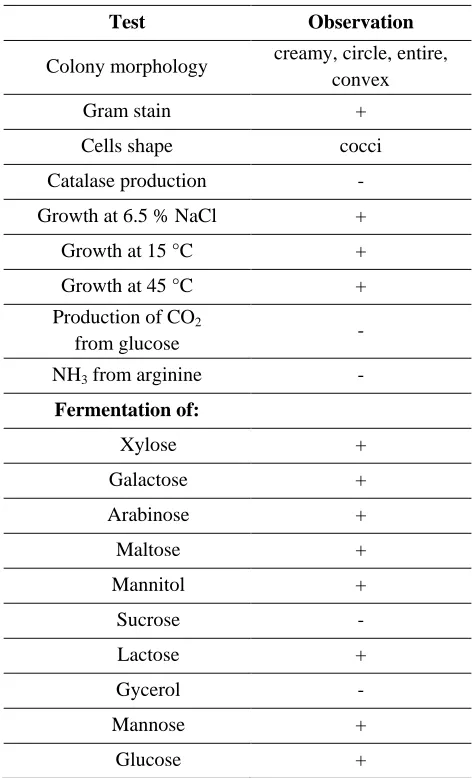
The results of physiological and biochemical characterization of the isolate W7 were shown in Table 2. The obtained result revealed that the bacterial isolate W7 is Gram positive bacterium but was negative for catalase reaction. This isolate was able to tolerate salinity and grow at 6.5 % NaCl. Also, the bacterial isolate W7 was able to grow at different low temperature levels (15-45 ◦C). The results also indicated that the isolate was unable to produce CO2 from glucose and NH3 from
arginine. The tested isolate has the ability to exploit glucose, mannose, galactose, xylose, maltose, mannitol, lactose and arabinose but unable to use sucrose and glycerol as a carbon source. Based on
the taxonomic characteristics described above, the isolate W7 was assigned to the genus Enterococcus.
Table 1. Lactic acid production detected by halo zones
(mm ± SE) on MRS - agar plate supplemented with CaCO3.
Isolate number Halo zone (mm ± SE)
H3 7 ± 0.1
W2 7 ± 0.4
W4 7.4 ± 0.2
W6 6 ± 0.2
W7 8 ± 0.4
Y1, W1, Yf-b,
Yf-g & Mix Negative
Table 2. Morphological and biochemical characterization
of the selected bacterial isolate W7.
Test Observation
Colony morphology creamy, circle, entire, convex
Gram stain +
Cells shape cocci Catalase production - Growth at 6.5 % NaCl + Growth at 15 °C + Growth at 45 °C + Production of CO2
from glucose -
NH3 from arginine - Fermentation of:
Xylose +
Galactose +
Arabinose +
Maltose +
Mannitol +
Sucrose -
Lactose +
Gycerol -
Mannose +
European Journal of Biological Research 2017; 7 (1): 22-30 3.3. Phyllogenetic identification
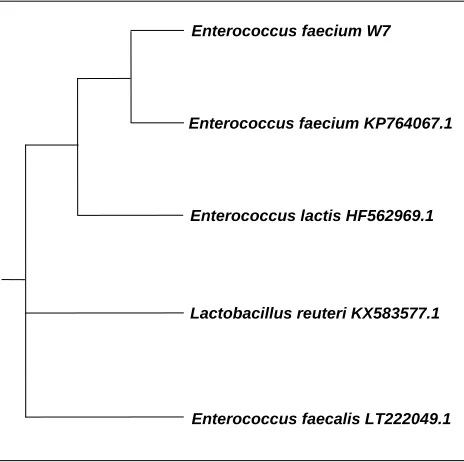
The selected bacterial isolate W7 was identified using phylogenetic analysis of 16S rRNA gene sequences. The partial 16S rRNA gene sequences of tested isolate was matched with previously published bacterial 16S rRNA gene sequences available in National Center for Biotechnology Information (NCBI) using Basic Local Alignment Search Tool (BLAST). Sequence analysis results revealed that the isolate W7 isolate have a sequence with 99% similarity to Enterococcus faecalis. A phylogenetic tree was constructed from a multiple sequences alignment of 16S rRNA gene sequences (Figure 1). The nucleotide sequences of the isolate W7 was deposited in the Gen-Bank nucleotide sequence database under new accession number KY072975.
Figure 1. The neighbor-joining tree based on 16SrRNA
gene sequences showing the positions of Enterococcus
faecalis W7 and related strains in GenBank.
3.4. Effect of pH
The effect of pH on lactic acid production was evaluated by using skimmed milk as fermentation medium having a pH range of 3.0-6.8 (Figure 2). The maximum production of lactic acid was detected at pH 6.5, (0.58 mg/ml). While, the lactic acid production decreased at both higher and
lower pH. A pH 6.5 was reported optimum for lactic acid production by Lactobacillus casei NBIMCC 1013 [26]. However, pH 5.5 has been used for lactic acid production using L. helveticus [27]. Lactococci have been found to withstand extracellular pH values down to 5.7 [28] or 5.0 [29]. Under these conditions, both the intracellular accumulation of the lactate anion [30] and the uncoupling of ATP synthesis [28] have been claimed to inhibit growth. From the above obser-vations, a pH 6.5 was considered optimal for maximum lactic acid production. In the subsequent experiments, the pH of the fermentation medium was adjusted to 6.5.
Figure 2. Effect of pH on lactic acid production by
Enterococcus faecalis W7.
3.5. Effect of temperature
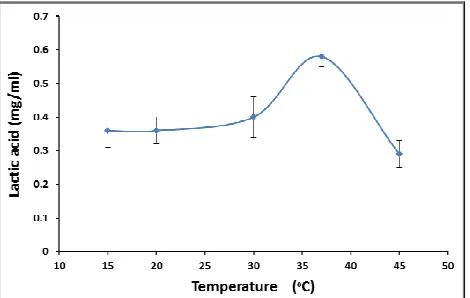
To study the effect of temperature on lactic acid production, skimmed milk medium after inoculation was incubated at a temperature range of 15-45°C. The lactic acid production increase gradually with increasing temperature to reach optimum lactic acid value (0.575 mg/mL) at 37°C then decreased at 45°C (Figure 3). The optimal temperature for growth of lactic acid bacteria varies between the genera from 20 to 45°C [31, 32]. In fermentations using L. delbrueckii, and L. bulgaricus a temperature of 45°C, or higher may
be maintained [33]. L. helveticus, and L. acidophilus can be used in a temperature range of 37-45°C. Krischke et al. [34] and Panesar et al. [26] used 37°C temperature for lactic acid production using L. casei. However, a temperature of 28°C has also been reported optimal for L. casei in a separate Enterococcus faecium W7
Enterococcus faecium KP764067.1
Enterococcus lactis HF562969.1
Lactobacillus reuteri KX583577.1
European Journal of Biological Research 2017; 7 (1): 22-30 study [35]. The temperature is also one of the
important factors, which influences the activity of metabolic cell enzymes. Enzymes are most active at optimum temperature and enzymatic reaction proceeds at maximum rate. Wouters et al. [36] noted reduced glycolytic activity leading to redu- ced production of lactic acid in L. lactis at low temperature. The ability to grow at high temperature is a desirable trait as it could translate to increased rate of growth and lactic acid production. At the same time, a high fermentation temperature reduces contamination by other microorganisms. So it was concluded that the optimum temperature for lactic acid production was 37°C and consequently a temperature of 37°C was selected for further experimentation.
Figure 3. Effect of temperature on lactic acid production
by Enterococcus faecalis W7.
3.6. Effect of inoculum size
Different inoculum levels (0.5-5%, v/v) were added to the fermentation medium (Figure 4). The lactic acid production increased gradually with increasing inoculum size to reach maximum value (0.72 mg/mL) at 5% inoculum size. This indicates that the lactic acid production increase with increasing density of starter culture. The low lactic acid production at 1% (v/v) inoculum level could be attributed to the low density of starter culture. The use of 2% (v/v) inoculum for the lactic acid production has been reported in earlier studies [37, 38]. 3%, v/v inoculum has also been used for lactic acid production [39]. Guha et al. [40] observed maximum lactic acid production of 2.52 gm/L with 4% (v/v) inoculum of bacterial culture. Panesar et
al. [26] observed maximum lactic acid production of 33.72 gm/L when the fermentation medium was inoculated with 2-4% (v/v) inoculum of the tested bacterial culture.
Figure 4. Effect of inoculum size on lactic acid
production by Enterococcus faecalis W7.
3.7. Effect of incubation time
European Journal of Biological Research 2017; 7 (1): 22-30 Figure 5. Effect of incubation time on lactic acid
production by Enterococcus faecalis W7.
3.8. Lactic acid production in different fermentation media
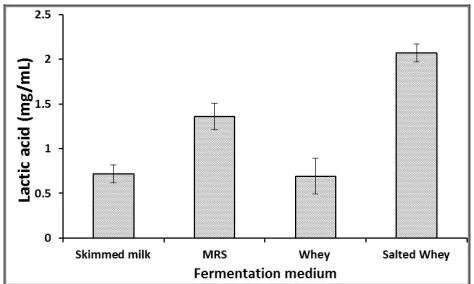
The amount of lactic acid production was evaluated using skimmed milk, whey, salted whey and MRS media under the above optimized conditions. The results indicated that the higher amount of lactic acid in salted whey than MRS (Figure 6). However, the lactic acid produced in skimmed milk and whey was slightly the same and relatively low. The results showed that higher yield of lactic acid by cultural bacteria grown in salted whey will be valuable for future application in industry for producing large amount of lactic acid using cultural bacteria and low cost fermentation media. This test gave an indication of the osmotolerance level of a LAB strain. Bacterial cells cultivated in high salt whey would experience a loss of turgor pressure, which would then affect the physiology, enzyme activity, water activity and metabolism of the cells [42]. Some cells overcome this effect by regulating the osmotic pressure between the inside and outside of the cell [28]. There are reports describing strains of lactococci [43] and lactobacilli [44, 45] showing decreased growth rate with increasing osmolarity of the medium. The bacterial isolate W7 could be similarly protected to be able to grow at higher NaCl concentration during industrial fermentation, as lactic acid is being produced by the cells, alkali would be pumped into the broth to prevent excessive reduction in pH. Thus, the free acid would be converted to its salt form which would in turn increase the osmotic pressure on the cells. Therefore, a LAB strain with high osmotolerance would be desirable as an industrial strain.
Figure 6. Effect of different fermentation media on lactic
acid production by Enterococcus faecalis W7.
4. CONCLUSION
Lactic acid is one of the different organic acids produced by bacteria and has numerous uses in food biotechnology especially in dairy products. So, the present study was aimed to isolate a novel strain of lactic acid bacteria applicable for lactic acid production from different inexpensive substrates. The isolated bacterium Enterococcus faecalis W7 was the most active isolate for lactic acid production and deposited in GenBank by accession number KY072975.
FUNDING INFORMATION
The present work was funded by Suez University, Suez, Egypt.
AUTHORS’ CONTRIBUTION
AAA: Critical revision of the article; A-HMR: Conception, design of the work, carried out the practical experiments, data collection, data analysis and interpretation; MMO: Critical revision of the article; NK: carried out the practical experiments; SGD: Drafting the article. The final manuscript has been read and approved by all authors.
TRANSPARENCY DECLARATION
The authors declare no conflicts of interest.
REFERENCES
poly-European Journal of Biological Research 2017; 7 (1): 22-30
lactic acid and lactic acid derivatives. FEMS Microbiol Rev. 1995; 16: 221-231.
2. Parmjit S, Panesar M, Shubhneet K. Bioutilisation of agro-industrial waste for lactic acid production. Int J Food Sci Technol. 2015; 50: 2143-2151. 3. Maas RHW, Bakker RR, Jansen MLA, Visser D, De
Jong E, Eggink G, Weusthuis RA. Lactic acid production from lime-treated wheat straw by
Bacillus coagulans: neutralization of acid by
fed-batch addition of alkaline substrate. Appl Microbiol Biotechnol. 2008; 78: 751-758.
4. Romani A, Yanez R, Garrote G, Alonso JL. SSF production of lactic acid from cellulosic biosludges. Biores Technol. 2008; 99: 4247-4254.
5. Ge XY, Qian H, Zhang WG. Improvement of l-lactic acid production from Jerusalem artichoke tubers by mixed culture of Aspergillus niger and
Lactobacillus sp. Biores Technol. 2009; 100:
1872-1874.
6. Ohara H. Biorefinery. Appl Microbiol Biotechnol. 2003; 62: 474-477.
7. Wan P, Yuan C, Tan L, Li Q, Yang K. Fabrication and evaluation of bioresorbable PLLA/magnesium and PLLA/magnesium fluoride hybrid composites for orthopedic implants. Compos Sci Tech. 2014; 98: 36-43.
8. Pushparani M, Latha S, Chandrasekhar K. Food waste management-lacic acid production by
Lactobacillus species. Int J Adv Biol Res. 2012;
2(1): 34-38.
9. Hofvendahl K, Hahn-Hagerdal B. Factors affecting the fermentative lactic acid production from renewable resources. Enzyme Microb Technol. 2000; 26: 87-107.
10. Subramanian MR, Talluri S, Christopher LP. Production of lactic acid using a new homo-fermentative Enterococcus faecalis isolate. Microb Biotechnol. 2015; 8: 221-229.
11. Tay A, Yang ST. Production of L(+)-lactic acid from glucose and starch by immobilized cells of
Rhizopus oryzae in a rotating fibrous bed bioreactor.
Biotechnol Bioeng. 2002; 80: 1-12.
12. Litchfield JH. Microbial production of lactic acid. Adv Appl Microbiol. 1996; 42: 45-95.
13. Lunt J. Large-scale production, properties and commercial applications of polylactic acid polymers. Polymer Degrad Stability. 1998; 59: 145-152.
14. Amass W, Amass A, Tighe B. A review of biodegradable polymers: uses, current developments in the synthesis and characterization of
biodegra-dable polymers, blends of biodegrabiodegra-dable polymers and recent advances in biodegradation studies. Polymer Int. 1998; 47: 89-114.
15. Jarvi’s L. Lactic acid outlook up as polylactide nears market. Chem Market Rep. 2001; 259: 5-14. 16. Calabia BP, Tokiwa Y. Production of D-lactic acid
from sugarcane molasses, sugarcane juice and sugar beet juice by Lactobacillus delbrueckii. Biotechnol Lett. 2007; 29(9): 1329-1332.
17. Dumbrepatil A, Adsul M, Chaudari S, Khire J, Gokhale D. Utilization of molasses sugar for lactic acid production by Lactobacillus delbrueckii subsp.
delbrueckii mutant Uc-3 in batch fermentation. Appl
Environ Microbiol. 2008; 74: 333-335.
18. Buyukkileci AO, Harsa S. Batch production of L (+) lactic acid from whey by Lactobacillus casei (NRRL B-441). J Chem Technol Biotechnol. 2004; 79: 1036-1040.
19. John RP, Nampoothiri KM, Pandey A. Fermentative production of lactic acid from biomass: an overview on process developments and future perspectives. Appl Microbiol Biotechnol. 2007; 74: 524-534. 20. De Man J, Rogosa M, Sharpe ME. A medium for
the cultivation of lactobacilli. J Appl Bacteriol. 1960; 23: 130-135.
21. Yi-sheng C, Hui-chung W, Fujitoshi Y. Isolation and characterization of lactic acid bacteria isolated from Ripemulberries in Taiwan. Braz J Microbiol. 2010; 41: 916-921.
22. Collins CH, Lyne PM. Microbiological methods. 5th edn. Butterworths, London, 1985.
23. Wittenberg R. Hydrogen peroxide formation and catalase activity in the lactic acid bacteria. J Gen Microbiol. 1964; 35: 13-14.
24. Pridham TG, Gottlieb D. The utilization of carbon compounds by some actinomycetales as an aid for species determination. J Bacteriol. 1948; 56: 107-114.
25. Kozaki M, Uchimura T, Okada S. Experimental manual for lactic acid bacteria. Asakurasyoten, Tokyo, Japan, 1992: 29-72.
26. Panesar PS, Kennedy JF, Knill CJ, Kosseva M. Production of L(+) lactic acid using Lactobacillus
casei from Whey. Braz Arch Biol Technol. 2010;
53: 219-226.
European Journal of Biological Research 2017; 7 (1): 22-30
28. Kashket ER. Bioenergetics of lactic acid bacteria: cytoplasmic pH and osmotolerance. FEMS Microbiol Rev. 1987; 46: 233-244.
29. Nannen NL, Hutkins RW. Intracellular pH effects in lactic acid bacteria. J Dairy Sci. 1991; 74: 741. 30. Russell JB, Diez-Gonzalez F. The effects of
fermentation acids on bacterial growth. Adv Microb Physiol. 1998; 39: 205-234.
31. Guha A, Banerjee S, Bera D. production of lactic acid from sweet meat industry waste by
Lactobacillus delbrucki. Int J Res Eng Tech. 2013;
2(4): 630-634.
32. Wood BJB, Holzapfel WH. The genera of lactic acid bacteria. Glasgow: Blackie Academic & Professional, USA, 1995.
33. Buchta K. Lactic acid. In: Biotechnology. Germany: VCH Verlag Weinheim, 1983.
34. Krischke W, Schroder M, Trosch W. Continuous production of L-lactic acid from whey permeate by immobilized Lactobacillus casei subsp. casei. Appl Microbiol Biotechnol. 1991; 34: 573-578.
35. Nabi B, Gh R, Baniardalan P. Batch and continuous production of lactic acid from whey by immobilized lactobacillus. J Environ Stud. 2004; 30: 47-53. 36. Wouters JA, Kamphuis HH, Hugenholtz J, Kuipers
P, De Vos WM, Abee T. Changes in glycolytic activity of Lactococcus lactis induced by low temperature. Appl Environ Microbiol. 2000; 66: 3686-3691.
37. Roy D, Goulet J, LeDuy A. Batch fermentation of whey ultrafiltrate by Lactobacillus helveticus for lactic acid production. Appl Microbiol Biotechnol. 1986; 24: 206-213.
38. Gandhi DN, Patel RS, Wadhwa BK, Bansal N, Kaur M, Kumar G. Effect of agro-based byproducts on production of lactic acid in whey permeate medium. J Food Sci Technol. 2000; 37: 292-295.
39. Chiarini L, Mara L, Tabacchioni S. Influence of growth supplements on lactic acid production in whey ultra filtrate by Lactobacillus helveticus. Appl Microbiol Biotechnol. 1992; 36: 461-464.
40. Guha A, Banerjee S, Bera D. Production of lactic acid from sweet meat industry waste by
Lactobacillus delbrucki. IJRET. 2013: 630-634.
41. Kumar S, Jha YK, Chauhan GS. Process optimization for lactic acid production from whey using Lactobacillus strains. J Food Sci Technol. 2001; 38: 59-61.
42. Liu HY, Badarinarayana V, Audino DC, Rappsilber J, Mann M, Denis CL. The NOT proteins are part of the CCR4 transcriptional complex and affect gene expression both positively and negatively. EMBO J. 1998; 17(4): 1096-1106.
43. Uguen P, Hamelin J, Le Pennec J, Blanco C. Influence ofosmolarity and the presence of osmoprotectant on Lactococcus lactis growth and bacteriocin production. Appl Environ Microbiol. 1999; 63: 291-293.
44. Hutkins RW, Ellefson WL, Kashket ER. Betaine transport impartsosmotolerance on a strain of
Lactobacillus acidophilus. Appl Environ Microbiol.
1987; 43: 2275-2281.
45. Glaasker E, Tjan FSB, Steeg PFT, Konings WN, Poolman B. Physiological response of Lactobacillus
plantarum to salt and nonelectrolyte stress. J