Available Online at www.ijpret.com 346
INTERNATIONAL JOURNAL OF PURE AND
APPLIED RESEARCH IN ENGINEERING AND
TECHNOLOGY
A PATH FOR HORIZING YOUR INNOVATIVE WORK
A REVIEW ON: DESIGN AND ANALYSIS OF FUZZY PID CONTROLLERS USING
GENETIC ALGORITHM
DARSHAN V. BHOYAR, BHAWNA J. CHILKE, SHAILESH S.KEMEKAR Suresh Deshmukh College of Engineering, Wardha (M.S), India.
Accepted Date: 15/03/2016; Published Date: 01/05/2016
\
Abstract: The type-2 fuzzy logic system have recently used in many control process due to
their model uncertainty, also the tuning of type-2 membership function (MFs) for interval
type-2 FLC gives a good response. The GA are search algorithm based on natural selection
and natural genetics .The objective of this paper is to examine the performance of GA base
type -2 fuzzy PID controller and it is to be compare with simple interval type -2 fuzzy and
multistage fuzzy PID with respective to setline time, accuracy, error rate, stability, etc. Use
for refrigeration application.
Keywords: Genetic Algorithm (GA), Type-2 fuzzy PID, Multistage fuzzy PID
,
Tuning of PIDCorresponding Author: MR. DARSHAN V. BHOYAR Access Online On:
www.ijpret.com
How to Cite This Article:
Darshan V. Bhoyar, IJPRET, 2016; Volume 4 (9): 346-350
Available Online at www.ijpret.com 347 INTRODUCTION
The PID is best known controllers used in the industrial controller processes are proportional integral-derivative (PID) controllers because of their simple structure and robust performance in a wide range of operating conditions.
The principle structure of the conventional PID controlled system consists of PID controllers and plant as
Fig.1 The conventional PID control system
PID controller is a linear controller. Ziegler and Nichols had proposed a famous tuning parameter of PID controller in 1942. Recently, many forms of the PID controller applications have broadened in many industry control applications. The most conventional PID controller (also called the linear PID controller) is described as follows:
u(t) =KP e(t) + KI ∫ et t dt + KD 0
de(t) dt
where KP, KI and KD are the proportional, integral, and derivative constant gains, respectively. The signal e(t) defined as e(t) = r(t) − c(t) is the error signal between the reference and the process output c(t).
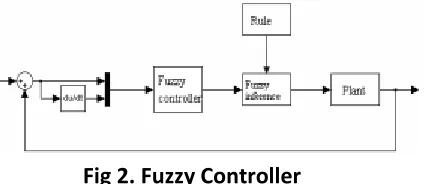
The Fuzzy logic is widely used in processes where system dynamics is either very complex or exhibit a highly nonlinear character. The first fuzzylogic control algorithm implemented by Mamdani was constructed to synthesize the linguistic control protocol of a skilled human operator.
Fig 2. Fuzzy Controller
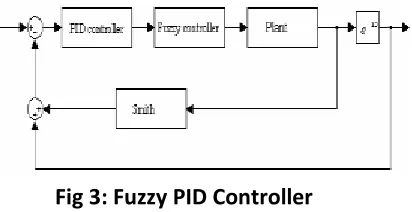
For improving systems performance, e.g., rise time, overshoot, and integral of the absolute error, many studies are attempting and satisfactory result given by Fuzzy PID.
Available Online at www.ijpret.com 348 Fig 3: Fuzzy PID Controller
LITERATURE REVIEW:
Sangzhi Zhu, Haiping Du, and Nong Zhang has discussed with a new active Hydraulically Interconnected Suspension (HIS) has been developed to compensate the limitations of conventional active suspensions such as expensive cost and high energy consumption .This paper compare the three controllers fuzzy logic controller , Fuzzy proportional integral derivative (PID) and LQR Controller with stability parameter . The effectiveness of all these three controllers has been verified by the simulation results . In this paper for application in HIS angle reductions is important , and the Fuzzy PID controller shows better effect and stability than other two controllers. The designed fuzzy-PID controller shows the best control ability and stability in the results, so it is more appropriate to adopt for apply in the proposed active HIS than other two controllers. [1]
Ahmet Sakalli, Tufan Kumbasar, M.Furkan Dodurka, Engin Yesil discussed with a simple interval Type-2 Fuzzy PID controller . In this paper analysis the structure of simplest IT2-FPID by using KM algorithm . The structure of ST1T2-FPID is compared with IT2-FPID , T1-FPID and hybrid fuzzy pid on the basis of stimulation result . The outcome of the study shows that, the advantage of the proposed STIT2-FPID structure is related to hybrid nature of the self-tuning structure because it benefits the advantages of the T1-FPID and IT2-FPID controllers by changing the size of the FOU in an online manner .This paper also the work on the tuning the fuzzy PID for enhance the transient state and disturbance rejection performance . This indicate tuning mechanism will improve the result . [2]
Available Online at www.ijpret.com 349 controller and P controller . By increasing the integral term to decrease steady-state error causes undesired behavior during the transient phase of the system response. The integral term should only be active during the steady-state portion of the response to either reduce or eliminate the steady-state error. This can be achieved by implement a switching multistage PID controller that consists of a first stage PD controller followed by a second stage PI controller. PD controller can not completely eliminate the error. To eliminate this error, the design of a multistage fuzzy PID controller is existing in this paper .[3]
Jouda Arfaoui , ElyesFeki , Abdelkader Mami have Discussed the Genetic algorithm which is generally used in the various best possible problems . This paper propose an another method for designing fuzzy logic controller for temperature control inside the cavity of refrigeration. This paper compare the result of GA FLC with Conventional PID and GA PID with respect to stability ,settling time and energy consumption . The result of this paper shows GA-FLC has good response compare with the other. GA_FLC reduced the consumption energy of about 1.3401kWh.[4]
PROPOSED METHODOLOGY:
The proposed methodology is,
1) Generate N-Random solution for the given input problem. 2) For each iteration fallow the given step.
a) Find the fitness of each solution (fitness is proportional to error of the solution. b) Find the mean fitness.
c) If the fitness is less than the mean fitness then pass this solution to the next iteration. (Cross-over)
d) If fitness is more than mean fitness then discard the solution & replace it with a new random solution (Mutation).
e) Repeat (a to d) for each iteration.
3) At the end of the all iteration we get optimal solution having minimum fitness.
CONCLUSION:
Available Online at www.ijpret.com 350 and conventional PID . So in this paper we are use GA in Type-2 Fuzzy PID and compare the result.
ACKNOWLEDGMENT:
I would like to thanks my guide Prof.B.J.Chilke Madam & Mr.Shailesh S. Kemekar Sir for his valuable support and encouragement. He kindly read my paper and offered invaluable detailed advices on grammar, organization, and the theme of the paper.
REFERENCE:
1. Sangzhi Zhu, Haiping Du, and Nong Zhang, “Development and Implementation of Fuzzy, Fuzzy PID and LQR Controllers for an Roll-plane Active Hydraulically Interconnected Suspension” 2014 IEEE International Conference on Fuzzy Systems (FUZZ-IEEE) July 6-11, 2014. 2. Ahmet Sakallı, Tufan Kumbasar, M. Furkan Dodurka, Engin Yesil , “The Simplest Interval Type-2 Fuzzy PID Controller: Structural Analysis” 2014 IEEE International Conference on Fuzzy Systems (FUZZ-IEEE) July 6-11, 2014, Beijing, China.
3. Kuldip S. Rattan, Matthew A. Clark, and Jonathan A. Hoffman. “ Design and Analysis of a
Multistage Fuzzy PID Controller” July 1-3,IEEE@ 2015 AACC. Chicago, IL, USA 4. Jouda Arfaoui, Elyes Feki, Abdelkader Mami “PID and Fuzzy Logic Optimized Controller for
Temperature control in a cavity of refrigeration” 2015 6th International Renewable Energy Congress (IREC)
5. M. Clark and K. Rattan, “Piecewise Affine Hybrid Automata Representation of a Multistage Fuzzy PID Controller”, AAAI Spring Symposium Series, 2014
6. D. Wu, “On the fundamental differences between type-1 and interval type-2 fuzzy logic controllers,” IEEE Transactions on Fuzzy Systems, vol. 20 (5), pp. 832-848, 2012
7. D. Wu, “On the fundamental differences between type-1 and interval type-2 fuzzy logic controllers,” IEEE Transactions on Fuzzy Systems, vol. 20 (5), pp. 832-848, 2012
8. T. Kumbasar, “A simple design method for interval type-2 fuzzy PID controllers,” Soft Computing, 2013.
9. M. F. Dodurka, T. Kumbasar, A. Sakalli and E. Yesil, “Boundary Function based Karnik- Mendel Type Reduction Method for Interval Type-2 Fuzzy PID Controllers,” IEEE World Congress on Computational Intelligence, 2014 (submitted).