Available Online at www.ijpret.com 43
INTERNATIONAL JOURNAL OF PURE AND
APPLIED RESEARCH IN ENGINEERING AND
TECHNOLOGY
A PATH FOR HORIZING YOUR INNOVATIVE WORK
IMPLEMENT EFFICIENT AND EFFECTIVE FAST CLUSTERING-BASED FEATURE
SELECTION ALGORITHM FOR HIGH-DIMENSIONAL DATA
MS ASHWINI PATIL, PROF PRITI V KALE Computer Department, S.S.G.M.C.E, Shegaon, India. Accepted Date: 15/03/2016; Published Date: 01/05/2016
\
Abstract: Feature selection is widely used in preparing high-dimensional data for effective
data mining. Getting fast popularity in the social media dataset presents new challenges for feature selection. Social media data consists of traditional high-dimensional, attribute-value data such as posts, tweets, comments, and images, and linked data that describes the relationships between social media users as well as who post the posts, etc. The nature of social media also determines that its data is massive, noisy, and incomplete, which exacerbates the al-ready challenging problem of feature selection. a fast clustering-based feature selection algorithm, FAST, is proposed and experimentally evaluated in this paper. The FAST algorithm works in two steps. In the first step, features are divided into clusters by using graph-theoretic clustering methods. In the second step, the most representative feature that is strongly related to target classes is selected from each cluster to form a subset of features. In this paper, we illustrate the various differences between attribute-value dataset and social media information, that investigate if linked data can exploited in a proposed feature selection frame-work by giving advantage of social science theories, Hence it extensively evaluated the effects of user-user and user-post relationships manifested in linked data on feature selection, and discuss some research issues for proposed work.
Keywords: FAST, FCBF, RELIEF, MST etc.
Corresponding Author: MS ASHWINI PATIL
Access Online On:
www.ijpret.com
How to Cite This Article:
Ashwini Patil, IJPRET, 2016; Volume 4 (9): 43-57
Available Online at www.ijpret.com 44 INTRODUCTION
Available Online at www.ijpret.com 45
Literatuer Surve
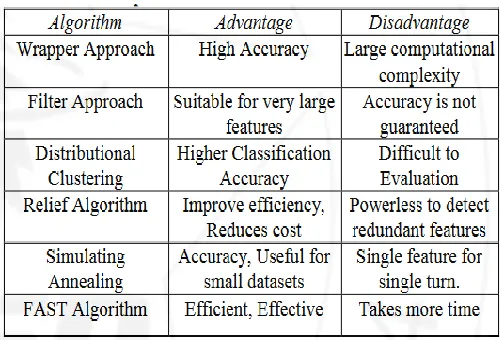
Useful Feature subset selection can be viewed as the process of identifying and removing as many irrelevant and redundant features as much as possible. This is because: irrelevant features do not contribute to the predictive accuracy, and redundant features do not getting a better predictor for they provide mostly information which is already present in other features. Many feature subset selection algorithms can effectively eliminate irrelevant features but fail to handle redundant features some of others can eliminate the irrelevant while taking care of the redundant features
Fig 1 Comparison of different algorithm
FETURE SUBSET SELECTION ALGORITHM
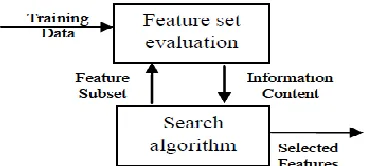
Available Online at www.ijpret.com 46 three techniques are described in detail. The overview of these three approaches is given in Figure 1
Figure 1: Basic feature (Filter) selection
Figure 2 Basic feature (Wrapper) selection
RELATED WORK
EXISTING SYSTEM.
Available Online at www.ijpret.com 47 Disadvantages of existing system:
1) The generality of the selected features is limited and the computational complexity is large.
2) Their computational complexity is low, but the accuracy of the learning algorithms is not guaranteed.
3) The hybrid methods are a combination of filter and wrapper methods by using a filter method to reduce search space that will be considered by the subsequent wrapper.
GOAL
The aim of the project is to implement a Feature selection technique which reduces size of the dataset to be tested and improves quality along with efficiency.
Our objective is that to develop an algorithm which can efficiently find out irrelevant and redundant features that than of previous algorithms. We have proposed FAST algorithm using dice coefficient measure which can deliver effective results.
CHALLENGES
In feature extraction scenario, various algorithms have been proposed for feature selection In the existing FAST feature extraction algorithm, main focus is on both removing unnecessary as well as immaterial data that means it extracts only targeted features. Problem in existing algorithm is that when it removes irrelevant features, it considers only single feature and match up to that to the target feature. If that feature matches then it extracts that feature otherwise remove it. So in this existing method the challenge lies in the fact that if more than one
feature are joint and they suit the target feature then it can be treated as relevant. Feature interface is the new challenge for identifying the applicable feature. In existing system where feature interface is not supported that proves to be the modification criteria for this work.
PURPOSE
Available Online at www.ijpret.com 48 model creation. The central supposition, when using a feature selection method, is that the data contains many redundant or irrelevant features. Unneeded features are those which offer no extra information than the presently
selected features, and irrelevant features supply no useful information in any context. The main and important reason of the feature extraction algorithm is that they discover out or extract only targeted features out of many features. They don’t measure the irrelevant and redundant data because irrelevant and redundant data affects the competence and effectiveness of the algorithm. In existing algorithm that uses a variety of different techniques to decide relevant features or removing
irrelevant or redundant features , when it removes the irrelevant features it does not consider the interface of different features. Proposed algorithm not only removes the irrelevant features but also focus on interaction of the features.
PROBLEM DEFINITION
Selection of a subset of good features with respect to the target concepts feature subset selection is an effective way for the reducing dimensionality, removing irrelevant data, increasing learning accuracy, and improving result. For efficiency issue the time is required to find a subset of features, the effectiveness is related to the quality of the subset of features. Based on some criteria, a fast clustering based feature selection algorithm is proposed and experimentally. The FAST algorithm works in two steps. In this first step features are divided into clusters by using a graph theoretic approach and clustering methods. In the second step the most representative feature that is strongly related to target classes and selected feature from each cluster to form a subset of features.
PROPOSED SYSTEM
Available Online at www.ijpret.com 49 Advantages
Good feature subsets contain features highly correlated with the class, no correlated with each other. The efficiently and effectively deal with both irrelevant and redundant features, and obtain a good feature subset
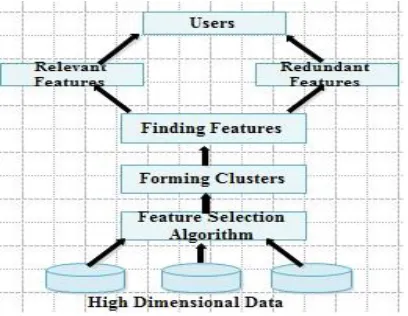
PROPOSED ARCHITECTURE
Fig 3 Proposed Architecture
MODULES
User Module
In this module, Users are having authentication and security to access the detail which is presented in the ontology system. Before accessing or searching the details user should have the account in that otherwise they should register first.
Distributed Clustering
Available Online at www.ijpret.com 50 text classification. proposed to cluster features using a special metric of distance, and then makes use of the of the resulting cluster hierarchy to choose the most relevant attributes. Unfortunately, the cluster evaluation measure based on distance does not identify a feature subset that allows the classifiers to improve their original
l performance accuracy. Furthermore, even compared with other feature selection methods, the obtained accuracy is lower.
Subset Selection Algorithm
The Irrelevant features, along with redundant features, severely affect the accuracy of the learning machines. Thus, feature subset selection should be able to identify and remove as much of the irrelevant and redundant information as possible. Moreover, “good feature subsets contain features highly correlated with (predictive of) the class, yet uncorrelated with (not predictive of) each other. Keeping these in mind, we develop a novel algorithm which can efficiently and effectively deal with both irrelevant and redundant features, and obtain a good feature subset.
Time Complexity
The major amount of work for this algorithm involves the computation of SU values for TR relevance and F-Correlation, which has linear complexity in terms of the number of instances in a given data set. The first part of the algorithm has a linear time complexity in terms of
the number of features m. Assuming features are selected as relevant ones in the first part, when k ¼ only one feature is selected.
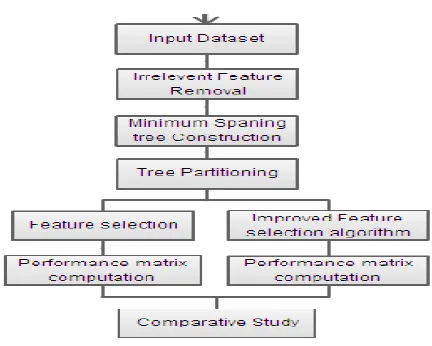
Flow chart:
Available Online at www.ijpret.com 51 Fig 4 Flowchart
PROPOSED METHODOLOGY
Modules Information
1. Graphical User Interface
First module consists of development of application in Java. includes the development of user registration and login parts. In this module contains calculation of Symmetric Uncertainty to find the best relevance of particular feature with target class
2. Minimum Spanning Tree
In this module the construction of the MST from a weighted graph and then partitioning of the MST into a forest with each tree representing a cluster.
3. Selection of Features
In this module we do selection of most relevant features from the clusters which is used to reduced training dataset containing relevant an useful features only which improves efficiency.
4. Contribution
Available Online at www.ijpret.com 52 MATHEMATICAL MODEL
John et al. [8] presented a definition of relevant features.
Suppose 𝐹 to be the full set of features, 𝐹𝑖 # 𝐹 be a feature, 𝑆𝑖
= 𝐹 −{𝐹𝑖} and 𝑆′𝑖⊆𝑆𝑖.
Relevant feature:
𝐹𝑖 is relevant to the target concept 𝐶 if and only if there exists
some 𝑠′ 𝑖, 𝑓𝑖 and 𝑐, such that, for probability 𝑝(𝑆′ 𝑖 = 𝑠′ 𝑖,𝐹𝑖 =
𝑓𝑖) > 0, 𝑝(𝐶 = 𝑐∣𝑆′ 𝑖 = 𝑠′ 𝑖,𝐹𝑖 = 𝑓𝑖) ∕= 𝑝(𝐶 = 𝑐∣𝑆′ 𝑖 = 𝑠′ 𝑖).
Markov blanket:
Given a feature 𝐹𝑖∈𝐹, let 𝑀𝑖⊂𝐹 (𝐹𝑖 ∕∈𝑀𝑖), 𝑀𝑖 is said to be
a Markov blanket for 𝐹𝑖 if and only if 𝑝(𝐹−𝑀𝑖 −{𝐹𝑖},𝐶∣𝐹𝑖,𝑀
𝑖)=𝑝(𝐹 −𝑀𝑖 −{𝐹𝑖},𝐶∣𝑀𝑖).
Redundant feature: Let 𝑆 be a set of features, a feature in 𝑆 is redundant if and only if it has a Markov Blanket. The symmetric uncertainty
(𝑆𝑈) [12] is derived from the mutual information by
normalizing it to the entropies of feature values or feature values and target classes.
The symmetric uncertainty is defined as follows
𝑆𝑈(𝑋,𝑌 )=2×𝐺𝑎𝑖𝑛(𝑋∣𝑌 ) 𝐻(𝑋)+𝐻(𝑌 )
H(X)=−Σ 𝑥∈𝑋𝑝(𝑥)log2 𝑝(𝑥).
𝐺𝑎𝑖𝑛(𝑋∣𝑌)=𝐻(𝑋)−𝐻(𝑋∣𝑌)
=𝐻(𝑌)−𝐻(𝑌∣𝑋).
𝐻(𝑋∣𝑌 )=−Σ 𝑦∈𝑌𝑝(𝑦) Σ 𝑥∈𝑋𝑝(𝑥∣𝑦)log2 𝑝(𝑥∣𝑦).
Available Online at www.ijpret.com 53 The relevance between the feature 𝐹𝑖 ∈ 𝐹 and the target concept 𝐶 is referred to as the T-Relevance of 𝐹𝑖 and 𝐶, and denoted by 𝑆𝑈(𝐹𝑖,𝐶).
F-Correlation:
The correlation between any pair of features 𝐹𝑖 and 𝐹𝑗 (𝐹𝑖,𝐹𝑗
∈𝐹∧𝑖 ∕= 𝑗) is called the F-Correlation of 𝐹𝑖 and 𝐹𝑗, and
denoted by 𝑆𝑈(𝐹𝑖,𝐹𝑗).
F-Redundancy:
Let 𝑆 = {𝐹1,𝐹2,...,𝐹𝑖,...,𝐹𝑘<∣𝐹∣} be a cluster of features. if
∃𝐹𝑗∈𝑆,𝑆𝑈 (𝐹𝑗,𝐶) ≥ 𝑆𝑈(𝐹𝑖,𝐶) ∧𝑆𝑈(𝐹𝑖,𝐹𝑗) > 𝑆𝑈 (𝐹𝑖,𝐶) is
always corrected for each 𝐹𝑖∈𝑆.
R-Feature:
A feature 𝐹𝑖∈𝑆 = {𝐹1,𝐹2,...,𝐹𝑘} (𝑘<∣𝐹∣) is a representative
feature of the cluster 𝑆 ( i.e. 𝐹𝑖 is a R-Feature ) if and only if,
𝐹𝑖 = arg max𝐹𝑗∈𝑆𝑆𝑈(𝐹𝑗,𝐶).
FAST Algorithm
FAST is Tree-Based Algorithm and Advanced Chameleon is Graph-Based Algorithm. Features in different clusters are very relatively independent the clustering-based strategy of has a high probability of producing a subset of useful and independent features. To ensure that the efficiency of FAST, we adopt the efficient minimum spanning tree clustering method, for Chameleon we adopt the K means Nearest neighbor graph clustering method. Feature subset selection algorithms, most of them can effectively eliminate to the irrelevant features but the fail to handle redundant features. There are also algorithms that can be eliminate the irrelevant features also taking care of the redundant features.
FAST Algorithm step
inputs: D(𝐹1, 𝐹2, ..., 𝐹𝑚, 𝐶) - the given data set
Available Online at www.ijpret.com 54
output: S - selected feature subset .
//==== Part 1 : Irrelevant Feature Removal ====
1 for i = 1 to m do
2 T-Relevance = SU (𝐹𝑖, 𝐶)
3 if T-Relevance >𝜃then
4 S = S ∪ {𝐹𝑖};
//==== Part 2: Minimum Spanning Tree
Construction ====
5 G = NULL; //G is a complete graph
6 for each pair of features {𝐹′𝑖, 𝐹′𝑗} ⊂ S do
7 F-Correlation = SU (𝐹′,′𝑗)
8 𝐴𝑑𝑑𝐹′𝑖𝑎𝑛𝑑/𝑜𝑟𝐹′𝑗𝑡𝑜𝐺𝑤𝑖𝑡 F-Correlation
𝑎𝑠𝑡𝑒𝑤𝑒𝑖𝑔𝑡𝑜𝑓𝑡𝑒𝑐𝑜𝑟𝑟𝑒𝑠𝑝𝑜𝑛𝑑𝑖𝑛𝑔𝑒𝑑𝑔𝑒;
9 min Span Tree = KRUSKALS(G); //Using
KRUSKALS Algorithm to generate the minimum
spanning tree
//==== Part 3: Tree Partition and
Representative Feature Selection ====
10 Forest = min Span Tree
11 for each edge ∈Forest do
12 if SU(𝐹′𝑖, 𝐹′𝑗) <SU(𝐹′𝑖, 𝐶) ∧SU(𝐹′𝑖, 𝐹′𝑗) <SU(𝐹′𝑗,𝐶)
then
Available Online at www.ijpret.com 55 14 S = 𝜙
15 for each tree ∈Forest do
16 𝐹𝑗𝑅= argmax𝐹′𝑘∈𝑇𝑖SU(𝐹′𝑘,𝐶)
17 S = S ∪ {𝐹𝑗𝑅};
18 return S
DATASET
The data has to be pre-processed for removing missing values, noise and outliers. Then the given dataset must be converted into the arff format. From the arff format, only the attributes and the values are extracted and stored into the database. By considering the last column of the dataset as the class attribute and select the distinct class labels from that and classify the entire dataset with respect to class labels.
CONCLUSION
An Efficient FAST clustering-based feature subset selection algorithm for high dimensional data improves the efficiency of the time required to find a subset of features. The algorithm involves 1) removing irrelevant features, 2) constructing a minimum spanning tree from relative ones, and 3) partitioning the MST and selecting representative features. In the proposed algorithm, a cluster consists of features. Each cluster is treated as a single feature and thus dimensionality is drastically reduced and improved the classification accuracy.
FUTUER ENHANCEMENT
In future scope, different correlation Measures along with fuzzy logic can be included in the present algorithm to improve performance of a system. We can enhance this work by extending
The symmetric uncertainty for extracting
Available Online at www.ijpret.com 56 REFERENCES
1. Qin Bao, “A Fast Clustering-Based Feature Subset Selection Algorithm for High Dimensional Data - Song in "IEEE TRANSACTIONS ON KNOWLEDGE AND DATA ENGINEERING” VOL:25 NO:1 YEAR 2013.
2. Kira K. and Rendell L.A., “The feature selection problem: Traditional methods and a new algorithm”, In Proceedings of Nineth National Conference on Artificial Intelligence, pp 129-134, 1992.
3. Koller D. and Sahami M., “Toward optimal feature selection”, In Proceedings of International Conference on Machine Learning, pp 284-292, 1996.
4. Kononenko I., Estimating Attributes “ Analysis and Extensions of RELIEF”, In Proceedings of the 1994 European Conference on Machine Learning, pp 171-182, 1994.
5. Yu L. and Liu H., “Feature selection for high-dimensional data: a fast correlation-based filter solution”, in Proceedings of 20th International Conference on Machine Leaning, 20(2), pp 856-863, 2003.
6. Fleuret F., “ Fast binary feature selection with conditional mutual Information”, Journal of Machine Learning Research, 5, pp 1531-1555, 2004.
7. Butterworth R., Piatetsky-Shapiro G. and Simovici D.A., “On Feature Selection through Clustering”, In Proceedings of the Fifth IEEE international Conference on Data Mining, pp 581-584, 2005.
8. Van Dijk G. and Van Hulle M.M., “Speeding Up the Wrapper Feature Subset Selection in Regression by Mutual Information Relevance and Redundancy Analysis”, International Conference on Artificial Neural Networks, 2006
9. Krier C., Francois D., Rossi F. and Verleysen “M., Feature clustering and mutual information for the selection of variables in spectral data, In Proc European Symposium on Artificial Neural Networks Advances in Computational Intelligence and Learning”, pp 157-162, 2007.
10. Guyon I. and Elisseeff A., “An introduction to variable and feature selection,” The Journal of Machine Learning Research, vol. 3, pp. 1157-1182, 2003.
11. Yu L. and Liu H., “Efficient feature selection via analysis of relevance and redundancy,” The Journal of Machine Learning Research, vol. 25, pp. 1205-1224, 2004.
12. Peng H. C., Long F. H., and Ding C., “Feature selection based on mutual information criteria of max-dependency, max-relevance, and min-redundancy,” IEEE Transactions on Pattern Analysis and Machine Intelligence, vol. 27, no. 8, pp. 1226-1238, 2005.