I
nternational Journal of PharmaceuticalB
iological andC
hemicalS
ciences e-ISSN: 2278-5191International Journal of Pharmaceutical, Biological and Chemical Sciences (IJPBCS) | JUL-SEPT 2014 | VOLUME 3 | ISSUE 3 | 89-94 www.ijpbcs.net or www.ijpbcs.com
R
esearch
A
rticle
Pa
ge
89
CATIONIC DYE (METHYLENE BLUE) REMOVAL FROM AQUEOUS SOLUTION BY
ADSORPTION ON ALUMINOPHOSPHATE ZEOLITES
Nirmala B*1, Suresh Kumar B.V2, Chethan B.S3, Srilakshmi B.P3, Sudha A.G3, Suresha E3
1
Assistant Professor, Department of Chemistry, University College of Science, Tumkur University, Tumkur-572 103
2Assistant Professor, Department of studies and research in geology, University of Mysore, Mysore- 560006 3UG students, University College of Science, Tumkur University, Tumkur-572 103
*Corresponding Author Email: [email protected]
INTRODUCTION
Industrial effluents are one of the major causes of
environmental pollution because effluents discharged
from dyeing industries are highly colored with a large
amount of suspended organic solids [1]. Dyes in
surface waters are of barrier effect on the sun light
penetration and aeration of water body, and thus
reduce photosynthetic activity. The toxic nature of the
dye effluents causes to death of soil microorganisms
when they are used for irrigation purposes and this
affects agricultural productivity. Untreated disposal of
this colored water into the receiving water body either
causes damage to aquatic life or to human beings by
their mutagenic and carcinogenic effect. The discharge
of such effluents is worrying for both toxicological and
environmental reasons [2, 3]. Conventional
wastewater treatment methods for removing dyes
include physicochemical, chemical and biological
methods, such as coagulation and flocculation [4],
adsorption [5], ozonation [6], electrochemical
techniques [7], and fungal decolonization [8]. Further
these methods are inefficient and incompetent because
these dyes are stable towards light, oxidizing agents
and aerobic digestion and are also highly soluble in
aqueous media. A comprehensive investigation shows
that adsorption technique is considered to be most
effective, simple method to remove water soluble dyes
[9]. Different types of adsorbents such as metal oxides,
agrowaste etc., are used [1]. Of which activated carbon
is considered to be very effective, unfortunately it is
expensive [10]. On the other hands, zeolite was found
very effective in reducing ammoniacal nitrogen and
COD [11-14] since it have high cationic exchange
capacities, large surface areas and high residual carbon
contents. The objective of the present study was to
investigate the ability of aluminophosphate zeolites for
the removal of methylene blue from an aqueous
solution by adsorption. Methylene blue (MB) is the ABSTRACT:
Removal of dyes from waste water is a major ecological problem. Color impurity in industrial effluents poses a significant risk to human health and the environment. Much effort has been expended to degrade them using various methods. The objective of this work is to study the adsorption of dye solution, methylene blue on microwave assisted synthesis of isopropyl amine templated aluminophosphate zeolites. The effectiveness of the aluminophosphate zeolites was evaluated at different adsorption dosage and contact time. Spectrophotometric technique was used for the measurement of concentration of dye before and after adsorption. The surface morphology of the adsorbents have been analysed using the scanning electron microscope (SEM). This work shows aluminophosphate zeolites could be utilized as an effective adsorbent for treating dye waste water.
KEYWORDS:
Nirmala B* et al;
CATIONIC DYE (METHYLENE BLUE) REMOVAL FROM……….
International Journal of Pharmaceutical, Biological and Chemical Sciences (IJPBCS) | JULY-SEPT 2014 | VOLUME 3 | ISSUE 3 | 89-94| www.ijpbcs.net
Pa
ge
90
cationic dye that is most commonly used for coloring.
It is generally used for dyeing cotton, wool, and silk.
MB can cause eye burns in humans and animals,
methemoglobinemia, cyanosis, convulsions,
tachycardia, dyspnea, irritation to the skin, and if
ingested, irritation to the gastrointestinal tract, nausea,
vomiting, and diarrhea [15]. Therefore, decolonization
of dyes is important aspects of wastewater treatment
before discharge.
Structure of methylene blue
MATERIALS AND METHODS
Preparation of adsorbents:
The adsorbent isopropyl amine templated
Aluminophosphate zeolites crystallization carried out
using a domestic microwave oven. The reactants were
phosphoric acid, aluminium hydroxide, Isopropyl
amine. Aluminium hydroxide was first hydrolysed in
deionized water and then phosphoric acid and IPA
added to the mixture dropwise into the reaction
mixture while stirring and heating at 60oC. IPA is a
structure directing agent. After the addition of IPA, the
gel was aged at room temperature for 2 h. The
suspension was transferred into a teflon liner and
tightly covered with a lid and placed in a microwave
oven and exposed to microwave for 60 seconds at
900w. After the synthesis, the liner was cooled to room
temperature. The products were first cleaned in
ultrasonic cleaner after recording the final pH, filtered,
washed with distilled water several times and dried
followed by calcination for 2 hours. The crystallinity
of the samples was analyzed by powder X-ray
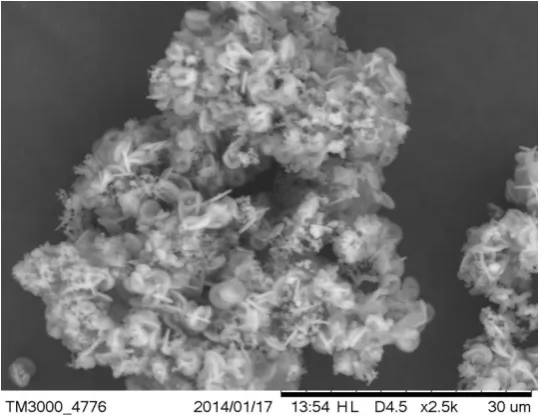
diffractometer(Figure 1) and the surface morphology
studied through SEM (Figure 2).
Nirmala B* et al;
CATIONIC DYE (METHYLENE BLUE) REMOVAL FROM……….
International Journal of Pharmaceutical, Biological and Chemical Sciences (IJPBCS) | JULY-SEPT 2014 | VOLUME 3 | ISSUE 3 | 89-94| www.ijpbcs.net
Pa
ge
91
Figure 2: SEM micrograph of IPA templated Aluminophosphate zeolite
Preparation of stock solution of Methylene blue dye
Methylene blue dye is widely used in textile, paper and
carpet industries. It is a basic cationic dye. Methylene
blue dye [C.I. =52015 B, chemical
formula=C16H18ClN3S; molecular weight= 373.91g;
melting point =100–110°C (and λmax=660 nm
(reported) and 670 nm (experimentally obtained) was
obtained from s. d. Fine Chemicals, Mumbai, India. An
accurately 0.02 gm. weighed quantity of the dye was
dissolved in 500 ml distilled water to prepare stock
solution. The solution is blue in colour. Experimental
solutions of the desired concentration were obtained by
dilutions of stock solution in 100 ml of distilled water.
a. Estimation of optimum amount of adsorbent
In order to find out the optimum amount of adsorbent
at which maximum adsorption takes place, 1.7x10⁻⁵
mg/L of methylene blue dye solution was taken in a
series of flasks with different quantity of adsorbents;
0.1, 0.2, 0.3, 0.4 and 0.5 gm. of aluminophosphate
zeolites. The solution of dye was kept on a shaking
magnetic stirrer for 15-20 min at 120 rpm for shaking.
Dye concentration estimated spectrophotometrically at
the wavelength corresponding to maximum absorbance, λmax using a spectrophotometer. The
samples to be withdrawn from the magnetic stirrer at
predetermined time intervals and the dye solution
should be separated from the adsorbent by the help of a
Centrifuge. The absorbance of solution is then
measured.
b. Estimation of optimum concentration of dye
solution
For the determination of optimum concentration of
dyes, solutions of different concentrations of dye were
prepared. From 1.7×10⁻⁵ mg/L to 3.5×10⁻⁵ mg/L of dye
solution was placed in respective flasks with optimum
amount of adsorbents for 15-20 min. The samples
withdrawn from the magnetic stirrer at predetermined
time intervals and the dye solution separated from the
adsorbent with the help of a Centrifuge. The
absorbance of solution is then measured. Dye
concentration estimated spectro photometrically at the
wavelength corresponding to maximum absorbance, λmax, using a spectrophotometer.
c. Effect of pH on Methylene blue uptake:
The pH is one of the most important factors controlling
the adsorption of dye onto adsorbent presumably due
to its influence on the surface properties of the
adsorbent and ionization/dissociation of the adsorbate
molecule. Adsorption of MB onto aluminophospahte
zeolites was carried out for the examination of the
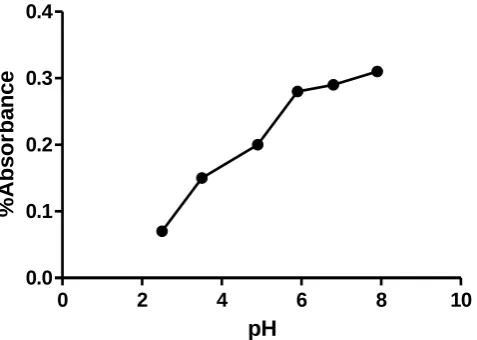
effect of pH at a range of 2.00-8.00 and it was found
Nirmala B* et al;
CATIONIC DYE (METHYLENE BLUE) REMOVAL FROM……….
International Journal of Pharmaceutical, Biological and Chemical Sciences (IJPBCS) | JULY-SEPT 2014 | VOLUME 3 | ISSUE 3 | 89-94| www.ijpbcs.net
Pa
ge
92
pH (Figure 3). The pH of the dye solutions were
adjusted with dilute HCl (0.1N) or NaOH (0.1N)
solution by using a pH meter. The effect of pH on the
adsorption of methylene blue on aluminophosphate
zeolites studied at RT, adsorbent dosage 0.1g and
contact time 1 h for the dye concentration 3.5×10⁻⁵
mg/L. Final % absorbances of dye solutions were
measured using UV spectrophotometer (λmax=670nm). Figure 3 showed that at low pH value,
the adsorption was decreased. When solution pH
increased from 2.00 to 9.00, the adsorption increased.
The maximum dye uptake was observed in the pH
range of 6.00. The basic dyes give positively charged
ions when dissolved in water. Thus, in acidic medium
positively charged surface of sorbent tends to oppose
the adsorption of cationic sorbate species. When the
pH of dye solution is increased the surface tends to
acquire negative charge, thereby resulting in an
increased adsorption of dyes due to increasing
electrostatic attraction between positively charged
sorbate and negatively charged sorbent [16]
0 2 4 6 8 10
0.0 0.1 0.2 0.3 0.4
pH
%
A
b
s
o
rb
a
n
c
e
Figure 3: Effect of initial pH on the adsorption of MB onto aluminophospahte zeolites
d. Effect of contact time and initial Methylene blue
concentration
Experiments were carried out at fixed adsorbent dose
(0.1 g/100 mL) in the test solution at room temperature
(27±2 °C), pH 7 and at different initial concentrations
of MB (1.7x10⁻⁵ to 3.6x10⁻⁵ mgL−1) for 60 minutes.
Figure 4 shows that the percentage of adsorption
efficiency of aluminophosphate zeolites decreased with
the increase of initial MB concentration in the solution.
0 1 2 3 4
0.0 0.5 1.0 1.5 2.0
%Absorbance
%Absorbance after 1 h
Concentration of dye in mg
%
A
b
s
o
rb
a
n
c
e
Nirmala B* et al;
CATIONIC DYE (METHYLENE BLUE) REMOVAL FROM……….
International Journal of Pharmaceutical, Biological and Chemical Sciences (IJPBCS) | JULY-SEPT 2014 | VOLUME 3 | ISSUE 3 | 89-94| www.ijpbcs.net
Pa
ge
93
e. Effect of adsorbent mass on MB adsorption with
contact time
The relation between removal of MB and reaction time
were studied to see the rate of dye removal. It was
found that more than 50% removal of MB
concentration occurred in the first 50 min, and
thereafter the rate of adsorption of the MB onto
aluminophosphate zeolites was found to be slow. The
rapid adsorption at the initial contact time is due to the
highly negatively charged surface of the
aluminophosphates for adsorption of cationic MB in
the solution at pH 7. Later slow rate of MB adsorption
is probably due to the electrostatic hindrance or
repulsion between the adsorbed positively charged
adsorbate species onto the surface of
Aluminophosphate zeolites and the available cationic
adsorbate species in the solution as well as the slow
pore diffusion of the solute ions into the bulk of the
adsorbent.
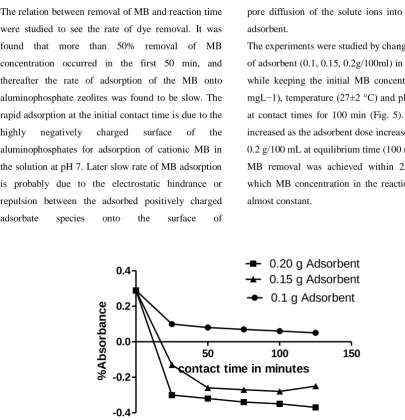
The experiments were studied by changing the quantity
of adsorbent (0.1, 0.15, 0.2g/100ml) in the test solution
while keeping the initial MB concentration (3.6x10⁻⁵ mgL−1), temperature (27±2 °C) and pH (7.0) constant
at contact times for 100 min (Fig. 5). The adsorption
increased as the adsorbent dose increased from 0.1 g to
0.2 g/100 mL at equilibrium time (100 min). Maximum
MB removal was achieved within 25–50 min after
which MB concentration in the reaction solution was
almost constant.
50 100 150
-0.4 -0.2 0.0 0.2 0.4
0.1 g Adsorbent
0.20 g Adsorbent
0.15 g Adsorbent
contact time in minutes
%
Ab
s
o
rb
a
n
c
e
Figure 5: Effect of adsorbent mass on MB adsorbtion with contact time
CONCLUSION
From the of present study, it may be concluded that
Isopropylamine templated aluminophosphate zeolites
could be used as an effective adsorbent for the removal
of methylene blue from aqueous solution. The amount
of dye adsorbed varied with initial dye concentration,
pH, contact time and adsorbent dose. Maximum
adsorbtion observed at pH =6 and maximum dye
removed at 50 to 100 minutes. With this environment
friendly adsorbent, considerable dye removal can be
achieved. So it can be substituting other expensive
bio-adsorbents. With the experimental data obtained in this
study, it is possible to design and optimize an
economical treatment process for the dye removal from
industrial effluents.
ACKNOWLEDGMENTS
The authors are thankful The University Grants
Commission, New Delhi, for the financial support to
carry out the present work.
REFERENCES
Nirmala B* et al;
CATIONIC DYE (METHYLENE BLUE) REMOVAL FROM……….
International Journal of Pharmaceutical, Biological and Chemical Sciences (IJPBCS) | JULY-SEPT 2014 | VOLUME 3 | ISSUE 3 | 89-94| www.ijpbcs.net
Pa
ge
94
[2] Robinson, T.; McMullan, G.; Marchant R.; Nigam, P.; 2001. Bioresour. Technol., 77, 247.
[3] Aksu, Z.; 2005. Process Biochem., 40, 997.
[4] Han, R. P.; Zhang, J. H.; Zou, W. H ; Shi, J.; Liu, H. M.; 2005. J. Hazard. Mater., 125, 266.
[5] Gupta, V. K.; Ali, I.; Suhas D.; Mohan, 2003. J. Colloid Interface Sci., 265, 257.
[6] Ho, Y. S.; Chiu, W. T.; Wang, C. C., 2005. Bioresour. Technol., 96, 1285.
[7] Kumar, K. V.; 2006. J. Hazard. Mater., 136, 197. [8] Ho, Y. S.; 2006. Water Res., 40, 119.
[9] A.Dabrowski, 2001. Adsorption-From Theory to Practice, Advances in colloids and Interface Science, 93, 135-224. [10] X.Y.Yang, B.Al-Duri, 2001. Application of branced pore
diffusion model in the adsorption of reactive dyes on activated carbon, Journal of Chemical Engineering, 83,15.
[11] Lee, J. H., Kim, D. S., Lee, S. O., & Shin, B. S. 1996. Treatment of municipal landfill leachates using artificial zeolite. Chawon Risaikring, 5, 34-41.
[12] Chang, W., Hong, S., & Park, J., 2001. Effect of zeolite media for the treatment of textile wastewater in abiological aerated filter. Process Biochemistry, 37, 693– 698. http://dx.doi.org/10.1016/S0032-9592 (01)00258-8 [13] Jung, J., Chung, Y. C., Shin, H. S., & Son, D. H., 2004.
Enhanced ammonia nitrogen removal using existent biological regeneration and ammonium exchange of zeolite in modified SBR process. Water Research, 38, 347–354. http://dx.doi.org/10.1016/j.watres.2003.09.025 [14] Otal, E., Vilches, L. F., Moreno, N., Querol, X., Vale, J.,
& Fernández Pereira, C.; 2005. Application of zeolitised coal fly ashes to the depuration of liquid wastes. Fuel, 84, 1440-1446. http://dx.doi.org/10.1016/j.fuel.2004.08.030 [15] Senthilkumaar, S.; Varadarajan, P. R.; Porkodi, K.;
Subbhuraam, C.V.; 2005. J. Colloid Interface Sci., 284, 78.
[16] Özdemir, Y.; Do an, M.; Alkan, M., 2006. Micropor. Mesopor. Mat., 96, 419
*Corresponding author
Email address: