[Kansal* 4(12): December, 2017] ISSN 2349-4506
Impact Factor: 2.785
G
lobal
J
ournal of
E
ngineering
S
cience and
R
esearch
M
anagement
COMPREHENSIVE REVIEW OF AES AND RSA SECURITY ALGORITHMS IN
CLOUD COMPUTING
Shubham Kansal*, Harkiran Kaur
*
Department of Computer Science Engineering Thapar Institute of Engineering and Technology
(Deemed to be University) Patiala (PB), India
Department of Computer Science Engineering Thapar Institute of Engineering and Technology
(Deemed to be University) Patiala (PB), India
DOI: 10.5281/zenodo.1120255
KEYWORDS
:
Cloud computing, cloud data security, AES, RSA.ABSTRACT
Cloud Computing referred as revolutionary approach which has changed the IT and business integration. It has benefits to almost every type of IT requirement, it can be used by enterprises to cut their IT costs, and it can be used by individual to use it as a storage solution with a disaster recovery solution. One major problem that exists with Cloud Computing, in the present scenario, is security and privacy of the data. Encryption is the most important part of the security if you own a private cloud holding your personal or critical data. It brings confidentiality to the critical data. This paper mainly reviews on existing security algorithms “Advanced Encryption Standard (AES)” and “Ron Rivest, Adi Shamir, and Adleman (RSA)”.
INTRODUCTION
Organizations utilize cloud in a variety of various service models which include “(SAAS) Software as a Service, (PASS) Platform as a Service and (IAAS) Infrastructure as Service”. These services could be deployed using various deployment models, the deployment models are private, public and hybrid. At the present time, there is no need to carry local hardware systems all over the place, it all can be handled by the cloud as an alternative. However, there is a risk that private information in these spaces can be seen by other people. This can happen in several ways like changing the settings on a document, accidentally share it with wide range of users. If a member of your group has a weak password and someone guesses that password then, any information shared with that person will be exposed, thus providing security to the data on cloud.
There are various security factors related with cloud computing. These components are partition into two main types: issues that looked by cloud suppliers and issues that looked by clients of a cloud. For the most part, cloud giving associations which is (SAAS) or (IAAS) utilize the component of a cloud. In the vast majority of cases, supplier of cloud guarantees that foundation is secure which is disseminated by supplier and customer's information and applications gave to client are ensured, additionally the client guaranteed the supplier offered the best possible security which is secure their data
EXISTING ALGORITHM
AES ALGORITHM
“The Advanced Encryption standard or AES” Recall that a major Shortcoming of DES is that the keylength is only 56 bit and that is considered to be short. In Other words, the key space is relatively small , and an attacker can use brute force to find the key. There was a need for a new encryptipn algorithm that have longer key length, but also be efficent. So, in 1997 NIST put out a public call to replace DES . After a few rounds of submissions and reviews, AES was finalized and it became a new standard.Like DES ,AES is also a block cipher, whereas in DES,the input plaintext block is 64 bit in AES it is 128 bit. In DES the keylength is only 56 bit .In AES it can be 128,192 or 256 bits.These key lengths are considered long enough to defeat brute force attempt to search for a key [5][7] .
OPERATIONS
[Kansal* 4(12): December, 2017] ISSN 2349-4506
Impact Factor: 2.785
G
lobal
J
ournal of
E
ngineering
S
cience and
R
esearch
M
anagement
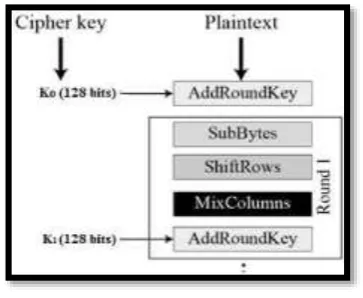
goes through several operations that, represent substitution and permutation and also the round key is Xor, to this state array .The operation at each round include substitute bytes. This involves using a table stated to as a Sbox to achieve byte substitution of the block. Shift rows is a simple arrangement that is row by row. Mixed columns is a replacement that alters each byte in a column as utility of the bytes in the column and then the result is XOR in a round key. The processes of the last round includes “Substitute bytes, Shift rows and Add round key”, and the outcome is a cipher text.In AES, the decryption procedure runs the algorithm in the reverse direction. This means that each of these processes must be reversible. An XOR operation by itself is reversible. The other operations meaning “Substitute Bytes, Shift Rows and Mix Columns”, and inverse function is used in a decryption algorithm. By using this inverse function, it can reverse the action of substitute bytes that was performed in the encryption. Likewise, it can reverse the effects of shift rows and mix columns in the decryption process. Therefore, each of the processes are reversible. As a result, when we run the algorithm in the reverse order, we can decrypt the cipher text back into the plaintext.
ENCRYPTION PROCESS
AES encryption consist of four sub-processes.
FIGURE 1 Encryption Process
a) Byte Substitution (Sub Bytes)
In AES divided 128 bits inputs in 16 input bytes, these input bytes divided for a S-box. S-box gives results in matrix form in which have four by four rows and columns.
b) Shift rows
In shift rows process, shift the each row of given matrix to the left. On the right side of row, re-inserted the entries which are ‘fall off’. Process for shift rows are:
First row of known matrix does not shifted by this process. Second row shifted to the left at one position. Third row shifted at two positions to the left side. Fourth row of matrix shifted at three position to left side. In which only shift the rows, input bytes is no change in new matrix.
c) Mix Columns
In mix column process, used special mathematical function for transformation of each column consist of four bytes. In this function four bytes of single column as input and outcome is four new bytes, which is replaced with original bytes of column. This process gave new matrix which is consist 16 new bytes. This process does not perform in last round of AES.
d) Add round key
In this process, matrix of 16 bytes consider as 128 bits and perform XOR operation to these 128 bits of round keys. In the last round output of this in the form of cipher text and 128 bits also change in 16 bytes.
[Kansal* 4(12): December, 2017] ISSN 2349-4506
Impact Factor: 2.785
G
lobal
J
ournal of
E
ngineering
S
cience and
R
esearch
M
anagement
Reverse process of encryption process is similar to decryption process of an AES. In which four processes performed in each round in a reverse order. These processes are: ’Add round key’, ’Mix columns’, ’Shift rows’, ’Byte substitution’Each round also consist sub-processes which are also in reverse order. Encryption and Decryption algorithms implemented separately.
B. AES Analysis
In present day, AES used cryptography, which is supported by hardware and software. Practically performed, in AES does not find cryptanalytic attacks against AES. Also, AES has key length flexibility which helps for ‘future proofing’ with ability to performed extensive key searches.
AES algorithm only guaranteed when this is correctly applied and provided good key management.
RSA ALGORITHM
RSA is a Cryptographic Algorithm used for encrypting data over the network. It was discovered by “Ron Rivest, Adi Shamir, and Adleman in 1978”. It is a type of asymmetric key based algorithm that uses two keys which is “Public key” and “Private key”. Public key is generated for generally encrypting the message (There is the other way around too, known as Digital Signing) and Private Key for decrypting the message. For encrypting, the receiver has to send his public key to the sender so that only the receiver will be able to decrypt it using private key. It is highly secure and reliable due to large prime numbers and their multiplication. But also is difficult to maintain due to complex numbers generation and even loss of data [12].
A. How does it work
Any user wants to use RSA, must create two Keys: a) Public Key, anyone can see this Key.
b) Private Key, only the owner can see this Key.
If A needs to send a message to B, it can be followed by two methods.
First Method
1. A, encrypts his message with his private key. 2. B, decrypts the message with the public key of A.
Second Method
1. A, encrypts his message with the public key of B. 2. B, decrypts the message with his private key.
B. Generate the Keys
To generate the keys we need to follow these steps: a) Consider two prime numbers A and B; b) 2. Calculate N = A * B;
c) 3. Calculate Z = (A – 1) * (B – 1);
d) Choose a private key (It mustn't have common factors with Z and must be less than Z); e) Calculate the public key knowing that (Private Key * Public Key) mod Z = 1.
C. Example
Choose two prime number s A and B: A = 11
B = 17
Calculate N = A * B: N = A * B = 11 * 17 = 187` Calculate Z = (A – 1) * (B – 1) :
Z = (A – 1) * (B – 1) = (11 – 1) * (17 – 1) = 10 * 16 = 160
Choose a private key (It must not have common f actors with Z and must be less than Z): Private Key = 3
[Kansal* 4(12): December, 2017] ISSN 2349-4506
Impact Factor: 2.785
G
lobal
J
ournal of
E
ngineering
S
cience and
R
esearch
M
anagement
Public Key = 107Public Key = (107, 187) Private Key = (3, 187)
D. Encrypt a Message
To encrypt a message, consider alphabet, like this:
Figure 2. Alphabet with key
Then, encrypt a message with the FIRST METHOD (Encrypt with the private key of A and decrypt with the public key of A)
Table 2. Encryption of Clear text
CLEARTEXT M M3 mod 187
S 19 127
I 9 168
S 19 127
T 20 146
E 5 125
M 13 140
I 9 168
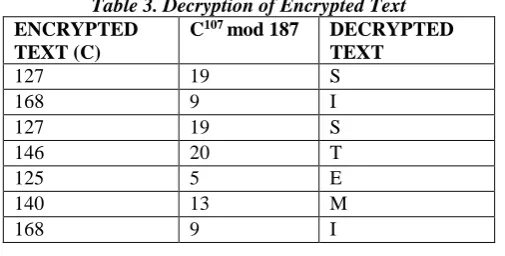
E. Decrypt a Message
To encrypt a message use the FIRST METHOD of encryption, so, decrypt the message with the public key of A:
Table 3. Decryption of Encrypted Text
ENCRYPTED TEXT (C)
C107 mod 187 DECRYPTED
TEXT
127 19 S
168 9 I
127 19 S
146 20 T
125 5 E
140 13 M
168 9 I
COMPARATIVE ANALYSIS OF AES AND RSA
TABLE 4. COMPARISON OF EXISTING CLOUD SECURITY ALGORITHMS BASED ON SEVERAL PARAMETERS
PARAMETER ALGORITHM
AES RSA
Developed 2000 1978
Key size 128,192,256 bits
>1024 bits
[Kansal* 4(12): December, 2017] ISSN 2349-4506
Impact Factor: 2.785
G
lobal
J
ournal of
E
ngineering
S
cience and
R
esearch
M
anagement
PARAMETER ALGORITHM
AES RSA
Ciphering and Deciphering key
Same Different
Algorithm Symmetric Algorithm
Asymmetric Algorithm
Encryption Faster Slower
Decryption Faster Slower
Power Consumption
Low High
Security Excellent Secured
Compared Secured
Inherent Vulnerabilities
Brute Forced Attack
Brute Forced and Oracle attack
Key Samilar key
used for Encryption and Decryption
Different key used for Encryption and Decryption
Rounds 10,12,14 1
Hardware and Software
Implementation
Faster Not Efficient
Ciphering and Deciphering Algorithm
Different Same
CONCLUSION AND FUTURE WORK
AES used to encode files and document, it is the fast and secure algorithm. AES uses the same key for Encoding and Decoding. There is key exchange problem, because if communication is done by AES then the receiver has to have a key. This problem overcome by using asymmetric algorithms which is RSA, in this encryption is done by sender’s side with the help of Private key and decryption is done by receiver’s side with the help of Public key to decrypt that encoded message. AES can be applied with relatively simple bit operations but RSA includes mathematics with very large numbers. RSA is more secure, but they utilize more CPU and memory resources than AES. There were still some problems related to present security algorithms such as “Timing attacks and problems with key distributions” and looking for more sophisticated algorithms of AES, RSA .
REFERENCES
1. Balachandra Reddy Kandukuri, Rama Krishna Paturi and Dr. AtanuRakshit, “Cloud security issues” In Services Computing, 2009. IEEE International Conference on, page 517520, 2009.
2. B. Schneier, ” Description of a New VariableLength Key, 64-Bit Block Cipher (Blowfish) Fast Software Encryption”, Cambridge Security Workshop Proceedings (December 1993), Springer-Verlag, 1994, pp. 191-204.
3. Cong Wang, Qian Wang, KuiRen and Wenjing Lou, “Ensuring Data Storage Security in Cloud Computing”, In Quality of Service, 2009. 17th International Workshop on, page 19, 2009.
[Kansal* 4(12): December, 2017] ISSN 2349-4506
Impact Factor: 2.785
G
lobal
J
ournal of
E
ngineering
S
cience and
R
esearch
M
anagement
5. D. S. Abdul. Elminaam, H. M. Abdul Kader and M. M. Hadhoud ,“ Performance Evaluation ofSymmetric Encryption Algorithms”, Communications of the IBIMA Volume 8, 2009.
6. Dr. Chander Kant and Yogesh Sharma, "Enhanced Security Architecture for Cloud Data Security" International Journal of Advanced Research in Computer Science and Software Engineering, Volume 3, Issue 5, May 2013, pp. 571-575.
7. Gurpreet Singh, Supriya Kinger”Integrating AES, DES, and 3-DES Encryption Algorithms for Enhanced Data Security “International Journal of Scientific & Engineering Research, Volume 4, Issue 7, July-2013. 8. Kashish Goyal, Supriya Kinger” Modified Caesar Cipher for Better Security Enhancement” International
Journal of Computer Applications (0975 – 8887) Volume 73– No.3, July 2013.
9. Mr. Gurjeevan Singh, , Mr. Ashwani Singla and Mr. K S Sandha “ Cryptography Algorithm Compaison For Security Enhancement In Wireless Intrusion Detection System” International Journal of Multidisciplinary Research Vol.1 Issue 4, August 2011.
10. RuWei Huang, Si Yu, Wei Zhuang and XiaoLin Gui, “Design of Privacy-Preserving Cloud Storage Framework" 2010 Ninth International Conference on Grid and Cloud Computing.
11. S. K. Randeep Kaur, "Analysis of Security Algorithms in Cloud," International Journal of Application or Innovation In Engineering & Management(IJAIEM), vol. 3, no. 3, 2014.
12. Uma Somani, “Implementing Digital Signature with RSA Encryption Algorithm to Enhance the Data Security of Cloud in Cloud Computing," 2010 1st International Conference on Parallel, Distributed and Grid Computing (PDGC - 2010).