ISSN: 2333-6080 (Print), 2333-6099 (Online) Copyright © The Author(s). 2014. All Rights Reserved. Published by American Research Institute for Policy Development DOI: 10.15640/jmm.v2n3-4a2 URL: http://dx.doi.org/10.15640/jmm.v2n3-4a2
A Social Media Experiential Learning Project to Engage Students and Enhance Learning in Retailing
C. M. Sashi1
Abstract
The advent and rapid diffusion of social media has excited sellers in a wide variety of industries worldwide with its potential for establishingrelationships and building customer engagement. Retailers in particular are trying to use the opportunities afforded by Facebook, Twitter, YouTube, etc., to connect and interact with buyers in an attempt to satisfy and retain them as loyal customers. This article shows how incorporating a social media experiential learning project in retailing courses can engage students, enhance learning, and equip students with the social media and digital marketing skills that retailers desire. Students form teams that work together throughout the semester on anexperiential learning project in which each team selects a retail firm and designs a social media strategy to build customer engagementfor the firm. Multiple reports are required with peer assessments of all reports, prompting each student to read, reflect, and benefit from the reports of other teams as well as receive feedback to help rewrite and improve their own reports. The project enables students to learn by participating and interacting, reflecting, understanding, and applying retailing concepts to develop social media strategies.
Keywords: Social Media, Customer Engagement, Retailing, Experiential Learning.
Introduction
The rapid adoption and widespread use of social media in their daily lives by students in recent years (see, e.g., Tuten & Marks, 2012) presents an opportunity for pedagogic innovations to engage studentsand enhance learning. Familiarity and comfort with Web 2.0 (O’Reilly, 2005) social media tools like Facebook, Twitter, YouTube, blogs, and wikis can be used to learnas well as apply marketing concepts and theories.
1
The emergence of these tools is creating significant new opportunities for marketers to engage with customers, changing the way marketing is practiced, and business curricula must respond (Miller, Mangold, Roach, & Holmes, 2013). Elective courses that require application of learned concepts for strategic decision-making are particularly suitable for fostering the development of social media skills. In fields like retailing where the value of social media in establishing relationships with customers is apparent, firms recognize the need for students with the training and ability to translate the concepts they have learned into retail strategies and seek to recruit students with these practical skills (see Harrigan & Hulbert, 2011). Marketing education “must emphasize the development of foundational meta-skills through experiential methods that demonstrate application in unique marketing contexts” (Finch, Nadeau, & O’Reilly, 2012, p. 65).
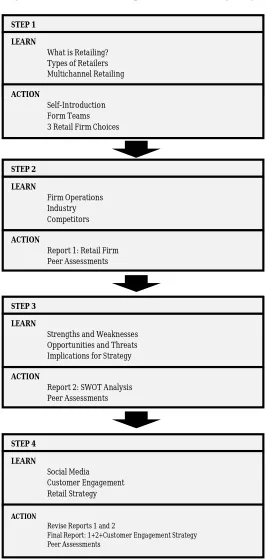
Practitioners sometimes bemoan the lack of entry-level skills in newly minted graduates, blaming a presumed separation of theory and practice resulting from the critical thinking skills emphasized by universities (see, e.g.,Schibrowsky, Peltier, & Boyt, 2002; Schlee & Harich, 2010). Critical thinking skills are necessary, however, as students advance in their careers and move up the hierarchy of the firm. In this article we describe an experiential learning exercise that integrates critical thinking and practical skills to prepare students for retailing careers. Students learn by doing a semester-long project in which they form teams and select a retail firm to study at the start of the term, examine its operations, industry, and competitors, perform a SWOT (strengths, weaknesses, opportunities, and threats) analysis, and develop a social media strategy to build customer engagement. The experiential learning project represents a pedagogic innovation that facilitates both student understanding of retailing concepts and the ability to apply them to solve problems. It improves student engagement by “moving toward models of education delivery focusing on value co-creation” (Taylor, Hunter, Melton, & Goodwin,2011, p. 73).
Applying abstract concepts to develop strategy for a specific retailer adds verisimilitude and excitement, making learning fun and engaging for students.
An Experiential Learning Retail Project: Social Media Strategy for Customer Engagement
The merits of passive and active learning as polar opposites have long been argued in education with the former considered a teacher-oriented perspective and the latter a learning-oriented perspective (Gonzalez, Ingram, LaForge, & Leigh, 2004). Passive learning is often depicted as lectures by the teacher with students listening and taking notes in the classroom, knowledge flowing from the teacher to the student. Active learning, on the other hand, is considered to involve the active participation of the student with interactionsbetween teacher and student, and also among students themselves, responsible for learning. In actuality,in marketing classes a hybrid model usually results with discussion, cases, papers, and projects employed to aid learning. Increasingly, application-oriented classes like retail management are focusing both on understanding concepts as well as using them to make decisions, requiring new modes of learning. The advent of the Internet and in particular Web 2.0 social media tools presents an opportunity for experiential learning and greater interactivity in such courses. For today’s digital learner, working in teams and learning from peers as well as the teacher and text interactively both online and offline can be an engaging experience that enhances learning.
Experiential Learning and Social Media
Social media is likewise distinguished by its interactive ability from traditional impersonal media used for communication. Tools like Twitter, Facebook, and YouTube enable interaction among large numbers of individuals and organizations in real time no matter where they are located in the world. Social media usage is fostered by ease of use (Biswas & Roy, 2014). Only personal face-to-face interactions can transcend social media in terms of information exchange quality but such interactions have severe limitations in terms of number, frequency, and location, and cannot be asynchronous. The benefits of social media for students are greater engagement, interest, control,and responsibility (Blankenship, 2011).
Although students are familiar with social media and use one or more tools like Facebook, YouTube, Pinterest, etc., in their daily lives, they need to understand how marketers in general and retailers in particular can employ them as part of the marketing mix. Students may even be familiar with the use of social media for marketing purposes from their own role as customers, but to comprehend its potential from a seller’s perspective, they need to learn how to use it as a tool to implement marketing mix decisions in order to satisfy customer needs (see Granitz & Koernig, 2011). The concepts and analytical frameworks required for these decisions have not changed, but social media provides superior tools for implementation because of the potential for interaction asynchronously with large numbers of customers in real time regardless of where they are located.
Student engagement can be improved by encouraging the learner to co-create the experience from the outset and matching the project to the high technical literacy of the current generation of learners with projects linked to social media (Hunter-Jones, 2012). Integrating social media into the marketing curriculum as an extension of experiential learning can lead to innovative teaching philosophies and applications (Granitz & Koernig, 2011).
Social Media and Customer Engagement
The emergence of Web 2.0 social media tools with thepotential for sellers to establish close relationships with customers by interacting with a large number of customers in real time unconstrained by location or a need for synchronicity has led to increasing interest in customer engagement among practitioners worldwide. Customer engagement has been defined as “an intimate long-term relationship with the customer” (Economist Intelligence Unit, 2007, p. 2). Sashi (2012) suggests that building customer engagement is a process that involves a customer engagement cycle with the following stages: connection, interaction, satisfaction, retention, commitment, advocacy, and engagement.
Customers in different stages of the customer engagement cycle vary in terms of the degree of relational exchange and emotional bonds (Sashi, 2012). At the end of the cycle, customers become fansof the seller with high relational exchange and high emotional bonds characterizing transactions between them. But for customers to become fans, a seller must first obtaintransactional customers with low relational exchange and low emotional bonds. Transactional customers may be converted to either loyal customers by transforming previously low relational exchanges into high relational exchanges or delighted customers by transforming previously low emotional bonds into high emotional bonds. Loyal customers become fans when high emotional bonds are established with them; delighted customers become fans when high relational exchangesare established with them. Only by attracting transactional customers can firms build customer engagement by using social media to take buyers through the stages of the customer engagement cycle, culminating in turning them into fans.
But in order for customers to become fans, they must transition through the stages of the customer engagement cycle.Customers in different stages of the customer engagement cycle are required in order that a few from each stage can move to the next stage. For example, a retailer must connect with a set of customers before it interacts with some of them and satisfies a few and so on. Some will become loyal customers (see, e.g., Rahman, 2014, for the importance of loyalty in retailing), others delighted customers, and yet others transactional customers with a few of the latter eventually becoming loyal or delighted, a few of whom may become fans. By focusing on the customer engagement cycle, students develop the social media strategies required to not only attract new customers but alsotransition existing customersinto loyal or delighted customers or fans.
The Retailing Team Project
The retailing project is carried out over the course of the entire semester. Students form teams of four during the second week using information from their self-introductions online or personal interaction during the first week. Each team chooses and submits three retail firms as possible choices for the project in the third weekand the teacher assigns one of these choices after all teams have submitted their requests, making sure that a variety of stores (online, bricks-and-mortar, hybrid, department, discount, quick service, franchise, specialty, etc.), products, and services are represented. Ensuring that retailers with different characteristics are included increases student engagement and learning by familiarizing them with a variety of retailers catering to buyers with different needs.
Figure 1: Social Media Experiential Learning Project
STEP 1
LEARN
What is Retailing? Types of Retailers Multichannel Retailing
ACTION
Self-Introduction Form Teams 3 Retail Firm Choices
STEP 2
LEARN
Firm Operations Industry Competitors
ACTION
Report 1: Retail Firm Peer Assessments
STEP 3
LEARN
Strengths and Weaknesses Opportunities and Threats Implications for Strategy
ACTION
Report 2: SWOT Analysis Peer Assessments
STEP 4
LEARN
Social Media
Customer Engagement Retail Strategy
ACTION
Revise Reports 1 and 2
Much of the learning occurs outside of class with the Internet, social media, and peers contributing to learning. Team members collaborate using social media tools like wikis, discussion boards, Google Docs, etc., a valuable learning experiencein itself.Students become active partners in the learning process and contribute to their own learning (Clayson & Haley, 2005) and the education of others (Frontczak, 1998). The retailing project fulfills the principles for the promotion of experiential learning in educationidentified by Kolb and Kolb (2008): respect for learners and their experience, begin learning with the learner’s experience of the subject matter, creating and holding a hospitable space for learning, spaces for conversational learning, acting and reflecting, feeling and thinking, inside-out learning, development of expertise, and learners to take charge of their own learning. It enables teachers and students to achieve learning goals through active learning (Graeff, 2010).
Project Assessment
The value of the social media experiential learning project in learning retailing may be assessed qualitatively using peer assessments, student comments, and actual performance as well as quantitatively from scores, grades, and student evaluations. Both qualitative and quantitative assessments are summarized below in terms of performance and student assessment.
Performance Assessment
A variety of retail firms are selected for the project from the choices submitted by teams and students react positively in the first peer assessment to the mix of firms included and acknowledge how much they learned as a consequence. Peer assessments of the first reports, which are mainly based on secondary research of published material, provide constructive reviews with suggestions for improvement both in content and writing style.
The final reports apply social media tools creatively to develop a customerengagement strategyfor the retailer using retailing concepts from the course. Most reports tend to focus on social media strategies in general rather than those for customer engagement in particularand tend to rely on a few well-known social media tools. Many teamsare enthusiastic about the potential of mobile devices like smartphones for retail strategiesto connect and interact with customers and explore the development of apps to foster customer engagement.
The reports are of relatively high quality and worthy of inclusion in student portfolios for presentation to prospective employers. In a highly competitive job market, the social media project helps students develop stronger skill sets to enhance their value and make them more attractive to employers (Hopkins, Raymond, & Carlson, 2011).
Scores on all three reports tend to be clustered at the high end of the range. Overall, only a few students get anindividual grade of C or lower with most meriting a B or higher grade.
Student Assessment
Qualitative comments from students expressed by email or in person are highly appreciative of the project and the course with several expressing interest in taking another class with the instructor. A sample comment on the student evaluation noted, “Really great class, great Professor” and “a little too much weight is given on the group project.”
Conclusion
The burgeoning role of social media in the marketing mix of retailers and its importance in establishing relationships and engaging with customers has made it necessary for students to be trained with theknowledgeand skills required to formulate and implement social media retail strategies. Incorporating a social media experiential learning project in retailing courses allows students to not only acquire and develop these skills but also learn retailing concepts better by applying them to real retail firms. The social media retailing project enables students to learn by (1) participating and interacting in teams, (2) reading and reflecting on other teams’ reports as well as peer assessments of their reports and rewriting their own reports, (3) better understanding retailing concepts from lectures, text, and discussion by exploring how they apply to a particular retailer, and (4) applying these concepts to develop a new social media strategy for the retailer to build customer engagement, thus satisfying all four stages of the experiential learning cycle. Students become engaged participants and co-creators of value in learning, enhancing both their own learning and that of others.
References
Biswas, A., & Roy, M. (2014). Impact of social medium on green choice behavior. Journal of Marketing Management, 2 (2): 95-111.
Blankenship, M. (2010). How social media can and should impact higher education.Hispanic Outlook in Higher Education, 21 (November):11-12.
Chapman, S., McPhee, P., &Proudman, B. (1995). What is experiential education? In K. Warren, M. Sakofs, &J. S. Hunt, Jr. (Eds.), The theory of experiential education, (pp. 235-247). Dubuque, IA: Kendall-Hunt Publishing Company.
Clayson, D. E., &Haley, D. A. (2005). Marketing models in education: Students as customers, products, or partners.Marketing Education Review, 15 (Spring): 1-10.
Economist Intelligence Unit (2007), Beyond loyalty: Meeting the challenge of customer engagement, Part 1.[Online]
Available:https://www.adobe.com/engagement/pdfs/partI.pdf
Finch, D., Nadeau, J., &O’Reilly,N. (2012). The future of marketing education: A practitioner’s perspective. Journal of Marketing Education, 35 (1): 54-67.
Frontczak, N. T. (1998). A paradigm for the selection, use, and development of experiential learning activities in marketing education. Marketing Education Review, 8 (Fall): 25-33.
Gonzalez, G. R., Ingram, T. N., LaForge, R. W., &Leigh,T. W. (2004). Social capital: Building an effective learning environment in marketing classes. Marketing Education Review, 14 (Summer): 1-8.
Granitz, N., &Koernig,S. K. (2011). Web 2.0 and marketing education: Explanations and experiential applications. Journal of Marketing Education, 33(1): 57-72.
Harrigan, P., & Hulbert, B. (2011). How can marketing academics serve marketing practice? The new marketing DNA as a model for marketing education. Journal of Marketing Education, 33 (3): 253-272.
Hopkins, C. D., Raymond, M. A., & Carlson, L. (2011). Educating students to give them a sustainable competitive advantage. Journal of Marketing Education, 33(3): 337-347. Hunter-Jones, P. (2012). The continuum of learner disengagement: Ethnographic insights into
experiential learning in marketing education. Journal of Marketing Education, 34(1): 19-29.
Kolb, D. A. (1984). Experiential learning. Englewood Cliffs, NJ: Prentice Hall.
Kolb, A., & Kolb, D. A. (2008). Experiential learning theory: A dynamic, holistic approach to management learning, education and development. In S. J. Armstrong&C. V. Fukami(Eds.), Handbook of management learning, education, and development (pp. 42-68). London: Sage.
Miller, F. L., Mangold, W. G., Roach, J., & Holmes, T. (2013). Building the technology toolkit of marketing students: The emerging technologies in marketing initiative. Marketing Education Review, 23 (2): 121-135.
O’Reilly, T. (2005), What is Web 2.0?[Online]
Available:http://oreilly.com/web2/archive/what-is-web-20.html
Rahman, M. K. (2014). Empirical evaluation of customer loyalty in Malaysian retail outlets. Journal of Marketing Management, 2 (2): 129-143.
Sakofs, M. (1995). Piaget – a psychological rationale for experiential education. In K. Warren, M. Sakofs,&J. S. Hunt, Jr.(Eds.), The theory of experiential education, (pp. 149-151). Dubuque, IA: Kendall-Hunt Publishing Company.
Sashi, C. M. (2012). Customer engagement, buyer-seller relationships, and social media.Management Decision, 50 (2): 253-272.
Schibrowsky, J. A., Peltier, J. W., & Boyt, T. E. (2002). A professional school approach to marketing education. Journal of Marketing Education, 24 (April): 43-55.
Schlee, R. P., & Harich, K. R. (2010). Knowledge and skill requirements for marketing jobs in the 21st Century. Journal of Marketing Education, 32 (December): 341-352.
Taylor, S. A., Hunter, G. L., Melton, H., & Goodwin, S.A. (2011). Student engagement and marketing classes. Journal of Marketing Education, 33(1): 73-92.