Hyper-Tubes of Hyper-Cubes
ATENA PARVAN-MOLDOVAN AND MIRCEA V.DIUDEA
Department of Chemistry, Faculty of Chemistry and Chemical Engineering, BabesBolyai University, 400028 Cluj, Romania
Correspondence should be addressed to [email protected] Received 10 June 2015; Accepted 29 June 2015
ACADEMIC EDITOR:ALI REZA ASHRAFI
ABSTRACT Hyper-tubes consisting of hyper-cubes of n-dimensions were designed and formulas for substructures of vary dimensions established.
KEYWORDS graph • n-cube • hyper-tube • hyper-torus • n-dimensional space
1.
I
NTRODUCTIONThe macroscopic universe, as well as the microscopic realm of molecules and crystals had required, in the last years, knowledge about spaces of dimensions higher than three. The aim of finding n-space domains surrounded by the usual Euclidean 3D-space, in complex chemicals (mineral or synthetic ones) promoted important works towards a systematic design of new n-dimensional hyper-structures. Let, first recall some basic mathematical notions.
A convex hull (or envelope) [13] of a set X of points in the Euclidean space is the
smallest convex set that contains X. A set of points is called convex if it contains all the line segments connecting each pair of these points. The convex hull of a finite point set S Rn forms a convex polygon, for n = 2, or, in general, a convex polytope in Rn. Every convex polytope in Rn is the convex hull of its vertices.
vertex-figure (i.e. the number of p-gons surrounding each vertex); the symbol {p, q, r} describes a 4D-structure, in which r 3D-objects join at any edge (r being the edge-figure) of the polytope, and so on. The Schläfli symbol has the nice property that its reversal gives the symbol of the dual polytope.
In dimensions 5 and higher, there are only three kinds of convex regular polytopes; no non-convex regular polytopes exist. In the following, some details are given.
The n-simplex [1], with Schläfli symbol {3n−1}, and the number of its k-faces
nk11 ,is a generalization of the triangle or tetrahedron to any dimensions. A simplex is an n -dimensional polytope, which is the convex hull of its n + 1 vertices. For example, a 0-simplex is a point, a 1-0-simplex is a line segment, a 2-0-simplex is a triangle, a 3-0-simplex is the tetrahedron, and a 4-simplex is the 5-cell.
The hypercube [1] is a generalization of the 3-cube to n-dimensions and is also
called an n-cube C(n). It is a regular polytope with mutually perpendicular sides, thus being
an orthotope. Its Schläfli symbol is{4,3n−2} and k-faces are counted by
2
n k
nk .The n-orthoplex or cross-polytope[1] has the Schläfli symbol {3n−2,4} and k-faces
11
2
k nk ; it exists in any n-dimensions as the dual of n-cube.The facets of apolytope are simplexes of the previous dimensions, while its vertex figures are other cross-polytopes of lower dimensions.
To investigate an n-dimensional polytopes, a formula, also due to Schläfli [4], is used
1
0
( 1)
1 ( 1)
n i n i i
f
(1)For n = 4, eq (1) reduces to the well-known Euler [5] relation
2(1 )
v e f g (2)
with v, e, f and g being the vertices, edges, 2-faces and the genus, respectively; g = 0 for the sphere and g = 1 for the torus.
2.
R
ESULTS ANDD
ISCUSSIONIn two previous papers [6,7], the hyper-cube embedding in the torus surface, particularly the tori T(4,r) and T(4,r,s), according to Diudea’s discretization procedure [8], was reported. In this paper, the formulas for the corresponding tubes (i.e. the open tori) are derived.
The number of k-cubes C(n,k) contained in the hypercube, C(n), can be calculated from the coefficients of (2k1)n [1]
( , ) 2n k n ; 0, .., 1
C n k k n
k
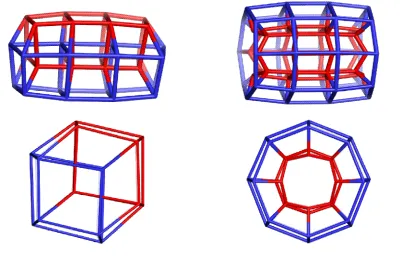
The hyper-cube can be embedded in a cylinder (or a tube, see Figure), to provide, for example, a tube of section 4 (i.e. a cuboid) along its generator r; such a tube is denoted hereafter TU((4,r),C(n),TU(n+1)).
Theorem 1. The k-dimensional substructures of a hyper-tube TU((4,r),C(n),TU(n+1)) are counted from the hypercube C(n , k) substructures by formulas:
( / 2 1) /
r
f r n fk ( / 2)r k fr
0,1,.., 1
k n
((4, ), ( ), ( +1), ) ( , ) k
TU r C n TU n k C n k f (4)
((4, ), ( ), ( +1), ( 1))
T r C n T n k r
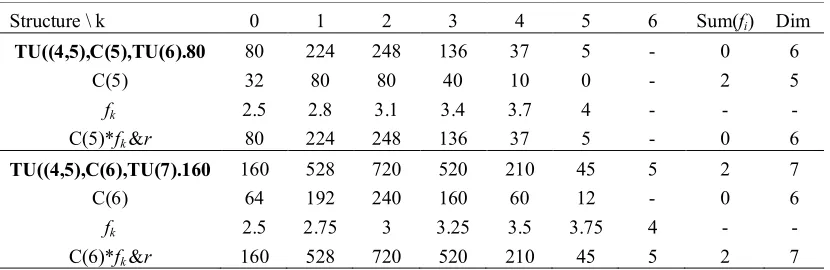
Demonstration comes out from the data listed in Table 1. One can see alternation of figure count Sum(fi) according to the Schläfli formula (1): zero for even TU-dimension and 2 for the even dimension Dim of the hyper-tube. It means that the elementary hyper-tube TU((4,r),C(n),TU(n+1)) is like the sphere (i.e. had the genus g = 0).
Table 1. Figure counting in two hyper-tubes embedding hyper-cubes.
Structure \ k 0 1 2 3 4 5 6 Sum(fi) Dim
TU((4,5),C(5),TU(6).80 80 224 248 136 37 5 - 0 6 C(5) 32 80 80 40 10 0 - 2 5
fk 2.5 2.8 3.1 3.4 3.7 4 - - -
C(5)*fk &r 80 224 248 136 37 5 - 0 6
TU((4,5),C(6),TU(7).160 160 528 720 520 210 45 5 2 7 C(6) 64 192 240 160 60 12 - 0 6
fk 2.5 2.75 3 3.25 3.5 3.75 4 - -
C(6)*fk &r 160 528 720 520 210 45 5 2 7
In a more complex hyper-tube (Figure, the right column); each unit in the tube TU((4,r,s),C(n),TU(n+1)) is an elementary hyper-torus T((4,r),C(n)T(n+1)) while there are s-units along the tube.
The following theorem will allow to understand the hyper-tube TU((4,r,s),C(n),T(n+1)) composition:
((4, ,1), C( ), ( +1), )) ((4, ), C( -1), ( ), ) ((4, ), C( -1), ( ), ( 1))
TU r n TU n k T r n T n k T r n T n k (5)
((4, , ), ( ), ( +1), ) ((4, ,1), ( ), ( +1), )) ((4, ), C( -1), ( ), )
TU r s C n TU n k s TU r C n TU n k T r n T n k
0,1,.., 1; 3
k n n
(6)
Figure 1. A tube TU(4,4),C(4),TU(5)).32 (left column) and a hyper-tubeTU((4,8,4),C(3),TU(4)).64 (right column)
Demonstration comes out from data listed in Table 2. Formulas work for any integer n>3. The all (+) sum of the substructures of the hyper-torus units can be evaluated by the formulas found at the bottom of this table.
Table 2. Figure count in the hyper-tubeTU((4,9,7),C(5),TU(6)).504.
Structure \ k 0 1 2 3 4 5 Sum(fi) Dim
TU((4,9,7),C(5),TU(6)).504 504 1692 2214 1413 441 54 0 6 T((4,9),C(4),T(5)).72 72 180 162 63 9 - 0* 5 - 72 180 162 63 9 - - TU((4,9,1),C(5),TU(6)).72 72 252 342 225 72 9 0** 6 TU((4,9,1),C(5),TU(6))x6 432 1512 2052 1350 432 54 - - + T((4,9),C(4),T(5)).72 72 180 162 63 9 0 - - Sum 504 1692 2214 1413 441 54 0 6 *All+Sum(fi)=r×2×3^(n-2)=486, for r=9; n=5
Note the difference between the hyper-cube and TU((4,r),C(n),TU(n+1)) on one hand and the hyper-tube TU((4,r,s),C(n),TU(n+1)) on the other hand: the figure sum, Sum(fi), in the two objects follows the formula (1) (with alternating 0 and 2 for even and odd n-dimension, respectively) while the last structure provides zero (see Table 2), irrespective of n parity. This is also true for the hyper-tori embedding hyper-cubes, because both cylinder and torus have the genus g = 1 [9].
3.
C
OMPUTATIONALD
ETAILSThe design and properties of the studied structures was performed by our original Nano Studio [10] software program.
4.
C
ONCLUSIONSMulti-shell clusters appearing frequently in minerals or synthetic chemicals [11] (e.g. some clusters of 13-atoms, like: MaMb12 or M13, M=Fe, Pd, Ru, Rh, showing giant magnetic moments [12,13], or simple molecules as B4Cl4, Co( ) . etc. can be considered to belong to space dimensions higher than three. Knowledge on such higher dimensional clusters could be of interest in structure elucidation efforts.
R
EFERENCES1. http://en.wikipedia.org/wiki/Convex_hull; http://en.wikipedia.org/wiki/Simplex; http://en.wikipedia.org/wiki/Cross-polytope; http://en.wikipedia.org/wiki/Hypercube.
2. H. S. M. Coxeter, Regular Polytopes, 3rd ed., New York: Dover, 1973.
3. B. Grünbaum, Convex Polytopes, Graduate Texts in Mathematics (2nd ed.), Springer, 2003.
4. L. Schläfli, Theorie der vielfachen Kontinuitätv Zürcher und Furrer, Zürich, 1901 (Reprinted in: Ludwig Schläfli, 1814–1895, Gesammelte Mathematische Abhandlungen, Band 1, 167–387, Verlag Birkhäuser, Basel, 1950).
5. L. Euler, Elementa doctrinae solidorum, Novi Comm. Acad. Scient. Imp. Petrop. 1758, 4,109–160.
6. M. V. Diudea, Toroidal hypercube, Int. J. Chem. Model. 2015, 7, 000-000.
8. M. V. Diudea, Graphenes from 4-Valent Tori, Bull. Chem. Soc. Japan, 2002, 75, 487492.
9. F. Harary, Graph Theory, Addison–Wesley, Reading, MA, 1969.
10.C. L. Nagy, M. V. Diudea, NANO–Studio, Babes–Bolyai Univ, Cluj, 2009.
11.V. Ya. Shevchenko, G. V. Zhizhin, A. L. MacKay, in: M. V. Diudea, C. L. Nagy (Eds.), Diamond and Related Nanostructures, Springer, Dordrecht, 2013, Chap. 17, p. 311320.
12.B. V. Reddy, S. N. Khanna, and B. I. Dunlap, Giant magnetic moments in 4d
clusters, Phys. Rev. Lett. 1993, 70 (21), 3323−3326.