Vol. 9, No. 1, 2017 Article ID IJIM-00675, 7 pages Research Article
Distribution of Ratios of Generalized Order Statistics From Pareto
Distribution and Inference
M. Rajaei Salmasi∗, G. Yari †‡
Received Date: 2015-08-09 Revised Date: 2016-06-06 Accepted Date: 2016-08-06
————————————————————————————————–
Abstract
The aim of this paper is to study distribution of ratios of generalized order statistics from pareto distribution. parameter estimation of Pareto distribution based on generalized order statistics and ratios of them have been obtained. Inferences using method of moments and unbiased estimator have been obtained to develop point estimations. Consistency of unbiased estimator has been illustrated. To compare the performances of the employed methods, numerical results have been computed. Il-lustrative example using real data is also given.
Keywords: Generalized Order Statisitcs; Pareto Distribution; Parameter Estimation.
—————————————————————————————————–
1
Introduction
K
atics (GOS) as a unified form of differ-mps [5,6] discussed generalized order statis-ent models of ordered random variables(r.v.’s). Let F be a comulative distribution function (CDF) with probability density function (PDF) of f, with constants and parameters, me = (m1, m2, . . . , mn−1), k ≥1,n∈N, n≥2 andγris given for all 1≤r≤n−1, m1, m2, . . . , mn−1 ∈ R, where γr = k+n−r+Mr ≥ 1, and Mr =
∑n−1
j=r mj.SupposeX=(1, . . . , n) denote n GOS,
then their joint PDF,
fX(1,n,m,ke ),...,X(n,n,m,ke )(x
1, . . . , xn), can be written
∗Department of Statistics, Science and Research
Branch, Islamic Azad University, Tehran, Iran.
†Corresponding author. [email protected]
‡Department of Mathematics, Iran University of
Sci-ence and Technology, Tehran, Iran.
as:
fX(1,n,m,ke ),...,X(n,n,m,ke )(x
1, . . . , xn) =
k(
n∏−1
j=1
γj)[ n∏−1
i=1
Fmi(xi)f(xi)]
×Fk−1(xn)f(xn) (1.1)
on the cone of
F−1(0)< x1 ≤. . .≤xn< F−1(1),
where cr−1 = ∏r
i=1γi, r = 1, . . . , n, and F =
1−F.is the survival function. Marginal PDF ofr is
fr(xr) =
cr−1
(m+ 1)rΓ(r)
×Fγr−1(xr)[1−F m+1
(xr)] r−1
f(xr) (1.2)
also the joint PDF of (Xr Xs), where r < s,is
fX(r,n,m,k),X(s,n,m,k)(x
r, xs) =
cs−1
(m+ 1)s−2Γ(r)Γ(s−r)F
m
(xr)
×[1−Fm+1(xr)] r−1
[Fm+1(xr)−F m+1
(xs)]
×Fγs−1(xs)f(xr)f(xs). (1.3)
[9] had studied a model of personal income ex-ceeded given level and he showed that it can be approximated by Pareto law. The PDF and CDF of Pareto law or exactly Pareto distribution (PD) are as follows:
f(x) =αβαx−(α+1), (1.4)
and
F(x) = 1−F(x) = 1−(β
x)
α, x > β. (1.5)
For detailed information one can refer to [4]. Sev-eral methods have been proposed in the litera-ture for estimating the PD parameters. [11] in-troduced uniformly minimum variance unbiased estimatior for unknown parameters of Pareto PD. [10] studied consistency of some estimators, and he suggested different popular techniques for in-ference. [4] discussed best linear unbiased esti-mates, [3] estimated PD unknown parameters us-ing generalized median estimator. Estimation of parameters from PD through order statistics and some other ordered random variables illustrated by [12] and [13].
Distribution of sum, product or ratios of random variables is an important issues of reliability and distribution theory which considered by many au-thors. [2] studied distribution of ratios of gen-eralized life distribution, [7] derived distribution of ratio of two normal random variables. Also, Kotz type distributions was studied by [8] about ratios. The present paper has focused on point estimations based on GOS from PD. Ratios of GOS has been studied and related distributions has obtained. Moment estimator based on ratios and Pareto random variables and Unbiased esti-mator have been employed in the present paper. To investigate consistency of the unbiased estima-tor, single and product moments for GOS of PD have been calculated. Numerical results for com-parison of the estimators have been computed. Illustrative example based on real data from ira-nian rural household income is also given. The
rest of paper is organized as follows: Section 2
includes ratio distribution of GOS from PD. in-ferences about parameters of PD have been dis-cussed in Section3. Sections 4and 5include nu-merical results and conclusions, respectively.
2
Distribution of ratios of GOS
from PD
Theorem 2.1 Let r and s denote rth and sth
GOS having Pareto as underlying distribution. Then (rs)(a(m+1)) distributed as beta with param-eters γs
m+1 and s−r, where r < s.
Proof. For simplicity, definexr=r andx−s=
s. Considering R∗ = xr
xs and Q=xs, it has been
obtained, Xr = QR∗ and Xs = Q, so Jacobian
has been computed
|J|= 1 0
R∗ Q
=Q.
Using1.3joint distribution ofQ=q andR∗ =R
can be written as
fQ,R∗(q, R) =qfXr,Xs(qR, q) =
qCs−1
(m+ 1)s−2Γ(r)Γ(s−r)F
m
(qR)
×[1−Fm+1(qR)
]r−1
×[Fm+1(qR)−Fm+1(q)
]s−r−1
×Fγs−1(q)f(qR)f(q). (2.6)
Using1.4and1.5, above relation can be rewritten as
fQ,R∗(q, R) =
(−1)s−r−1 α
2β2αC s−1
(m+ 1)s−2Γ(r)Γ(s−r)
×q−2α−1
(
β q
)α(γr−2)
R−α(m+1)−1
×[1−R−αm+1]s−r−1
×
[
1−
(
β q
)α(m+1)
R−α(m+1)
]r−1
. (2.7)
we have R < 1 so it can be obtaied Rb > b, fur-thermore, it is known that b < Q, so it is been concluded b < Rb < Q, so taking integral as fol-lows,
fR∗(R) =
g(R)
∫ ∞
β R
q−2α−1
(
β q
)α(γr−2)
× [ 1− ( β q
)α(m+1)
R−α(m+1)
]r−1
q, (2.8)
where,
g(R) = (−1)s−r−1 α
2β2αC s−1
(m+ 1)s−2Γ(r)Γ(s−r)
×R−α(m+1)−1[1−R−αm+1]s−r−1.
To get the solution of 2.8, following change of variable has been considered
z= 1−
(
β q
)α(m+1)
R−α(m+1),
and it can be written
fR∗(R) =g(R)h(R)
∫ 1
0
zr−1(1−z)mγr+1−1z,
(2.9) whereh(R) = αβ2Rααγr(m+1),so we have
fR∗(R) =g(R)h(R)Bet
(
r, γr m+ 1
)
,
where, Bet(a, b) = Γ(Γ(aa)Γ(+bb)) is beta function. Ac-cording to the fact, relation1.2is a density func-tion, and integration based on it over the support of the random variable X equals to 1, therefore,
Bet
(
r, γr
m+1 )
Cr−1
Γ(r)(m+1)r = 1,so we have
Cr−1
Γ(r)(m+ 1)r =Bet
(
r, γr m+ 1
)
. (2.10)
Using recent equlity and relations γr−γr+1 =
m+1 andαγr+1−1−α(m+1)(s−r−1) =αγs−1,
DF ofR∗ could be written as
fR∗(R) =
αCs−1Bet (
r, γr
m+1 )
(m+ 1)s−1Γ(r)Γ(s−r)
×Rαγs−1
[
1−Rα(m+1)
]s−r−1
. (2.11)
By change of variable W = Rα(m+1), and using
equality
Γ
(
s−r+ γs
m+1 ) Γ ( γs m+1 ) = ∏
j =r+ 1sγj
(m+ 1)s−r ,
we get to
Cs−1Bet (
r, γr
m+1 )
(m+ 1)sΓ(r)Γ(s−r) =
1
Bet
(
γs
m+1, s−r ),
which completes the proof.
Theorem 2.2 Let r denotes rth GOS based on Pareto distribution with parameters α and β. Then γrr−r1 has Pareto distribution with
param-eters αγr and γr.
Proof. Using 1.3, 1.4 and 1.5 and transforma-tionsU =γrr−r1 and z=r−1, it can be written
fr,s(u, z) =
zCr−1
γr(m+ 1)r−2Γ(r−1)
×
(
β z
)αm[
1−
(
β z
)α(m+1)]r−2
×α2β2αz−(α+1)
(
βγr
uz
)α(γr−1)(
uz γr
)−(α+1)
.
Following transformation has been assumed
h=
(
β z
)α(m+1)
,
after some calculation it been obtained
f(u) = α
2βαm+2αC r−1
γr(m+ 1)r−2Γ(r−1)
×(βγr)α(γr−1)u−(α+1)
uα(γr−1)γ
r−(α+1)
× β
α(m+ 1)β
−αγr−mα−alpha+1
×
∫ 1
0
hγrm++1m+1−1(1−h)r−2h,
which gives the proof of theorem,
Table 1: Moment Estimations.
Estimations MSE
n αˆ βˆ αˆ βˆ
10 4.137 3.4718 2.1811 0.8243
50 3.1574 3.5103 0.8615 0.4187
100 2.9899 3.5143 0.6452 0.3333
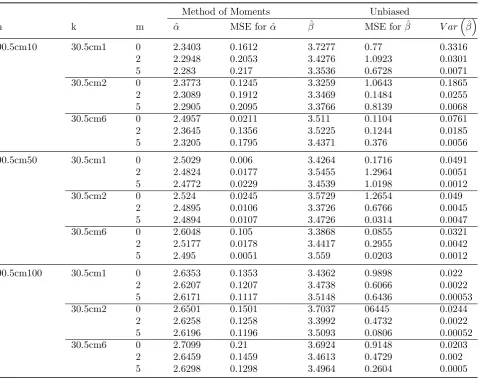
Table 2: Estimation based on GOS.
Method of Moments Unbiased
n k m αˆ MSE for ˆα βˆ MSE for ˆβ V ar
(
ˆ β
)
90.5cm10 30.5cm1 0 2.3403 0.1612 3.7277 0.77 0.3316
2 2.2948 0.2053 3.4276 1.0923 0.0301
5 2.283 0.217 3.3536 0.6728 0.0071
30.5cm2 0 2.3773 0.1245 3.3259 1.0643 0.1865
2 2.3089 0.1912 3.3469 0.1484 0.0255
5 2.2905 0.2095 3.3766 0.8139 0.0068
30.5cm6 0 2.4957 0.0211 3.511 0.1104 0.0761
2 2.3645 0.1356 3.5225 0.1244 0.0185
5 2.3205 0.1795 3.4371 0.376 0.0056
90.5cm50 30.5cm1 0 2.5029 0.006 3.4264 0.1716 0.0491
2 2.4824 0.0177 3.5455 1.2964 0.0051
5 2.4772 0.0229 3.4539 1.0198 0.0012
30.5cm2 0 2.524 0.0245 3.5729 1.2654 0.049
2 2.4895 0.0106 3.3726 0.6766 0.0045
5 2.4894 0.0107 3.4726 0.0314 0.0047
30.5cm6 0 2.6048 0.105 3.3868 0.0855 0.0321
2 2.5177 0.0178 3.4417 0.2955 0.0042
5 2.495 0.0051 3.559 0.0203 0.0012
90.5cm100 30.5cm1 0 2.6353 0.1353 3.4362 0.9898 0.022
2 2.6207 0.1207 3.4738 0.6066 0.0022
5 2.6171 0.1117 3.5148 0.6436 0.00053
30.5cm2 0 2.6501 0.1501 3.7037 06445 0.0244
2 2.6258 0.1258 3.3992 0.4732 0.0022
5 2.6196 0.1196 3.5093 0.0806 0.00052
30.5cm6 0 2.7099 0.21 3.6924 0.9148 0.0203
2 2.6459 0.1459 3.4613 0.4729 0.002
5 2.6298 0.1298 3.4964 0.2604 0.0005
Table 3: Real data.
41187 5796 1133 167 21 32403 1666 42627
23606 2612 15921 488 55237 37012 18225
2.1 Real DATA
Real data survey are also included. 15 data from census results of 2014 rural household income in islamic republic of Iran are taken and illustra-tive example has constructed. Based on proposed methods, unknown parameters of population has
Table 4: Estimation results.
Method of Moments GOS Moment Unbiased
ˆ
α βˆ αˆ βˆ
2.424 11124 2.3157 11226
k= 1, m= 0
3
Inference
3.1 GOS moments of Pareto distribu-tion
It is well known that the expectation value and variance of PD 1.4are respectively,
E(X) = αβ
α−1 α >1 (3.13)
V ar(X) = αβ
2
(α−1)2(α−2) α >1, (3.14)
second moment of PD can be derived by3.13and
3.14 as follows:
E(X2) = αβ
2
α−2 α >2 (3.15)
In order to compute GOS moments of PD, it is necessary to obtain distribution of GOS from PD. Using1.2,1.4and1.5, PDF ofrthGOS from PD can be presented as:
fr(x) = αβ
αγrC
r−1
Γ(r)(m+ 1)r−1 x > β. (3.16)
Based on 3.16,tth moment is given by
E(r)t=
∫ ∞
β
xtfr(x)x,
taking integral leads to the following relation,
E(rt)=βt Cr−1
Γ(r)(m+ 1)r
×Bet
(
r, αγr−t
(m+ 1)α
)
. (3.17)
Setting t=0 leads to 2.10. Using 2.10, relation
3.17 can be rewritten as:
E(rt)=βt Bet
(
r, αγr−t (m+1)α
)
Bet
(
r, γr (m+1)
) . (3.18)
First and second moments can be obtained by setting t= 1,2 in the relation3.18, therefore we get to:
E(r) =β Bet
(
r, αγr−1 (m+1)α
)
Bet
(
r, γr (m+1)
), (3.19)
and
E(r)2=β2 Bet
(
r, αγr−2 (m+1)α
)
Bet
(
r, γr (m+1)
) . (3.20)
Variance of GOS from PD can be calculated as
V ar(r) =
β2[
Bet
(
r, αγr−2 (m+1)α
)
Bet
(
r, γr (m+1)
)
−
Bet
(
r, αγr−1 (m+1)α
)
Bet
(
r, γr (m+1)
) 2
]. (3.21)
3.2 Method of moments
In order to get the moment estimators of un-known parameters of PD, we have to consider following relations,
E(X) =X, E(X2) =X2, (3.22)
where X= n1∑ni=1xi and X2 = 1n∑ni=1x2i.
3.2.1 Method of moments using PD
Using3.13,3.15 and 3.22, it can be obtained
β= α−1
α x, β
2 = α−2
α x
2. (3.23)
Using 3.23 and simple calculation moment esti-mators ofαandβ could be achieved respectively:
ˆ
αm = 1 +
√
x2
x2−x2, (3.24)
and
ˆ
βm =
ˆ
αm−1
ˆ
αm
3.2.2 Method of moments using GOS from PD
Using Theorem 2.2and similar to the 3.2.1, mo-ment estimator of α could be obtained based on GOS from PD. According to relations 3.22, 3.13
and 3.15, clearly it can be written
E
(
γr
Xr
Xr−1 )
= αγ
2
r
αγr−1
=Y , (3.26)
and
E
(
γr
Xr
Xr−1 )2
= αγ
3
r
αγr−2
=Y2, αγ
r >2,
(3.27) where
nY =γ1Y1+
n
∑
i=2 (
γi
Xi
Xi−1 )
,
and
nY2 = (γ
1Y1)2+
n
∑
i=2 (
γi
Xi
Xi−1 )2
,
furthermore,Yi,i= 1,2,· · ·, nare GOS from PD.
Therefore, moment estimator forαbased on GOS can be obtained as:
ˆ
αgm= 1 +
√
Y2
Y2−Y2.
3.3 Unbiased estimation
At this subsection β has been estimated through unbiased estimator when α has been assumed to be known. Considering 3.19, it can be written
E
(
r G(α, r)
)
=β, (3.28)
where, G(α, r) = Bet
(
r,(αγrm+1)−1α) Bet
(
r,(mγr+1)
), therefore, it can be concluded ˆβU nb = G(α,rr ) is the unbiased
esti-mator of β. In order to evaluate consistency of the estimator, variance can be computed. Using
3.21, variance of unbiased estimator can be ob-tained,
V ar
(
ˆ
βU nb
)
= 1
G2(α, r)var(r).
4
Numerical study
4.1 Simulated DATA
For comparison performances of methods and evaluation of estimators in different cir-cumstances numerical study are considered. different samples with different sample sizes (n = 10,50,100), and values k=1,2,6 m=0,2,5 and also with parameter values of α = 2.5, and
β = 3.5 are derived based on algorithm discussed in [1].
5
Conclusion
In this paper distribution of ratios of GOS from PD were obtained. Single moments of were de-rived and based on them moment estimators for PD unknown parameters were constructed. Us-ing ratio distribution moment inference was done. Unbiased estimator based on moments of PD through GOS was derived, and consistency of es-timator was studied. To compare of methods and different parameter values the numerical studies were presented.
Based on numerical results following conclusions are obtained:
• Table 1 shows that when sample size in-creases, the MSE of both unknown param-eters of PD estimated based on method of moments is low, so the estimators give bet-ter performances.
• Table 1 and 2 showed that the estimators based on GOS are better than the others.
• Based on GOS method of moments when
n and m increase simultaneously estimator gives better performances.
• Table 2 shows that when n increases and k
decreases, estimator slightly performs good.
• Unbiased estimator gives better results when
nand k increase.
• Table 2 shows that unbiased estimator of β
References
[1] Z. Aboeleneen, Inference for weibull dis-tribution under generalized order statistics, Mathematics and Computers in Simulation 81 (2010) 26-36.
[2] A. P. Basu, R. H. Lochner, On the distri-bution of the ratio of two random variables having generalized life distributions, Techno-metrics 13 (1971) 281-287.
[3] V. Brazauskas, R. Serfling, Robust estima-tion of tail parameters for two-parameter Pareto and exponential models via general-ized quantile statistics, Extremes 3 (2000) 231-249.
[4] N. L. Johnson, S. Kotz, N. Balakrishnan,
Continuous univariate distributions, Wiley, NewYork, ckem Col. 1, 2nd Ed.
[5] U. Kamps, A concept of generalized order statistics, Teubner Skripten zur mathematis-chen Stochastik. B.G. Teubner 1995a
[6] U. Kamps, A concept of generalized order statistics, Journal of Statistical Planning and Inference 48(1995b) 1-23.
[7] G. Marsaglia,Ratios of normal variables and ratios of sums of uniform variables, Jour-nal of American Statistical Asoociation 60 (1965) 193-204.
[8] S. Nadarajah, The Kotz type ratio distribu-tion, Statistics 46 (2012) 167-174.
[9] V. Pareto, Cours conomie Politique Profess a l’Universit de Lausanne, Vol. I, 1896; Vol. II, 1897.
[10] R. E. Quandt, Old and new methods of esti-mation and the Pareto distribution, Metrika 10 (1966) 55-82.
[11] S. K. Saksena, Estimation of parameters in a Pareto distribution and simultaneous comparison of estimation, PH.D. Thesis, Louisiana Tech. University, Ruston, Lou-siana.
[12] K. Vnnman, Estimators Based on Order Statistics from a Pareto Distributio, Jour-nal of the American Statistical Association 71(1976) 704-708.
[13] S. J. Wu, Estimation for the two-parameter Pareto distribution under progressive censor-ing with uniform removals, J. Statist. Com-put. Simul. 73 (2003) 125-134.
Mehdi Rajaei Salmasi was born in 1983 in Salmas, Iran. He is Ph.D of statistics received from sci-ence and research branch of Islamic Azad University. He is member of department of mathematics at the Islamic Azad University, Urmia Branch, Iran. His research area is distribution and estimation theory.