Pathogen Reduction of Plasma
Farhad HESHMATI, MD, PhD
Transfusion Medicine unit, Cochin Hospital, Paris, France, E-mail: farhad.heshmati@cch. aphp.fr
Despite improvements in safety of plas-ma transfusion due to correct selection of the donors, performance of serological screening (HIv1-2, HTLv1-2, HCv, HBv, CMv, vDRL and TPHA) and nucleic acid testing (nAT) for HIv & HCv, some infec-tious transmissions, particularly virus transmissions still remain.
These risks are due to the known ma-jor serologically screened viruses at the
window period, unscreened viruses, un-detectable viruses and also new, emerg-ing, re-emergemerg-ing, or mutated infectious agents resulting from the climatic, eco-logic and socioeco-logic changes and travels. In France, the estimation of risks for con-ventional virus transmission by blood labile products was performed by the health authority “afssaps” (J.Pillonel et all, 2009).
virus Incidence
HIv 1/2,950,000 to 1/4,800,000
HBv 1/1,000,000
HCv 1/12,500,000
HTLv Without leukocyte removal 1/8,300,000
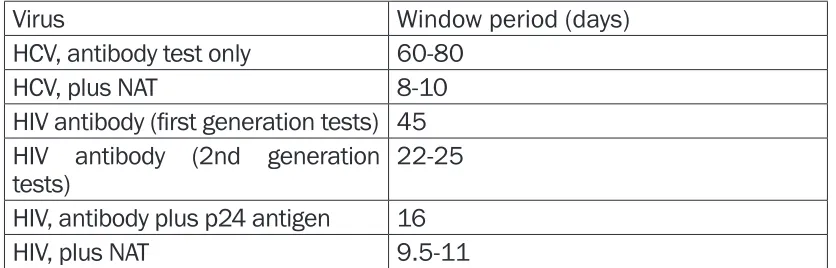
virus Window period (days)
HCv, antibody test only 60-80
HCv, plus nAT 8-10
HIV antibody (first generation tests) 45 HIv antibody (2nd generation
tests) 22-25
HIv, antibody plus p24 antigen 16
HIv, plus nAT 9.5-11
Table 1: Quantitative estimation of the risk of blood donation contamination by infectious agents
Table 2 : Window period for the major transmissible viruses by blood transfusion
Limits of blood transfusion security and the recent epidemic of the West nile virus (Wnv) in the USA and Chi-kungunia in the Reunion Island con-firmed the necessity of pathogen reduction technologies (PRT) for the blood labile components.
The International Consensus Confer-ence concerning pathogen reduction of blood labile products was hold in Toronto (2007) and emitted the fol-lowing recommendations:
- Set-up of pathogen inactivation for all blood labile products
- Pathogen inactivation of the labile blood products could not wait until availability of all types of inactivation of blood labile products
- Pathogen inactivation might be set-up when an efficient method is avail-able
- Transfusion of such pathogen inac-tivated products must be universal for all patients.
First, in 1992, the plasma was treat-ed for viral rtreat-eduction by solvent/de-tergent (SD). Later on,
plasma and platelet were treated by Riboflavin in 2004, followed by platelet pathogen reduction by UvC in 2006.
Plasma and platelet pathogen re-duction by Amotosalen (Intercept) was available from 1997 as well as plasma pathogen reduction by Meth-ylene blue (MB) from 1998.
Since 2010, in France only
pathogen-reduced FFP is authorized.
Solvent-Detergent Plasma (SD-Plasma)
The first type of viral reduced plasma was the plasma treated by the sol-vent/detergent method.
SD-Plasma is a standard 200 ml frozen plasma derived from pooled plasmas treated by organic solvents and detergents to inactivate lipid-coated viruses.
Apheresis plasmas (about 700 cc) are frozen (-30 C°) within 6 hours after collection and sent to the SD preparation centers.
After thawing (+ 30 C°), 100 plas-mas of the same ABO blood group are pooled (about 70 litres), without Rhesus group consideration. Then the first filtration is performed and pathogen reducing agents (1% tri-n-butyl phosphate (TnBP) + Triton X 100) are added to the plasmas. Af-ter incubation, TnBP and Triton are eliminated. The plasma is filtered for sterilization (0.22µ) then conditioned on 200 ml bags. In France, the num-ber of pooled plasmas is increased to 130 by the health authorities. Several clinical studies improved efficacy of coagulation factors and safety of SD plasmas.
The concentrations of the different proteins in the SD plasmas (haemo-static factors, C and S proteins, ATIII, ADAMTS 13, …) correspond to the
centrations recommended by the Eu-ropean Council.
The pathogen reduction by SD is ef-fective only on the lipid-enveloped vi-ruses (HIv, HTLv, HBv, HCv) and not on the non-enveloped viruses (Parvovirus B19, ...).
Advantages of SD FFP
- Homogeneity of the plasma from the same pool.
- Presence of immune neutralizing an-tibodies.
- Efficacy on elimination of enveloped viruses.
- Cytolysis of the remaining cells by SD process that renders intra-cellular viruses accessible to inactivation pro-cess.
- no risk of TRALI (anti HLA and leuco-agglutinins are controlled).
- Rhesus groups not considered (elimi-nation of the cells & phospholipids). - Possibility of concentration of the haemostatic factors at the end of pro-cess.
- Efficacy is assessed in the treatment of Thrombotic microangiopathy (TMA) (SD plasma does not contain the HMW multimers of vWF and the title of AD-AMTS 13 proteases is correct).
Disadvantages:
- Heavy investments
- Contamination risk for non-envel-oped viruses and viruses not sensi-tive to SD inactivation
SD-mini pool Plasma
A new technique of solvent/deter-gent plasma with limited number of pooled units of FFP (produced in Switzerland) in a closed system is under clinical studies in Egypt.
Methylene Blue Plasma (MB-Plas-ma)
Theraflex MB-Plasma system is a photodynamic procedure using Methylene Blue (MB) and visible light and applied to single donor units of plasma.
MB is a phenothiazine-based photo-sensitizer with particular affinity for Guanosine-Cytosine pairs.
After addition of MB to the plasma, it intercalates into nucleic acids and after illumination by visible light (630 nm wave lengths, 180 joules/cm2), singlet oxygens are formed and de-stroy the viral nucleic acids.
MB-plasma systems are suitable for both whole blood and apheresis plasma.
The process requires a very simple dry set, including Plasmaflex filter for leuco-depletion, MB pill, illumi-nation bag, bleuflex filter for MB and photoproduct retention and storage bag and Macotronic device from the Maco Pharma society. Two units can be processed in 15 minutes.
Advantages of MB plasma
- no need for pooling (one donation = one bag of plasma)
- Easy and rapid technique
- Inactivation of enveloped and non-enveloped viruses
- no dilution of plasma (dry pill)
Disadvantages of MB plasma
- The plasmas are not homogenous (single donor)
- All the vWF multimers are present - Risk of allergy to MB
- Limited action on the bacteria.
Intercept Plasma
Plasma pathogen reduced by Inter-cept (Amotosalen) was introduced in 2006 and use the same technology as for platelets. Each set of Intercept plasma can produce up to three 200 mL transfusion units within 10 min-utes from fresh or frozen apheresis plasma (or whole blood plasma) of donors (prevention of TRALI). In the case of whole blood plasma, pooling of 2 or 3 individual plasma units is required.
The Intercept Blood system can in-activate viruses, bacterias, parasites and leucocytes by photo activation of a synthetic Psoralen “Amotosalen hy-drochloride” and UVA light (3 Joules/ cm2).
Intercept Blood system consists of a plastic container (15 mL of Amo-tosalen solution), an illumination bag, a compound adsorption device (reduces the level of residual Amo-tosalen), and three plastic storage
bags.
Amotosalen intercalates into the DnA and RnA strands and after illumina-tion by UvA light (320 to 400 nm) and forms covalent bonds (cross linkage) with pyrimidine bases in nucleic ac-ids and inhibits the replication and proliferation of the pathogens and leukocytes.
Several clinical randomized trials demonstrated the efficacy and safe-ty of Intercep plasma transfusion, the presence of the all coagulation factors with a normal title, the ab-sence of the haemostasis activation markers, and improved efficacy in the treatment of acquired coagulop-athies and TMA.
Intercept pathogen is effective on enveloped viruses (4.5 to 7.5 log reductions). non-enveloped viruses are also correctly reduced as well as gram positive, gram negative bacte-rias and spirochetes.
Intercept technology efficacy is limit-ed for certain non-enveloplimit-ed viruses (HAv, Parvovirus B 19) and the bac-terias under form of spores (Bacillus cereus).
Mirasol pathogen reduction tech-nology
Caridian BCT proposes a CE mark approval for apheresis and whole blood-derived platelets and plasma pathogen reduction system using Ri-boflavin (Vitamin B2) and UV light.
Riboflavin has a selective affinity for nucleic acids, combines with UvA light, and enhances selectively ir-reparable damages in the Guanine bases of DnA of the pathogens. The safety and efficacy of Mirasol-treated platelets were studied in a multi-center clinical trial called “ MIR-ACLE” demonstrating that Mirasol and its photo products are not toxic and not mutagenic. no toxicologic ef-fects were observed in animal stud-ies. So there is no need to remove Riboflavin from pathogen-reduced components.
no adverse event was attributed to Mirasol pathogen treated before transfusion.
Two apheresis plasmas are treated by Riboflavin and UV light within 10 minutes and 6 units of plasma are produced at each cycle.
Mirasol system is effective on the viruses, bacterias and protozoaires. The quality of the proteins, especially haemostasis factors meets the
Euro-pean norms.
Conclusion
All these PRT are now available and used in routine in many countries. Although there is no universal PRT available, pro-gressively the non-pathogen reduced products are abandoned.
Granulocyte transfusions cannot be treated by such a technology and red blood cell concentrates are under inves-tigation by certain ones.
In France, the pathogen-reduced plasma is the only authorized plasma. An impor-tant part of the platelets are now also treated by PRT and by the time all plate-let concentrates would be treated so. The PRT are inaccessible in the countries in the way of development, because of the price of the final products and initial investments.
Efficacy of PRT is now proved but the sensitivity of each technic is different. Moreover, little or no efficacy on bacte-rial spores, Prions and non-enveloped viruses was evidenced.