Original Article
Incidence Rate of Cutaneous Leishmaniasis in Chabahar
within 2008-2010
Mojtaba Moghateli1, faiz Mohammad Atesh Bahar2, Nooshin Yoshany3, Ehsan Movahed4, Kheir Mohammad Jadgal4, Hossien Izadirad5, Ali fattahi Bafghi6
1.
Department of Medical Parasitology & Mycology, School of Medicine, Shahid Sadoughi University of Medical Sciences,
Yazd, Iran.
2. Department of preventive management and Surveilance of diseases, Hormozgan university of medical sciences,
Hormozgan, Iran.
3.
Department of Health Education and Promotion, Social Determinants of Health Research Center, Shahid Sadoughi
University of Medical Sciences, Yazd, Iran.
4.
Department of Health Education and Promotion, Shahid Sadoughi University of Medical Sciences, Yazd, Iran.
5.
Department of Health Education and Promotion, Faculty of Medical Sciences, Tarbiat modares University, Tehran, Iran.
6.
Department of Medical Parasitology & Mycology, School of Medicine, Shahid Sadoughi University of Medical Sciences,
Yazd, Iran.
Received: 2015/11/12 Accepted: 2016/02/15
Abstract
Introduction: As Lieshmaniasis is considered as a huge hygienic problem and since epidemiological studies are effective in controlling this disease as well as taking prevention steps, the present study aims to assess the incidence rate of cutaneous lieshmaniasis in Chabahar, Sistan and Baluchestan within 2008-2010.
Materials and Methods: This descriptive-analytical study has been conducted on the victims of cutaneous leishmaniasis during previous years in health centers of Chabahar, by extracting the demographic and epidemiologic information, recorded in Chabahar health centers, as well as analyzing the study data via SPSS software (ver, 18).
Results: Out of total victims of cutaneous leishmaniasis under the study, the total incidence rate was reported 114 and 90 cases/100000 person-years, respectively, in males and females. The highest total incidence rate of the disease was in the age range of birth to 4 years )incidence rate of 196 cases/100000 person-years( and the lowest one in the age range of 5 to 9 years )incidence rate of 70 cases/100000 person-years(. Most damages (wounds) were observed in the hands and feet. Moreover, the majority of the patients had two wounds )incidence rate of 66 cases/100000 person-years(. The studied patients were Iranian and Afghani with the majority belonging to the former. A sum of 241 patients (37%) lived in cities, whereas the remaining 412 patients (63%) resided in the villages. Moreover, the highest incidence rate of the disease was reported in winter (2008) and the least one in autumn (2010).
Conclusion: As the study results revealed, disease incidence rate in Chabahar during 2008-2010 had a descending
trend, which can indicate an improvement in educational-hygienic status as well as observance hygiene practices by the people.
Keywords: Chabahar; Cutaneous leishmaniasis; Epidemiological feature
Corresponding author:Tel:+989367846226 email:[email protected]
Introduction
Cutaneous leishmaniasis is one of the zoonotic
parasite diseases, which has been called among
the sixth row of important infectious diseases of
the world tropical regions by WHO. It is endemic
in 88 countries from four continents of the world
(22 countries in Europe and America and 66
countries in Asia and Africa), regarded as the
most important disease of tropical and subtropical
diseases after Malaria [1-3]. Currently there are 12 million victims of Leishmaniasis in the world [4] . Annually, two million new cases of the disease
occur, half million of which are visceral and 1.5
million are cutaneous [4]. Ninety percent of cutaneous leishmaniasis occurs in seven countries
of Afghanistan, Algeria, Brazil, Iran, Peru, Saudi
Arabia, and Syria [4]. As a matter of fact, different Leishmania parasites can be mentioned as the
disease agent [4]. Humans can be infected by the sting of female sandfly (phlebotomus), which
normally lives in forests, caves, and small
rodents’ lairs [5]
. The disease is one of the most
important and commonest local diseases of Iran
and the second parasitic disease after malaria,
transmissible from arthropods, which can be seen
both in urban and rural regions [6]. Annually, 20 thousand cases of cutaneous leishmaniasis are
reported from various parts of the country, which
is estimated to be many times more in reality [7] and .thus, leishmaniasis is considered as a huge
hygienic problem in Iran [3]. Cutaneous
Ilam, Yazd, and Bushehr demonstrated the
highest frequency within recent years[8]. In general, the highest rate of disease occurrence in
the country was observed in such provincesas
Yazd, Bushehr, Khorasan, Fars, Ilam, Khuzestan,
and Isfahan with an average of 166 cases out of
100 thousand people,, whereas the lowest rate of
cutaneous leishmaniasis (less than 10 cases in
100,000 people) was reported in western and
north western provinces of the country [9]. The disease imposes heavy economic burden on
families, societies, and countries, specifically the
developing ones [4]. The 5-capacity antimony (glucantime) is used to cure the disease which is
an expensive medicine, requiring frequent
injections [10]. It should be noted that the parasite’s resistance to this medicine is also common [10]. Moreover, it has various important side effects
such as arrhythmia, pancreas and liver enzymes,
leukopenia, anemia, and thrombocytopenia, which
on rare cases, it results in cardiac toxicity and
sudden death [4]. Since epidemiological studies are effective in controlling the disease as well as
taking preventive steps, the present study aims to
carry out an epidemiological survey of cutanoues
leishmaniasis in Chabahar, Sistan and
Baluchestanwithin 2008-2010, demonstrating a
decrease of disease as a result of healthcare
promotion along with other factors such as health
education in high level via health experts of the
Materials & Methods
This descriptive-analytical study was conducted
on the cutanoues leishmaniasis victims who had
visited health centers and lab clinics of Chabahar
within 2008-2010. After carrying out the required
tests and confirming the disease in the visiting
people, their information was recorded in specific
patient forms and then, they underwent the
required remedies. The required information was
extracted from Information Record System of
Chabahar such as the patient’s age sex, place of
residence, ethnicity, inflicted body organ and
infection season. Moreover, the patients’ demographic data were analyzed via SPSS
software (ver, 18).
Results
The present study was conducted on 653 positive
cases of cutaneous leishmaniasis within
2008-2010, among which 373 (57%) were males and
280 (43%) were females. during the three years of
this study, the most victims of the disease was
observed in 2008 (men 25.4% and women,
17.7%), whereas in 2009 the rates differed to
15.6% men and 13.4% women, and in 2010, 16%
and 11.6% were reported for male and female
patients respectively. The total incidence rate
among males was 114 cases/100000 person-years
and 90 cases/100000 person-years in females. As
the results indicated, the highest incidence rate
was observed among men in 2008 (with an
incidence rate of 158 cases/100000 person-years),
whereas the lowest one was reported in 2010
(with an incidence rate of 92 cases/100000
person-years). Moreover, the highest incidence
rate was reported among women in 2008 (with an
incidence of 116 cases/100000 person-years) and
the lowest one in 2010 (with an incidence rate of
70 cases/100000 person-years) (Table 1).
Table 1: Incidence rate of cutaneous leishmaniasis infection based on victims’ sex
2010 2009
2008 Sex
92
94 158
Male
70
86 116
Female
The highest total incidence rate of the disease was
observed in the age range of birth to 4 years
(incidence rate of 196 cases/100000 person-years)
and the lowest one in the age range of 5 to 9 years
(incidence rate of 70 cases/100000 person-years).
The incidence rate had declined in all the studied
age groups within 2008-2010, except from
2009-2010 in the age group of 20-29 years (Table 2).
Table 2: Incidence rate of cutaneous leishmaniasis infection based on victims’ age 2010 2009 2008 Age 330 144 330 0-4 74 70 74 5-9 110 100 110 10-19 102 69 102 20-29 83 80 83 30-39 138 49 138 40-49 150 99 150 Beyond 50
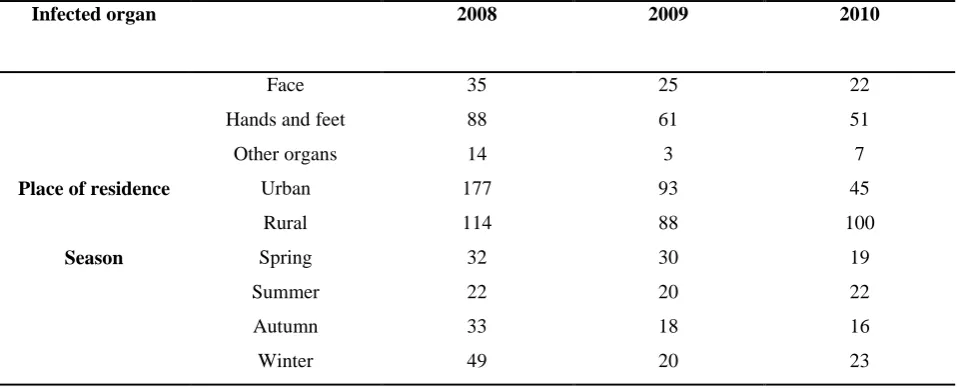
In regard with inflicted body organ, the highest
total incidence rate belonged to the patient's hands
and feet (the total incidence rate of 66
cases/100000 person-years) and the lowest one
was related to other organs (an incidence rate of 8
cases/100000 person-years). In general, the
incidence rate decreased from 2008-2010 except
from 2009-2010, during which it had slightly
increased in related to other organs). (Table 3).
In general, the incidence rate of disease was
reduced within 2008-2010 in urban areas, though
in rural areas, it increased slightly within
2009-2010. Therefore, the total incidence of the disease
was also based on the location of the subjects, so
as it was reported higher in rural areas compared
to urban areas (Table 3).
Seasonal incidence rate is presented in Table 3.
As it can be seen, the total incidence rate of the
disease occurred in winter and the lowest one was
related to summer season.
Table 3: Incidence rate of cutaneous leishmaniasis victims based on the infected organ, place of residence, and the infection season 2010 2009 2008 Infected organ 22 25 35 Face 51 61 88 Hands and feet
7 3 14 Other organs 45 93 177 Urban
Place of residence
100 88 114 Rural 19 30 32 Spring Season
Discussion
The main aim of the present study was to assess
cutaneous leishmaniasis in Chabahar within
2008-2010, in regard with sex, age, infected organ,
place of residence, and season of the year. The
results showed that the incidence rate of the
disease had a decreasing process as the years
passed, demonstrating an improvement in
educational-hygienic status as well as people's
following of hygiene practice. In the current
study, 57% of the victims were males and 43%,
were females and the incidence rate of disease
was higher among men than women.One of the
main causes of higher incidence rate among men
than women is that men stay more outside home
at night because of their job (horticulture) that do
not have appropriate clothing to prevent mosquito
bites, and therefore, they are more susceptible to
mosquito bites. Similar studies have been
conducted in Damghan, Kermanshah, Barkhoar in
Isfahan, and Gonbad Kavoos demonstrating that
the percentage of the men were reported to be
more than that of women [11-15],whereas in a study in Abarkooh, Yazd, the number of cutaneous
leishmaniasis victims was more within women
compared to men [16]. Higher proportion of the men to women could be due to their occupations,
less immunity, less clothing, hot weather of the
region, and exposure to sand flies [17]. Probably cultural and behavioral factors as well as the type
of clothing caused men to be more exposed to the
disease than women 18].
As the findings of the conducted studies revealed,
the highest incidence rate of cutaneous
leishmaniasis was related to the victims aged from
birth to 4 years.Probably, the highest incidence
rate of the disease in lower ages was due to their
less immunity as well as more stings of the
mosquitoes; however, other studies did not
confirm our results as in the study conducted by
Talari et al., the most frequency of infestation was
seen in the ages 0 to 10 years [19]. Moreover, according to study results by Yaghoubi et al. in
Yazd as well as those of Gurel et al., the highest
percentage of infestation was reported from 5 to 9
years of age[7, 20]. In another study by Uzun et al., the greatest age of infestation was 10 to 19 years
[21]
.
The present study findings showed that the total
incidence rate of the disease has occurred in
winter and the lowest one was related to summer
season. As it is known, this season (winter) in the
tropical region of chabahar is quite favorable for
sandflies' reproduction and activity. Howover,in
extremely hot seasons like summer and the
months of May and June, the lowest cases were
observed in chabahar due to reduced activity and
reproduction of vectors at this time of year, while
in a study by nadim et al., the occurrence rate of
cutaneous leishmaniasis approached zero until the
middle of March in accordance to the seasonal
changes, [18]. In other studies, conducted in Damghan, Gonbad Kavoos, and Aran Bidgol (in
Isfahan province) the most cases of the disease
was observed in April and September [11, 15, 22].
The results revealed that, in regard with inflicted
body organ, the highest total incidence rate
belonged to the patient's hands and feet (with an
incidence rate of 66 cases/100000 person-years)
and the lowest one was related to the other organs
(with an incidence rate of 8 cases/100000
person-years), respectively. Furthermore, a similar study
carried out in Mir Javeh, Zahedan, reveals the
same results and a study conducted in Pakistan,
reported the most infections to occur in the hands.
As a result, both these studies confirm the
findings of the present study [23, 24]. A study carried out in Cukorova, Turkey, reports the most
infections spreaded in the hands, feet, and other
organs respectively [21].
Conclusion
Based on the findings of the current study, the
disease represented a descending process
indicating the promotion of educational-hygienic
status as well as observance of personal hygiene
principals by the people.
Acknowledgements
We hereby thank disease experts of healthcare
network in Chabahar for their assistance in
surveying cutaneous leishmaniasis
epidemiologically
References:
1- Control of the leishmaniases. Report of a WHO Expert Committee. Geneva: World Health Organization 1990;159.
2- Ahmadi Yazdi C, Narmani M R, Sadri B. Cutaneous Leishmaniasis in Iran. The Journal of Infectious Diseases.2003;3:14-9.
3- Shirazi M, Ranjbar R, Khansari K. Secondary bacterial infections of skin lesions suspicious for cutaneous leishmaniasis. Iranian Journal Infect Dis Tropical Med .2006; 12 (38):55-58. [Persian]
4- Ashford RW, Bern C, Boelaert M, et al. Leishmaniasis control. World Health Organization.2010: 5: 7-16 5- Torgersona PR, Macpherson CN. The socioeconomic burden of parasitic zoonoss: Global trends. Vet Parasitol
2011; 182 (1):79-95.
6- Leishmaniasis and leishmania/HIV co-infection. In: WHO report on global surveillance of epidemic-prone infectious diseases, WHO/CDS CSR/ISR/2000.1: 121– 127.
7- Yaghoobi-Ershadi MR, Zahraei-Ramezani AR, Akhavan AA, et al. Rodent control operations against zoonotic cutaneous leishmaniasis in rural Iran. Annuals Saudi of Medicine. 2005: 25 (4): 309-312.
8- Noorpisheh SH, Naghizadeh MM, Nikrouz L. A study on the life quality of patients suffering from leishm. Journal of Fasa University of Medical Sciences. 2013. 3(2): 155-162. [Persian]
9- Athari A, Jalallu N. Epidemiological survey of cutaneous leishmaniasis in Iran 2001-2005.Scientific Journal of Isfahan University Medical Science. 2006; 24(82):8-13. [Persian]
10- Sundar S, Jha T, Thakur C, et al. Oral miltefosine for Indian visceral leishmaniasis. New England Journal of Medicine. 2002; 347(22):1739-46.
11- Mohammadi Azni S, Nokandeh Z, Khorsandi A, AR SD. Epidemiology of cutaneous leishmaniasis in
14- Ebadi M, Hejazi S H. Epidemiology of cutaneous Leishmaniasis in the students of primary schools in Borkhar region, Isfahan .Journal of Kerman 2003; (10)2: 92-98. [Persian]
15- Sofizadeh A, Cherabin M, Mehravaran A. Cutaneous leishmaniasis in Gonbad Kavoos, North of Iran(2009-11):an epidemiological study. Journal of Gorgan University Medical Science 2012;14(4):100-106. [Persian] 16- Ayatollahi J, Karimi M. The prevalence of cutaneous leishmaniasis (CL) in the villages of Abarkouh (Yazd
Province). Iranian Journal of Infection Disease 2005;10(30):13-18. [Persian]
17- zahirnia AH, Moradi A, Norouzi NA, et al. surveying the Epidemiology of cutaneous leishmaniasis in Hamadan province during the years 2002 to 2007. Scientific Journal of Hamadan University Medical Sciences Health Services. 2009;16(1):43-47. [persian]
1. 18-Nadim A, Javadiad E. Epidemiology of th e Leishmaniases in Iran. In: Ardehali s, Rezai HR, Nadim editors. Leishmania and Leishmaniases, 2nd ed. Tehran, Nashre Daneshgahi Press; 1994.176-208.
18- Talari SA, Vakilli Z, Moshtaghi S. Prevalence of cutaneus Leishmaniasis in Kashan, 1994-2000. Feyz. 2003;7(26): 71 -6. [Persian]
19- Gurel MS, ulukanligil M and Ozbilge H. Cutaneous leishmaniasis in Sanliurfa: epidemiologic and clinical features of the last four years (1997-2000). International Journal of Dermatology. 2002; 41(1): 32-7.
20- Uzun S, Uslular C, Yucel A, et al. Cutaneous leshmaniasis: evaluation of 3,074 cases in the Cukurova region of Turkey. British Journal of dermatology.1999; 140(2): 347-50.
21- Ramezani Y, Mousavi SGA, Bahrami A, et al. Epidemiological study of cutaneous leishmaniasis in Aran and Bidgol from April to September 2009. KAUMS Journal (FEYZ). 2011;15(3):254-8. [Persian]
22- Fazaeli A, Fouladi B, Sharifi I. Emergence of cutaneous leishmaniasis in a border area at south-east of Iran: an epidemiological survey. Journal of Vector Borne Disease. 2009;46:36-42. [Persian]
23- Ullah S. Prevalence of cutaneous leishmaniasis in Lower Dir District (N.W.F.P), Pakistan. Journal of Pakistan Association Dermatology 2009;19:212-5.